The Zcash protocol remains unaffected despite the governance clash and restructuring with Bootstrap.
Wallet
Memecoins are back, but one specific wallet metric suggests the $50 billion rally is a dangerous trap
After a year of steady decline, the “memecoin dominance” ratio, a key metric tracking the sector’s share of the total altcoin market, has abruptly reversed course from historic lows.
This came as the total capitalization of meme assets reclaimed the $50 billion mark and tokens such as PEPE, BONK, and FLOKI posted outsized double-digit gains to start the year.
The surge is forcing institutional managers and retail traders alike to confront a critical question: Is this a fleeting spasm of post-holiday speculation, or the early bellwether for a broader market rotation?
Data from market intelligence firm CryptoQuant highlights the severity of the shift. Following the “memecoin mania” that peaked in November 2024, the sector’s dominance within the altcoin market began a long slide.
At its height, meme tokens accounted for 11% of the total altcoin market capitalization, a ratio of 0.11. By December 2025, that figure had collapsed to just 3.2% (0.032), a historical floor.
However, analysts note that the last time the ratio touched these levels, it preceded a massive expansion in speculative liquidity that eventually dragged the broader altcoin complex higher.
Speculative investors are now viewing the current bounce from that bottom as a potential leading indicator.
If the trend sustains, it suggests that the market’s appetite for risk is returning faster than anticipated, potentially setting the stage for a new altcoin season that could influence blockchain activity and listing standards throughout 2026.


Altcoin season is cancelled this year: Alts fail to match last cycle $1.6 trillion ceiling
Altcoin market cap still below 2021 market top as BTC tests late-cycle window.
Oct 20, 2025 · Liam ‘Akiba’ Wright
A signal from the noise
According to data from analytics platform Santiment, the collective market capitalization of meme coins jumped more than 20.8% in the first week of the year, pushing the sector’s total value above $45.3 billion.
CoinGecko data puts the figure even higher, estimating the total value of the “joke economy,” spanning dog and frog themes and political satire, at roughly $51.6 billion.
The rally has been led by familiar names that dominated previous cycles. In the past seven days alone, PEPE and the self-deprecatingly named USELESS token have each surged 54%. MOG climbed 38%, while the Solana-based heavyweight BONK added 34%.
Even legacy assets like Dogecoin and Shiba Inu have joined the fray, with Shiba Inu jumping 13% on Sunday amid renewed trading frenzy.
Santiment analysts attributed the timing of the bounce to a classic contrarian signal. The rally began shortly after Christmas, precisely when “FUD” (fear, uncertainty, and doubt) about speculative assets reached its peak among retail traders.


As sentiment hit rock bottom and casual traders wrote off the sector, smart money appeared to step in, capitalizing on the capitulation to accumulate positions at discounted valuations.
For fund managers who spent 2025 shifting allocations toward “quality”, the resurgence of the meme sector presents a dilemma.
The move tests how far the industry is willing to lean back into leverage. Ignoring the rally risks missing the first leg of a risk-on phase, while chasing it requires re-entering the most volatile assets in the digital ecosystem.
The ETF multiplier
Unlike previous meme cycles driven almost entirely by offshore exchanges and decentralized swaps, the 2026 rebound has a regulated dimension.
The approval and launch of complex crypto exchange-traded funds (ETFs) in the US have created new transmission channels for speculative mania to reach traditional brokerage accounts.
Bloomberg Intelligence ETF analyst Eric Balchunas noted that some of the best-performing products to start the year were leveraged memecoin ETFs.
Specifically, the 21Shares 2x Long Dogecoin ETF (TXXD) has logged standout performance, indicating that demand for meme exposure is not limited to crypto-native “degens” using on-chain wallets.


This institutionalization of the “joke economy” changes the stakes for the broader market. When billions of dollars flow into meme-themed assets, the impact ripples outward.

It influences listing decisions at major centralized exchanges, which rely on trading fees from high-volume tokens to subsidize other operations. It also exerts pressure on asset managers to broaden their product pipelines.
If a $50 billion asset class begins to set the cycle’s tempo, the industry’s infrastructure is forced to adapt to the liquidity demands of assets once dismissed as ephemeral gags.
Meanwhile, the sector is also diversifying internally. CoinGecko data breaks down the $51.6 billion meme economy into distinct sub-sectors, revealing a complex hierarchy.
“The Boy’s Club” (Matt Furie-inspired characters like PEPE) and “Frog-Themed” tokens now command 10.9% and 10.7% of the meme market, respectively, challenging the historical dominance of “Dog-Themed” coins, which sit at roughly 6.1%.


Newer categories like “PolitiFi” (political finance tokens) and “AI Memes” have carved out multi-billion dollar niches, suggesting the sector is evolving its own internal rotation dynamics.
Top AI Agents Crypto Assets by Market Cap
Infrastructure wars reignite
The resurgence of memecoins is also acting as a stress test and a growth driver for the underlying blockchain networks, particularly Solana and Coinbase’s layer-2 network, Base.
On Solana, the “memecoin launchpad” ecosystem has hit a three-month high in activity. Metrics for daily volume, tokens launched, and “daily token graduations,” coins that gain enough traction to move from launchpads to decentralized exchanges, are all spiking.


This activity revives the “fee war” narrative, where competing chains battle to become the preferred venue for high-frequency speculative trading.
Last year, platforms like Pump.fun and LetsBonk drove massive revenue for the Solana network; the early 2026 data suggests this trend is re-accelerating.
This dynamic has drawn commentary from industry leaders who view the phenomenon as more than just gambling.
Jesse Pollak, lead developer for Coinbase’s Base network, argued that these assets serve a functional purpose in the crypto economy. Pollak described memes as “coordination points for community” that bring people together and create a context for collective creation.
“We need more memecoins because we need more creativity, community, and collective action,” Pollak said, framing the assets as a top-of-funnel mechanism that onboards users who eventually migrate to other on-chain applications.
For the blockchain networks themselves, the stakes are tangible. A sustained meme rally drives demand for the network’s native token (used to pay gas fees), tests network throughput, and attracts liquidity providers.
The centralization paradox
Despite the narratives of community and decentralized fun, available data reveal significant risks regarding concentration.
While the price action suggests a broad-based frenzy, ownership of the top assets remains heavily centralized.
Santiment data on Shiba Inu, one of the sector’s stalwarts, shows that the 10 largest wallets control nearly 63% of the total supply. The single largest wallet holds approximately 41% of the supply, a position currently valued at roughly $3.3 billion.


This level of concentration is not unique to Shiba Inu, as many high-flying tokens in the “Solana Meme” and “Frog-Themed” categories exhibit similar distributions.
This creates a perilous environment for late-arriving retail investors. With liquidity concentrated in the hands of a few “whales,” the risk of a coordinated sell-off remains high.
CryptoQuant analysts cautioned that while the setup mirrors previous pre-bull run signals, “it is still very early to say for sure” if the trend will hold.
For speculative investors, the current moment represents a high-risk, high-reward signal. The bounce from historical lows in dominance suggests the market is waking up, but the market’s structure, which is heavily concentrated and driven by leverage, remains fragile.
Prediction markets have moved directly into self-custodial wallets for the first time, with Solflare launching native prediction market trading inside its application.
The integration allows users to trade real-world event outcomes on Solana without leaving the wallet, marking a significant step toward mainstream distribution for event-based contracts.
The feature is built on the DFlow Prediction Markets API and sources liquidity from Kalshi, one of the most established regulated players in the sector.
According to Solflare, the rollout introduces prediction markets with zero added fees, full self-custody, and on-chain settlement, all within its existing wallet interface.
From niche product to wallet-native feature
Until now, prediction markets have existed mainly as standalone platforms, requiring users to move funds between wallets, exchanges, and specialized apps.
By embedding the product directly into a popular Solana wallet, Solflare is removing that friction and positioning prediction markets alongside everyday crypto activities such as token swaps, staking, and NFT management.
0⃣➡️1⃣
For the first time ever, Prediction Markets are now live in @Solflare.
Built on the DFlow Prediction Markets API with @Kalshi liquidity.
Trade real-world events on Solana with zero added fees and full self-custody.
All inside one of the most secure crypto wallets. pic.twitter.com/laqEj3yJA2— DFlow (@dflow) December 29, 2025
The launch enables users to trade on outcomes tied to politics, economics, and other real-world events while maintaining custody of their assets at all times. Positions are opened and managed directly from the wallet, with Solana handling execution and settlement.
Rather than building an isolated market, Solflare’s integration relies on Kalshi’s existing order flow and pricing.
Kalshi supplies the underlying event contracts, while DFlow provides the infrastructure layer that connects regulated prediction liquidity to on-chain wallet environments.
This model allows wallets to offer prediction markets without fragmenting liquidity across multiple venues.
Fast growth sets industry records
The launch follows a period of growth for on-chain prediction activity. Opinion, one of the fastest-scaling prediction market products built on similar infrastructure, reached $10 billion in trading volume and $100 million in open interest within just 54 days of launch, according to figures shared alongside the announcement.
Those metrics represent one of the fastest adoption curves recorded for a prediction market product, indicating rising demand for real-time sentiment trading tied to global events.
54 days. From zero to mainstream.
$10B in trading volume.
$100M in open interest.Opinion sets a new record as the FASTEST-GROWING prediction market in HISTORY. pic.twitter.com/Ugnjl08xvR— Opinion ⁒ (@opinionlabsxyz) December 29, 2025
Regulatory and market implications
While Kalshi operates under US regulatory oversight, integrating its liquidity into a self-custodial wallet introduces new questions around jurisdiction, compliance, and user access. The integration does not alter Kalshi’s contract structure but changes how end users interact with those markets.
Similar wallet-level integrations are likely to draw attention from both regulators and competitors as prediction markets continue to expand beyond specialized platforms. Industry observers note that distribution, rather than contract design alone, may determine which products achieve mainstream adoption.
The Solflare launch indicates a shift in how prediction markets are delivered to users. They are increasingly becoming embedded features within crypto ecosystems.
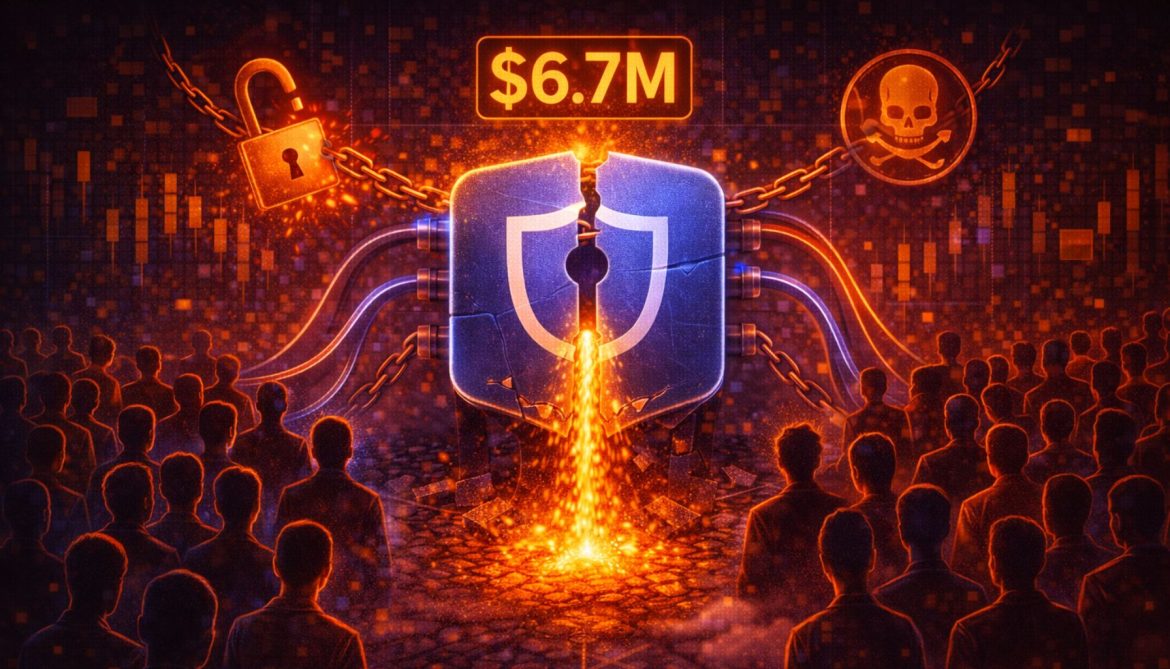
Amid already fragile sentiment across the crypto market, attackers exploited Trust Wallet, shaking confidence in self-custody solutions. The breach has impacted hundreds of users, with on-chain data showing that more than $6.77 million has already been stolen. The timing has amplified concern, coming at a moment when investors are already navigating heightened uncertainty, declining prices, and rising risk aversion.
Related Reading
According to the Trust Wallet team, the exploit appears to be linked to a recent update to its Chrome browser extension. In a public statement posted on X, the company urged users to take immediate action, stating: “Users with Browser Extension 2.68 should disable and upgrade to 2.69.” The message suggests that the vulnerability was isolated to a specific version of the extension, rather than the core wallet infrastructure, but the scale of the losses has nonetheless raised alarm.
Trust Wallet is one of the most widely used self-custody wallets in the industry. Reporting a user base of roughly 220 million people globally. That reach makes any security incident particularly significant, not only because of the direct financial impact, but also due to the broader implications for trust in non-custodial platforms.
As investigations continue and affected users assess the damage, the exploit adds another layer of stress to a market already grappling with weak sentiment and elevated skepticism toward crypto infrastructure.
Funds Tracked As Trust Wallet Commits To Full Reimbursement
On-chain investigators have begun tracing the movement of funds linked to the Trust Wallet exploit. According to analysis shared by Lookonchain, the attacker has already transferred approximately $5.5 million through a combination of instant swap services and centralized exchanges, including ChangeNOW, FixedFloat, KuCoin, and HTX.
Routing funds through multiple channels suggests an attempt to obscure flows and accelerate laundering. A pattern commonly observed in recent wallet exploits.
Despite the ongoing movement of stolen assets, Trust Wallet has moved quickly to reassure users. Binance founder and former CEO Changpeng Zhao (CZ) publicly stated that Trust Wallet will fully cover all user losses resulting from the incident. This commitment has been central to calming concerns. Particularly given the wallet’s large global user base and the broader climate of weakened trust in crypto infrastructure.
The Trust Wallet team later reinforced this position with a formal statement, confirming the scale of the impact and outlining next steps. “We’ve confirmed that approximately $7M has been impacted and we will ensure all affected users are refunded,” the team said.
The team added that supporting affected users is the top priority, and they are actively finalizing the refund process. The statement also warned users to avoid interacting with messages that do not originate from official Trust Wallet channels.
As fund tracking continues, the focus has now shifted from damage assessment to execution of reimbursements and restoration of user confidence.
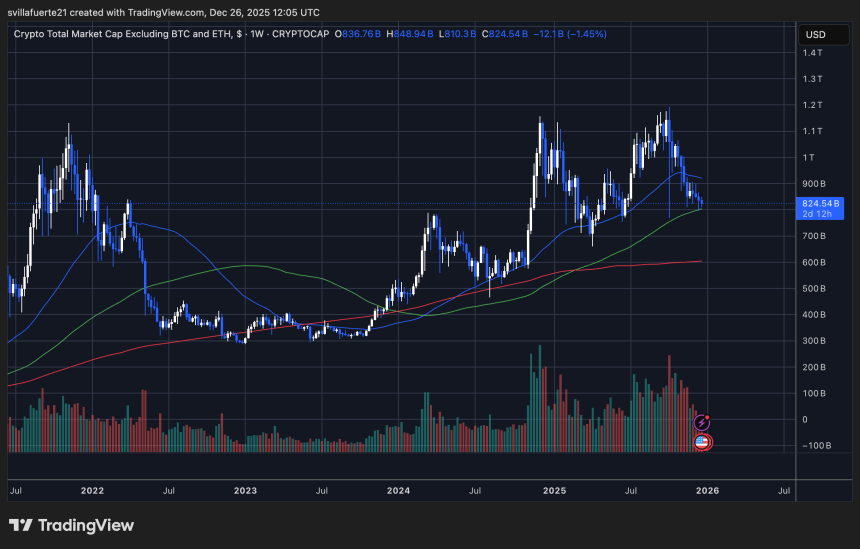
Altcoin Market Holds Key Support As Broader Structure Weakens
The total cryptocurrency market capitalization excluding Bitcoin and Ethereum is trading near the $825 billion level on the weekly chart. Following a sharp pullback from the $1.1–$1.2 trillion highs reached earlier this year. This index, used as a proxy for broader altcoin market health, shows a clear loss of momentum after an aggressive expansion phase. Signaling rising stress across the altcoin sector.

Technically, the market has slipped below its faster weekly moving average, which previously acted as dynamic support during the uptrend. That level has now flipped into resistance, limiting upside attempts.
Price is currently hovering just above the longer-term moving averages, which converge between roughly $780 billion and $820 billion. This zone represents a critical structural support area. A sustained break below it would likely confirm a broader bearish transition for altcoins.
Related Reading
From a market-structure perspective, holding the current range keeps the possibility of consolidation alive. However, failure to defend this support would open the door to a deeper retracement toward the $650–$700 billion region. For a bullish case to re-emerge, the altcoin market would need to reclaim the $900 billion level and reestablish acceptance above its key moving averages.
Featured image from ChatGPT, chart from TradingView.com
XRP is flooding Ethereum and Solana, but this invisible layer exposes your wallet to a $1.5 billion risk
Hex Trust launched wrapped XRP across Ethereum, Solana, Optimism, and HyperEVM on Dec. 12 with $100 million in initial liquidity, positioning the token as a trading pair for Ripple’s RLUSD stablecoin.
This latest move to make XRP available across multiple ecosystems adds to Coinbase’s cbXRP on Base and Axelar’s eXRP on the XRPL EVM sidechain.
Within months, XRP will exist in at least four distinct wrapped formats across a dozen networks, each with different custody arrangements and bridge infrastructure.
Additionally, RLUSD has over $1 billion in circulation, mostly on Ethereum, and deep XRP/RLUSD pairs on chains where capital already sits, expanding XRP’s addressable market beyond XRPL’s native orderbooks.
But the expansion trades one risk profile for another. Native XRP operates as a trustless protocol asset, while wrapped XRP replaces that model with a custodian holding real XRP, a bridge coordinating cross-chain state, and smart contracts managing the synthetic token.
The question is whether the liquidity gains compensate for the new layers of trust, operational complexity, and attack surface.
What actually launched
Hex Trust issues wXRP tokens 1:1 with native XRP held in segregated institutional custody, with minting and redemption restricted to authorized participants via a KYC/AML-compliant flow.
The token uses LayerZero’s Omnichain Fungible Token standard, synchronizing supply via message-passing contracts across multiple chains. Hex Trust seeded the launch with $100 million in TVL and positioned wXRP as a counterpart to RLUSD on EVM chains.
Wrapped.com has offered Wrapped XRP as an ERC-20 token on Ethereum since December 2021, with Hex Trust as the custodian.
Coinbase’s cbXRP on Base follows the same structure: 1:1 backing by XRP held in Coinbase custody, redeemable through Coinbase’s operational flow.
Ripple’s XRPL EVM Sidechain, live on mainnet since June 2025, provides a different on-ramp. Users lock XRP on the XRP Ledger and receive eXRP on the EVM sidechain via Axelar’s bridge.
The sidechain uses eXRP as its gas token, and Axelar’s interoperability layer connects it to 80 additional chains, routing eXRP into broader EVM DeFi.
Firelight’s stXRP adds another synthetic layer: users stake XRP on Flare and receive a liquid staking derivative.
The proliferation is rapid, as each product targets a different use case, but all replace native XRPL settlement with a trusted intermediary.
Liquidity gains are real but conditional
RLUSD reached $1 billion in circulation within a year of launch, with most issued on Ethereum rather than XRPL.
That gives XRP a large, liquid stablecoin counterpart on chains where trading volume already concentrates. Hex Trust’s $100 million initial TVL seeds deep orderbooks from day one.
Wrapping XRP on Ethereum, Solana, and Base plugs it into the deepest on-chain trading venues.
Native XRPL has a functional DEX, but its liquidity is thin compared to Uniswap, Curve, or Raydium. A wrapped token on those platforms gains access to better execution, tighter spreads, and integration into lending and yield protocols that do not exist on XRPL.
The XRPL EVM sidechain and Axelar bridge create a direct path from XRPL into multi-chain DeFi. Lock XRP, mint eXRP, route it through Axelar to Arbitrum or Polygon, and XRP functions as collateral in protocols that have never integrated XRPL directly.
But the liquidity improvement assumes wrappers maintain tight pegs, custodians process redemptions reliably, and bridges do not become attack vectors. Each assumption introduces new points of failure that native XRPL does not have.
Where risk migrates
The shift from native XRP to wrapped representations transfers risk from protocol-level consensus to custodial and bridge infrastructure.
Custodian and issuer risk comes first. Every wrapped XRP product requires someone to hold the underlying asset. For wXRP, that is Hex Trust. For cbXRP, Coinbase. For eXRP, Axelar’s validator network controls the bridge state and mint/burn logic.
XRP wrappers add another layer of risk on top of the XRP Ledger’s consensus, as they are centralized entities that promise to hold and redeem XRP. If the custodian halts withdrawals, declares insolvency, or suffers a hack, the wrapped token’s backing disappears regardless of what happens on XRPL.
Bridge and interoperability risk is the second layer. Hex Trust’s wXRP uses LayerZero’s OFT standard for cross-chain coordination, managing supply via off-chain message-passing and on-chain validation.
Axelar’s eXRP depends on validators relaying state between XRPL and the EVM sidechain.
Bridges have been the single largest target in DeFi exploits. Hacken’s 2025 Web3 Security Report showed that over $1.5 billion of the $3.1 billion stolen from crypto services in this year’s first half relates to bridges, accounting for over 50% of DeFi losses.
Vitalik Buterin’s argument against cross-chain architectures emphasizes that bridges do not diversify risk but rather concentrate it. A bug in a bridge contract can drain reserves across all connected chains simultaneously.
Redemption mechanics form the third risk domain. Hex Trust’s wXRP restricts minting and redemption to authorized participants, not end users. If those merchants become insolvent or halt operations, liquidity providers holding wXRP have no direct path to redeem for native XRP.
The token can trade freely on secondary markets, but its convertibility depends on intermediaries remaining functional.
XRP already exhibits fragmentation: Wrapped.com’s Ethereum wXRP, Hex Trust’s multi-chain wXRP, Coinbase’s cbXRP on Base, and Axelar’s eXRP all claim 1:1 backing but operate on separate infrastructure.
A liquidity shock or operational pause in one version creates arbitrage gaps, temporary de-pegs, and user confusion about which wrapper holds value.
| Risk type | What it is (plain English) | Where it shows up in XRP’s multi-chain setup |
|---|---|---|
| Custody / issuer risk | Someone has to hold the real XRP and promise 1:1 backing for the wrapped token. If they fail, the wrapper can be under-collateralized or unrecoverable. | Hex Trust for wXRP; Coinbase for cbXRP; any custodian behind older ERC-20 wXRP; entities holding locked XRP for bridges or sidechains. |
| Bridge / messaging risk | Cross-chain value moves via bridge contracts and message relayers. Bugs or attacks can mint extra wrapped tokens, block redemptions, or steal locked XRP. | LayerZero OFT stack for multi-chain wXRP; Axelar bridge for XRPL EVM eXRP; any third-party bridges linking XRP to EVM or Solana. |
| Smart-contract / protocol risk | Wrapped tokens and bridges rely on smart contracts with upgrade keys and governance. A bug, admin error, or malicious upgrade can break the wrapper. | wXRP contracts on Ethereum, Solana, Optimism, HyperEVM; cbXRP contracts on Base; eXRP contracts on XRPL EVM; DeFi protocols that list these assets as collateral or LP tokens. |
| Redemption and peg risk | The promise that 1 wrapped token always redeems 1 native XRP depends on smooth mint/burn flows and cooperative issuers/merchants. Stress events can break that. | Authorized-merchant model for wXRP; institution-only redemption flows at Coinbase; bridge withdrawal queues when moving back to XRPL. |
| Liquidity fragmentation | Multiple different “XRP” tickers across chains split order books and depth. Some wrappers may be deep and tight, others thin and fragile. | Native XRP on XRPL; Hex Trust wXRP; legacy ERC-20 wXRP; cbXRP on Base; eXRP on XRPL EVM; any future competing wrappers. |
| Regulatory / compliance risk | Wrapped assets and custodial bridges sit squarely in regulated territory. Enforcement or licensing changes can force abrupt pauses or wind-downs. | Hex Trust’s regulated custody; Coinbase’s cbXRP; RLUSD–wXRP pairs on KYC venues; any wrapper issued under a specific jurisdiction’s rules. |
| Operational / key-management risk | Custodians, bridge operators, and protocols all depend on ops processes and key security. Human error or compromised keys can be fatal. | Custody setups for the underlying XRP; multisigs or HSMs securing bridge and token contracts; relayer and oracle infrastructure that reports cross-chain state. |
| Narrative / functional drift | Once XRP is wrapped and paired with RLUSD or other stables, its role can shift from “payments asset” to “volatile DeFi collateral,” changing who uses it and why. | wXRP–RLUSD pairs on Ethereum/Solana; DeFi protocols that treat wrapped XRP mainly as yield collateral, not as a settlement rail. |
Testing for infrastructure versus wrapper theater
The expansion can be evaluated through four questions that reveal whether the product improves market plumbing or adds synthetic layers without reducing systemic risk.
First, who holds the XRP, and under what regime? Hex Trust and Coinbase position themselves as regulated custodians with segregated client assets.
RLUSD is regulated by the New York Department of Financial Services, and Ripple just got a national bank charter. That regulatory scaffolding determines whether users have legal recourse if custody fails.
A wrapper that cannot clearly identify its custodian, audit trail, and reserve attestation is not infrastructure, it is an unregulated promise.
Second, how many dependencies sit between the user and native XRP? A Solana DeFi user holding wXRP depends on XRP remaining on XRPL, Hex Trust maintaining reserves, LayerZero OFT messages propagating correctly, and Solana smart contracts executing as designed.
Native XRPL settlement depends on XRPL’s consensus. Wrapped XRP has four or five.
Third, what economic role does XRP serve once wrapped? RLUSD’s $1 billion circulation and positioning as a payments stablecoin create tension. A stable, regulated dollar token may be better suited for institutional settlement than volatile XRP.
If true, wrapped XRP ceases to function as a transactional medium and becomes collateral sitting atop a stablecoin-based payments layer.
Fourth, is the risk compensated and transparent? Bridges remain the industry’s preferred attack surface, with billions in losses since 2022. If a wrapper offers marginal convenience but depends on an opaque custodian or experimental bridge design, the trade-off is asymmetric.
By contrast, if wXRP/RLUSD pairs develop deep liquidity on audited protocols with circuit breakers, the risk/return calculation becomes defensible.
Risk reallocation
XRP’s expansion across Ethereum, Solana, Base, and the XRPL EVM sidechain is not a decentralization narrative. It is a liquidity-for-custody trade.
The wrapped tokens improve access to deeper markets and richer protocol integrations. However, they replace the XRP Ledger’s trustless settlement with trusted custodians, experimental bridges, and fragmented redemption flows.
For institutions evaluating whether to deploy capital into wrapped XRP, the calculus is not “does this expand XRP’s reach?” but “does the custodial and bridge infrastructure meet the same reliability standard as the native ledger it wraps?”
The current architecture works as long as nothing breaks. The question is what happens when something does.
Wallet In Telegram Lists Monad, Enabling Telegram TGE Trading & Expanding MON Distribution
Panama City, Panama, November 24th, 2025, Chainwire
This partnership expands global access to one of 2025’s most anticipated Layer-1 networks through Telegram.
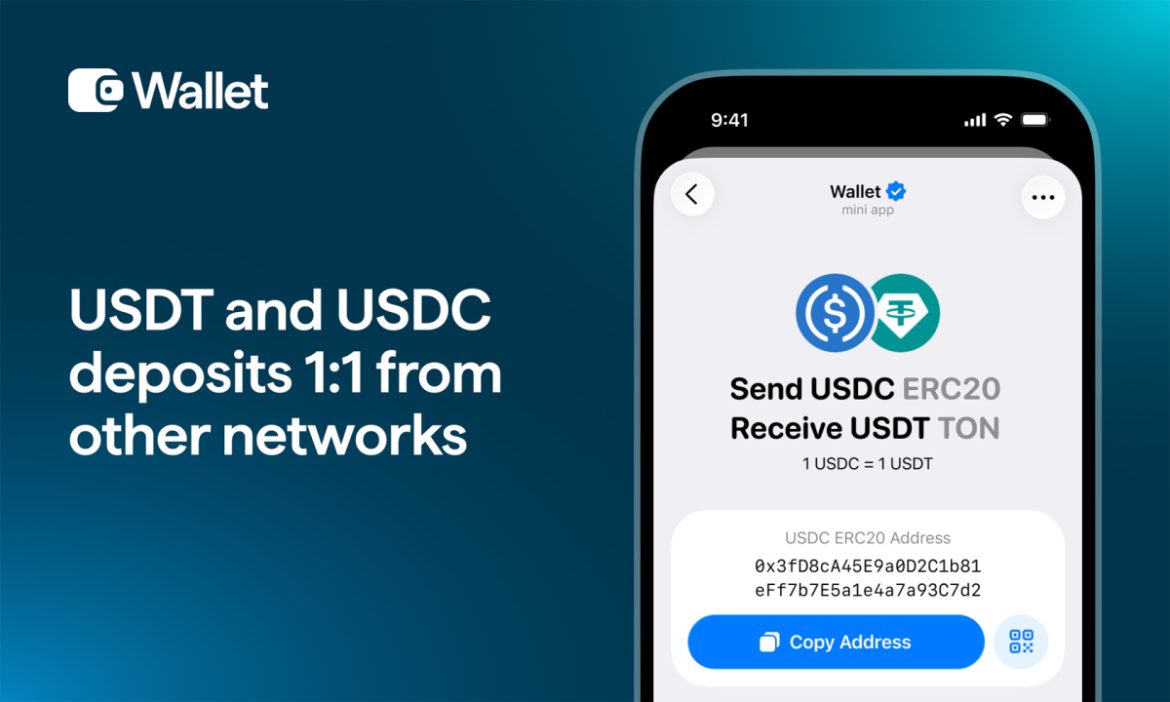
Wallet in Telegram, a digital asset solution natively embedded into Telegram’s interface, today announced a listing partnership and full token listing with Monad, the high-performance EVM Layer-1 inaugurating Coinbase’s new ICO platform. The partnership and listing will be available through the custodial Crypto Wallet, enabling users to discuss trading opportunities directly in Telegram and execute TGE trades natively within the app – keeping conversation and execution in one unified place.
From launch day, Wallet in Telegram users will be able to deposit, withdraw and trade MON directly within the app. The listing will be accompanied by a dedicated native MON staking functionality as well as incentive programs for traders designed to introduce Monad to Telegram’s audience across established and emerging crypto markets.
Regarded as one of 2025’s most consequential blockchain debuts, Monad sets a new performance standard for EVM-compatible networks. Its parallel and asynchronous execution model enables Ethereum-style smart contracts to operate at significantly higher throughput, targeting 10,000 transactions per second, sub-second latency, and low fees while preserving full bytecode-level EVM compatibility and decentralization.
Monad’s development has attracted extensive institutional support, with more than $225 million raised from investors including Paradigm, Dragonfly and Electric Capital. As the first project to launch through Coinbase’s new ICO platform, Monad has conducted a $188 million public sale following a testnet that processed over 5 billion transactions. The network will also distribute an airdrop to more than 230,000 eligible users.
“Monad represents a defining moment for next-generation blockchain infrastructure – combining breakthrough performance with full EVM compatibility,” said Halil Mirakhmed, Chief Strategy Officer at Wallet in Telegram. “Our mission is to ensure that users everywhere can participate in the most important moments in crypto from day one. By partnering with Monad at launch, we’re opening this milestone to millions of people around the world and supporting the growth of what we believe will be a foundational network for years to come.”
Wallet in Telegram is expanding its role as a universal gateway to digital assets for everyone. Alongside leading cryptocurrencies, it now offers xStocks for selected NASDAQ equities and will join blue-chip token generation events such as the Monad (MON) TGE, giving users curated access to top-tier crypto, public stocks and early-stage blockchain networks in one easy-to-use interface.
“Wallet in Telegram makes Monad uniquely accessible to a broad retail audience at launch,” said Keone Hon, Co-founder of Monad. “Starting from the launch, Telegram users around the world can engage with Monad’s technology through a familiar interface — advancing our goal to build fast, simple and scalable blockchain systems.”
Expanding access to Monad through Wallet in Telegram supports both teams’ efforts to make high-profile crypto launches more accessible to everyday users worldwide. With a deeply global user base and a presence in regions where early participation in major crypto events has often been limited, Wallet in Telegram offers a meaningful expansion of Monad’s retail footprint.
About Wallet in Telegram
Wallet in Telegram is a digital asset solution natively embedded into Telegram’s interface. Backed by The Open Platform, Wallet in Telegram gained 140M+ users in 2025, and aims to make its solution available to all 1BN+ of Telegram’s users. Wallet in Telegram offers a dual-wallet experience with Crypto Wallet (a multi-chain wallet for trading and sending crypto to contacts) and TON Wallet (a self-custodial wallet with access to the TON ecosystem of dApps and tokens).
About Monad
Monad is a high-performance Layer 1 blockchain engineered for speed without sacrificing security or decentralization, all while maintaining full compatibility with the existing Ethereum ecosystem. MON is the Monad network’s native token, used to pay gas fees, secure the chain via staking, and align validators, developers, and users around the growth of the protocol.
Contact
Masha Balanovich
Wallet in Telegram
masha@wallet.tg
Top Presales to Watch Out for In November 2025 – $EV2, $MaxiDOGE, and Best Wallet Lead The Way
Disclosure: This is a paid article. Readers should conduct further research prior to taking any actions. Learn more ›
November 2025 is shaping up to be a pivotal month for crypto investors. This comes as a wave of several top presales is making waves across different spheres, such as gaming, fintech, and memecoin. Here, we will spotlight the top five presales to watch in November 2025.
As the crypto market recovers from its cyclical downturn, its market cap has risen by nearly 5% to a staggering $4.57 trillion. This increase comes forth amid the major macroeconomic shifts and renewed investor confidence, driven by regulatory clarity in the space. That being the case, many investors are looking for the next 100× presale projects to invest in.
As market sentiments signal a bullish run, based on current market prices, such as Bitcoin hovering around $106k, presales remain the most compelling yet complex arenas for growth. With this generation of projects, launches are more structured, as tokenomics are more transparent, teams are often KYC-verified, and products are frequently live.
This November, there are potential breakout stories that range from Bitcoin Layer-2 projects to GameFi ecosystems, among others. Here are some of the top presales to watch out for in November 2025.
Top Crypto Presales To Close Out 2025
1. Earth Version 2 ($EV2)
Earth Version 2 ($EV2) is a gaming token developed by Funtico and Frozen Dawn Entertainment. It features a game that is available on PC (Steam), PS5, and Xbox. By combining its entertainment with NFTs and blockchain-based economies, EV2 is revolutionizing the gameplay by supporting actual asset ownership, together with play-to-earn opportunities.
With its presale currently underway, EV2’s native token, $EV2, is priced at $0.01. With 90,500 tokens already sold, EV2 is set to increase the price to $0.015 during the presale. This makes the project one of the most lucrative investments for investors who believe in the return of gaming as a central crypto narrative.
2. GoodCrypto (GOOD)
GoodCrypto is not just another crypto presale rocking the space. It is a multi-exchange trading app that seeks to revolutionize the way users trade, track, and manage portfolios. With a total raise of $657,000, its native token, $GOOD, holds considerable promise for its holders. This is courtesy of the 50% revenue share of all swap fees collected on the platform, as well as the swap fee discounts.
With only 20% of the tokens up for presale and the presale ending on November 30, 2025, $GOOD is positioning itself among the presale projects that investors don’t want to miss out on.
3. Best Wallet (BEST)
Best Wallet is a revolutionary non-custodial wallet that aims not only to streamline the buying process but also to provide personalized, multi-wallet portfolios. With over $5.1 million already raised, Best Wallet is underscoring both community confidence and market relevance in what it has to offer.
Beyond that, its users will be able to enjoy seamless cross-chain swaps, all from their phones. Additionally, the early holders of the $BEST token will have the power to participate in governance, pay platform fees, receive staking rewards, and gain early access to new presales. This has made it an interesting pick among the top presales to watch out for in November.
4. Tapzi (TAPZI)
Tapzi has positioned itself as one of the most compelling presales worth looking out for in November. This is because it is the first Web3 gaming platform that focuses on the skills to determine the winner in the game. Its presale is currently live till January 30, 2026, during which the $TAPZI tokens can be bought for $0.0035.
With 69.27% of the tokens already sold, Tapzi aims to sell $150M worth of tokens before launching at $0.01. The difference between the presale and launch value makes it a lucrative investment for buyers who want to make a winning buy. Additionally, as a gamified platform, players can stake $TAPZI and participate in games such as live chess, rock-paper-scissors, and checkers, where winners receive the entire prize pool.
5. Maxi Doge (MAXI)
Maxi Doge is a meme coin with maximalist branding. By leveraging the meme culture that has developed around the successes of Dogecoin and Shiba Inu, Maxi Doge has positioned itself as the next big viral token. A quick look at its presale figures shows that $MAXI is currently trading for $0.0002675 per token.
With over $3.9 million out of the $4.3 million required, the token has shown strong early interest among many. The low entry price and the promise evident from the $800k that has been raised since July 29, 2025, make Maxi Doge a presale project worth watching in 2025 for investors who are excited about 1000× leverage.
Future of Crypto Presales
The crypto presale landscape in 2025 is markedly different from those of previous cycles. This is greatly attributed to the research-driven environment, one where investors demand substance and verifiable progress. For this, all the credit goes to the speculative frenzy that was seen in the 2021 and 2022 era, which paved the way for a more selective path. Not forgetting the diversification in the space, presales now feature more than just meme coins, as innovations can be seen in categories such as Bitcoin scalability, fintech integration, and cross-chain gaming.
Additionally, with the regulatory and audit oversight in place, the current presales are rewarding transparency and penalizing opacity. A collection of all these aspects suggests that the next generation of successful presales will be those that combine innovation with credibility.
Conclusion
Being one of the most dynamic and potentially rewarding frontiers, the presale space in the crypto industry has remained one of the most trodden paths by disciplined investors. With a snapshot of the top presales to watch out for in November, it is clear that the presale market is no longer a speculative lottery but a venture landscape. In a market that rewards early conviction, these five presales represent the most compelling opportunities to watch as 2025 draws to a close.
Disclaimer: This is a sponsored post. CryptoSlate does not endorse any of the projects mentioned in this article. Investors are encouraged to perform necessary due diligence.
Latest Sponsored News
Partner-supported content providing insights into projects and innovations in blockchain.
Long-Time HODLer Says $3M Worth of Tokens Were Stolen From His Cold Wallet
An American retiree says more than $3 million in XRP vanished after he checked Ellipal’s mobile app on Oct. 15 and saw his balance gone, a discovery that spurred an on-chain tracing effort by pseudonymous analyst ZackXBT.
CoinDesk has not independently verified the investor’s identity, balances, or the complete on-chain path. The account comes from several YouTube videos posted since Oct. 15, Ellipal’s public statement on Oct. 18, and ZackXBT’s Oct. 19 X thread.
What the victim says happened
The investor, who identified himself as Brandon, said he lives in North Carolina, is 54, and that his wife, 60, is also retired. He said the XRP position was almost their entire retirement savings and that they had planned to buy a house in Las Vegas.
He said he had been accumulating XRP since 2017 and previously held more but sold some for living expenses. In his YouTube videos, he said he discovered the theft by checking the Ellipal app on Wednesday, Oct. 15, and then determined the drain occurred on the previous Sunday, Oct. 12.
He described two 10-XRP test pulls around 11:15 a.m. Eastern time, followed by a sweep of about 1,209,990 XRP to a newly created address, then rapid fan-out across dozens of wallets and eventually hundreds. He said smaller balances of other assets, including roughly $1,000 in XLM and about $900 in FLR, remained.
He said he filed with the FBI’s Internet Crime Complaint Center and contacted local authorities, but struggled to reach specialized cyber units quickly. He said he does not know precisely how the funds were taken from the hot wallet.
Ellipal’s explanation and the cold-to-hot confusion
Ellipal said on Oct. 18 that its review indicated the user had imported the hardware wallet’s seed phrase into the Ellipal mobile app, which would recreate the wallet on an internet-connected device.
In an email to the user, Ellipal explained that if a cold wallet’s seed is used on a phone or tablet, the seed and resulting private keys would be stored on that device, effectively making it a hot wallet and greatly reducing security.
Brandon said he had Ellipal’s app on both an iPhone and an iPad. He mentioned that the iPhone app showed a blue background, which Ellipal told him denotes a cold-wallet connection, and the iPad app showed an orange background, which Ellipal told him indicates a hot wallet.
Ellipal emphasized that its hardware devices are air-gapped and said it has not seen thefts originate from the hardware itself. The company’s account points to user error, though it does not by itself prove how the compromise occurred.
Where the funds reportedly went, per ZackXBT’s investigation
In an Oct. 19 thread, ZackXBT said he identified the theft address by matching the video’s timing and amounts. He reported that the attacker created more than 120 Ripple-to-Tron orders on Oct. 12 using Bridgers, a swap service formerly known as SWFT. He noted that some block explorers label those hops as “Binance” because Bridgers uses the exchange for liquidity.
He said the funds consolidated on Tron at a wallet TGF3hP5GeUPKaRJeWKpvF2PVVCMrfe2bYw and by Oct. 15 were dispersed to over-the-counter brokers adjacent to Huione, an online marketplace in Southeast Asia that has been cited in recent public actions by U.S. authorities. CoinDesk has not independently reproduced the full tracing or confirmed the ultimate recipients.
Recovery odds and user takeaways
ZackXBT cautioned that most “recovery” firms are predatory, often producing superficial reports while charging high fees. He said quick reporting to credible investigators and compliant platforms can improve the odds of flags or freezes, but recoveries are rare once funds move through cross-chain swaps and OTC venues.
For users, the core lesson is straightforward: if the goal is cold storage, do not type a hardware wallet’s seed into a mobile or desktop app. Use a distinct seed for any hot wallet and consider a BIP39 passphrase for high-value cold storage.
Brandon said the loss wiped out what he considered the couple’s retirement plan. He said he shared his experience to warn others and to seek guidance, while acknowledging the chances of recovery are low.
Bull Bitcoin, the international privacy-focused bitcoin exchange, has just announced the global release of BULL Wallet on iOS. The mobile app is designed for both beginners and hardcore cypherpunk Bitcoin OGs. Available now on iOS and Android, BULL Wallet optimizes for “top-tier privacy, security, and usability for day-to-day Bitcoin transactions and secure long-term cold storage,” according to a press release shared with Bitcoin Magazine.
“BULL Wallet is my passion project and a gift to the Bitcoin network. It is Bitcoin-only, fully open-source, and built to prioritize privacy, security, and simplicity,’’ said Pouliot of the wallet, which is fully open-source and ad-free.
The BULL bitcoin wallet is fully featured, delivering a wide range of features, starting off with basic send, receive, and accounting, down to hardware wallet support via COLDCARD integration — generally considered the most paranoid and advanced hardware wallet. In between, the wallet makes a series of opinionated design choices that optimize for bitcoin privacy while avoiding high degrees of complexity seen in other popular bitcoin mobile wallets today.
Of course, as is on brand for the company, the wallet is bitcoin only, though it supports the crypto asset leader in both the Lightning Network and the Liquid Network, giving users great options for both privacy, long-term custody, and transaction speeds. The wallet even has a swap exchange integrated using a powerful technology called atomic swaps, which lets users move from one layer to another of bitcoin without having to trust any exchange with their funds in the transition, unlike normal centralized exchanges or even popular swap or ‘instant exchanges’.
The BULL Wallet also has a deep integration with the Bull Bitcoin exchange, a feature crucial to the long-term sustainability of mobile wallets, which tend to struggle otherwise to find a business model and thus stay afloat. Exchange interactions are opt-in and can be ignored altogether, but if turned on, they can unlock extra features like fiat payments of bills, quick purchases, and the sale of bitcoin, among other features, depending on jurisdiction.
I bought coffee with BULL wallet
How much did I pay? Tell me anything about merchant identity, other clients, wallet info, tx history? Where’s the money now? Where did I get those coins from? What’s my balance? Whats my cost-basis? Who has my KYC info?https://t.co/vlCM2WbRLA
— FRANCIS – BULLBITCOIN.COM (@francispouliot_) October 13, 2025
One of the most compelling features the BULL Wallet offers is seamless integration with Payjoin, a privacy protocol that, unlike popular coin mixers, does not take a long time nor require a third party to help coordinate. Instead, if both the sender and the recipient support the protocol, the payjoin transaction takes place, making it harder for data analysis companies to know who paid how much to whom. Payjoin transactions look like normal transactions, but simply organize the money flows in a private way, resulting in a measurable upgrade in user privacy, something that is generally positive for Bitcoin’s censorship resistance qualities as well.
The BULL Wallet has a long list of features under the hood that advanced users will appreciate, while new users can simply benefit from, such as;
- Segwit-native descriptor-based architecture using the trusted BDK library
- Standard BIP39 mnemonic support
- Connection to personal nodes or your own Electrum server for direct Bitcoin network access
- Coin selection and labeling capabilities
- Customizable mempool-based fee calculations with RBF to avoid overpaying mining fees
- Watch-only wallet import
- Encrypted secrets to protect against malicious apps
- Secure keyboard to prevent clipboard hijacking
- No push notifications and no data collection
- Address labeling for enhanced coin selection
- BIP85-based secrets derivation
- Multiple fiat currency support
- Testnet compatibility
Future Roadmap
The team, made up of four full-time developers and “lifelong funding”, has a deep roadmap ahead, which, if completed, could result in the most powerful Bitcoin-only mobile wallet in the industry. Some of these milestones include:
- Fully reproducible builds
- Ark Network integration
- Silent Payments
- Secure and anonymous metadata backups
- Advanced coin labeling and selection
- Support for all major hardware wallets
- Multisignature wallets and Miniscript
- Nostr-based anonymous chat
- LN addresses
Francis, an entrepreneur with deep experience in the Bitcoin industry, said of the roadmap that “this is only the beginning, we will keep improving it forever.”
A new mystery has been solved, as the US government used an unknown exploit to seize Bitcoin wallets. 220,000 wallets are impacted, many of which are still active.
Now that the secret is out, hackers could make attempts to drain these “doomed” crypto addresses. Concerned readers should check the list of vulnerable wallets, and move their tokens as necessary.
Sponsored
Sponsored
A New Bitcoin Wallet Flaw
The crypto community has been full of questions after the US government seized $15 billion in Bitcoin this week. The assets were taken from a known heist in 2020, but sleuths were mystified as to how law enforcement obtained the private keys.
Now, however, one DeFi developer revealed the nature of a new Bitcoin wallet vulnerability:
Apparently, the hacker’s wallets contained a crucial error that made it easy for anyone to steal this Bitcoin. The analyst characterized these wallets as “doomed from the start,” as the Pseudo Random Number Generator that created the private keys had major technical flaws.
Some analysts have even theorized that law enforcement knew about this Bitcoin wallet vulnerability for several years without publicizing it.
Either the government knowingly kept the secret and only revealed it when prosecuting criminals, or someone else discovered it. In that case, the US may have learned of this flaw recently.
Sponsored
Sponsored
A Dangerous Secret
Either way, it’s clear why crypto crimefighters would want to keep this knowledge from general circulation. An estimated 220,000 Bitcoin wallets contain this error, too. Many of these addresses are still active, and it would be trivially easy for hackers to penetrate them.
Readers may wish to check the list to see if their own Bitcoin wallets are vulnerable. If you are storing any crypto in one of these defective addresses, you should move it to safer storage immediately.
BeInCrypto has many resources to help its readers protect their assets, and can recommend solid security plans.
Still, full-blown hysteria might be inappropriate. Prominent sleuths have claimed in unequivocal language that “you will not have this issue if you use a reputable wallet.”
The failed number generation is most common in self-programmed wallets, especially those with AI-generated code.
However, many professionals take wallet security very seriously in their products.
All that is to say, if your Bitcoin wallets come from any leading firm, they’re probably safe. If, however, you’re using an obscure third-party creation or have attempted to generate one yourself, you may not be aware of these serious problems.
The exploit is public, and hackers could come probing at any moment.