MSCI’s new non-operating company rules could exclude Strategy, Metaplanet and SharpLink. The final list of affected firms is due Nov. 11.

 Live Chat
MSCI’s new non-operating company rules could exclude Strategy, Metaplanet and SharpLink. The final list of affected firms is due Nov. 11.

Citi’s Scott Chronert says the S&P 500 needs both AI stocks and rate-sensitive sectors to rally to reach 8,100. Only one of those groups is in good standing, by his account.
Chronert, Citi Research’s head of U.S. equity strategy, says AI-linked companies make up just over half of the index. Third-quarter earnings season is getting underway.
Citi raised its year-end target to 8,100 from 7,700 in June, citing AI-driven earnings strength. On the AI side, Chronert expects earnings tailwinds to continue through third-quarter reports.
In contrast, Chronert said rate-sensitive sectors have dropped about 10% since the Federal Reserve’s Jackson Hole symposium in late August.
Those include utilities, real estate, consumer discretionary stocks, and, to a degree, banks.
A rebound hinges on markets pricing out some expected Fed rate hikes, he said. The Fed raised rates by a quarter point on September 16. However, it could raise them again at the October 28 meeting.
Chronert also named the midterm elections as a hurdle the index must clear before year-end.
Meanwhile, Matt Stucky, senior portfolio manager at Northwestern Mutual, expects a positive season. He said consensus points to upper-20s year-over-year earnings growth, versus low 30s in the second quarter.
He said valuation multiples, the price paid per dollar of profit, could drive stocks from here. Fed policy, the 10-year Treasury yield, inflation, and oil all feed into that.
Aya Yoshioka of Wealth Enhancement Group said the outlook depends on what hyperscalers say about AI capital spending. Hyperscalers are the large cloud providers building out AI infrastructure.
Yoshioka wants to see last quarter’s strong cloud growth and investment returns continue. Without that, a correction could follow as investors reset expectations for 2027.
“we need this broadening trade to come back to get to my 8100”
Scott Chronert, head of U.S. equity strategy at Citi
Concentration was a theme across the panel, which noted the AI trade now touches about 50% of S&P 500 companies. Chronert’s 8,100 target depends on the other half joining in.
The post Citi Says S&P 500 Needs AI and Non-AI Stocks to Reach 8,100 appeared first on BeInCrypto.
TL;DR: Sui and Alibaba Cloud are working on an integration that would let AI agents pay for cloud services per request using stablecoins within budgets set by their owners. The collaboration was unveiled at Sui Basecamp and remains under development, with no public launch date yet.
The next stablecoin user may not be a person.
Sui and Alibaba Cloud are working on a payments model that would allow autonomous AI agents to pay for cloud resources one request at a time without asking a human to approve every transaction.
The collaboration was unveiled at Sui Basecamp in Singapore.
The concept connects Alibaba Cloud services with Sui Agent Payments, a framework in which the owner of an AI agent sets an on-chain budget and spending limits.
Once those rules are in place, the agent can make individual cloud or inference calls and settle the cost in stablecoins.
That turns the normal cloud billing model on its head.
Instead of a company receiving a monthly invoice for a pool of API and computing usage, each action can become its own programmable payment.
The user still controls the budget.
The agent controls spending inside that boundary.
That distinction is important because autonomous payments are one of the practical bottlenecks facing AI agents.
Software can already decide to call an API, order a task or request computing resources.
But if every action requires a human to enter card details or approve an invoice, the agent is not truly operating autonomously.
Stablecoins are particularly well suited to machine payments because they can move around the clock, settle programmatically and be divided into very small amounts.
Sui’s role is to provide the blockchain execution and payment logic around those transactions.
Alibaba Cloud brings the actual services an agent might need to purchase, including compute and other cloud resources.
The partnership is not a live commercial service yet.
No launch date, price schedule or first customer has been announced.
That makes it important not to confuse the demonstration with a finished product.
But the model is worth watching because it connects two technologies that have often been discussed separately.
AI agents need money.
Stablecoins need useful transactions.
A cloud service that can be purchased automatically creates a clear reason for an agent to hold and spend a digital dollar.
There are also obvious controls that need to work.
An autonomous agent with an unlimited wallet is a security nightmare.
Budget limits, permissions and transaction rules therefore become as important as the payment rail itself.
Sui Agent Payments is being designed around that idea, with owners defining the amount an agent is allowed to spend before it starts acting.
If the model eventually reaches production, the most interesting part may be how little the user thinks about blockchain.
A company gives software a budget.
The software buys the computing resources it needs.
Stablecoins settle the bill underneath.
That is much closer to infrastructure than speculation, and it may be where machine-to-machine crypto payments start to make sense.

Editorial Process for bitcoinist is centered on delivering thoroughly researched, accurate, and unbiased content. We uphold strict sourcing standards, and each page undergoes diligent review by our team of top technology experts and seasoned editors. This process ensures the integrity, relevance, and value of our content for our readers.

Was the US government behind this major liquidation event?
Although BTC was halted at $87,000 once again at the start of the business week, it still managed to hold relatively stable at over $85,600 before the bears took complete control for less than half an hour earlier this morning and drove it south by $2,000.
Naturally, such a violent move spiked the liquidations, as the total value of wrecked positions rocketed to over $550 million on a daily scale. $430 million came in the past 4 hours alone, and almost all were from longs.
Interestingly, ETH longs are responsible for the lion’s share as the altcoin’s price tumbled by roughly 4%, going below $2,600. Other alts, such as XRP, HYPE, DOGE, and ADA, were hit even harder, with losses of up to 6% on a 24-hour scale.
More than 100,000 traders were wiped-out in the past day, with the single-largest liquidation order taking place on Binance. It was worth a whopping $26 million and involved the ETH/USDC pair, according to CoinGlass.
A couple of reasons pop up in the past several hours that could have resulted in this major leg down. At first, Lookonchain reported that the US government has moved a portion of the crypto it holds. In total, they transferred 834 BTC ($71.56 million) to Coinbase Prime, while moving another 40,285 BNB.
As we have explained before, even if the authorities have sold that amount, it doesn’t translate necessarily into breaking Trump’s promise to never sell any BTC.
The second possible reason could be linked to insiders, as Lookonchain updated. 4 newly created wallets deposited $1 million USDC into hyperliquid just minutes before the crash and opened 40x shorts on nearly 150 BTC ($12.5 million).
Bitcoin has dropped below $84,000.
Just before the market dropped, 4 newly created wallets deposited 1M $USDC into #Hyperliquid and opened 40x shorts on 148.49 $BTC ($12.5M).
Insiders?
https://t.co/EzPGCixA9c
https://t.co/idcl5q2vtM
https://t.co/6cNec0Rc3Y
https://t.co/jFDTRz3l9X— Lookonchain (@lookonchain) October 7, 2026

Stablecoin cards are beginning to look less like a consumer crypto experiment and more like business payment infrastructure.
Visa published new data on October 1 showing that approximately 17% of stablecoin-linked card volume in its fiscal 2026 year-to-date period came from business and commercial card programs. The company says it now supports more than 160 stablecoin-linked card programs across consumer, business and commercial use cases.
The percentage matters because companies use cards very differently from retail users.
A consumer may use a stablecoin-linked card because it makes a crypto balance spendable at ordinary merchants.
A business may be solving a different problem: cross-border settlement, treasury management, supplier payments or moving money between systems that do not share the same banking hours.
Visa says those use cases are gaining traction as financial institutions and payment providers explore stablecoins as infrastructure rather than as speculative assets.
The pattern is already visible elsewhere in payment infrastructure. Visa itself has already moved stablecoin settlement deeper into institutional treasury operations, while Toss Bank has tested Solana-based remittance rails.
The common denominator is not a new token price cycle. It is money movement.
Stablecoins can settle onchain, but most businesses still operate in a world of bank accounts, invoices, card networks and conventional accounting systems.
Card programs create a bridge. A company can hold or receive digital dollars while still spending through merchant infrastructure that already exists globally.
That hybrid model is likely to be important during the transition period because it does not require every supplier or employee to become a blockchain user.
Regulation will still shape how quickly the model spreads. In Europe, issuers are working inside MiCA and exchanges have already adjusted which stablecoins they support. NewsBTC’s coverage of Circle bringing EURC to Base shows how regulated stablecoin distribution and blockchain liquidity are beginning to reinforce each other.
Consumer activity still makes up the majority of Visa’s stablecoin-linked card volume.
The significance of the 17% figure is that business usage is now large enough to measure as a distinct part of the network rather than a rounding error.
If the share keeps climbing, stablecoins may become most important not because shoppers choose to pay with crypto, but because businesses quietly use tokenized money underneath familiar payment products.
That would be a much less visible form of adoption, and potentially a much larger one.
—
This article was written by the News Desk and edited by Samuel Rae.
The crypto market will welcome tokens worth more than $913 million this week. Major projects, including DoubleZero (2Z), Sui (SUI), and Collector Crypt (CARDS), will release significant new token supplies.
These unlocks could introduce market volatility and influence short-term price movements. So, here’s a breakdown of what to watch.
DoubleZero is a network layer built for blockchains and other distributed systems. It routes validator traffic over fiber links supplied by independent contributors, which reduces latency compared with the public internet.
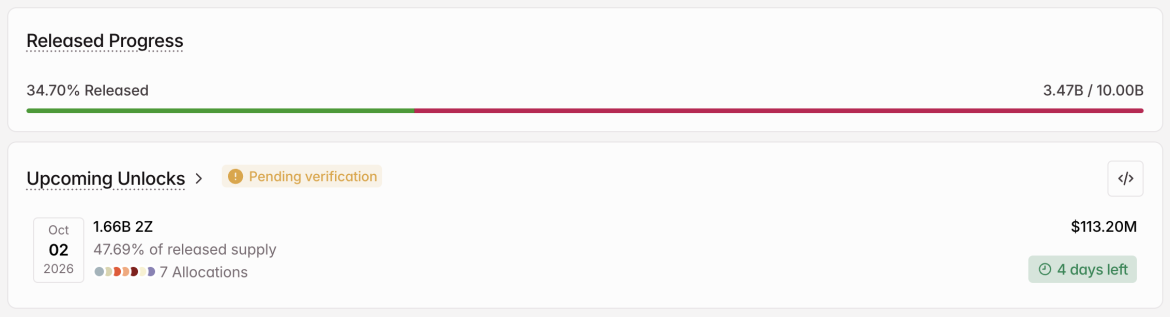
On October 2, the network will unlock 1.66 billion 2Z, worth $113.20 million. The tokens account for 47.69% of the released supply. The date also marks one year since 2Z began trading on October 2, 2025.
DoubleZero will split the supply 7 ways. Jump Crypto will receive the largest share at 575 million 2Z. Malbec Labs and institutions will get 350 million and 300 million tokens, respectively.
The team will receive 250 million 2Z, while contributors will get 100 million. Finally, builders and validators will receive 50 million and 30 million tokens.
Sui is a high-performance Layer-1 blockchain. It utilizes the Move programming language to enable scalable, secure, and efficient decentralized applications (dApps).
Moreover, the network focuses on parallel execution for high throughput, making it suitable for gaming, decentralized finance (DeFi), and Web3 ecosystems.
On October 1, Sui will unlock 13.26 million altcoins as part of its monthly schedule. This stack represents 0.32% of the released supply. Furthermore, it is worth approximately $16.84 million.

Of the unlocked supply, early contributors and the community reserve will get 7.19 million and 4 million SUI, respectively. Lastly, Mysten Labs will receive 2.07 million altcoins.
Collector Crypt is a marketplace on the Solana (SOL) blockchain for tokenized trading cards. Users can buy, trade, and redeem graded physical cards that the platform keeps in storage vaults. CARDS is the platform’s native token.
On September 29, Collector Crypt will unlock 59.26 million CARDS. The tokens are valued at $11.67 million and account for 10.62% of the released supply.

The team will receive most of the unlocked tokens: 32.50 million CARDS. The community will get 14.58 million tokens. In addition, advisors and seed investors will receive 7.01 million and 5.16 million CARDS, respectively.
In addition to these three, Ethena (ENA), Falcon Finance (FF), and Sign (SIGN) will also experience new supply entering the market this week. Tokenomist has marked the unlocks as pending verification, so these figures remain projections.
The post 3 Token Unlocks to Watch in This Week appeared first on BeInCrypto.

Cardano’s onchain governance system has approved a new round of treasury allocations aimed at infrastructure and ecosystem development, giving the network another live test of its Voltaire-era decision process.
The important part is not only where the ADA goes.
It is how the decision gets made.
Cardano has spent years building toward a model where ecosystem funding and protocol decisions are increasingly handled through formal community governance.
The latest allocations put that framework to work.
Approved funding is aimed at core infrastructure and developer-focused initiatives, with disbursement structured around milestones rather than one unconditional transfer.
That approach is designed to give governance participants more oversight over whether funded projects actually deliver.
It also makes the treasury a strategic tool rather than simply a pool of ADA waiting to be spent.
Approval does not mean every ADA allocation is immediately released.
Milestone-based funding creates an additional layer between governance approval and full payment.
That is worth emphasizing because treasury votes can otherwise sound like instant transfers.
The broader significance is that Cardano’s governance architecture is now being used for real resource allocation.
That creates the same opportunities and problems faced by other DAOs: voter participation, accountability, technical complexity and the risk of funding projects that fail to produce useful results.
The difference is scale.
Cardano’s treasury and governance system are intended to support a large base-layer ecosystem rather than a single DeFi application.
The latest funding round will therefore be watched as much for execution as for the vote itself.
Voltaire governance becomes meaningful only if approved projects turn treasury capital into infrastructure and applications that users actually value.
Cardano’s approach also differs from governance systems where a small protocol treasury is controlled by a relatively narrow group of token holders. The ambition here is to use governance as a recurring layer for ecosystem-wide funding decisions. That makes process quality important: voters need enough information to judge proposals, milestones need to be measurable and unsuccessful projects need consequences. If those controls work, the treasury can become a long-term growth engine. If they do not, a large funding pool can just as easily become a source of waste and political friction inside the ecosystem.
This article was written by the News Desk and edited by Samuel Rae.
Editorial Process for bitcoinist is centered on delivering thoroughly researched, accurate, and unbiased content. We uphold strict sourcing standards, and each page undergoes diligent review by our team of top technology experts and seasoned editors. This process ensures the integrity, relevance, and value of our content for our readers.

The total crypto market cap hit a multi-month peak at over $2.9 trillion after the latest rally.
Bitcoin went on a wild run on Monday, surging by over $7,000 on the heels of massive ETF inflows and topping $87,000 for the first time since late January before it finally calmed at around $86,000.
Most altcoins registered similar or even more impressive gains, including Ripple’s XRP, which flew past $1.50, and DOGE, which has neared $0.10.
There was very little evidence last week of what would transpire in the crypto markets, starting from Friday and culminating on Monday evening, at least for now. The CLARITY Act was voted down in the US Senate, marking the first major blow against the industry. A day later, the Federal Reserve increased rates for the first time since July 2023. Both of these developments led to short-term declines for BTC, which slumped to $75,000 on a couple of occasions.
However, it reacted well on Thursday and especially on Friday. The BOJ’s decision to mimic the Fed didn’t harm bitcoin. Just the opposite; the asset rebounded to over $78,000 before it initiated another leg up that afternoon to over $80,000. It climbed to almost $82,000 on Wednesday, when the new escalation in both major wars led to a brief retracement to $80,300.
Monday, though, belonged to the bulls. BTC began its gradual ascent in the morning and culminated in the evening with a surge past $87,000 as the ETF inflows rocketed, which became an eight-month peak. After gaining $7,000 in less than 24 hours, bitcoin was due for a pullback. It dipped to $85,000 earlier today before it recovered to $86,000 as of now.
Its market cap has risen to $1.730 trillion on CMC, while its dominance over the alts stands above 59%.
Ethereum touched $2,800 briefly for the first time since the start of the year before it slid to $2,750. BNB tapped $800, but it’s now down to $788. Ripple’s XRP has reclaimed the key $1.50 resistance after another 4% run in the past 24 hours. Naturally, analysts have flipped bullish again, outlining some major predictions.
Dogecoin has neared $0.10 after a similar increase; ADA is close to $0.25, while NEAR has tapped $4.50. SHIB, CRO, HBAR, TAO, and PEPE have risen the most over the past day. In contrast, MORPHO, RAIN, UNI, ENA, BTW, and AAVE are in the red.
The total crypto market cap is up by over 3.5% today to $2.9 trillion on CMC.
Disclaimer: Information found on CryptoPotato is those of writers quoted. It does not represent the opinions of CryptoPotato on whether to buy, sell, or hold any investments. You are advised to conduct your own research before making any investment decisions. Use provided information at your own risk. See Disclaimer for more information.

Mutsamudu, Comoros, September 17, 2026 – MEXC, a pioneer in 0-fee digital asset trading, has announced a major upgrade to MEXC AI under its philosophy of “Intelligence for Every Opportunity.” With enhanced AI Assistant and AI Radar capabilities, MEXC AI is evolving from an information-focused assistant toward a more connected trading experience spanning opportunity discovery, market analysis, strategy generation and execution.
In a 24/7 market, traders have access to more information than ever, but turning that information into action often requires moving between different tools for research, analysis and execution.
MEXC AI is designed to shorten this distance. By bringing market intelligence, conversational interaction, strategy generation and user-confirmed execution into the trading environment, MEXC aims to make AI part of the trading journey itself rather than a standalone information tool.
At the center of the upgrade are AI Assistant and AI Radar.
AI Assistant, MEXC AI’s core conversational interface, draws on real-time market data, positions and trading activity on MEXC to provide more context-aware interactions. The upgrade introduces a redesigned half-screen interface with conversation history, scenario-aware responses, and an adaptive conversational experience aligned with different market contexts.
AI Radar focuses on market intelligence and opportunity discovery. New features include AI Visual, which transforms complex financial news into more intuitive visual content; AI Video Brief, an AI-hosted daily recap of key global market developments; and Trending Stock Insights, which brings together trending U.S. stocks, market activity and key events.
Together, AI Radar and AI Assistant help users move more efficiently from discovering what is happening to understanding what it means in their own trading context.
Beyond the latest upgrade, MEXC AI is building a more connected journey across Discover, Understand and Trade.
Existing capabilities including AI Rankings, AI Trends and Smart Chart support market discovery and analysis, while AI Strategy allows users to translate natural-language trading ideas into strategies that can run automatically after users review and confirm the parameters. AI Model Copy Trade provides another way to access selected trading strategies and activity.
MEXC will introduce a new command-line trading interface designed to support AI Agent use cases. Within user-authorized permissions, compatible AI agents will be able to interact with MEXC capabilities, extending MEXC AI from information and analysis toward more flexible, agent-driven trading workflows.
“The next phase of AI in trading is not about giving users more answers. It is about reducing the distance between trading intent and execution while keeping users in control,” said Vugar Usi, CEO of MEXC. “MEXC AI is designed to connect opportunity discovery, analysis, strategy generation and user-confirmed execution within the trading environment. Our goal is not to remove the trader from the decision, but to make intelligence available at every step of the trading journey.”
This evolution reflects MEXC’s broader Trading Companion vision, which aims to make AI a more continuous part of the trading journey. It helps users discover opportunities, understand market movements and move from insight toward action more efficiently. To bring this vision to life, MEXC is launching Trading Takes Two, a month-long campaign that will showcase how MEXC AI supports users across different stages of the trading journey, under the philosophy of “Intelligence for Every Opportunity.”
For more information and to experience MEXC AI’s capabilities, please visit the MEXC AI page.
About MEXC
Founded in 2018, MEXC is a leading global multi-asset trading platform built as your 0-fee gateway to infinite opportunities. Serving users across 170+ markets, MEXC provides simple and efficient access to crypto, stocks, tokenized assets, derivatives, and a growing range of TradFi-linked opportunities through one account and one gateway.
With 0 trading fees, deep liquidity, broad asset coverage, and a high-performance trading experience, MEXC is designed for retail users who want to discover earlier, act faster, and trade with fewer barriers. As crypto and traditional finance continue to converge, MEXC is committed to making global opportunities more accessible, helping users trade freely and MEXCmize every opportunity.
MEXC Official Website| X | Telegram |How to Sign Up on MEXC
For media inquiries, please contact MEXC PR team: media@mexc.com
Risk Disclaimer:
This content does not constitute investment advice. Given the volatility of financial markets, including digital assets, tokenized assets, and traditional financial products, investors should carefully assess market conditions, underlying asset fundamentals, and potential financial risks before making any investment or trading decisions.
Source
Morgan Stanley told investors a stock market correction could arrive within 30 days. However, based on developments over the weekend, markets may not wait that long, with Monday likely to be the first test.
Mike Wilson, the bank’s chief US equity strategist, is not worried about artificial intelligence (AI). He is worried about oil.
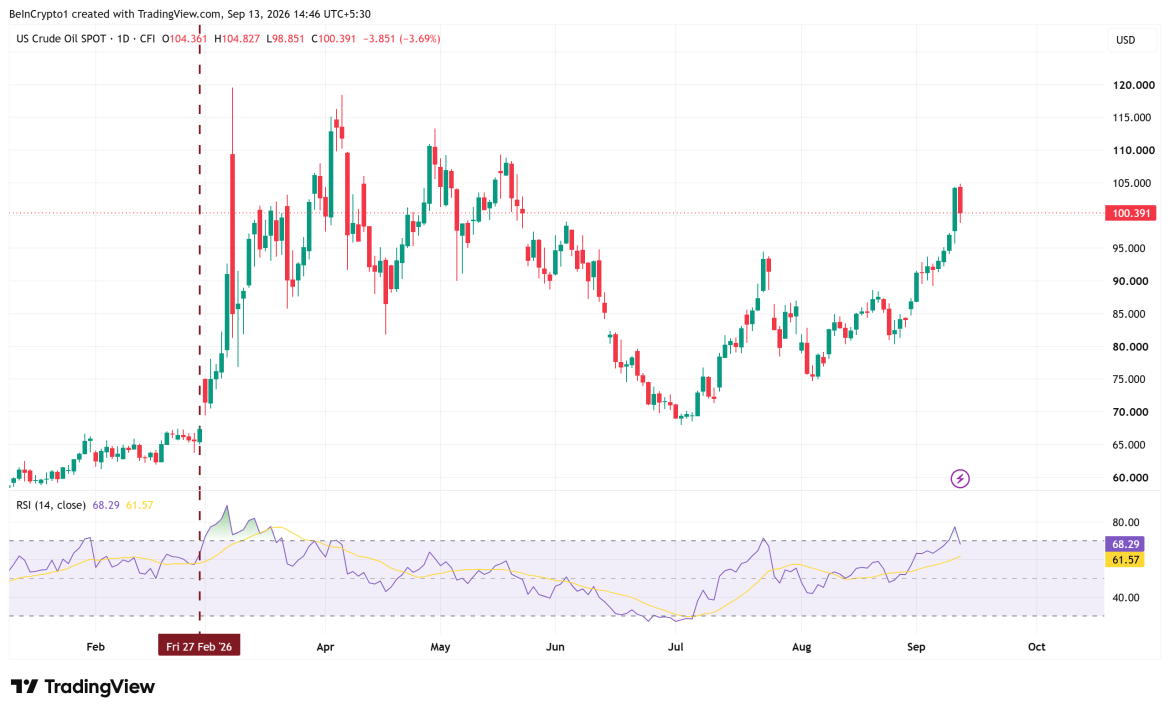
Wilson told Bloomberg that energy costs could starve the market of cash. US benchmark crude prices continue to hold above $100, up nearly 80% this year.
“I do think in the next 30 days, if oil goes to $120, $130, $140, that’s a drain on liquidity,” he said.
Wilson described market liquidity as sufficient for now, but not abundant.
He is not telling clients to sell. Instead, Morgan Stanley is rotating toward companies that generate cash internally, not cutting equity exposure.
Morgan Stanley began covering Coinbase (COIN) on September 10, its first call on the exchange since the 2021 listing. While the rating was equal weight, the price target is $250, representing a climb of almost 43% from the current price of $175.26.

The bank argues Coinbase now works as financial plumbing rather than a crypto bet.
Bitcoin spot trading brings in just over 10% of revenue, down from more than half at listing, finance chief Alesia Haas said this week.
That thesis has not met a risk-asset selloff yet. It might on Monday after key developments this weekend.
However, markets may not have to wait that long, as something else landed after Friday’s close. Anthropic chief executive Dario Amodei proposed slowing AI model development, and OpenAI’s Sam Altman and Elon Musk agreed.
Monday could be a bloodbath for the stock market. Likely temporary until the messaging & vision gets cleared up about super intelligence,” entrepreneur Patrick Bet-David stated.
That view assumes AI is carrying the index. However, data complicates this, with all indications suggesting the impact, if any, could be limited to tech stocks alone.
The standard S&P 500 (SPX) is weighted by company size, so the biggest AI names move it more than everyone else. An equal-weight version of the same 500 companies (SPXEW), which gives a small utility the same say as Nvidia, tracks how the average stock is doing.
Those two have run in line in 2026, both up roughly 13%. When AI leads a market, a wide gap opens between them. This year it has not.

BeInCrypto reached a similar conclusion in July, when the index’s worst stocks of 2026 fell more than 40% and AI disruption explained only part of the damage.
Nevertheless, even as Morgan Stanley’s clock runs 30 days, a possible risk-asset selloff could hit markets on Monday.
The post Morgan Stanley Gives Huge Stock Market Crash Warning in 30 Days appeared first on BeInCrypto.


