In a post on Friday, Vlad Tenev said securities issuers should control shareholder rights, but not separate products that track their publicly traded shares.


 Live Chat
In a post on Friday, Vlad Tenev said securities issuers should control shareholder rights, but not separate products that track their publicly traded shares.
Cryptocurrency exchange Coinbase partnered with financial platform Moov to bring stablecoin infrastructure to more than 1,000 community banks and credit unions that are part of Moov’s customer base.
The partnership will combine Coinbase’s regulated digital asset infrastructure and Moov’s payments platform to offer stablecoin payment acceptance, settlement and real-time funding, according to a Thursday announcement.
The infrastructure will support use cases such as consumer stablecoin payments, merchant settlement and payouts. It will also offer businesses and merchants access to Coinbase custodial accounts.
Community banks in the US typically have less than $10 billion in total assets and include state chartered institutions as well as savings and loan holding companies.
The announcement comes as some of the largest US banks are experimenting with stablecoin infrastructure. On Wednesday, U.S. Bank, the fifth-largest commercial bank in the US, completed a live cross-border payment using its proprietary USBDC stablecoin on the Stellar blockchain.
Earlier this month, 21 financial institutions, including Bank of America, Citi, Goldman Sachs, Deutsche Bank and UBS, announced plans to form a company to issue stablecoins, including a US dollar-denominated stablecoin in the first half of 2027.
Non-bank competitors are entering the stablecoin niche. In August, Western Union partnered with stablecoin infrastructure provider Rain to launch a digital wallet and Visa-branded card that enables users to hold and spend a US dollar-backed stablecoin.
Related: Mastercard, Borderless test shared identity checks for stablecoin transfers
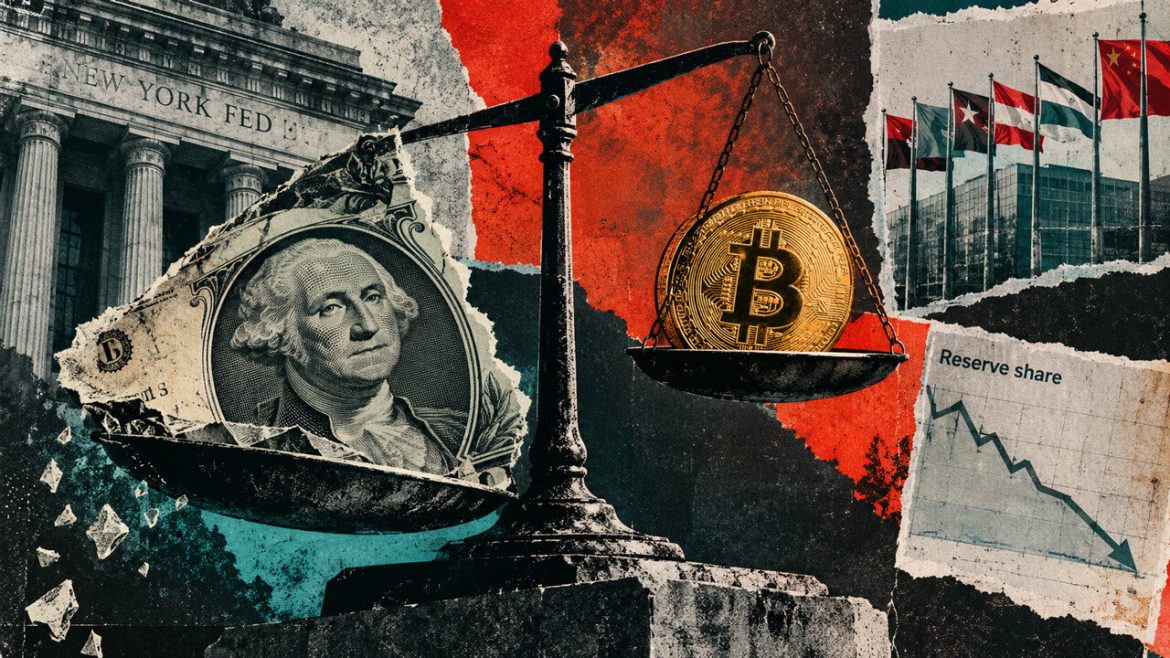
A Sept. 2, 2026 analysis by New York Fed researchers shows how a few large reserve portfolios can lower the global dollar share without a broad retreat from dollars. For investors assessing future sovereign demand for Bitcoin, the distinction is between a changing average and an investment decision.
Linda S. Goldberg, Oliver Hannaoui and Sneha Parthasarathy report that the dollar share of global official foreign-exchange reserves fell from 64% at year-end 2015 to 56% at year-end 2025, using IMF COFER data.
Their country-level evidence points to concentrated decisions and changes in reserve sizes.
Countries can change the currency mix of their portfolios, the “preferences” channel. Alternatively, their total reserves can grow or shrink, changing their weight in the global average.
When a country with a below-average dollar allocation accumulates reserves, it can pull down the worldwide dollar share without cutting its own allocation. Switzerland did that between 2015 and 2019: its reserve growth pushed the aggregate share down even as its own dollar allocation rose.
For that period, 76 countries had complete endpoint data within a 79-country exercise. Their preferences and reserve-size contributions declined by 1.2 and 1.5 percentage points, respectively.
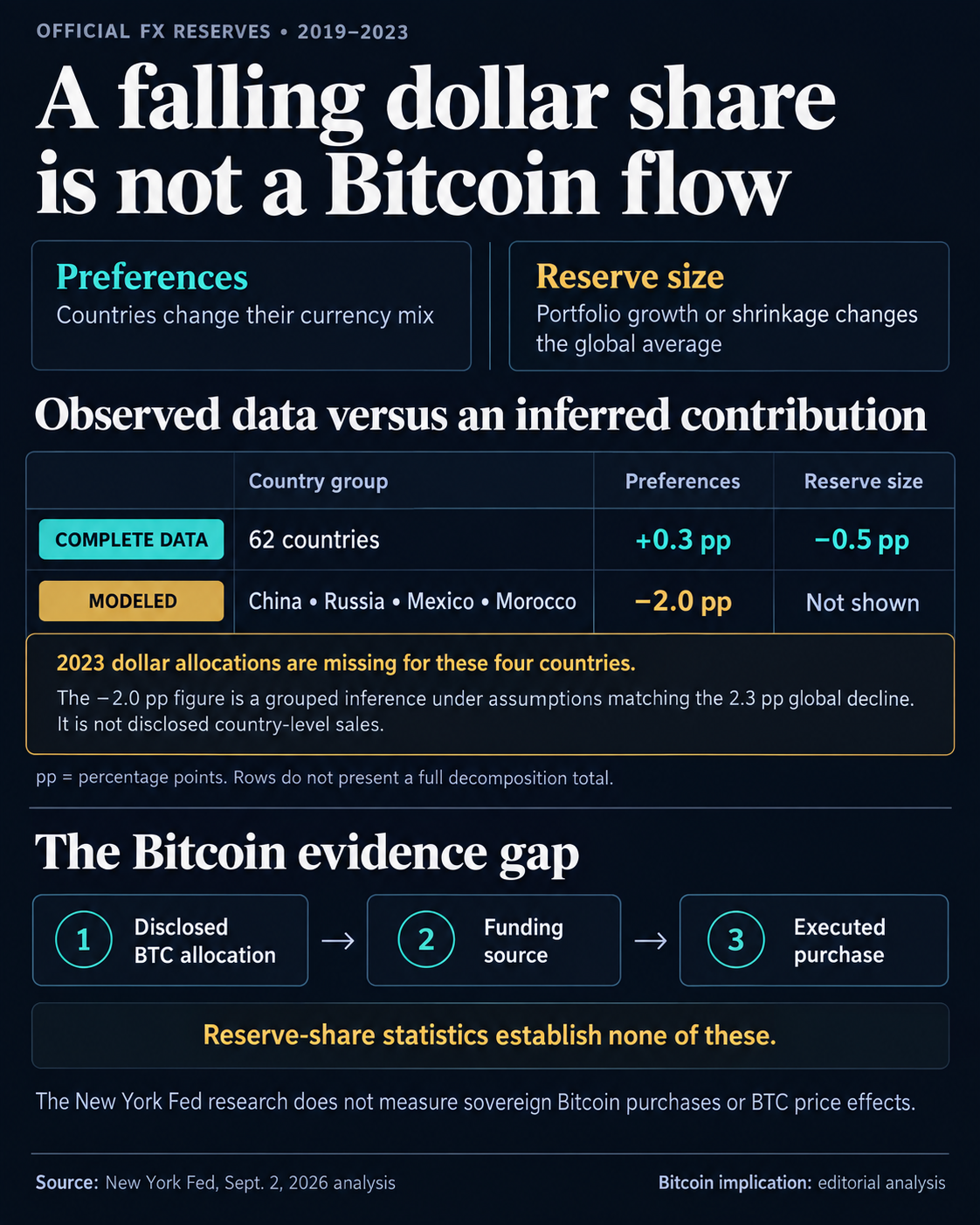
For 2019-2023, the 62 countries with complete data contributed a positive 0.3 percentage point through preferences and a negative 0.5 percentage point through reserve-size changes.
China, Russia, Mexico and Morocco lacked 2023 dollar-allocation data. Under assumptions matching the observed 2.3-percentage-point global decline, the researchers inferred a combined negative 2.0-percentage-point preferences contribution for that group.
The underlying Staff Report 1087, issued in March 2024 and revised in February 2026, separates reserves needed for liquidity from an investment portion above those needs. Trade payments, foreign-currency debt, and currency stabilization sustain the need for liquid reserves.
The paper models that investment portion using short-term external debt or three months of imports as alternative measures of liquidity needs.
Diversification is more prevalent when reserves can satisfy those needs. Its earlier decomposition covers 2015-2020, while its broader country panel spans 1999–2023.
The distinction also applies when a central bank actually buys Bitcoin. On Nov. 13, 2025, the Czech National Bank announced a $1 million digital-asset test portfolio including Bitcoin, with a dollar stablecoin and tokenized deposit also part of the project.
The amount covered the whole portfolio, and the purchase was explicitly outside international reserves.
Applied to Bitcoin, the reserve research supports a limited inference: diversification beyond liquidity needs does not identify the money’s destination. Neither New York Fed source measures sovereign Bitcoin purchases or estimates a Bitcoin price effect.
A sovereign Bitcoin demand case needs separate evidence: a disclosed allocation, its funding source, and executed purchases, with official reserves distinguished from holdings outside them. A shrinking dollar share supplies none of those details.

The Liquid Network said Sunday that purported white-hat hackers withdrew about 4,000 bitcoin, worth about $320 million, from the federation wallet that backs L-BTC. Bridge nodes were disabled, and the sidechain was paused. Other issued assets, including USDT, DePix and RWAs, were unaffected, the official account said on X.
The Liquid Network is a federated sidechain of Bitcoin, founded by Adam Back’s Blockstream. The Liquid chain issues a variety of assets such as LBTC, which it backs with BTC on the Bitcoin main chain, held in a large multisig of 15 corporate and known members. 11 of the 15 members need to sign a valid multi-signature transaction to move coins from the treasury. Before the hack, the treasury held over 4200 BTC; after the hack, Blockstream’s proof of reserves page reports a little over 207 BTC left.
The hackers withdrew 4,019.4 BTC from the reserve address in a peg-out transaction using the SideSwap Peg-out Authorization Key. SideWap is a bridge exchange and a member of the Liquid Federation. While details on the mechanism of the hack are not confirmed yet, it appears an inflation bug on the LBTC side chain was exploited by the hackers to create over 4,000 LBTC that did not exist before, and cash them out for on-chain bitcoin from the federation. Because the transaction appeared as valid, given the consensus bug, the federation members’ HSM security servers signed the BTC withdrawal transaction, worth roughly 320 million at the time.
The hacker moved the funds to an address ending in 6gyqjlte, from which they quickly signed a new transaction with a message on the OP_RETURN arbitrary data field saying “we are whitehats. contact us on chain.” Those coins were still at that address at the time of writing.
A small mainnet transaction to the hacker address followed by an OP_RETURN saying “Please contact [email protected]”, presumably from a Blockstream public address, though that remains unconfirmed. A later OP_RETURN spend from the hacker address carried “Please contact us on Signal @m671aw.70”, however, this may be spam and does not share a link to the address with the stolen funds.
In response to the breach, exchanges were told to pause L-BTC deposits and withdrawals. Bridge nodes on the Liquid Network have been paused, limiting access to the side chain, which continues to produce blocks.
JAN3 CEO Samson Mow said Aqua’s Liquid features were affected and that on-chain bitcoin still worked. Other wallets in the industry that use the Liquid Network are expected to be affected. Users holding LBTC now effectively have their savings at risk, since the underlying BTC is currently not redeemable. Given the private nature of the Liquid chain, user onchain analytics are scarce and not much public information is known about how much LBTC is held by retail users versus corporations of Blockstream itself. Nevertheless, should the funds not be returned, it would be a heavy blow to the Liquid Network’s user base.
Users of LBTC don’t have many options but to wait for conversations with the hackers to resolve. Given the size of the hack, it would be difficult for the hackers to get away with stealing all that bitcoin, though perhaps not impossible. What may happen is that the hackers ask for a finder’s fee and return the majority of the funds.

Jessie A Ellis
Sep 05, 2026 10:18
PLTR is sitting at $175.10 with 61% of futures positioning stacked short — yet taker buy flow is winning on the tape right now. Either the $177 pivot gets reclaimed and this thing rips to $185+, or…
The chart is telling a split story, and how you read it determines whether you’re long or short into next week. Price at $175.10 is sitting beneath both the 7-day SMA at $179.07 and the 20-day SMA at $178.47 — that’s the immediate overhead wall. Momentum has gone completely flat; the MACD histogram has converged to zero, meaning the near-term bullish impulse that drove price up from the 50 SMA region at $158.94 has fully exhausted itself. Buyers and sellers are in a dead heat right now, and that stalemate won’t last.
The Bollinger Band picture reinforces the caution. At a %B of 0.34, PLTR is drifting in the lower third of its band range, well off the upper band ceiling at $189.04 and edging toward the lower band at $167.89. That’s not panic territory yet, but it’s not a setup that screams “buy the dip” without confirmation either. The RSI hovering just above 50 tells the same story — no directional conviction from the bulls despite a technically intact longer-term uptrend, with the 50-day SMA ($158.94) and the 200-day SMA ($143.70) both providing a wide structural cushion far below current price.
The daily ATR of $7.36 is worth watching closely. It means any decisive move — either a crack through $171.82 or a reclaim of the $180.27 resistance — will cover serious ground quickly, likely triggering stops and accelerating the move in whichever direction it breaks. As tracked across real-time market data aggregators including Blockchain.news, tokenized equity positions like PLTR trade around the clock, meaning those break points can trigger at any hour, not just during Wall Street’s 9:30–4:00 window.
Here’s where it gets genuinely interesting — and where the bears should be sweating. The derivatives market is screaming crowded short. Both retail traders (61.2% short) and top-tier whale accounts (61.3% short) are positioned on the same side of the book. That kind of alignment is rare, and historically it’s the setup that precedes violent, painful short squeezes rather than clean, orderly breakdowns.
And yet, look at what the actual tape is doing: the 1-hour taker buy/sell ratio is sitting at 1.28, with buyers outnumbering sellers nearly 1.3-to-1 in aggressive market orders. Someone is accumulating into this weakness while the short crowd piles on. Open interest jumped 8.77% in the past 24 hours — that’s not short covering, that’s fresh capital entering new positions. The neutral 0.0000% funding rate means there’s no funding cost punishing either side, so these short positions are sitting comfortable — for now.
The conflict is plain: positioning says down, but actual order flow says up. When those diverge this sharply, the resolution tends to be explosive. The 24-hour volume at roughly $22.1 million on Binance spot reflects a market that’s active but not yet at the fever pitch that typically accompanies a confirmed directional move. That changes the moment price touches a key level.
With no specific KOL calls or institutional analyst reports available in the verified data window, the fundamental narrative falls squarely back on what Palantir actually is: one of the most polarizing AI infrastructure plays in the US equity market. The company’s AI Platform (AIP) has been the engine driving its commercial segment growth, converting enterprise AI spending into recurring revenue in a way that few pure-play government-data companies have managed before. Government contract tailwinds — particularly from defense and intelligence agency procurement — remain the structural bedrock, and in an environment where AI defense spending isn’t slowing down, that foundation is hard to shake.
The bull case for PLTR has always rested on the compounding nature of its data moat, and that thesis hasn’t changed. Analysts who have been covering this name know that valuation remains the friction point — PLTR has never been cheap, and at elevated price levels, any macro wobble or earnings miss creates outsized drawdowns because there’s no valuation floor to catch it. The $175 range, sitting meaningfully above the 50-day and 200-day SMAs, implies the market is still pricing in significant forward growth, which means execution risk is front and center heading into the next earnings cycle.
For traders following the 24/7 tokenized market on platforms covered by Blockchain.news, the key distinction is that news drops — contract wins, earnings pre-announcements, Fed commentary — can hit PLTR’s price action in the middle of the night, bypassing the traditional pre-market buffer that equity traders use to position themselves.
Two clear scenarios dominate the next 7 to 30 days, and I’m giving the squeeze path higher probability right now — approximately 60/40 in favor of the upside scenario — based purely on the taker flow divergence from short positioning.
The Bull Squeeze Path (60% probability): Price reclaims the $177.00 pivot within the next 48–72 hours, likely triggered by a continuation of the aggressive buy flow or a macro catalyst from US equity markets. Once $177 flips to support, the $180.27 immediate resistance becomes the next magnet. With 61% of the book short, a sustained move through $180 doesn’t just test resistance — it forces stop-outs and margin calls on a crowded trade, launching price toward the $185.45 strong resistance level. In a full squeeze scenario with decent volume follow-through, the upper Bollinger Band at $189.04 comes into play within 2–3 weeks. Target zone: $185–$189 on a 14–21 day horizon.
The Bearish Flush Path (40% probability): If the $171.82 immediate support breaks on any real volume — a disappointing macro data print, sector rotation out of AI names, or simply exhausted buy-side flow — the next hard stop is $168.55. Below that, the Bollinger lower band at $167.89 is unlikely to hold given the velocity of a genuine breakdown. In that scenario, look for a possible flush toward the $160–$163 zone over 2–4 weeks before the 50-day SMA reasserts itself as structural support. The current 24h low of $173.72 is already testing near that first support cluster — this trigger is closer than most bears realize.
The single most important level to watch is $177.00. It’s not flashy, but it’s the pivot that determines whether PLTR shorts are heroes or kindling. Stay disciplined around that line. Position sizing matters here more than directional conviction given the $7.36 daily ATR — this name can hand you a full week’s expected move in a single session once it decides to break.
As reported across crypto-equity crossover markets on Blockchain.news, tokenized stock instruments like PLTR increasingly function as round-the-clock proxies for institutional sentiment on the underlying equity — meaning the price action you’re seeing right now at 10:16 UTC is the market’s real-time verdict on Palantir’s fundamental story, not a delayed echo of it.
Fundamental data, analyst ratings and price targets are sourced from Yahoo Finance as of September 05, 2026 and reflect consensus estimates, not investment advice.
Image source: Shutterstock

The first thing that comes to mind when you think about blockchain jobs is the six-figure salary. However, any beginner searching for blockchain jobs with no experience is likely to end up with disappointment when they look at most of the blockchain job descriptions. You will have a hard time understanding how an ‘entry-level’ role requires at least five years of professional Web3 experience.
Even with the massive fluctuations in crypto markets worldwide, the demand for blockchain talent continues growing. Employers not only look for developers and engineers but also experts who understand the broader blockchain space and can contribute valuable outcomes to their blockchain and Web3 projects. You can get a job in the blockchain space without any prior experience when you know what you have to do and what to avoid.
Build your identity as a certified blockchain expert with 101 Blockchains’ Blockchain Certifications designed to provide enhanced career prospects.
Many people who want blockchain jobs start by spending months reading about cryptocurrencies and blockchain technology. The candidates then take online courses and certifications to prove their capabilities for different blockchain jobs. Subsequently, candidates update their resume with phrases like “interested in blockchain” or “blockchain and crypto enthusiast”. However, these methods seem to have little impact when the candidates get zero responses for job applications.
Anyone trying to find how to get a job in crypto with no experience must know that hundreds of people are trying to follow the general approach. It is important to understand that reading about crypto does not mean that you are eligible to work on crypto projects. On top of it, applying for multiple jobs on job boards lands you up in the middle of intense competition.
You should remember that companies want blockchain experts who can do the job and not people who can learn on the job. Employers look for specific things in candidates who apply for blockchain jobs to find the ideal candidate for specific roles.
Are you ready to take your career to the next level? Join our Premium plan now and get access to exclusive web3 & blockchain job listings on 101 Blockchains.
If you are preparing for blockchain jobs without any prior experience, then you are might be focusing on creating CVs. Many candidates believe that an appealing CV is the best way to attract the attention of employers. However, shifting the focus towards building a strong portfolio can make a huge difference.
Professionals working in crypto jobs remote no experience roles don’t wait for employers to give them a chance. On the contrary, they created their own reputation by participating and contributing to real-world projects before anyone hired them. The essential tricks to create a portfolio that can help you land blockchain jobs without any experience can offer significant benefits for your career.
The competition for blockchain jobs is growing at an unprecedented pace and you can see it clearly in the number of applicants for crypto jobs. As the market grows more saturated, it is difficult for people without any experience to find blockchain jobs. You need to stand out from the crowd, even for entry level blockchain jobs, by following the best practices suggested by experts.
If you take a look at most of the candidate resumes for blockchain jobs, you will find generic descriptions. Employers know that they are hiring for the role of a blockchain developer or analyst and don’t want candidates looking for “opportunities”.
You can grab the attention of a recruiter by mentioning specific details about your blockchain expertise. Candidates can point out that they are fluent in Solidity development, know the best practices for DeFi security, and have deployed smart contracts. Providing specific details makes it difficult for employers to forget your application and increases your chances of securing the job.
Create new, high-level, innovative blockchain solutions for different industries as a highly-skilled blockchain developer with a Blockchain Developer Career Path.
One of the unique things that beginners should try to find blockchain jobs without any experience is to share their journey in public. Posting small achievements on Twitter or social media and forums alongside maintaining documentation of your learning journey can change your career trajectory.
Sharing your progress in public will help in building your reputation as you learn new skills and also creates accountability. It will also prove that you are a good communicator and know how to present your views, which is a valuable skill in any professional. Most important of all, your public image as a blockchain expert will also attract opportunities you never knew existed.
Building another generic smart contract or NFT project may sound like the best choice for your portfolio. However, finding blockchain jobs with no experience requires expertise in solving problems in the real-world. You should showcase your ability to solve a problem that you have personally experienced.
Candidates can build a tool to estimate gas fees or write a comprehensive guide on bridging assets between blockchain networks. When you show that you know how to solve real problems, you convince the employers that you bring real value to the table.
Beginners preparing for blockchain jobs without any experience may think that building a new project from scratch is extremely difficult. It is important to know that you don’t have to build from zero to showcase your blockchain expertise. You can try many other things, such as,
The efforts you invest in existing projects will enhance your hands-on experience and credibility. You can also build connections with the team behind the existing projects and expand your professional network. As a matter of fact, the references from the team can show that you have genuinely contributed to the project.
Candidates looking for blockchain jobs with zero experience often make the mistake of ignoring the importance of choosing a niche. If you say that you are interested in DeFi, NFTs, metaverse, and DAOs, the recruiter cannot decide which role will be the best for you. With a specific niche, you can prove that you are not another generalist who knows little about everything.
As you pursue your favorite blockchain jobs as a beginner, it may be difficult to maintain the same consistency throughout. Therefore, you should always look for steady progress in your learning journey and build your skills one week at a time.
Every candidate who wants to know how to get a job in crypto with no experience must understand that the experience does not come only from a job. You have to show proof that you can do the job and get things done rather than telling employers that you know things. Beginners can start with online courses and certifications, followed by picking a specific niche and participating in real-world projects to gain experience. Choose the right platform for blockchain training, and you will find the fastest path to your favorite blockchain job now.
*Disclaimer: The article should not be taken as, and is not intended to provide any investment advice. Claims made in this article do not constitute investment advice and should not be taken as such. 101 Blockchains shall not be responsible for any loss sustained by any person who relies on this article. Do your own research!

Russia-based Sality watched for copied bitcoin and Ethereum addresses and quietly replaced them with the attacker’s. CrowdStrike and law enforcement have now isolated more than 15,000 infected machines.

Cointelegraph is committed to providing independent, high-quality journalism across the crypto, blockchain, AI, and fintech industries.
All news, reviews, and analyses are produced with full journalistic independence and integrity. For more details on our standards and processes, please read our Editorial Policy.
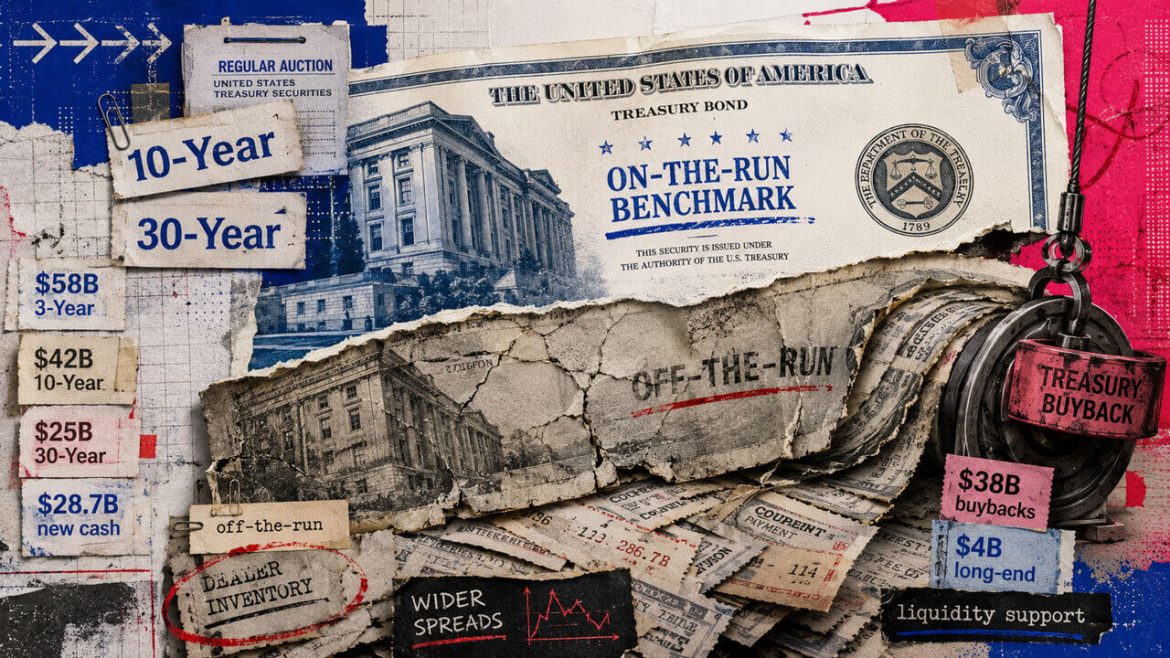
The US Treasury expects to borrow $739 billion from July through September while paying investors to hand back some of its older bonds. The pairing looks self-defeating because both transactions involve the same issuer. However, they are on separate ledgers and solve separate problems: auctions finance the government and create liquid benchmarks, while buybacks retire selected old issues or help Treasury manage its cash balance.
Treasury’s Aug. 3 borrowing estimate assumes a $950 billion cash balance at the end of September, then projects another $628 billion of borrowing from October through December. Its August refunding statement authorized as much as $38 billion of liquidity-support purchases and $25 billion of short-dated cash-management purchases during the current quarter.
Treasury widened the program on Aug. 19, lifting the maximum size of each buyback in the 10-to-20-year and 20-to-30-year sectors from $2 billion to at least $4 billion for operations from Sept. 9 through Nov. 4.
The announcement kept the regular auction schedule intact and confirmed that purchased debt will generally be replaced through new issuance, giving the government room to sell and buy bonds during the same financing cycle. Because the expansion came later, the earlier $38 billion quarterly figure isn’t a final ceiling for long-end purchases.
Treasury sells bills, notes, bonds, floating-rate notes, and inflation-protected securities to fund the gap between federal receipts and spending, refinance maturing debt, and maintain its cash balance. Bills mature within a year and are generally sold at a discount, while notes and bonds usually pay interest every six months across maturities from two to 30 years. “Coupon” is the old name for that periodic interest payment, inherited from the paper certificates whose interest slips investors once clipped by hand.
An auction can introduce a new security or reopen an existing one, with competitive bids establishing the market-clearing yield and price. A new 10-year note receives a fresh CUSIP and becomes the current benchmark, while a reopening adds supply to that same security at a later auction. The August refunding, for example, comprised a $58 billion three-year note, a $42 billion 10-year note and a $25 billion 30-year bond, producing $28.7 billion of new cash once maturing securities were accounted for.
The newest security in a maturity bucket becomes the on-the-run issue, usually trading more frequently and at tighter bid-ask spreads than comparable older bonds. Traders and institutions use it for hedging and price discovery, giving Treasury a reason to keep benchmark auctions large and predictable even when its cash balance can support buybacks.
Once a new security replaces it, the previous benchmark becomes off-the-run while retaining the same federal guarantee and scheduled payments. Trading migrates toward the fresh issue and the pool of natural buyers narrows, leaving dealers to use more balance-sheet capacity when they warehouse the older bond. Investors can then face a wider selling spread, and small price gaps can open between securities with nearly identical interest-rate exposure.
Across a debt market measured in tens of trillions of dollars, small trading frictions become expensive when volatility consumes dealer capacity, and investors crowd into the newest issues. An old Treasury can retain the same credit quality and cash flows while becoming inconvenient to sell, which is why a liquidity-support buyback gives dealers and other holders a regular outlet for selected off-the-run supply.
Treasury announces an eligible maturity bucket and a maximum purchase amount before each operation, then approved counterparties submit competitive offers through FedTrade, with the New York Fed acting as Treasury’s fiscal agent. Sellers specify the security and price, and Treasury evaluates those offers using market prices and relative value across eligible issues, according to its buyback guidance.
It can accept less than the published maximum when prices look unattractive, preserving the discipline of an auction rather than guaranteeing every seller an exit.
Liquidity-support operations focus on older coupons whose trading can benefit from a regular buyer, with Treasury retiring accepted securities as scheduled auctions keep building the current benchmarks. Josh Frost, then Treasury’s assistant secretary for financial markets, described the program as a tool for ordinary market functioning that can reduce fragmented supply and free dealer capacity between operations.
Cash-management buybacks address a different problem because tax receipts, spending, maturities, and auction settlements arrive in uneven waves.
Treasury can buy securities that are close to maturity when its cash balance would otherwise run higher than desired, smoothing upcoming redemptions and giving debt managers more control over near-term cash needs. That flexibility also reduces the need for abrupt bill-auction adjustments around large payment dates.
Treasury’s own borrowing estimates exclude a large net effect from the program because every repurchased dollar has to be financed somewhere else, all else equal. If Treasury sells $100 billion of new securities to private investors and buys back $4 billion held by private investors, privately held debt has increased by $96 billion. Reaching a $100 billion net borrowing target alongside that purchase would require roughly $104 billion of gross issuance.
That also lets sales and purchases expand together because the Treasury can deepen a current benchmark, remove a slice of older supply and still raise the net cash in its financing plan. The federal deficit determines the net financing need, while buybacks alter the age, composition, and maturity profile of debt held by the public.
Auction proceeds and buyback payments pass through the Treasury General Account, the federal government’s operating account at the Fed. When private buyers settle a Treasury auction, money moves toward the TGA and reserve balances in the banking system generally decline, all else equal. Federal spending and Treasury buybacks send funds back toward private accounts, generally adding reserves along the way.
The Fed’s Aug. 27 H.4.1 release showed the TGA averaging $950.7 billion during the week ended Aug. 26 and standing at $959.4 billion on Wednesday, while reserve balances averaged $2.92 trillion. Treasury expects the account to finish September near $950 billion, reach roughly $1.05 trillion, plus or minus $50 billion, in late October and settle near $850 billion at year-end.
A $4 billion buyback can therefore put cash into sellers’ hands on settlement day, and a larger auction can pull cash toward the TGA on another day. Taxes and federal outlays add more movements, so the reserve path depends on the full calendar rather than the headline maximum attached to one operation. Timing can loosen or tighten dollar availability for several days even when the quarter’s net borrowing estimate barely moves.
The source of the money separates Treasury buybacks from quantitative easing because the Fed creates reserve balances when it purchases securities for its own portfolio, adding reserves to its liabilities and bonds to its assets. Treasury spends an existing TGA balance and replenishes that balance through taxes or debt sales, while repurchased securities are retired instead of joining a monetary-policy portfolio.
Those balance sheets give the two programs different effects because removing off-the-run duration can free dealer capacity, narrow relative-value gaps, and make long bonds easier to transact, while surrounding Treasury issuance can absorb cash and add duration elsewhere. Accepted offers, auction demand, settlement dates and maturity buckets determine the combined result.
Treasury preserves that two-sided structure because shrinking benchmark auctions whenever cash-management needs fluctuate would make issuance less predictable, fragment current securities, and risk higher financing costs over time. Regular auctions give investors dependable supply, while selective purchases let debt managers address older pockets of inventory without rebuilding the entire calendar around temporary cash swings.
Long-dated bonds are the most price-sensitive securities in the regular auction schedule, and warehousing them consumes more dealer risk capacity when yields move sharply. Older 20- and 30-year issues can linger once demand concentrates in a fresh benchmark, so doubling the per-operation ceiling gives Treasury more room to buy attractive offers while retaining the option to stop below the cap.
Treasury’s formal objective is ordinary market functioning, and the agency hasn’t announced a target for long-term yields. Purchases can still affect relative prices at the margin because they remove duration from selected issues and give dealers another buyer, which makes intent and market effect separate parts of the analysis. A $4 billion operation can ease a local pocket of illiquidity, while its scale stays small beside a Treasury market measured in tens of trillions of dollars.
For Bitcoin, the connection runs through reserve availability, long-term yields, collateral markets, and dealer capacity, all of which influence the cost of carrying risk across asset classes. CryptoSlate has tracked how Treasury yields can transmit stress into Bitcoin, and buybacks enter that channel by easing selected bond inventories while auctions move cash toward the TGA.
A well-received long-bond buyback could ease a local dislocation and lower one source of cross-market strain, while a heavy auction week or a rapid TGA build could absorb cash at the same time. Bitcoin can benefit when yields settle and dollar availability improves, though the size and timing of those effects have to be measured across the whole financing schedule. Treating every purchase ceiling as an equal injection assigns the program a power its funding mechanics don’t provide.
The larger long-end operations begin Sept. 9, and the next quarterly refunding announcement arrives Nov. 4. Accepted purchase amounts, offered prices, demand for the new benchmarks, and the TGA path around settlement will show how much Treasury has improved trading in old bonds while continuing to finance the government through new ones.
The debasement trade is back — and will benefit bitcoin.
That’s according to asset manager Grayscale’s crypto research team, who wrote in a note this week that the U.S. government debasing its currency would lead to cash hitting digital assets.
“Unchecked government debt growth undermines the credibility of fiat currencies and drives investors to seek out alternative stores of value like physical gold and certain cryptocurrencies,” the note by the firm’s head of research, Zach Pandl, read, adding that primarily bitcoin would benefit.
The so-called debasement trade is when investors buy an asset as a way to hedge against a currency losing value. The trade was hot last year, and helped bitcoin’s run, but the digital asset’s run lost steam after October as traders turned their attention to stocks related to artificial intelligence.
But since last week, bitcoin has benefited from news that the U.S. Treasury would at least double the size of its liquidity-support buyback operations. The announcement last week hurt the dollar but non-yielding assets have benefited.
“That buybacks are needed at all is the problem: heavy growth in government debt is driving up the cost of borrowing,” the note continued. “The Treasury is treating the symptoms (rising bond yields) because they cannot cure the disease (structural deficits).”
The note added that on the same day last week as the buyback announcement, the Treasury also said the U.S. public debt exceeded $40 trillion for the first time.
As debt and interest payments grow, the government needs to either raise taxes, cut spending, or issue more debt.
Bitcoiners see the more politically likely path as expanding the dollar supply — which is ultimately bad for the dollar, and good for scarce assets like bitcoin.
After bitcoin started surging last week, the dollar had its worst week of August and was trading at a three-month low.
Bitcoin was trading for $77,493 on Friday afternoon in New York after hitting a high this week of $81,281. Over a 24-hour period, the coin now sits unmoved, but over a 30-day period, it has jumped by more than 20%.


