Advances in compact proofs have erased Poseidon’s previous performance advantage, according to researcher Justin Drake.

 Live Chat
Advances in compact proofs have erased Poseidon’s previous performance advantage, according to researcher Justin Drake.
The executable draft adds Security Council oversight of Endowment transactions and narrows the Foundation’s initial token grant to 1 million ENS after delegates called the earlier plan a “governance attack.”
Katherine Wu, chief operating officer of ENS Labs, posted an executable draft Thursday of the proposal to establish an ENS Foundation, dropping a plan to shift the DAO’s operational wallet to the new entity after weeks of delegate opposition to an earlier version of the plan.
The draft, “[Draft] [Executable] Next Era of ENS DAO: Empowering the ENS Foundation,” keeps the DAO’s roughly 54.6 million ENS tokens and its operational wallet, holding an estimated $16 million in ETH and stablecoins, under tokenholder control. The only ENS token transaction in the proposal is a one-time transfer of 1 million ENS, restricted to Foundation employee compensation with multi-year vesting. The Foundation Board would gain administrative control of the roughly $65 million Endowment Safe, with every Endowment transaction now subject to a timelock and a Security Council cancellation right.
The draft follows a temp check Wu published June 19 that proposed a broader transfer of authority. ENS co-founder Nick Johnson, who holds one of the Foundation’s five board seats under the proposal, wrote on X that the changes responded to “difficult questions” and community feedback since that original post. The ENS DAO account summarized the revision as authorizing the Foundation “to administer the Endowment” while tokenholders “retain control over the protocol, remaining DAO-held ENS, the operational wallet, and the appointment and removal of Foundation directors.”
ENS traded at $4.34, up 4.2% over 24 hours, according to CoinGecko. The protocol generated $216,369 in fees over the past 30 days, according to DefiLlama.
The June 19 temp check, as The Defiant reported, proposed delegating management of the DAO’s operational wallet, its ENS token holdings and the Karpatkey-managed Endowment to Foundation governance. Thursday’s draft narrows that scope on two of those three fronts. The operational wallet, wallet.ensdao.eth, stays with the DAO, with existing funding streams continuing to draw from it. DAO-held ENS tokens stay under the same onchain mechanism and tokenholder control, apart from the 1 million ENS carve-out; any further use of the DAO’s token holdings would require a separate proposal through ordinary governance.
Only the Endowment Safe moves to Foundation-administered control, and the draft adds a new safeguard there: transactions pass through a timelock by default, and the Security Council can cancel any of them before execution, a check the current structure doesn’t have.
The scaled-back scope follows weeks of delegate opposition to the original temp check. Johnson said in June he would self-delegate his ENS holdings to support the measure, a move Rotki founder Lefteris Karapetsas said left Johnson “essentially becoming the DAO,” and Security Council member Brantly Millegan called the plan “the equivalent of treasury capture by ENS Labs,” The Defiant reported.
The proposed five-seat board is unchanged from the temp check: Johnson holds a permanent seat with succession to an ENS Labs representative if he departs, ENS Labs general counsel Alexander Urbelis is nominated as full-time executive director, and independent seats go to A.Capital Ventures partner Kartik Talwar, Prelude co-founder Brett Sun and Aragon CEO Anthony Leutenegger.
Independent directors are compensated 40,000 USDC per year, and any decision on ENS Labs funding requires a majority of independent directors’ approval in addition to a board majority, under the interim conflict-of-interest policy attached to the draft.
The Foundation would receive no operating budget under the proposal until its executive director publishes a budget to the DAO forum, and transfers from the Endowment are capped at $500,000 for standup costs until then.
Thursday’s draft is the latest turn in a monthslong dispute over control of ENS DAO’s treasury and governance. After Johnson said he would self-delegate to back the original Foundation plan, he used that same voting power to block an onchain vote renewing the DAO’s Security Council, a multisig empowered to cancel malicious proposals already in the timelock queue, The Defiant reported.
Christoph Jentzsch, who wrote code for the original 2016 “The DAO,” responded by proposing on X that ENS DAO dissolve itself outright. Separately, ENS co-founder Alex Van de Sande has proposed delegating 5 million ENS from the DAO’s dormant community treasury to outside stakeholders, an unrelated reform effort aimed at the same underlying concentration of voting power in the DAO.
New York, United States, July 28th, 2026, Chainwire
BitSafe has released infrastructure for builders launching decentralized financial applications on Canton Network.
Backed by a Canton Foundation Development Fund grant of over $1 million (8,500,000 $CC), BitSafe today opened the public beta of Decentralization Manager, an open-sourced framework allowing apps and institutions to build resilient products that distribute control across multiple independent operators.
Canton Network has become critical infrastructure for institutions bringing real capital and operations on-chain. Meeting institutional application standards requires audit trails and distributed trust, but until now every team building on Canton has had to build threshold custody, governance, and audit infrastructure from scratch. Decentralization Manager makes those reusable, so teams build the application, not the infrastructure.
Independently audited by Quantstamp, Decentralization Manager marks an exciting expansion of on-chain use cases and allows institutions to continue leveraging the network’s privacy-native architecture while mitigating risk by distributing their operations.
Decentralization Manager ships with pre-built frameworks for token issuance and custody and enables additional products such as:
Contact us to start launching decentralized applications and assets.
CBTC, the first non-native asset on Canton, is the first live use case of Decentralization Manager. With over 10 million transactions to date, node operators powering CBTC already earn a share of Canton fees from on-chain transactions. Decentralization Manager now extends that opportunity across the network. Application builders get an easier path to high quality node operators who can support their products, and those operators earn the same share of Canton fees in return.
“The future of institutional blockchain depends on making sophisticated infrastructure easier to build and adopt,” said Viv Diwakar, Head of the Canton Foundation. “By open-sourcing Decentralization Manager, BitSafe is giving developers the tools to create resilient, privacy-preserving applications that distribute trust across independent operators without compromising the governance and control institutions require. Contributions like this strengthen the Canton ecosystem and help accelerate the growth of institutional digital assets and tokenized financial markets. We’re pleased to see BitSafe making this capability available to the wider community and look forward to seeing the next generation of institutional applications built on Canton.”
As of today, Palladium Labs is the first builder announced using Decentralization Manager to enable multi-party authorization for protocol operations. “Distributed trust and full auditability are table stakes for institutional-grade credit infrastructure like Alpend,” said Akshay Sinha, Cofounder & CTO of Palladium Labs. “Decentralization Manager makes that a framework the entire Canton ecosystem can build on. Adopting it was one of the easier decisions we’ve made.”
In addition to Palladium, CBTC Attestors Nethermind, DSRV, and Finoa Consensus Services have already implemented Decentralization Manager. Their institutional participation affirms a collective effort across Canton to embrace decentralized technology that prioritizes data privacy, operational control, and resilience.
The public beta is open now on the Canton Foundation’s GitHub, with an additional grant application underway. Builders who need operators to complete their Decentralized Party can reach out to BitSafe to be matched with vetted, institutional-grade node operators. Institutions looking to issue and govern Canton-native tokens can engage BitSafe’s Decentralization Services for custom tokenization engagements.
Additional quotes from ecosystem partners:
“The CBTC Decentralized Party has shown how far Canton has come, and the public beta opening of Decentralization Manager is a big step for the whole ecosystem. Onboarding was remarkably smooth for our team – contract deployment was essentially one click. For any app still running on a single validator, this is the easiest path we’ve seen to move beyond a single point of failure.” – Joonkyo Kim, CTO, DSRV
”As one of the attestors securing CBTC, we’ve operated inside BitSafe’s decentralized signing architecture from an early stage, so we’ve seen firsthand what it takes to distribute trust across independent operators in production. Onboarding into Decentralization Manager was refreshingly straightforward, the admin tooling is intuitive and whenever we hit an issue the BitSafe team resolved it quickly and communicated the whole way through.
Institutions bringing real assets onto Canton increasingly expect exactly this: no single point of control with the audit trails and operational resilience their risk teams demand. Making that kind of infrastructure open and repeatable is a meaningful step for the ecosystem.” – Mateusz Jędrzejewski, CIO, Nethermind
“BitSafe’s Decentralization Manager turns the infrastructure we already run into a setup with no single point of failure, the kind institutions expect from Canton. We’re glad to extend our partnership with BitSafe and look forward to building more together as new applications join the network.” – Daniel Schrader, Managing Director, Finoa Consensus Services
About BitSafe
BitSafe builds decentralized, privacy-enabled digital asset infrastructure on the Canton Network. As the team that brought Bitcoin to Canton ($CBTC), BitSafe’s threshold-governed multi-sig infrastructure distributes custody and governance, eliminates single points of failure, and enables institutions and developers to launch trading venues and build compliant financial products and assets across the ecosystem.
Kadeem Clarke
BitSafe
marketing@bitsafe.finance

Poised to become the world’s most prominent “real humans’ network”, the project previously known as Worldcoin aims to establish an identity layer to distinguish unique individuals from automated bots. The protocol relies on custom hardware, known as an Orb, to issue credentials without compromising user privacy.
“World’s technology and proof of human and variations are among the most important building blocks to secure and verify interactions in an increasingly digital driven world,” said Tom Lee, an Eightco Holdings board member who also serves as the chairman of Bitmine, in a statement.
World said the investment comes as it shifts from building the network to scaling the utility.
To date, more than 39 million people have joined the World Network, with more than 18 million humans verified by an Orb, World said in the funding announcement press release. The network has utilized more than 475 million World ID proofs since its launch, scaling its capacity alongside the rollout of its updated, enterprise-ready infrastructure, it added.
World, the Sam Altman-backed digital identity project, unveiled in April what it called its most significant upgrade yet to World ID, positioning the system as “full-stack proof of human” infrastructure aimed at consumers, enterprises and AI agents.
Palo Alto, United States, June 25th, 2026, Chainwire
Story rebrands as The DATA Foundation, launches DATA Network with flagship Kled AI integration, registering 1.5 billion user-contributed records on the platform
The Foundation also introduces Trace, the first public audit layer for consent, licensing, and data provenance at scale
Today, Story announces a strategic transition to become The DATA Foundation (“DATA”) and launches Trace, an onchain registry for AI training data provenance and licensing. The launch includes a flagship integration with Kled, the world’s largest opt-in human data marketplace, registering 1.5 billion user-contributed records on the Network. Andrea Muttoni becomes CEO of The DATA Foundation, and Kled’s founder, Avi Patel, joins in an advisor position as the Chief Data Officer.
AI’s Training Data Has Hit a Bottleneck
The shift to DATA reflects where the market is pulling hardest. AI training data has emerged as the most valuable and least solved category of IP. Frontier AI labs have hit a multi-billion-dollar data bottleneck, where the internet has been effectively exhausted for scraping. The remaining supply is either expensive and bespoke or legally undocumented, leaving labs without a way to source data at scale, prove its provenance, or guarantee its quality.
The legal stakes are rising, as frontier labs stake out market-defining products on data sourced through opaque networks, often without clear records of consent or jurisdiction. Scraped and undocumented data is no longer an option for enterprise-grade AI.
“The challenge in AI has shifted from compute and architecture to sourcing and provenance. As the scrapable web fractures, the question for labs now is who is keeping the receipts,” said Andrea Muttoni, CEO of The DATA Foundation. “With Kled, we combine full data transparency and auditability with the largest pool of AI training data on the planet.”
Building the Infrastructure for Trusted AI Data
DATA builds on the original mission to deliver a data and intellectual property (IP) layer for the internet, recognizing that the form of data and IP that is most critical in this era is AI training data. DATA Network brings essential infrastructure for training AI, anchored by a flagship integration with Kled. Starting today, Kled’s licensing rails and contributor receipts run on DATA Network with added support for stable coin payouts, which involves registering a staggering 1.5 billion user-contributed records with programmatic legal safeguards.
“Frontier labs have exhausted the supply of high-quality, human-generated public text available on the open web. Suppliers showing data-sourcing provenance will win the next decade of deals, and that’s our bet,” said Avi Patel, CEO and founder of Kled and part-time advisory CDO of The DATA Foundation. “Instead of sourcing data blindly, Kled’s data marketplace and DATA’s auditable chain of custody converge on what labs actually need to license data with confidence and transparency.”
Trace Launches as the Public Audit Layer for AI Training Data
Trace, The DATA Foundation’s public audit and search platform, also launches today alongside the Kled integration. Trace generates immutable, confidential receipts for every contribution, allowing labs to verify the legitimacy of datasets in seconds. For every single record uploaded by users worldwide, a receipt on DATA will be generated, enabling upstream compensation for contributors’ data and intellectual property. This addresses an urgent need for a verifiable and compliant AI training data market, which has become a legal and operational minefield.
A Wider Contributor Network
DATA’s thesis was validated by Poseidon, the AI data processing project incubated by Story, which cleans, normalizes, and scores raw human data for authenticity and quality, ensuring every record that reaches a buyer is model-ready. Poseidon’s early traction with frontier labs proved the AI training data opportunity. Backed by a16z and now running entirely on DATA, its contributor app Numo is live today, bringing thousands of contributors into the AI economy in exchange for real-time payouts.
“We started Story to build an IP layer for the internet, and the most important IP of this era is the data you can’t scrape: how a surgeon’s hands move, how a robot grips, how people speak, drive, and work in the real world,” said SY Lee, CEO of PIP Labs and strategic adviser to The DATA Foundation. “DATA is where that conviction goes next: an end-to-end network that proves real-world data’s origin, licenses it, and pays the people who made it. “
Token Migration and Ecosystem Continuity
The $IP token migrates to $DATA one-to-one with no action required from existing holders. Migration guidance, exchange timing, and an FAQ are available here.
About The DATA Foundation
Data is the biggest bottleneck in frontier AI. The data models need most either sits siloed with people and companies, or doesn’t exist yet, and won’t, until incentives are aligned to create it. DATA Network is the world’s AI audit rails built to answer the three questions every lab asks: can you source data at scale, prove where it came from, and guarantee its quality? Contributor apps including Numo and Kled supply opt-in human data; Trace gives every record a public, tamper-proof receipt; Poseidon turns it into model-ready datasets, so frontier AI can keep advancing on a foundation it can trust. $IP is now $DATA. More information available at datafdn.org.
HV
henri.vies@piplabs.xyz
New nonprofit research and development lab brings together a group of senior technical contributors from the Ethereum Foundation to ready the network for step-function wave of adoption from institutions, agentic finance and DeFi
Ethlabs to reinforce foundational commitments to credible neutrality, censorship resistance and security
NEW YORK, June 23, 2026 /PRNewswire/ — A coordinated group of Ethereum ecosystem stewards today announced the launch of Ethlabs, an independent, nonprofit research and development organization formed to ready Ethereum for the next phase of institutional adoption. The funding effort is led by Bitmine Immersion Technologies, Inc. (NYSE: BMNR), Sharplink, Inc. (NASDAQ: SBET), Ethereum co-founder Joe Lubin and other key Ethereum ecosystem contributors including Anchorage, Octant and SNZ.
As stablecoins, tokenized real-world assets, funds and autonomous AI commerce move onchain, they are converging on Ethereum as the neutral, credibly permissionless settlement layer for the global economy. Ethlabs exists to ensure the network is ready to absorb that demand at scale, advancing a faster Ethereum with trustworthy interoperability, so institutions building on Ethereum can do so with the neutrality, resilience, privacy and security they require.
Cofounded by five former senior Ethereum Foundation researchers: Ansgar Dietrichs, Barnabé Monnot, Caspar Schwarz-Schilling, Josh Rudolf and Julian Ma, Ethlabs brings together researchers responsible for key contributions to finality, scaling, data availability, the virtual machine and protocol economics — the technologists who have guided the network through its most consequential upgrades over the past decade. This initiative gives that work a dedicated institutional home with stable, long-term funding.
The launch reflects a natural evolution of the Ethereum ecosystem. As the Ethereum Foundation refocuses on its core mandate and embraces a multi-node future, Ethlabs emerges as one of several independent organizations advancing the network in parallel. Ethlabs’ early work will center on what institutions need to move onchain at scale: faster settlement, native issuance and cross-chain movement on robust infrastructure, capacity on mainnet and research that grounds ETH’s monetary properties.
Thomas “Tom” Lee, Chairman of Bitmine. “We believe Ethereum is positioned to grow significantly in adoption by institutions and by AI agents. And naturally, the ecosystem needs to dramatically expand its investment in talent and research to support this growth. The formation of Ethlabs demonstrates that key stakeholders are stepping up to help ensure Ethereum remains a leading platform for decentralized finance. We believe positive momentum is building in the digital asset ecosystem, and initiatives like this strengthen the foundation of the ecosystem as the community works together to advance Ethereum’s next chapter. As a significant institutional participant in the Ethereum ecosystem, Bitmine is excited to help serve as a steward of Ethereum’s long-term growth and support the dedicated builders, researchers and innovators who are helping shape its future.”
Joseph Chalom, Chief Executive Officer of Sharplink. “We are at the beginning of an institutional supercycle on Ethereum, and the researchers behind this organization are the people who will make the network ready to carry it. They have quietly shaped Ethereum for the better part of a decade, and giving their work a stable, independent home is one of the most meaningful contributions we can make to the ecosystem. We hold ETH because we believe in what this network is becoming, and supporting the people advancing it at the protocol level is the clearest way we know to back that conviction. This is what responsible stewardship looks like: using our position to drive the next wave of institutional adoption and to strengthen the foundation the entire onchain economy will be built on. Sharplink is proud to help bring Ethlabs to life, alongside our ecosystem partners.”
Joe Lubin, Ethereum co-founder and founder and Chief Executive Officer of Consensys. “Ethereum is entering its next stage of evolution. We are now poised to recognize and implement the idea that there should be a number of steward nodes of Ethereum, each configured in their unique way to evolve and protect what is sacred about the network and massively grow the world’s appreciation and utilization of it. With support from the Sharplink, Bitmine and many others, Ethlabs is the latest group of EF origin that is externalizing to become a major node of the network of “Responsible Institutions and Stewards of Ethereum”. By providing a long-term, independent home to researchers and developers advancing Ethereum’s core technology and values, Ethlabs will be instrumental in preparing the network for the next major wave of adoption, from institutional finance to agentic commerce, with the scale, security, interoperability and resilience that global institutions require. Today and going forward the Ethereum ecosystem will be further decentralized, enormously stronger with each steward more focused and empowered.”
Ansgar Dietrichs, Executive Director of Ethlabs. “Ethereum is at a pivotal moment. A decade of uninterrupted operation and a track record of credible neutrality have earned it the trust of users and institutions around the world. As blockchain systems move rapidly into mainstream use, the coming years will define the shape of the onchain economy for decades. Ethereum is uniquely positioned to become the shared base layer of that economy, the neutral foundation the broader onchain ecosystem is built on, where users, institutions, and agents can transact and interoperate without intermediation. Ethlabs was created to help Ethereum realize that potential. As longtime contributors to the core protocol, we are establishing an independent non-profit organization to advance Ethereum’s core technology and the shared standards and infrastructure builders depend on, and we are excited to carry forward that work at the moment it matters most.”
The funding effort has been organized to preserve Ethlabs independence at every level. Contributions flow through an independent grants administrator that handles screening, valuation and disbursement. Funders provide accountability through transparent quarterly reporting and an independent annual audit, rather than influence over the research agenda. Final decisions on research priorities and technical direction will rest with Ethlabs leadership.
About Bitmine
Bitmine (NYSE: BMNR) is a Bitcoin miner with operations in the US. The company is deploying its excess capital to be the leading Ethereum Treasury company in the world, implementing an innovative digital asset strategy for institutional investors and public market participants. Guided by its philosophy of “the alchemy of 5%,” the Company is committed to ETH as its primary treasury reserve asset, leveraging native protocol-level activities including staking and decentralized finance mechanisms. The Company launched MAVAN (Made-in America Validator Network), a dedicated staking infrastructure for Bitmine assets, in 2026.
About Sharplink
Sharplink (NASDAQ: SBET) is a leading institutional-grade Ethereum treasury platform designed to give public market investors smarter, more productive exposure to ETH. Ethereum underpins the majority of global stablecoin, tokenized real-world assets and decentralized finance settlement, making ETH a unique native yield generation and long-term network growth opportunity. Sharplink was founded in 2019 and is headquartered in Miami, Florida. Learn more at www.sharplink.com.
About Ethlabs
Ethlabs is an independent, nonprofit research and development lab and ecosystem steward focused on the next era of growth for Ethereum and ETH. It exists to turn Ethereum’s unique properties into infrastructure, standards, and outcomes that users, builders, institutions, and asset issuers can rely on. All of its research is published openly. Learn more at ethlabs.org.
Forward-Looking Statement
This press release contains “forward-looking statements” within the meaning of the Private Securities Litigation Reform Act of 1995, including statements regarding anticipated institutional interest in Ethereum, research focus and technical roadmaps, governance arrangements, grants administration and oversight mechanisms, and treasury and digital-asset strategies. These statements are based on current expectations and involve risks and uncertainties that could cause actual results to differ materially, including market conditions for digital assets, regulatory changes, protocol-level developments or setbacks, the timing and success of research efforts, funding availability, and general economic conditions. Additional risk factors are described in Sharplink’s and Bitmine’s SEC filings at www.sec.gov. Forward-looking statements speak only as of the date of this release, are not guarantees, and neither Sharplink nor Bitmine undertakes any obligation to update them except as required by law. This press release is for informational purposes only and does not constitute an offer to sell or a solicitation of an offer to buy any security or digital asset.

Mythos, the new AI model from Anthropic that has sparked fear and confusion in traditional tech and finance, is also driving a massive shift in how the crypto industry thinks about security.
For years, decentralized finance has focused its defenses on smart contracts. Code is audited, vulnerabilities are cataloged, and many common exploits are well understood. But Mythos, a model designed to identify and chain together weaknesses across systems, is pushing attention beyond code and into the infrastructure that supports it.
“The bigger risks sit in infrastructure,” said Paul Vijender, head of security at Gauntlet, a risk management firm. “When I think about AI-driven threats, I’m less concerned about smart contract exploits and more focused on AI-assisted attacks against the human and infrastructure layers.”
That includes key management systems, signing services, bridges, oracle networks, and the cryptographic layers that connect them. These components are less visible than smart contracts and are often outside traditional audit scope.
In fact, this month, web infrastructure provider Vercel, which many crypto companies use, disclosed a security breach that may have exposed customer API keys, prompting crypto projects to rotate credentials and review their code. Vercel traced the intrusion to a compromised Google Workspace connection via the third-party AI tool Context.ai, which an employee used.
Mythos belongs to a new class of AI systems built to simulate adversaries. Instead of scanning for known bugs, it explores how protocols interact, testing how small weaknesses can be combined into real-world exploits. That approach has drawn attention beyond crypto. Banks like JP Morgan are increasingly treating AI-driven cyber risk as systemic and are exploring tools like Mythos for stress testing. Earlier this month, Coinbase and Binance both reportedly approached Anthropic to test Mythos.
Early findings from models like Mythos have identified weaknesses in the behind-the-scenes systems that keep crypto platforms secure, including the technology that protects keys and handles communication between systems.
“I think there are two areas where AI models are especially valuable,” Vijender said. “First, multi-step exploit chains that historically only get discovered after money is lost. Second, infrastructure-layer vulnerabilities that traditional audits never touch.”
That shift matters in a system built on composability, where DeFi protocols can connect and build on each other’s services.
DeFi protocols are designed to interconnect. They share liquidity, rely on common oracles, and interact through layers of integrations that are difficult to map in full. That interconnectedness has driven growth, but it also creates pathways for risk to spread, as seen in recent bridge exploits like the Hyperbridge attack, in which an attacker minted $1 billion worth of bridged Polkadot tokens on Ethereum by exploiting a flaw in how cross-chain messages were verified.
“Composability is what makes DeFi capital efficient and innovative,” Vijender said. “But it also means a minor vulnerability in one protocol can become a critical exploit vector with contagion potential across the ecosystem.”
Without AI, those dependencies are hard to trace. With AI, they can be mapped and exploited at scale. The result is a shift from isolated exploits to systemic failures that cascade across protocols.
Still, some industry leaders see Mythos as an acceleration rather than a turning point.
At Aave Labs, founder Stani Kulechov said AI reflects the dynamics already at play in DeFi’s adversarial environment.
“Web3 is no stranger to well-funded and motivated adversaries,” he told CoinDesk. “AI models represent an evolution in the tools used to achieve exploits.”
From that perspective, DeFi is already built for machine-speed attacks. Smart contracts execute automatically, and defenses such as liquidation mechanisms and risk parameters operate without human intervention.
“DeFi operates at compute speed, so AI doesn’t introduce a new dynamic,” Kulechov said. “It intensifies an environment that has always required constant vigilance.”
Even so, Aave is seeing AI surface new categories of vulnerabilities, including issues that human auditors may have previously deprioritized.
“The Mythos paper shows that AI can uncover old bugs that were previously deprioritized,” he said.
That breadth still matters in a system where even smaller vulnerabilities can undermine trust or be combined into larger exploits.
If attackers can move faster, the question becomes whether defenses can keep pace.
For both Gauntlet and Aave, the answer lies in changing the security model itself. Audits before deployment and monitoring after were designed for human-paced threats. AI compresses that timeline.
“To defend against offensive AI, we will need to take an AI-centric approach where speed and continuous adaptation are essential,” Vijender of Gauntlet said. That includes continuous auditing, real-time simulation, and systems built with the assumption that breaches will happen.
Aave has already integrated AI into its workflows, using it for simulations and code review alongside human auditors. “We take an AI-first approach where it adds clear value,” Kulechov of Aave Labs said. “But it complements, rather than replaces, human-led auditing.”
In that sense, AI equips both attackers and defenders.
For builders, the long-term effect may be less disruption than divergence.
“We haven’t tested Mythos yet, but we’re genuinely interested in what it and tools like it can do for protocol security,” said Hayden Adams, founder and CEO of Uniswap Labs. “AI gives builders better ways to stress test and harden systems.”
Over time, Adams expects the gap between secure and insecure protocols to widen.
“Projects that prioritize security will have greater ability to test and harden systems before launching,” he said. “Projects that don’t will be most at risk.”
That may be the real shift. Security is no longer about eliminating vulnerabilities. It is about continuously adapting to a system in which those vulnerabilities are constantly rediscovered and recombined.
Read more: Move over bitcoin and quantum risks. Anthropic’s Mythos AI could have major implications for DeFi
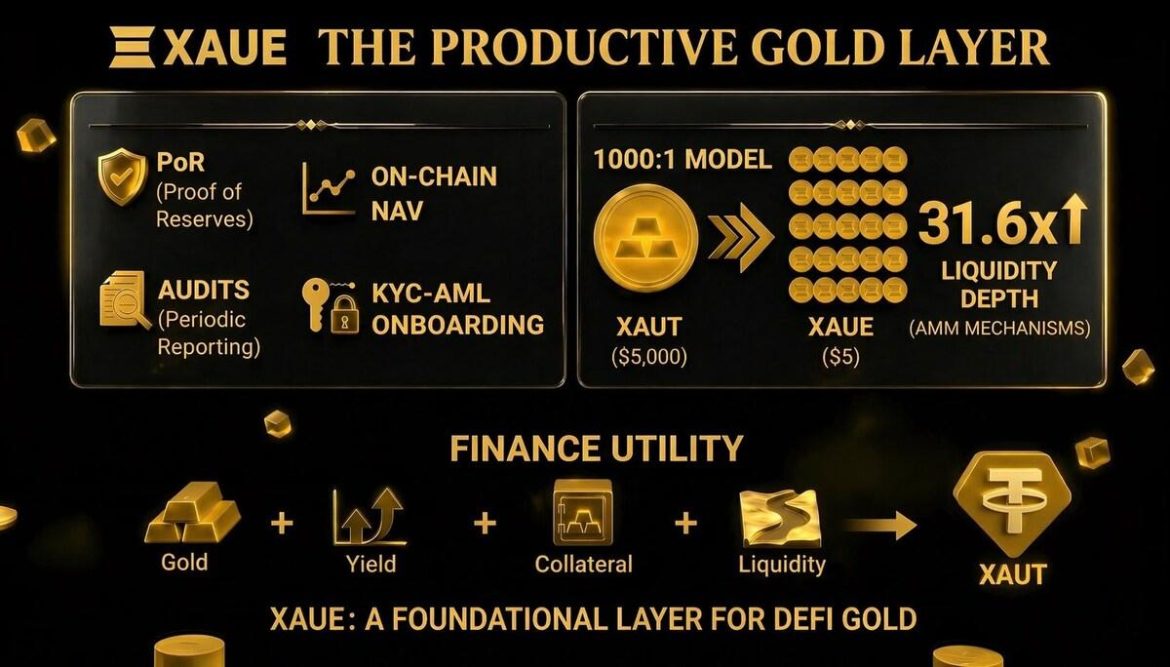
PANAMA CITY, April 22, 2026 /PRNewswire/ — Aurise Foundation today announced the launch of XAUE, a yield-bearing gold token designed as a Treasury Layer for Tether Gold (XAU₮). Built for qualified institutional participants, XAUE introduces crypto-native yield generation to traditionally non-yielding gold, transforming it into a programmable and capital-efficient on-chain asset.
At launch, ecosystem partners Aurelion and Antalpha have jointly committed 16,052 XAU₮ into XAUE (approximately $76 million as of April 22). As the ecosystem expands, XAUE may potentially integrate with leading more decentralized financial protocols, positioning itself as a foundational collateral and settlement asset across on-chain financial markets.
From Passive Store of Value to Productive On-Chain Asset
Gold has long served as a hedge against inflation and systemic risk, yet its capital efficiency has remained structurally limited. While gold ETFs improved accessibility, they lack 24/7 liquidity. Digital gold assets such as XAU₮ and PAXG have enhanced transferability and global accessibility, but still primarily rely on price appreciation without intrinsic yield generation.
XAUE is designed to bridge this gap. By preserving exposure to the underlying value of XAU₮ while introducing a gold-denominated yield mechanism, XAUE enables holders to benefit from compounding growth measured in gold units. The protocol adopts a monotonically increasing exchange rate model, where the gold value backing each XAUE token might grow over time as net yield accrues.
For example, Deposit 1 XAU₮ to receive 1,000 XAUE (1000:1). With a 2% annual yield, reserves grow to 1.02 XAU₮ while supply stays fixed, so 1,000 XAUE redeems for 1.02 XAU₮—delivering passive, auto-compounding gold returns.
About XAUE
XAUE is a decentralized asset enhancement protocol built on Ethereum, designed as a Treasury Layer for Tether Gold (XAU₮). By introducing gold-denominated yield, compliant access frameworks, efficient reserve verification, and a 1000:1 fractionalization model, XAUE redefines how gold can function within on-chain financial systems.
About Aurise Foundation
XAUE is a DeFi protocol on Ethereum and the Treasury Layer for Tether Gold (XAU₮), issued by Aurise Foundation (Panama). It enables yield generation on gold via quantitative strategies and institutional lending, while remaining fully backed by physical gold or XAU₮. Aurise Foundation and its partners oversee governance, audits, Proof of Reserves, and AML/KYC compliance. Access is limited to whitelisted, KYC/KYB-verified institutions in eligible jurisdictions. More information: xaue.com.
Disclaimer
This press release does not constitute any offer or solicitation. The disclaimer is available here

Sam, United States, April 20th, 2026, Chainwire
Unicoin Inc. today announced the official launch of the Unicoin Foundation, a mission-driven organization dedicated to leveraging blockchain technology to create meaningful social impact and expand access to the digital economy.
The Foundation’s launch aligns with the evolving market restructuring and regulatory clarity introduced under the leadership of U.S. Securities and Exchange Commission Chair Paul Atkins, which emphasizes transparency, responsible innovation, and clear governance frameworks for digital assets. This milestone underscores Unicoin’s long-standing commitment to compliance, accountability, and building a sustainable and inclusive crypto ecosystem.
A New Era: Crypto as a Force for Good
Anchored in the flagship initiative “Crypto for Good,” the Unicoin Foundation aims to demonstrate how cryptocurrencies can contribute to broader social and economic initiatives.
Through education and ecosystem development programs, the Foundation is developing a scalable entry point to the digital economy for communities traditionally underrepresented in crypto. Within its Crypto for Good framework, it presents digital assets as a tool for expanding access, opportunity, and participation across global markets.
Its education-first approach focuses on financial literacy and long-term wealth creation, enabling individuals to transition from passive saving to active participation in both traditional and digital markets. At the same time, the Foundation accelerates entrepreneurship through hands-on training, mentorship, and startup support, equipping participants with practical capabilities in AI, blockchain, and Web3 to build and scale ventures, shifting the narrative from speculation to knowledge, ownership, and value creation.
Strengthening Trust Through Transparency and Compliance
The establishment of the Unicoin Foundation reflects the company’s proactive alignment with the principles of transparency and responsible governance emphasized in the evolving regulatory landscape. By separating social impact and educational initiatives into an independent foundation, Unicoin reinforces its commitment to ethical innovation and long-term sustainability.
“The future of crypto will be defined by trust, education, and real-world impact,” said Silvina Moschini, co-founder of Unicoin.
A Strategic Engine for Ecosystem Growth
Beyond its social mission, The Unicoin Foundation is expected to play a pivotal role in strengthening Unicoin’s global reputation, expanding its community, and accelerating adoption. By engaging new audiences and fostering trust, the Foundation supports the long-term development and sustainability of the Unicoin ecosystem.
These efforts are further reinforced through a set of strategic impact areas that translate the mission into measurable value creation. The Foundation drives market expansion by actively engaging women and underserved communities worldwide, unlocking new user segments and fostering inclusive participation in the digital economy. It contributes to ecosystem development by supporting entrepreneurs, developers, and innovators, enabling the creation of new solutions and use cases within the Unicoin network.
Finally, it strengthens community engagement by building a global network of informed and empowered participants who act as advocates and contributors to the ecosystem’s growth.
“With the Unicoin Foundation, we are creating a structure that not only advances responsible innovation, but also expands access to opportunity—ensuring that the benefits of digital assets are more inclusive, transparent, and meaningful for communities worldwide, added Alex Konanykhin, co-founder and CEO of Unicoin.”
Governance and Partnerships
The Unicoin Foundation will operate with independent governance from Unicoin Inc, guided by principles of transparency, accountability, and measurable impact.
The Foundation will be chaired by Robert Newman, a seasoned entrepreneur and one of Unicoin’s largest investors, and governed by a board of 27 directors, all of whom are Unicoin investors elected by shareholder vote, ensuring strong alignment between governance and the broader community.
This milestone follows a significant governance decision within the ecosystem:
The restructuring aligns the ecosystem with SEC Chair Paul Atkins’ proposed “token taxonomy” framework, under which certain digital tools and functional tokens may fall outside securities registration requirements if they are not reliant on managerial efforts for profit.
About Unicoin
Unicoin Inc., a/k/a TransparentBusiness, is a U.S.-based crypto company committed to building one of the world’s most transparent and compliant cryptocurrency ecosystems. Through innovation, education, and community engagement, Unicoin aims to democratize access to economic opportunities and redefine the role of digital assets in society.
About the Unicoin Foundation
The Unicoin Foundation is an independent, mission-driven organization dedicated to advancing the responsible adoption of blockchain technology. Through its Crypto for Good initiative and comprehensive educational programs, the Foundation seeks to empower individuals, support impactful projects, and foster a more inclusive and sustainable global economy.
Website: www.unicoin.org
Forward-Looking Statements
This press release contains forward-looking statements regarding future events and the anticipated impact of the Unicoin Foundation. These statements are subject to risks and uncertainties, and actual results may differ materially. Nothing in this release constitutes an offer to sell or a solicitation of an offer to purchase any securities or digital assets.
Policy Advisor
Sam Amsterdam
Unicoin
Sam@amsterdamgroup.net

The NFT space has always been a story of experimentation, resilience, and evolution—and today marks another pivotal chapter. Foundation, one of the early and culturally significant NFT art platforms, has officially announced its wind-down after a failed acquisition attempt. While the news may feel heavy, the deeper story reveals both the fragility of platforms and the enduring strength of decentralized ownership.
https://x.com/saturnial/status/2044555725717098750
Let’s break down what’s happening, what it means for collectors and artists, and why this moment reinforces one of Web3’s core promises.
Foundation launched in 2021 as a curated NFT marketplace focused on digital art and creator empowerment. It quickly became a cultural hub, onboarding influential artists and fostering a strong collector community. Alongside platforms like SuperRare and Nifty Gateway, Foundation helped define the early NFT art boom.
However, according to the announcement, Foundation had been working on a sale earlier this year. The intention was clear: pass the torch to a new operator who would continue supporting the platform and its community.
That plan has now collapsed.
The buyer is no longer able to operate the platform, and Foundation has made the difficult decision not to pursue further acquisition opportunities—citing current market conditions as a limiting factor.
As a result, the platform is shutting down permanently, and its infrastructure has already been taken offline.
Here’s the most important takeaway: your NFTs are safe.
Foundation emphasized a critical principle of blockchain technology—non-custodial ownership.
Unlike traditional platforms that hold your assets, Foundation NFTs live on the blockchain (primarily Ethereum). This means:
Even though the website is gone, the smart contracts and tokens remain intact onchain.
This is Web3 working as intended.
While ownership is secure, there’s a nuance that collectors and artists cannot ignore: media storage.
Foundation has been pinning NFT metadata and files via IPFS (InterPlanetary File System), a decentralized storage solution. However, they’ve announced they will only continue this service for one more year.
After that, if no one else is “pinning” the files, there’s a risk that the associated media could become inaccessible.
This is a crucial reminder: decentralization often requires personal responsibility.
If you currently have NFTs listed for sale on Foundation, there’s a temporary complication.
Those NFTs are held in Foundation’s marketplace smart contract. While still non-custodial in design, the primary way to interact with that contract was through Foundation’s frontend—which is now offline.
The team is working on a solution that will allow users to:
Details are expected soon, but for now, patience is required.
Foundation’s shutdown reflects broader market conditions. The NFT space has matured significantly since its explosive rise in 2021–2022. Liquidity has thinned, speculative hype has cooled, and platforms are facing the challenge of building sustainable models.
Even culturally important platforms are not immune.
But this isn’t the end—it’s a recalibration.
We’re seeing a shift toward:
Ironically, Foundation’s shutdown proves the very thesis it stood for.
If this were a Web2 platform:
Instead:
This moment highlights the difference between platform dependency and protocol-level permanence.
Foundation played a meaningful role in shaping NFT culture. It empowered artists, onboarded collectors, and helped define what digital ownership could look like.
While its chapter is closing, the ecosystem it helped build is still very much alive.
The responsibility now shifts back to the community—to preserve, adapt, and continue pushing the space forward.
As always in Web3: platforms may come and go, but the chain endures.
Foundation is shutting down after a failed sale, and its platform is now offline. Your NFTs remain safe in your wallet because they exist onchain, but you need to back up your media (via IPFS) within the next year. Listed NFTs are temporarily stuck in a smart contract, with a solution coming soon. The shutdown reflects broader NFT market challenges—but also reinforces the power of decentralization.


