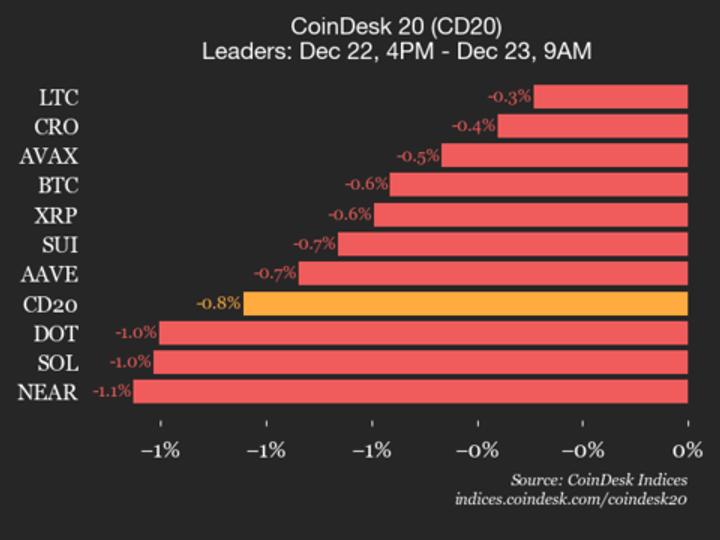
Internet Computer (ICP) was also an underperformer, down 2% from Monday.
drops
Twenty One Capital Drops in NYSE Debut as Bitcoin Treasury Firms Face ‘Broader Re-Pricing’
In brief
- Twenty One Capital began trading on the NYSE as XXI, bolstered by a big Bitcoin stash after merging with Cantor Equity Partners.
- Shares hovered near $11 on debut day, falling short of the SPAC’s prior close near $14.
- Observers told Decrypt that treasury-heavy firms face shrinking premiums as markets favor clearer business models.
Twenty One Capital began trading on the New York Stock Exchange as XXI on Tuesday after completing its merger with Cantor Equity Partners, entering the market with more than 43,000 BTC worth almost $4 billion already on its balance sheet, primed in a position among the world’s largest public corporate holders of the asset.
Yet its trading debut was met with sharp selling, with XXI shares spending the session at roughly $11, putting it well below Cantor Equity Partners’ final pre-merger close near $14.
Debut trading for XXI aligned with patterns seen across other Bitcoin treasury listings this year, where new entrants have often priced below their pre-merger benchmarks as Bitcoin remains off its highs and premiums in the segment continue to narrow.
The company enters the market backed by Tether, Bitfinex, and a minority investment from SoftBank, with management outlining plans to build financial infrastructure and education products around Bitcoin.
Those efforts remain at an early stage, and investors have been weighing how quickly Twenty One can move from a balance sheet-driven profile to one supported by clear business operations.
DAT firms face “broader re-pricing”
The slide is “part of a larger pattern” in which investors “have grown cautious toward Bitcoin treasury companies and SPAC listings” because of their “tendency to behave like leveraged BTC bets that don’t have proven revenue,” Shawn Young, chief analyst at MEXC Research, told Decrypt.
“Investors now strategically look closely for clearer business models, cleaner governance, and real revenue plans,” he added.
XXI’s debut arrives as a “risk-off climate” continues, with the market “no longer prioritizing these firms the premium like it once did,” Young said.
“The drop isn’t exclusive to Twenty One as it reflects a broader re-pricing of companies that have a ‘we hold a lot of Bitcoin’ approach instead of ‘we generate predictable cash flow’,” he noted.
The stock might remain the same and trade “heavily in line with BTC, at least until the company proves it can build real, sustainable revenue on top of that asset base,” Young said.
The same happened with other SPAC listings, where markets appeared to have “overgrown the phase where a firm could raise capital, buy Bitcoin, and expect its equity to trade above the value of those holdings,” John Murillo, chief business officer at B2BROKER, told Decrypt.
Citing ProCap Financial’s (BRR) similar but “even more brutal” drop at roughly 50-60% this week, Murillo noted how discounts “are becoming the norm.”
“Investors are increasingly unwilling to pay NAV premiums for pure balance-sheet Bitcoin exposure,” Pei Chen, COO and executive director at AI liquidity engine Theoriq, told Decrypt.
This comes as “Bitcoin volatility compresses risk appetite,” with other treasury plays struggling to outperform spot, he explained.
While its sizable holdings and high-profile backing give it “more scale and optionality than most peers,” the long-term upside “won’t come from stack size alone,” Chen said.
“It will hinge on credible execution, transparent governance, and proving it can build durable, revenue-generating businesses on top of its Bitcoin reserve,” he opined.
Other observers say it’s a matter of how effectively the company can use its holdings to build an actual business around them, noting that a large Bitcoin stash alone does not ensure long-term performance.
“What matters is whether they can turn that treasury into real business activity — yield, liquidity, partnerships, or products that generate revenue outside of pure BTC exposure,” Kanny Lee, co-founder and CEO of secondary markets trading protocol SecondSwap, told Decrypt.
Twenty One’s long-term outlook could improve if it builds “real operating fundamentals on top of the treasury,” Lee said. “If not, the stock will likely continue to trade like a leveraged proxy for Bitcoin, and the market already has cleaner ways to get that exposure.”
Daily Debrief Newsletter
Start every day with the top news stories right now, plus original features, a podcast, videos and more.
Ethena’s synthetic-dollar stablecoin USDe saw one of its sharpest monthly contractions yet, while fiat-backed stablecoins like USDT, USDC and PYUSD attracted billions in inflows.
CoinGecko data showed that Ethena’s USDe stablecoin fell from a market capitalization of $9.3 billion on Nov. 1 to a valuation of $7.1 billion on Nov. 30. The token saw roughly $2.2 billion in redemptions, marking a 24% decline in supply in November.
Ethena’s USDe is a synthetic stablecoin that maintains its dollar peg through trading strategies with crypto and futures contracts rather than holding actual dollars. This means that USDe outflows mean that users are either selling USDe on the open market, withdrawing from pools or unwinding their positions on decentralized applications (DApps).
At the time of writing, CoinGecko data shows that the overall stablecoin market cap is at $311 billion. The market remains dominated by US dollar stablecoins, capturing $303 billion of the sector’s total valuation.
USDe outflows follow October depeg
USDe’s November contraction comes weeks after the synthetic stablecoin suffered a depegging event on the crypto exchange Binance. At the time, USDe briefly plunged to $0.65 on the exchange.
Ethena founder Guy Young said that the drop was caused by a Binance-specific oracle issue and not a problem with USDe’s underlying collateral mechanism that backs the asset.
Young said that the USDe token’s minting and redemption functions operated “perfectly” during the incident, with approximately 2 billion tokens redeemed across decentralized finance (DeFi) platforms.
On Oct. 9, USDe market cap hovered at $14.8 billion, making it the third-largest stablecoin at the time. Since then, the stablecoin lost over 53% of its market capitalization.
At the time of writing, CoinGecko data shows that USDe has a total valuation of $6.9 billion, dropping to the fourth spot in the stablecoin market cap rankings.
Related: Lawmakers stumble on stablecoin terms as US Congress grills Fed’s Bowman
Fiat-backed stablecoins grew by $3.2 billion in November
While the synthetic-dollar stablecoin struggled during the month, fiat-backed stablecoins recorded modest but steady gains over the same time period.
Tether’s USDt (USDT) saw a $1.3 billion increase to $184.6 billion, while Circle’s USDC (USDC) climbed to $76.5 billion, adding roughly $600 million to its supply.
PayPal USD (PYUSD) posted the strongest growth among the major dollar-pegged stablecoins, jumping from $2.8 billion to $3.8 billion in November. This marks 1 billion inflow for the month — a 35% month-on-month growth.
DefiLlama data showed that since PayPal PYUSD stablecoin grew by over 216% since September, when it had a market cap of $1.2 billion. This represents a $2.6 billion increase in just three months.
Meanwhile, Ripple’s (RLUSD) stablecoin, which breached a market capitalization of $1 billion for the first time in November, continued its growth throughout the month.
According to CoinGecko, RLUSD went from a $960 million market cap on Nov. 1 to a market cap of $1.26 billion on Nov. 30, marking a $300 million increase.
Magazine: China officially hates stablecoins, DBS trades Bitcoin options: Asia Express
MANTRA Tests Critical Support as OM Price Drops 3.7% Amid Broader Crypto Weakness
Joerg Hiller
Oct 19, 2025 09:30
OM price falls to $0.12 as MANTRA technical analysis reveals bearish momentum building with RSI at 35.51 and trading below key moving averages in thin volume.
Quick Take
• OM trading at $0.12 (down 3.7% in 24h)
• No major catalysts driving current weakness
• Testing support near 52-week lows with RSI oversold
• Following Bitcoin’s broader market decline
Market Events Driving MANTRA Price Movement
Trading on technical factors in absence of major catalysts, MANTRA has declined 3.7% over the past 24 hours as OM price action reflects broader cryptocurrency market weakness. No significant news events have emerged in the past week that would directly impact MANTRA’s fundamentals or trading sentiment.
The current sell-off appears to be following Bitcoin’s recent weakness, with institutional participants showing reduced activity across altcoin markets. Daily trading volume of $4.48 million on Binance spot represents below-average liquidity, suggesting limited conviction from both buyers and sellers at current levels.
Without fresh catalysts to drive momentum, OM price movement has been primarily driven by technical selling as traders react to deteriorating chart patterns and weakening momentum indicators.
OM Technical Analysis: Bearish Momentum Building
Price Action Context
MANTRA technical analysis reveals a concerning setup as OM price trades significantly below all major moving averages. At $0.12, the token sits 85% below its 52-week high of $8.50 and dangerously close to the yearly low of $0.10. The 7-day simple moving average at $0.13 has provided immediate resistance, while the 20-day SMA at $0.15 represents a more significant technical hurdle.
The price structure shows OM following Bitcoin’s broader weakness but with amplified volatility typical of smaller-cap altcoins. Volume patterns suggest institutional interest remains minimal at these levels.
Key Technical Indicators
The RSI reading of 35.51 indicates oversold conditions are developing, though momentum hasn’t reached extreme levels that typically mark significant bottoms. MACD remains in negative territory at -0.0183, with the histogram showing continued bearish divergence as selling pressure persists.
Bollinger Bands positioning reveals OM price in the lower portion of the trading range, with the %B reading of 0.2292 suggesting proximity to the lower band at $0.09. This technical setup often precedes either a bounce or further breakdown depending on broader market conditions.
Critical Price Levels for MANTRA Traders
Immediate Levels (24-48 hours)
• Resistance: $0.13 (7-day moving average and recent breakdown level)
• Support: $0.10 (52-week low and psychological round number)
Breakout/Breakdown Scenarios
A break below $0.10 support could trigger accelerated selling toward the $0.03 level, representing the next major technical support zone. Conversely, a recovery above $0.15 would need to reclaim the 20-day moving average to signal any meaningful bullish reversal attempt.
OM Correlation Analysis
MANTRA continues tracking Bitcoin’s directional moves with high correlation, typical during periods of broad crypto market weakness. The token shows no significant divergence from sector peers, indicating fundamental factors specific to MANTRA aren’t currently driving price action.
Traditional market correlations remain minimal, with OM price movements primarily influenced by crypto-native factors and Bitcoin’s performance rather than equity or commodity market dynamics.
Trading Outlook: MANTRA Near-Term Prospects
Bullish Case
Recovery above $0.13 resistance accompanied by increased volume could signal short-term relief rally toward $0.15-$0.18 range. RSI oversold conditions provide potential for technical bounce if broader crypto sentiment stabilizes.
Bearish Case
Failure to hold $0.10 support risks extended decline toward $0.03 level with limited technical support between current levels. Continued low volume suggests minimal buying interest at these prices.
Risk Management
Conservative traders should consider $0.09 as maximum downside risk, representing roughly 25% below current levels. Position sizing should account for OM’s elevated volatility, with daily ATR of $0.02 representing significant intraday movement potential relative to the $0.12 price level.
Image source: Shutterstock
In brief
- Human visits to Wikipedia fell 8% year-over-year, with Wikipedia attributing it to people visiting AI summaries instead of consulting Wikipedia.
- AI summaries and search engines now answer questions outright, with nearly 60% of Google queries ending in on-page responses powered by Wikipedia content.
- Publishers call the trend “existential,” accusing tech platforms of using their work without compensation.
>>>> gd2md-html alert: inline image link in generated source and store images to your server. NOTE: Images in exported zip file from Google Docs may not appear in the same order as they do in your doc. Please check the images!
—–>
The Wikimedia Foundation announced this week that human traffic to Wikipedia fell roughly 8% between May and August compared to the same period last year. The decline came into focus after the foundation discovered that sophisticated bots, primarily from Brazil, had been disguising themselves as human visitors.
After updating its detection systems in May, the foundation reclassified traffic data and found much of the unusually high traffic in May and June came from bots built to evade detection. The revised numbers revealed what many in publishing already knew: fewer people visit Wikipedia directly because search engines now provide answers on their own pages.
“After making this revision, we are seeing declines in human pageviews on Wikipedia over the past few months, amounting to a decrease of roughly 8% as compared to the same months in 2024,” Marshall Miller, wrote. “We believe that these declines reflect the impact of generative AI and social media on how people seek information, especially with search engines providing answers directly to searchers, often based on Wikipedia content.”
AI is not just killing Wikipedia. Data from Pew Research showed median year-over-year referral traffic from Google Search to premium publishers has decreased almost every week during May and June 2025, with losses outpacing gains two-to-one. Nearly 60% of all Google searches end up in an AI summary instead of promoting the reading of the actual source.

Publishers across industries are sounding alarms and resorting to lawsuits to get some protection. Danielle Coffey, who leads the News/Media Alliance representing more than 2,000 outlets, said Google is using publisher content without compensation while offering no meaningful way to opt out without disappearing from search entirely.
“It’s parasitic, it’s unsustainable, and it poses a real existential threat to many in our industry,” she said.
The volume of AI content online is rising fast. Research from SEO firm Graphite found that as of November 2024, almost half of new web articles were generated using AI in some form, up from just 5% before ChatGPT’s launch. A post by Ask Perplexity on X claimed AI content went from around 5% in 2020 to 48% by May 2025, with projections saying 90% or more by next year.
The Wikimedia Foundation said fewer visits to Wikipedia could mean that fewer volunteers grow and enrich the content, and fewer individual donors support the work. The foundation is responding by enforcing policies for third-party access, developing a framework for attribution, and experimenting with ways to bring free knowledge to younger audiences on platforms like YouTube and TikTok.
The foundation said Wikipedia’s human knowledge is more valuable to the world than ever before, 25 years since its creation. The question is whether the platforms using that knowledge will support the ecosystem that creates it.
The Wikipedia Foundation did not immediately respond to a request for comments by Decrypt.
Generally Intelligent Newsletter
A weekly AI journey narrated by Gen, a generative AI model.
Several regional banks in the United States are facing renewed stress despite strengthening their finances after the 2023 banking crisis, and Bitcoin could benefit from any liquidity crisis that follows.
Strike CEO Jack Mallers sees the banking stress as validation that Bitcoin (BTC) is correctly pricing in an impending liquidity crisis, opining that the Federal Reserve’s inevitable response will drive BTC prices higher.
“Bitcoin is accurately smelling trouble right now,” he said on the Primal social media platform on Friday.
“The US is going to have to inject some of that sweet, sweet liquidity soon and print a ton of money or else their fiat empire goes kaboom.”
Taking the conversation over to X, he said, “Bitcoin is the most sensitive to liquidity. It moves first. It’s a truth machine.”
“Yields are puking, spreads blowing out, and banks are stressed. Bitcoin is working. It smells trouble. When they’re forced to print, it’ll move first again, and outperform everything.”
US banking crisis redux
The March 2023 regional bank crisis was never truly resolved — just papered over with government bailouts and acquisitions.
However, this created a moral hazard, as banks took excessive risks knowing the government would backstop deposits beyond the Federal Deposit Insurance Corporation (FDIC) limits.
Wall Street is growing concerned about the health of the nation’s regional banks, following the write-off of bad loans to commercial customers, as reported by the Associated Press on Friday.
Related: Bitcoin hits 15-week low under $105K as US regional bank woes echo 2023
Zions Bank and Western Alliance stocks crashed this week due to loan problems, triggering broader market fears because confidence in regional banks had never been fully restored after 2023.
The US banking system remains vulnerable, propped up by implicit government guarantees rather than sound financial practices, explained the Kobeissi Letter.
Bitcoin tanks to 4 month low
Whatever benefits may accrue to Bitcoin from this banking crisis, they’re not yet apparent.
The asset tanked to a four-month low of $103,850 on Friday, shedding over $5,000 in a matter of hours.
It has since recovered to trade at $107,000 on Saturday morning in Asia, but remains down more than 15% from its all-time high.
“BTC on sale. If this US regional banking wobble grows to a crisis, be ready for a 2023-like bailout. And then go shopping, assuming you have spare capital,” said BitMEX co-founder Arthur Hayes.
Magazine: Binance shakes up Korea, Morgan Stanley’s security tokens in Japan: Asia Express
OM Price Drops to $0.12 as Bitcoin Sell-Off and Fed Rate Hike Signals Pressure MANTRA
Iris Coleman
Oct 17, 2025 23:23
MANTRA (OM) trades at $0.12 following a 3.3% decline as Bitcoin’s drop below $110,000 and Federal Reserve hawkish signals weigh on cryptocurrency markets.
Quick Take
• OM trading at $0.12 (down 3.3% in 24h)
• Bitcoin’s fall below $110,000 triggering broader crypto sell-off
• Federal Reserve signaling potential rate hikes pressuring risk assets
• OM testing lower Bollinger Band support near $0.10
Market Events Driving MANTRA Price Movement
The OM price has faced significant downward pressure over the past 48 hours, primarily driven by Bitcoin’s decline below the psychologically important $110,000 level. This cryptocurrency market leader’s weakness has created a cascading effect across altcoins, with MANTRA experiencing a 3.3% decline in the last 24 hours.
Adding to the bearish sentiment, the Federal Reserve’s signals regarding potential interest rate increases to combat inflation have spooked investors across risk assets. The central bank’s hawkish stance has historically led to capital outflows from cryptocurrencies as investors seek safer, yield-bearing traditional assets. This macroeconomic headwind has overshadowed MANTRA’s recent positive development.
Despite the broader market pressure, MANTRA did announce a strategic partnership with a major financial institution to enhance DeFi services earlier this week. However, this fundamental positive has been overwhelmed by the macro-driven sell-off affecting the entire cryptocurrency sector.
OM Technical Analysis: Testing Lower Support Zone
Price Action Context
The OM price currently sits well below its key moving averages, with the token trading at $0.12 compared to its 20-day SMA of $0.15 and 50-day SMA of $0.18. This positioning indicates continued bearish momentum in the near term. MANTRA technical analysis shows the token is closely following Bitcoin’s price action, maintaining its historical correlation during market downturns.
Trading volume on Binance spot market reached $9.6 million in the past 24 hours, suggesting moderate institutional interest despite the price decline. The elevated volume during the sell-off indicates genuine selling pressure rather than low-liquidity price manipulation.
Key Technical Indicators
The RSI reading of 36.33 places OM in neutral territory but trending toward oversold conditions, potentially setting up for a technical bounce. The MACD histogram shows bearish momentum at -0.0012, confirming the current downtrend remains intact.
Most notably for MANTRA technical analysis, the Bollinger Bands position shows OM trading near the lower band at $0.10, with the current %B position at 0.1981 indicating proximity to oversold levels.
Critical Price Levels for MANTRA Traders
Immediate Levels (24-48 hours)
• Resistance: $0.13 (24-hour high and immediate technical bounce target)
• Support: $0.10 (Bollinger Band lower boundary and psychological level)
Breakout/Breakdown Scenarios
A break below $0.10 support could accelerate selling toward the strong support zone at $0.03, representing the 52-week low territory. Conversely, a recovery above $0.13 would need to reclaim the $0.15 level (20-day SMA) to signal any meaningful technical improvement.
OM Correlation Analysis
Bitcoin’s influence on OM price remains pronounced, with MANTRA following the broader cryptocurrency market’s risk-off sentiment. The correlation has strengthened during this sell-off period, typical behavior for altcoins during Bitcoin weakness.
Traditional markets are also weighing on cryptocurrency sentiment, with the Federal Reserve’s hawkish signals affecting risk asset appetite across all sectors. This macro correlation suggests OM price movements will likely continue tracking broader market sentiment in the near term.
Trading Outlook: MANTRA Near-Term Prospects
Bullish Case
A technical bounce becomes increasingly likely as OM approaches oversold RSI levels and tests Bollinger Band support. Recovery above $0.13 resistance, combined with Bitcoin stabilization above $110,000, could target the $0.15-$0.18 resistance zone where multiple moving averages converge.
Bearish Case
Continued Federal Reserve hawkishness and Bitcoin weakness below $110,000 could pressure OM toward the $0.10 support break. A decisive move below this level opens downside toward $0.03, particularly if broader crypto market sentiment deteriorates further.
Risk Management
Conservative traders should consider $0.09 as a stop-loss level below current support, representing roughly 25% downside risk from current levels. Given the Daily ATR of $0.02, position sizing should account for continued volatility in the current macro environment.
Image source: Shutterstock
- Zcash price dropped to the $190 support level.
- Macro headwinds also had Bitcoin falling to below $105,000 to trigger further bleeding across crypto.
- Analysts remain bullish despite the dip.
Zcash (ZEC) tumbled to lows of $190, with its double-digit declines reflecting widespread market unease.
Triggered by macroeconomic pressures, most coins plummeted to key levels, including Bitcoin, which retested the $105,500 area.
Crypto pullback and Zcash price today
Zcash, the privacy-focused cryptocurrency launched in 2016, experienced a sharp decline on Friday.
The token dipped to support around the $190 mark as a broader crypto market retracement ensued to see total market liquidations surpass $1 billion.
ZEC, one of the outperformers in recent weeks, fell below the key support level of $200.
Moreover, the price declines are accompanied by rising trading volume to reinforce the profit taking.
Per CoinMarketCap, the daily trading volume for the privacy-focused coin has jumped 26% to over $742 million.
Meanwhile, the price has fallen nearly 20% in the same time frame.

Zcash has climbed 260% over the past month, outperforming nearly all of the top 100 cryptocurrencies by market capitalisation.
The market-wide pullback reflects broader macroeconomic factors, including renewed tensions in the US-China trade dispute and the ongoing US government shutdown.
Investors who had recently entered Zcash appear to be taking profits after a strong rally fueled by optimism surrounding its zero-knowledge proof technology.
Zcash has seen a notable surge in institutional interest in recent weeks.
Grayscale’s Zcash Trust has been a key driver, with assets under management exceeding $92 million — a signal of rising adoption.
The trust allows traditional investors to gain exposure to ZEC, one of the leading privacy coins, without the operational complexities of holding the asset directly.
ZEC price forecast
Major declines across the market came as investors, spooked by the latest news from US regional banks, exited positions.
Specifically, reports on Friday indicated that two US regional banks have hit the rocks with bad loans.
Jitters around banking sector risks saw a sharp dump for bank stocks cascade into futures trading on Wall Street.
A slip for the S&P 500 and the Nasdaq also sent crypto nosediving.
But Bitcoin’s drop could allow some capital rotation to revive ZEC price, one analyst pointed out on X.
Correlation among shielded transactions adoption gives this strength.
Bitcoin dropped $500B.
Zcash dropped $1.6B.
What are the chances a slice of that $500B lost in Bitcoin rotates back into $ZEC, as shielded Zcash emerges as Encrypted Bitcoin?$ZEC what’s next? pic.twitter.com/5ijKj430c7
— Michelangelo.zec ⓩ🛡️ (@BTCTurtle) October 17, 2025
Market analysts point to overbought conditions in the short term.
A look at the Relative Strength Index (RSI) shows a dip into oversold territory, which means a potential reversal.
Overall, while the $190 mark signals a key demand zone, the $240 mark represents a crucial hurdle.
ZEC price reached highs of $295 earlier in the month.