

Key Takeaways
- ▸ SB430 would treat sports event contracts as sports wagers, forcing exchanges to obtain licenses and pay a 20% tax on adjusted revenue.
- ▸ Regulators are considering penalties (including a proposed $5M fine) as courts so far side with Ohio’s authority, even before new legislation passes.
- ▸ If enacted, SB430 would almost certainly trigger federal preemption challenges, setting up another state vs. CFTC showdown.
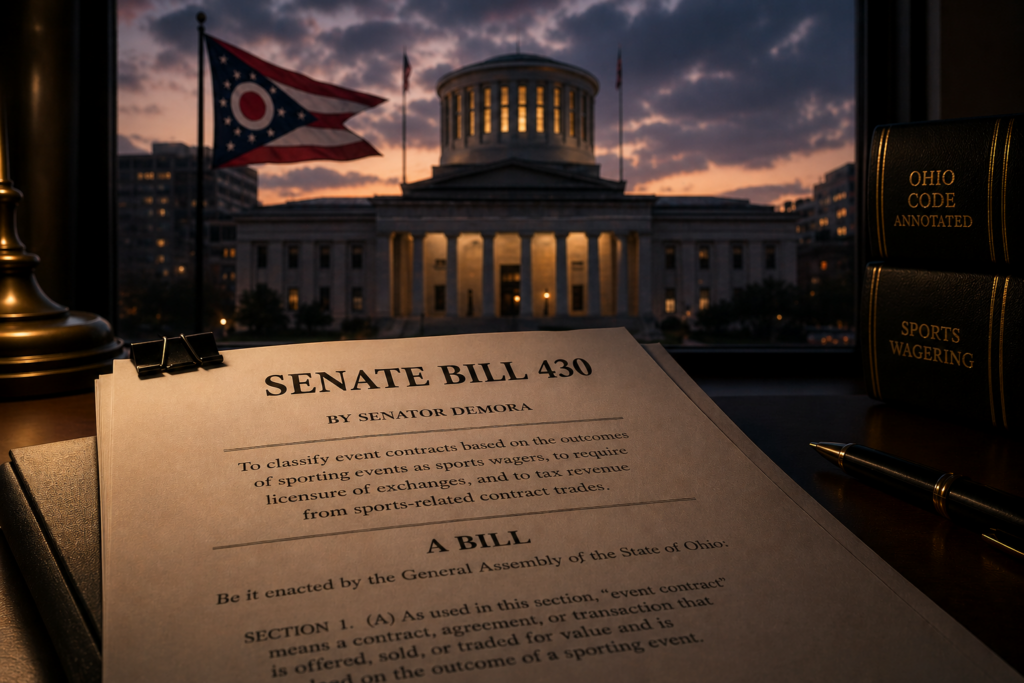
Ohio’s attorney general and gaming regulators are already considering potential penalties for offering prediction market trading within the state, but that could become a clearer violation of state law if a new bill in the Ohio Senate passes. Ohio Sen. Bill DeMora presented his proposal on Monday to classify event contracts based on the outcomes of sporting events as sports wagers and require that exchanges obtain licensure from the state.
The bill would also tax revenue from sports-related contract trades, which would make Ohio the first to do so though others are considering similar measures. Should Ohio enact the statute, court challenges would be inevitable.
Ohio SB430 classifies sports event contracts as gambling
A hot-button issue in disputes between prediction market exchanges and state governments across the United States is whether event contracts on those exchanges that are settled based on the outcomes of sporting events fit within the legal parameters of sports betting. DeMora’s bill, SB430, would settle that question in terms of Ohio law.
The proposal includes text that reads, “‘sports gaming’ includes the use of a prediction market to acquire, sell, or trade an event contract that is contingent on the outcome of a sporting event.” Due to that distinction, prediction markets seeking to continue to allow Ohioans to trade contracts related to sporting events would have to follow the same procedures that licensed online sportsbooks in the state face. Those responsibilities include applying for licensure with the Ohio Casino Control Commission (OCCC) and paying the state a privilege fee of 20% of adjusted revenue from the trading.
SB430 has not yet been assigned to committee in the Ohio Senate. Whether and how far the legislation progresses may reflect the actions of other officials in the state.
Ohio attorney general, gaming regulators pondering options
Ohio officials have enjoyed success in their efforts to restrict prediction market trading within the state so far. Kalshi’s petitions of federal courts to block enforcement actions have failed to date.
As a result, Ohio Attorney General Dave Yost is considering levying penalties against Kalshi, which might include a $5 million fine that the OCCC recommended. The lawsuit that Kalshi filed against Ohio officials still has yet to be adjudicated, though.
If federal courts continue to rule in Ohio’s favor, that could make at least some of the tenets of SB430 more about the letter of the law than the spirit of the law. Attorneys representing the state are already arguing that prediction market trading on sporting events fits within the parameters of Ohio’s existing gambling statutes.
Favorable court decisions could set that precedent in practice even if Ohio’s gambling statutes don’t explicitly state it. At the same time, enacting SB430 could give counsel for the state additional leverage to make their arguments.
Enrollment of the language of SB430 would not alter the federal preemption arguments that Kalshi has made, leaving that question outstanding for the courts to decide. Preemption could also become a pertinent issue in challenges to SB430 if it becomes law.
Constitutionality challenge imminent if Ohio enacts prediction markets bill
If SB430 builds momentum, prediction market exchanges and potentially the Commodity Futures Trading Commission (CFTC) will likely have lawsuits ready to file the moment the new law takes effect. It’s possible that multiple entities could present the federal court for Ohio’s Southern District with complaints, too.
Common criticisms in such complaints are likely to focus on federal laws governing commodity exchanges. Statements in the briefs will probably try to make the case that it’s impossible for prediction market exchanges to simultaneously comply with the CFTC’s and Ohio’s regulatory frameworks, as the two are at odds with each other.
The ramifications of DeMora’s bill are yet another obstacle that prediction markets will have to overcome to continue offering prediction markets in the Buckeye State. Due to Ohio’s relatively unfriendly political environment for exchanges, the progress of SB430 merits close watching.


