The prediction market industry enables people to bet on US elections and sporting events.

 Live Chat

The prediction market industry enables people to bet on US elections and sporting events.
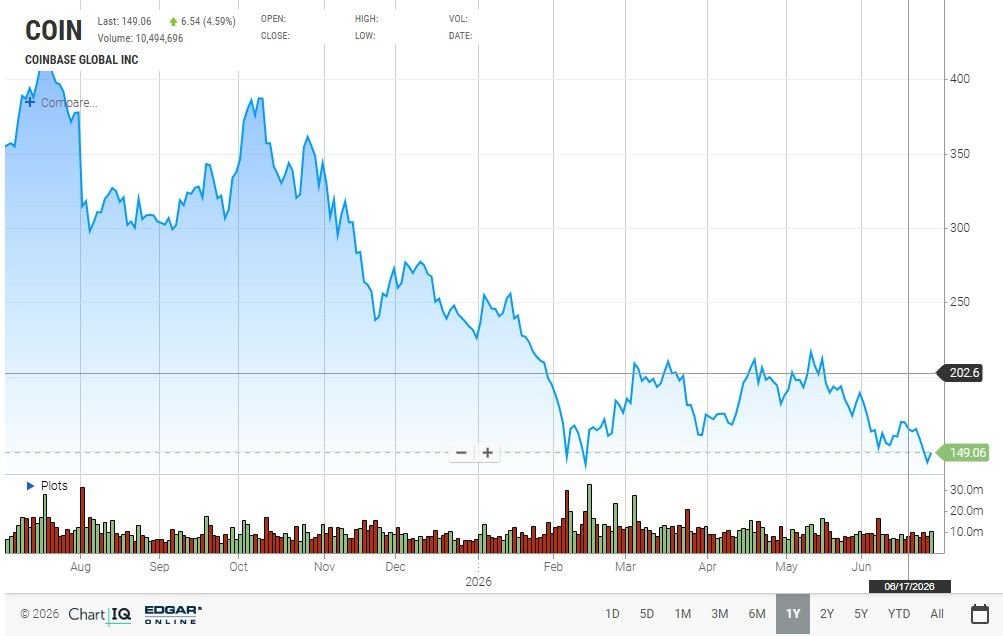
Coinbase CEO Brian Armstrong responded to criticism over the company’s promotion of high-risk products to young and financially vulnerable users. He called for responsible product design that does not restrict adult choice.
Zcash founder Zooko publicly criticized Coinbase for promoting sports betting and Bitcoin (BTC) price prediction to inexperienced users. Armstrong acknowledged the tension, noting that companies must balance user freedom against platform responsibility.
The CEO argued on X that companies should not aggressively promote high-risk products to unsophisticated users. A clear distinction exists between making products available and actively pushing them on people least equipped to handle the risks.
Three practical measures followed from that position. Platforms should offer clearer risk disclosures, built-in financial literacy tools, and user preference settings to control which products appear. Together, these options could create a more personalized experience without removing adult access.
Additionally, Zooko’s criticism targeted how Coinbase surfaces Bitcoin price prediction and sports betting to inexperienced users. That kind of aggressive in-app promotion crosses a line, Armstrong said, even if the products themselves remain available.
The Coinbase chief recently commented on Coinbase’s Bitcoin market view, noting AI cost reductions alongside broader product expansion. Responsible design, he suggested, needs to accompany that growth rather than trail it. However, those ambitions now face questions about whether user safety has kept pace.
Meanwhile, scrutiny of Coinbase’s 2026 product direction reflects the broader sentiment around the company’s trajectory. Critics have argued that feature expansion has outpaced user protections. That tension sharpened further with Zooko’s public call-out this week.
Beyond the exchange, Coinbase’s Base chain B20 push and Coinbase Luxembourg MiCA hub show a widening footprint. That scope makes it harder to enforce product design standards uniformly across user segments.
The CEO also addressed whether sports prediction markets should exist at all. Private companies should not decide that question on their own. Instead, democratic processes are better suited to establish those limits.
The position separates two types of responsibility. How a platform promotes products differs from whether those products should exist.
The Coinbase CEO supports tighter design standards, including opt-in controls and personalized risk settings. Nevertheless, the case for regulatory rather than corporate limits remains central to that position.
The post Coinbase CEO Armstrong Comments on Betting Promotion Concerns in the Base App appeared first on BeInCrypto.

BELIZE City, Belize, May 21st, 2026, PlayNewswire
The 2026 football season is expected to draw strong betting interest. For crypto players, the experience goes beyond pre-match picks, extending to live odds, promotions, casino games and entertainment content within one platform.
As a crypto casino and sportsbook, BC.GAME brings football betting, crypto payments, casino games, live dealer tables, crash games and BC Originals into one account and wallet system.
Football Betting Markets to Watch in 2026
Football bettors can follow a wide range of markets in 2026, including pre-match odds, outright markets, player props, goal totals and in-play betting.
France, Spain, England, Brazil and Argentina are likely to remain key teams in early betting conversations, while Portugal, Germany, Morocco, Colombia, Japan, the United States and Norway may attract attention across value picks and stage-specific markets.
Beyond predicting the final winner, players can follow match winner, draw no bet, double chance, over/under goals, top scorer, player props and live betting, with in-play markets responding to goals, red cards, substitutions and shifts in momentum.
BC.GAME’s Crypto Sportsbook Experience
BC.GAME places sports betting inside a broader crypto casino environment.
Players can follow pre-match and in-play odds while also accessing casino games, live dealer tables, crash games, BC Originals and other platform content through the same account and wallet. For players already familiar with digital assets, this creates a more direct path into football betting and wider gaming activity.
A player may start with a pre-match market for a key fixture, track in-play odds during the match, and then continue into casino or BC Originals after the final whistle.
That integrated structure is central to BC.GAME’s 2026 football campaign: football markets, crypto payments and casino entertainment sit within one connected platform experience.
Football Promotions With a Crypto-Native Layer
BC.GAME’s 2026 football campaign will include football-themed promotions, sportsbook activity and tournament-style rewards, including leaderboards, boosted odds, free bets, prize pools and other activities connected to the football season.
The campaign is designed for different participation styles. New users can look at entry-level offers and free bets to start exploring football markets more easily. More active sportsbook players may focus on boosted odds, leaderboards and ongoing prize pools. For players planning to follow the full season, leaderboard and staged campaign formats can offer more sustained engagement than one-off bonuses.
Campaign rewards will also cover a broader range of prize categories, including luxury cars, final match ticket packages, tech products, football collectibles and other tournament-linked rewards.
Beyond Campaign Rewards: BC Engine and $BC
Beyond campaign prizes, BC.GAME also extends its rewards mechanism into the platform’s everyday experience through $BC and BC Engine.
Players can earn $BC rewards when participating in casino games and eligible platform activities, with those rewards automatically entering BC Engine. Built around real yield and hourly settlement, BC Engine distributes crypto rewards based on the amount of $BC held by users at the time of settlement.
The BC Engine reward pool is supported by revenue from different products and partners across the platform, including profits from in-house games such as BC Originals, as well as revenue share from partner products such as Croco and Betby.
BC.GAME also supports the $BC ecosystem through its daily burn mechanism. Under the staking unlock rule, if users unstake within seven days of staking, 1% of the unstaked amount is burned; after seven days, staked $BC can be fully unlocked.
This makes $BC more than a one-off campaign reward. It becomes part of BC.GAME’s crypto-native rewards system.
Final Take
BC.GAME’s 2026 football campaign brings football betting, crypto payments, casino entertainment and platform rewards into one connected experience. Players can start with football markets and related promotions, then continue into casino games, live games, crash games, BC Originals and the rewards system supported by $BC and BC Engine.
As the 2026 football season develops, BC.GAME aims to make football betting part of a broader crypto-first entertainment environment, rather than a standalone sportsbook activity.
About BC.GAME
BC.GAME is a crypto entertainment platform offering a wide range of online gaming experiences, including casino games, sports, live casino, poker, and proprietary titles. The platform supports multiple cryptocurrencies and continues to expand its product offering through new game releases, feature development, and international brand partnerships.
Disclaimer: Gambling involves risk. Players must be of legal gambling age in their jurisdiction and should gamble responsibly. Campaign availability, rewards and sportsbook markets may vary by region and are subject to BC.GAME’s terms and conditions.
Pr manager
Olivia Dixon
BC.GAME
oliviadi@bcgame.com
Key Takeaways
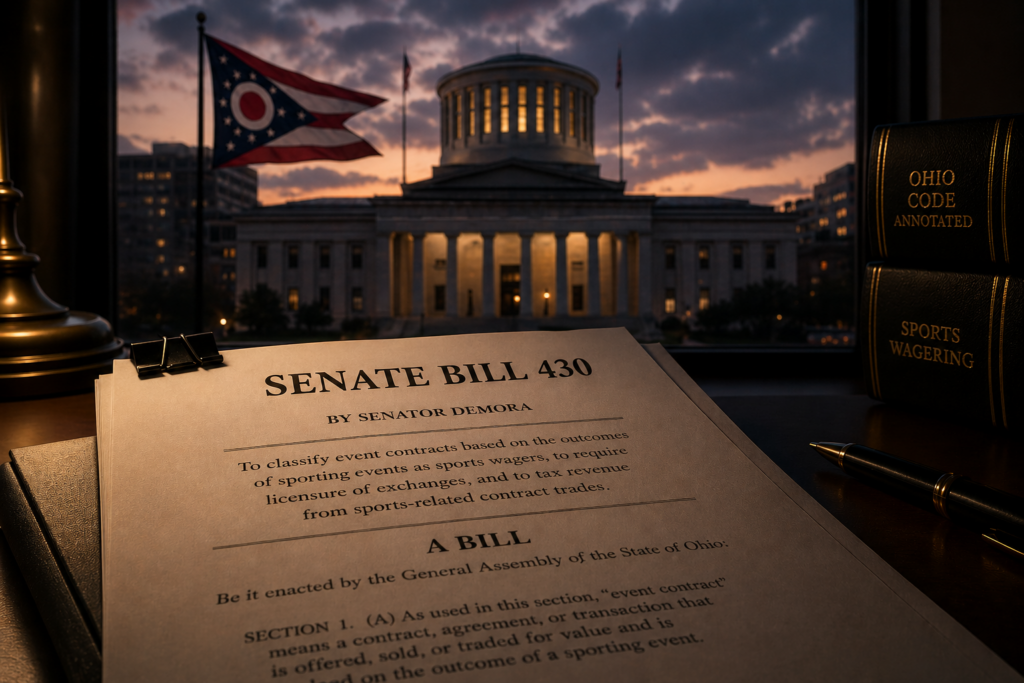
Ohio’s attorney general and gaming regulators are already considering potential penalties for offering prediction market trading within the state, but that could become a clearer violation of state law if a new bill in the Ohio Senate passes. Ohio Sen. Bill DeMora presented his proposal on Monday to classify event contracts based on the outcomes of sporting events as sports wagers and require that exchanges obtain licensure from the state.
The bill would also tax revenue from sports-related contract trades, which would make Ohio the first to do so though others are considering similar measures. Should Ohio enact the statute, court challenges would be inevitable.
A hot-button issue in disputes between prediction market exchanges and state governments across the United States is whether event contracts on those exchanges that are settled based on the outcomes of sporting events fit within the legal parameters of sports betting. DeMora’s bill, SB430, would settle that question in terms of Ohio law.
The proposal includes text that reads, “‘sports gaming’ includes the use of a prediction market to acquire, sell, or trade an event contract that is contingent on the outcome of a sporting event.” Due to that distinction, prediction markets seeking to continue to allow Ohioans to trade contracts related to sporting events would have to follow the same procedures that licensed online sportsbooks in the state face. Those responsibilities include applying for licensure with the Ohio Casino Control Commission (OCCC) and paying the state a privilege fee of 20% of adjusted revenue from the trading.
SB430 has not yet been assigned to committee in the Ohio Senate. Whether and how far the legislation progresses may reflect the actions of other officials in the state.
Ohio officials have enjoyed success in their efforts to restrict prediction market trading within the state so far. Kalshi’s petitions of federal courts to block enforcement actions have failed to date.
As a result, Ohio Attorney General Dave Yost is considering levying penalties against Kalshi, which might include a $5 million fine that the OCCC recommended. The lawsuit that Kalshi filed against Ohio officials still has yet to be adjudicated, though.
If federal courts continue to rule in Ohio’s favor, that could make at least some of the tenets of SB430 more about the letter of the law than the spirit of the law. Attorneys representing the state are already arguing that prediction market trading on sporting events fits within the parameters of Ohio’s existing gambling statutes.
Favorable court decisions could set that precedent in practice even if Ohio’s gambling statutes don’t explicitly state it. At the same time, enacting SB430 could give counsel for the state additional leverage to make their arguments.
Enrollment of the language of SB430 would not alter the federal preemption arguments that Kalshi has made, leaving that question outstanding for the courts to decide. Preemption could also become a pertinent issue in challenges to SB430 if it becomes law.
If SB430 builds momentum, prediction market exchanges and potentially the Commodity Futures Trading Commission (CFTC) will likely have lawsuits ready to file the moment the new law takes effect. It’s possible that multiple entities could present the federal court for Ohio’s Southern District with complaints, too.
Common criticisms in such complaints are likely to focus on federal laws governing commodity exchanges. Statements in the briefs will probably try to make the case that it’s impossible for prediction market exchanges to simultaneously comply with the CFTC’s and Ohio’s regulatory frameworks, as the two are at odds with each other.
The ramifications of DeMora’s bill are yet another obstacle that prediction markets will have to overcome to continue offering prediction markets in the Buckeye State. Due to Ohio’s relatively unfriendly political environment for exchanges, the progress of SB430 merits close watching.

U.K.-based Smarkets has applied to become a federally regulated prediction market exchange in the U.S.
London-based betting exchange operator Smarkets has taken a formal step toward launching a federally regulated prediction market platform in the United States.
A new filing posted to the Commodity Futures Trading Commission’s industry portal on March 4 shows Smarkets Board of Trade Exchange LLC applying to become a Designated Contract Market (DCM), the regulatory status that allows platforms like Kalshi, Crypto.com, and Polymarket US to offer event contract trading nationwide under federal commodities law. If approved, the designation would allow Smarkets to operate its own exchange and list markets tied to real-world outcomes.
Smarkets currently operates a peer-to-peer sports betting exchange primarily serving the U.K. Over the past year, CEO Jason Trost has signaled plans to bring the company’s exchange model to the U.S. through a CFTC-regulated platform.
Smarkets’ existing platform is heavily focused on sports. A U.S. version would likely offer a broader mix of contracts tied to political, cultural, economic, and other events. Smarkets’ U.K. platform already has a look and feel similar to U.S. prediction exchanges.
In June of last year, Trost discussed his vision for the U.S. version of Smarkets on Eilers & Krejcik Gaming’s Zero Latency podcast. He said he began looking seriously into pursuing DCM status when he moved to the U.S. in 2017. Trost said at that time, offering markets for sports and politics was a “no go.”
“Without politics and without sports, event markets aren’t that interesting,” he said, adding that markets for things like the price of oil and Fed interest rate decisions weren’t real money-making opportunities. Trost said Kalshi “opened up the floodgates” when the platform began offering sports and political markets.
“Back in 2017, without politics, I thought it was not that interesting,” Trost said. “With politics, it’s 100% interesting, and with sports it’s a million percent interesting. So, with what Kalshi has done blowing the regulatory door open, it’s a no-brainer for us as a business to get a CFTC license.”
Trost also said there are plans to eventually make Smarkets more of a multi-asset trading platform, beyond event contracts.
“The long term vision for Smarkets is to turn it into a general trading platform,” he said. “So if you want to trade stocks, bonds, options, prediction markets, you can do that with Smarkets. And so the place we’re starting is the CFTC. Obviously we do sports in the U.K. and a few other countries already, but we want to turn Smarkets into a more generic trading platform for people.”
Smarkets’ filing materials outline the structure and operating rules for the proposed exchange, including how contracts would trade, clear, and ultimately settle.
Trading on the platform would take place through a central limit order book where participants submit bids and offers for event contracts tied to defined outcomes. The rulebook describes the contracts as binary event contracts that resolve to two possible outcomes, typically framed as “Yes” or “No.”
The documents also outline the clearing framework supporting the exchange. According to the filing, contracts traded on the platform would be cleared through Smarkets Board of Trade Clearing, which the materials describe as a fully collateralized clearinghouse responsible for clearing and settling trades. A separate application for the clearing entity has yet to appear in the CFTC’s Derivatives Clearing Organization (DCO) filings portal.
The rulebook further describes a market structure that includes intermediaries like futures commission merchants and introducing brokers that could route customer orders and clear resulting positions through the clearinghouse.
The filing also details the exchange’s market surveillance and recordkeeping systems. Smarkets says the platform will use automated monitoring tools to detect potential manipulation or other irregular trading activity, while maintaining a full audit trail of orders, modifications, and cancellations.
Finally, the rulebook lays out how contract outcomes would be determined. If questions arise over how a market should settle, an internal Outcome Review Committee would determine the final result based on relevant evidence.
Smarkets’ application joins a growing group of pending DCM filings from companies with roots in exchange-style sports betting, reflecting a broader push by operators built around market-based sports betting models to seek federal approval for nationwide event-contract markets. While many of these companies currently focus on sports, the proposed exchanges would be able to list a much wider range of contracts upon approval.
One of the most prominent is Sporttrade, an exchange-style sportsbook where customers trade positions against one another through an order book rather than betting against a house. The company has filed applications to operate both a DCM and a DCO.
Novig, which operates a prominent sweepstakes-based peer-to-peer sports prediction platform, is pursuing a similar transition through a subsidiary called Ludlow Exchange, which entered the CFTC portal with its own DCM application.
Another entrant is ProphetX, which also runs a sweepstakes-based peer-to-peer sports betting exchange and has applied for DCM and DCO approval.
RSBIX represents a slightly different model. The venture has partnered with the U.K.-based real-money betting exchange Matchbook, whose technology would underpin the proposed U.S. platform. Matchbook is first launching a U.K. prediction market platform as a trial run ahead of the U.S. effort. The RSBIX filing was the earliest of the recent sports exchange applications to appear in the CFTC portal, first showing up last September.
DCM filings are only one path sports gaming companies are taking into the prediction market space. DraftKings, FanDuel, and Fanatics have all launched prediction-style platforms through partnerships, while daily fantasy sports operators Underdog and PrizePicks have also introduced event-contract trading products through similar arrangements.
Just this week, Betr, the sports betting startup co-founded by Jake Paul, announced a partnership with Polymarket to launch a prediction market product. Betr originally launched as a micro-betting-focused sportsbook and has since experimented with several alternative gaming formats as it expands beyond traditional wagering.
Sports markets have become the center of an ongoing dispute between federal prediction market platforms and state gaming stakeholders, lawmakers and regulators, who argue that sports event contracts function as sports betting products subject to state licensing rules. Prediction market operators, meanwhile, say the contracts fall exclusively under federal CFTC oversight.
Even as sports contracts remain the most legally contentious segment of the prediction market industry, recent signals from the CFTC suggest the federal regulator may be moving toward a clearer framework for the products.
CFTC Chairman Michael Selig has repeatedly indicated the agency intends to defend its authority over prediction markets under the Commodity Exchange Act. In recent remarks and policy moves, Selig has emphasized that the commission has sole jurisdiction over event contracts.
The CFTC is also preparing near-term guidance aimed specifically at prediction markets that could arrive at any moment. Selig has indicated the agency plans to issue interpretive guidance clarifying the status of event contracts, ahead of a broader rulemaking process expected to establish more formal standards.
For the growing list of DCM hopefuls like Smarkets now sitting in the CFTC pipeline, clearer federal guidance on event contracts, particularly those tied to sports, could help reduce regulatory uncertainty and make it easier for new platforms to launch once approvals are secured.

Mike Breen
Mike Breen has been a professional writer and editor covering a wide range of topics for more than 30 years. He’s been a freelance gaming industry writer since 2020, reporting on sports betting, online casinos, and more for various Catena Media sites, and he began reporting on prediction market industry news in 2025 for Prediction News. Prior to that, Mike was a founding editor at his hometown altweekly newspaper in Cincinnati, Ohio, where he extensively covered local arts, music and news.Mike’s published writing has received recognition and several awards from organizations like the Society of Professional Journalists and the Association of Alternative Newsmedia.When Mike is not working, he enjoys playing and listening to music, attending comedy shows, watching movies, and spending time with his family and three cats.

Pantera-led funding round values company at $500 million as Novig pivots from sweepstakes sports betting exchange model to federally-regulated prediction markets
Sports prediction market platform Novig has raised $75 million in Series B funding led by crypto investment firm Pantera Capital, a move that comes as the company pushes toward federal regulatory approval that could allow nationwide operation under financial market oversight rather than state sportsbook licensing or sweepstakes-style operating models.
“Our mission is to democratize and financialize sports markets, and we’re proud of the fact that Novig users are 10 times more likely to win than on traditional sportsbooks,” Novig CEO Jacob Fortinsky said in a news release announcing the funding. “We chose to partner with the best crypto venture firms in the world to further accelerate our plans to make Novig the most efficient and liquid sports prediction market in the world.”
“Others are using prediction market technology to financialize new markets with unproven demand,” Fortinsky added. “We leverage it to fix broken markets where demand already exists.”
The round also included Multicoin Capital, Makers Fund, and Edge Equity, plus returning investors Forerunner, Perceptive Ventures, and NFX. Novig says total capital raised since launch now exceeds $105 million.
Forbes reported the Series B funding valued Novig at roughly $500 million post-money.
Novig’s funding news comes on the heels of a regulatory development that could matter more than the capital itself. As DeFi Rate previously reported, a Novig-linked entity, Ludlow Exchange, recently entered the Commodity Futures Trading Commission (CFTC) portal with an application to become an approved Designated Contract Market, a federal exchange designation that would allow Novig to list event contracts for trading nationwide under CFTC regulation.
“We have submitted our application to the CFTC and are diligently working to make the transition to be available to Americans in every single state,” Fortinsky wrote in a lengthy X post announcing the funding round.
Fortinsky has indicated the company hopes that approval could come relatively quickly. He told the Sports Business Journal that Novig plans to phase out its sweepstakes offering and transition to a fully CFTC-regulated prediction market within roughly six months, pending approval. That timeline remains uncertain, but it signals growing confidence inside the company that prediction markets tied to sports events may eventually secure clearer federal footing.
Some investors framed their backing of Novig in part as a critique of current sportsbook market structure, arguing prediction markets offer a more efficient alternative.
Pantera has invested widely across the crypto sector, including exchanges like Coinbase, blockchain networks such as Solana, and decentralized finance projects. How that crypto focus ultimately fits with a sports prediction market platform like Novig remains unclear.
Pantera investor Mason Nystrom framed the Novig investment around sports betting market structure.
“Prediction markets have gone mainstream. But we should be honest about why,” Nystrom wrote on X. “Sports betting accounts for the vast majority of prediction market volume, upwards of 90% on some major platforms.”
Nystrom argued traditional sportsbooks represent flawed market design.
“All of this effectively amounts to a bad market structure with a heavy tax on participation,” he wrote, adding that prediction markets offer “a peer-to-peer marketplace with global liquidity,” “better odds,” and “a market without exploitative vigs.”
Pantera’s involvement, along with backing from other crypto-focused investors like Multicoin Capital, reflects venture interest in exchange-style betting models that more closely resemble financial markets than traditional sportsbooks. Multicoin investment partner Shayon Sengupta echoed that assessment.
“An exchange is, from first principles, a strictly superior market mechanism for sports betting,” Sengupta wrote. “Allowing multiple market makers to face a given taker produces deeper liquidity and tighter spreads across tens of thousands of markets than a single counterparty model.”
Novig’s move into federally-regulated prediction markets would mark another strategic pivot for the company. Novig initially explored operating as a state-licensed, real-money sports betting exchange before switching to a sweepstakes-style model that allowed broader U.S. access without traditional sportsbook licensing. The Ludlow Exchange filing now signals a third phase, as the company seeks a nationwide framework that could offer more regulatory clarity and scalability than either earlier approach.
Like its investors, Novig has framed the federal prediction market push as more than a regulatory workaround, positioning it instead as a structural improvement to sports betting itself. In his announcement post on X, Fortinsky argued that sports prediction markets can better align pricing, liquidity, and incentives than sportsbook models, which typically rely on fixed odds and bookmaker spreads.
“We believe we’re at the beginning of a much larger paradigm shift,” he wrote. “Sports betting and financial markets are converging, and prediction markets are evolving into true trading platforms shaped by the same principles that power modern exchanges: transparency, efficiency, liquidity, and fairness. That’s exactly what the next generation of traders expect, and exactly what Novig was built to deliver from day one.
DeFi Rate has reached out to Novig seeking clarification on whether the exchange would expand beyond sports markets into other prediction categories. This story will be updated if the company responds.
A sports-heavy focus carries some risk. Prediction markets tied to sports events have already drawn scrutiny from regulators and gaming stakeholders in several states, raising the possibility that even federally-regulated platforms could face localized restrictions in certain jurisdictions.
Despite those unresolved regulatory questions, Fortinsky argued in his X post announcing the funding that prediction markets offer a better experience for bettors and traders than traditional sportsbooks.
“At Novig, we believe the future of sports betting is trader-first, trusted, and transparent,” Fortinsky wrote. “We believe markets — not casinos — should set prices. And we believe sports prediction markets should be as fair and efficient as any modern financial exchange.”
“Whether you love sports betting or hate it, it’s here to stay. It’s legal, nationwide, and culturally embedded,” he added. “The question isn’t whether the market will exist; it’s whether it will finally work for the people who participate in it.”

Mike Breen
Mike Breen has been a professional writer and editor covering a wide range of topics for more than 30 years. He’s been a freelance gaming industry writer since 2020, reporting on sports betting, online casinos, and more for various Catena Media sites, and he began reporting on prediction market industry news in 2025 for Prediction News. Prior to that, Mike was a founding editor at his hometown altweekly newspaper in Cincinnati, Ohio, where he extensively covered local arts, music and news.Mike’s published writing has received recognition and several awards from organizations like the Society of Professional Journalists and the Association of Alternative Newsmedia.When Mike is not working, he enjoys playing and listening to music, attending comedy shows, watching movies, and spending time with his family and three cats.

Seeking truth has never been so profitable.
Prediction markets, futures markets for retail users to forecast everyday outcomes, peaked in December at over $4 billion in weekly trading volume.
Despite record volumes plummeting after the 2024 US elections, popular platforms like Kalshi and Polymarket blew past those highs again and again throughout 2025, according to data collated by the Dune user dashboard.
Along the way, they raised hundreds of millions of dollars in fresh capital at multi-billion valuations.
Now, insiders suggest that 2026 will be even bigger.
“Prediction markets should be a multiple of their current size,” Dustin Gouker, founder of gambling consultancy Closing Line Consulting, told DL News.
That growth won’t just come from homegrown crypto entities — gambling platforms and more traditional financial firms are lining up too for a slice of the pie.
However, regulatory challenges risk grinding the $4 billion freight train to a halt, or at least slow it down as it steams into 2026.
Polymarket and Kalshi enter the new year as competition heats up.
Crypto companies like Coinbase and Crypto.com, as well as more traditional sports-betting firms, are butting in.
“There is so much opportunity for continued growth that I believe there is room for many players because prediction markets, in some ways, will be limitless,” Travis McGhee, the global head of predictions at Crypto.com, told DL News.
In November, the CME Group, which runs the Chicago Mercantile Exchange, said it would launch a prediction market product in December together with one of the world’s largest gambling companies, FanDuel.
The CEO of Flutter, the Irish-American sports betting company that owns FanDuel, said the offering would unlock “an immediate growth opportunity” for the $17 billion company.
Elsewhere, trading platform Robinhood muscled into the competition.
Having partnered with Kalshi, the fintech generated roughly $300 million in revenue across nine billion event contracts and one million prediction market traders.
In November, Robinhood announced that it would launch its own proprietary prediction market in early 2026 — potentially leaving Kalshi out of the new product.
“When you build something as successful as Kalshi has, it’s no surprise that everyone and their mum wants a piece of it,” Jack Such, a growth executive at Kalshi, told DL News in November.
“It’s the ultimate compliment that companies like CME and Robinhood are validating the industry we created.”
Meanwhile, prediction markets have come under fire from authorities worldwide.
Gaming commissions across the US, for instance, have been a central sticking point. Some allege that prediction markets operate as unlicensed sportsbooks rather than federally regulated derivatives platforms.
And with sports markets on both Kalshi and Polymarket emerging as extremely lucrative opportunities, overcoming these legal issues is crucial for all companies entering the niche in 2026.
“Trading volume should meaningfully increase several times over current, as long as sports betting continues to be legal,” Gouker.
After a drawn-out legal battle with the Commodity Futures and Exchange Commission, which concluded in 2025, Kalshi looked bound for greener pastures for the rest of the year.
That soon changed when state gaming commissions in the US began to issue cease-and-desist letters as sports markets boomed on various prediction market platforms.
‘It’s important for people to understand that prediction markets are not wagering or betting.’
— Travis McGhee, the global head of predictions at Crypto.com
In October, Kalshi sued the New York State Gaming Commission over the agency’s order, putting its enforcement — and the company’s exit from the Empire State — on hold.
Several states followed suit, just as Kalshi countersued.
Many of the cease-and-desist letters revolve around the same legal argument: Prediction market platforms are operating as betting platforms that have failed to register with local state authorities.
As such, their continued operation is illegal, as the New York gaming commission alleged.
“By operating unlicensed sports betting, Kalshi has violated gambling laws, engaged in illegal deceptive activity, and unjustly enriched itself at the expense of tens of thousands of consumers,” the November complaint read.
Kalshi responded that the CFTC regulates it and thus does not fall under the purview of state gambling authorities.
And as more and more providers cropped up over the year, similar arguments have played out among the competition, too.
Amid pushback from several state regulators, Crypto.com pulled its prediction market product from several states.
On December 12, the gaming outlet Sports Betting Dime reported that the Arizona Department of Gaming intended to revoke Underdog’s gaming license due to its partnership with Crypto.com to launch prediction markets.
Crypto.com’s McGhee said the company regularly works with regulators and other key stakeholders to ensure compliance with its product.
Elsewhere, even before facing any legal action, Coinbase preemptively sued authorities in Michigan, Illinois, and Connecticut.
“Because the spectre of Illinois enforcement is imminent and existential to Coinbase’s event-contract operations in Illinois, Coinbase respectfully seeks expedited consideration of its request for a preliminary injunction,” the December 18 filing from December 18.
Many prediction markets argue, including Kalshi, that so-called event contracts, the markets these platforms spring up to let users put money down on future outcomes, are essentially commodities.
Certainly, it isn’t gambling, Crypto.com’s McGhee told DL News.
“It’s important for people to understand that prediction markets are not wagering or betting,” he said.
Users can buy “yes” or “no” tokens for any number of geopolitical, sports, or political questions.
A market with over $60 million in trading volume asks users how much the US Federal Reserve will cut rates, if at all, in January.
The “yes” token for the response “no change” currently has the highest odds at 83%, making the token worth 83 cents. If the Fed decides not to change rates at the January meeting, then the token’s value will jump to one dollar, and all other outcomes will plummet to zero.
It’s this monetary incentive, proponents say, that gives prediction markets their enhanced truth-finding ability.
Besides truth-seeking, CEOs posit that prediction markets give users a way to protect their financial positions, like a hedge.
Robinhood CEO Vlad Tenev said prediction markets can serve as a variety of insurance against catastrophe, such as fires or floods.
If 2025 was the year prediction markets hit the mainstream, 2026 will reveal their staying power.
Negative decisions in federal and state courts remain major blockers for the niche, Gouker said.
Likewise, the upcoming midterm elections next year will mark another turning point for prediction markets and the crypto industry more broadly.
“If Democrats take back the House, you could see this manifest more seriously after 2026,” Gouker told DL News.
Liam Kelly is DL News’ Berlin-based DeFi correspondent. Have a tip? Get in touch at liam@dlnews.com.

On-chain data shows that deep-pocketed investors, often referred to as whales and sharks, are aggressively buying Ethereum. They continue to accumulate even as the asset trades sideways just below the $4,000 mark.
On October 24, a blockchain analytics platform reported that wallets controlling between 100 and 10,000 ETH had increased their holdings by more than 218,000 ETH. At current market prices, the purchases are worth over $870 million.
According to the firm, the timing of these purchases is notable considering this cohort had unloaded around 1.36 million ETH between October 5 and 16.
Sponsored
Sponsored
Notably, this period coincided with one of the most volatile stretches in the crypto industry as more than $20 billion in leveraged positions were wiped from the market.
The downturn followed President Donald Trump’s announcement of a 100% tariff on Chinese goods. The move rattled global risk assets and triggered a brief flight from digital currencies.
However, their recent spate of purchases suggests that confidence is gradually returning among Ethereum’s largest stakeholders. They have now reclaimed nearly one-sixth of what they previously sold.
Considering this renewed wave of faith, ETH’s price has largely stabilized this week. It climbed about 2%, peaking near $4,100 before settling around $3,912 at press time.
Industry experts now interpret this stability as an early signal that whales are accumulating strategically rather than speculating on short-term swings.
That shift in behavior has also fueled optimism among traders.
On Polymarket, several bettors predict that ETH could surpass $5,000 before the year ends, with some calling for a potential run toward $10,000.
They argue that the network’s expanding role in stablecoins, real-world asset tokenization, and institutional settlement systems could sustain this rally.
If that thesis holds, Ethereum’s recent whale accumulation may not be driven by trading momentum. Instead, it could mark early preparation for the next structural upswing in digital asset demand.

Prediction markets are now handling more trading than during the 2024 presidential election as the buzzy platforms roar back into the mainstream.
Last week, top markets, including leaders Polymarket and Kalshi, saw users trade over $2 billion worth of bets — around $52 million more than the biggest previous trading week.
Two big prediction events are helping drive the volume: one asking bettors who will win the New York City mayoral election next month, and another asking which team will win the 2026 Super Bowl in February.
Prediction markets soared in the leadup to the 2024 presidential election as punters bet on whether Kamala Harris or Donald Trump would win.
But after the event was over, trading volumes dropped sharply.
Now, prediction markets are bouncing back, spurred on by a friendlier regulatory environment in the US and a coordinated push from players like Kalshi to tap the lucrative sports betting market.
“The takeover of the gambling space seems to be working,” Sam Gellman, a crypto data analyst, said of the record prediction market trading volume on X. “I truly expected it all to fade post-election. I was wrong.”
Prediction markets let users bet on the likelihood of future events, ranging from politics to culture and sports.
Unlike traditional betting platforms, where the house sets the odds based on its best diligence, Polymarket odds are a real-time reflection of the bets placed by users.
Simply put, the more demand there is for a certain outcome, the higher the odds and the prices paid for the bets.
Fierce competition between market leaders Polymarket and Kalshi underpins prediction markets’ surging popularity.
Launched in 2020, Polymarket has been the dominant prediction market for most of its life.
But now it has found a serious rival in Kalshi. It briefly overtook Polymarket in trading volume in September as the platform leaned heavily into sports betting.
“Football is now accounting for more than 70% of all of Kalshi’s trading volume,” Dustin Gouker, a sports betting consultant and predictions market analyst, previously told DL News. “It consistently built up the sports betting product for months and then launched National Football League and college football markets.”
Now Polymarket and Kalshi are neck and neck, with each handling close to $1 billion in weekly volume.
There are differences in each platform’s strategy. Polymarket’s volume appears to be concentrated in fewer larger markets, while Kalshi’s volume is more distributed.
For example, on Polymarket, the Super Bowl and mayoral election markets account for a combined $602 million in volume. The same two markets on Kalshi account for just $60 million.
Additionally, Polymarket has earned credibility among crypto enthusiasts due to its increased transparency from the platform running on blockchain rails. Kalshi, on the other hand, is built on a less transparent internal system.
However, Kalshi has hinted at incorporating blockchain technology into its future products.
“The next 10x unlock for us will be building new financial primitives for trading on Kalshi,” John Wang, Kalshi’s crypto lead, said in a presentation at Solana APEX at the start of the month.
“And crypto, as this global financial layer, is honestly essential to fulfilling that vision.”
Tim Craig is DL News’ Edinburgh-based DeFi Correspondent. Reach out with tips at tim@dlnews.com.

Despite a record-setting crash late last week, crypto traders are piling into new bets that Bitcoin will blow past $130,000 before the year’s end.
Data from Glassnode, a crypto analytics platform, shows a dense cluster of call positions around the $130,000 price level.
Options calls pay out if the price of the underlying asset rises above the trader’s strike price, which is $130,000 in this case.
Market data from Deribit, a crypto derivatives exchange, also mirrors the same trend. There’s $1.7 billion in bets that Bitcoin’s price will trade between $140,000 and $150,000 before the end of the year.
Analysts at the crypto exchange Bitfinex have warned that sentiment and speculative activity, rather than key US economic data, are behind the latest wave of exuberance.
The US Bureau of Labour Statistics, for instance, has halted its monthly jobs reports and delayed its inflation data due to the ongoing government shutdown.
Without that compass, Bitfinex analysts say traders and investors should brace for potential price volatility ahead.
That’s because the analysts say the absence of data may be “masking underlying fragility,” which could amplify volatility when the numbers are eventually released.
Despite the data blackout, Bitcoin investors remain bullish.
Apart from options traders, punters on Polymarket, a platform where crypto traders bet on real-world outcomes, are also enthusiastic about Bitcoin’s price trajectory this year.
Data from the crypto betting platform shows users have stacked more than $33 million into bets on Bitcoin’s price this year.
The $130,000 price bet is the most popular among optimistic punters on the platform, with 52% of the betting activity on that price level in favour of the outcome.
Bitcoin traded at $111,600 on Wednesday, down 11% from its recent peak of $126,000.
Osato Avan-Nomayo is our Nigeria-based DeFi correspondent. He covers DeFi and tech. Got a tip? Please contact him at osato@dlnews.com.


