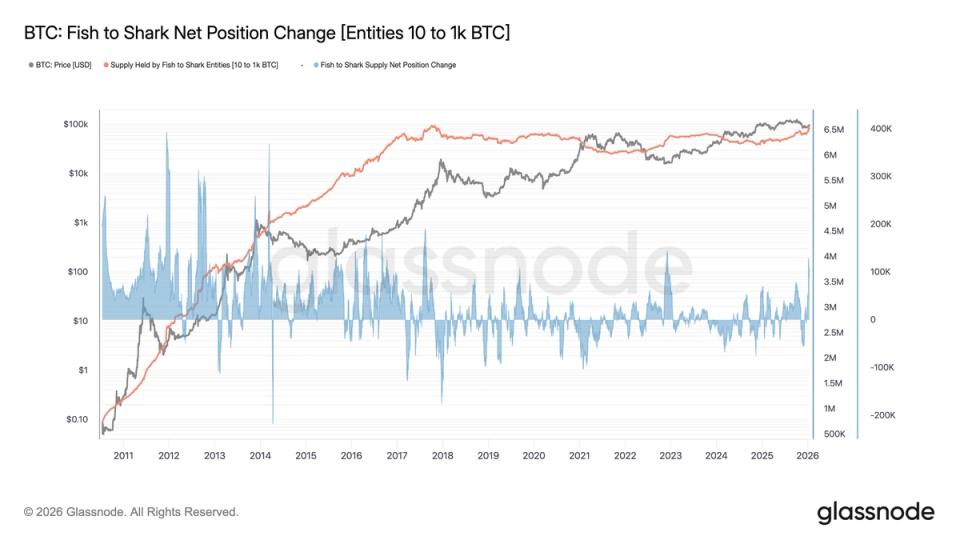
The so-called Fish-to-Shark cohort added 110,000 BTC over the past 30 days, according to Glassnode.

 Live Chat

The so-called Fish-to-Shark cohort added 110,000 BTC over the past 30 days, according to Glassnode.

Massive Coinbase News! Bitcoin Rips to $96,750! Football.Fun TGE Interview with Founder!

So far, BTC has remained still.
The dispute over Greenland continues as numerous countries from the European Union sent military personnel to the island in a so-called reconnaissance mission.
US President Donald Trump, who keeps claiming that his country needs to control the island, just announced a new set of tariffs against all nations that have sent troops.
In a post on his social media platform TruthSocial, the POTUS said the tariffs will impact Denmark, Norway, Sweden, France, Germany, the United Kingdom, the Netherlands, and Finland.
At first, the taxation will be 10% on all goods sent to the US starting from February 1, 2026. However, if there’s no deal for the acquisition of Greenland by June 1, the tariffs will increase to 25%.
BREAKING: President Trump announces a 10% tariff on Denmark, Norway, Sweden, France, Germany, the UK, Netherlands, and Finland beginning February 1st.
This tariff will be increased to 25% beginning on June 1st.
Tariffs will remain in effect until the US reaches a deal to buy… pic.twitter.com/978qAHjxao
— The Kobeissi Letter (@KobeissiLetter) January 17, 2026
In his statement, Trump emphasized that a deal means a “complete and total purchase of Greenland,” which, he claims, is essential for his country’s national security.
In a separate post on X, the analysts from the Kobeissi Letter estimated that $1.2 trillion worth of annual bilateral trade will be impacted under these new tariffs. They also asserted that the potential acquisition of Greenland would cost the US around $700 billion.
They warned that the US-EU trade war, which began last year shortly after Trump’s inauguration, just “escalated to a whole new level,” as it’s clear that Greenland has become the POTUS’s “top strategic focus.”
Recall that BTC’s price was among the worst-performing assets last year when Trump announced the first wave of tariffs against countless countries. It slumped from its then-ATH of $110,000 to under $75,000 in the span of just a few months.
Trump’s announcement from earlier today hasn’t harmed bitcoin’s price performance yet. The cryptocurrency trades inches above $95,000, showing little to no movement over the past 24 hours.

The US Department of Justice has charged a man for allegedly laundering $1 billion in criminal funds, using USDT on the Tron blockchain to help him do so.
Feds said in a statement that Venezuelan national Jorge Figueira, 59, allegedly made the transactions in “a scale of criminal conduct that poses a profound threat to financial systems and public safety.”
Court documents unsealed this month allege that Figueira’s cryptocurrency of choice was Tether’s USDT stablecoin, which he used to receive huge payments in digital tokens before converting them via liquidity providers into US dollars.
“Let me be clear with you, [USDT] is used a lot for laundering money,” Feds quoted Figueira saying in a phone call.
“It is used for what we are doing,” he continued. “It is used to transfer money in a quick way, even to make it get to jurisdictions that have some type of issues, etcetera,” he added, using China as an example.
Feds allege in court documents that blockchain analysts found the illicit money movements were made using the Tron blockchain — the crypto network founded by entrepreneur Justin Sun.
USDT, the most-traded digital asset, runs on a number of blockchains but transactions on Tron are faster and cheaper than other networks.
Figueira allegedly made many transactions to a number of crypto wallets before using liquidity providers to then convert the crypto to cash for American bank accounts.
But using USDT or other cryptocurrencies to launder money is nothing new, FBI Special Agent Stephen A. Walker said in the affidavit.
“The cryptocurrency ecosystem is often used by money launderers to receive money, and to launder it quickly, anonymously, and at scale,” Walker testified.
Walker added that “a series of convoluted transactions and quick swaps between financial accounts, whether traditional bank accounts or cryptocurrency wallets” often shows that money movements are being obfuscated.
Figueira allegedly received huge transfers for crooks, with feds quoting him boasting that he and his associates would manage sometimes up to $700 million per month, sending funds all over the world — from Colombia to China.
Court documents added Figueira allegedly said he could receive $100 million in a single transaction with his digital wallet.
The Justice Department said it had identified approximately $1 billion that moved through digital wallets used by Figueira and his operation to individuals and businesses throughout the world.
Figueira now faces up to 20 years in prison if convicted of conspiracy to launder money, the Justice Department said.
The Justice Department did not immediately respond to further questions from DL News.
DL News reached out to Tron’s press department for comment.
Mathew Di Salvo is a news correspondent with DL News. Got a tip? Email at mdisalvo@dlnews.com.

Institutional crypto platform Anchorage Digital is looking to raise hundreds of millions of dollars of fresh capital as it eyes a potential Initial Public Offering.
The raise would be in the $200 million to $400 million range, while a possible IPO is slated for sometime next year, according to a Bloomberg report on Friday, citing people familiar with the matter who asked to remain anonymous.
Anchorage’s affiliate, Anchorage Digital Bank National Association, became the first federally chartered crypto bank in 2021 and is now well-positioned to lead stablecoin issuance and related services following the passage of the GENIUS Act in July.
Anchorage CEO Nathan McCauley said in September that he planned to double the company’s stablecoin team over the next year to accommodate the expected boom in digital dollars.
“2025 was our year of scale. We made a series of acquisitions, inked major partnerships, and launched new business lines like stablecoin issuance to solidify our lead in institutional crypto,” an Anchorage spokesperson told Bloomberg.
One of those partnerships included Tether, the issuer behind the largest stablecoin, USDT, with the two companies announcing plans in September to launch a USAT token in the US.
Anchorage also provides custody, trading, and staking services for banks, hedge funds, and venture capital firms, acting as a regulated bridge for TradFi players to access crypto.
In December, Anchorage also expanded its wealth management arm through the acquisition of Securitize For Advisors and token lifecycle management by integrating Hedgey.
Related: Goldman Sachs CEO says CLARITY Act ‘has a long way to go‘
Anchorage secured $350 million in funding late 2021, led by KKR & Co, with participation from Goldman Sachs, GIC, and Apollo credit funds.
Anchorage’s valuation was marked at over $3 billion at the time.
Meanwhile, one of Anchorage’s crypto custody competitors, BitGo, filed S‑1 IPO paperwork to list on the New York Stock Exchange in September, while crypto trading platform Kraken filed an S-1 in November and is eyeing a public listing in early 2026.
Magazine: One metric shows crypto is now in a bear market: Carl ‘The Moo

Newrez plans to treat eligible cryptocurrency holdings as qualifying assets in its mortgage underwriting process, a move that could broaden access to home loans for crypto holders.
The change is expected to take effect in February across the lender’s non-agency products, covering home purchases, refinancings and investment properties. While borrowers can already use assets such as stocks and bonds in underwriting, crypto holders have typically been required to sell their positions.
At launch, Newrez said it will recognize Bitcoin (BTC), Ether (ETH), spot exchange-traded funds (ETFs) backed by those assets, and US dollar-backed stablecoins. The crypto assets must be held with US-regulated crypto exchanges or fintech platforms, brokerages or nationally chartered banks, the company said.
Under the policy, cryptocurrency holdings considered in underwriting may have valuations adjusted to reflect market volatility, while borrowers would still be required to cover closing costs and make mortgage payments in US dollars.
Newrez chief commercial officer Leslie Gillin said about 45% of Gen Z and Millennial investors own cryptocurrency, adding that the policy is aimed at broadening access to homeownership among younger buyers.
The move by Newrez follows policy discussions in the US over whether digital assets should be considered in mortgage risk assessments.
In June 2025, the US Federal Housing Finance Agency (FHFA) instructed Fannie Mae and Freddie Mac to develop proposals examining how to consider cryptocurrencies as assets in single-family mortgage risk assessments without conversion to US dollars.
Less than two months later, Wyoming Senator Cynthia Lummis introduced the 21st Century Mortgage Act, which would codify the FHFA directive.
Lummis said the bill addresses housing affordability challenges for younger Americans, adding that “the American dream of homeownership is not a reality for many young people” and that the legislation reflects the growing number who hold digital assets.
The bill was read twice in the Senate and referred to the Committee on Banking, Housing and Urban Affairs, where it has not advanced further.
Although limited in scope, a market already exists for crypto-backed home financing, allowing borrowers to use BTC or ETH as collateral.
Mauricio Di Bartolomeo, co-founder of Ledn, told Cointelegraph in June that some Bitcoin holders have used their assets to finance real estate purchases without liquidating them.
Magazine: Here’s why crypto is moving to Dubai and Abu Dhabi

The Ethereum Foundation has published a step-by-step plan to let Ethereum’s main chain validate blocks using zkEVM proofs, reducing the need for validators to re-run every computation themselves. The proposal, shared via X on Jan. 15 by Tomasz K. Stańczak, Co-Executive Director at the Ethereum Foundation, lays out the engineering work needed across Ethereum’s execution and consensus clients, plus new proving infrastructure and security processes.
zkEVM on L1 – the planhttps://t.co/KLz7PoH6q9
— Tomasz K. Stańczak (@tkstanczak) January 15, 2026
Already in July last year, the Ethereum Foundation announced its “zk-first” approach. Today, Ethereum’s validators typically check a block by re-executing the transactions and comparing results. The plan proposes an alternative: validators could verify a cryptographic proof that the block’s execution was correct.
The document summarizes the intended pipeline in plain terms: an execution client produces a compact “witness” package for a block, a standardized zkEVM program uses that package to generate a proof of correct execution, and consensus clients verify that proof during block validation.
The first milestone is creating an “ExecutionWitness,” a per-block data structure containing the information needed to validate execution without re-running it. The plan calls for a formal witness format in Ethereum’s execution specifications, conformance tests, and a standardized RPC endpoint. It notes that the current debug_executionWitness endpoint is already “being used in production by Optimism’s Kona,” while suggesting a more zk-friendly endpoint may be needed.
A key dependency is adding better tracking of which parts of state a block touches, via Block Level Access Lists (BALs). The document says that as of November 2025, this work was not treated as urgent enough to be backported to earlier forks.
The next milestone is a “zkEVM guest program,” described as stateless validation logic that checks whether a block produces a valid state transition when combined with its witness. The plan emphasizes reproducible builds and compiling to standardized targets so assumptions are explicit and verifiable.
Beyond Ethereum-specific code, the plan aims to standardize the interface between zkVMs and the guest program: common targets, common ways to access precompiles and I/O, and agreed assumptions about how programs are loaded and executed.
On the consensus side, the roadmap calls for changes so consensus clients can accept zk proofs as part of beacon block validation, with accompanying specifications, test vectors, and an internal rollout plan. The document also flags execution payload availability as important, including an approach that could involve “putting the block in blobs.”
The proposal treats proof generation as an operational problem as much as a protocol one. It includes milestones to integrate zkVMs into EF tooling such as Ethproofs and Ere, test GPU setups (including “zkboost”), and track reliability and bottlenecks.
Benchmarking is framed as ongoing work, with explicit goals like measuring witness generation time, proof creation and verification time, and the network impact of proof propagation. Those measurements could feed into future gas repricing proposals for zk-heavy workloads.
Security is also marked as perpetual, with plans for formal specs, monitoring, supply-chain controls like reproducible builds and artifact signing, and a documented trust and threat model. The document proposes a “go/no-go framework” for deciding when proof systems are mature enough for broader use.
One external dependency stands out: ePBS, which the document describes as necessary to give provers more time. Without it, the plan says the prover has “1–2 seconds” to create a proof; with it, “6–9 seconds.” The document adds a two-sentence framing that captures the urgency: “This is not a project that we are working on. However, it is an optimization that we need.” It expects ePBS to be deployed in “Glamsterdam,” targeted for mid-2026.
If these milestones land, Ethereum would be moving toward proof-based validation as a practical option on L1, while the timing and operational complexity of proving remain the gating factors.
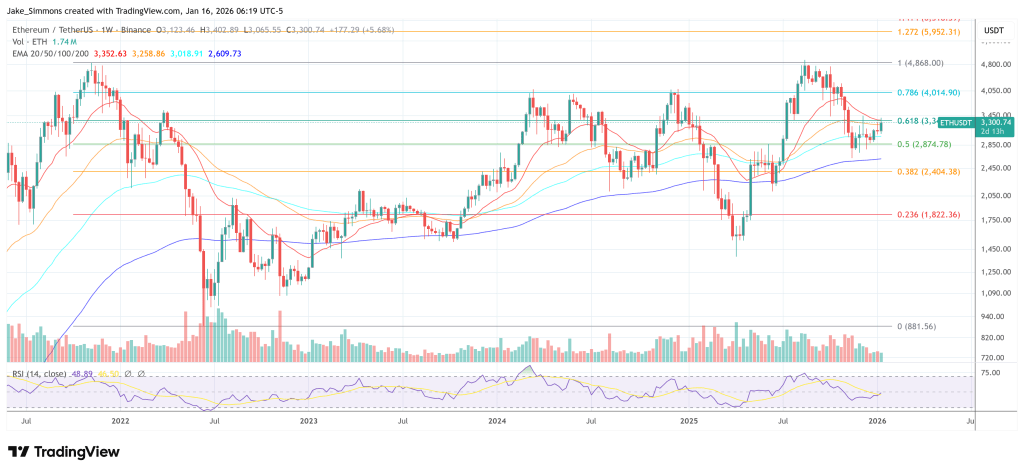
At press time, ETH traded at $3,300.
Featured image created with DALL.E, chart from TradingView.com

Editorial Process for bitcoinist is centered on delivering thoroughly researched, accurate, and unbiased content. We uphold strict sourcing standards, and each page undergoes diligent review by our team of top technology experts and seasoned editors. This process ensures the integrity, relevance, and value of our content for our readers.

Galaxy CLO 2025-1 totals $75 million and brings a private credit deal onchain.
Galaxy revealed on Jan. 15 that it has issued its first collateralized loan obligation (CLO) and tokenized the deal on Avalanche, a Layer 1 blockchain with a total value locked (TVL) of over $1.2 billion.
The instrument, dubbed Galaxy CLO 2025-1, totals $75 million and includes a $50 million allocation from Grove, an institutional credit protocol that operates as a Star, or SubDAO, within the Sky Ecosystem.
A CLO is a structured credit product that bundles corporate loans and sells them to investors across different risk tiers. Galaxy said the transaction will support its lending activities.
Avalanche said the CLO’s debt tranches were issued and tokenized on its network and are listed on INX for qualified investors. The network added that tokenization could enable lower-cost trading and faster settlement, while also improving transparency for investors.
“This transaction marks another meaningful step forward for onchain credit, demonstrating how familiar securitization structures can be brought onchain without compromising institutional standards,” said Sam Paderewski, co-founder at Grove Labs.
Paderewski added that Grove’s investment underscores its focus on supporting onchain tokenized credit products.
The allocation adds to Grove’s activity on Avalanche, according to the announcement. Grove previously deployed $250 million into tokenized real-world assets (RWAs) on the Avalanche network.
The announcement comes as more private credit products move onchain. Avalanche cited other institutional credit products already running on its network, including tokenized funds tied to Janus Henderson’s Anemoy Fund and Apollo’s ACRED.
Private credit remains the largest category in tokenized RWAs, with about $19.1 billion in onchain value, followed by tokenized securities, mainly Treasuries, at roughly $9 billion, according to a December report from RWAio.
AVAX, Avalanche’s native token, was trading around $13.74 on Thursday, down about 6.2% over 24 hours, according to CoinGecko. The token had roughly $388 million in daily trading volume.
Meanwhile, Galaxy (GLXY) shares were up about 13% on Thursday, trading around $31.90, according to Google Finance.

Since missing its Jan. 15 markup date and being pushed to the end of the month, the Digital Asset Market Clarity (CLARITY) Act is becoming a proxy fight over who gets to intermediate US dollar yield onchain — open decentralized finance (DeFi) protocols and payment rails, or a narrow club of large custodians and banks?
With the latest draft tightening how rewards on stablecoins can be offered, critics, including stablecoin issuers and institutional DeFi platforms, warn the bill risks exporting onchain credit offshore rather than making it safer in the United States.
Coinbase’s decision to pull support for the bill this week laid bare industry fears that the compromise has tipped too far toward incumbents, the text locking in a punitive model for DeFi and rewards.
Coinbase CEO Brian Armstrong argued that it was better to have “no bill than a bad bill,” and chief legal officer at Variant Fund, Jake Chervinsky, said that CLARITY was the kind of law that would “live for 100 years,” and “We can take all the time we need to get it right.”
Related: Coinbase CEO expects market structure bill markup ‘in a few weeks’
Clearpool onchain credit marketplace CEO and co-founder Jakob Kronbichler spoke to Cointelegraph about the CLARITY Act’s “core risk”: regulators deciding where yield is allowed to exist, instead of how risk is managed in onchain markets.
“Demand for dollar yield won’t disappear because of legislation,” he said, arguing that if compliant onchain liquidity structures are constrained, activity is “likely to move offshore or concentrate in a small number of incumbent intermediaries.”
Ron Tarter, CEO of stablecoin issuer MNEE and a former lawyer, echoed Kronbichler’s concerns, telling Cointelegraph, “If stablecoin rewards are pushed offshore rather than made transparent and compliant onshore, the US risks losing both innovation and visibility into these markets.”
“That choice will shape where institutional onchain credit develops over the next decade,” Kronbichler warned.
Tarter reads CLARITY as drawing a deliberate line between passive, deposit‑like interest and activity‑based incentives, adding that the key fulcrum is the phrase “solely in connection with holding.”
From his perspective, the bill is trying to mediate between banking groups worried that stablecoin yields could drain deposits and platforms viewing rewards as a core revenue stream and incentive.
Related: Crypto industry split over CLARITY Act after Coinbase breaks ranks
For now, Kronbichler sees one bright spot: CLARITY’s current approach “makes a sensible distinction by not treating developers of non‑custodial software as financial intermediaries,” something he calls critical for innovation and institutional comfort.
The real challenge, he argues, is keeping compliance obligations tied to entities that actually control access, custody, or risk parameters, rather than drifting toward general software maintainers who do not. If those lines blur, institutional desks will struggle to assess liability and may simply avoid US‑facing onchain credit products.
Tarter agrees that the developer control test will likely be one of the most contested flashpoints at markup, expecting fierce debate over what qualifies as truly decentralized software and “situations where a small group can materially control outcomes.”
Magazine: How crypto laws changed in 2025 — and how they’ll change in 2026
Amboss — data analytics for the Bitcoin Lightning Network — CEO Jesse Shrader sees a genuine consumer protection problem in rewards “simply for holding” that mask dilution or rehypothecation, pointing to past failures like Celsius and BlockFi.
He draws a sharp line between opaque, platform‑defined yields and activity-derived yields, which, he argues, are more transparent from a network design perspective.
For lawmakers looking to preserve that distinction, Shrader’s first ask is simple: require regulated tokens to disclose clearly “the sources of their yield so consumers can adequately assess their risk.”
What kind of CLARITY outcome would genuinely protect users without choking compliant onchain dollar markets for everyone involved?
“A light touch from regulators is appreciated,” Shrader said, while Tarter believes the win comes from US policy protecting users “without banning compliant innovation” (and without locking in a rewards regime that only the largest custodians can afford to navigate).

U.S. Senate Democrats are reportedly set to reopen talks with representatives from the cryptocurrency industry on Friday, according to people familiar with the plan speaking to CoinDesk.
All this comes less than two days after a last-minute postponement of a key Senate Banking Committee hearing on sweeping digital asset legislation.
The call follows Wednesday night’s abrupt cancellation of the committee’s planned markup of the long-negotiated crypto market structure bill, which had been expected to divide regulatory oversight of digital assets between the Securities and Exchange Commission (SEC) and the Commodity Futures Trading Commission (CFTC).
The delay came after Coinbase, the largest U.S.-based crypto exchange, withdrew its support for the draft legislation, citing concerns over stablecoin rewards programs and what it viewed as excessive authority granted to the SEC.
Coinbase CEO, Brian Armstrong, said that banks are trying to “kill their competition” with the crypto market structure legislation. “Crypto companies should be allowed to compete and offer loans just like banks,” Armstrong said.
Thursday marked a pause in public activity after the cancellation, but lawmakers and industry participants say negotiations are far from over.
Democrats from both the Senate Banking Committee and the Senate Agriculture Committee — which oversees the CFTC — are expected to join Friday’s call, along with representatives from crypto policy advocacy groups in Washington, according to reports.
The Banking Committee had been scheduled to hold an all-day session Thursday to debate amendments and vote on whether to advance the bill.
That plan unraveled late Wednesday after Coinbase CEO Brian Armstrong said the company could not support the current version of the legislation. Shortly thereafter, Senate Banking Committee Chair Tim Scott, R-S.C., postponed the hearing.
Despite the setback, several lawmakers involved in the negotiations said discussions will continue. In a post on X, Sen. Cynthia Lummis, R-Wyo., a leading crypto advocate in the Senate, said lawmakers were “closer than ever” to reaching agreement.
“Everyone is still at the negotiating table, and I look forward to partnering with [Chairman Scott] to deliver a bipartisan bill the industry — and America — can be proud of,” Lummis wrote Thursday.
Sen. Bill Hagerty, R-Tenn., echoed that optimism, saying he remained “confident” that lawmakers could reach a consensus “in short order.”
“I am fully committed to continuing this important work with my colleagues on market structure and look forward to passing legislation that ensures this innovative technology flourishes in the United States for decades to come,” Hagerty said.
Industry reaction to Coinbase’s withdrawal has been mixed. While Armstrong’s comments intensified scrutiny of the bill, other crypto executives and advocacy groups urged lawmakers to keep pushing forward.
Kraken co-CEO Arjun Sethi said abandoning negotiations now would worsen regulatory uncertainty for U.S. crypto firms. “Walking away now would not preserve the status quo in practice,” Sethi said in a post on X. “It would lock in uncertainty while the rest of the world moves forward.”
A major point of contention in recent negotiations has been whether stablecoin issuers should be permitted to offer rewards or yield programs — an issue that has drawn pushback from bank lobbyists and some Democrats concerned about consumer protection and competition with traditional deposits.
While the Banking Committee’s markup has been postponed, the Senate Agriculture Committee is still expected to hold a hearing on the legislation on January 27, after previously pushing back its own earlier session. Ultimately, both committees’ work would need to be merged before the bill could advance to the full Senate.
Some analysts see the delay as a strategic pause, with Benchmark’s Mark Palmer saying it could help lawmakers build broader bipartisan support and ultimately strengthen what he called a potentially historic overhaul of U.S. financial regulation.
Others are more doubtful: TD Cowen warned that bridging Democratic demands and Coinbase’s objections may be difficult, especially since some disputed provisions were already concessions to Democrats, while election-year timing and the Senate’s 60-vote threshold add further hurdles.


