The fund will allocate 30% to crypto tokens and 70% to financial services stocks, taking both long and short positions to capitalize on market shifts.

 Live Chat

The fund will allocate 30% to crypto tokens and 70% to financial services stocks, taking both long and short positions to capitalize on market shifts.

Disclosure: This is a paid article. Readers should conduct further research prior to taking any actions. Learn more ›
On January 19 (SGT), SUN.io, TRON’s flagship project, announced a strategic Chinese branding upgrade, reintroducing itself as “Sun Wukong” (“孙悟空,” the Monkey King) alongside a refreshed visual identity. Tapping into the deep cultural resonance of the legendary Monkey King, this move is designed to establish a strong cultural layer for TRON’s DeFi ecosystem—one that combines universal recognition with powerful narratives.
This rebranding sees SUN.io’s entire portfolio—including SunSwap, SUN DAO, SunPump, and SunX—unite under the “Sun Wukong” Chinese visual identity. This shared narrative transforms SUN.io from a collection of high-performance DeFi tools into a cohesive economic powerhouse, driving deeper synergy and liquidity across the TRON ecosystem.
This strategic blueprint is grounded in the robust foundation of proven track record and market standing that SUN.io has built over time. As a battle-tested flagship DeFi platform within the TRON ecosystem, SUN.io has become deeply integrated into the network’s financial fabric, serving as indispensable infrastructure and a critical liquidity hub that underpins its dynamic activity.
According to the official stats, SunSwap—the core decentralized exchange (DEX) in the ecosystem—boasts over $490 million in total value locked (TVL) as of January 8, with over 25,000 liquidity pools created. It has facilitated more than $340 million in trading volume over the past 7 days across more than 17,000 traders, handling approximately 90% of the total trading volume on the TRON network. Among these, TRX and USDT are the most actively traded assets, consistently maintaining a 24-hour trading volume north of $100 million.
On the other hand, the meme fair launch platform, SunPump, has demonstrated strong ecosystem vitality. Its AI-powered agent, SunGenX, has redefined meme coin creation on X through a simple one-click issuance service. Among the 100,000-plus tokens listed on SunPump so far, trending assets such as SUNDOG and PePe have been successfully listed on Binance Alpha, validating SunPump’s role as a powerhouse for innovative asset discovery.
In the derivatives vertical, the decentralized perpetuals exchange SunX (formerly SunPerp) is also growing at a rapid clip. As a key margin trading hub in the ecosystem, SunX has seen consistently rising trading volumes, alongside growing user engagement and deeper liquidity. As of January 8, SunX recorded a total trading volume of over 23.94 billion USDT, serving a cumulative total of more than 89,000 users, which has firmly established its position as the definitive destination for advanced trading.
Meanwhile, SunAgent, the ecosystem’s AI-powered trading tool, has completed a critical iteration. Featuring an intuitive chat interface, SunAgent acts as a seamless bridge across SunSwap, SunPump, and SunX. With a full suite of automated on-chain services spanning token issuance, swapping, staking, voting, and data queries, SunAgent dismantles the barriers to complex DeFi operations, delivering a fluid, capital-efficient experience to all SUN.io users.
The competitive edge of SUN.io derives from the architectural coordination of its product suite. Rather than operating in isolation, each product line functions as part of an intricately linked, mutually reinforcing system. Together, they form a cohesive growth flywheel that guides digital assets through the entire lifecycle from inception to maturity.
To start with, SunPump is the engine of this collaborative system that sets innovative ideas into motion. Leveraging the AI-driven launch tool SunGenX, SunPump streamlines asset creation to its simplest form, consistently funneling fresh liquidity and new users into the system. These nascent meme assets then find their way to SunSwap for initial liquidity and price discovery, translating novelty into market value.
While creating a streamlined pipeline for new assets to enter the market in synergy with SunPump, SunSwap takes it a step further, perpetuating initial liquidity into sustainable yield. Beyond providing efficient trading channels, SunSwap uses dynamic fee structures and diverse pools to reward liquidity providers, fostering a vibrant, healthy ecosystem.
For traders ready to move beyond the basics into complex risk management and margin trading, SunX steps in as a pivotal value multiplier. As the ecosystem’s specialized derivatives hub, SunX delivers a major breakthrough: it combines the high throughput of an off-chain order book with the efficiency of on-chain settlement, and offers a lightning-fast trading experience that rivals centralized exchanges—without compromising asset security.
To complete this loop, the buyback and burn program of the SUN token anchors the ecosystem in a self-sustaining value cycle. While SunSwap V2 allocates 0.05% of every transaction fee to SUN buybacks, SunPump and SunX go even further, committing 100% of their protocol revenue to the burn. According to official data, over 650 million SUN tokens have been permanently removed from circulation—representing more than 3% of the total supply. This sustainable mechanism systematically tightens the token’s circulating supply, fueling a self-reinforcing deflationary cycle.
Through this masterful architectural design, SUN.io has evolved beyond a mere collection of products into a self-driven, flourishing crypto economy. Looking ahead, the ecosystem will continue to perfect the journey from asset issuance to market liquidity and long-term appreciation, shaping itself into a sounder DeFi ecosystem.
SUN.io is TRON’s first integrated platform for swaps, farming, meme launches, on-chain governance, and perpetual trading. It has become the largest asset issuance and trading platform on the TRON blockchain and serves as a core hub of TRON DeFi.
Official Website Chinese Website

With the rise of Layer 2 networks like Arbitrum One and Arbitrum Nova, the Arbitrum gaming NFT ecosystem makes transactions faster, cheaper, and more reliable, allowing NFTs to function as true gameplay assets rather than mere collectibles.
If you’re exploring the NFT gaming ecosystem, this article highlights key gaming projects, marketplaces, and infrastructure powering Arbitrum GameFi. We also show how it shapes player engagement, token utility, and future growth potential, and how it compares with other blockchain gaming networks.
The Arbitrum gaming and NFT ecosystem has shown rapid growth, driven by its high-performance Layer 2 (L2) solutions and the adoption of Orbit-based Layer 3 (L3) networks. Here are the top Arbitrum gaming NFT projects to watch in 2026:
Games on Arbitrum One and Arbitrum Nova support item crafting, PvP battles, and NFT-based upgrades at scale, making high-frequency gameplay economically viable. Several projects stand out due to active communities, integrated marketplaces, and high on-chain activity. Below are some of the major Arbitrum-Powered NFTs games:
| Project | Description | Key Features | Token/NFTs |
| Big Time | Multiplayer action RPG with dungeon exploration and loot collection | Cross-game NFT equipment, PvE/PvP mechanics, high-resolution graphics | TIME token, in-game NFT gear |
| Pirate Nation | On-chain pirate RPG on Arbitrum Nova/Apex with PvP and collectible-driven gameplay | Fully on-chain characters, real-time battles, player-owned progression | Pirate NFTs, in-game assets |
| BattleFly | Strategy-based auto-battler integrated with the Treasure ecosystem | DAO governance, staking mechanics, play-to-earn rewards | BattleFly NFTs, MAGIC token |
| Spartadex | Gamified decentralized exchange combining NFT trading and gameplay | NFT staking, exchange-integrated rewards, leaderboard competition | Spartadex NFTs, platform token |
| The Beacon | Upcoming RPG with a large community and Epic Games Store integration | Community-driven beta, NFT-based progression, guild features | Beacon NFTs, in-game currency |
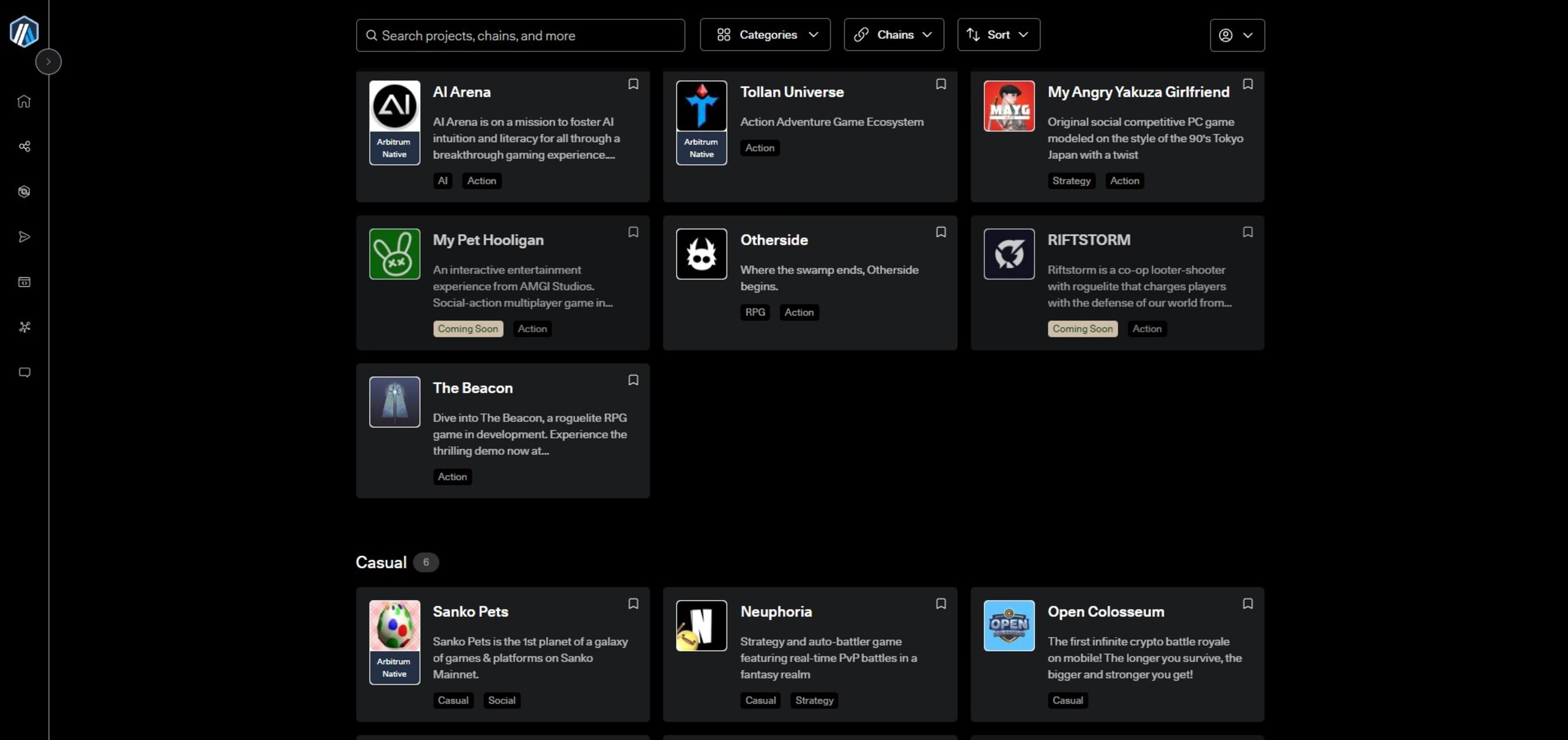
The Arbitrum GameFi ecosystem is the financial and infrastructure layer that supports blockchain gaming on the Arbitrum network. It merges gameplay with decentralized finance, allowing players to earn real value through NFTs, in-game tokens, staking, and yield-generating mechanics.
This ecosystem includes DAO-governed gaming studios, tokenized reward systems, decentralized marketplaces, and liquidity protocols that connect in-game assets with broader DeFi networks.
Players can stake Arbitrum-based tokens such as MAGIC or platform-native currencies to unlock features, participate in governance, or earn yields tied to game activity. Game developers benefit from Arbitrum’s scalable Layer 2 and Layer 3 infrastructure, low transaction fees, and Ethereum compatibility, which reduces the complexity of building high-frequency GameFi applications.
Meanwhile, ecosystem initiatives like Treasure DAO and Orbit chains provide funding, shared liquidity, and modular frameworks for new games and NFT economies. Together, these components support Arbitrum in being a leading hub for sustainable, token-driven GameFi innovations.
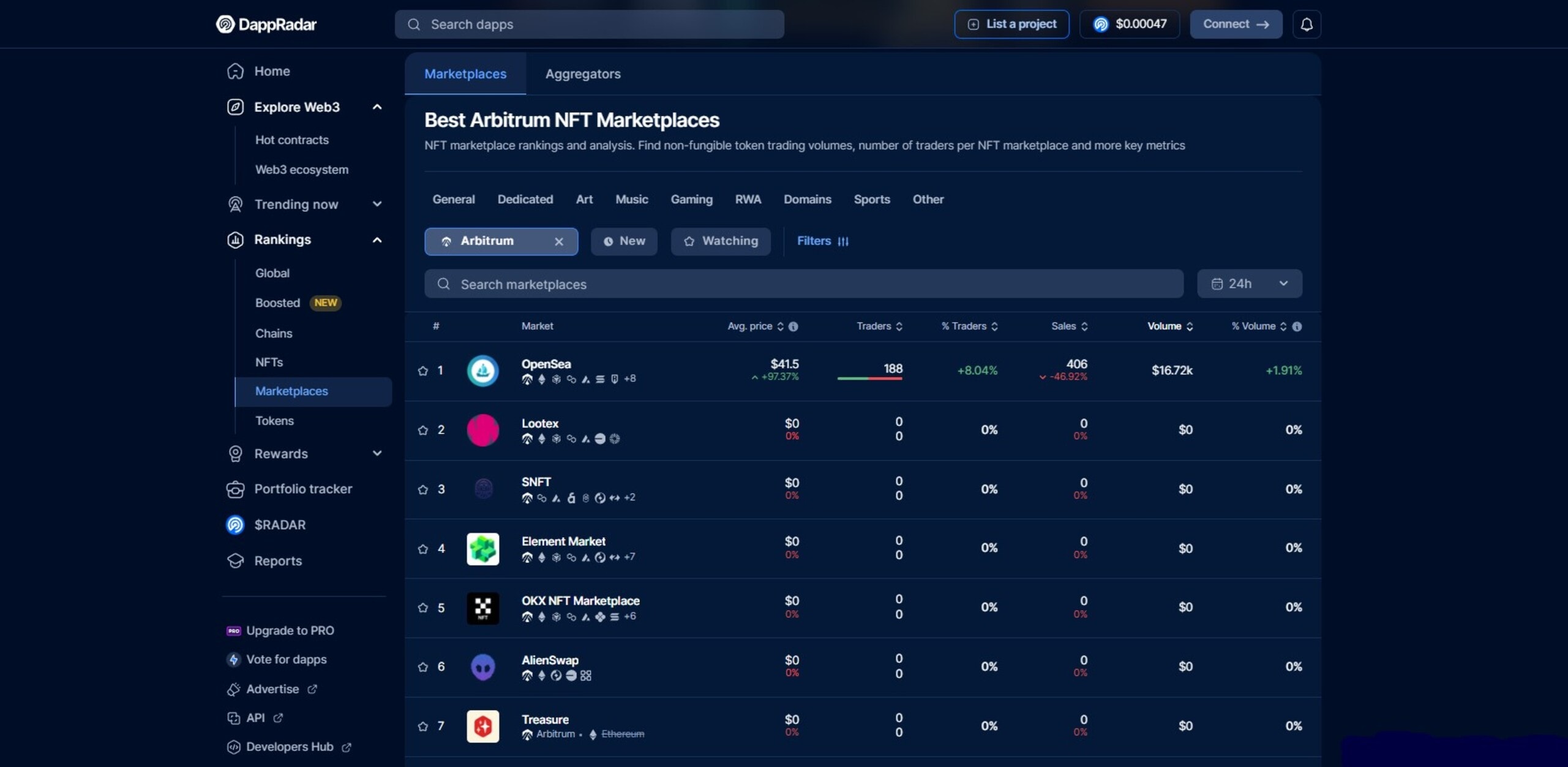
NFT marketplaces are the backbone of Arbitrum’s gaming ecosystem, providing liquidity, trading, and distribution channels for in-game assets such as characters, equipment, land, and collectibles. Multi-chain platforms like OpenSea support Arbitrum-native NFTs, enabling minting, listing, and secondary-market trading with reduced fees and fast confirmations.
Smart contracts on these platforms enforce royalty payments, verify asset authenticity, and enable trustless peer-to-peer transfers, ensuring secure and transparent NFT ownership. Specialized marketplaces also strengthen in-game economies by prioritizing utility over speculation.
Platforms like Treasure Marketplace and Smolverse integrate directly with gameplay dashboards, enabling players to acquire, upgrade, or trade assets without leaving the game. Meanwhile, cross-chain marketplaces such as OKX NFT Marketplace expand liquidity and exposure for Arbitrum gaming NFTs, connecting them to a broader digital asset ecosystem.
Arbitrum is the leading Layer 2 scaling solution that uses optimistic rollups to dramatically expand blockchain capacity while preserving core security guarantees. The network enables developers and users to run high-volume, decentralized applications such as gaming, DeFi, and NFT trading at a fraction of the cost of mainnet.
This architecture relies on sequencer networks, fraud-proof dispute systems, and customizable Orbit Layer 3 chains, all of which connect Layer 2 activity seamlessly back to Ethereum’s settlement layer. Rather than competing as a separate blockchain, Arbitrum acts as an efficiency multiplier, enabling assets and logic to gain practical utility across scaled environments.
Supporting this growth, initiatives such as the ARB DAO treasury, Gaming Catalyst Program, and dedicated gaming funds provide grants, shared infrastructure, and modular tooling to encourage sustainable development.
The network also has a native token, ARB, with a market cap of approximately $1.23 billion and a price of around $0.21. It also has a circulating supply of 5.83 billion tokens. Meanwhile, its DeFi TVL stands at about $2.91 billion, reflecting assets locked in protocols on the chain, alongside a stablecoin market cap of $3.46 billion.
Arbitrum saw 68% year-over-year growth to 119 Web3 gaming titles by late 2024, largely via Orbit’s 23 new networks. It ranks high in dApp activity, with $141.57 million in transaction volume alongside Ethereum’s lead, and web3 games accounting for 28.3% of 1.5 million daily active users across chains.
Over 600,000 monthly users engage with the network, supporting high-volume gaming transactions. However, you can see a similar, if not better, adoption trend with other chains, such as the SUI gaming NFT ecosystem and the Ethereum gaming NFT ecosystem. For better insight, let’s explore how Arbitrum gaming compares with other blockchain gaming platforms.
| Feature | Arbitrum | Sui |
| Type | Ethereum Layer 2 | Layer 1 Blockchain |
| Actual TPS | 6,000+ | 10,000 |
| Maximum TPS | 40,000 | 297,000 |
| Fees | $0.01, gasless gaming | $0.001 native |
| Gaming TVL | $3B+ | $300M+ |
| Ecosystem | 30+ Orbit games, Stylus Rust | Early Move-based games |
| NFT Support | ERC-721/1155 native | Object-centric model |
| Transaction Speed | Fast confirmations with rollup scaling | High throughput with parallel execution |
| Maturity | 3+ years, $18B TVL | 1 year, rapid growth |
| Security Model | Inherits Ethereum security | Independent validator network |
| NFT Compatibility | Full ERC-721 and ERC-1155 support | Native object-based NFT model |
| Feature | Arbitrum | Ethereum |
| TPS | 22x higher max TPS | 15-30 TPS |
| Block Time | 250ms | 12 seconds |
| Network Layer | Layer 2 scaling solution | Base Layer 1 blockchain |
| Transaction Fees | Significantly lower gas fees | High gas fees during congestion |
| Gaming Scalability | Optimized for high volume gaming activity | Limited scalability for real-time games |
| Security | Secured by Ethereum | Native base layer security |
| Developer tool | Stylus + EVM | Solidity only |
| TVL | $18B | $60B+ L1 |
Below are ways you can get started in Arbitrum’s gaming NFT ecosystem, from setting up a wallet to bridging funds, exploring games, and participating in communities to build valuable in-game assets.
Finally, track Arbitrum network upgrades, Layer 3 launches, and project announcements to optimize performance, maintain security, and identify new opportunities in gaming and NFT markets.
Arbitrum plays a pivotal role in Web3 gaming as an Ethereum Layer-2 solution, offering low fees, high throughput, and tools like the Orbit Framework for custom Layer-3 chains tailored to games.
Its Gaming Catalyst Program (GCP) and Gaming Ventures initiative provide grants and investments—such as a $10 million first wave from a 200 million ARB ($65 million) fund—to support developers building on-chain games. These efforts have driven ecosystem growth, positioning Arbitrum as a leader for mass-scale gaming adoption
Here, we explore the network’s scalability edge, specialized tools like Arbitrum One, Arbitrum Nova, and Arbitrum Orbit, plus innovations such as Stylus, all designed to enhance player immersion.
Arbitrum scales Ethereum through optimistic rollups that bundle thousands of transactions off-chain for secure settlement, reducing fees to mere pennies while achieving 40,000 TPS. This enables gamers to execute in-game actions, NFT trades, and loot drops instantly without network congestion.
Developers can predict costs in advance, avoiding volatile gas spikes that would otherwise impact profitability in high-player titles. As a result, block times drop to 250 milliseconds, matching traditional servers for real-time PvP battles or live events. The predictable, low-cost structure allows studios to implement free-to-play entry with optional NFT upgrades, onboarding new players without friction.
Arbitrum supports specialized chains like Arbitrum Nova, optimized for high-volume, low-cost gaming, and uses Data Availability Committees to reduce fees. It also provides tools through Arbitrum Orbit for creating custom “game rollups” that handle game-specific logic and microtransactions efficiently.
This setup ensures that high-frequency gameplay and NFT interactions remain smooth without congestion or unpredictable costs. Together, Arbitrum Orbit and Nova give developers a flexible, scalable infrastructure for both indie and AAA blockchain games.
Arbitrum Orbit allows developers to create custom Layer 3 chains for gaming, optimized for high-frequency transactions and NFT interactions. Each chain operates independently yet remains interoperable with Arbitrum One and Nova, enabling seamless asset flow across the ecosystem.
Developers can configure throughput, fees, governance, and data layers to ensure smooth performance for competitive, large-scale games. By isolating computation-heavy workloads at the L3 level, Orbit chains reduce congestion on parent networks and maintain consistent, low-latency gameplay.
This design is already being applied in production. Xai, for example, leverages Arbitrum Orbit to support AAA-style Web3 gaming with fast settlement and low fees. Sanko Network also uses Orbit to build a creator- and community-driven gaming ecosystem with its own economic and governance parameters.
Underneath all these, Arbitrum Orbit is powered by the Arbitrum Nitro stack, which ensures high scalability, full EVM compatibility, and efficient transaction compression. Support for Stylus further expands development flexibility by enabling smart contracts in Rust and C++ alongside Solidity, often at lower gas costs.
Developers can also choose between AnyTrust and traditional rollup data models, allowing them to balance cost efficiency, security, and privacy based on application needs.
Arbitrum Stylus introduces a second virtual machine to the Arbitrum stack, enabling smart contracts to run in WebAssembly (WASM) alongside traditional EVM contracts. This allows developers to write contracts in languages like Rust, C, and C++, leveraging decades of optimized compiler toolchains for efficient execution.
Stylus contracts execute faster and consume less gas for memory- or compute-intensive operations, making them ideal for on-chain games, DeFi, and generative applications. Fortunately, Stylus contracts remain fully interoperable, allowing hybrid applications to call between EVM and WASM seamlessly.
Stylus programs undergo coding, activation, execution, and fraud-proofing, ensuring security and determinism while maintaining Ethereum-level guarantees. During activation, WASM code compiles to native machine code with precise metering for safe and predictable operations.
Developers can port existing Rust, C, or C++ applications or optimize parts of Solidity contracts without rewriting from scratch. By combining high performance, low costs, and interoperability, Stylus enhances Arbitrum’s appeal as a developer-friendly platform for Web3 gaming and high-performance dApps.
Arbitrum improves gameplay by making blockchain interactions seamless, so players experience instant transactions without waiting. Simplified wallet connections and embedded accounts let new users join games quickly, reducing onboarding friction.
With gasless actions on Orbit chains, players can focus on strategy and progression instead of worrying about fees. They can also use the analytics dashboards to track in-game assets across titles, giving players a clear overview of their NFTs and tokens.
Aside from that, integrated social features, such as leaderboards, guilds, and chat systems, keep communities engaged around shared achievements. While mobile SDKs and offline caching maintain smooth gameplay even on limited network connections, making games accessible anywhere.
Below are the main risks and challenges developers and players face in Arbitrum’s gaming NFT ecosystem.
Arbitrum improves Web3 gaming with 250ms block times and over 6,000 TPS, which allows large player activity while securing $18B in assets. This performance enables ERC‑721 and ERC‑1155 NFTs that give players real ownership of items across games. That ownership becomes more powerful through Stylus, which supports Rust, C++, and Solidity for advanced gameplay logic.
This technical base then attracts Web2 studios seeking smoother blockchain integration. Because studios onboard faster, wallets like Session and Wildcard simplify access through email or social login.
This easy entry connects players to DeFi tools such as Uniswap, Aave, and GMX for in-game earning. Games like Otherside and Golden Tides demonstrate these connected economies. This growth then creates demand for scalable gaming infrastructure.
To meet this demand, Orbit-powered Layer 3 chains provide custom gaming rollups. These chains support cross-game assets and VR experiences. Governance through DAOs organizes communities and marketplaces. Together, these systems position Arbitrum as a long-term gaming foundation.
Arbitrum’s ecosystem enables fast, low-cost, and secure gaming experiences, letting players truly own and trade NFTs across multiple titles. The combination of Stylus, Orbit-powered Layer 3 chains, and wallet integrations empowers developers to create immersive, real-time, and interconnected gameplay.
These features support sustainable P2E models and vibrant in-game economies while attracting both indie and AAA studios. Ultimately, Arbitrum delivers a flexible, scalable, and player-focused infrastructure that enhances engagement, ownership, and long-term growth in Web3 gaming.
The best NFT depends on your goals. However, some of the top options include Treasure DAO, which historically dominates Arbitrum’s gaming NFT space, accounting for over 95% of network gaming transactions. Other options are Pirate Nation and Spartadex. The first offers fully on-chain pirate-character NFTs, while the latter combines gaming with exchange mechanics and boasts a high number of active wallets.
It depends on your priorities and the type of game you want to play. Arbitrum NFTs offer faster transactions, lower fees, and smoother gameplay for high-volume games, while Ethereum NFTs benefit from a larger community, broader marketplaces, and stronger long-term liquidity. Choosing the better option depends on whether you value speed and affordability or ecosystem size and established credibility.
Yes, investing in Arbitrum NFTs can be safe if you research the game, the developers, and the NFT’s utility. The platform benefits from Ethereum-level security and audited smart contracts, but market risks still exist.
Yes, it is possible to earn money playing NFT games, but income depends on the game’s economy, your skill, and strategy. Play-to-earn models allow players to earn NFTs, tokens, or other rewards that can be sold or staked.

Full Name: Shivani Gade
Designation: Senior Full Stack Consultant
Company: Oracle Financial Services Software Limited
Country: United States
I have successfully earned the Certified Enterprise Blockchain Architect (CEBA)™ credential from 101 Blockchains.
Operating at the intersection of industry and academia, I required a curriculum that could satisfy rigorous architectural standards while addressing practical enterprise demands. With over 9 years of experience in financial systems and currently pursuing a PhD in Information Systems Engineering & Management, I needed a program that moved beyond hype. 101 Blockchains provided that balance, offering a structured approach to DLT that complements my doctoral research.
At 101 Blockchains, you don’t just earn certifications — you gain real-world skills that shape you into a confident blockchain professional.
The program acted as a conceptual bridge between my work with traditional payment rails and decentralized networks. The architectural frameworks were instrumental to my current research on mapping legacy systems to blockchain, giving me the technical depth to design viable migration paths for complex enterprise environments.
It has become a cornerstone in my professional development toward becoming a Distinguished Engineer. The certification has strengthened my authority as a Full Stack Consultant while providing the necessary scaffolding for my dissertation work on future-ready financial infrastructures.
Treat this certification as the “backbone” of your career. Regardless of your tenure in the industry, starting from a verified baseline is essential. It provides the structural knowledge required to navigate the complexities of this evolving field.
From learners to leaders — explore the success stories of 100,000+ professionals with 101 Blockchains.
Absolutely. While my roots are in Fintech, this education is vital for anyone interested in building futuristic architectures in any domain. Whether you are a developer or a researcher, this program provides the blueprint for designing the next generation of resilient, decentralized systems.

Spot market conditions for Bitcoin are showing early signs of improvement with increased trading volume and decreasing sell-side pressure, according to analysts from Glassnode.
There has been a “modest” lift in spot Bitcoin (BTC) trading volume, “while the net buy–sell imbalance has broken above its upper statistical band,” reported Glassnode on Monday.
This is signaling a “clear reduction in sell-side pressure,” but despite this, spot demand “remains fragile and uneven,” it added.
Bitcoin declined almost 3% from its weekend high of $95,450 to trade at around $92,550 at the time of writing as markets continue to digest the fallout from the latest escalation in the US/EU trade war.
The asset remains up 6% since the beginning of the year.
“Overall, Bitcoin remains in consolidation, but internal conditions are improving,” said Glassnode, adding that markets are gradually rebuilding.
“While defensive positioning persists, strengthening buy-side dynamics and renewed institutional interest suggest a gradual rebuild toward a more constructive market structure.”
Gracie Lin, CEO at OKX Singapore, told Cointelegraph on Tuesday that the report suggests the market has absorbed much of the late-2025 profit-taking and that sell-side pressure is easing.
“Long-term holders appear less inclined to sell into every rally, while ETF flows continue to show institutions buying pullbacks,” she said.
“With fresh tariff headlines, softer growth signals across parts of APAC, and record gold prices in the background, that strengthens the case for Bitcoin being treated less as a short-term trade and more as a portfolio hedge — even as volatility remains a feature of the asset.”
Related: Bitcoin futures OI rebounds 13% as analysts see cautious return of risk appetite
Analysts at Swissblock said the decline in Bitcoin network growth and a recent liquidity drain resemble conditions last seen in 2022.
Similar network levels back then “triggered a BTC consolidation phase as network growth began to recover, even while liquidity remained weak and bottomed out,” they added.
“History shows that the subsequent surge in both metrics fueled the major bull run,” said Swissblock.
Magazine: Wintermute on crypto recovery, BTC allocation cut on quantum risk: Hodler’s Digest
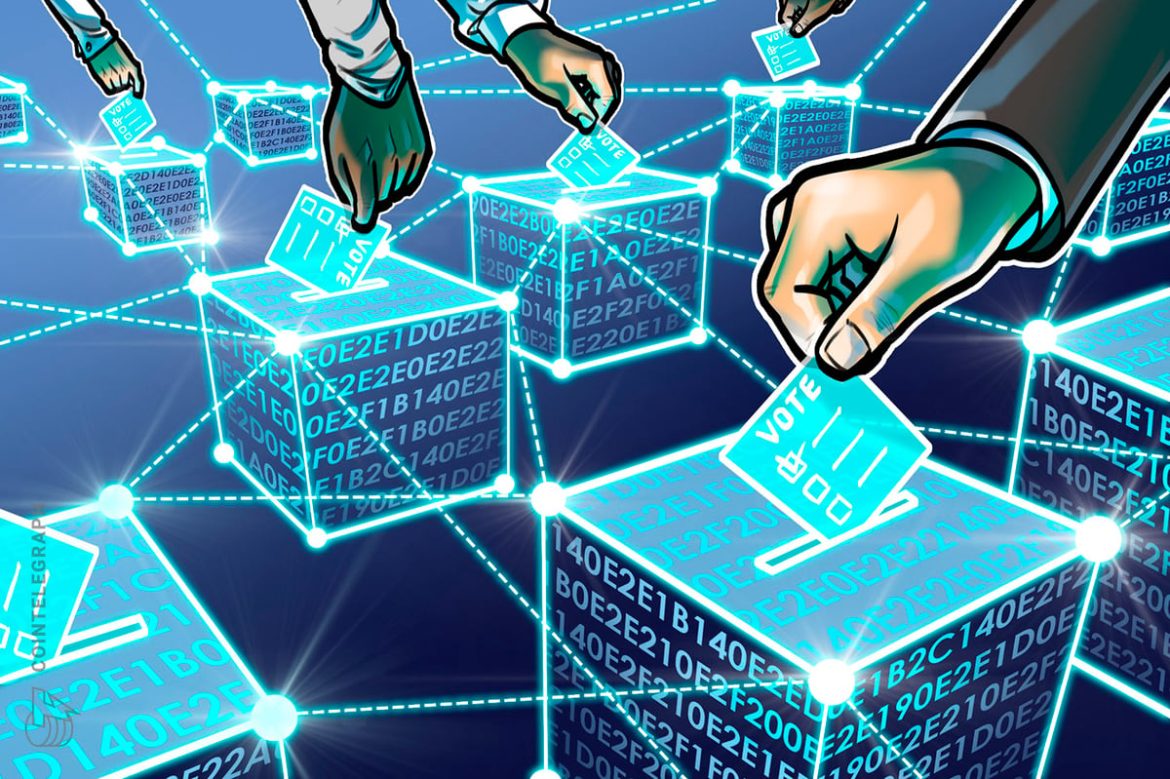
Injective’s protocol community approved a major tokenomics overhaul on Monday, passing a governance proposal with 99.89% support based on staked voting power.
Injective is a layer-1 blockchain focused on decentralized finance applications, with INJ (INJ) serving as its native token for staking, governance and transaction fees.
The Supply Squeeze proposal (IIP-617) reduces its native token issuance and maintains the network’s buyback-and-burn program, which uses protocol-generated revenue to permanently remove tokens from circulation.
The network said it has removed about 6.85 million INJ from circulation through token burns. The proposal is designed to accelerate tokens removal by aligning reduced issuance with recurring buybacks.
According to an X post from Injective on Monday, the governance changes, which are live, will enable “INJ to become one of the most deflationary assets over time.”
The governance vote follows a prolonged downturn in INJ’s market price amid a broader altcoin sell-off. Over the past year, INJ has fallen nearly 80% and is down more than 90% from its all-time high achieved in March 2024. The token was down about 8% on Monday, according to CoinGecko data.
Community reaction on X after the vote was mostly optimistic, with users framing it as a structural shift rather than a short-term market catalyst.
According to DefiLlama data, at time of writing Injective had $18.67 million in total value locked (TVL) across its DeFi ecosystem, down sharply from peaks above $60 million in 2024.

Related: After bitter vote, Aave founder pitches bigger future for DeFi lending giant
Despite declines in INJ’s price and the network’s total value locked, Injective continued to attract institutional engagement in 2025, spanning regulated investment products, validator participation and new financial market offerings.
In July, Cboe and Canary Capital both filed regulatory applications for a staked Injective exchange-traded fund (ETF), with each seeking to list a fund that would hold and stake INJ to generate rewards through an “approved staking platform.”

Injective also continues to expand its validator set. In February, Deutsche Telekom’s IT services subsidiary, Deutsche Telekom MMS, joined the network as a validator.
More recently, Korea University became the first academic institution to operate a validator and conduct onchain research on the network, according to an announcement on Wednesday.
Magazine: Davinci Jeremie bought Bitcoin at $1… but $100K BTC doesn’t excite him

The cryptocurrency market will welcome a wave of tokens worth more than $1.054 billion in the third week of January 2026. Major projects, including Bitget Token (BGB), LayerZero (ZRO), and River (RIVER), will release previously locked supplies over the next seven days.
These unlocks could increase short-term volatility and influence price movements. So, here’s a breakdown of what to watch in each project.
Sponsored
Sponsored
BGB is a unified ecosystem token for both the centralized exchange Bitget and Bitget Wallet. As a utility token, it provides functional benefits within the Bitget ecosystem, such as trading fee discounts, participation in platform activities, and access to additional perks.
On January 26, the team will release 140 million BGB, worth $518 million. The tokens account for 10.5% of the released supply.
The team will split the unlocked supply two ways. Bitget will allocate 80 million tokens for team incentives. Furthermore, it will direct 60 million altcoins for branding and promotion.
Sponsored
Sponsored
LayerZero is an interoperability protocol that connects different blockchains. Its primary goal is to facilitate seamless cross-chain communication. Thus, it enables decentralized applications (dApps) to interact across multiple blockchains without relying on traditional bridging models.
The team will unlock 25.71 million tokens on January 20, representing 6.36% of the released supply. Moreover, the supply is worth approximately $43.96 million.

LayerZero will award 13.42 million altcoins to strategic partners. Core contributors will get 10.63 million ZRO. Lastly, 1.67 million ZRO are for tokens repurchased by the team.
River is a protocol focused on creating a chain-abstraction stablecoin system. It allows users to collateralize assets on one chain and mint on another, enabling native earning, leverage, and scalability across multiple networks.
The team will unlock 1.5 million RIVER, worth approximately $39.83 million, on January 22. The tokens represent 4.32% of the released supply. Furthermore, investors will receive the entire unlocked supply.

In addition to these, other prominent unlocks investors can look out for in the third week of December include Plume (PLUME), Humanity (H), Undeads Games (UDS), and more, which will contribute to the total market-wide releases.


You might have millions of nodes verifying everything, but if only experts grasp the guts, everyday users still depend on developers. Self-sovereignty means anyone can truly own and run their node without blind faith.
Buterin fears Ethereum bloating from feature creep. Short-term wins like niche cryptography add functionality fast, but they erode long-term resilience. Trustlessness vanishes when users lean on “high priests” decoding PhD-level math. The walkaway test flops if new teams cannot maintain abandoned code. Self-sovereignty slips away for non-experts unable to audit protocols.
He pushes three simplification metrics. First, shrink code to fit a few pages; less code means fewer bugs. Second, ditch complex dependencies—stick to basic hashes over lattices or isogenies (advanced math few understand). Third, lock in invariants, core rules like gas limits simplifying client work. Ethereum’s EIP-6780 killed selfdestruct, capping storage changes per block.
An important, and perenially underrated, aspect of “trustlessness”, “passing the walkaway test” and “self-sovereignty” is protocol simplicity.
Even if a protocol is super decentralized with hundreds of thousands of nodes, and it has 49% byzantine fault tolerance, and nodes fully… pic.twitter.com/kvzkg11M3c
— vitalik.eth (@VitalikButerin) January 18, 2026
Garbage collection fights bloat. Piecemeal tweaks streamlined gas costs in Glamsterdam, tying fees to real resources. Big sweeps swapped proof-of-work for proof-of-stake. Future “Lean consensus” could scrap mistakes wholesale. Rosetta-style compatibility demotes old features to smart contracts, freeing new clients. Swap EVM for RISC-V? Old code runs as contracts.
Buterin eyes Ethereum’s first 15 years as adolescence, wild experimentation yielding gems and junk. Protocols must slow evolution, shedding dead weight for a “hundred-year hyperstructure” outlasting empires. Complexity invites exploits; simplicity endures.
Vitalik Buterin urges building better DAOs to overcome current flaws in crypto governance. Ethereum envisioned DAOs as superior, code-driven alternatives to corporations and governments, but today’s token-voting treasuries prove inefficient, prone to whale capture, and politically weak. Still, DAOs remain essential for better oracles (fixing stablecoin vulnerabilities), onchain disputes, trusted lists, quick projects, and long-term maintenance. He contrasts “concave” problems needing consensus against attacks with “convex” ones favoring decisive leaders under checks.
We need more DAOs – but different and better DAOs.
The original drive to build Ethereum was heavily inspired by decentralized autonomous organizations: systems of code and rules that lived on decentralized networks that could manage resources and direct activity, more…
— vitalik.eth (@VitalikButerin) January 19, 2026
Solutions lie in ZK privacy, AI to combat decision fatigue (user-controlled, not takeover), and advanced forums like Pol.is. Examples like MakerDAO’s whale issues highlight needs; trends show $15B DAO treasuries but poor turnout. New designs must prioritize oracles and communication equally. This ensures Ethereum’s robust base layer extends upward, creating enduring decentralization.


The information provided by Altcoin Buzz is not financial advice. It is intended solely for educational, entertainment, and informational purposes. Any opinions or strategies shared are those of the writer/reviewers, and their risk tolerance may differ from yours. We are not liable for any losses you may incur from investments related to the information given. Bitcoin and other cryptocurrencies are high-risk assets; therefore, conduct thorough due diligence. Copyright Altcoin Buzz Pte Ltd.
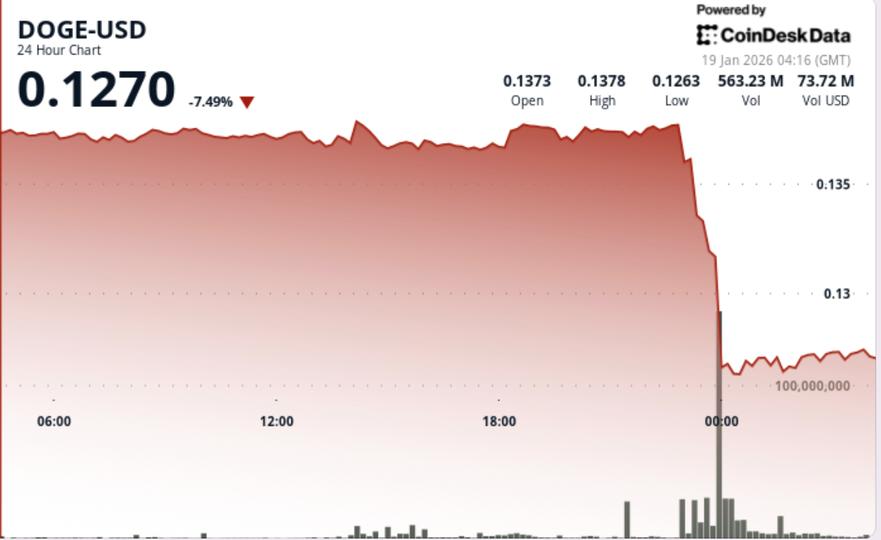
Traders are watching $0.127 as near-term support, with $0.137 now the key level DOGE must reclaim to stabilize.

FanDuel becomes first sports gaming operator to offer some form of event contract trading nationwide
FanDuel unveiled its prediction market platform, FanDuel Predicts, just before Christmas, following the launches of similar prediction products from some of its biggest sports betting and fantasy sports competitors.
This week, FanDuel Predicts became available in all 50 states, making FanDuel the first sports gaming operator to have a prediction market presence nationwide. The event contract trading platforms from Fanatics and DraftKings, as well as ones from DFS heavyweights PrizePicks and Underdog, still limit access to certain states.
Launched on Dec. 22, access to the FanDuel Predicts app was available in just five states initially, with the company saying at the time that it intended to offer event contracts in all states. The timeline accelerated this week, with gaming industry reporter Dustin Gouker noting on Jan. 14 that product availability had expanded to 18 states, including California, Texas, and Florida, and that it was “coming soon nationwide.”
“Soon” turned out to be the very next day. On Thursday, FanDuel Predicts was accessible in every state, but with limited market selection in the additional jurisdictions. Specifically, the platform’s sports event contracts are not available to traders in the 32 newly added FanDuel Predicts states. Users in those states only have access to the platform’s finance, economic and commodities markets.
FanDuel is generally avoiding offering sports prediction markets in states that have legalized sports betting. But some of the states in which FanDuel Predicts offers sports event contract trading do allow limited sports betting activity. States like New Mexico, Nebraska and North Dakota only permit in-person sports betting at retail sportsbooks, while others, like Florida and Delaware, only allow a single licensed online sportsbook to offer sports wagering statewide.
FanDuel is limiting its sports prediction markets to states without broad, regulated online sports wagering in part to avoid running afoul of state gaming authorities, which have increasingly signaled they consider sports event contracts to be unlicensed sports betting. Some regulators have explicitly warned that offering event contracts could jeopardize existing licenses in their state. In Arizona, gaming regulators moved to revoke Underdog’s DFS license because of its prediction‑market partnership with Crypto.com. FanDuel Predicts is not available in any state currently embroiled in legal battles with prediction platforms over their right to offer sports markets.
FanDuel Sportsbook does not operate in any of the 18 states FanDuel Predicts is offering sports event contract trading. FanDuel could restrict access to sports markets in one or more of those states in the future. When the product launched, FanDuel stated in a news release that “as new states legalize online sports betting, FanDuel Predicts will cease offering sports event contracts in those states.”
Here are the 18 states in which users can trade on sports outcomes via FanDuel Predicts:
FanDuel Predicts markets are facilitated by the CME Group, a full-service CFTC-approved prediction exchange. CME, a well-established and respected derivatives marketplace, also currently powers the event contracts at DraftKings Predictions.
FanDuel Predicts offers sports event markets for game winners, point totals and point spreads across several major U.S. sports leagues, including the NFL, NBA and NHL, as well as NCAA football and basketball.
Users in states without sports access can trade on the platform’s financial markets, including contracts on stocks, crypto, indices and economic indicators, as well as oil, gold and agricultural commodities.
The FanDuel Predicts app is fast loading and easy to navigate, making browsing and trading easy and friction-free. The layout is fairly bare-bones, stylistically matching the look of FanDuel Sportsbook. It’s a little less visually inviting than Kalshi’s interface, more closely resembling how markets are shown at Crypto.com and most other prediction platforms, with minimal aesthetic bells and whistles.
The layout has the three main sections — Commodities, Financials and (where available) Sports — across the top of the app, with a toolbar across the bottom providing quick access to your orders, a solid search feature, a “Learn” section that offers several basic FAQs, and the homepage.
The homepage shows a few popular markets; there and in the individual market sections you can choose how the market odds are shown. You can view the prices as a percentage (the common odds method used on most prediction platforms), as cents-per-contract, as +/- odds (which most U.S. sportsbooks use), or as multipliers, showing the potential return ratio (like “1.66x”). Kalshi has a similar feature that can be adjusted in the settings, but FanDuel Predicts provides access to it directly on the section pages.

Contract pricing, determined by trading activity and not set by the platform itself, is the same as what you’ll find at DraftKings Predictions, as they currently share the same market provider, CME Group. FanDuel Predicts’ pricing is also very close to Kalshi’s.
Though there are likely some exceptions, when comparing a few economic markets on both Kalshi and FanDuel Predicts, we found the odds to be mostly identical. For example, in markets for what the U.S. unemployment rate will be in January, both had “Yes” contracts for the rate to be above 4.6% at $0.22 a piece. Even for contracts that are closer to 50/50, the pricing is very similar. A successful $100 trade on the 4.6% unemployment rate contract would net a payout of $451 on Kalshi and $454 on FanDuel Predicts.
FanDuel Predicts charges a 2% “transaction fee” on all trades, based on the maximum potential payout of your order. If you sell your position prior to the market settling, the same 2% fee is applied to the original potential payout amount. The fee structure is a little more transparent and easy to understand than the trading fees at Kalshi, where taker fees are determined by a formula that takes into account trade size and a variable fee rate, typically coming out to around 1-2%. Using the $100 unemployment market trade example above, Kalshi’s fees were $5.24, while the transaction fee at FanDuel Predicts was $9.08.
By going nationwide with its prediction markets, FanDuel is aiming to capture market share ahead of its sports gaming competitors.
DraftKings Predictions launched in 38 states, with sports contracts limited to 17 states. Delaware is the only state in which FanDuel Predicts offers sports markets but DraftKings Predictions does not. Like FanDuel Predicts, DraftKings Predictions only features CME Group markets for sports and finance/economics. The company has said it also intends for its Predictions product to be available nationwide.
Access to Fanatics Markets, the first predictions product from a traditional online sports betting company, is currently limited to 24 states. Fanatics Markets, which features event contracts from partner Crypto.com, does not split the types of markets available in different states. So users in each of the states in which Fanatics Markets launched can trade on prediction markets related to sports, finance, politics and culture/entertainment.
Which company known for its traditional sports betting products will join FanDuel, Fanatics and DraftKings and enter the prediction market fray next remains unclear, as most have taken a “wait and see” approach publicly. But it’s likely that another sports wagering operator will test the prediction market waters soon, as the performance and regulatory challenges faced by DraftKings, FanDuel, and Fanatics become more evident.

Mike Breen
Mike Breen has been a professional writer and editor covering a wide range of topics for more than 30 years. He’s been a freelance gaming industry writer since 2020, reporting on sports betting, online casinos, and more for various Catena Media sites, and he began reporting on prediction market industry news in 2025 for Prediction News. Prior to that, Mike was a founding editor at his hometown altweekly newspaper in Cincinnati, Ohio, where he extensively covered local arts, music and news.Mike’s published writing has received recognition and several awards from organizations like the Society of Professional Journalists and the Association of Alternative Newsmedia.When Mike is not working, Mike enjoys playing and listening to music, attending comedy shows, watching movies, and spending time with his family and three cats.


