

Key Takeaways
- ▸ The DOJ and CFTC’s coordinated action against Van Dyke sets a landmark precedent: using classified government information to trade on prediction markets is prosecutable under existing federal law.
- ▸ Polymarket flagged the suspicious account and referred it to the DOJ, a meaningful data point in the ongoing debate over whether offshore prediction markets can and will police themselves.
- ▸ The Maduro trades were one of several suspicious trading patterns in 2026, prompting ongoing scrutiny of existing insider trading rules and enforcement.
The suspected inside trader who netted more than $400K on well-timed trades related to the capture of former Venezuela president Nicolas Maduro has finally been named. The Department of Justice today unsealed an indictment against Gannon Ken Van Dyke, a U.S. Army Special Forces master sergeant, charging him with using classified military intelligence to place winning bets on Polymarket, netting around $404,000 on a mission he helped plan and execute.
The charges, outlined in a DOJ press release, represent what appears to be the first-ever federal insider trading prosecution on a prediction market platform, ABC News first reported Thursday evening.
The Maduro insider trading plot
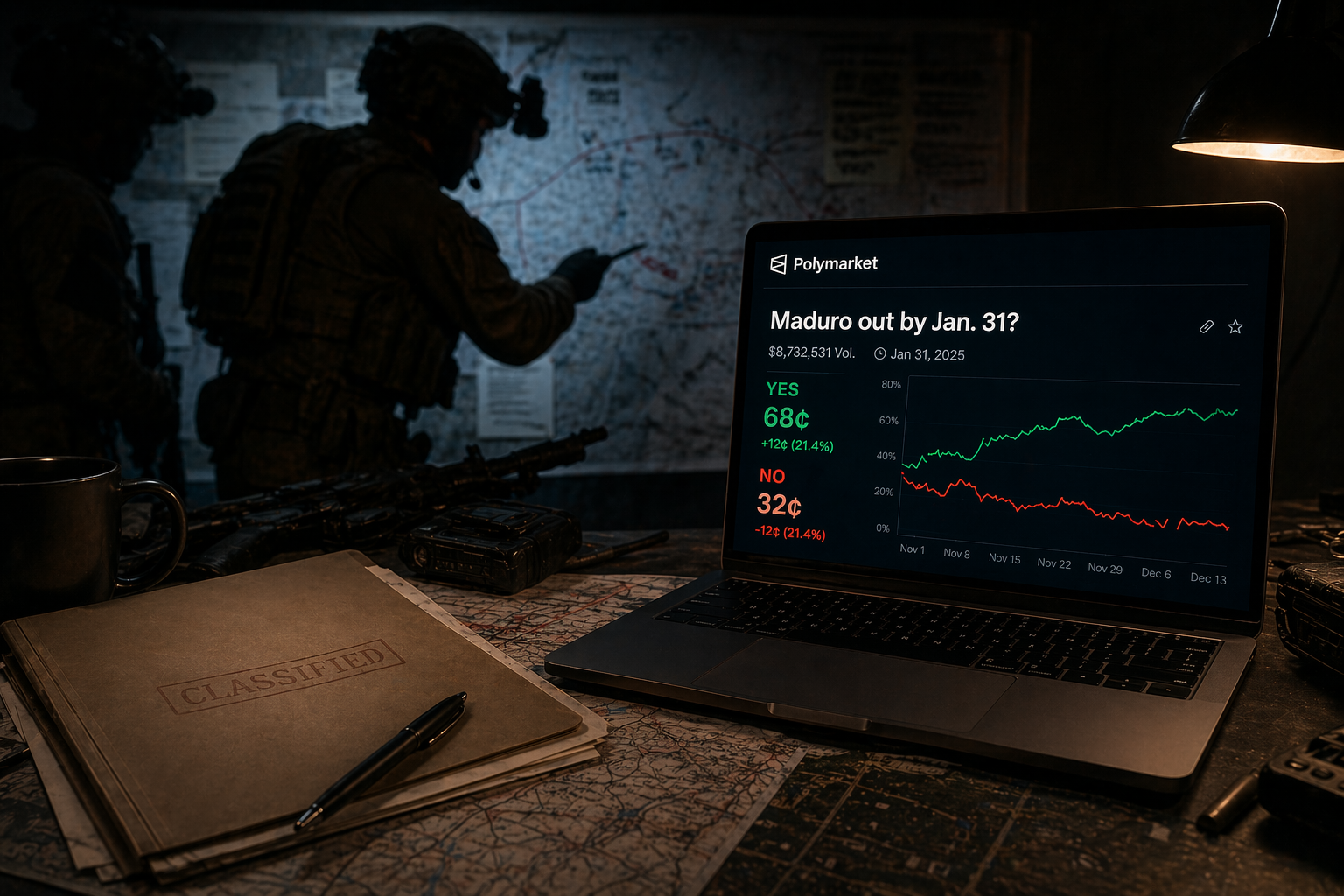
Van Dyke created a Polymarket account on Dec. 26, 2025, funded it, and began trading on Maduro- and Venezuela-related markets. He made approximately 13 trades through the evening of Jan. 2, 2026, all taking the “Yes” position on outcomes including “U.S. Forces in Venezuela by January 31,” “Maduro out by January 31,” and related contracts, betting a total of approximately $33,034 while in possession of classified nonpublic information about Operation Absolute Resolve.
The largest single position, a $32,537 bet that Maduro would be out of office by January 31, resulted in a 1,242% profit of $404,222. In the predawn hours of Jan. 3, U.S. forces apprehended Maduro and his wife at a residence in Caracas. Hours later the president announced the operation publicly. Polymarket resolved the relevant contracts to “Yes,” and Van Dyke’s total alleged profit came to approximately $409,881.
Then he tried to cover his tracks. Van Dyke sent most of his proceeds to a foreign cryptocurrency vault before depositing them into a newly created online brokerage account, and asked Polymarket to delete his account, falsely claiming he had lost access to his email, according to the DOJ release.
The exit plan hit a snag, however. Polymarket flagged the account, referred the matter to the DOJ, and cooperated with the resulting investigation, saying on X that the arrest proved its systems worked.
Last month, we published our enhanced market integrity rules to combat insider trading.
When we identified a user trading on classified government information, we referred the matter to the DOJ & cooperated with their investigation.
Insider trading has no place on Polymarket.…
— Polymarket (@Polymarket) April 23, 2026
The charges against Van Dyke
Van Dyke faces counts of unlawful use of confidential government information for personal gain, theft of nonpublic government information, commodities fraud, wire fraud, and making an unlawful monetary transaction. The CFTC filed a parallel civil complaint on the same allegation, a significant pairing that backs up recent claims from CFTC chair Michael Selig about making prediction market integrity a serious enforcement priority. FBI Assistant Director in Charge James Barnacle said in the release: “Van Dyke profited more than $400,000 by trading various outcomes related to Venezuela after learning of the operation because of his role as a U.S. Army soldier.”
When asked about the arrest in the Oval Office on Thursday, President Trump told reporters he would look into it, saying, “That’s like Pete Rose betting on his own team.” He continued: “You look at what’s going on all over the world, in Europe and every place, they’re doing these betting things. I was never much in favor of it. I don’t like it conceptually, but it is what it is. No, I think that I’m not happy with any of that stuff. But they have all these different sites. They have predictive markets. It’s a crazy world. It’s a much different world than it was,” ABC News reported.
Why the world has been watching this one
This arrest closes a chapter that opened in January, and one DeFi Rate has covered closely. When the suspicious Maduro trades first surfaced in early January, the story generated enormous heat and very little light. We noted in our January analysis that many of the loudest reactions conflated separate regulatory jurisdictions, rules, and market structures, and that suspicion is not proof. At the time, there was no confirmed insider. The fact that this and many other suspicious trades took place on Polymarket global, a non-US platform that operates outside of CFTC jurisdiction, is an important distinction that complicated the matter in terms of jurisdiction and enforcement potential.
Still, this particular controversy underscored the need for improved market integrity measures and regulatory clarity that politicians were already beginning to call for. Today’s arrest validates that concern, and answers the question of what actually happened.
The legislative response had already been building. In early January, 12 U.S. senators sent a letter to the CFTC demanding action. Rep. Ritchie Torres introduced a bill to ban federal officials from trading on prediction markets when they hold relevant nonpublic information. Regarding the offshore platform point, as DeFi Rate reported in April, Massachusetts Reps. Seth Moulton and Jim McGovern led a push urging the CFTC to take direct action against offshore platforms like Polymarket, citing the Maduro trades as exhibit A.
The Maduro case also isn’t the only suspicious pattern in 2026. Earlier this month, newly created Polymarket accounts placed unusually precise, well-timed bets on a U.S.-Iran ceasefire on April 7, generating hundreds of thousands of dollars in profits with the investigation still open. Another high-profile case resulted in a Google insider who profited over $1 million on non-public information being caught back in December.
Maduro insider crackdown in the bigger prediction markets picture
As Polymarket and Kalshi have grown in popularity, so has scrutiny over whether people with inside access are exploiting the platforms. Donald Trump Jr. is both an investor in and adviser to Polymarket and Kalshi, the two largest prediction markets in the U.S. The conflict-of-interest complaints among vocal critics inside and outside of Congress hasn’t gone away.
Today’s indictment won’t resolve every structural question hanging over the industry, but it does establish that federal law applies to prediction markets, and prosecutors are willing to use it. Acting Attorney General Todd Blanche made that explicit in the DOJ release, noting that while widespread access to prediction markets is a relatively new phenomenon, federal laws protecting national security information fully apply. He also said: “Our men and women in uniform are trusted with classified information in order to accomplish their mission as safely and effectively as possible and are prohibited from using this highly sensitive information for personal financial gain.”
Van Dyke is expected to appear before a magistrate judge in the Eastern District of North Carolina.
This is a developing story. We will update the article as more details emerge.


