Advances in compact proofs have erased Poseidon’s previous performance advantage, according to researcher Justin Drake.

 Live Chat
Advances in compact proofs have erased Poseidon’s previous performance advantage, according to researcher Justin Drake.

Flock Safety wanted to turn rideshare and delivery vehicles into rolling surveillance machines. The plan, laid out in a presentation prepared for the Georgia Attorney General’s office, called for dashcams in 350,000 Uber, Lyft, and delivery vehicles — all scanning license plates as they moved through traffic. Flock says the project never launched. But the fact that it got far enough to land in a formal presentation says a lot about where the company’s ambitions were headed.
The partner in that plan was Nexar, a company that already has cameras installed across a large number of vehicles. Flock’s existing model is pretty much the opposite of mobile — fixed cameras bolted to poles, quietly logging every car that passes and feeding that data into a searchable database of vehicle movements. The Nexar partnership was meant to plug the gaps. Fixed cameras miss plenty. Mobile ones, riding along in thousands of rideshare cars crisscrossing cities every day, basically don’t. The pitch was real-time tracking at a scale that stationary hardware can’t touch.
Flock isn’t alone in this space.
Axon already sells similar technology for police vehicles. Motorola’s DRN and Vigilant units run comparable systems through repossession agents — repo drivers scanning plates all day, feeding that data back into commercial databases. Flock wanted to scale that model to civilian rideshare fleets. It’s a logical next step if you’re a company sitting on a $8.4 billion valuation, which Flock hit in April, and you’re already operational in over 5,000 communities across the United States. Growth has to come from somewhere.
But the timing was rough. The Los Angeles Police Department let its Flock contract expire in July, citing “serious concerns” over privacy and civil liberties. That’s a significant loss — the LAPD isn’t a small client, and its exit sends a signal to other departments watching from the sidelines. Worse, reports surfaced around the same time about law enforcement officers abusing the license-plate tracking system, with some cases leading to resignations and arrests. That’s not the kind of press you want when you’re trying to pitch a nationwide expansion.
The backlash isn’t just coming from police departments walking away.
EPIC, the non-profit Electronic Privacy Information Center, has called outright for a ban on automatic license-plate readers. Washington state passed SB 6002, which restricts their use. California is weighing similar legislation to control how that data gets shared. At the federal level, a proposed House bill would require warrants before the government can deploy AI surveillance tools — a direct response to exactly the kind of technology Flock sells.
And then there’s Norfolk. A federal judge allowed a lawsuit there to proceed, ruling that it raises legitimate Fourth Amendment questions about warrantless tracking. The case leans on Carpenter v. United States, the Supreme Court decision that addressed the legality of government access to location data without a warrant. That precedent is uncomfortable for Flock. If courts start applying Carpenter logic to license-plate databases — which capture location over time, not just a single moment — the legal foundation for Flock’s core product gets shakier.
There’s also a proposed bill that would withhold federal funding from municipalities using these surveillance systems. That’s a harder threat to ignore than a privacy advocate’s press release. Cities that depend on federal dollars would have to choose.
Community opposition has gone beyond petitions and public comment periods. People have been physically dismantling or obscuring Flock’s stationary cameras. That’s not a fringe reaction — it’s showing up in enough places to be a pattern. Neighborhoods where the cameras landed without much public input are pushing back in the most direct way possible.
The installation of Flock cameras on federal buildings has drawn its own wave of criticism. Opponents argue it crosses a line, and they’re probably right that it raises questions fixed-pole cameras outside a gas station don’t. The scale of federal property is different. The reach is different.
Flock’s situation right now is a company with serious market penetration — 5,000-plus communities, an $8.4 billion valuation, cameras already embedded in daily American life — running into a wall of legal, legislative, and community resistance that it didn’t fully anticipate. The mobile expansion plan with Nexar didn’t launch. But it was real enough to put in a presentation for a state attorney general. That’s not nothing.
Whether the Norfolk lawsuit survives further legal scrutiny, whether Washington’s model spreads to a dozen more states, whether the federal warrant bill actually moves — unclear. No timeline on any of it. What’s clear is that Flock’s stationary network, already under pressure, was almost a lot bigger.
The company’s cameras are in 5,000-plus communities. The LAPD contract is gone.
Flock Safety prepared a presentation for the Georgia Attorney General’s office outlining a plan to install Nexar dashcams in 350,000 Uber, Lyft, and delivery vehicles to scan license plates across the U.S. Flock says the project was never launched.
The LAPD let its contract with Flock Safety expire in July, citing “serious concerns” over privacy and civil liberties issues tied to the license-plate tracking system.
The executable draft adds Security Council oversight of Endowment transactions and narrows the Foundation’s initial token grant to 1 million ENS after delegates called the earlier plan a “governance attack.”
Katherine Wu, chief operating officer of ENS Labs, posted an executable draft Thursday of the proposal to establish an ENS Foundation, dropping a plan to shift the DAO’s operational wallet to the new entity after weeks of delegate opposition to an earlier version of the plan.
The draft, “[Draft] [Executable] Next Era of ENS DAO: Empowering the ENS Foundation,” keeps the DAO’s roughly 54.6 million ENS tokens and its operational wallet, holding an estimated $16 million in ETH and stablecoins, under tokenholder control. The only ENS token transaction in the proposal is a one-time transfer of 1 million ENS, restricted to Foundation employee compensation with multi-year vesting. The Foundation Board would gain administrative control of the roughly $65 million Endowment Safe, with every Endowment transaction now subject to a timelock and a Security Council cancellation right.
The draft follows a temp check Wu published June 19 that proposed a broader transfer of authority. ENS co-founder Nick Johnson, who holds one of the Foundation’s five board seats under the proposal, wrote on X that the changes responded to “difficult questions” and community feedback since that original post. The ENS DAO account summarized the revision as authorizing the Foundation “to administer the Endowment” while tokenholders “retain control over the protocol, remaining DAO-held ENS, the operational wallet, and the appointment and removal of Foundation directors.”
ENS traded at $4.34, up 4.2% over 24 hours, according to CoinGecko. The protocol generated $216,369 in fees over the past 30 days, according to DefiLlama.
The June 19 temp check, as The Defiant reported, proposed delegating management of the DAO’s operational wallet, its ENS token holdings and the Karpatkey-managed Endowment to Foundation governance. Thursday’s draft narrows that scope on two of those three fronts. The operational wallet, wallet.ensdao.eth, stays with the DAO, with existing funding streams continuing to draw from it. DAO-held ENS tokens stay under the same onchain mechanism and tokenholder control, apart from the 1 million ENS carve-out; any further use of the DAO’s token holdings would require a separate proposal through ordinary governance.
Only the Endowment Safe moves to Foundation-administered control, and the draft adds a new safeguard there: transactions pass through a timelock by default, and the Security Council can cancel any of them before execution, a check the current structure doesn’t have.
The scaled-back scope follows weeks of delegate opposition to the original temp check. Johnson said in June he would self-delegate his ENS holdings to support the measure, a move Rotki founder Lefteris Karapetsas said left Johnson “essentially becoming the DAO,” and Security Council member Brantly Millegan called the plan “the equivalent of treasury capture by ENS Labs,” The Defiant reported.
The proposed five-seat board is unchanged from the temp check: Johnson holds a permanent seat with succession to an ENS Labs representative if he departs, ENS Labs general counsel Alexander Urbelis is nominated as full-time executive director, and independent seats go to A.Capital Ventures partner Kartik Talwar, Prelude co-founder Brett Sun and Aragon CEO Anthony Leutenegger.
Independent directors are compensated 40,000 USDC per year, and any decision on ENS Labs funding requires a majority of independent directors’ approval in addition to a board majority, under the interim conflict-of-interest policy attached to the draft.
The Foundation would receive no operating budget under the proposal until its executive director publishes a budget to the DAO forum, and transfers from the Endowment are capped at $500,000 for standup costs until then.
Thursday’s draft is the latest turn in a monthslong dispute over control of ENS DAO’s treasury and governance. After Johnson said he would self-delegate to back the original Foundation plan, he used that same voting power to block an onchain vote renewing the DAO’s Security Council, a multisig empowered to cancel malicious proposals already in the timelock queue, The Defiant reported.
Christoph Jentzsch, who wrote code for the original 2016 “The DAO,” responded by proposing on X that ENS DAO dissolve itself outright. Separately, ENS co-founder Alex Van de Sande has proposed delegating 5 million ENS from the DAO’s dormant community treasury to outside stakeholders, an unrelated reform effort aimed at the same underlying concentration of voting power in the DAO.

Start every day with the top news stories right now, plus original features, a podcast, videos and more.

Elon Musk’s SpaceX has turned one of the world’s largest artificial intelligence clusters into a commercial compute product, creating a new challenge for Bitcoin miners racing to recast themselves as AI infrastructure companies.
Anthropic said it reached a deal to use the full computing power of SpaceX’s Colossus 1 facility in Memphis, Tennessee, giving the Claude maker more than 220,000 Nvidia processors and 300 megawatts of new capacity within a month.
The added capacity helped Anthropic double Claude Code rate limits for paid plans, remove peak-hour usage caps for Pro and Max accounts, and sharply increase developer request volume for its Claude Opus models.
The agreement gives SpaceX a marquee AI customer as it tries to show investors that its infrastructure ambitions extend beyond rockets and satellites.
It also lands directly in the market Bitcoin miners have been trying to enter: the race to secure power for data centers for AI firms that need electricity faster than the grid can deliver it.
For miners, the problem is no longer only Bitcoin’s price, network difficulty, or the next halving. The new question is whether they can compete with technology giants, neoclouds, and Musk-linked infrastructure platforms in the race to convert electricity into AI revenue.
Bitcoin miners have spent the past year arguing that their future will be shaped less by block rewards and more by powered sites, long-term leases, and AI compute demand.
That shift accelerated after the 2024 Bitcoin halving, which cut the block subsidy paid to miners and tightened an already difficult margin structure.
CoinShares said the fourth quarter of 2025 was the most difficult period for miners since the halving, as Bitcoin’s price correction and near-record hashrate pushed hashprice to five-year lows.
The firm said hash price fell further in the first quarter to about $29 per petahash per second per day, extending pressure on operators with older machines and higher power costs.
As a result, BTC mining economics have pushed several public miners toward AI and high-performance computing.
CoinShares said listed miners could generate as much as 70% of their revenue from AI by the end of this year, up from roughly 30% today. The firm also said that public miners have announced more than $70 billion in aggregate GPU colocation and cloud service agreements with hyperscalers and AI customers through 2025 and early 2026.
That transition is already visible in the sector’s corporate map. BTC miners like TeraWulf, Core Scientific, Cipher, and Hut 8 have increasingly become data-center operators that still mine Bitcoin.
Other miners, including IREN and Bitfarms, are using mining as a bridge into high-performance computing, while some operators remain more closely tied to Bitcoin mining and low-cost energy strategies.
The distinction has become central to investor valuations. CoinShares said miners with secured HPC contracts trade at enterprise-value-to-next-12-month sales multiples of 12.3 times, compared with 5.9 times for pure-play miners.
The result is a sector split between infrastructure companies with AI exposure and mining companies whose earnings still move more directly with Bitcoin’s price and hash price.
Meanwhile, the miner pivot has gained traction because AI demand has exposed a bottleneck that mining companies understand better than most: access to large-scale electricity.
AI developers need chips, but chips are only useful when they can be installed in facilities with power, cooling, and grid connections. That has shifted market attention toward energized sites capable of supporting dense computing loads.
Artemis, a blockchain analysis firm, has argued that the AI trade may be more about power than chips, pointing to a projected roughly 50-gigawatt US data-center power deficit through 2028.
The firm also described BTC miners such as IREN, Core Scientific, and TeraWulf as AI infrastructure companies hiding in plain sight.
At the same time, Artemis noted that the Bitcoin miner AI theme rose 56% over the past month, ahead of baskets tied to AI chips, data centers, power, and other infrastructure segments.
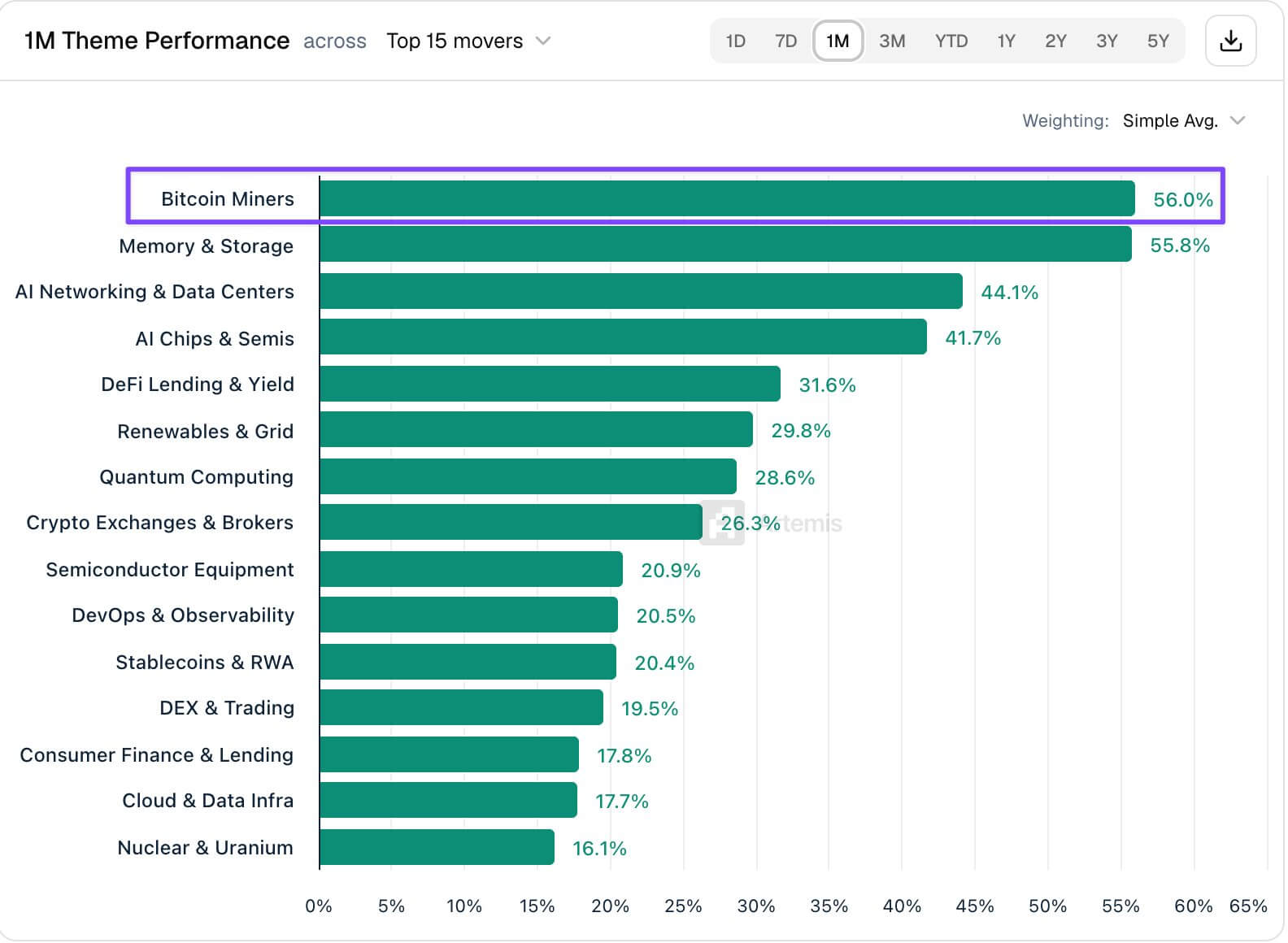
That price action reflects a market increasingly willing to value miners for their power portfolios rather than only for their Bitcoin production.
Modular Capital’s research points to the same constraint. The firm said AI workloads require sustained high-density power at a scale that the existing grid interconnection process cannot deliver quickly.
It estimated that data centers, which now account for about 3% to 4% of total US grid consumption, could reach 12% by 2028 as hyperscaler capital expenditure runs near $650 billion this year.
The grid queue makes the scarcity more acute. Modular said large-load interconnection timelines can stretch four years or more, while ERCOT, the Texas grid operator, has roughly 458 gigawatts of pending applications.
In PJM, the grid region covering Virginia, Ohio, Pennsylvania, and much of the Northeast, a new large-load interconnection is broadly stalled after available supply capacity fell 20% over four years. Large transformers can take two to three years to procure, and substations for loads above 100 megawatts can add another 18 to 24 months.
Those delays explain why BTC miners have become attractive candidates for AI infrastructure. Many of them had secured power contracts before the AI buildout intensified. Some already have land, interconnections, and operating experience with industrial-scale energy use.
However, a mining site still needs significant work before it can host advanced AI workloads, but the most valuable asset may be its place in the power queue.
SpaceX’s Colossus deal changes the competitive map because it shows that the power trade is attracting companies with deeper capital pools and broader technology platforms.
Neocloud operators buy or lease large pools of GPUs and rent computing capacity to AI developers. Bitcoin miners have been trying to move into that market by offering powered shells, colocation, and, in some cases, cloud services.
Musk’s ecosystem can approach the same market from another angle by building massive AI clusters for internal use, then leasing capacity when workloads shift elsewhere.
For context, Musk reportedly said SpaceX had moved its AI training efforts to Colossus 2 and would provide computing capacity to other AI companies making similar efforts to favor humanity.
This comment suggests Colossus 1 became available because SpaceX’s own training work had already moved to a newer site, allowing the company to monetize an existing asset without abandoning its broader AI ambitions.
That is a different kind of competition for BTC miners. A converted mining site may offer cheap power and faster time-to-market than a new data-center project. Colossus offers immediate scale, a frontier AI customer, and a platform tied to Musk’s broader ambitions in AI, space, and infrastructure.
Anthropic also said it is interested in working with SpaceX on multiple gigawatts of orbital data centers, a long-range concept that would use solar power in space and require major technical and capital commitments.
That broadens the competitive field for BTC miners as they are no longer pitching AI conversion only against other miners. They are competing with hyperscalers, neoclouds, energy developers, infrastructure funds, and technology platforms that can build or reallocate capacity at enormous scale.
Key Takeaways
The suspected inside trader who netted more than $400K on well-timed trades related to the capture of former Venezuela president Nicolas Maduro has finally been named. The Department of Justice today unsealed an indictment against Gannon Ken Van Dyke, a U.S. Army Special Forces master sergeant, charging him with using classified military intelligence to place winning bets on Polymarket, netting around $404,000 on a mission he helped plan and execute.
The charges, outlined in a DOJ press release, represent what appears to be the first-ever federal insider trading prosecution on a prediction market platform, ABC News first reported Thursday evening.
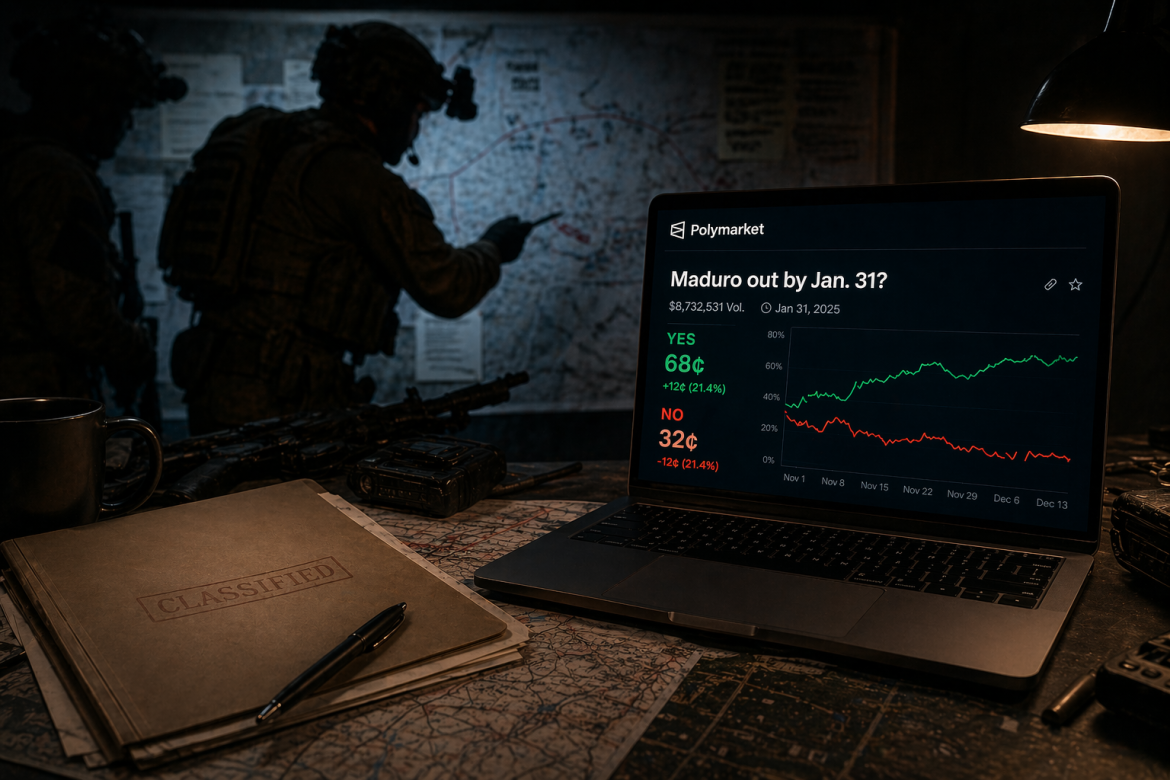
Van Dyke created a Polymarket account on Dec. 26, 2025, funded it, and began trading on Maduro- and Venezuela-related markets. He made approximately 13 trades through the evening of Jan. 2, 2026, all taking the “Yes” position on outcomes including “U.S. Forces in Venezuela by January 31,” “Maduro out by January 31,” and related contracts, betting a total of approximately $33,034 while in possession of classified nonpublic information about Operation Absolute Resolve.
The largest single position, a $32,537 bet that Maduro would be out of office by January 31, resulted in a 1,242% profit of $404,222. In the predawn hours of Jan. 3, U.S. forces apprehended Maduro and his wife at a residence in Caracas. Hours later the president announced the operation publicly. Polymarket resolved the relevant contracts to “Yes,” and Van Dyke’s total alleged profit came to approximately $409,881.
Then he tried to cover his tracks. Van Dyke sent most of his proceeds to a foreign cryptocurrency vault before depositing them into a newly created online brokerage account, and asked Polymarket to delete his account, falsely claiming he had lost access to his email, according to the DOJ release.
The exit plan hit a snag, however. Polymarket flagged the account, referred the matter to the DOJ, and cooperated with the resulting investigation, saying on X that the arrest proved its systems worked.
Last month, we published our enhanced market integrity rules to combat insider trading.
When we identified a user trading on classified government information, we referred the matter to the DOJ & cooperated with their investigation.
Insider trading has no place on Polymarket.…
— Polymarket (@Polymarket) April 23, 2026
Van Dyke faces counts of unlawful use of confidential government information for personal gain, theft of nonpublic government information, commodities fraud, wire fraud, and making an unlawful monetary transaction. The CFTC filed a parallel civil complaint on the same allegation, a significant pairing that backs up recent claims from CFTC chair Michael Selig about making prediction market integrity a serious enforcement priority. FBI Assistant Director in Charge James Barnacle said in the release: “Van Dyke profited more than $400,000 by trading various outcomes related to Venezuela after learning of the operation because of his role as a U.S. Army soldier.”
When asked about the arrest in the Oval Office on Thursday, President Trump told reporters he would look into it, saying, “That’s like Pete Rose betting on his own team.” He continued: “You look at what’s going on all over the world, in Europe and every place, they’re doing these betting things. I was never much in favor of it. I don’t like it conceptually, but it is what it is. No, I think that I’m not happy with any of that stuff. But they have all these different sites. They have predictive markets. It’s a crazy world. It’s a much different world than it was,” ABC News reported.
This arrest closes a chapter that opened in January, and one DeFi Rate has covered closely. When the suspicious Maduro trades first surfaced in early January, the story generated enormous heat and very little light. We noted in our January analysis that many of the loudest reactions conflated separate regulatory jurisdictions, rules, and market structures, and that suspicion is not proof. At the time, there was no confirmed insider. The fact that this and many other suspicious trades took place on Polymarket global, a non-US platform that operates outside of CFTC jurisdiction, is an important distinction that complicated the matter in terms of jurisdiction and enforcement potential.
Still, this particular controversy underscored the need for improved market integrity measures and regulatory clarity that politicians were already beginning to call for. Today’s arrest validates that concern, and answers the question of what actually happened.
The legislative response had already been building. In early January, 12 U.S. senators sent a letter to the CFTC demanding action. Rep. Ritchie Torres introduced a bill to ban federal officials from trading on prediction markets when they hold relevant nonpublic information. Regarding the offshore platform point, as DeFi Rate reported in April, Massachusetts Reps. Seth Moulton and Jim McGovern led a push urging the CFTC to take direct action against offshore platforms like Polymarket, citing the Maduro trades as exhibit A.
The Maduro case also isn’t the only suspicious pattern in 2026. Earlier this month, newly created Polymarket accounts placed unusually precise, well-timed bets on a U.S.-Iran ceasefire on April 7, generating hundreds of thousands of dollars in profits with the investigation still open. Another high-profile case resulted in a Google insider who profited over $1 million on non-public information being caught back in December.
As Polymarket and Kalshi have grown in popularity, so has scrutiny over whether people with inside access are exploiting the platforms. Donald Trump Jr. is both an investor in and adviser to Polymarket and Kalshi, the two largest prediction markets in the U.S. The conflict-of-interest complaints among vocal critics inside and outside of Congress hasn’t gone away.
Today’s indictment won’t resolve every structural question hanging over the industry, but it does establish that federal law applies to prediction markets, and prosecutors are willing to use it. Acting Attorney General Todd Blanche made that explicit in the DOJ release, noting that while widespread access to prediction markets is a relatively new phenomenon, federal laws protecting national security information fully apply. He also said: “Our men and women in uniform are trusted with classified information in order to accomplish their mission as safely and effectively as possible and are prohibited from using this highly sensitive information for personal financial gain.”
Van Dyke is expected to appear before a magistrate judge in the Eastern District of North Carolina.
This is a developing story. We will update the article as more details emerge.

Tether is leading a $150M recovery initiative for Drift Protocol; the plan will also shift the perp DEX’s primary settlement asset to USDT on Solana.
Tether announced a strategic collaboration with Drift Protocol on Thursday, April 16, to support user recovery and facilitate the platform’s relaunch following the exploit earlier this month.
The recovery plan is backed by up to $150 million in combined support, including up to $127.5 million from Tether, according to the announcement from the firm. The structure links funding to trading activity on Drift’s platform, enabling user balance restoration as the exchange resumes operations and generates revenue.
As the Defiant reported previously, the perpetual futures DEX was hacked for over $270 million in crypto on April 1. An April 5 postmortem from Drift revealed that the attack was the result of a complex social engineering and corporate infiltration scheme that began at least six months before the exploit occurred. Per Drift’s report, independent, nonprofit on-chain security group SEAL 911 found that the exploit was likely carried out by a North Korean state-affiliated group.
As part of the relaunch, Drift will transition its settlement asset from USDC to USDT, bringing its over 128,000 users and 35 ecosystem teams, including Gauntlet, Neutral, and M1, onto USDT-based trading on Solana, per the announcement. The move positions USDT as a primary settlement asset on what was Solana’s largest perp DEX.
The bulk of USDT’s over $185.4 billion circulating supply is currently on Ethereum and TRON, with both chains holding about 45% of the stablecoin’s market cap. About $3 billion in USDT is currently on Solana, making it the fourth-largest chain by USDT market cap, following BNB Smart Chain (BSC).
Tether CEO Paolo Ardoino said in today’s announcement that the investment and collaboration reflect confidence in Drift’s role in DeFi, and emphasized aligning recovery with real activity and long-term growth.
The DRIFT token rallied over 14% today on the news to ab0out $0.05, after falling sharply after the exploit. The token remains down 98% from its all-time high of $2.60 set in November 2024, per CoinGecko data.
Earlier this week, Tether launched its own wallet app, a multichain, self-custodial wallet that supports USDT, USAT, XAUT, and Bitcoin.
This article was written with the assistance of AI workflows. All our stories are curated, edited and fact-checked by a human.

Start every day with the top news stories right now, plus original features, a podcast, videos and more.

Rebeca Moen
Jan 21, 2026 22:20
GitHub Copilot CLI introduces plan mode for collaborative coding, GPT-5.2-Codex model, and infinite session support through auto-compaction features.
GitHub shipped a substantial update to Copilot CLI on January 21, 2026, introducing plan mode—a feature that lets developers collaborate with the AI before any code gets written. The update also brings GPT-5.2-Codex and session management tools that effectively eliminate context window limitations.
Plan mode addresses a persistent frustration with AI coding assistants: they often start implementing before fully understanding the task. Press Shift + Tab to enter plan mode, where Copilot analyzes your request, asks clarifying questions about scope, and builds a structured implementation plan. You review and approve before a single line of code appears.
The new ask_user tool powers this conversational approach, prompting for input on design decisions and confirming assumptions. Think of it as a technical spec session with an AI that actually listens.
The latest Codex model optimized for code generation is now available via the /model command or –model gpt-5.2-codex flag. GitHub added configurable reasoning effort for GPT models with extended thinking capabilities, letting developers balance response speed against reasoning depth.
Ctrl + T toggles visibility of the model’s reasoning steps during generation. The setting persists across sessions—useful for understanding how Copilot approaches complex problems or debugging unexpected outputs.
Auto-compaction kicks in when conversations hit 95% of the token limit, compressing history in the background without interruption. Manual compression is available via /compact, and /context shows detailed token usage breakdown.
Developers can now queue additional messages while Copilot is thinking—send follow-up instructions or steer the conversation without waiting. When rejecting a tool permission request, inline feedback helps Copilot adapt its approach rather than halting entirely.
The /review command analyzes staged or unstaged changes directly in the terminal. Copilot also now stores conventions, patterns, and preferences it learns across sessions, making future interactions more productive.
GitHub Copilot has been activated by over one million developers and adopted by more than 20,000 organizations since launch. The CLI entered public beta in November 2023, with reports indicating roughly 30% of coding suggestions get accepted.
Update via brew upgrade copilot-cli, winget upgrade GitHub.Copilot, or npm install -g @github/copilot@latest. GitHub CLI users can run gh copilot to get started—first-time use prompts automatic installation.
Image source: Shutterstock

The reiteration of the payment company‘s plans not to pursue a public offering followed a $500 million fundraise in November, leading to a $40 billion valuation for Ripple.
Ripple Labs president Monica Long has ruled out an IPO for the company, saying it was in a “really healthy position” without going public.
In a Tuesday interview with Bloomberg, Long addressed rumors that Ripple was planning to go public after the company reached a $40 billion valuation in November. The Ripple president said the company was focused on growth following the $500 million fundraise headed by Citadel Securities and Fortress Investment Group that led to its valuation.
“Currently, we still plan to remain private,” said Long, expanding on her comments in November after the fundraise. “Often the strategy driving an IPO is to get the access to the investors and the liquidity of the public markets […] We’re in a really healthy position to continue to fund and invest in our company’s growth without going public.”
The comments from Long going into 2026 came months after the US Securities and Exchange Commission announced it would wind down its enforcement actions against Ripple, fueling speculation about an IPO. Long has repeatedly denied reports that Ripple was pursuing a public offering.
Related: SEC now fully Republican, set for pro-crypto rulemaking in 2026
At the time of writing, the price of XRP (XRP) was $2.20, having dropped by about 6% in the previous 24 hours. The token is the fourth largest cryptocurrency by market capitalization.
In December, the US Office of the Comptroller of the Currency (OCC) conditionally approved applications from Circle and Ripple for national trust bank charters. BitGo, Fidelity Digital Assets and Paxos also received conditional approval to convert their existing state-level trust companies into federally chartered national trust banks.
Ripple’s application said its charter would “not be a stablecoin issuer” for its US dollar-pegged coin, Ripple USD (RLUSD), while the other companies will provide a variety of digital asset custody services to users. Of the applicants, BitGo has announced plans to go public, and Circle launched an IPO in May.
Magazine: How crypto laws changed in 2025 — and how they’ll change in 2026


