Russia-based Sality watched for copied bitcoin and Ethereum addresses and quietly replaced them with the attacker’s. CrowdStrike and law enforcement have now isolated more than 15,000 infected machines.


 Live Chat
Russia-based Sality watched for copied bitcoin and Ethereum addresses and quietly replaced them with the attacker’s. CrowdStrike and law enforcement have now isolated more than 15,000 infected machines.

After 5+ years, we’re winding down POAP.
Over the years, we:
* minted millions of collectibles across hundreds of communities.
* did incredible collaborations with world-class organizations – Coinbase, Amex, WMG, Bayer, and a long tail of others, including countless in crypto.… pic.twitter.com/iFbRqs5qsI— isabel (@izonline) August 3, 2026
One of Web3’s most recognizable digital-collectible platforms is coming to an end—leaving behind millions of tokens, hundreds of communities, and an important lesson about building sustainable products without sacrificing their soul.
POAP, the platform that transformed attendance and participation into collectible digital memories, is winding down after more than five years.
The announcement was shared by POAP general manager and co-founder Isabel Gonzalez, who reflected on the platform’s accomplishments, its sustainability challenges, and the lessons its team learned while building through one of the most volatile eras in crypto.
During its run, POAP minted millions of digital collectibles across hundreds of communities. It also worked with major organizations including Coinbase, American Express, Warner Music Group, and Bayer, alongside countless crypto-native projects and events.
But POAP’s significance cannot be measured by mint totals or corporate partnerships alone.
For many people, POAP became a visual history of their journey through Web3—a wallet-sized scrapbook recording conferences attended, communities discovered, classes completed, hackathons survived, and friendships formed.
POAP stands for “Proof of Attendance Protocol.” The concept was elegantly simple: give someone a blockchain-based collectible proving they participated in a particular experience.
The earliest POAPs appeared at ETHDenver in 2019. The platform later moved to the xDai network, now known as Gnosis Chain, allowing organizers to distribute large numbers of collectibles without burdening participants with Ethereum mainnet gas fees.
That combination of simplicity, affordability, and emotional resonance helped POAP spread rapidly across Web3.
Communities used POAPs to recognize contributors. DAOs issued them during governance calls. Artists distributed them at exhibitions. Educators used them to commemorate completed courses, while conferences turned them into digital souvenirs.
POAP also gave mainstream organizations an accessible entry point into NFTs. Warner Music Group, for example, partnered with POAP in 2022 to help artists create digital mementos connected to concerts and album experiences. At the time, WMG described the technology as a bridge between digital identity and physical experience. Warner Music Group
At one major Devcon activation, POAP reportedly minted more than 8,000 collectibles during a single week. Its Airport Rally later expanded the idea beyond scheduled events, letting collectors claim location-based POAPs while traveling through more than 100 airports worldwide.
POAP had found something that many NFT projects missed: the collectible did not need a speculative price to have value. Its value came from the memory attached to it.
According to Gonzalez, the decision reflects the difficulty of creating a sustainable crypto company without compromising the qualities that made its product meaningful.
Crypto’s boom-and-bust funding cycles frequently reward rapid expansion, aggressive monetization, and speculative activity. POAP, however, was built around low-cost or free collectibles whose primary purpose was commemoration rather than financial trading.
That created a fundamental business-model challenge. How do you monetize participation without making every interaction transactional? How do you charge communities without excluding the grassroots organizers responsible for the product’s growth? And how do you introduce commercial incentives without turning sentimental collectibles into another speculative asset?
POAP had already entered maintenance mode earlier in 2026, ending active development and stopping the onboarding of new issuers while continuing to support existing collections, integrations, and collector tools. The team said it wanted to explore more open infrastructure for digital collectibles. The Defiant
The latest announcement goes further, describing the company as winding down. It does not yet provide a detailed closure schedule or explain the long-term status of every application, API, and service.
Previously minted collectibles do not automatically disappear when the company behind an interface winds down. Their underlying blockchain records remain onchain. However, the tools people use to display, organize, issue, and interact with those assets may depend on infrastructure that requires ongoing maintenance.
That distinction is one of the defining promises—and persistent complications—of digital ownership.
One of Gonzalez’s biggest lessons from POAP is that customer communities remain among the most undervalued assets a company can build.
POAP grew because people cared enough to carry it into new spaces. Organizers created drops for small meetups, developers integrated POAP into applications, collectors shared their badges, and community members invented uses the original team could never have centrally planned.
This is what authentic distribution looks like.
The strongest communities do not merely consume a product. They interpret it, adapt it, teach others how to use it, and turn it into part of their identities.
POAP had brand ambassadors everywhere precisely because the product represented participation rather than promotion. Receiving a badge often felt less like entering a marketing funnel and more like being recognized for showing up.
That distinction matters—not only for Web3 companies, but for every brand trying to manufacture “community” through loyalty points, Discord servers, or engagement campaigns.
Community cannot simply be added as a growth channel. It must be earned through shared meaning.
Crypto conversations have a habit of becoming trapped in technical architecture, token prices, and whichever narrative is driving the current cycle.
POAP was a reminder that the technology was never supposed to be the entire point.
The point was connection.
People collected POAPs because they represented moments: attending an early DAO meeting, meeting online friends in person, completing a hackathon, watching an artist perform, or joining a community before it became widely known.
The blockchain provided provenance and persistence, but the emotional value came from the human experience behind the token.
This remains one of the strongest long-term arguments for NFTs. The technology can create durable, interoperable records of culture, identity, participation, and belonging. Those applications may ultimately prove more important than purely speculative collectibles.
POAP did not need to promise financial returns. It gave people a way to say: I was there.
POAP’s final lesson may be the most relevant in the age of artificial intelligence.
Software is becoming dramatically easier to build. AI-assisted development can compress months of product work into weeks—or even days. Distribution is also becoming increasingly automated, optimized, and engineered.
When features can be replicated quickly, technical functionality becomes a weaker competitive moat.
Trust becomes the differentiator.
Customers want confidence that the products, platforms, and digital assets they adopt will continue to exist. They want brands that can evolve with changing technology without abruptly abandoning the values that attracted their communities in the first place.
This is especially important in Web3, where users are often asked to invest more than money. They invest identity, reputation, creative work, community relationships, and years of participation.
Longevity cannot be guaranteed, but it can be cultivated through transparent governance, open standards, portable data, sustainable economics, and infrastructure that does not depend entirely on one company’s survival.
It would be easy to interpret POAP’s wind-down as another failure from the NFT era. That reading would miss what the platform actually accomplished.
POAP proved that millions of people were willing to collect blockchain-based objects without requiring promises of profit. It showed that an NFT could function as a memory, credential, community signal, and cultural artifact. It helped normalize digital ownership for people who might never have purchased a traditional NFT.
The company struggled to convert that cultural utility into a sustainable business. That is a significant failure of the model—but it is not evidence that the underlying behavior was meaningless.
The next generation of builders can learn from both sides of the story.
Digital collectibles need open, durable infrastructure. They need business models aligned with their communities. They need portable experiences that can survive individual applications. Most importantly, they need to preserve the human connection that makes a digital object worth keeping.
POAP may be winding down as a company, but the millions of memories it helped record—and the product category it helped establish—will remain part of Web3’s history.
Sometimes the most important proof of attendance is proof that an idea mattered.
POAP is winding down after more than five years of creating blockchain-based memories for events, communities, brands, classrooms, and hackathons. The platform minted millions of collectibles and worked with organizations including Coinbase, American Express, Warner Music Group, and Bayer. Its closure highlights the difficulty of building a sustainable crypto business without compromising a community-first ethos. POAP’s enduring legacy is the demonstration that NFTs can hold emotional and cultural value without depending on speculation—and that community, connection, trust, and longevity remain the strongest moats in an increasingly automated world.

Aave founder Stani Kulechov called the DeFi access point ‘an OG’ as its team said it would sunset the UI.
SummerFi, a DeFi access point operating for seven years, said it will wind down Summer.fi and sunset its user interface, attributing the decision to a recent exploit on its Lazy Summer Protocol.
“After 7 amazing years building in DeFi, the recent exploit on the Lazy Summer Protocol has forced us into the very difficult decision to wind down Summer.fi and sunset the UI,” the company said Wednesday on its official X account. It added, “We want to thank all our users, the community and supporters – you made it worthwhile.”
The post is the first statement from the operator tying its closure to the exploit. SummerFi did not state an effective wind-down date or address the status of user funds in the announcement.
The Defiant reported on July 6 that Summer Finance was drained of $6 million in a flash-loan exploit. SummerFi has separately characterized the incident as NAV manipulation rather than a flash-loan hack; that account has not been independently reconciled with the earlier description.
Stani Kulechov, founder of lending protocol Aave, reacted to the announcement on X, writing, “Sad to see as SummerFi has been an OG in DeFi. It also demonstrates the stakes and costs that go into providing high quality and secure DeFi access point.” He added that the seven years “been a nice ride for their team” and that SummerFi “will be missed.”
The closure follows other DeFi front-end shutdowns. Zapper, a portfolio and transaction interface, is set to close Aug. 3 after nearly seven years. Front ends that route users to onchain protocols carry operating and security costs that the underlying smart contracts do not, a point Kulechov underscored in his post.
SummerFi has not published a schedule for how or when users should move assets ahead of the UI sunset.

On July 14, MetaMask launched a new on-chain experience to celebrate its 10th anniversary, allowing users to look back at their transaction history right inside the app. This move is accompanied by the “Reveal Your Decade On-chain” campaign on X, as MetaMask continues to expand from a wallet into a broader on-chain financial platform.
Ten years ago, one developer pushed 598 lines of code the day after Ethereum came alive, on the bet that people should be able to hold and use their money directly.
A hundred million downloads later, the bet is the same.
Here’s what’s coming next 👇 pic.twitter.com/tpLAFPAI7e
— MetaMask 🦊 (@MetaMask) July 14, 2026
The MetaMask project was founded in 2016 by Kumavis and Dan Finlay, starting as a self-custodial browser wallet on Ethereum before expanding to Bitcoin, Solana, and many other blockchain networks. This 10-year story is used by MetaMask to highlight its journey from a wallet to a broader on-chain platform.
MetaMask is not only marking its 10-year milestone with a new campaign but also recalling the product’s origin story. In the article “Ten Years After the First Commit,” the project stated that Kumavis opened the metamask-extension repository on July 31, 2015, and pushed 598 lines of code before the first version was shipped on July 14, 2016.
MetaMask also took this opportunity to emphasize its current scale: over 100 million downloads, a presence in approximately 190 countries, and a cumulative total transaction volume measured in trillions of USD. In 2025 alone, MetaMask’s security layers blocked more than 6.5 million malicious website visits, prevented nearly 150,000 malicious transactions, and helped users avoid over $500 million in losses.
MetaMask allows users to open the app and review their activity history in a recap experience right inside the wallet. According to MetaMask’s description, this section not only lists recent activities but also aggregates each user’s on-chain journey into a more visual format. At the end of the experience, an On-chain Persona Card is issued, in which each user receives their own unique “class” and “level.”
This campaign is named “Reveal Your Decade On-chain.” On MetaMask’s teaser, users are reminded that they can look back at their ten years of activity on the blockchain in a personalized format, instead of having to manually trace each transaction across multiple chains and dApps. Notably, MetaMask is turning fragmented on-chain data into a quick summary that can be viewed directly in-app, while also creating a format compact enough for users to share if they wish.
MetaMask is using this feature to push its narrative beyond the role of a conventional wallet. Instead of being just a place to store keys and sign transactions, users are viewed as having an on-chain history that can be aggregated and presented as a consumer product.
This feature also shows that MetaMask wants to make on-chain data more accessible to mainstream users. However, along with this comes the familiar privacy challenge of Web3: on-chain data is inherently public, while signals from browsers, dApps, and wallet usage behavior can further expose links between addresses and users.
An article published on July 7, 2026, on arXiv, analyzing 85 browser-extension wallets representing 35.16 million users, showed that routine RPC operations can expose connections among multiple addresses. Another study from 2023 also recorded 1.325 websites running wallet-probing scripts, along with address leaks across 211 applications and 13 wallets.
Against this backdrop, “Reveal Your Decade On-chain” is not just a commemorative feature. It is MetaMask’s way of attempting to balance personalized experiences with the sensitivity of on-chain data.
MetaMask is using its 10-year milestone to push its narrative away from the old definition of a browser wallet. In its official announcement, the project describes “Open Money” as the next phase, where users can hold, transfer, save, invest, and use money in a way that is more like the Internet than traditional banking.
The appointment of Gal Eldar as CPO also follows this direction. According to MetaMask, Eldar has been involved in many of the project’s expansion products, from fiat on-ramp, Swaps, Bridges, and Smart Transactions to MetaMask Card, Perps, Prediction Markets, and Money Account.
The way MetaMask has chosen to celebrate its 10th anniversary shows that the project wants to tie its birthday to a larger product transition. Instead of just looking back at the past, MetaMask is focusing on its next phase in on-chain finance.

That transition has also reshaped the Ethereum Foundation itself.
Earlier this year, the foundation published a renewed mandate emphasizing Ethereum’s core values: including credible neutrality, self-sovereignty and open infrastructure, while reducing its involvement in some implementation-focused initiatives. Combined with ongoing budget constraints, the shift has resulted in restructuring across the organization.
Dietrichs views those changes less as a crisis than an overdue evolution. “It’s more a transition period,” he said. “Ethereum is now much more intentionally, proactively reorienting itself to be ready for this new time period.”
But as the turmoil started to unveil itself at the EF, many have started to wonder whether EthLabs would replace it. Dietrichs sees that rather than competing with the foundation, EthLabs intends to complement it. “We’re deliberately positioning ourselves to fill the gaps that the Ethereum Foundation now deliberately leaves,” Dietrichs said. “We’re not trying to create a competing vision for Ethereum.”
Those gaps, he argues, center on adoption-oriented engineering work, like improving Ethereum’s scalability, strengthening layer-1 performance, advancing interoperability, and identifying the technical barriers preventing broader institutional use.
“The gap we see is this more practical, adoption-oriented work, making Ethereum, practically useful for the real world,” he said. EthLabs plans to continue work its founders previously led within the foundation, including layer-1 scaling research, while expanding into areas like interoperability and engagement with financial institutions exploring blockchain infrastructure.

Hundreds of Ethereum wallets that had sat untouched for years were drained into the same tagged address, turning old key exposure into this week’s sharpest crypto security warning.
On Apr. 30, WazzCrypto flagged the incident affecting mainnet wallets on X, and their warning spread quickly because the affected accounts did not appear to be freshly baited hot wallets. They were old wallets with quiet histories, some tied to assets and tooling from an earlier Ethereum era.
Over 260 ETH, roughly $600,000, was drained from hundreds of dormant wallets. More than 500 wallets appear to be affected, with losses totaling roughly $800,000, and many wallets have been idle for four to eight years. The related Etherscan address is labeledFake_Phishing2831105, and shows 596 transactions, and records a 324.741 ETH movement to THORChain Router v4.1.1 around the Apr. 30 window.
The constant across them is more important for now: long-idle wallets have been moved to a common destination, while the compromise path remains unresolved.
That unresolved vector makes the drain the strongest warning this week, following a surge in DeFi hacks. Protocol exploits usually give investigators a contract, a function call, or a privileged transaction to inspect.
Here, the central question sits at the wallet layer. Did someone obtain old seed phrases, crack weakly generated keys, use leaked private-key material, abuse a tool that once handled keys, or exploit another path that has yet to surface?
Public discussion has produced theories including weak entropy in legacy wallet tools, compromised mnemonics, trading-bot key handling, and LastPass-era seed storage. One affected user personally raised the LastPass theory.
The practical advice for users is limited but urgent. Idleness does not mitigate private-key risk. A wallet with value depends on the full history of the key, the seed phrase, the device that generated it, the software that touched it, and every place that secret may have been stored.
For users, the response is probably to inventory high-value old wallets, move funds only after setting up fresh key material through trusted hardware or modern wallet software, and avoid entering old seeds into checkers, scripts, or unfamiliar recovery tools. Revoking approvals helps for protocol exposure, including Wasabi’s user warning, but a direct wallet drain points first to key security rather than token approvals.
The wallet cluster landed amid April’s crypto exploit tally, which was already elevated. DefiLlama-linked reporting put April at roughly 28 to 30 incidents and more than $625 million in stolen funds. As of May 1, the live DefiLlama API showed 28 April incidents totaling $635,241,950.
A May 1 market thread captured the pressure point: this week’s wallet drains, Wasabi Protocol’s admin-key exploit, and April’s larger DeFi losses all hit control surfaces that ordinary users rarely inspect. The link across the month is architectural rather than attributional.
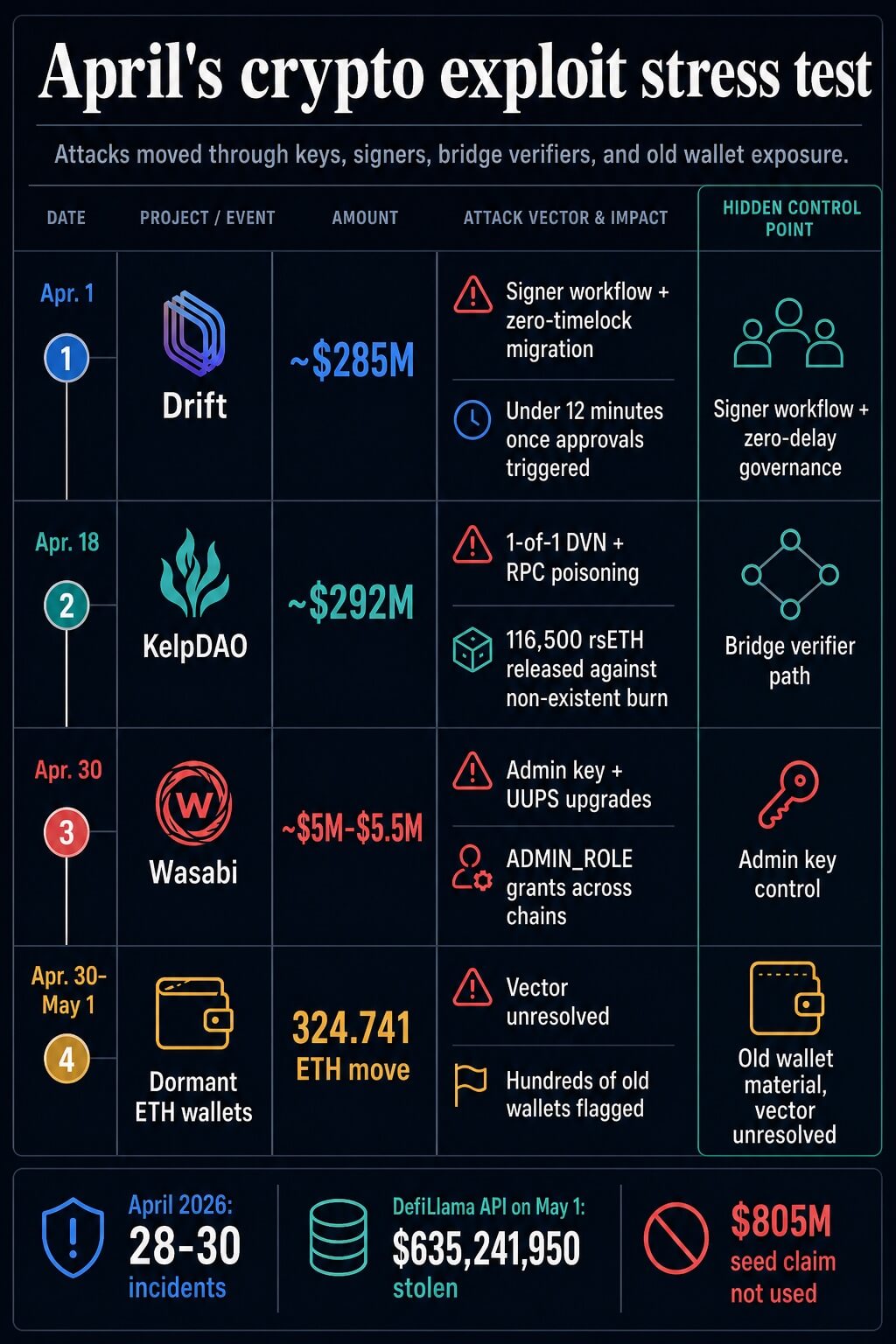

Wasabi Protocol supplies the clearest recent protocol example. The Apr. 30 exploit reportedly drained roughly $4.5 million to $5.5 million after an attacker gained deployer/admin authority, granted ADMIN_ROLE to attacker-controlled contracts, and used UUPS proxy upgrades to drain vaults and pools across Ethereum, Base, and Blast. Early security alerts flagged the admin-upgrade pattern as the attack unfolded.
The reported mechanics put key management at the center of the incident. Upgradeability can be normal maintenance infrastructure. Concentrated upgrade authority turns that maintenance path into a high-value target. If one deployer or privileged account can change implementation logic across chains, the boundary around an audited contract can vanish once that authority is compromised.
That is the user-facing problem hidden inside many DeFi interfaces. A protocol can present open contracts, public front ends, and decentralization language while critical upgrade power still sits in a small set of operational keys.
Drift pushed the same control problem into signer workflow. Chainalysis described social engineering, durable nonce transactions, fake collateral, oracle manipulation, and a zero-timelock 2-of-5 Security Council migration. Blockaid put the loss around $285 million and argued that transaction simulation and stricter co-signer policies could have changed the outcome.
The Drift case matters here because the path did not depend on a simple public-function bug. It depended on a workflow where valid signatures and fast governance machinery could be turned toward a hostile migration. A signer process became the control surface.

KelpDAO moved the stress test into cross-chain verification. The incident statement described a bridge configuration in which the rsETH route used LayerZero Labs as the sole DVN verifier. Forensic reviews described compromised RPC nodes and DDoS pressure feeding false data to a single-point verification path.
The result, according to Chainalysis, was 116,500 rsETH, worth roughly $292 million, released against a non-existent burn. The token contract could remain intact while the bridge accepted a false premise. That is why a verifier failure can become a market-structure problem once the bridged asset sits inside lending markets and liquidity pools.
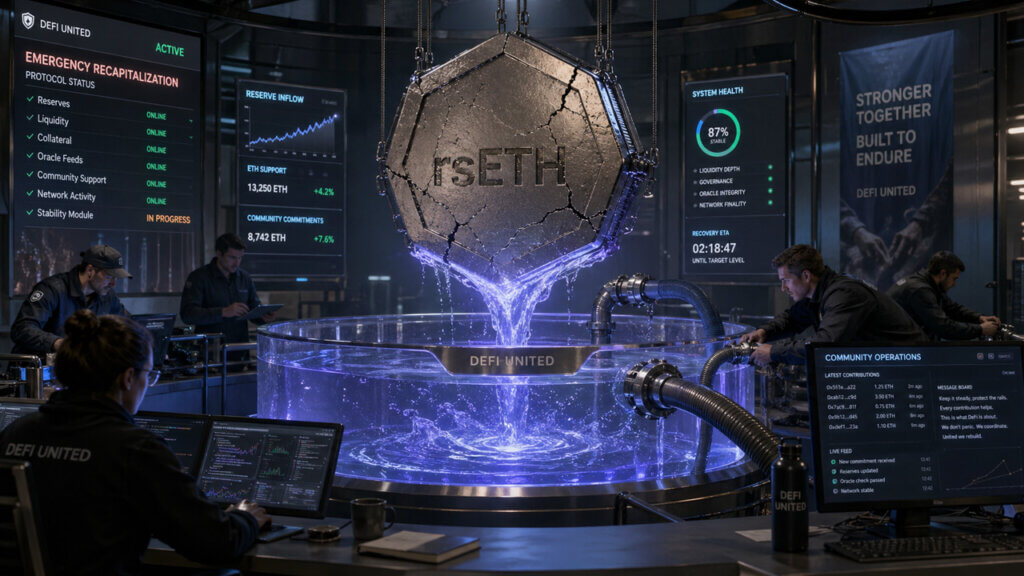
I think Project Glasswing deserves a special mention here for context, separate from causation. Anthropic says Claude Mythos Preview found thousands of high-severity software vulnerabilities and shows how AI can compress vulnerability discovery. That raises the bar for defenders, but the causal record in these crypto incidents points to keys, signers, admin powers, bridge verification, RPC dependencies, and unresolved wallet exposure.
The security implications are still serious. Faster discovery gives attackers and defenders more parallel surface to work through. It also makes old operational shortcuts more expensive because dormant secrets, privileged keys, and single-verifier paths can be tested faster than teams can manually review them.
The controls that follow from April sit above and around the codebase.
| Incident | Hidden control point | Failure mode | Practical control |
|---|---|---|---|
| Dormant Ethereum wallets | Old wallet material | Funds moved from long-idle wallets into a tagged address while the vector remains unresolved | Fresh key generation for valuable dormant funds, cautious migration, and no seed entry into unknown tools |
| Wasabi | Admin and upgrade authority | Privileged role grants and UUPS upgrades enabled vault and pool drains | Key rotation, stronger thresholds, bounded admin powers, timelocks, and independent monitoring of upgrade actions |
| Drift | Security Council signer workflow | Pre-signed durable nonce transactions and zero-delay governance enabled fast admin takeover | Higher thresholds, delay windows, transaction simulation, and policy-enforced co-signing |
| KelpDAO | Bridge verification path | RPC poisoning and a 1-of-1 DVN route allowed a false cross-chain message to pass | Multi-DVN verification, cross-chain invariant monitoring, and independent checks outside the same verifier path |
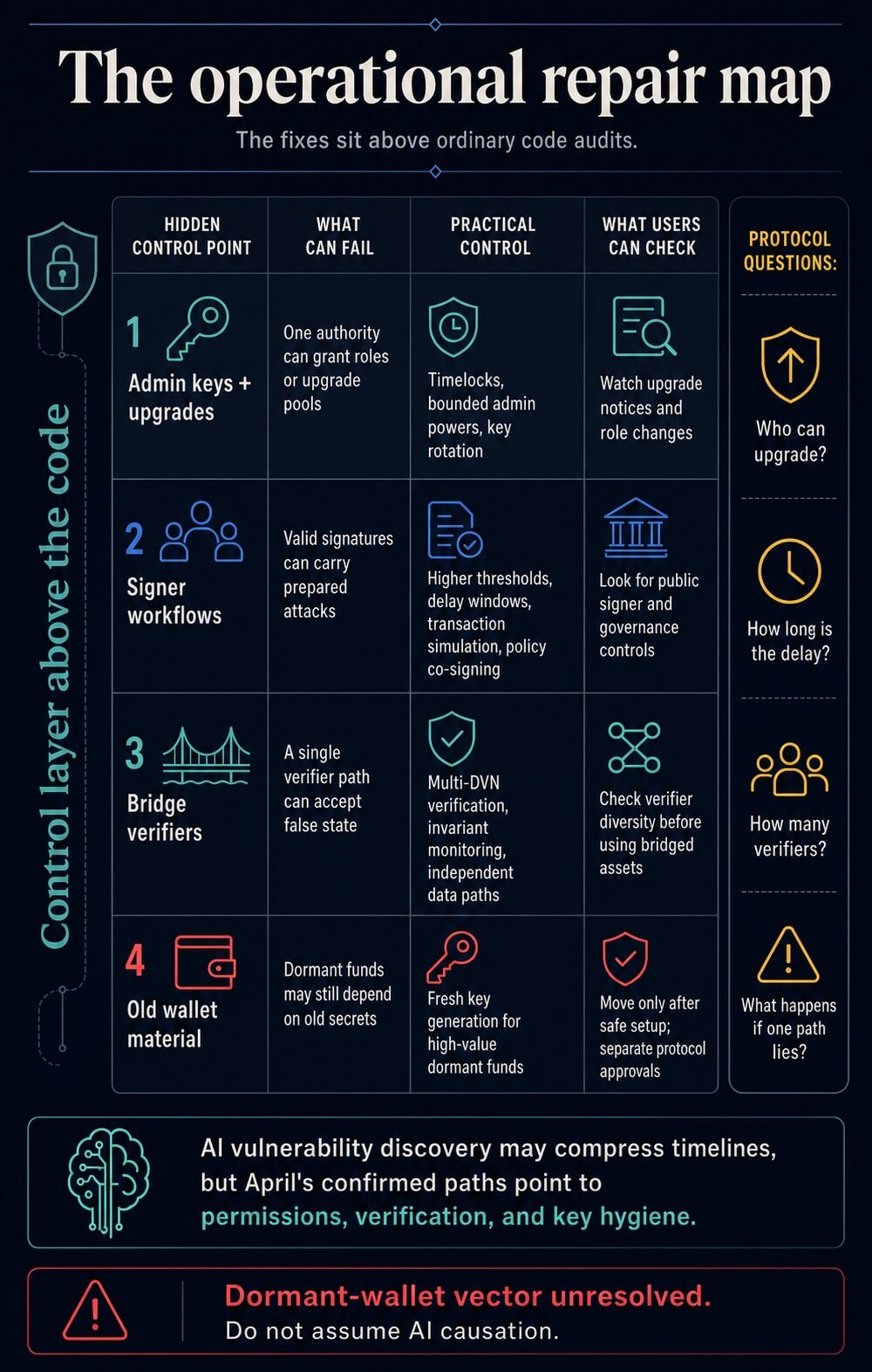
For protocols, the priority is to reduce the amount that any single authority can do at once. That means time locks on admin operations, stronger and more stable signer thresholds, monitored privileged-transaction queues, explicit limits on parameter changes, and co-signing systems that simulate transaction effects before humans approve them.
For bridges, the priority is independent verification and invariant checks. A cross-chain message should be tested against the economic fact it claims to represent. If rsETH leaves one side, the system should verify the corresponding state change on the other side before the destination side releases value. That monitoring needs to exist outside the same path that signs the message.
For users, the repair list is smaller. Move valuable old funds to fresh keys through a process you already trust. Separate that action from protocol-specific approval cleanup. Treat every claim about the wallet-drain root cause as provisional until forensic work identifies a common tool, storage path, or exposure source.
April proved that the average user’s security checklist is likely incomplete. Audits, public contracts, and decentralized interfaces can coexist with concentrated admin authority, weak signer procedures, brittle bridge verification, and old wallet secrets.
The next quarter will reward proof over decentralization language: constrained upgrade powers, visible timelocks, independent verifier paths, transaction simulation for privileged actions, disciplined access controls, and documented key rotation.
The dormant-wallet drains show the uncomfortable user-side version of the same problem. A system can look quiet while an old control failure waits in the background. April’s exploit wave exposed that layer above the code; the next phase will show which teams treat it as core security before funds move.

KelpDAO’s $292 million rsETH exploit landed at the wrong moment for DeFi. Roughly $10 billion left the sector over the weekend, after confidence had already been shaken by Drift Protocol’s April 1 breach and Venus’s March post-mortem.
That combination makes DeFi’s problem harder to ignore. While open DeFi may still be alive for now, it is losing the case for being the default gateway to on-chain finance. Stablecoins, tokenized Treasuries, and regulated settlement rails continue to scale, while permissionless protocols continue to absorb the trust discount.
A hack scoreboard circulating on X captures the mood.

Some incidents are well documented. Some remain live situations. Some blur the line between protocol exploit, bridge failure, and user compromise. The safer route is to anchor the piece to verified 2026 failures and to the competitive shift they expose.
This moment feels different from the heyday of the DeFi Summer in 2019 and the bull run of 2021, which now feel like distant memories. Back then, DeFi sold the market on openness, speed, and composability. In 2026, those same traits still matter, but they no longer come with automatic narrative prestige.
Each large exploit raises the cost of trusting the stack, while the safest and fastest-growing corners of on-chain finance increasingly look like payment rails, Treasury wrappers, and regulated tokenized products rather than reflexive token ecosystems.
The live test is whether open DeFi can rebuild trust fast enough to keep default-front-end status. Right now, the sector looks squeezed rather than finished.
The easiest mistake after a big exploit is to treat every failure as another smart-contract bug. Drift’s loss of about $285 million is a good example of why that frame is getting stale.
Chainalysis described a breach built around privileged access, pre-signed administrative actions, and fake collateral rather than a simple line-by-line contract failure. The market got another lesson in how much DeFi risk now lives in governance paths, signer workflows, and operational complexity.
That detail changes what users are being asked to trust. Audits and battle-tested code still matter, but they do not cover the full path from signer to bridge to oracle to market configuration. Once the system spans multiple chains, admin councils, liquidity venues, and collateral wrappers, the attack surface grows faster than the language around decentralization.
Venus’s own post-mortem shows a different version of the same problem. The attacker borrowed about $14.9 million against an inflated THE position and left the protocol with just over $2 million in bad debt. That was not the same failure mode as Drift, yet the reader-facing conclusion was similar. A major DeFi venue could still be pushed into emergency accounting around thin liquidity and structural edge cases.
Then came KelpDAO’s weekend shock. The exploit was severe enough, according to CryptoSlate, to trigger roughly $10 billion in withdrawals across DeFi and to force freezes around rsETH-linked markets. Even if that outflow estimate moves as conditions settle, the signal is clear. Users saw cross-chain complexity, collateral uncertainty, and possible contagion, then pulled capital.

That reaction lines up with the broader security trend TRM outlined in its 2026 crime-report summary. The firm said infrastructure attacks drove the majority of 2025 hack losses, outpacing smart-contract exploits.
DeFi’s trust problem is becoming harder to quarantine because the sector is defending the entire operating system around the code, not only the code itself.
The capital base tells a different story from a straight collapse narrative. An April CryptoSlate report pointed out that USDT had reached $185 billion in market capitalization and USDC had reached $78 billion.
The same report cited DefiLlama figures showing Tron at $86.958 billion in stablecoins and Solana at $15.726 billion.
DefiLlama’s Ethereum chain page also shows where the deepest open DeFi capital still sits, which makes the current setup look more like concentration than abandonment.
The rotation is even clearer in low-volatility yield products. RWA.xyz’s Treasury dashboard shows $10.9 billion in tokenized U.S. Treasuries and 55,144 holders as of March 12, 2026.
The user taking risks there is still choosing blockchain-based settlement and ownership rails. What that user is rejecting is the idea that open-ended DeFi complexity deserves an equal share of the balance sheet.
A quick way to frame the split is this:
| Trust and positioning pressure | On-chain growth signals |
|---|---|
| KelpDAO’s $292M exploit triggered a reported $10B retreat across DeFi. | USDT and USDC together now account for roughly $263B in supply. |
| Drift lost more than half its TVL in a privileged-access breach. | Tokenized U.S. Treasuries reached $10.93B with 55,144 holders. |
| Venus showed lending markets still carry thin-liquidity and bad-debt risk. | Visa is pairing USDC settlement expansion with a broader institutional stablecoin push. |
The split is hard to miss. Capital is rotating toward products that look more legible, more collateralized, and more institution-friendly.
That is why Visa’s 2026 stablecoin strategy note deserves attention. Visa said stablecoin supply grew more than 50% in 2025, reaching $274 billion in December from $186 billion a year earlier. It also framed 2026 as the year institutions need an actual stablecoin strategy. That is the language of a market category being normalized.
The same pattern appears in settlement. In its December 2025 USDC settlement announcement, Visa said its monthly stablecoin settlement volume had passed a $3.5 billion annualized run rate.
The specific number is smaller than the broader stablecoin market, yet the institutional meaning is larger. Regulated financial plumbing is moving on-chain without needing the full cultural package that DeFi used to sell.
A recent CryptoSlate analysis framed the competitive problem clearly. Regulated venues are chasing an on-chain capital pool above $330 billion, including roughly $317 billion in stablecoins and nearly $13 billion in tokenized U.S. Treasuries.
That capital will continue to look for speed, programmability, and round-the-clock settlement. The broad live market overview reinforces that attention is concentrated on the largest assets and rails rather than on the long tail of governance experiments.
That is where the 2021 comparison turns harsh.
In the earlier cycle, DeFi could claim it was both the infrastructure and the product. It was where the innovation lived, where the yields lived, and where users went if they wanted to see the future arrive early. In 2026, more of the future is being packaged in ways that cut out the messier parts of that proposition.
Tokenized funds can offer 24/7 movement and faster settlement. Stablecoins can handle payments and treasury operations. Institutions can adopt those benefits while keeping tighter control over compliance, counterparties, and market structure.
More than 80 crypto projects had formally shuttered or started winding down in the first quarter, according to a CryptoSlate report on project closures. That number spans more than just DeFi, but it still reinforces the point that capital is becoming less patient with products that cannot demonstrate durable utility, yield, or distribution.
Crypto ETFs belong in that context. At the product level, regulated options now absorb more attention and capital, while users and institutions gravitate toward rails that deliver blockchain advantages without demanding full DeFi trust assumptions.
That leaves DeFi with a narrower but still meaningful role. Open composability and permissionless experimentation still matter, especially as a research lab for new financial primitives before safer wrappers absorb demand.
The latest evidence describes a trust squeeze.
Open DeFi is losing narrative leadership and may lose default-front-end status unless it can rebuild trust, tighten operations, and prove that its added complexity buys something irreplaceable.
The live debate now is who captures the next wave of on-chain demand, and the safer wrappers are winning the race.

BOSTON, MA, April 10, 2026 (GLOBE NEWSWIRE) — Alleron Expert Group (AEG), a Boston-based cloud consulting and managed services firm, today announced a significant expansion of its service portfolio alongside a landmark milestone: six consecutive years of 100% client retention. The achievement — virtually unheard of in the managed services industry — reflects the firm’s founding commitment to elite, senior-only cloud engineering for mid-market and enterprise organizations across financial services, real estate, and regulated industries.
| 100% Client Retention |
99.99% Uptime SLA |
15 Min Support Callback |
6 Yrs Zero Churn |
AEG operates on a model that inverts the standard MSP playbook. Where most providers rely on junior engineers, offshore teams, and opaque service bundles, AEG deploys exclusively senior cloud architects — each of whom personally designs, deploys, and supports every environment they touch. There are no account managers, no help desk handoffs, and no proprietary lock-in. Every AEG client has their engineer’s direct number.
“The IT consulting industry rewards salesmanship over expertise. We built AEG to fix that. Our clients don’t call a help desk — they call the engineer who built their environment. When you pair genuine expertise with true accountability, 100% client retention isn’t a goal — it’s the natural outcome.”
— Gene Glekel, Founder & Principal Engineer, Alleron Expert Group
Contractually Backed Performance, Not Promises
AEG backs every engagement with a 99.99% uptime SLA — financially and contractually guaranteed. Clients experiencing issues receive a 15-minute callback, not a ticket queue. All engagements operate without long-term contracts; clients may cancel within 30 days if AEG fails to perform. To date, no client has. AEG also offers a contingency pricing model, where clients pay from savings generated in the first year of engagement — aligning the firm’s incentives directly with client outcomes.
Proven ROI Across the Most Demanding Environments
Clients migrating from colocation to cloud consistently achieve full payback within six months through eliminated waste, reduced sprawl, and right-sized infrastructure. AEG’s proactive monitoring resolves the majority of issues before clients are ever aware of them — a discipline rooted in the firm’s hedge fund origins, where security and resilience standards allows no compromise.
“AEG’s strategy saved us over $1MM in the first three years. Our environment is complex, highly secure, and regulated. They performed the transition seamlessly without a single outage and responded to support issues in real-time.”
— Vitaly Milavsky, CTO, FirTree Capital Management
“We ended up working with AEG to perform a full Cloud transition, with exponentially better agility, operational resilience, and OpEx reduction of roughly 50%.”
— Rizwan Ali, CTO, New Holland Capital
A Full-Spectrum Cloud Practice
The expanded service portfolio spans three integrated practice areas:
Built from the Ground Up for Regulated Industries
Founded as a division of a famous NYC-based Managed Service Provider, AEG was built to address a persistent market gap: regulated-industry firms were dependent on IT partners who lacked genuine cloud expertise, resulting in sprawling environments, escalating costs, and weakening security postures. AEG applies financial-services-grade security standards universally — clients consistently pass IT compliance audits with minimal friction. All environments are fully documented with zero proprietary dependencies. Clients own their infrastructure outright.
About Alleron Expert Group
Alleron Expert Group (AEG) is a Boston-based cloud consulting and managed services firm specializing in Azure and AWS architecture, cloud migration, disaster recovery, and managed cloud operations. AEG staffs exclusively senior cloud engineers — no junior staff, no sales team, no offshore delivery. Since founding, the firm has maintained 100% client retention and a financially guaranteed 99.99% uptime SLA, serving mid-market and enterprise organizations across financial services, real estate, and regulated industries.

The SEC just made its biggest crypto classification move in years, placing major tokens such as Ethereum, Solana, Cardano, Dogecoin, Avalanche, XRP, and Chainlink into a “digital commodities” bucket while saying some token sales can stop being treated as securities-law cases once the issuer’s core promises are fulfilled.
Paired with a new SEC-CFTC coordination framework, the March 17 interpretation is less a narrow staking memo than a broad attempt to replace years of crypto-by-enforcement with a clearer split between assets, contracts, and regulator turf.
Until Gary Gensler left the SEC, crypto in the US has lived under a legal cloud. Tokens were launched, traded, staked, wrapped, and airdropped while builders and users were left guessing about the boundary between securities law and commodity law.
The long-awaited interpretation explaining how federal securities laws apply to certain crypto assets and common crypto transactions, and the CFTC joined it, saying it will administer the Commodity Exchange Act consistently with that view.

The Mar. 17 release provides interpretive guidance while preserving existing fraud liability and registration requirements. Additionally, it draws clearer lines.
The SEC’s fact sheet says the agency had spent more than a decade engaging with crypto, mostly through Howey-based analysis, and, before 2025, failed to build a tailored framework, instead “regulating by enforcement.”
The Mar. 11 SEC-CFTC memorandum of understanding then established a Joint Harmonization Initiative to clarify product definitions, reduce friction for dually registered venues and intermediaries, and coordinate policymaking, exams, and enforcement.
In the MOU itself, the agencies also commit to consult on overlapping enforcement matters, including, where appropriate, before a Wells notice or similar step.
That makes this week’s interpretation bigger than staking or airdrops.
In plain English, the SEC is now saying that many major crypto tokens are not themselves securities.
It then goes further to confirm that some ordinary crypto activities, such as covered staking, mining, wrapping, and certain airdrops, can fall outside securities-sale treatment in some circumstances, and that a token sale does not necessarily remain a live securities-law relationship forever if the issuer’s essential promises have been fulfilled.
That does not erase fraud liability, excuse unlawful original sales, or settle every edge case, but it does give exchanges, issuers, builders, and users a much clearer answer to the question that has hung over the market for years: what is the asset, what is the contract around it, and when does that contract end?

The government is finally saying, in plainer terms, what people are buying: a commodity-like token, a collectible, a practical tool, a payment stablecoin, or a tokenized security.
The SEC fact sheet states that digital commodities, digital collectibles, digital tools, and GENIUS Act payment stablecoins fall outside securities classification, whereas tokenized securities remain securities.
That means that a stablecoin such as USDC falls outside the securities classification, while the tokenized stocks xStocks issued by Kraken and Backed Finance would be classified as securities.
It also says covered protocol mining, covered protocol staking, and wrapping of a non-security crypto asset fall outside the offer-and-sale requirement, and that certain airdrops fail Howey’s investment-of-money prong.
It also reduces one of crypto’s biggest structural drags in the US: uncertainty over ordinary token activity being considered an illegal securities transaction after its conclusion.
The interpretation says that added clarity could reduce legal costs, increase competition, and encourage more activity to remain in the US.
| Category | SEC/CFTC treatment in the release | What it means in plain English |
|---|---|---|
| Digital commodities | Not themselves securities | Commodity-like tokens do not start inside securities law |
| Digital collectibles | Not themselves securities | Collectible-style assets are outside the securities bucket |
| Digital tools | Not themselves securities | Utility-like tokens are not automatically securities |
| GENIUS Act payment stablecoins | Not themselves securities | Some payment stablecoins begin outside securities status |
| Tokenized securities | Remain securities | Tokenized stocks, bonds, and similar assets stay inside securities law |
| Covered mining | Not an offer/sale of securities in described cases | Core protocol participation may sit outside securities treatment |
| Covered staking | Not an offer/sale of securities in described cases | Some staking activity is clearer for users |
| Wrapping non-security assets | Not an offer/sale of securities in described cases | Technical asset transformations are not automatically securities transactions |
| Certain airdrops | Fail Howey’s investment-of-money prong | Some free token distributions may fall outside securities law |
The most important shift may be conceptual. The SEC says a non-security crypto asset can be sold subject to an investment contract and later, separate from that contract, once the issuer’s essential promises are fulfilled, or, in some cases, if those promises clearly fail.
In plain English: a token can exit securities status when the underlying investment contract ends.
That directly addresses the long-running fear that tokens are permanently stained by the way they were first sold. The release explains that when buyers cease to reasonably expect the issuer’s essential managerial efforts to remain connected to the asset, the token can separate and exit that contractual relationship.
Separation still requires that the original token sale was registered or exempt when the investment contract was created, and fraud liability can survive even after the token later separates.
The release also says the common-enterprise element of Howey must be satisfied, and it explains that if the issuer’s promises remain connected to a token, secondary market trades in that token can still be securities transactions until separation occurs.
The agencies are saying the answer depends on whether the underlying issuer-driven investment contract is still alive.
That is a much more structured framework than the old blanket fog.
| Question | If yes | If no |
|---|---|---|
| Is the asset itself a tokenized security? | Securities law applies | Go to next question |
| Was it sold with an investment contract? | Go to next question | Asset begins outside securities status |
| Are issuer promises still central? | Securities obligations may continue | Separation becomes possible |
| Was the original sale registered or exempt? | Separation may occur if contract ends | Liability can survive |
For users, the practical shift is that the SEC has defined core behaviors more precisely.
Covered protocol mining, protocol staking, and wrapping are outside securities-sale treatment in the circumstances described, and certain no-consideration airdrops fail Howey’s investment-of-money prong.
The government has said that some ordinary crypto activities may fall outside the securities bucket in the described circumstances, while other configurations may still trigger securities obligations.
For platforms, the new rulebook reduces the category problem.
Digital commodities, collectibles, tools, and permitted payment stablecoins begin with the assumption that securities laws apply to the contractual relationships surrounding them, if any, rather than to the assets themselves. Tokenized stocks, bonds, and similar instruments remain subject to securities law.
Non-security tokens still tied to issuer promises carry securities obligations until separation.
The release provides exchanges and wallet providers with clearer listing and feature logic while Congress continues work on the permanent statute.
The bull case holds that this will serve as the interim US operating manual. Exchanges, wallets, and issuers use the taxonomy and separation framework to lower legal friction, while the SEC and CFTC use the MOU to reduce overlap in exams and enforcement.
Congress codifies most of the framework, the agencies jointly formalize more definitions, and onshore token issuance, staking, and secondary trading expand because firms can finally structure products around clearer lines.
The SEC’s own economic section points to better pricing efficiency, more capital formation, and more competition if clarity holds.
The bear case holds that the interpretation proves helpful within a narrower scope. Litigation tests the boundaries of “separation,” later commissions revisit parts of the framework, and firms still avoid aggressive launches because past failures to register and anti-fraud exposure remain enforceable.
In this scenario, legal uncertainty diminishes but persists in edge cases.
The SEC says the Crypto Task Force has already received more than 300 written submissions and held multiple roundtables, including a Mar. 21, 2025, session specifically on security status.
On Jan. 29, CFTC Chairman Michael Selig publicly called for clear, unambiguous safe harbors for software developers, onshoring of perpetuals, and a harmonized crypto taxonomy with the SEC.
Taken together with the Mar. 11 MOU and the Mar. 17 interpretation, the move appears to be a sequenced regulatory project.
This also puts the US closer to other major jurisdictions. The EU says MiCA is a comprehensive legislative framework covering crypto-assets and related services. The UK FCA is rolling out a staged crypto regime, with its roadmap pointing to final rules in 2026 and the new regime expected to come into force in October 2027.
The US is taking an interpretation-heavy approach, grounded in existing securities and commodity statutes. At the same time, this release moves it closer to the category-based regulatory style that other major jurisdictions are already adopting.
The real significance of this release is that the two main US market regulators are trying to move crypto from a regime of case-by-case enforcement toward a more coherent market structure.
The interpretation is paired with the Mar. 11 SEC-CFTC memorandum of understanding aimed at harmonizing oversight, and both agencies framed this week’s action as a bridge to broader market structure legislation in Congress.
Once assets are sorted into buckets and the agencies coordinate on overlaps, the next big battles shift to exchange registration, custody, tokenized securities plumbing, stablecoin competition, and the extent to which Congress codifies this framework.
The press release itself says the interpretation complements congressional efforts.
The agencies published a category-based taxonomy, explicitly addressed when non-security tokens become subject to an investment contract and when they stop being subject to one, and clarified several common crypto activities that had lived in gray areas.
That represents a materially more structured approach to enforcement.
If market participants can better predict which rules apply to which assets and activities, compliance costs should fall, pricing distortions from uncertainty should ease, and more activity can plausibly stay onshore.
Whether this becomes a true turning point, however, will depend on whether courts accept the framework, future SEC leaders keep it in place, and Congress locks it into statute.

Polkadot has reported its first quarterly profit in almost three years as the long-running blockchain project commits to a new belt-tightening regimen.
In its 2025 fourth-quarter financial report, the cooperative that governs Polkadot reported spending $7.4 million while adding assets worth around $11.5 million, giving it a profit of some $4.1 million.
“The Polkadot Treasury has grown more conservative and focused on essential operations and development,” Tommi Enenkel, Polkadot’s ecosystem developer and co-author of the report, said.
Enenkel attributed the positive quarter to “the Gavin effect,” referencing Polkadot’s creator Gavin Wood, who returned as CEO of Parity Technologies, the for-profit Polkadot developer, in August 2025.
“It shows the positive effect a voice of reason with the support of big bags has,” Enenkel said.
It’s the first time Polkadot has generated a quarterly profit since it started reporting its finances publicly in 2023.
It’s also a stark turnaround from the first half of 2024, when Polkadot spent a whopping $87 million. At the time, the project laid out $37 million on advertising and paid influencers $5 million to promote the blockchain on social media as part of a large marketing push.
Amid the splurge, Polkadot spent $180,000 to slap its logo on “an entire fleet of Europe-based private jets” for six months in a bid to promote the blockchain to “an elite target group.”
Of the $7.4 million Polkadot spent between October and December last year, $2.5 million — the largest outlay — went on development.
After that, outreach accounted for $1.7 million, $870,000 of which Polkadot spent on advertising.
The remainder of the expenditure went towards operations, business development initiatives, economic incentives, research, and talent and education.
At the same time, Polkadot gained 4.1 million of newly-issued DOT tokens.
In addition to cutting down on spending, the report also showed Polkadot diversifying more of its treasury away from the blockchain’s native DOT token.
Stablecoins now account for 18% — or $10.5 million — of Polkadot’s reserves, up from just under $1.7 million in the first half of 2024.
While Polkadot’s cost cutting has helped stabilise the project, it’s not the whole picture.
The blockchain’s balance sheet has declined in US dollar terms because the value of the DOT token has plummeted some 37% over the past three months.
Polkadot holds almost 32 million DOT tokens, accounting for 77% of its reserves.
“The USD equivalent value has diminished significantly in Q4 due to the declining DOTUSD rate. A risk that is more and more being mitigated by diversification into stables,” Enenkel said.
Tim Craig is DL News’ Edinburgh-based DeFi Correspondent. Reach out with tips at tim@dlnews.com.


