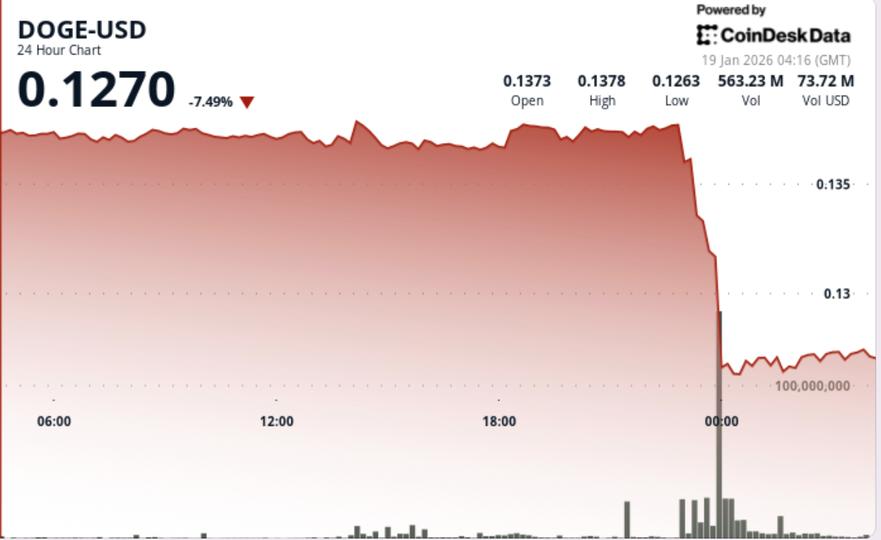

Traders are watching $0.127 as near-term support, with $0.137 now the key level DOGE must reclaim to stabilize.
Selling
PRAGUE, Nov. 19, 2025 /PRNewswire/ — Clapp Finance today announced the launch of its multi-collateral credit lines, offering a unique way to unlock liquidity from crypto holdings without selling them. This product provides instant, pre-approved capital with highly flexible terms, designed for modern investors who require continuous access to cash or stablecoins.
With demand for crypto-collateralized loans at a record high, Clapp’s solution offers a safer, more adaptable alternative, giving users full control, continuous liquidity, and greater peace of mind.
Why Clapp Stands Out
Users may combine up to 19 different cryptocurrencies as collateral for one or more credit lines. You can add, remove, or swap these assets even after you have drawn funds, without needing to close your line of credit.
This provides unparalleled flexibility for real-time portfolio management with access to liquidity 24/7. Future updates could also enable repayment directly from collateral.
Clapp CEO Ilya Stadnik explains:
“People want to use their crypto as financial fuel, not just hold it — CeFi lending is up almost 150% since 2023. But it’s been stuck in the past: rigid, one-size-fits-all loans. We built multi-collateral, multi-line credit to give users real flexibility. Optimize your collateral, access funds in cash or stablecoins, and always stay in control. It’s like having a financial dashboard for your digital wealth.”
Key Features & Benefits
- Multi-collateral: Combine multiple cryptocurrencies as collateral and actively manage them — swap, add, or remove — without closing your credit line.
- Multi-line: Run several credit lines at once.
- Instant liquidity: Receive pre-approved funds 24/7 in EUR (via SEPA) or stablecoins (USDT/USDC).
- Pay-as-you-use interest: Pay interest solely on the capital you withdraw.
- Flexible repayment: Pay back what you want, when you want. No fixed schedules.
- Integrated Wallet & Exchange: A unified platform to manage your portfolio, exchange, and credit lines seamlessly.
Ready to unlock the full potential of your portfolio? Activate your Clapp crypto credit line today and experience financial agility without compromise.
About Clapp Finance
Clapp is an EU-based fintech company founded in 2025, providing an all-in-one platform for crypto management. With its integrated wallet, exchange, portfolios, and multi-collateral credit lines, Clapp fuses CeFi and DeFi via powerful and intuitive financial tools, serving users in 130+ countries.
Clapp’s journey on X and LinkedIn.
Media Contact:
Alicia Ktorides
PR & Communications Manager
aktorides@clapp.finance
https://clapp.finance
SOURCE Clapp Finance
Will Mt Gox’s First BTC Movement in 8 Months Add to Bitcoin’s Selling Pressure?
Historical data shows that nearly every large transfer from Mt. Gox has negatively affected bitcoin’s price.
Bitcoin (BTC) has been under a lot of pressure recently, with its price dropping to levels not seen since mid-April 2025. Amid the persistent negative trend, one of the largest holders of BTC had executed a major transfer that is capable of shaking the market further.
According to a tweet by Lookonchain, the estate trustee of the defunct cryptocurrency exchange Mt. Gox has moved approximately $1 billion in BTC within the last 24 hours. With the market already bleeding, the latest Mt. Gox transfer raises the question of whether BTC will buckle under intensifying selling pressure and decline further.
Mt Gox Makes Bitcoin Moves
The last time Mt Gox made a significant transfer was eight months ago, on March 25. CryptoPotato reported at the time that the entity moved 11,501 BTC, worth over $1.01 billion, from its cold wallet to two addresses. Following that transaction were two others worth more than $77 million each.
Since then, the cold wallet holding the defunct estate’s bitcoins has remained nearly dormant, only executing transactions worth less than $300 at a go. About seven hours before press time, the wallet suddenly moved 10,608 BTC worth no less than $953.66 million. A subsequent transaction from the wallet moved $16.8 million worth of bitcoins to another address.
In total, Mt. Gox has moved 10,793 BTC, worth $970.46 million, to two different addresses. The cold wallet still held $3.16 billion in BTC at press time.
Based on historical data, large Mt. Gox transfers have consistently preceded significant sell-offs. This is because the defunct exchange’s creditors tend to offload their assets soon after repayments are made.
Over a decade after its collapse, Mt. Gox began repaying creditors in July 2024. Although the payments were scheduled to be concluded last month, the entity announced that it was moving the deadline to October 2026. The estate trustee cited incomplete procedures as a reason for the change in plans. This means the Bitcoin market will witness more large transfers from wallets tied to the defunct entity in the coming months.
You may also like:
Will BTC Dump Further?
Mt. Gox may only be conducting some internal shuffling arrangements for the ongoing repayments, rather than immediately dumping the assets. However, past data shows that nearly every large transfer from the entity has led to a significant plunge in bitcoin’s price.
Data from CoinMarketCap shows that BTC has tumbled over 6.6% from $95,000 to $89,300. Although the asset had rebounded to $91,000 at the time of writing, Bitcoin moves from wallets tied to Mt Gox could trigger a deeper correction.
SECRET PARTNERSHIP BONUS for CryptoPotato readers: Use this link to register and unlock $1,500 in exclusive BingX Exchange rewards (limited time offer).
HBAR Tests Lower Bollinger Band Support at $0.16 as Crypto Markets Face Broad Selling Pressure
Timothy Morano
Oct 19, 2025 07:57
Hedera (HBAR) trades near $0.16 support level with RSI at 33.98, suggesting potential oversold bounce as token approaches critical technical inflection point amid broader market weakness.
Quick Take
• HBAR trading at $0.16 (down 0.5% in 24h)
• No major catalysts driving price action in past week
• Token testing lower Bollinger Band support zone
• Following Bitcoin’s bearish momentum with broader crypto selloff
Market Events Driving Hedera Price Movement
Trading on technical factors in absence of major catalysts, HBAR price has declined modestly over the past 24 hours as the broader cryptocurrency market faces selling pressure. No significant news events have emerged in the past week that would directly impact Hedera’s price trajectory, leaving technical analysis as the primary driver for short-term movements.
The current HBAR price action reflects the broader risk-off sentiment across digital assets, with Bitcoin’s continued weakness weighing on altcoin performance. Market participants appear to be de-risking positions ahead of potential macroeconomic developments, creating a challenging environment for most cryptocurrency projects including Hedera.
HBAR Technical Analysis: Testing Critical Support Zone
Price Action Context
Hedera technical analysis reveals HBAR currently trading below all major moving averages, with the token sitting at $0.16 compared to the 7-day SMA of $0.18 and 20-day SMA of $0.20. The current positioning suggests continued bearish momentum in the near term, though the proximity to the lower Bollinger Band at $0.15 indicates potential oversold conditions.
Trading volume on Binance spot market of $12.6 million remains moderate, suggesting institutional interest has not dramatically shifted despite the recent price weakness. The token’s position relative to its 52-week range shows HBAR trading closer to annual lows of $0.13 than highs of $0.29.
Key Technical Indicators
The RSI reading of 33.98 places HBAR in neutral territory but approaching oversold conditions, which historically has provided bounce opportunities for the token. The MACD histogram at -0.0032 confirms bearish momentum remains intact, though the divergence between MACD (-0.0154) and signal line (-0.0123) is narrowing.
Bollinger Band positioning shows HBAR with a %B reading of 0.1653, indicating the token trades near the lower band support level. This technical setup often precedes either a bounce back toward the middle band or a breakdown below support if selling pressure intensifies.
Critical Price Levels for Hedera Traders
Immediate Levels (24-48 hours)
• Resistance: $0.18 (7-day moving average and immediate technical hurdle)
• Support: $0.15 (lower Bollinger Band and psychological level)
Breakout/Breakdown Scenarios
A breakdown below $0.15 support could accelerate selling toward the strong support zone at $0.07, representing a significant downside risk for HBAR holders. Conversely, a reclaim of $0.18 resistance would target the 20-day moving average at $0.20, offering a potential 25% upside from current levels.
HBAR Correlation Analysis
Bitcoin’s continued weakness has maintained pressure on HBAR price, with the token following the broader cryptocurrency market’s risk-off sentiment. While traditional market correlations remain muted in the absence of significant macroeconomic catalysts, the general cryptocurrency sector weakness continues to weigh on Hedera’s price performance.
The correlation with Bitcoin remains positive but has shown signs of weakening as HBAR approaches technical support levels that could provide independent buying interest regardless of broader market conditions.
Trading Outlook: Hedera Near-Term Prospects
Bullish Case
A successful defense of the $0.15 lower Bollinger Band support, combined with RSI approaching oversold territory, could trigger a relief rally toward $0.18-$0.20 resistance zone. Improving Bitcoin sentiment would likely amplify any HBAR price recovery.
Bearish Case
Failure to hold $0.15 support on increased volume would likely accelerate selling pressure toward the $0.13 annual low and potentially the strong support at $0.07. Continued Bitcoin weakness would exacerbate downside pressure.
Risk Management
Conservative traders should consider stop-losses below $0.14 to limit downside exposure, while aggressive buyers might accumulate near current levels with tight risk management given the proximity to technical support. Position sizing should account for the elevated volatility indicated by the 14-day ATR of $0.02.
Image source: Shutterstock
Crypto Hackers Lose Millions During ‘Black Friday’ Market Meltdown Due to Panic Selling
Last week’s massive crypto crash didn’t just hit traders, it also wiped out millions in stolen funds held by hackers who, caught in the panic, misplayed the market with disastrous timing.
Blockchain sleuth Lookonchain has tracked at least six wallets linked to known hackers that lost more than $13.4 million after panic-selling ether ETH$3,889.53 during the downturn.
The hackers in question appear to be part of a group of cybercriminals who have recently engaged in cryptocurrency theft. The mention of “6 hacker wallets” losing over $13.4 million suggests a coordinated effort, possibly linked to a known hacking syndicate.
Buying high, selling low
The sell-off began when one wallet offloaded 7,816 ETH at $3,728 per coin, a move that coincided with the steepest part of the crash. As prices dropped further, five more wallets followed suit, contributing to the broader market dump.
However, rather than holding the sold assets in stablecoins or attempting to launder the ETH, the hackers rebought the same amount — 7,816 ETH — at $4,159 as the markets bounced back, locking in another round of losses.
By Oct. 18, blockchain analysis revealed that the total loss from these trading missteps reached $13.4 million.
Given the scale of the funds (about $29 million in the latest transaction alone), these hackers are likely sophisticated actors with access to advanced tools for exploiting vulnerabilities in decentralized finance (DeFi) protocols, exchanges, or smart contracts.
Panic selling
The hackers’ trading patterns during volatile market conditions suggest that while they’re experienced in exploiting the ecosystem’s players, they react to market swings like any other over-leveraged trader would: with poor timing and emotional decision-making.
Lookonchain labeled the behavior as “panic selling,” while some crypto observers even joked that the attackers might be “great hackers, terrible traders.”
It wasn’t all their money
However, the hackers likely acquired those funds through hacking. So while the losses are real, the funds were likely not earned but stolen.
Blockchain analysts believe the ETH originated from earlier attacks, meaning the hackers were trading with assets they hadn’t bought in the first place.
In that sense, the losses may not hurt in the way they would for ordinary traders.
Think of it this way: someone finds a suitcase of cash, gambles it poorly, and walks away empty-handed. They’re worse off than before but not out-of-pocket, since the money they lost wasn’t theirs in the first place.
Maybe the hacker group should’ve just stuck with hacking and maybe start looking for a portfolio manager for criminals. Still, the missteps reveal something about the current state of the crypto landscape. Even sophisticated attackers can falter under pressure.
Wash trading
There’s another possibility out there. While they were ‘terrible traders’, they may also have been laundering their ill-gotten gains through these trades, strategically dumping tainted funds during the panic to then buy back clean funds, even if at a loss.
As one X poster said, “It’s a form of money laundering. While they are puking, on the other side, they are buying. Then they reverse after it rises. Loose the stolen money, earn on fresh money.”
The Oct. 10 market correction affected traders across the board, triggered by a combination of macroeconomic pressures and thinning liquidity in decentralized markets that led to a $500 billion slump.
While hacks and exploits are usually viewed in isolation, last week’s developments show how on-chain markets, by design, apply the same rules to everyone: whether they’re retail traders, whales, or hackers.
Altcoins Selling Pressure Persists As Exchange Inflow Hits 2025 High — Details
Altcoins have not quite recovered from the significant downturn that hit the financial markets a week ago. Most large-cap cryptocurrency assets, including Bitcoin, are either revisiting their low from the previous week or struggling to mount any real pressure from their current position.
For instance, the largest altcoin by market cap, Ethereum, after briefly returning to above $4,200 earlier this week, is back to its level in the aftermath of the October 10th bloodbath. According to the latest on-chain data, it appears that investors are increasingly losing confidence in the long-term promise of the altcoins.
Are Altcoins In For A Deeper Correction?
In a new post on X, CryptoQuant’s Head of Research, Julio Moreno, revealed that altcoins are making their way in large volumes to centralized exchanges. This fresh trend reflects a less optimistic shift in investor sentiment after a particularly positive start to the month of October.
The relevant indicator here is the Exchange Inflow Transaction Count, which measures the number of transactions involving the deposit of a cryptocurrency (altcoins, in this context) into a centralized exchange. This metric can be used to assess investor sentiment at every given moment in the market.
A significant rise in the Exchange Inflow Transaction is typically considered a bearish signal, as it suggests that investors are moving their assets to centralized exchanges to sell. Ultimately, this trend could mean imminent selling pressure for the cryptocurrency (or group of digital assets, as in this case).
Moreno revealed in his post on X that the number of transactions sending altcoins onto trading platforms has reached a new high in 2025. As observed in the chart below, the world’s largest cryptocurrency exchange by trading volume, Binance, has been responsible for the majority of the cryptocurrencies flowing into these centralized platforms.
While the market already seems to be undergoing a significant correction, a continuous flow of assets into exchanges could mean an extended period of downward movement for the altcoins. However, the peak of this metric could also be significant, as it could signal the bottom and potential reversal of the altcoin market.
Altcoin Market Cap Falls To $1.45 Trillion
According to the latest data, the cryptocurrency market (excluding Bitcoin) is valued at around $1.45 trillion, reflecting an over 1% drop in the past 24 hours. What’s more worrying is the market’s record in the past week, as the altcoins have lost nearly 13% of their value over the last seven days.
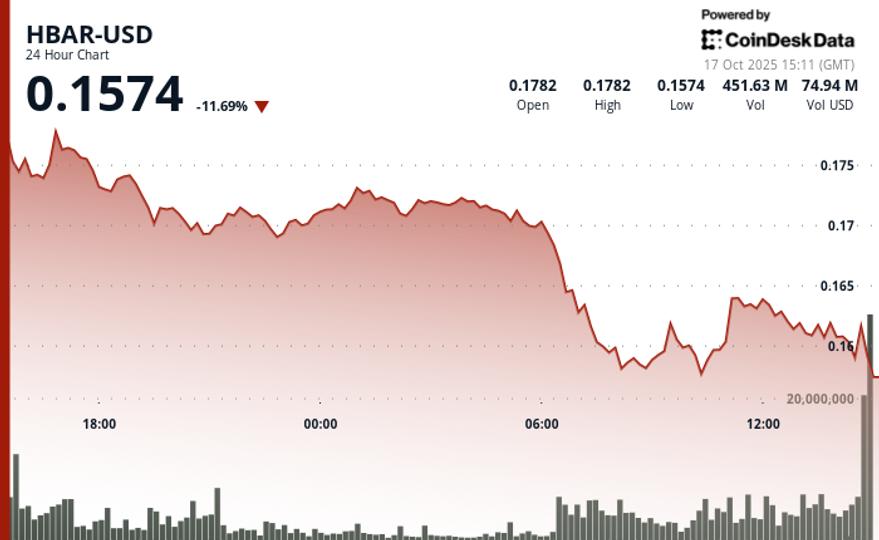
HBAR fell sharply over the 24-hour period from Oct. 16 at 15:00 to Oct. 17 at 14:00, dropping from $0.18 to $0.16 — an 11.15% decline within a 12.74% trading range.
The heaviest selling occurred between 06:00 and 08:00 on October 17, when the price fell from $0.17 to $0.16 on strong volume. Resistance formed at $0.17, while repeated rebounds near $0.16 established firm support despite a continued bearish pattern of lower highs.
In the final hour of trading, HBAR showed high volatility around the $0.16 mark, recovering briefly after a steep dip between 13:43 and 13:47. Trading volume surged above 4 million during this rebound, suggesting temporary stabilization at key support levels.
The decline reflected broader market weakness, with selling pressure intensifying across the digital asset space. Despite short-term recovery efforts, HBAR remains under downward pressure, indicating that consolidation within the $0.16 range may precede any potential reversal.
Technical Indicators Expose Market Fragility
- HBAR declined 11.15% throughout the preceding 24-hour period from 16 October 15:00 to 17 October 14:00.
- Robust resistance established at the $0.17 threshold accompanied by elevated selling pressure.
- Support levels confirmed around the $0.16-$0.16 range with multiple rebound attempts.
- Lower peaks pattern indicates sustained bearish momentum despite consolidation efforts.
- Volume surged to 175.12 million during peak selling pressure between 06:00-08:00.
- Final hour demonstrated volatility with recovery attempts and elevated volume exceeding 4 million.
Disclaimer: Parts of this article were generated with the assistance from AI tools and reviewed by our editorial team to ensure accuracy and adherence to our standards. For more information, see CoinDesk’s full AI Policy.
Binance-Led Selling Pressures Bitcoin, But ‘Uptober’ May Soon Flip the Script
Despite the current selling pressure, CryptoQuant sees only a short-term dip before Bitcoin’s late-October rebound historically kicks in.
Bitcoin suffered a fresh decline of 2% over the past 24 hours, falling below $111,000 on Friday. The ongoing market decline is being primarily driven by Binance-led selling pressure, said CryptoQuant.
The company’s analysts, however, believe this represents a short-term correction rather than the end of the broader bull cycle.
Bears Dominate in Short-Term
Three crucial indicators – the Coinbase Premium, Funding Rate, and Taker Buy/Sell Ratio – collectively highlight this market behavior. The US buying activity appears to be strong, as evidenced by the Coinbase Premium, which remains positive. Despite this, Bitcoin’s price continues to falter, which means that selling on Binance is overpowering US-based demand.
Meanwhile, Binance’s Funding Rate has stayed negative for four straight days, even as most other exchanges record positive rates, revealing that futures traders on the platform are betting on short-term downside moves. In addition to this, the Taker Buy/Sell Ratio has dropped to its lowest level in over a year, as aggression among sellers increased, implying that market order flows are heavily skewed toward liquidation.
While these factors depict Binance’s outsized influence on near-term price action, CryptoQuant argued that the correction appears cyclical rather than structural. Bitcoin’s on-chain fundamentals, such as network activity and long-term holder accumulation, remain strong, and the overall market structure continues to support a bullish outlook.
As such, investors may see a surge in volatility in the short-term as the market digests these developments, but the broader uptrend remains unbroken.
Is ‘Uptober’ Still Alive?
Bitcoin may, in fact, soon regain momentum as October progresses. CryptoQuant data points to a recurring seasonal trend in which BTC often delivers its strongest performance during the latter half of the month. Since 2020, a $100 position in Bitcoin at the start of October has typically grown to around $120-$125 by month’s end. This pattern has been fairly consistent.
You may also like:
The explanation lies in the fact that during the second half of October, Bitcoin’s exchange reserves have historically declined by 0.5-1% as investors withdraw BTC into self-custody or long-term storage. This contraction in sellable supply tightens market liquidity, which makes prices more sensitive to renewed buying pressure.
Early in the month, price action is usually shaped by short-term traders, but as the month unfolds, long-term holders resume accumulation, which boosts positive sentiment and sparks the so-called “Uptober” effect.
At the same time, stablecoin issuance tends to rise, which means that new capital is flowing into the crypto ecosystem and increasing market demand. These factors together create favorable conditions for late-month rallies.
Binance Free $600 (CryptoPotato Exclusive): Use this link to register a new account and receive $600 exclusive welcome offer on Binance (full details).
LIMITED OFFER for CryptoPotato readers at Bybit: Use this link to register and open a $500 FREE position on any coin!