Bitcoin’s latest oversold RSI mirrors 2020 and February 2026 setups that preceded 50% and 30% rebounds, putting $70K back in focus.
Solana (SOL), currently trading at around $91.90, has been under immense bear pressure in recent months.
The token has seen a steady decline from its previous highs, but recent technical signals suggest a rebound could be in play.
The $90 level is emerging as a key support level, which, if held, could trigger a strong upward move.
The immediate support level at $90 has been tested several times in recent weeks, and every time Solana approaches it, buyers have stepped in to prevent further declines.
Technical charts show that holding this level is critical since a break below it could lead to a pullback toward $77.

On the other hand, maintaining $90 provides a foundation for bulls to push higher.
Momentum indicators show a mixed picture, with shorter timeframe charts indicating growing strength, although some oscillators are still signalling caution.
This suggests that while there is potential for upward movement, the market is waiting for confirmation.
Trading volume has also picked up slightly in the past month, showing renewed interest among traders.
Yet, on-chain activity has dropped, indicating fewer transactions on the network.
This combination of higher trading volume and lower on-chain use points to speculative interest driving the short-term rally.
The combination of technical support, rising volume, and potential bullish momentum makes the $120 target realistic if $90 holds.
If Solana holds $90, the path to $96.47 is relatively clear.
Once $96.47 is broken and sustained, a move toward $120 becomes plausible.
This would represent a nearly 30% gain from current levels, making it an attractive scenario for bullish traders.
Historical patterns also support this possibility.
In previous cycles, Solana has seen rapid rallies after establishing such strong support levels.
Short-term momentum is improving, and daily momentum indicators such as Moving Average Convergence Divergence (MACD) and the Relative Strength Index (RSI) are turning more positive.
The MACD histogram is above the middle line, and the signal line has moved above the main MACD line, and the RSI has rebounded above 50 after a slight dip, signalling a possible rebound in the near term.
These suggest that buyers are gaining control, at least for the near term.
However, caution still remains since any failure at the resistance at $96.47 could lead to sideways trading or a complete collapse.
In addition, the market is sensitive to broader cryptocurrency trends, and a strong rebound in Bitcoin (BTC) and Ethereum (ETH) could further lift Solana’s price, while weakness in these coins could cap Solana’s gains.
One day after recording its worst single-session loss in history, South Korea’s KOSPI surged more than 11% on Thursday, staging one of the most dramatic reversals the index has ever seen.
No major economy is more acutely wired to Middle East instability than Seoul — and this week proved it.
South Korea’s two main stock indices — the large-cap KOSPI and tech-heavy KOSDAQ — are among Asia’s most actively traded markets and a key barometer of Korean retail investor sentiment.
By mid-morning, the KOSPI had climbed to 5,682 — up from Wednesday’s close of 5,093 — after touching an intraday high of 5,715. The KOSDAQ recovered above the 1,000 level, gaining over 11%. A buy-side sidecar was triggered in early trade — a striking contrast to Wednesday’s sell-side sidecar and full circuit breaker halt. The won strengthened sharply, pulling back from an overnight high of 1,505 to trade near 1,461.
The catalyst: oil prices stabilized, with Brent crude holding at $81.40 and WTI at $74.66, and reports of back-channel contacts between Washington and Tehran lifted sentiment across Asian markets. Wall Street had closed higher on Wednesday, with the Nasdaq up 1.29%, led by Tesla (+3.44%), Amazon (+3.95%), and Nvidia (+1.66%).
Samsung Electronics and SK Hynix — which had shed 21% and 22.75% respectively from their late-February peaks — rebounded 13–15% in early trade. Foreign investors, who had used both stocks as first-resort liquidity during the panic, returned as net buyers of over 710 billion won by mid-morning. Retail investors added another 600 billion won alongside them.
The scale of the crash and recovery reflects a structural reality. Over the two sessions on March 3–4, the KOSPI and KOSDAQ fell 18.43% and 17.97%, respectively — the worst and second-worst performances globally. Japan fell 6.57%, Taiwan 6.46%, and China’s Shenzhen Composite just 3.76%. US indices barely registered, declining less than 0.35% combined.
Korea imports over 70% of its energy from the Middle East and operates an export-dependent economy with high sensitivity to commodity shocks. When US-Israel strikes on Iran triggered Strait of Hormuz closure fears, global risk was concentrated in Seoul with exceptional force. Wednesday’s KOSPI decline of 12.06% surpassed even the 12.02% drop recorded the day after 9/11 — a threshold that had stood for 25 years.
Analysts are cautiously optimistic but warn that the path forward depends on geopolitical developments. One analyst argued that a prolonged Hormuz blockade is self-defeating for Iran. It would cut Tehran’s foreign exchange revenues while inviting further military response. Another pointed to a potential mediator as the key turning point. At current index levels, he said, “the case for buying is strong.”
Mirae Asset set a near-term KOSPI recovery target of 5,800. Kiwoom Securities suggested the two-day selloff had effectively front-loaded the war risk premium in full.
For crypto markets, as BeInCrypto reported Wednesday, Korea’s retail investor base showed some resilience during the crash — with newly listed tokens on Upbit and Bithumb posting double-digit gains even as equities collapsed. But Thursday’s equity rebound may quickly reverse that dynamic.
With foreign and retail investors pouring over 1.3 trillion won back into equities in a single morning session, the stock market’s gravitational pull reasserts itself. Korea’s crypto volumes had already dropped by more than 80% during the KOSPI’s 85% bull run since President Lee’s election, and a sharp V-shaped equity recovery threatens to drain whatever crypto inflows emerged during the two-day panic.
The won pulled back from 1,505 to near 1,461. That partial recovery reduces the currency-hedge appeal that briefly boosted digital assets. The effect is already visible in the data: Bitcoin rose 6.4% in dollar terms over the past 24 hours, but gained only around 5% on Upbit in won terms — the won’s sharp rebound absorbed more than a percentage point of that gain.
If geopolitical risk continues to ease, the KOSPI could push toward Mirae Asset’s 5,800 target. Korean retail capital — historically the most swing-sensitive in global crypto markets — would likely follow equities. Not digital assets.
The slowdown in on-chain activity echoes a similar lull last summer that came right before a huge rebound in Bitcoin.
The total fees paid on the Binance Smart Chain (BSC) recently fell to approximately $593,000, marking the network’s lowest usage cost since at least August 2025.
This collapse in transaction activity on one of crypto’s busiest highways is reviving memories of a similar demand drought last summer that immediately preceded a 95% rally in Bitcoin (BTC).
Blockchain fees are the clearest measure of user demand, representing what people pay to move tokens or use decentralized applications. When fees drop sharply, it signals reduced network congestion and waning speculative interest.
According to data from analyst Amr Taha, on February 23, BSC fees sank to $593,000, which is well below the $1.07 million trough recorded on August 7, 2025. At that time, Bitcoin was trading near $55,000, and, per Taha, the fee drop later helped form a major bottom before the asset embarked on a rally that saw its price shoot up by more than 95%.
The on-chain observer also flagged a steep drop in Bitcoin’s short-term holder realized market cap, which fell to about $386 billion on February 24, well below an earlier low of $440 billion recorded on April 8, 2025.
Historically, similar contractions have coincided with heavy capitulation phases that preceded rebounds, including the move that took BTC from around $78,000 to above $108,000 following the April 2025 low.
While the decline in spot activity signals caution, the derivatives market is undergoing a structural reset that could pave the way for the next move. According to XWIN Research Japan, open interest in Bitcoin futures has fallen sharply, reflecting a broad deleveraging phase. Analysts at the institution noted that the recent drop in price was accompanied by falling open interest, indicating that liquidations and derivatives-driven unwinds, rather than aggressive spot selling, drove the decline. This type of reset can stabilize the market, even if it does not immediately signal renewed demand.
Further complicating the outlook is the options market structure. Coinbase Institutional’s analysis shows a pronounced negative gamma band concentrated between $60,000 and $70,000. When dealers hold negative gamma, their hedging activity can amplify price moves, meaning a break below $60,000 could accelerate selling.
Despite the cautious tone, some on-chain indicators offer a glimmer of stability, with the Binance Fund Flow Ratio remaining low around 0.012, implying limited immediate sell-side pressure. During the recent drop toward the mid-$60,000 region, the ratio did not spike, meaning panic-driven spot inflows were absent.
However, as XWIN Research noted, weak inflows do not equal strong accumulation, and the medium-term trend of demand metrics has not yet turned decisively upward.
For a durable bottom to form, stronger spot volume support will be essential. As it stands, Bitcoin is trading just above $68,000 at the time of writing, down roughly 23% over the past month and more than 46% below its all-time high above $126,000.
LIMITED OFFER for CryptoPotato readers at Bybit: Use this link to register and open a $500 FREE position on any coin!
A $7.8 trillion cash pile sits in US money market funds, earning, rolling, waiting. The Federal Reserve began this easing cycle on Sept 18, 2024, and it’s now been 522 days since that first cut.
Looking at historical market movements, we’re entering a window whereby funds have typically started to rotate back into riskier assets. Bitcoin analyst Matthew Hyland made exactly this claim on X over the weekend.
Historically around 500-1000 days after the FED begins rate cuts the liquidity begins to leave the money market funds and flow out into the markets.
The calendar supports the setup, but the incentives will decide the outcome.

Bitcoin moves get scarier as institutional traders run out of “fast cash” with most funds parked earning yield with slow TradFi settlement times.
Feb 16, 2026 · Liam ‘Akiba’ Wright
The latest weekly read from the Investment Company Institute puts total money market fund assets at $7.791T for the week ended Feb 18, 2026, with $6.405T in government funds, $1.242T in prime funds, and $0.144T in tax exempt funds, a distribution that tells you where the demand has preferred to sit, close to Treasurys and close to daily liquidity.
We can view this as “cash on the sidelines,” a reserve that can stampede into risk assets once the Fed turns the corner.
However, the cash is a yield product; it has incentives, mandates, a monthly statement, and a reason it accumulated here in the first place. Rates rose, yields followed, and cash found a home with fewer questions attached, and now rates are stepping down, and the question shifts from size to direction.
The effective federal funds rate sits at 3.64% in the January 2026 monthly print, down from 4.22% in September 2025, a simple compression of return that changes what “safe” pays.
You can see it in money fund yield tracking as well. Crane’s index sits around 3.58% for the week ended Jan 2, 2026, a quieter yield that narrows the gap between waiting and reaching. The cash pile still looks tall on a chart, and the path under it is a slope, and slopes create motion.
The easy reservoir that used to sit in the Fed’s overnight reverse repo facility has already drained down to almost nothing, $0.496B on Feb 20, 2026, so the next “liquidity story” lives in portfolio choices rather than a mechanical facility unwind.
The cash can stay where it is, roll into duration, move into credit, drift into equities, or leak into crypto rails, and each path has a different set of consequences.


Persistent ETF outflows indicate market hesitation despite Fed’s temporary liquidity maneuver.
Feb 19, 2026 · Oluwapelumi Adejumo
Money market funds hold more than one kind of money. ICI’s weekly split shows $3.082T in retail money market funds and $4.709T in institutional funds, and institutional cash carries a different posture, it pays vendors, it backs credit lines, it covers payroll cycles, it sits there as policy, and those policies move slower than memes.
That composition sets the baseline for the flow math. A 1% move in total money market assets equals about $78B, a 5% move equals about $390B, a 10% move equals about $779B, and those numbers get interesting even before you argue about where they land, since they tell you how large the gear is that the rate path is trying to turn.
The incentive lever is yield, which follows the Fed’s path.
Morgan Stanley frames it in the plain language investors actually live with, money market yields track the Fed, cuts compress returns, and investors reevaluate where they sit as the path evolves. The forward-looking part is simple: the more the path points down, the more the ledger begins to ask, “What else pays,” and the answer changes by risk tolerance and by mandate.
Macro liquidity watchers will also keep one eye on the Treasury’s own cash balance and the Fed’s balance sheet, since both shift the waterline in reserves and financing.
The Fed’s balance sheet, WALCL, stands at $6.613T, and the Treasury General Account weekly average sits around $912.7B for the same week, both series that traders read like gauges, each movement a reminder that cash is a system with valves.
A rate-cutting cycle creates a menu, and the first courses look like duration and credit. Morgan Stanley points out that in prior easing windows, investment-grade bonds beat cash equivalents between the end of hikes and the end of cuts, providing a grounded alternative to the idea that money-market outflows automatically become equity or crypto inflows.
That detail is important for Bitcoin, since it depends on marginal flow, and marginal flow depends on which bucket investors choose first. In a world where cash rolls into bonds, the rotation still exists, and the risk bid looks more measured. Though when cash skips the bond aisle and reaches for risk, the rotation becomes a discontinuity.
Crypto has its own liquidity mirror. The stablecoin market stands at $308B, with USDT at $186B, a balance sheet for on-chain “cash” that can expand when risk appetite rises, and contract when the system tightens.
Market-moving headlines and context delivered every morning in one tight read.
5-minute digest 100k+ readers
Free. No spam. Unsubscribe any time.
Whoops, looks like there was a problem. Please try again.
You’re subscribed. Welcome aboard.
Stablecoins carry a different role than money market funds, and the comparison helps; each is a wrapper for short-term value storage, and each wrapper moves when the opportunity cost shifts.


Stablecoin supply tells you how much dollar collateral the system can recycle before slippage rises and liquidations run. With supply now drifting lower, the question isn’t whether Bitcoin will go up or down, but how violent will the path be?
Feb 21, 2026 · Andjela Radmilac
Bitcoin also has a relatively new intake pipe in US spot ETFs. Inflow and outflow totals become a ruler for the money market scenario math, since you can compare a hypothetical $39B shift to a realized $61.3B of ETF intake, and you can see how quickly the scale begins to matter.
In this scenario, Bitcoin becomes a flow instrument, and the story shifts toward market microstructure, incremental supply meets incremental demand, and price tends to respond in jumps rather than in steps.
Across all three scenarios, the common denominator is incentive. The Fed began cutting on Sept 18, 2024, with a 50 basis point move to a 4.75 to 5.00% target range, and the calendar since then has moved faster than the cash has moved, which leaves the market watching the yield slope and the allocation choices.
Macro stories age well when they rest on a durable context.
The IMF’s January 2026 update projects 3.3% global growth in 2026 and 3.2% in 2027, a baseline that supports a soft-landing narrative even as regional risks remain, and that matters for risk assets, since growth expectations influence allocation behavior as much as yields do.
Meanwhile, the plumbing gauge that powered many liquidity stories earlier in the decade, the Fed’s ON RRP facility, has already drained close to zero, which shifts attention back to the slower gears, money market composition, institutional constraints, and the relative return of bonds, equities, and alternative assets.
It also explains why the “cash on the sidelines” framing feels both true and incomplete. The cash exists, but its exit is not mechanical. It requires decisions, and those decisions follow incentives.
To track that process, a small set of recurring gauges matters more than headlines:
Money market assets and composition: ICI’s weekly report provides the base map, total AUM, government vs. prime share, and the retail–institutional split.
Money fund yields: Crane’s index offers a compact read on the incentive to stay put.
The rate path: The effective federal funds rate shows what “cash” actually earns.
Forward guidance: The Fed’s projected destination in the SEP anchors expectations.
System plumbing: ON RRP, WALCL, and WTREGEN indicate how reserves and liquidity are shifting.
Crypto’s internal cash: Stablecoin supply, plus daily and cumulative Bitcoin ETF flows, show how much of that rotation is reaching digital rails.
Taken together, these gauges offer a cleaner way to talk about “liquidity,” and keep us anchored when the market tries to turn it into a slogan.
The market has a way of turning a calendar into destiny, and a cash pile into a prophecy.
The better read comes from the incentives and the pipes, yields that slide, wrappers that reprice, mandates that loosen or hold, and a set of flow rails that turn small percentages into large numbers when they meet an asset built for marginal demand.
Bitcoin (BTC) bottomed after CME futures speculators turned net bullish in April 2025. A similar positioning shift is resurfacing in 2026, raising the odds of a BTC price recovery in the coming weeks.
Key takeaways:
Non-commercial Bitcoin futures traders cut their net position to about -1,600 contracts from roughly +1,000 a month earlier, according to the CFTC Commitment of Traders (COT) report published last week.
In practice, this means that large speculators, including hedge funds and similar financial institutions, have shifted from net short to long, with bulls outnumbering bears on the CME.
The rapid net-short unwind implies that “smart money” added longs “with some urgency,” said analyst Tom McClellan, while pointing to two similar past swings that preceded Bitcoin price bottoms.
For instance, BTC’s price gained around 70% after a sharp dip in CME Bitcoin futures net shorts in April 2025. In 2023, BTC price rose by over 190% under similar futures market conditions.

As of February, the smart money swing is flashing once again, just as Bitcoin defends its 200-week exponential moving average (200-week EMA, the blue line), which has acted as a bear-market floor in most major drawdowns of the last decade.
On Sunday, BTC’s 200-week EMA was hovering around near $68,350.

The last time Bitcoin traded around this moving average during deep sell-offs (in 2015, 2018 and 2020), it eventually marked the end of the downtrend and the start of a new recovery phase.
Related: Bitcoin historical price metric sees $122K ‘average return’ over 10 months
Bitcoin’s weekly relative strength index (RSI) remains in oversold territory, a sign that selling pressure is nearing exhaustion.
That further raises Bitcoin’s odds of recovering in the coming weeks. A decisive rebound from the 200-week EMA could trigger a run-up toward the 100-week EMA (the purple wave) at roughly $85,000 by April.
McClellan cautioned that the smart money shift is “a condition, not a signal,” meaning Bitcoin could still slide from its current price levels before a durable low forms.
That may trigger the 2022 scenario, wherein BTC plunged by over 40% after breaking below its 200-week EMA despite similar oversold conditions.

A repeat of that 40% plunge in 2026 could result in BTC prices falling toward $40,000, or 60% from its record high of around $126,270.
Some analysts, including Kaiko, also see BTC potentially bottoming around $40,000–$50,000 based on its “four-year cycle” framework.
This article does not contain investment advice or recommendations. Every investment and trading move involves risk, and readers should conduct their own research when making a decision. While we strive to provide accurate and timely information, Cointelegraph does not guarantee the accuracy, completeness, or reliability of any information in this article. This article may contain forward-looking statements that are subject to risks and uncertainties. Cointelegraph will not be liable for any loss or damage arising from your reliance on this information.
“Massive November pump, then straight off a cliff. Classic rug vibes,” one X user argued.
The list of altcoins that have posted substantial declines over the past week is quite long, and their poor performance coincides with the broader market decline that occurred a few days ago.
Internet Computer (ICP) is the worst performer (at least from the top 100 club), with its price slipping by 10% within that period. The question now is whether a further plunge is knocking on the door.
ICP currently trades at approximately $3.26 (per CoinGecko data), a substantial decrease from the local peak of almost $10 recorded towards the end of last year. Its downtrend has caught the eye of numerous analysts, some of whom believe the bulls are unlikely to regain control anytime soon.
X user Alisa noted the significant decline in recent months, arguing that ICP’s chart indicates “exit liquidity.” “Massive November pump, then straight off a cliff. Classic rug vibes,” they stated.
The market observer claimed that Internet Computer has always had a “sketchy” marketing, adding that the valuation has finally matched the hype – “garbage.”
Alisa questioned how the asset’s current market capitalization is approximately $1.8 billion, characterizing it as “dead coin walking” and warning investors not to catch this “falling knife.”
More Crypto Online also sounds quite pessimistic. The analyst thinks the current structure is bearish due to falling below certain important price levels, claiming that a plunge to multi-month lows is possible:
“From the recent support area, price has again produced only a 3-wave rally into the long-standing resistance zone between $4.48 and $7.52. This resistance has held repeatedly, while support levels continue to break, which increases the probability of further downside. In bearish environments, this pattern typically keeps pressure to the downside intact. As a result, a move toward lower levels, potentially even below the October 10th low near $1.51, cannot be ruled out.”
On the other hand, many other analysts continue to predict that ICP could be on the verge of a major rally. X user Nehal envisioned a 60% increase in the short term, seeing the price trading above $5 sometime in February.
Prior to that, Bitcoinsensus suggested that ICP has been coiling inside a falling wedge pattern. According to the X user, the price has been compressing within a multi-year wedge, while breaking the formation to the upside could lead to a price explosion above $20.
ICP’s recent exchange netflow supports the optimistic forecasts. Over the past several weeks, outflows have dominated inflows, meaning that investors have shifted from centralized platforms to self-custody methods. This, in turn, reduces the immediate selling pressure.
BNB price is showing early signs of recovery amid a turbulent market week for altcoins, with the price having slipped off intraday highs of $903.
While prices hovered about 1.4% down in the past 24 hours, changing hands around $882, means bulls could eye a return to the key $900 mark and target $1,000.
Market optimism, institutional interest, and technical indicators could align for this to happen within the coming days or weeks.
Notably, the cryptocurrency’s resilience above $800 comes as Bitcoin stabilizes above $91,000 following a rebound from lows near $80,000.
While the market is mixed, bulls are showing resilience.
Although prices have dipped more than 35% from recent all-time highs, market experts remain bullish on BNB’s trajectory.
Even as short-term volatility persists, technical analyses suggest the token could reach an average price of $1,000 in the coming months.
Momentum could push the BNB price beyond the psychological level of $1,200 and then the ATH above $1,370.
Short-term, technical indicators support a mixed picture. BNB’s 50-day moving average is sloping and acting as a key hurdle around $1,050, while the relative strength index (RSI) at 40 signals neutral territory but with a potential dip before oversold recovery.
However, price saw a breakout above the resistance line of a falling wedge, and the MACD hints at a bullish crossover.
If BNB clears the $900 resistance, we could see a swift move to $1,000, potentially aligning with broader market stabilization.
As well as broader sentiment, BNB’s utility in the Binance ecosystem positions it for outperformance in a risk-on environment.

Several key factors are converging to ignite BNB’s next leg higher, with the spotlight firmly on institutional inflows and whale dynamics.
At the forefront is the freshly filed VanEck BNB ETF, submitted to the SEC on November 21 for listing on Nasdaq.
The spot ETF would hold BNB directly, tracking the BNB Index without initial staking, although future yields via third-party providers could be added with notice.
If approved, VBNB could mirror the success of Bitcoin and Ethereum ETFs, unlocking billions in traditional capital and enhancing BNB’s legitimacy.
Many see this as a game-changer for altcoin exposure, and social hype has surged.
Broader market stabilization is another tailwind.
Bitcoin’s rebound, following recent dovish remarks from New York Fed President John Williams, helped bulls. This eased last week’s panic selling, where BTC plunged below $80,000.
Losses for BTC dragged altcoins down.
Exchange-traded product flows have also flipped positive after consecutive net outflows. Despite subdued large-whale demand overall, inflows at support levels around $800 suggest discounted buying ahead of a rally.
Pi Coin has recently witnessed heightened volatility, with its price fluctuating amid weak growth over the past few days.
The altcoin’s limited upward movement has raised skepticism, but improving investor sentiment and technical signals suggest a potential reversal is likely.
Sponsored
Sponsored
The Relative Strength Index (RSI) for Pi Coin is currently in the oversold zone, a level that often indicates exhaustion among sellers. Historically, such dips have marked key turning points for the cryptocurrency.
Just last week, a similar condition preceded a notable rebound, suggesting that accumulation may soon replace selling pressure.
Investors often interpret oversold conditions as opportunities to enter the market at discounted prices. If accumulation strengthens, Pi Coin could experience a shift in momentum as buyers move to capitalize on low valuations.
Want more token insights like this? Sign up for Editor Harsh Notariya’s Daily Crypto Newsletter here.
Sponsored
Sponsored
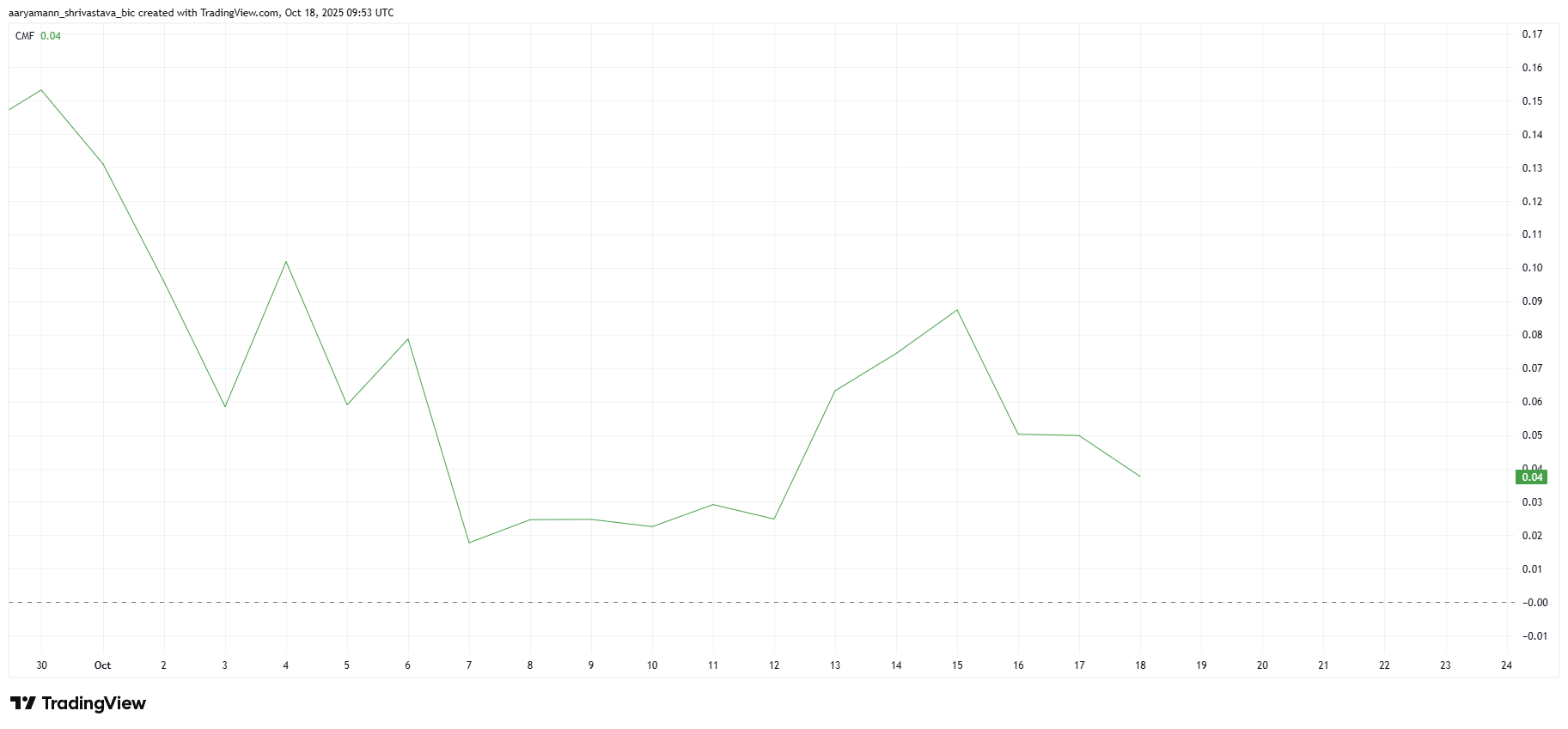
The Chaikin Money Flow (CMF) indicator has shown fluctuations over recent sessions but remains above the zero line in positive territory. This implies that capital inflows continue to outweigh outflows, a positive sign for market stability. Even with temporary weakness, sustained inflows indicate that Pi Coin’s investor confidence has not fully eroded.
While momentum has softened slightly, the overall liquidity structure supports a steady recovery. If the CMF maintains its position above zero, it could provide the foundation for renewed buying activity.
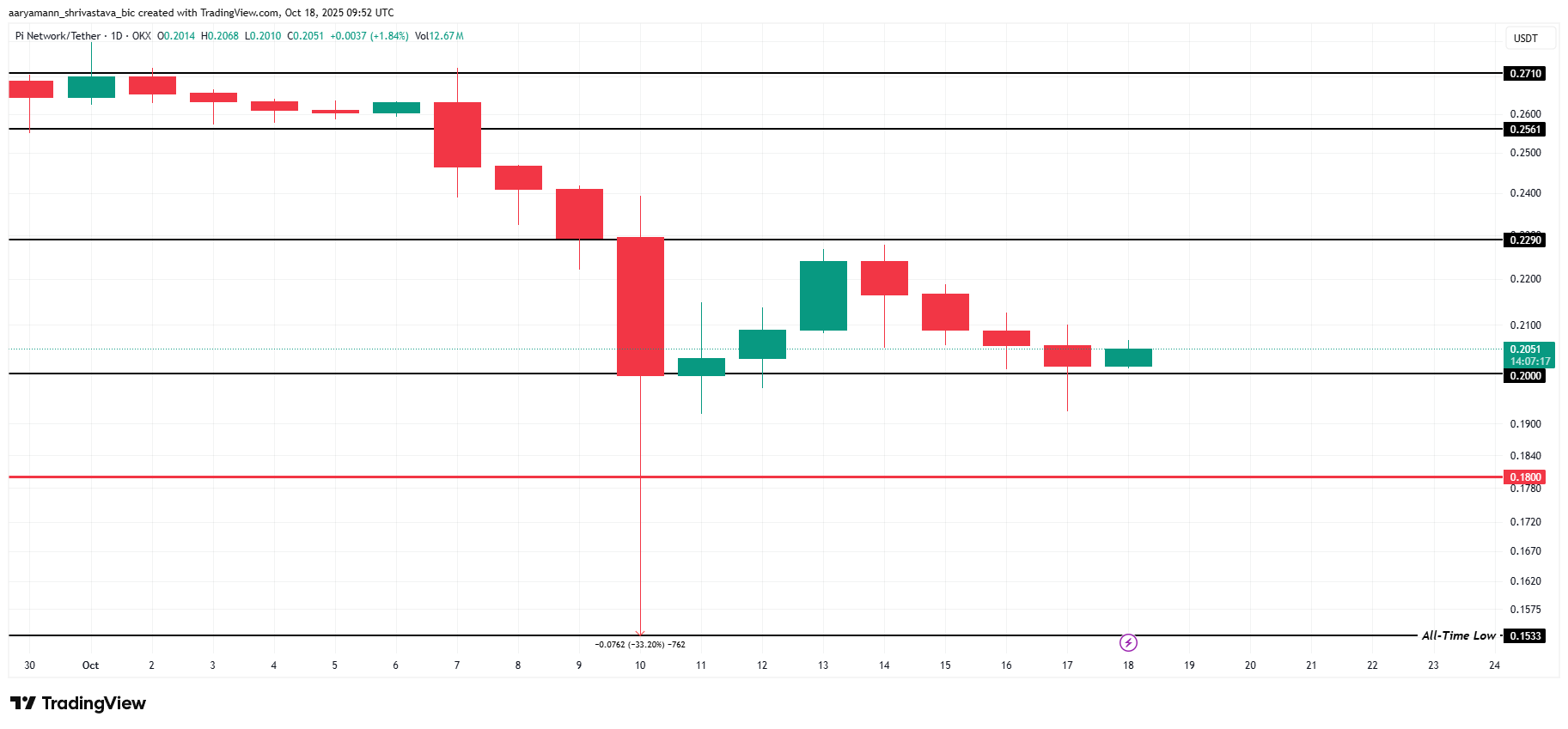
Pi Coin is trading at $0.205, holding firmly above the $0.200 support level, which has acted as a critical base for past rebounds. The level helped the altcoin recover last week, and a similar bounce could emerge if bullish sentiment builds further.
Should this occur, Pi Coin could rise toward the $0.229 resistance level, with a potential breakout paving the way to $0.256. Achieving this move would require solid investor support and favorable market cues.
However, if the broader market turns bearish, Pi Coin could lose the $0.200 support. Thus, the token could slip to $0.180 or even $0.153—its all-time low—invalidating the bullish thesis.
Cardano (ADA) fell roughly 27% this week, slipping below the $0.66 support as risk-off flows hit crypto. Bitcoin’s slide toward $104,000 and softer altcoin liquidity magnified downside, and on-chain data shows large holders leaning defensive.
Santiment-tracked wallets holding 1–10 million ADA offloaded about 40 million ADA over seven days, while broader whale distribution reportedly reached 350 million ADA, pressuring price. other big wallets accumulated 140–200 million ADA, creating a split tape that’s fueling choppy consolidation between $0.65–$0.70.
Derivatives add to the cautious tone. Cardano’s open interest slipped 2.12% to $669.9 million, and long liquidations ($1.13 million) dwarfed shorts ($187,000), signaling bulls bore the brunt of the latest flush.
On the 4-hour chart, ADA is carving a falling wedge, but confirmation requires a breakout above $0.74. Until then, momentum indicators remain mixed: RSI 37 (approaching oversold) while CMF 0.12–0.15 hints at returning spot inflows that have yet to overpower supply from large holders.
Technicians flag a “risk-first” path: losing $0.66 puts $0.65 in play; failure there opens $0.62–$0.60, then $0.57 (channel/structure confluence). A deeper shakeout could probe $0.53 if broader crypto weakness persists.
On the upside, ADA must reclaim $0.66 and then clear $0.74–$0.80 (50-day EMA cluster) to flip trend strength. Above that range, bulls target $0.86, with a psychological $1.00 retest feasible into Q4 if risk appetite and flows improve.
Several analysts still eye a path toward $1.20–$1.60 on a confirmed breakout, but most caution the market may dip before it rips given leverage resets and uneven liquidity.
ETF headlines (including the Oct. 23 Grayscale ADA ETF decision window), stablecoin and ETF net flows, and whether whale selling cools. A rotation back into altcoins typically follows BTC stabilization; conversely, renewed BTC downside would likely extend ADA’s consolidation near the lows.
ADA's price trends to the downside on the daily chart. Source: ADAUSD on Tradingview
Beyond price, Cardano’s community treasury has surpassed 1.6 billion ADA ($1 billion), funded by fees and staking rewards and governed via Project Catalyst, a war chest that supports tooling, DeFi, and infrastructure without VC overhang.
New staking access (e.g., eToro U.S.) and ongoing initiatives like Midnight and Leios continue to broaden the roadmap, even as TVL ($288 million) lags larger chains.
Cover image from ChatGPT, ADAUSD on Tradingview