MSCI’s new non-operating company rules could exclude Strategy, Metaplanet and SharpLink. The final list of affected firms is due Nov. 11.


 Live Chat
MSCI’s new non-operating company rules could exclude Strategy, Metaplanet and SharpLink. The final list of affected firms is due Nov. 11.

Start every day with the top news stories right now, plus original features, a podcast, videos and more.

XRP and Bitcoin (BTC) were pitted against each other in a recent analysis, with market expert X Finance Bull revealing what early investors could have gained if they had invested $500 into both XRP and BTC in 2014. The analysis compares the performance of both cryptocurrencies over the years, highlighting the factors behind XRP’s growth and sustained momentum.
A new analysis by X Finance Bull reveals the dramatic growth potential of early investments in Bitcoin and XRP. According to the report, a $500 investment in XRP at the 2014 lows would be worth approximately $255,000 today. He compares XRP’s gains with those of Bitcoin, noting that if investors had bet the same amount in BTC in 2014, their investments would have grown to around $133,000.
These figures suggest that XRP outperformed Bitcoin by more than twice over the same period, delivering a 511-fold return, compared to BTC’s 266-fold gain. During that time, XRP’s performance benefited not only from early, steady adoption and speculative interest but also from the continued development of its underlying payment system.
Over the years, XRP has moved beyond a purely speculative asset, gaining more traction as it evolves into a potential global settlement layer. Sharing similar sentiments, X Finance Bull highlighted how XRP’s infrastructure developments have significantly supported its significant price growth today. He noted that the cryptocurrency has seen major progress in areas such as Exchange-Traded Funds (ETFs), banking licenses, and enterprise-level adoption.
Notably, XRP Spot ETFs officially launched in November 2025, attracting massive inflows that have significantly boosted demand for XRP among institutional investors. In addition, the Office of the Comptroller of the Currency (OCC) has conditionally approved Ripple’s application to establish a national trust bank charter. All of these developments have contributed to XRP’s price growth over the past few months.
In his post, X Finance Bull suggested that investors who held onto their XRP positions through the volatile years “know why they held.” Following the cryptocurrency’s dramatic rally above $3, many investors reaped the rewards of staying invested from its lows and trusting in its potential for future price appreciation.
From 2018 to 2025, XRP struggled with a lawsuit filed by the US Securities and Exchange Commission (SEC). During those years of legal turmoil, many investors continued to hold onto their XRP despite the uncertainty and price stagnancy.
Following Ripple’s legal win, XRP surpassed $3 in 2025, marking its first break above that level since 2018. Compared to XRP, Bitcoin has also experienced significant growth in the past few years. After crossing the $100,000 threshold in 2024, BTC continued its surge into 2025, finally hitting a peak above $126,000 in October.
Featured image from Shutterstock, chart from Tradingview.com

What to Know:
Bernstein’s latest forecast has reignited institutional fervor: Bitcoin hitting $150,000 in 2026.
Analysts at the firm, including Gautam Chhugani, point to an ‘unprecedented institutional adoption cycle‘, driven by Spot ETF inflows and post-halving supply shocks, as the primary catalyst. This isn’t just a price target. It’s a signal that the asset class is graduating from speculative retail play to sovereign-grade treasury reserve.
But there’s a catch. A six-figure Bitcoin creates a distinct second-order problem: scalability. As network valuation swells, base layer transaction fees historically skyrocket. The main chain becomes impractical for anything other than massive settlements. This outcome creates a vacuum for Layer 2 infrastructure, protocols that inherit Bitcoin’s security while handling the heavy lifting of execution.
Smart money is already front-running this infrastructure crunch. While Bitcoin consolidates, capital is rotating aggressively into scalability solutions designed to unlock dormant liquidity.
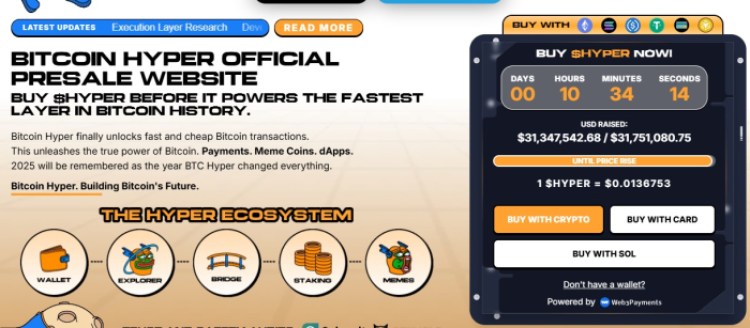
You can see this shift in the rapid ascent of Bitcoin Hyper ($HYPER), a new high-performance Layer 2 project that has already secured over $31 million in funding. The thesis is simple: if Bitcoin becomes the global vault, protocols like Bitcoin Hyper are positioning themselves as the high-speed rails moving the cash.
Read more about $HYPER here.
The current Bitcoin Layer 2 landscape is crowded. Bitcoin Hyper ($HYPER), however, is carving out a specific niche by jamming the Solana Virtual Machine (SVM) directly into Bitcoin’s settlement layer. Most existing solutions face a brutal trade-off: secure but slow, or fast but centralized.
By using the SVM, Bitcoin Hyper aims to deliver the execution speed developers expect from Solana, blazing fast, low-cost, while anchoring finality to the Bitcoin network.
This technological hybrid attacks the core limitations hindering Bitcoin’s DeFi ecosystem: glacial block times and no native smart contract programmability. Through a Decentralized Canonical Bridge and modular architecture, the protocol allows seamless transfer of $BTC into a high-performance environment.
Suddenly, complex DeFi applications, from lending protocols to NFT platforms, aren’t just possible; they’re scalable.
That matters for market dynamics. If Bernstein’s $150K prediction holds water, demand for ‘productive $BTC’, assets used as collateral rather than sitting idle, will likely surge. Bitcoin Hyper’s approach allows it to serve as the execution layer for this liquidity. Developers are particularly interested in the Rust-compatible SDK, which lowers the drawbridge for builders migrating from Solana’s ecosystem to Bitcoin’s liquidity.
$HYPER is available here.
Capital flow into the Bitcoin Hyper presale suggests high-net-worth investors are betting big on this ‘SVM on Bitcoin’ narrative. According to official data, the project has raised a staggering $31.3M. In the current fundraising environment? That figure stands out. The token is priced at $0.0136753, enticing early backers looking for leverage against Bitcoin’s main layer moves.
On-chain analysis reveals this interest isn’t limited to retail participants. Etherscan records show 2 whale wallets have accumulated over $1M ($500K, $379.9K, $274K) in recent transactions.
The risk for any new Layer 2 is intense competition from established players like Stacks or emerging zero-knowledge rollups. (Competition is fierce in this sector). However, Bitcoin Hyper’s staking model offers a compelling incentive structure to keep liquidity locked. The protocol offers high APY staking immediately after TGE, with a short 7-day vesting period for presale participants.
This structure rewards long-term alignment over mercenary capital. For investors watching the Bernstein target of $150,000, $HYPER represents a leveraged bet on the infrastructure required to support that valuation.
Buy $HYPER here.
Disclaimer: This article is not financial advice. Cryptocurrencies are high-risk assets. The $150K Bitcoin prediction is an analyst forecast, not a guarantee. Always conduct your own due diligence before investing.

Moon Inc. (HKEX: 1723) has raised about US$8.8 million to launch a Bitcoin prepaid card in Thailand and South Korea, with plans to expand across Asia. The company, a leader in prepaid connectivity and digital asset solutions, confirmed the successful HK$65.5 million fundraising earlier today.
The round was supported by a consortium of Bitcoin miners and investors through the issuance of new shares and convertible notes, according to a note shared with Bitcoin Magazine.
“The successful completion of this private placement marks another critical milestone in Moon Inc.’s growth, and we are grateful for the confidence our new and existing investors have shown in our long-term vision,” said John Riggins, CEO of Moon Inc.
According to a filing with the Hong Kong Stock Exchange, the proceeds will support Moon Inc.’s Pan-Asian expansion, starting with Thailand and South Korea, alongside the launch of its Bitcoin-enabled prepaid card.
The cards enable users to acquire, store, and transfer Bitcoin without the complexity of traditional wallets, merging Moon Inc.’s prepaid telecom expertise with innovative digital asset functionality.
In other words, the cards will let people buy and send Bitcoin easily, without needing a separate crypto wallet — basically like a pre-paid phone card.
Looking ahead, Moon Inc. is evaluating Taiwan, Japan, and Vietnam for future growth opportunities.
Riggins framed the fundraise and new prepaid card as a step toward bridging traditional capital markets within the Bitcoin economy, leveraging Moon Inc.’s existing wholesale telecom distribution networks.
“We see this as more than a fundraise — it’s a vote of confidence in Hong Kong’s role as a gateway for regulated digital-asset innovation and in Moon Inc.’s ability to bridge traditional capital markets with the Bitcoin economy,” Riggins said.
Back in March, the company became the first publicly traded company in Greater China to adopt a Bitcoin treasury strategy, integrating Bitcoin into both its balance sheet and retail business model.
The fundraising follows Moon Inc.’s majority acquisition by Sora Ventures and UTXO Management earlier this year, a move that has accelerated the company’s strategic initiatives and broadened its digital asset offerings.
In addition to the pre-paid card, Moon Inc. also announced they were named one of Hong Kong’s 10 most innovative companies by Capital Magazine.
“We’re honored to be recognized for driving Bitcoin adoption in Asia, particularly through our prepaid Bitcoin card,” Riggins said.
Disclaimer: Moon Inc is a portfolio company of UTXO Management, a regulated capital allocator focused on the digital assets industry. Bitcoin Magazine is owned by BTC Inc., which operates UTXO Management. UTXO invests in a variety of Bitcoin businesses, and maintains significant holdings in digital assets.


