Zcash’s NU7 upgrade is now live on testnet, giving developers several weeks to assess 25-second blocks and other protocol changes before a planned November mainnet activation.

 Live Chat

Zcash’s NU7 upgrade is now live on testnet, giving developers several weeks to assess 25-second blocks and other protocol changes before a planned November mainnet activation.

ROAD TOWN, British Virgin Islands, May 25, 2026 /PRNewswire/ — AFX, a high-performance sovereign L1 purpose-built for decentralized derivatives, has officially launched its Points Program, introducing a multi-season incentive system designed to reward genuine ecosystem participation ahead of the protocol’s future token launch.
Unlike traditional DeFi farming models that primarily reward raw trading volume, AFX’s points system is built around a different principle: rewarding real contribution. Active traders, liquidity providers, and community participants can now earn points through meaningful participation across the protocol, with all accumulated points eventually redeemable into tokens at TGE.
This program will run across three consecutive seasons, with each season featuring its own dedicated points pool. Importantly, points do not reset or expire between seasons. All accumulated points will be merged and redeemed together at a unified rate during TGE, encouraging long-term ecosystem participation rather than short-term farming behavior.
A Multi-Layered Incentive System Built for Real Participation
AFX users can earn points through three independent participation methods simultaneously:
The protocol evaluates trading contribution across multiple dimensions — including trade execution, position holding, and market diversity — rather than relying solely on trading volume. Liquidity providers who contribute capital to the AFX LP Vault are also rewarded based on their actual contribution to protocol liquidity depth, supporting healthier and more efficient market conditions for all participants.
Season 1 Now Live
Season 1 officially begins on May 25, 2026, and will run for eight weeks through July 20, 2026. During this phase, AFX will distribute points across two independent pools:
Points will be settled weekly and distributed every Monday at 00:00 UTC.
The launch of the Mainnet Points Program marks the next major step in AFX’s broader ecosystem rollout as the protocol continues building toward governance token launch and long-term community ownership.
About AFX
AFX is a high-performance sovereign L1 purpose-built for decentralized derivatives. By synthesizing the rapid execution of a centralized exchange with the immutable sovereignty of blockchain, AFX delivers a professional-grade Perp DEX environment characterized by sub-100ms finality, institutional liquidity, and unmatched capital efficiency.

When Rayls opened its public mainnet on April 30, 2026, it did so with a roster that most blockchain projects spend years assembling. The Layer 1 chain, built by Parfin (core developer of Ralys), went live recently, and was preceded by Tether made a strategic investment in Parfin, the core developer of Rayls. That backing sits alongside Rayls’ inclusion in Mastercard’s Crypto Partner Program, a J.P. Morgan Kinexys deployment and a $1 billion partnership agreement with AmFi – all secured within the 18 months preceding launch.
The institutional momentum behind the chain reflects a broader shift in how large financial organizations are approaching blockchain infrastructure. Rayls offers verifiable sub-second finality and low gas fees on its public chain, alongside full EVM compatibility – a combination that lowers the integration cost for institutions already running Solidity-based systems. The technical baseline appears to have been a decisive factor for each of the major partners.
Tether’s strategic investment in Parfin closed in November 2025. This signals the world’s largest stablecoin issuer backing the company building Rayls at the infrastructure level, rather than simply deploying a token on top of it. In March 2026, Mastercard added Rayls to its Crypto Partner Program alongside Polygon, Solana, Ripple and Stellar – a shortlist that places the chain in the company of some of the most liquid and developer-active networks in the market.
The AmFi partnership, announced in December 2025, is the deal with the largest direct volume implication. The agreement targets $1 billion in assets under management on the Rayls network by the end of 2027, with $100 million committed by July 2026 and $500 million by January 2027. The milestones represent contracted deployment rather than indicative targets, which gives the figures a different weight when assessing the chain’s near-term transaction volume.
J.P. Morgan’s Kinexys division – the bank’s blockchain and digital-assets infrastructure arm – has deployed on the network and independently assessed its privacy architecture. The Kinexys relationship also brings credibility to the chain’s regulatory positioning: Rayls is designed to operate within MiCA, CVM, BACEN and US financial-market frameworks, and J.P. Morgan’s involvement implies a level of compliance due diligence that most new chains do not receive at launch.
XP Inc., Brazil’s largest independent investment bank, and Nuclea are issuing stablecoins on Rayls. AmFi brings tokenized real-world asset deployment, while Nimofast adds a pipeline of tangible real-economy assets and cash flows. Animoca Brands rounds out the roster on the digital-assets side. Across the full partner network, the combined end-client reach exceeds 200 million users.
Parfin’s own FX desk is scheduled to migrate approximately $400 million in monthly foreign exchange flows to the Rayls network from Q3 2026. That migration represents production transaction volume rather than a pilot, and the figure gives a concrete floor estimate for the chain’s early throughput under real commercial conditions.
Beyond the corporate partner base, Rayls has engaged with the Central Bank of Brazil, the Bank for International Settlements and the European Commission on digital-asset and stablecoin policy frameworks.
The public mainnet also brings Rayls’ RLS tokenomics live. The burn mechanism is designed to connect network activity with the token’s economic model, giving the chain a clearer link between institutional demand, transaction volume and its native token layer.
With the mainnet live, the focus shifts to delivery against the contracted milestones – $100 million with AmFi by July, the $400 million FX migration from Q3, continued stablecoin issuance from XP and Nuclea, and the expansion of asset activity through Rayls Private Networks. The sub-second finality and low gas fees that attracted the partner roster now face their first test at production scale.

The Ethereum Foundation has published a step-by-step plan to let Ethereum’s main chain validate blocks using zkEVM proofs, reducing the need for validators to re-run every computation themselves. The proposal, shared via X on Jan. 15 by Tomasz K. Stańczak, Co-Executive Director at the Ethereum Foundation, lays out the engineering work needed across Ethereum’s execution and consensus clients, plus new proving infrastructure and security processes.
zkEVM on L1 – the planhttps://t.co/KLz7PoH6q9
— Tomasz K. Stańczak (@tkstanczak) January 15, 2026
Already in July last year, the Ethereum Foundation announced its “zk-first” approach. Today, Ethereum’s validators typically check a block by re-executing the transactions and comparing results. The plan proposes an alternative: validators could verify a cryptographic proof that the block’s execution was correct.
The document summarizes the intended pipeline in plain terms: an execution client produces a compact “witness” package for a block, a standardized zkEVM program uses that package to generate a proof of correct execution, and consensus clients verify that proof during block validation.
The first milestone is creating an “ExecutionWitness,” a per-block data structure containing the information needed to validate execution without re-running it. The plan calls for a formal witness format in Ethereum’s execution specifications, conformance tests, and a standardized RPC endpoint. It notes that the current debug_executionWitness endpoint is already “being used in production by Optimism’s Kona,” while suggesting a more zk-friendly endpoint may be needed.
A key dependency is adding better tracking of which parts of state a block touches, via Block Level Access Lists (BALs). The document says that as of November 2025, this work was not treated as urgent enough to be backported to earlier forks.
The next milestone is a “zkEVM guest program,” described as stateless validation logic that checks whether a block produces a valid state transition when combined with its witness. The plan emphasizes reproducible builds and compiling to standardized targets so assumptions are explicit and verifiable.
Beyond Ethereum-specific code, the plan aims to standardize the interface between zkVMs and the guest program: common targets, common ways to access precompiles and I/O, and agreed assumptions about how programs are loaded and executed.
On the consensus side, the roadmap calls for changes so consensus clients can accept zk proofs as part of beacon block validation, with accompanying specifications, test vectors, and an internal rollout plan. The document also flags execution payload availability as important, including an approach that could involve “putting the block in blobs.”
The proposal treats proof generation as an operational problem as much as a protocol one. It includes milestones to integrate zkVMs into EF tooling such as Ethproofs and Ere, test GPU setups (including “zkboost”), and track reliability and bottlenecks.
Benchmarking is framed as ongoing work, with explicit goals like measuring witness generation time, proof creation and verification time, and the network impact of proof propagation. Those measurements could feed into future gas repricing proposals for zk-heavy workloads.
Security is also marked as perpetual, with plans for formal specs, monitoring, supply-chain controls like reproducible builds and artifact signing, and a documented trust and threat model. The document proposes a “go/no-go framework” for deciding when proof systems are mature enough for broader use.
One external dependency stands out: ePBS, which the document describes as necessary to give provers more time. Without it, the plan says the prover has “1–2 seconds” to create a proof; with it, “6–9 seconds.” The document adds a two-sentence framing that captures the urgency: “This is not a project that we are working on. However, it is an optimization that we need.” It expects ePBS to be deployed in “Glamsterdam,” targeted for mid-2026.
If these milestones land, Ethereum would be moving toward proof-based validation as a practical option on L1, while the timing and operational complexity of proving remain the gating factors.
At press time, ETH traded at $3,300.
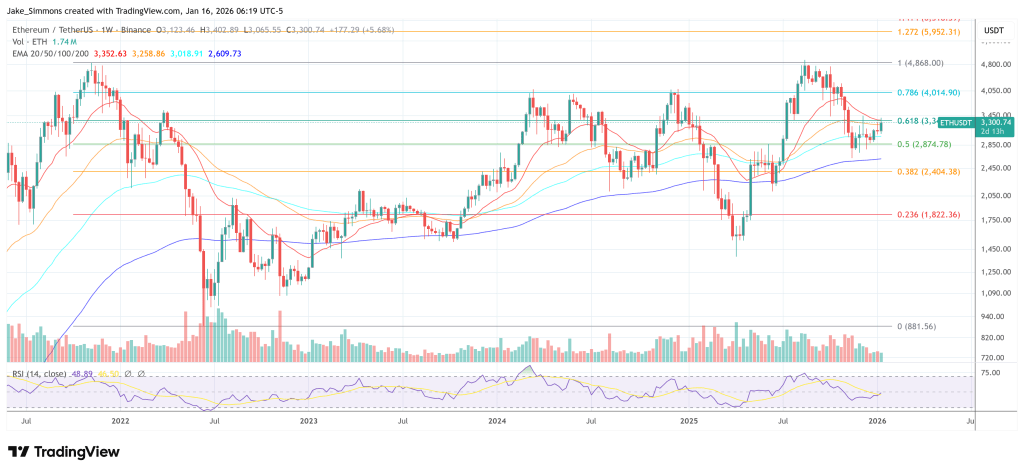
Featured image created with DALL.E, chart from TradingView.com

Editorial Process for bitcoinist is centered on delivering thoroughly researched, accurate, and unbiased content. We uphold strict sourcing standards, and each page undergoes diligent review by our team of top technology experts and seasoned editors. This process ensures the integrity, relevance, and value of our content for our readers.

Ethereum’s Fusaka upgrade activates Dec. 3, deploying a suite of changes designed to increase rollup throughput, tighten gas markets, and add native support for passkey-style signatures.
The fork introduces PeerDAS data-availability sampling, doubles the default block gas limit, and prepares the network for blob-only parameter expansions scheduled for later this month and January.
Fusaka is named after the star Fulu (‘auxiliary road’) and the city of Osaka (‘slope or hill’), continuing Ethereum’s convention of pairing a star and a city.
Editor’s Note: Sloping side road’ is a playful nod to the Fulu + Osaka mash-up, not an official translation.
The central technical shift is PeerDAS, formalized in EIP-7694. The protocol allows nodes to verify that blob data exists by sampling small pieces rather than downloading entire blobs.
That removes a scaling bottleneck introduced by EIP-4844 and creates a path to push blob throughput up by roughly an order of magnitude over time.
Higher blob capacity translates directly into cheaper layer-two transaction fees, as rollups compress user transactions into blobs and post them to Ethereum’s base layer.
Fusaka also raises the default gas limit per block to 60 million gas, up from the 30 million configuration set after the Merge.
The increase doubles the L1 block gas budget, providing more room for both standard transactions and blob processing.
Two follow-on “Blob Parameter Only” forks, BPO1 on Dec. 9 and BPO2 on Jan. 7, will adjust blob parameters without additional code changes, further expanding capacity.
EIP-7918 ties the minimum blob base fee to execution gas, preventing blob prices from collapsing to near zero while L1 gas remains expensive.
The change keeps the data-availability market economically rational as usage fluctuates. Previously, blob fees could diverge sharply from execution costs, creating arbitrage opportunities and distorting rollup economics.
A set of related Ethereum Improvement Proposals (EIPs) hardens several heavy opcodes and transaction limits. The EIPs are 7823, 7825, 7883, and 7934.
The proposals cap ModExp precompile input sizes, raise its gas cost, introduce a transaction gas limit ceiling, and enforce an RLP block size limit. These constraints reduce denial-of-service attack surface and make worst-case client workloads more predictable.
EIP-7939 introduces a count-leading-zeros opcode that makes bit-manipulation, integer logarithms, and randomness logic cheaper and simpler on-chain.
The addition benefits DeFi protocols and cryptographic contracts that rely on efficient bitwise operations.
Deterministic proposer lookahead, specified in EIP-7917, gives validators a fixed schedule of who will propose blocks.
MEV relays and staking operators can use the more precise timeline to coordinate more safely and efficiently, reducing uncertainty in block-production workflows.
EIP-7951 adds a native precompile for the secp256r1 curve, the same cryptographic standard used by Apple Secure Enclave, Android Keystore, and WebAuthn.
Wallets and smart account schemes can now verify passkey-style signatures directly on Ethereum, enabling FaceID and TouchID authentication flows without custom bridges or circuits.
The precompile removes a major friction point for consumer-facing applications that rely on biometric hardware.
Fusaka activates at block height on Dec. 3, with the first blob-parameter adjustment following six days later. BPO2 lands Jan. 7, completing the initial capacity expansion.
The phased rollout allows node operators and rollup teams to monitor blob usage and client performance before the next parameter increase.
The upgrade does not introduce consensus-layer changes to staking or validator incentives. All modifications target execution-layer throughput, gas mechanics, and developer primitives.
Validators running updated clients will process the new opcodes and blob logic without changes to their staking setup.
Fusaka represents Ethereum’s most throughput-focused upgrade since EIP-4844 introduced blobs in March 2024. The fork doubles block gas capacity, scales data-availability sampling, and adds cryptographic hooks for mainstream authentication hardware.
The combination positions Ethereum to absorb higher rollup activity without proportional fee increases, while giving developers new primitives for on-chain computation and user onboarding.

Today, BOS (BitcoinOS) announced a successful $10M dollar fund raise. BOS is an innovative Bitcoin “operating system” built around zero-knowledge proofs, a layer two protocol designed to unlock smart contracts for Bitcoin, such as interoperability across blockchains, potentially unlocking institutional value for Defi while opening bitcoin yield opportunities for traditional finance.
Greenfield Capital led the strategic rounds, with backing from other capital investors including FalconX, DNA Fund, Bitcoin Frontier Fund, Trust Machines, UTXO Management, LR Ventures, Silvermine Capital, and MMW 2020 Trust. Angel investors like Paul Taylor (former Blackrock Private Equity Partners), and Leeor Groen (Spartan Group Partner) also participated in the rounds.
Funding “will be primarily used to continue the momentum of technological achievements to transform the internet into a unified international economy of trust built on Bitcoin,” BOS said in a press release shared with Bitcoin Magazine. The BOS roadmap includes ramping up the production phase of both institutional and developer protocols before market roll-out.
Founding Partner of Greenfield Capital, Jascha Samadi, said, “BitcoinOS’s successful verification of ZK proofs directly on Bitcoin mainnet represents a fundamental breakthrough in blockchain infrastructure. They’ve achieved true Bitcoin programmability without modifying the base protocol—solving a challenge the industry has faced since Bitcoin’s inception. This technology transforms Bitcoin from a store of value into the secure foundation layer for the entire digital asset ecosystem.”
BOS CEO and Co-founder Edan Yago affirms, “We are now in a very exciting time for Bitcoin, and this fundraise will strongly contribute to its exponential growth. The confidence instilled in us from capital investors and Bitcoin-focused funds is a testament to the high demand and strong market excitement in our achievements. We are proud to accelerate Bitcoin and BTCFi into true mainstream adoption while maintaining the decentralized and trustless ethos it was founded upon.”
BOS has achieved a series of technical milestones that have brought it recognition from industry players and investors. Highlights include an “industry-first” bridgeless cross-chain asset transfer, and the launch of Charms, a protocol for programmable tokens on Bitcoin that leverages zk-proofs to enable client-side validation of transactions. BOS has also integrated with multiple ecosystems, notably Cardano, Ethereum, and Litecoin, to enable trustless Bitcoin bridging.
Most recently, BOS introduced Grail Pro, an institutional-grade protocol that allows BTC yield generation while retaining self-custody. “This is currently in a pilot with key institutions and custodians as Grail Pro aims to unlock $690M of institutional BTC securely,” according to the press release.
Bitcoin Magazine is wholly owned by BTC Inc., which operates UTXO Management, a regulated capital allocator focused on the digital assets industry. UTXO invests in a variety of Bitcoin businesses and maintains significant holdings in digital assets.


