Bitcoin’s latest oversold RSI mirrors 2020 and February 2026 setups that preceded 50% and 30% rebounds, putting $70K back in focus.
The Bitcoin price has surged back above $69,000 after experiencing a major decline last week. While the price appears to be rebounding from the downtrend, a market analyst has warned that the BTC could still face another price crash. After projecting its decline from above $100,000, the analyst now forecasts a price plunge to $29,000, likely marking Bitcoin’s final bottom.
Market expert LavaXBT has shared two possible scenarios for Bitcoin’s next move. However, the analyst appears to be leaning more bearish, projecting that BTC could fall again, hitting levels not seen in years. In his “macro update,” shared on X, the analyst predicts that Bitcoin could first decline to $45,000 before plunging toward a possible price floor around $29,000, as shown on the chart.
LavaXBT noted that his previous thesis for the first quarter of 2026 did not play out as expected, despite most technical indicators aligning. He attributed this deviation to a lack of trading volume and the ongoing geopolitical tensions affecting the market. Recently, financial markets have been experiencing significant volatility as investors’ fear grow amid the US-Iran war. While Bitcoin appears resilient, the conflict and reduced confidence could still put significant pressure on its price.
Given the analyst’s bearish outlook, he plans to short Bitcoin if its price jumps back up to $73,000, $78,000, and possibly $80,000. He emphasized that the current environment is not ideal for trading, given Bitcoin’s low volume and how unpredictable its price action has become.
Also, LavaXBT believes that a decline in Bitcoin could affect the broader altcoin market. He predicts that if BTC crashes to $29,000, then altcoins will likely fall harder. He also expects most altcoins to return to their 2022 crash prices or drop even lower.
As a result, the analyst has warned against buying altcoins at random levels. Rather, he suggests that traders and investors should wait for Bitcoin to hit strong support levels before considering accumulating altcoins. He highlighted the importance of patience, noting that he would wait and focus on higher opportunities as the Bitcoin price navigates the current bear market.
While he projects that Bitcoin could fall to $29,000, which is a more than 58% decline below its current price of over $69,000, LavaXBT has also outlined the potential for a strong upside. In his price chart, the analyst noted that the likelihood of Bitcoin reaching an all-time high in this cycle would only increase when it reclaimed the swing high around $93,000.
Once Bitcoin exceeds this resistance zone, LavaXBT noted that the cryptocurrency must close above $120,000 before it can confirm its uptrend and establish higher highs. If this happens, he believes the target for the next macro upswing is around $160,000, exceeding BTC’s current all-time high of $126,000 by roughly 27%.
Featured image created with Dall.E, chart from Tradingview.com
XRP (XRP) traded at $1.37 after a 3.5% decline in the last 24 hours, shrugging off Goldman Sachs’ disclosure of exposure to spot XRP exchange-traded funds (ETFs).
While this highlights long-term institutional confidence, it comes amid fragile risk sentiment and a typical breakdown from a bearish setup.
Key takeaways:
Goldman Sachs disclosed $152.17 million in spot XRP ETF holdings across four funds, making it the largest institutional holder in this segment.
XRP maintains its bear pennant breakdown setup targeting $0.72.
Goldman Sachs has emerged as the largest disclosed institutional holder of US spot XRP ETFs, revealing a $152 million position in its Q4 2025 13F filing with the SEC.
Related: XRP treasury Evernorth files with SEC to list shares on Nasdaq
The $3.5 trillion asset manager has spread its exposure across four funds: $39.8 million in Bitwise XRP ETF, $38.5 million in Franklin XRP Trust, $38 million in Grayscale XRP ETF, and $35.9 million in 21Shares XRP ETF.
Goldman isn’t alone. Its allocation accounts for roughly 73% of the about $211 million held by the top 30 institutional investors in XRP ETFs, according to Bloomberg Senior ETF analyst James Seyffart.
While this institutional move highlights long-term confidence, XRP price remains 25% below its yearly open around $1.84, driven by slowing ETF inflows and macro headwinds.
Cumulative net inflows into US-based XRP ETFs crossed the $1 billion mark within the first few months of trading, peaking at $1.28 billion on Jan. 16. The pace has since cooled to $1.21 billion today.
Total assets under management peaked around $1.65 billion in early January but have dropped to roughly $995 billion, dragged down by XRP’s price decline and a stretch of net outflows, according to data from SoSoValue.
XRP ETFs recorded a total of $56.5 million in net outflows between March 3 and March 16. Since then, the daily inflows have been muted below $5 million.

XRP price broke down from its prevailing bear pennant when it dropped below the lower trend line of the pattern at $1.40 on Thursday. The price could retest the lower trend line as new resistance, a move that could confirm the breakdown.

Bull pennants form when price consolidates inside a triangle following a steep decline. Once the price breaks below that triangle, it triggers another massive downward move.
For XRP, the measured target of the bear pennant is $0.72, roughly 48% below the current price.
As Cointelegraph reported, a break below $1.27 would suggest that the bears are still in control, fueling XRP/USD drop toward $1.
XRP’s volatility metrics are warning of an imminent massive price move.
The 30-day Realized Volatility (RV 30D) has dropped to around 0.5266, marking the lowest level for 2026.
Meanwhile, the Volatility Z-Score is at -0.9048, “reflecting a clear decline in volatility compared to the historical average,” CryptoQuant analyst Arab Chain said in a recent Quicktake note, adding:
“This type of volatility contraction is commonly referred to as volatility compression, a phase that often precedes a sharp price movement in either direction.”

This article does not contain investment advice or recommendations. Every investment and trading move involves risk, and readers should conduct their own research when making a decision. While we strive to provide accurate and timely information, Cointelegraph does not guarantee the accuracy, completeness, or reliability of any information in this article. This article may contain forward-looking statements that are subject to risks and uncertainties. Cointelegraph will not be liable for any loss or damage arising from your reliance on this information.
What could happen to ETH if the conflict in the Middle East comes to an end?
While the war between the United States (supported by Israel) and Iran has dragged on for almost a month, recent indications hint that a de-escalation might be on the horizon.
Some industry participants believe that an eventual truce could act as a catalyst for the cryptocurrency market, but one popular analyst thinks such a development could prompt a price collapse for Ethereum.
The bear market observed over the past several months has caused the broader crypto market to decline substantially from its peak registered last year. In addition, the war in the Middle East has worsened things by spreading further panic and uncertainty among investors.
According to X user Ted, though, ETH’s reaction to the conflict has been anything but logical. When the US and Iran began exchanging strikes, many braced for a steep sell-off, yet the price slipped from about $2,000 to around $1,850 – an evident drop but perhaps far from the meltdown the crowd feared.
Lately, numerous developments have signaled that a ceasefire might be on the way. The BBC reported that Iran has received a 15-point peace plan from the United States, while Iranian officials have opened the key oil corridor, the Strait of Hormuz, for “non-hostile vessels.” Oil prices fell on the news, while Ted said people now expect a pump for ETH after a potential peace deal.
However, he believes the second-largest cryptocurrency could post a minor resurgence after the positive development (if it indeed happens), followed by a plunge toward new lows.
Other analysts claimed that ETH is at a crossroads and that the next move will heavily depend on certain drivers. Merlijn The Trader, for instance, stressed the importance of the $2K psychological level, suggesting that holding above that mark could trigger a price explosion to a whopping $12,000. On the other hand, losing it would break nine years of support.
Meanwhile, Wise Crypto assumed that the market is at “a tipping point,” with recent whale selling acting as a bearish force, while the ongoing shift from exchanges to self-custody provides a counterbalancing bullish signal.
Others are entirely optimistic, suggesting that ETH has reached levels that can be interpreted as perfect buying opportunities. Ali Martinez, for example, argued that the asset had entered a “generational buy zone” because its Market Value to Realized Value (MVRV) had fallen below 1.
The analyst reminded that in the past, drops to such territory have been followed by massive price increases. He also outlined several MVRV pricing bands designed to serve as a roadmap, with $4,632/$5,624 set as long-term “expansion” zones.
In the meantime, BitMine continues to acquire ETH following a fresh purchase of around 65,000 coins for around $140 million. The company now holds nearly 4% of the asset’s circulating supply, while its aggressive accumulation could encourage smaller players to follow suit and allocate capital to the ecosystem.
LIMITED OFFER for CryptoPotato readers at Bybit: Use this link to register and open a $500 FREE position on any coin!
Following the recent market trend, the XRP price has maintained its hold on an important trendline over the years. This trendline leans bullish, and as long as the cryptocurrency holds above it, the likelihood of a recovery remains high. However, a break below this multi-year trendline could signal doom, with crypto analyst CrypFlow forecasting how low the digital asset could go before eventually finding a bottom.
According to crypto analyst CrypFlow, the XRP multi-year trendline that began back in the year 2017 is currently still in play. In fact, with the price trading well above the $1.2 level, it continues to hold up well. So far, this has suggested that bulls still have some strength left, and this trendline has been a beacon.
From here on out, the XRP price would only need to actually complete a breakout to maintain its uptrend. This breakout would not only need to happen, but it would need to do so with momentum. As CrypFlow explains, for momentum to follow, the XRP price needs to do two things.
The first of these is that the XRP price needs to break out of the descending resistance. This descending resistance had begun back in 2025, continuing on into 2026. As long as this resistance remains, the price remains bearish. But a break towards $2 invalidates it.
Next on the list is that the XRP RSI downtrend needs to be broken as well. A breakout above $2 will complete this, ensuring that there is enough momentum for the cryptocurrency to follow. Such a move, the crypto analyst believes, would send the XRP price toward its 2018 highs of $3.8.
However, in the case that the bulls are unable to complete a breakout within moments, then the bears could take control once again. Such a scenario would see the price lose its multi-year trend and eventually fall below $1.
Related Reading: Analyst Says Bitcoin Price Is Showing Dangerous Weakness, Here’s Why
Once this happens, then there is little cushion left for the cryptocurrency. As the price falls, the analyst highlights what they call the ‘discount zone,’ where XRP would be seemingly cheap to buy, and this lies around the $0.6-$0.8 level. Nevertheless, once the decline is over, the price is expected to rebound again.
Featured image from Dall.E, chart from TradingView.com
Bitcoin BTC
“ETF holders and corporate treasuries are buying 6-month and 1-year puts at $60k or below ($60,000 put, a derivative contract offering protection against potential price slide below that level) as portfolio insurance,” Jean-David Péquignot, chief commercial officer of derivatives exchange Deribit.
This put option works like insurance: It lets buyers sell bitcoin at $60,000 even if the price crashes lower, shielding ETF investors and corporate treasuries with BTC from steeper losses while they hold for the long haul.
Péquignot was responding to questions about surging interest in the $60,000 put. At the time of writing, those contracts had $1.50 billion in open interest – the highest across all strikes and expiries on Deribit. On the exchange, one contract represents one BTC. The platform accounts for nearly 80% of the global crypto options activity.
The surge in interest in $60,000 puts expiring in six months or longer signals deep fears that any price bounce could fizzle fast, paving the way for a sharper drop.
What makes this hedging even more noteworthy is that ETF holders and corporate treasuries own a significant supply of bitcoin.
Investors have poured billions into U.S.-listed spot bitcoin ETFs and similar products worldwide in recent years. The U.S. funds alone have seen inflows of 1.26 million BTC, roughly 6% of bitcoin’s total circulating supply. Meanwhile, publicly listed firms hold about 1.14 million BTC, or 5.7% of BTC’s supply.
Bitcoin has been trading choppy below $70,000, having hit lows near $60,000 early this month, CoinDesk data show. The cryptocurrency has gained nearly 5% since Wednesday to trade near $67,500, but the options market remains unimpressed, with puts continuing to trade at a significant premium to calls or bullish bets.
“While spot price climbed, the 25-delta risk reversal remained stubborn. 30-day puts are still trading at a ~7% volatility premium over calls, signaling that smart money is still paying up for downside protection rather than chasing the pump,” Péquignot said.
He added that volatility may pick up as prices drop below $63,000. That’s because dealers and market makers who create order-book liquidity are “short gamma” at $60,000 or lower.
This means that as prices approach $60,000, these entities may sell more to rebalance their overall exposure to neutral, inadvertently adding to downside volatility.
Forced liquidations in the crypto derivatives market reached about $150 billion in 2025, according to CoinGlass data.
On its face, the figure looks like a year of persistent crisis. For many retail traders, watching price feeds turn red became shorthand for chaos. In practice, it captured something more mundane and structural: the notional value of futures and perpetual positions that exchanges forcibly closed when margin fell short.
Most of the time, that flow was more of a maintenance function than a crash. In a market where derivatives rather than spot markets set the marginal price, liquidations operated like a recurring levy on leverage.
Taken in isolation, the number looked alarming. However, set against the backdrop of 2025’s derivatives machine, it did not.
The aggregate crypto derivatives turnover reached roughly $85.7 trillion for the year, or about $264.5 billion a day.
In that context, the liquidation tally represented the byproduct of a market in which perpetual swaps and basis trades were the dominant instruments, and where price discovery was tightly coupled to margin engines and liquidation algorithms.
So, as crypto derivatives volumes climbed, the market’s open interest steadily rebuilt from the depressed levels that followed the 2022–2023 deleveraging cycle.
By Oct. 7, notional open interest across major venues had reached about $235.9 billion. Bitcoin had traded as high as roughly $126,000 earlier in the year.
The spread between spot and futures prices supported a thick layer of basis trades and carry structures that relied on stable funding and orderly market behavior.
Essentially, the stress that mattered was not evenly spread. It was driven by a combination of record open interest, crowded positioning, and the growing share of leverage in mid-cap and long-tail markets.
The structure worked until a macro shock hit, when margin thresholds were tightly clustered, and risk was pointing in the same direction.
The breakpoint for the crypto derivatives market did not come from within the emerging industry. Instead, the catalyst was driven by the policies of the world’s largest countries.
On Oct. 10, President Donald Trump announced 100% tariffs on imports from China and signaled additional export controls on critical software.


Major exchanges are suffering from a “drought” in order book depth, creating a volatility trap where even modest selling triggers massive price swings.
Dec 23, 2025 · Liam ‘Akiba’ Wright
The statement pushed global risk assets into a sharp risk-off move. In equities and credit, the adjustment showed up as widening spreads and lower prices. In crypto, it collided with a market that was long, levered, and sitting on record derivatives exposure.
The first move was straightforward: spot prices fell as traders marked down risk.
However, in a market where perpetual futures and leveraged swaps dictate the marginal tick, that spot move was enough to push a large block of long positions across their maintenance margin lines.
So, exchanges began liquidating under-margined accounts into order books that were already thinning as liquidity providers pulled back.
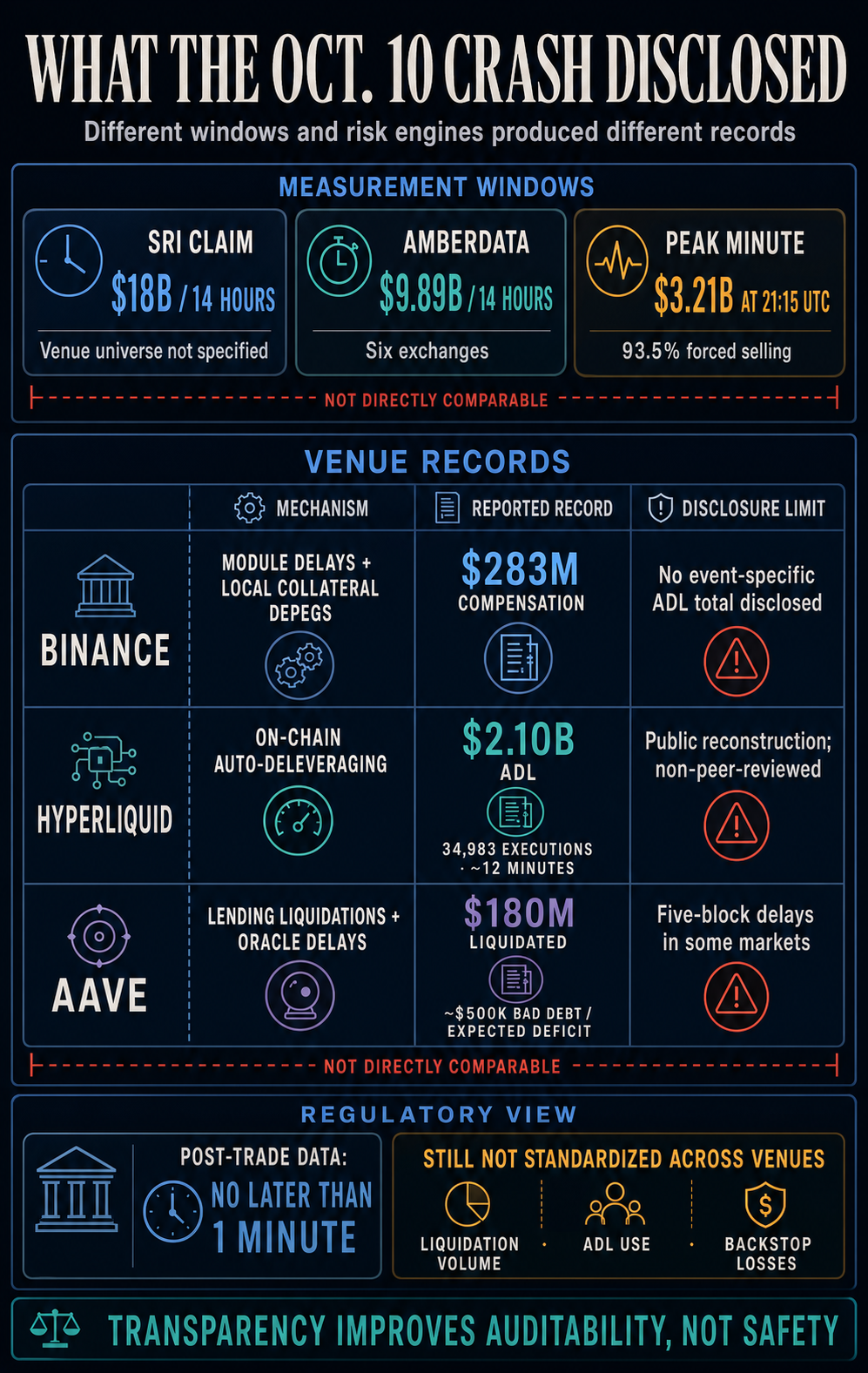
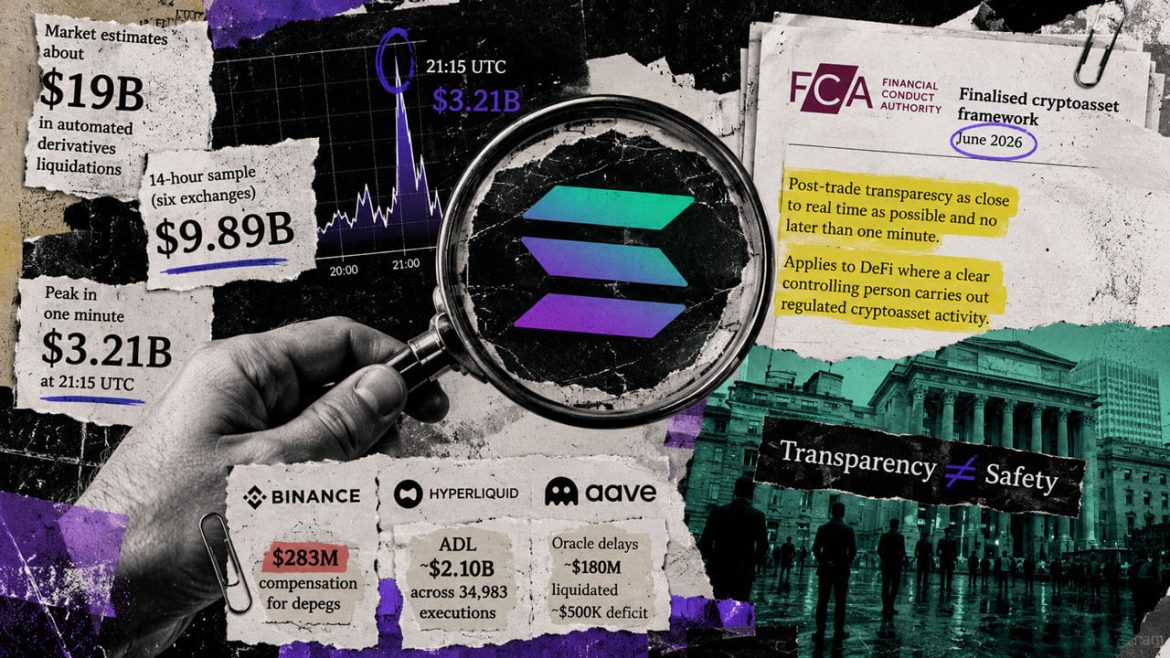
As a result, the forced liquidations across the market totaled more than $19 billion between Oct. 10 and 11.


As the dust settles on the biggest crypto market crash in history and leverage’s excesses were forcibly purged from the ecosystem, Bitcoin’s resilience shines.
Oct 12, 2025 · Christina Comben
The majority were on the long side, with estimates suggesting 85% to 90% of the wiped-out positions were bullish bets. The skew confirmed what positioning data had been flagging for weeks: a one-sided market leaning on the same direction of trade and the same set of instruments.
The liquidation wave followed the standard path at first. Accounts that breached margin thresholds were tagged for closure. Positions were sold at or near market prices, draining bids and pushing prices into the next stop layer.
Open interest fell by more than $70 billion in a matter of days, dropping from the early-October peak toward roughly $145.1 billion by year-end.
Even after the crash, that end-of-year figure remained above the 2025 starting point, underscoring the leverage that had accumulated before the event.
What made October different from the daily churn was not the existence of liquidations, but their concentration and the way product features interacted with depleted liquidity. Funding conditions tightened, volatility spiked, and hedging assumptions that had held for most of the year broke down in a matter of hours.
The most important shift in that window occurred in mechanisms that are usually invisible: the backstop exchanges deploy when standard liquidation logic runs out of road.
Under normal conditions, liquidations are handled by selling down positions at a bankruptcy price and using insurance funds to absorb any residual losses.
Auto-deleveraging (ADL) serves as a contingency behind that process. When losses threaten to exceed what insurance funds and fees can cover, ADL reduces exposure on profitable opposing accounts to protect the venue’s balance sheet.


Aug 4, 2020 · Priyeshu Garg
From Oct. 10 to 11, that safeguard moved to center stage.

As order books in some contracts thinned and insurance buffers came under stress, ADL began to trigger more frequently, especially in less liquid markets. Profitable shorts and market makers saw their positions cut according to pre-set priority queues, often at prices that diverged from where they would have chosen to trade.
For firms running market-neutral or inventory-hedging strategies, the impact was acute. A short futures leg intended to offset spot or altcoin exposure was partially or fully closed by the venue, turning an intended hedge into realized P&L and leaving residual risk unprotected.
In some cases, accounts were forced to reduce winning positions in Bitcoin futures while remaining long in thin altcoin perps that continued to slide.
Market Cap $1.74T
24h Volume $43.03B
All-Time High $126,173.18
The heaviest distortions showed up in those long-tail markets. While Bitcoin and Ethereum drew down by 10% to 15% during the window, many smaller tokens saw their perpetual contracts fall by 50% to 80% from recent levels.
Market Cap $353.28B
24h Volume $19.08B
All-Time High $4,946.23
In markets with limited depth, forced selling and ADL hit order books that were not built to absorb such a large flow. Prices gapped lower as bids disappeared, and the mark prices that feed into margin calculations adjusted accordingly, pulling more accounts into liquidation.
The result was a loop. Liquidations pushed prices lower, which widened the gap between index prices and the levels at which ADL events were executed. Market makers that might have stepped in at narrower spreads now faced uncertain hedge execution and the prospect of involuntary reductions.
Due to this, many cut back on quoting size or moved wider, further reducing visible liquidity and leaving liquidation engines to work with thinner books.
The episode highlighted a critical point for a market where derivatives define the tape: safeguards that contain risk in ordinary conditions can amplify it when too much leverage is stacked in the same direction and in the same venues.
The crash was not simply “too much speculation.” It was the interaction of product design, margin logic, and infrastructure limits under stress.
Venue concentration shaped the market outcome as much as leverage and product mechanics.
This year, crypto derivatives liquidity has clustered around a small group of large platforms.
For context, Binance, the largest crypto exchange by trading volume, processed about $25.09 trillion in notional volume for the year, capturing close to 30% of the market.
Three others, including OKX, Bybit, and Bitget, followed with $10.76 trillion, $9.43 trillion, and $8.17 trillion in turnover, respectively.
Together, the top four accounted for roughly 62% of global derivatives trading.


On most days, that concentration simplified execution. It put depth in a handful of order books and allowed large traders to move risk with predictable slippage. In a tail event, it meant that a relatively small number of venues and risk engines were responsible for the bulk of liquidations.
During the October break, those venues de-risked in sync. Similar books of client positions, similar margin triggers, and similar liquidation logic produced simultaneous waves of forced selling.
The infrastructure that connects these platforms—on-chain bridges, internal transfer systems, fiat rails—came under strain as traders tried to move collateral and rebalance positions.
As a result, withdrawals and inter-exchange transfers slowed, narrowing the corridors firms rely on to arbitrage price gaps and maintain hedges.
When capital cannot move quickly across venues, cross-exchange strategies fail mechanically. A trader short on one exchange and long on another may see one leg forcibly reduced by ADL while being unable to top up margin or shift collateral in time to protect the other side. Spreads widen as arbitrage capital retreats.
The October episode condensed all of these dynamics into a two-day stress test. Roughly $150 billion in liquidations over the full year now reads less as a measure of chaos and more as a record of how a derivatives-dominated market clears risk.
Most of the time, that clearance was orderly and absorbed by insurance funds and routine liquidations.
In the October window, it exposed the limits of a structure that depends heavily on a few large venues, high leverage in mid-cap and long-tail assets, and backstops that can reverse roles under pressure.
Unlike prior crises that centered on credit failures and institutional insolvencies, the 2025 event did not trigger a visible chain of defaults. The system reduced open interest, repriced risk, and continued operating.
The cost was borne in concentrated P&L hits, sharp dispersion between large-cap and long-tail assets, and a clearer view of how much of the market’s behavior is dictated by plumbing rather than narrative.
For traders, exchanges, and regulators, the lesson was direct. In a market where derivatives set the price, the “liquidation tax” is not just an occasional penalty on over-leverage. It is a structural feature, and under hostile macro conditions, it can shift from routine cleanup to the engine of a crash.
Two Bitcoin wallets linked by analysts to Silk Road–era activity last moved 3,421 BTC in May this year. Now, follow-on activity on Dec. 10 added a fresh pulse to a year of dormant-supply awakenings.
According to the Digital Watch Observatory, the May spends totaled about 3,421 BTC, roughly $322.5 million at the time.
The sequence included a 2,343 BTC outlay at block height 895,421 that rerouted outputs into a new SegWit address pattern.
On-chain forensics show 31 outputs with consolidation into a new P2WPKH destination, a pattern more consistent with custody housekeeping than immediate exchange deposition.
Trackers on Dec. 10 flagged additional consolidation totaling just over $3 million from over 300 wallets labeled as Silk Road–linked, maintaining attention on these addresses and inviting a near-term read on whether labels or routing matter more for price discovery.
The December flows were small in BTC terms relative to the May sequence, although still timely given renewed sensitivity to old-coin movements this year.
That sensitivity has been shaped by episodes in which government-controlled Silk Road coins were routed to Coinbase Prime, a step traders treat as a sale-preparatory move.
The U.S. government transferred 10,000 BTC to Coinbase Prime in August 2024 and about 19,800 BTC in December 2024, and these transfers have coincided with short-lived risk-off positioning in the days around the transfers.
The May wallets were initially created in July 2013 and then were silent for about 11 to 12 years before spending, which anchors the setup for a dormant-supply narrative.
The output structure during the May sequence leaned toward consolidation and re-keying, with fresh Bech32 custody destinations rather than exchange-labeled deposit heuristics.
That distinction shapes trader response, because flows into Coinbase Prime or other prime broker venues are treated as near-term supply, while internal consolidation to P2WPKH does not imply imminent distribution.
A practical way to compare scale and routing is to line up the Silk Road–linked wallet moves against two prior U.S. government transfers that hit Coinbase Prime.
The amounts involved in 2024 were an order of magnitude larger than the May 2025 dormant-wallet spends, which helps explain why market participants prioritize exchange-tagged receipts over unlabeled consolidations.
| Date window | Controller / label | Amount (BTC) | Approx. USD at time | Routing pattern |
|---|---|---|---|---|
| May 5–7, 2025 | Silk Road–linked wallets | 3,421 | ~$322.5M | Consolidation to new P2WPKH |
| Aug. 2024 | U.S. government, Silk Road seizures | 10,000 | ~$600M | To Coinbase Prime |
| Dec. 2024 | U.S. government, Silk Road seizures | ~19,800 | ~$2B | To Coinbase Prime |
| Dec. 10, 2025 | Silk Road–linked wallets | ~$3M equivalent | — | Follow-on consolidation |
The category of Silk Road coins has a long public track record through auctions, seizures, and more recent exchange-routed transfers. In 2014, the U.S. Marshals Service auctioned 29,656 BTC seized from Silk Road, a sale won by Tim Draper, which set an early playbook for transparent liquidation.
That auction demonstrated that official supply could be scheduled and absorbed without an opaque drip. The approach has evolved. The Department of Justice and IRS-CI later seized 69,370 BTC tied to “Individual X” in 2020 and 50,676 BTC from James Zhong, announced in 2022, with sentencing in 2023.
A 2023 court filing outlined a staged liquidation of about 41,490 BTC from the Zhong cache during 2023, which gave markets interim visibility into execution but still left timing risk around transfer days.
Coinbase Prime receipts, or other exchange-labeled custody endpoints, are read as a prelude to distribution through OTC or block trading, which can compress basis and nudge funding toward neutral as desks hedge inventory.
Consolidation to fresh P2WPKH addresses, by contrast, aligns with internal re-keying or moving to updated custody stacks, which carries a lower immediate sale probability.
The May 2025 paths fit the latter mold, while the larger 2024 government transfers fit the former, which has been the trigger for option skew to lean put-heavy and for implied volatility to pop in short tenors.
Market structure in December 2025 adds another layer. Record outflows from U.S. spot Bitcoin ETFs in November, followed by renewed inflows in early December, left traders focused on the balance between passive demand and any labeled supply.
Weekly fund-flow swings remain the highest-frequency barometer for direction, and flows can offset or amplify the signal from labeled on-chain transfers. If exchange tags do not appear after a labeled wallet spends, realized volatility tends to mean-revert as liquidity providers normalize their inventory.
A benign consolidation path, with a 40–55% probability, would involve continued migration to fresh SegWit or Bech32 custody without exchange tags. The outcome would be a short headline window, fading option skew, and a return to ETF-led tape.
A stealth OTC distribution path, with a 25–35% probability, would see coins route to a prime broker like Coinbase Prime and then move through block trades, producing mild and persistent ask-side pressure and compressing basis while funding moderates.
A headline-driven de-risk path at 10–20% would require new, larger government transfers in the 10,000-20,000 BTC range that coincide with a weak ETF flow day, triggering rapid downticks as miners and perpetual traders sell into the move. The 2024 transfer playbook is the best analog for that third scenario.
There have been multiple Satoshi-era awakenings this year, and a wave of cohort spends older than 7 years into the fourth quarter, which helps explain why even modest December movements from Silk Road–linked labels still register in positioning.
That said, on-chain details remain the first filter. P2WPKH consolidation, fresh custody destinations, and the absence of exchange-labeled receipts within 24 to 72 hours have aligned with low follow-through on price in prior cases.
Conversely, Arkham or Whale Alert flags that explicitly show Coinbase Prime receipts, paired with mid-day U.S. prints, have coincided with short-term inventory hedging, wider short-dated put skew, and a softer basis.
History provides grounding. The first major public liquidation in 2014 through the USMS auction showed that scheduled, transparent sales can be absorbed. Subsequent seizures, including the 69,370 BTC linked to “Individual X” and the 50,676 BTC from James Zhong as noted by the Department of Justice, moved into a framework where courts cleared liquidation pathways.
A 2025 court decision declined to block the sale of a separate 69,370 BTC cache, effectively keeping the legal channel open.
For the immediate tape, the watchlist is straightforward. Look for exchange-labeled receipts, especially Coinbase Prime, in the days after any fresh Silk Road–linked spend.
Track daily ETF flow direction, since the interaction between passive demand and labeled supply governs whether headlines fade or drive a broader de-risk. Monitor the options surface for short-dated skew leaning toward puts, along with quick changes in perpetual funding and futures basis on transfer days, which serve as positioning tells.
However, given that billions of dollars’ worth of Bitcoin is now regularly absorbed by ETF liquidity each week, it is unlikely that any Silk Road sales would materially affect the Bitcoin price without some other psychological catalyst.
According to the Digital Watch Observatory, the May 2025 pattern points to consolidation over distribution, and the Dec. 10 activity remains consistent with that base case until exchange tags appear.
The crypto market is facing a defining crash in late November 2025, with record Bitcoin and Ethereum ETF outflows. Institutional flight has shattered the bullish narratives from earlier in the year. Bitcoin and Etherum erased significant value in a 24-hour window, driving market sentiment to its lowest point since mid-2023.
Bitcoin currently trades near $83,000, a stark 35% retracement from its October all-time highs, while Ethereum clings to support near $2,700.
Institutional investors drove the sell-side pressure to historic levels this November. U.S.-listed spot Bitcoin ETFs registered a staggering $3.79 billion in collective outflows, shattering the previous record of $3.56 billion set in February 2025. Metrics confirm that institutional players are de-risking aggressively rather than buying the dip.
BlackRock’s iShares Bitcoin Trust (IBIT), the world’s largest Bitcoin fund, saw redemptions exceeding $2 billion in November alone. On Thursday, November 20, the 11 U.S. spot Bitcoin ETFs experienced a single-day withdrawal of over $900 million, the second-largest daily outflow since their January 2024 inception.
Ether ETFs fared no better, recording total outflows of $1.79 billion. These figures represent a clear vote of “no confidence” from traditional finance sectors regarding the short-term performance of the top two cryptocurrencies.
Bitcoin ETFs saw record-breaking net outflows in November. – Source: SoSoValue
Amidst the sea of red, a peculiar divergence emerged in the ETF sector. While investors fled Bitcoin and Ether, they actively allocated capital to alternative Layer-1 assets. Data shows that Solana and XRP ETFs bucked the macro trend during the same period. XRP ETFs attracted $410 million in net inflows, while Solana ETFs secured $300.46 million.
However, the broader altcoin market did not share this resilience. Tokens such as INJ, NEAR, ETHFI, APT, and SUI plummeted between 16% and 18% in 24 hours. The contrast highlights that regulated institutional products for SOL and XRP are seeing demand, while on-chain spot markets for other altcoins are suffering from the liquidity drought.
Learn more: NFTPlazas Guide: BNB Chain Ecosystem
This liquidity crunch correlates with broader macroeconomic weakness. The Nasdaq 100 currently trades 9.4% below its October 31 record, signaling that risk-off sentiment pervades both traditional equities and digital assets.
The derivatives market currently paints a picture of panic and defensive hedging. The “Fear and Greed Index” flashed a score of 11/100 on Friday, indicating “Extreme Fear”, which is the lowest reading since June 2023. Traders are scrambling to protect downside risk.
Volatility indices surged, with Bitcoin’s 30-day implied volatility (BVIV) topping 64% and Ether’s jumping to 87%, the highest since April. Bitcoin’s spike in volatility drove the cost of options premiums higher. Order flow on Deribit shows a heavy bias toward put options (bets that prices will fall). In a sign of extreme pessimism, some traders even purchased deep out-of-the-money puts on BlackRock’s IBIT ETF with a strike price of just $15.
15DTE $IBIT calls being bought for $2.2M here pic.twitter.com/FyF1ZiRNle
— Salma (@salmaogs) November 20, 2025
Furthermore, bullish speculators faced a total wipeout. Bitcoin Open Interest (OI) crashed from 752,000 BTC to 700,000 BTC in a single day as exchanges liquidated over-leveraged long positions. While the Relative Strength Index (RSI) indicates the market is technically “oversold,” the massive reduction in open interest suggests that the market has reset, and few traders are willing to “catch the falling knife” in the immediate term.
Learn more: Exchange benefit – Hyperliquid Registration Tutorial
Bitcoin price hovered near $93,000 on Tuesday as the market continued to reel from thin liquidity, cascading leverage, and growing bearish conviction across key technical levels.
The Bitcoin price traded near $94,000 at midday, up 1% in the past 24 hours, with a hefty $111 billion in trading volume. The asset now sits 1% below its weekly high of $93,669 and 4% above its weekly low of $89,368.
Bitcoin’s circulating supply stands at 19,950,440 BTC, inching closer to its 21 million hard cap, while its global market cap ticked 1% higher to $1.85 trillion, according to Bitcoin Magazine Pro data.
But sentiment is anything but buoyant. With volatility rising and liquidity thinning, even modest flows are pushing the market around.
“Markets are still feeling the impact of the October 10 liquidation event,” Nicolai Søndergaard, Research Analyst at Nansen, wrote to Bitcoin Magazine. “Market depth has fallen by roughly 30% since then, which means even modest selling pressure can move prices sharply. That’s essentially why Bitcoin slipped below $90,000 today. When liquidity is this thin, it takes far less capital to push the market in either direction, and when you layer leverage on top, volatility becomes inevitable.”
What Søndergaard is pointing to is the wave of liquidations triggered after a fresh bout of trade jitters set off a historic rush to unwind bitcoin long positions. Investors shed roughly $19 billion in leveraged bets across major exchanges in less than a day — with some estimates putting the total closer to $30 billion.
On that day, the bitcoin price dropped over 10%. It marked the largest bitcoin liquidation event on record.
Søndergaard added that options data shows a “non-negligible” probability of a dip toward the mid-$80,000 range, though a bounce or stabilization near current levels appears more likely.
Some long-term investors see opportunity in the chaos: “If your objective is to save in the hardest money humanity has ever known, you can stack 25% more bitcoin than you were able to just a month ago,” wrote Timot Lamarre, Director of Market Research at Unchained, to Bitcoin Magazine.
The broader market mood turned sharply negative after Bitcoin price’s decisive break below $96,000, a level analysts at Feral Analysis and Juan Galt had flagged for weeks as critical weekly support. Analysts warn that “with the price closing so low, we should not expect much of a bounce at this level, if any.” Resistance above $94,000 is “thick now,” they said, with sellers waiting at every major price shelf.
A heavy-volume support zone sits at $83,000–$84,000. Another key area sits at $69,000–$72,000, marking the top of the 2024 consolidation range. A slide into the mid-$80Ks is also becoming more plausible if volatility spikes again.
Upside scenarios remain challenging. Even a surprise short squeeze, they wrote, would face “the equivalent of a brick wall” between the bitcoin price of $106,000 and $109,000. Only a weekly close above $116,000 would force a reconsideration of the bear trend — an outcome they call unlikely.
The bitcoin price has now fallen more than 25% from its October peak. That decline has triggered fresh debate over whether the 2025 cycle top is already behind us. Historically, the September–December window hosts major cycle highs. This year’s structure fits the pattern — but with a twist: the top may have arrived early and with less force than expected.
A late-cycle peak in Q1 2026 remains possible. With equities showing early signs of fatigue and liquidity draining from risk markets more broadly, they argue that “little hope remains for any meaningful rally or new highs” in the near term.
At the time of writing, the bitcoin price is 92,916. It’s 24-hour lows is $89,183 according to BM Pro data.