This latest U.S. appeals court ruling sets up a rift between federal courts on event contracts, suggesting the U.S. Supreme Court may need to settle the matter.


 Live Chat
This latest U.S. appeals court ruling sets up a rift between federal courts on event contracts, suggesting the U.S. Supreme Court may need to settle the matter.

A US appeals court has allowed a proposed Binance-related theft lawsuit to proceed in federal court, rejecting a lower-court order that had forced the plaintiffs into arbitration.
The Eleventh Circuit issued an extraordinary writ of mandamus on August 19, directing the lower court to vacate its arbitration order. The panel found that the eight alleged crypto theft victims had never opened Binance accounts and therefore were not bound by Binance’s Terms of Use.
That is an important procedural ruling.
It does not mean Binance has been found liable. It does not prove RICO or anti-money-laundering allegations. It only determines that the plaintiffs can pursue the case in federal court rather than being forced into arbitration.
Many online platforms include arbitration clauses in their terms.
Those clauses can require users to resolve disputes privately instead of suing in court. Companies often prefer arbitration because it can reduce litigation costs, limit class-action risk, and keep disputes out of public court proceedings.
But arbitration usually depends on agreement.
If someone never opened an account and never accepted the terms, the argument that they must arbitrate becomes weaker.
That appears to be the issue in this case.
The plaintiffs argued they were victims of crypto theft and did not agree to Binance’s user terms. The appeals court agreed that forcing arbitration under those terms was improper.
Crypto theft cases often involve complicated chains of transactions, exchanges, wallets, and intermediaries.
Victims may claim stolen funds passed through major platforms even if they were never customers of those platforms. Exchanges, meanwhile, may argue that claims connected to their services should be handled under platform terms.
The Eleventh Circuit ruling limits how far that argument can reach.
If non-users are not bound by platform terms, they may have more room to pursue claims in court. That could matter in future theft, laundering, fraud, and tracing cases.
It does not guarantee those plaintiffs will win. It simply keeps the courthouse door open.
The lawsuit reportedly includes serious allegations, including RICO and anti-money-laundering compliance claims against Binance-related defendants.
But allegations are not findings.
The court did not rule that Binance laundered funds, violated RICO, or caused the plaintiffs’ losses. It only addressed whether the plaintiffs could be compelled to arbitrate.
That distinction is essential.
Crypto litigation headlines can easily make procedural rulings sound like judgments on the facts. This ruling is about venue and consent, not liability.
Even though the ruling is procedural, it still adds pressure to exchanges.
Major platforms are already under scrutiny from regulators, plaintiffs, and law enforcement over transaction monitoring, sanctions compliance, fraud controls, and the movement of stolen assets.
A federal case moving forward can create discovery, public filings, and legal risk.
That may encourage platforms to keep strengthening compliance systems, especially around suspicious flows and account activity linked to hacks or scams.
The case now returns to federal court unless further review changes the outcome.
The plaintiffs still need to prove their claims. Defendants can still challenge the allegations, seek dismissal, contest class certification, and defend the case on the merits.
For now, the key point is narrower.
The appeals court found that alleged victims who never opened Binance accounts could not be forced into arbitration based on account terms they did not accept.
That gives the case a path forward in federal court — and adds another legal development to the growing list of crypto exchange liability battles.
This article is based on the Eleventh Circuit’s mandamus ruling and related court materials.
This article was written by the News Desk and edited by Samuel Rae.

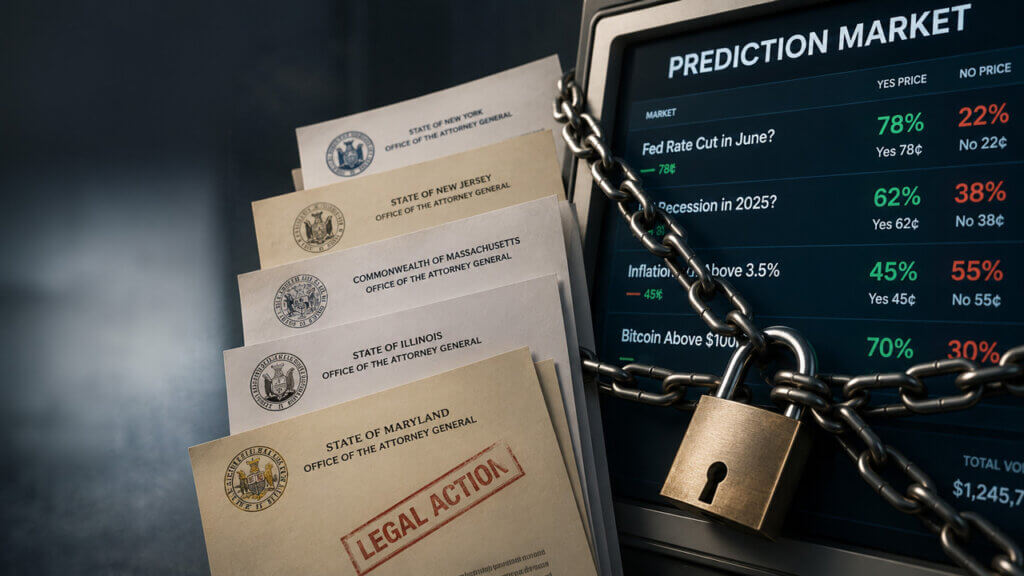
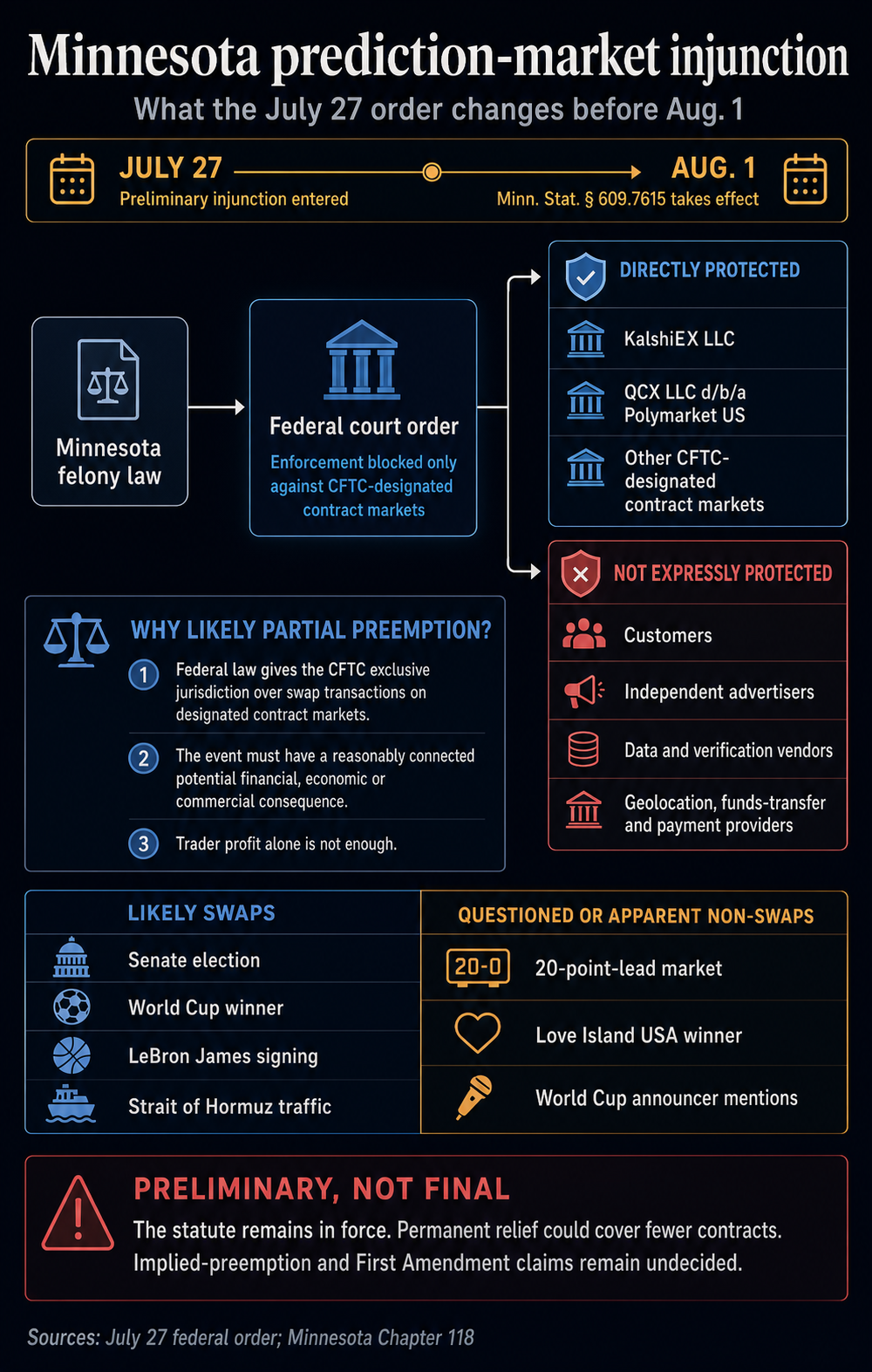
A federal judge has temporarily barred Minnesota from enforcing its new prediction-market felony law against federally regulated exchanges designated by the Commodity Futures Trading Commission as contract markets, including Kalshi and Polymarket US, days before the statute takes effect on Aug. 1.
Judge Katherine Menendez granted preliminary-injunction motions filed by the CFTC, KalshiEX and QCX, the registered entity doing business as Polymarket US. Her July 27 order prevents named Minnesota officials from enforcing Minn. Stat. § 609.7615 against CFTC-designated contract markets until the cases reach a final merits decision.
Menendez found the plaintiffs likely to prove that the Commodity Exchange Act expressly preempts part of Minnesota’s law. Federal law gives the CFTC exclusive jurisdiction over swap transactions conducted on designated contract markets, and the swap definition can include event contracts whose outcomes have a reasonably connected potential financial, economic or commercial consequence. A trader’s potential profit alone is not enough.
The order does not treat every event contract as a swap. Menendez identified markets tied to a Senate election, the World Cup winner, a LeBron James signing and Strait of Hormuz traffic as likely swaps. She questioned a 20-point-lead market and said contracts on the winning Love Island USA couple or words used by World Cup announcers appeared unlikely to qualify. Any permanent injunction could therefore apply to fewer contracts.
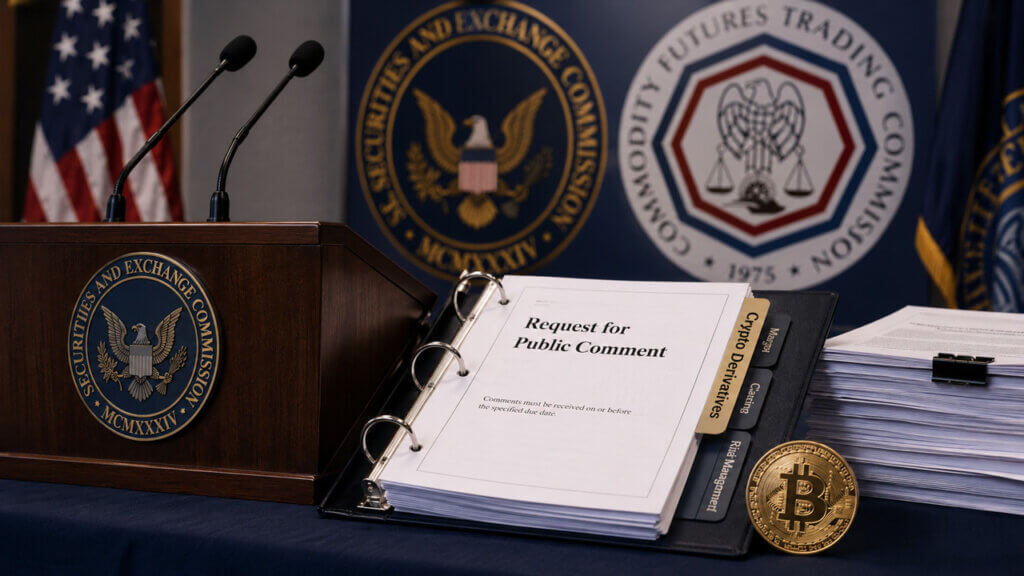
Chapter 118 replaced the prediction-market provisions enacted earlier in Chapter 97. The law remains scheduled to take effect Aug. 1 for crimes committed on or after that date.
Under its core offense, creating or operating a covered prediction market, or intentionally facilitating it through specified listing, funds, settlement, counterparty or pricing activity, is a felony when done for consideration and as part of a business. Other provisions cover providers who knowingly supply data directly to a market, or geolocation, funds-transfer or payment services to one, to enable or settle prohibited wagers. A separate clause criminalizes advertising or marketing financial or technological products that promote prohibited transactions.
Because the order protects only CFTC-designated contract markets, it does not expressly shield customers, independent advertisers or outside service providers. The statute remains in force, and the court has not decided the plaintiffs’ implied-preemption or First Amendment claims.
Polymarket US welcomed the ruling and said it expected to keep serving Minnesota users. Attorney General Keith Ellison said the state disagreed and would continue defending the law as the record develops.
By contrast, a New York court denied Kalshi interim protection from existing state gambling enforcement earlier in July. Both cases remain open, and the opposite preliminary results do not settle how federal registration interacts with state gambling laws nationwide.

An appellate court is expected to reach a decision after hearing arguments from Kalshi and lawyers representing the state of Nevada.
Some legal experts speculated that the state vs. federal jurisdiction battle over regulating prediction markets companies could soon be headed to the United States Supreme Court.
On Thursday, the US Court of Appeals for the Ninth Circuit heard oral arguments from lawyers representing prediction markets platform Kalshi and Nevada authorities over the state’s ban on the prediction markets’ event contracts. The appeal was over a lower court decision preventing Kalshi from offering certain event-based contracts in Nevada, based on claims that the company needed a gaming license.
The appellate judge overseeing Thursday’s oral arguments and the lawyer for Kalshi acknowledged that there had been several state-level enforcement actions against the company and other prediction market platforms, including criminal charges filed in Arizona. However, last week a federal court blocked Arizona authorities from enforcing the state’s gambling laws on Kalshi’s event contracts.
“I think the body of case law does demonstrate that what we really need to avoid here is having a state and a federal court considering exactly the same issue at exactly the same time and potentially reaching different outcomes,” said Colleen Sinzdak, representing Kalshi.
Related: CFTC probes oil futures trades tied to Trump’s moves in Iran: Report
Central to Kalshi’s argument was that the platform’s event contracts were “swaps” falling under the purview of the Commodity Futures Trading Commission (CFTC) rather than state gaming authorities. CFTC Chair Michael Selig has backed this position in the case of Crypto.com’s prediction markets against Nevada authorities.
The appellate court did not immediately announce a decision following oral arguments. Any ruling could affect how state courts treat prediction market platforms like Kalshi and Polymarket as policymakers come to terms with the growing market, expected to reach $1 trillion by 2030.
Coinbase chief legal officer Paul Grewal, whose company was not a party to the Kalshi proceedings but has a stake in the prediction markets fight, speculated that the case could go the US Supreme Court.
“The questions at oral argument are an unreliable signal in predicting the leanings of a court,” said Coinbase chief legal officer Paul Grewal in a Thursday X post following the oral arguments. “Either way, I stand by my longstanding prediction— the Supreme Court will resolve whether sports [contracts] on [Designated Contract Markets] are swaps subject to the exclusive jurisdiction of the CFTC.”
The US Supreme Court gave states the authority to regulate sports gambling in its 2018 decision in Murphy v. National Collegiate Athletic Association.
Magazine: Should users be allowed to bet on war and death in prediction markets?
A US federal court has rejected Custodia Bank’s final attempt to challenge the Federal Reserve’s authority over granting master accounts — effectively ending the crypto-focused bank’s five-year-long battle for direct access to the central bank’s payment system.
The US Court of Appeals for the Tenth Circuit said in a filing on Friday that it wouldn’t hear Custodia’s final appeal on that point in a 7-3 vote.
Custodia first applied for a master account in October 2020, which allows financial institutions to hold reserves directly at the Federal Reserve and access its payment rails, enabling them to settle transactions without relying on intermediary banks.
After the Fed rejected its master account application, Custodia turned to the courts, arguing the Monetary Control Act entitles state-chartered banks to access Fed services and therefore a master account.
However, the multiple courts have now ruled that the Fed retains discretion over whether to grant master accounts.
Custodia’s blow comes as Kraken became the first crypto platform to receive a master account from the Federal Reserve Bank of Kansas City on March 4.
Kraken’s master account enables it to connect to the Fedwire payments system, though it does not include the full range of services available to traditional banks.
The move raised hopes that US regulators could offer “skinny” or limited master accounts to crypto firms.
While only three judges sided with Custodia, one of them, Judge Timothy Tymkovich, wrote a strong dissenting opinion, stating that “a master account is ‘indispensable’ for a bank’s operations” and being denied one is “akin to a death sentence.”
Related: Democrats say they will oversee reported DOJ probe into Binance
He noted that three months after Custodia’s application in October 2020, the Fed said Custodia was eligible and told it there were “no showstoppers” with its application.
He added, “I do not agree that Reserve Banks have discretion over account applications and would have allowed the mandamus claim to go forward.”
Magazine: Clarity Act risks repeat of Europe’s mistakes, crypto lawyer warns

Kalshi has scored another win in its fight to define the future of sports prediction markets.
On Monday, a California federal judge refused to block the platform’s contracts, siding with the company’s argument that it is a federally regulated exchange and not a sportsbook. The ruling hands tribes their first loss in a fast-expanding legal battle that could redraw the boundaries of gambling law.
U.S. District Judge Jacqueline Scott Corley rejected a motion for a preliminary injunction from Blue Lake Rancheria, Chicken Ranch Rancheria of Me-Wuk Indians, and Picayune Rancheria of the Chukchansi Indians. The tribes sought to block Kalshi from offering “sports event contracts” accessible from tribal lands, arguing that the operator’s activities violated the Indian Gaming Regulatory Act (IGRA) and constituted unlicensed Class III gaming.
Corley disagreed. In her 28-page order, she ruled that Kalshi’s operations fall under the Commodity Exchange Act (CEA) and the oversight of the Commodity Futures Trading Commission (CFTC).
“The UIGEA, unlike IGRA, expressly addresses internet gaming that can be accessed in locations where such gaming is unlawful, including Indian lands,” Corley wrote, referring to the Unlawful Internet Gambling Enforcement Act (UIGEA). Because Kalshi is registered with the CEA, its online contracts “are not bets or wagers under the UIGEA,” even if users trade them while on tribal property.
Judge Corley is also persuaded by Kalshi’s argument that interstate (or in this case, state-to-Indian) gaming issues are governed by UIGEA, not IGRA, and UIGEA carves out trading activity governed by the CEA. pic.twitter.com/n7hdJx5aJw
— Andrew Kim (@akhoya87) November 10, 2025
The ruling follows a string of federal victories for Kalshi, which has faced regulatory pressure from states including Maryland, Nevada, and New Jersey. In each case, judges have declined to halt its operations while litigation continues, citing the CFTC’s exclusive jurisdiction over federally registered exchanges.
Still, tribal governments remain central to the fight. Their lawsuits argue that prediction markets siphon revenue from tribal gaming and erode sovereign authority. Earlier this year, a similar challenge helped pause Crypto.com’s event-contract offerings in Nevada.
Corley acknowledged those sovereignty concerns but said they weren’t grounds for a preliminary injunction.
“By self-certifying the legality of its event contracts in a way that insulates its activities from judicial review,” she wrote, “Kalshi may have found a way around prohibitions on interstate gambling that were created with the Tribes’ best interest in mind.”
While the order is limited to preliminary relief, it reinforces the federal footing Kalshi and similar firms rely on. The court’s reasoning effectively affirms that CFTC-regulated exchanges sit outside state and tribal gambling frameworks, at least for now.
That interpretation narrows the reach of IGRA and state gaming laws in the online prediction-market space, underscoring the jurisdictional gap between traditional gambling regulation and federally registered financial exchanges.
Industry observers say the decision could encourage other platforms to expand their offerings while awaiting further federal guidance.
At the same time, the ruling heightens pressure on the CFTC, which has yet to issue clear rules around sports-based or election-based event contracts. Congress and federal agencies may now face renewed calls to clarify where prediction markets end and gambling begins.
For tribes, the legal route has narrowed but not closed. Their best leverage may now shift from courtroom litigation to legislative advocacy, pushing for clearer boundaries between financial contracts and games of chance.
Ultimately, Corley’s order keeps Kalshi trading, keeps tribes frustrated, and keeps the federal government in charge — at least until the Ninth Circuit or the CFTC decides otherwise.


