Bitcoin and altcoins saw strong double-digit price rebounds after this week’s brutal sell-off, but do technical charts forecast a longer-term recovery, or is today’s rally just a dead cat bounce?

 Live Chat

Bitcoin and altcoins saw strong double-digit price rebounds after this week’s brutal sell-off, but do technical charts forecast a longer-term recovery, or is today’s rally just a dead cat bounce?

South Korea’s cryptocurrency exchange Bithumb faced a major operational mishap on February 6, 2026, which quickly sent the BTC/KRW trading pair down by double digits.
It brings to mind past controversies about the exchange, including incidents of partial liability in data leaks.
Sponsored
Sponsored
Reportedly, a staff member accidentally sent 2,000 Bitcoin (BTC) to hundreds of users instead of the intended 2,000 Korean Won (KRW) reward.
The error triggered an immediate wave of sell-offs, sending Bitcoin’s price on the exchange more than 10% below global market rates.
Dumpster DAO core member Definalist first reported the incident, citing a routine airdrop meant as a small incentive for platform users.
Amidst the chaos, some users reportedly benefited significantly from the mistake, selling their unexpected Bitcoin windfall at market prices.
The accidental BTC distribution has raised questions about internal controls and risk management at crypto exchanges, particularly those handling high-value digital assets.
Sponsored
Sponsored
“Crazy to think that exchanges can still do paper trading like this, even in 2026 lmao,” remarked Definalist.
Notably, however, the Bitcoin price crash was largely confined to Bithumb due to the exchange’s isolated order book. Users sold massive amounts of BTC directly on Bithumb, overwhelming its liquidity and causing a 10% local drop.
Other exchanges remained unaffected because the selling pressure didn’t enter their markets, and global arbitrage mechanisms hadn’t yet adjusted the discrepancy, keeping the impact largely contained.
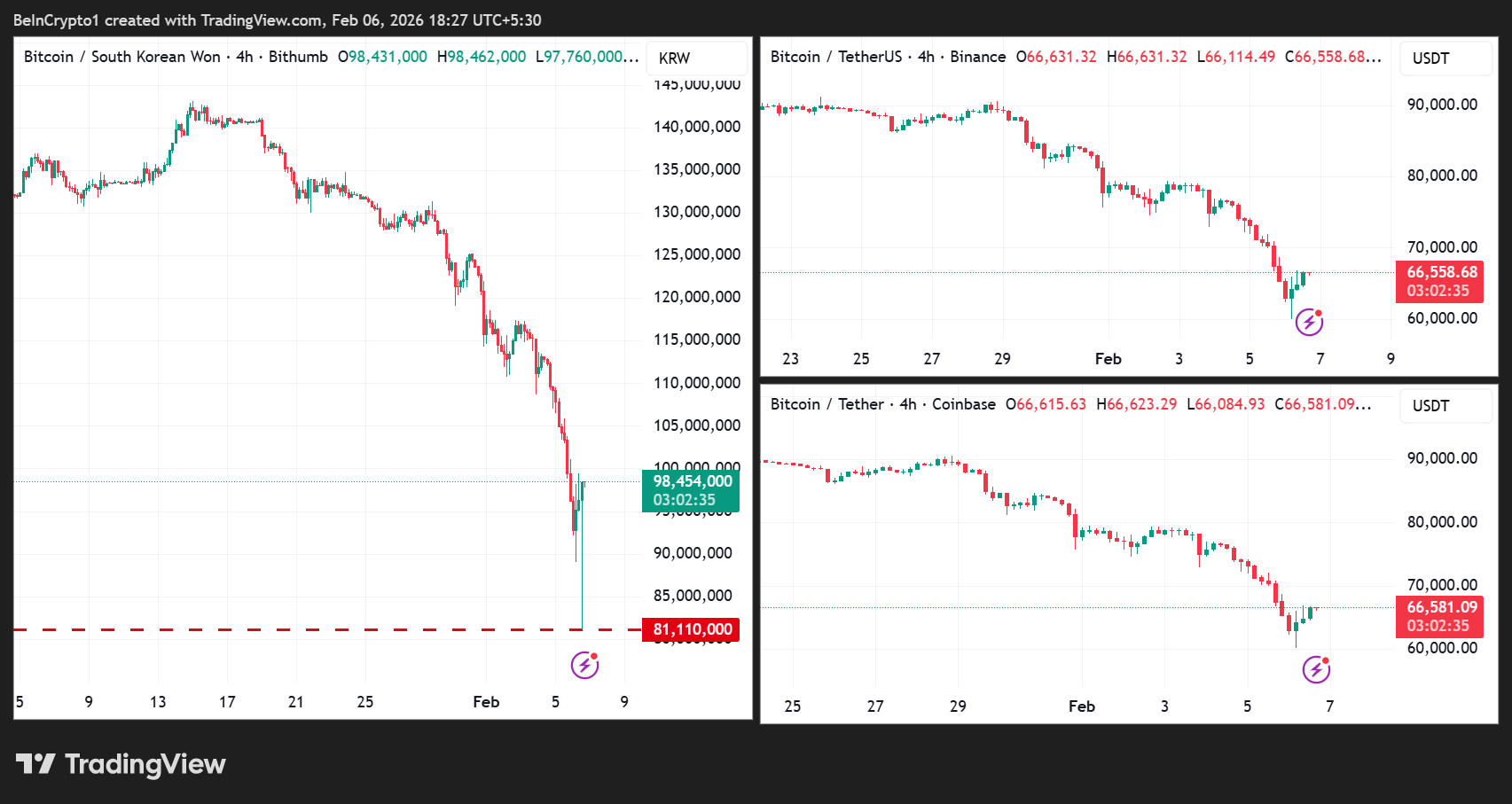
Notwithstanding, the incident highlights the operational risks that can persist even in major exchanges, despite years of industry maturation. It also shows how a simple input error can cascade into substantial market disruption.
Sponsored
Sponsored
Bithumb did not immediately respond to BeInCrypto’s request for comment and has not yet released an official public statement on corrective measures.
Still, the event could influence market confidence in the short term, particularly on exchanges where operational errors have immediate price consequences.
Bithumb itself has a checkered history with security and operational issues. In 2017, a data breach exposed customer information, and in a 2020 ruling, local media reported that the exchange was found partially liable in one case in which a user lost $27,200.
The court ruled that, although Bithumb’s database had been accessed, the claimants should have recognized the scam attempts and awarded only $5,000 in damages.
Sponsored
Sponsored
Other claims were dismissed because the court found the private information could have been obtained elsewhere.
Bithumb has also undergone significant corporate changes in recent years. In 2018, the exchange sold a 50% stake to BK Global Consortium, a group led by startup investor Kim Byung-gun, who was already the company’s fifth-largest shareholder.
This acquisition came amid a broader contraction in the crypto sector investment. According to FinTech Global research, global crypto investments peaked at $7.62 billion in 2018 before falling to $3.11 billion in 2019. In the first half of 2020 alone, the sector raised just $578.2 million.
This latest mishap adds to Bithumb’s long history of operational challenges, reinforcing the view that while crypto adoption is growing, the sector remains vulnerable to human and technical errors, even in leading exchanges.

Key takeaways
The cryptocurrency market continues to underperform as BTC and the other leading coins are in the red. Bitcoin has lost 0.7% of its value in the last 24 hours and is now trading around $89,150.
The broader cryptocurrency market is attempting to stabilize after this week’s sell-off. Bitcoin price started the week on a negative note, closing below key support levels: the 50-day Exponential Moving Average (EMA) at $91,942.
The bulls attempted to defend the $90k psychological level but failed, with Bitcoin retesting the midpoint of a horizontal parallel channel at $87,787 before embarking on a recovery. At the time of writing on Friday, BTC is trading at around $89,175.
If the recovery continues, Bitcoin could extend its rally towards the first major resistance and the 50-day EMA at $91,942.
The Relative Strength Index (RSI) on the 4-hour chart is 39, pointing upward toward the neutral 50 level, indicating fading bearish momentum. For the bullish momentum to be sustained, the RSI must move above the neutral level.

Despite that, the Moving Average Convergence Divergence (MACD) indicator showed a bearish crossover on Tuesday, suggesting a mild downward pressure.
If the recovery fails and Bitcoin’s daily candle closes below the $87,787 support level, it could extend the fall toward the lower consolidation boundary at $85,569.
Currently, the market conditions are choppy, with no clear direction in sight. Bitcoin has eliminated most of the gains it accumulated earlier this month, thanks to the trade tensions between the United States and the European Union (EU) regarding Greenland.
However, while the issue seems to be resolved, Bitcoin’s performance has not significantly improved.

So far, BTC has remained still.
The dispute over Greenland continues as numerous countries from the European Union sent military personnel to the island in a so-called reconnaissance mission.
US President Donald Trump, who keeps claiming that his country needs to control the island, just announced a new set of tariffs against all nations that have sent troops.
In a post on his social media platform TruthSocial, the POTUS said the tariffs will impact Denmark, Norway, Sweden, France, Germany, the United Kingdom, the Netherlands, and Finland.
At first, the taxation will be 10% on all goods sent to the US starting from February 1, 2026. However, if there’s no deal for the acquisition of Greenland by June 1, the tariffs will increase to 25%.
BREAKING: President Trump announces a 10% tariff on Denmark, Norway, Sweden, France, Germany, the UK, Netherlands, and Finland beginning February 1st.
This tariff will be increased to 25% beginning on June 1st.
Tariffs will remain in effect until the US reaches a deal to buy… pic.twitter.com/978qAHjxao
— The Kobeissi Letter (@KobeissiLetter) January 17, 2026
In his statement, Trump emphasized that a deal means a “complete and total purchase of Greenland,” which, he claims, is essential for his country’s national security.
In a separate post on X, the analysts from the Kobeissi Letter estimated that $1.2 trillion worth of annual bilateral trade will be impacted under these new tariffs. They also asserted that the potential acquisition of Greenland would cost the US around $700 billion.
They warned that the US-EU trade war, which began last year shortly after Trump’s inauguration, just “escalated to a whole new level,” as it’s clear that Greenland has become the POTUS’s “top strategic focus.”
Recall that BTC’s price was among the worst-performing assets last year when Trump announced the first wave of tariffs against countless countries. It slumped from its then-ATH of $110,000 to under $75,000 in the span of just a few months.
Trump’s announcement from earlier today hasn’t harmed bitcoin’s price performance yet. The cryptocurrency trades inches above $95,000, showing little to no movement over the past 24 hours.
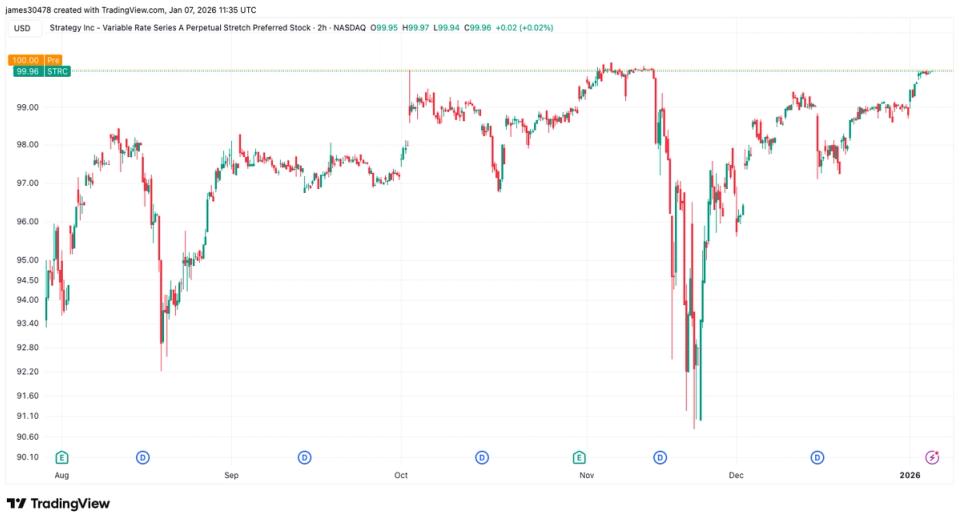
Stretch (STRC), the perpetual preferred equity issued by Strategy (MSTR), the largest corporate holder of bitcoin
STRC last traded at that level between Nov. 4 and Nov. 13, before falling to a low near $90. The return to par allows Strategy to issue shares through at-the-market (ATM) offerings tied to the product.
The equity is branded as short-duration, high-yield credit. It currently pays an 11% annual dividend, distributed monthly in cash. The dividend rate is reset monthly to encourage trading around the $100 par value and to help reduce price volatility.
Since inception, STRC has risen 16% and offers an effective yield of roughly 11%. The annualized yield is calculated as the current dividend divided by the STRC share price.
MSTR raised the dividend rate on STRC to 11% at the start of the year, marking the fifth dividend increase since the product was introduced in July. The company’s common stock is up 4% in pre market trading to $165, while STRC is up 0.03% at $100.

As Bitcoin mining evolves into a highly competitive, infrastructure-heavy industry, access for everyday users continues to shrink. High hardware costs, energy demands, and technical complexity have pushed mining almost entirely into the hands of large-scale operators.
BTC Forge is positioning itself as a first-of-its-kind cloud mining platform designed specifically for passive Bitcoin income, offering users a way to earn BTC daily without owning hardware, managing machines, or understanding mining operations. By abstracting the technical layer entirely, the platform aims to redefine how individuals participate in Bitcoin mining in 2025 and beyond.
Traditional Bitcoin mining requires ASIC machines, constant maintenance, cooling systems, and access to low-cost electricity. These requirements create a high barrier to entry and ongoing operational risk.
BTC Forge replaces this model with prepaid cloud mining contracts. Instead of purchasing equipment, users acquire mining capacity hosted and operated by BTC Forge. The platform manages everything behind the scenes, including:
In return, users receive daily Bitcoin payouts directly tied to mining activity, creating a passive income experience designed for simplicity rather than speculation.
The BTC Forge process is intentionally streamlined to appeal to users seeking hands-off exposure to Bitcoin mining:
No technical setup, configuration, or hardware oversight is required. Users can simply monitor earnings and performance through the platform dashboard.
Additional information about the mining structure and contracts is available at
👉 https://btcforge.ai/
BTC Forge is not targeting active traders or complex DeFi participants. Instead, it focuses on users who want long-term, passive exposure to Bitcoin mining economics without daily involvement.
The platform is accessible on both desktop and mobile devices, allowing users to:
This approach reflects a growing demand for simplified crypto income tools that remove operational friction while maintaining direct BTC exposure.
Cloud mining has historically faced skepticism due to unreliable operators, unclear infrastructure, and inconsistent payouts. BTC Forge enters this space with a clear focus on direct Bitcoin rewards rather than synthetic tokens or gamified yield mechanics.
By structuring participation around mining contracts and daily BTC distributions, the platform aims to separate itself from opaque yield platforms and short-term incentive models. The emphasis remains on mining-derived Bitcoin rather than speculative reward systems.
BTC Forge continues to build its ecosystem while maintaining an active public presence across multiple official channels on X (formerly Twitter):
These channels are used to communicate platform updates, ecosystem expansion, and long-term strategic direction, supporting ongoing transparency and community engagement.
As Bitcoin’s network difficulty increases and mining infrastructure becomes more capital intensive, simplified participation models are gaining relevance. Platforms like BTC Forge reflect a broader shift toward abstracting technical complexity while preserving exposure to Bitcoin mining rewards.
For individuals who want to earn Bitcoin passively without dealing with hardware, energy costs, or operational risk, BTC Forge presents itself as a modern entry point into the mining ecosystem.

In what’s become all too familiar action at the start of the U.S. trading day, the crypto sector quickly more than gave up even the tiniest hint of an overnight rally.
Nudging above $89,000 at one point as the U.S. slept on Friday, bitcoin
Again all too familiar for crypto bulls, the poor price action occurred as metals continued to soar, with gold, silver, copper and platinum all posting new record highs on Friday.
Already attracting capital that might otherwise go to bitcoin as part of the global debasement trade, the metals today are also maybe benefitting from rising geopolitical tension after the U.S. hit Islamic State targets in Nigeria on Christmas Day and added to pressure against Venezuela by blocking sanctioned oil tankers.
Palladium and platinum led the metals surge, both up more than 10%, while silver and copper gained 5%. Gold is ahead 1.5% to $4,573 per ounce.
The Nasdaq, S&P 500, and DJIA were all trading nearly flat in morning action.
Bitcoin was lower by 1.6% over the past 24 hours; ether
Crypto stocks were also in the red, with Coinbase (COIN), named one of the three most promising fintech ideas in 2026 by Clear Street’s Owen Lau, outperforming with just a 2% decline. Gemini (GEMI) was down 6%, Bullish (BLSH) off 3.8% and Galaxy Digital (GLXY) lower by 3.5%.
Bitcoin miners were hit especially hard in the early post-Christmas trading session — even those who have pivoted business models from mining BTC to AI infrastructure. IREN (IREN), Cipher Mining (CIFR), Terawulf (WULF) and Marathon Digital (MARA) were among those falling 5% or more. A standout performer over the past week on its own AI plans, Hut 8 (HUT) was leading the loss list Friday, down 7.5%.

Bitcoin’s Structure Shift indicator has dropped to -0.5, and hence a firm transition begins.
Bitcoin (BTC) is showing clear signs of entering an increased risk-off phase as market structure indicators shift into bearish territory.
According to analyst Axel Adler Jr., both the Structure Shift composite indicator and the Bull-Bear Index point to growing downward pressure, particularly in the derivatives market.
The Structure Shift signal, which measures overall market structure on a scale from -1 to +1, has fallen from positive territory to around -0.5. This confirms the dominance of a bearish regime.
At the same time, Bitcoin’s price has dropped toward the lower boundary of the 21-day Donchian Channel, currently hovering near the $85,000 support level. This means that the market has not only firmly established itself in a bearish structural zone, but any recovery will require the composite signal to move back above zero while holding channel support.
Derivatives are playing a key role in this transition. The Bull-Bear Index, which separates short-term and long-term market pressure, shows the fast bearish component moving into negative territory, while the bullish component has dropped to just 5%. Such a pattern suggests that selling pressure from futures markets is outweighing demand in the spot market, thereby leaving short-term momentum firmly in the bears’ favor.
Adler explained that while a negative Structure Shift signal does not predict an immediate price drop, it does show the need for defensive positioning.
CryptoQuant data added further context to the current regime. While US spot Bitcoin ETFs recorded combined outflows of roughly $635 million over two days, on-chain indicators point to significant pessimism among short-term participants.
The Coinbase Premium Gap has dropped to deeply negative levels, while the Fear and Greed Index shows extreme fear as it sits at 11. Additional stress indicators, including rising supply in loss, and a depressed short-term holder MVRV, indicate many recent buyers are capitulating at a loss.
However, a certain cohort of whales and miners continues to act as outliers in this environment. For instance, the Miner Position Index (MPI) at -0.81 indicates miners are sending fewer BTC to exchanges and thus reducing selling pressure. Meanwhile, wallets holding between 1,000 and 10,000 BTC have accumulated nearly 700,000 BTC over the past two months.
Disclaimer: Information found on CryptoPotato is those of writers quoted. It does not represent the opinions of CryptoPotato on whether to buy, sell, or hold any investments. You are advised to conduct your own research before making any investment decisions. Use provided information at your own risk. See Disclaimer for more information.
Bitcoin
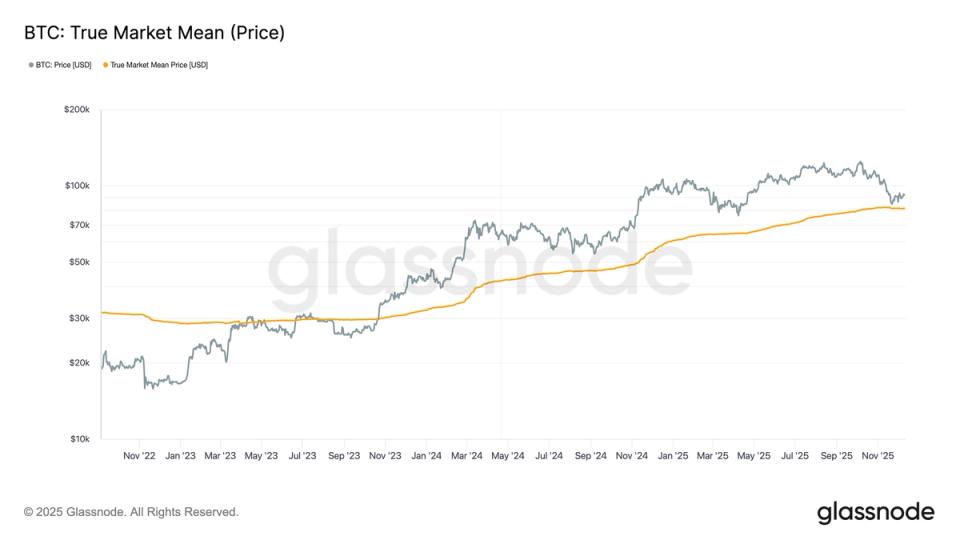
These metrics help to identify where investors are most likely to defend positions during drawdowns. The area of support proved vital, as it aligned closely with the average acquisition prices of multiple investor cohorts.
First, the True Market Mean, represents the average onchain purchase price of bitcoin held by active market participants. It focuses on coins that have moved recently, filtering out long dormant supply, and therefore reflects the cost basis of investors who are most likely to trade.
During this pullback, the True Market Mean sat near $81,000 and acted as clear support. Notably, bitcoin first moved above this level in October 2023 and had not traded below it since, reinforcing its importance as a structural bull market threshold.
Second, the U.S. spot ETF cost basis reflects the weighted average price at which bitcoin has flowed into U.S. listed spot ETFs. This is calculated by Glassnode using the combined daily ETF inflows with the market price.
The average cost basis currently sits around $83,844, according to Glassnode, and bitcoin once again bounced off this level, which it similarly did during the April tariff-driven selloff.
The third metric, the 2024 yearly cost basis, tracks the average price at which coins acquired in 2024 were withdrawn from exchanges. CoinDesk Research has shown a pattern that yearly cohort cost bases tend to act support during bull markets.
In this case, the 2024 cost basis near $83,000, according to checkonchain, provided additional confirmation of demand, again was also seen as support during the April correction.

These metrics highlight the depth of demand of support in the $80,000 region.

Twenty One Capital’s NYSE debut saw a nearly 20% drop, signaling cautious investor sentiment toward Bitcoin-heavy public listings.
XXI traded close to its net asset value, suggesting the market did not assign a meaningful premium beyond the value of the firm’s Bitcoin holdings.
The decline reflected broader market pressures, including Bitcoin volatility, fading enthusiasm for SPAC-backed listings and weakening mNAV premiums.
The muted reaction suggests investors may now expect Bitcoin-focused firms to show clear, durable revenue models rather than relying primarily on large BTC holdings.
The public debut of Twenty One Capital, a closely watched Bitcoin-focused company, on the New York Stock Exchange (NYSE) was met with cautious investor sentiment. Trading under the ticker XXI, the firm’s shares fell by nearly 20% on its first day.
This article explores what the market reaction may signal about shifting investor demand, the erosion of the mNAV premium and the broader scrutiny facing Bitcoin-backed equity listings.
Twenty One Capital is an institutionally backed, Bitcoin-native public company with the stated ambition of becoming the largest publicly traded holder of Bitcoin (BTC). The firm went public via a special-purpose acquisition company (SPAC) transaction with Cantor Equity Partners and began trading under the ticker XXI.
At launch, the company reported a treasury of over 43,500 BTC, valued at roughly $3.9 billion-$4.0 billion, placing it among the largest corporate Bitcoin holders.
The firm was built with a clear focus: a corporate structure that places Bitcoin at the center of its strategy. Its founders and backers position it as more than a treasury vehicle. Jack Mallers, who also founded Strike, has said that Twenty One aims to build corporate infrastructure for Bitcoin-aligned financial products.
This model places Twenty One alongside other digital asset treasury (DATs) companies, but with key differences. Its backers include Cantor Fitzgerald, a Federal Reserve primary dealer; Tether, the issuer of USDt (USDT) and a major holder of US Treasurys; Bitfinex and SoftBank. These institutional relationships position Twenty One as one of the most heavily backed Bitcoin-native companies to list publicly.
The company arrived amid a broader wave of publicly traded firms pursuing Bitcoin-centric strategies, inspired in part by the expansion model used by Strategy (formerly MicroStrategy). Still, Twenty One’s stated intention is not simply to replicate that approach but to pursue revenue-driven growth while maintaining a large Bitcoin reserve.
Given the scale of its treasury and the profile of its backers, many market participants expected strong attention around Twenty One’s launch. Yet its first day of trading on Dec. 9, 2025, delivered a different outcome. The stock fell sharply despite the company’s large Bitcoin holdings and high-profile institutional support.
When Cantor Equity Partners’ SPAC shares converted into XXI, the new stock opened at $10.74, below the SPAC’s prior close of $14.27. After-hours trading showed only a modest rebound. By the close of its first day of trading, the shares were down approximately 19.97%, settling at $11.96.
This performance underscored a broader trend in which newly listed crypto-related firms often trade below their pre-merger benchmarks. The move also left the newly public equity trading at a discount relative to its underlying cryptocurrency holdings, indicating that valuation dynamics for this type of stock may be shifting.

The sharp decline in Twenty One Capital’s stock price was not unique to the company. It reflected a convergence of three market factors in late 2025:
Erosion of the multiple-to-net-asset-value (mNAV) premium
Continued volatility in crypto markets
Weaker sentiment toward SPAC-driven public debuts.
The clearest sign of market caution was that the stock did not trade at a meaningful premium to the value of its underlying Bitcoin holdings. This is typically assessed using the mNAV ratio.
Historically, Bitcoin treasury firms have commanded a high mNAV premium at points in past market cycles. That premium has often been interpreted as a sign of investor confidence in management’s ability to create value beyond the underlying assets.
Twenty One Capital, however, traded at or near its asset value, effectively assigning little to no premium to its business plans or management. This suggested the market was valuing the stock largely as a direct and potentially volatile proxy for Bitcoin rather than pricing in a distinct operating-business premium.
Twenty One Capital debuted during a challenging period for both the crypto market and SPAC-driven listings. In the run-up to the debut, cryptocurrencies faced selling pressure. Bitcoin had fallen more than 28% from its October peak, creating a risk-off climate in which investors were less willing to assign generous valuations to crypto-linked equities.
The merger with Cantor Equity Partners was a SPAC-driven route to going public. While the prospect of the deal previously sent the SPAC’s shares sharply higher, by late 2025, enthusiasm for high-profile crypto SPACs had cooled. A long track record of post-merger underperformance has contributed to investor fatigue and skepticism, which can lead newly listed companies to trade below their pre-merger benchmarks.
Did you know? The equity trading below the value of its Bitcoin treasury is an example of a valuation paradox, where a newly public stock trades at a discount to the market value of the primary liquid assets it holds.
Another reason for investor caution may be the lack of a clear, proven, revenue-generating operating model at the time of the debut. This suggests some investors may be moving away from pure “Bitcoin treasury” narratives and placing greater emphasis on differentiation and predictable cash flows.
Twenty One Capital went public with large Bitcoin holdings, but without a detailed, publicly available business plan or a confirmed timeline. The debut also came during a period of heightened scrutiny of the digital asset treasury company sector.
According to Reuters, analysts suggest it is becoming “harder for DATs to raise capital” and that companies “need to show material differentiation” to justify their trading multiples.
The sharp drop in XXI’s share price may indicate that the market’s perspective is evolving. Some investors may be shifting their focus toward a company’s ability to execute a sustainable business model alongside its assets. Public markets may increasingly prioritize firms that can generate predictable cash flows rather than those that primarily hold Bitcoin.
This article does not contain investment advice or recommendations. Every investment and trading move involves risk, and readers should conduct their own research when making a decision. While we strive to provide accurate and timely information, Cointelegraph does not guarantee the accuracy, completeness, or reliability of any information in this article. This article may contain forward-looking statements that are subject to risks and uncertainties. Cointelegraph will not be liable for any loss or damage arising from your reliance on this information.


