Bitcoin’s latest oversold RSI mirrors 2020 and February 2026 setups that preceded 50% and 30% rebounds, putting $70K back in focus.
A Casascius coin tied to 25 BTC moved this week, converting a 2011 physical Bitcoin artifact into spendable BTC during a broader market selloff.
Galaxy Research identified the item as an S1-COIN-25 Casascius physical Bitcoin, a large-denomination piece from the era when Bitcoin could still be handed across a table as a loaded coin. The reported alert valued the 25 BTC at about $1.78 million at the time.
The on-chain sequence is more precise than a simple cash-out. The watched address received a 25 BTC output in block 156,413 on Dec. 7, 2011. It later accumulated small dust outputs before spending its funded outputs this week.
The first 2026 spend landed on June 3 at block 952,159. That transaction spent 25.00002187 BTC from the address and returned 24.98998 BTC to the same address after fees and dust handling.
A second transaction on June 4 at block 952,267 moved 24.98996629 BTC to a SegWit address, leaving the watched address with no balance.
The event proves a status change rather than a confirmed sale. Bitcoin, once attached to a physical collectible, became spendable via a normal wallet path. The chain shows movement away from the old address without any evidence of an exchange deposit, custodian route, or sale.
The June 3 transaction matters because it exposed activity from an address that had carried its original 25 BTC output since 2011. The spend returned most of the value to the same address, so a one-line address history can overstate what changed.
The June 4 transaction completed the visible move. The final spend sent 24.98996629 BTC from the watched address to bc1qn5snfwq447vge9ynnz66xqm9kpam9eu34z52dk. The fee was 1,371 sats.
After that, Blockstream’s address view showed no remaining balance. The holder’s reason remains unknown, and the available record ends with a transfer to another Bitcoin address.
That boundary matters for market interpretation. Old coins moving can look like holder behavior during a selloff, while the available data only establishes transfer to a recipient address.
CryptoSlate applied a similar standard to Mt. Gox-linked wallet movements, treating the first transfer as a warning light until later routing showed more. The same discipline applies here, where the next useful signal is onward routing.

The transfer revived the bankruptcy overhang while BTC was already under pressure, but the watched threshold is onward routing to exchanges, custodians, liquidity providers, or repayment partners.
Jun 3, 2026 · Liam ‘Akiba’ Wright
For now, the address history supports the following conclusion: a long-dormant, Casascius-attributed 25 BTC address became active, then sent nearly all of its remaining balance away from the original address.
Casascius attribution and on-chain proof do separate jobs. The visible chain proves the key was used. Galaxy-attributed secondary coverage supplies the label that makes it a physical-coin event.
Keeping those layers separate preserves the cultural hook without turning a tracker alert into more certainty than the record can carry.
A move from an old address becomes supply-only if subsequent routing points to a venue where coins can be sold or financed.
Until then, the strongest verifiable signal is a custody transition. A private key once hidden in a physical object has been used, and the BTC now sits outside the original Casascius-attributed address.
Casascius coins occupy a strange place in Bitcoin history because they turned a purely digital bearer asset into a physical object. The original site describes pieces with their own Bitcoin address and a redeemable private key sealed inside.
The Casascius FAQ explains the tamper-evident hologram and the rationale behind making a physical Bitcoin as a proof-of-concept and conversation piece.
That design created a trade-off outside ordinary wallet custody. Leaving the hologram intact preserves the object as a loaded collectible. Peeling it gives the holder control over the BTC, but changes the item from a funded artifact into a spent collectible.
The owner is choosing between numismatic scarcity and direct wallet liquidity. That choice makes this move more distinctive than a dormant wallet transfer.
A standard wallet can sit idle for years and then move without changing its form. A Casascius redemption changes the nature of the thing itself.
The coin can still exist as a physical object, but its main economic value has shifted back to Bitcoin on-chain.
Market-moving headlines and context delivered every morning in one tight read.
5-minute digest 100k+ readers
Free. No spam. Unsubscribe any time.
Whoops, looks like there was a problem. Please try again.
You’re subscribed. Welcome aboard.
CryptoSlate covered a larger version of that tension in 2025, when a holder unlocked about $10 million from a rare Casascius bar. That case also forced a choice between keeping a scarce, loaded relic and redeeming the BTC.


Rare Casascius bar redemption showcases a 2,000,000% return on a 2012 Bitcoin investment.
Jul 2, 2025 · Oluwapelumi Adejumo
The current 25 BTC move lands differently because of timing. Bitcoin was already under pressure, and old-wallet activity carries a sharper edge when leverage is unwinding.
CryptoSlate’s Bitcoin price page shows BTC near $63,000 on June 4, down 5.7% over 24 hours, 13.8% over seven days, and 22% over 30 days.
At that snapshot price, 25 BTC is worth about $1.58 million, which is already below the $1.78 million recently reported in the Galaxy-attributed alert.
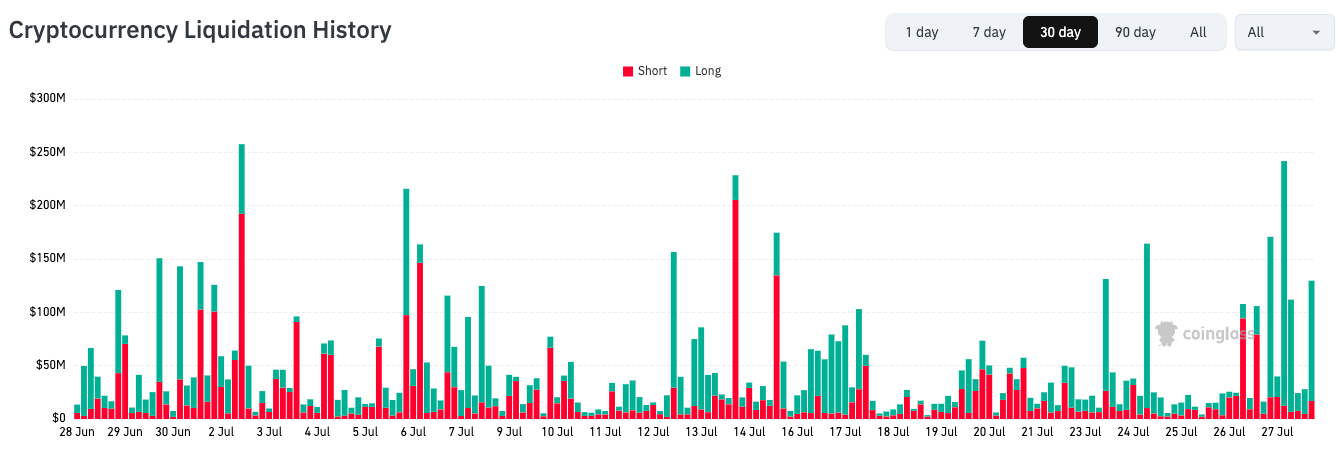
Bitcoin fell from $71,765 to $67,895 on June 2, triggering about $394 million in one-hour liquidations as leveraged long positions unwound.


The sharp pullback punished bullish bets and exposed how crowded crypto positioning had become before the selloff.
Jun 2, 2026 · Oluwapelumi Adejumo
That selloff makes any movement from old BTC addresses feel more consequential than it would during a calm rally.
The cultural signal and the trading signal are different. The cultural signal is clear: one of Bitcoin’s early physical storage formats appears to have rejoined the ordinary liquidity layer.
The trading signal remains unresolved. The watched BTC has left the original address, while the available data leaves open whether it will be sold, stored, pledged, or moved again.
Casascius redemptions connect the Bitcoin of forums, holograms, and physical experiments with the Bitcoin of ETFs, market-cap dashboards, and institutional liquidity.
A physical coin from 2011 can sit untouched for years, then become on-chain BTC in a market where every old coin movement is scanned for supply pressure.
It is a small event compared with Mt. Gox balances, ETF flows, or miner selling, but it is vivid because the holder had to alter a collectible to make the BTC liquid.
The next signal is simple. If the June 4 recipient address routes funds toward an exchange, custodian, mixer, or known liquidity venue, the signal moves from culture and custody into market supply.
If it stays parked, the event remains a clean example of Bitcoin’s long memory: old keys, old objects, and old storage habits can still wake up when the asset around them has become a global market.
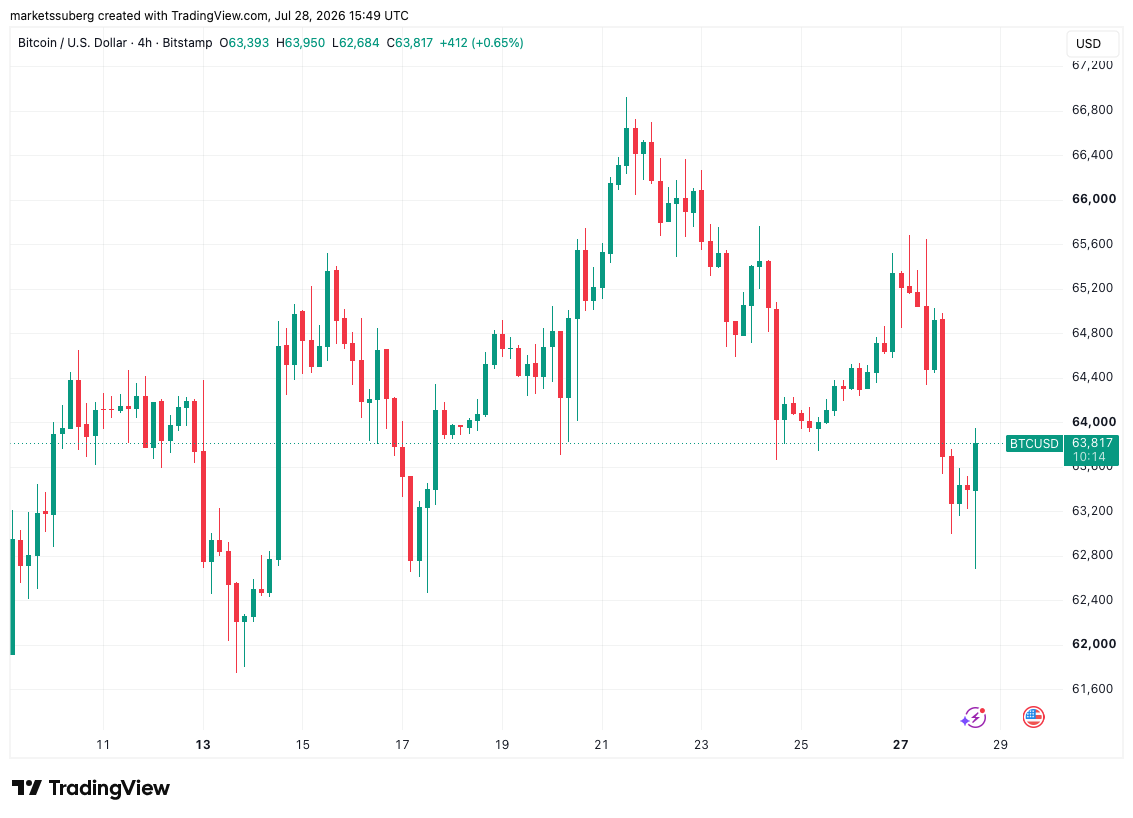
Bitcoin continued to slide lower on Thursday, exacerbating losses across the entire crypto market with no clear signs of a bottom.
The leading crypto has dropped roughly 17% over four days, from nearly $74,000 on Monday to Thursday’s intraday low of $61,556, according to CoinGecko data.
In under four days, total crypto market liquidations hit $4.47 billion, with bullish bets contributing $3.82 billion–roughly 93% of all positions wiped. At time of publication, BTC remains underwater, trading at around $63,680, down 5.1% on the day.
Derivatives and options data provide a new layer of insight into Bitcoin’s recent drop, apart from the sustained ETF outflows, worsening geopolitical conditions and its second-order effects, Decrypt previously reported.
The Coinbase premium has been negative since late April and has widened since May 26, according to CoinGlass data. The metric, which measures the price difference between Bitcoin on Coinbase versus Binance, has remained negative for the better part of 2026, with only occasional positive spikes in March and April. A sustained negative premium suggests weak U.S. institutional demand.
Bitcoin’s 30-day 25-delta skew has collapsed from -4.2 to -9.4, according to Deribit data, indicating that options investors continue to pay premiums for downside protection through bearish bets or put options.
Since June, Bitcoin’s open interest has fallen from 282,000 BTC to 265,000 BTC, according to Velo data, as spot and perpetual cumulative volume delta, the difference between market buying and selling pressure, has both tanked. That combination suggests new short positions have piled on as Bitcoin continued to drop.
On a brighter note, spot orderbook depth at 5% and 10% shows investors have continued to buy dips despite the selloff.
The primary driver of the selloff remains geopolitical risk, Illia Otychenko, lead analyst at CEX.IO, told Decrypt. “Renewed escalation between the U.S. and Iran increased risk aversion across markets and even put a chance for potential rate hikes on the table,” he said. “U.S. equities continue to push to new all-time highs, attracting speculative capital toward AI stocks and away from crypto.”
Otychenko noted that shortly before the decline accelerated, Bitcoin’s short-term holder cost basis fell below the true mean price—a crossover that historically occurred during the middle stages of previous bear markets. “The average recent buyer is now underwater relative to a long-term valuation benchmark,” he explained. “Historically, this creates a self-reinforcing cycle where losses trigger additional selling pressure.”
Several on-chain models suggest Bitcoin could still move below $60,000, according to Otychenko. He also noted that the long-term holder supply reached a new all-time high this week—a trend that often occurs during bear markets. “If historical patterns hold, a bottom could emerge within the next three to six months.”
Should Bitcoin lose $60,000, Otychenko identified the realized price near $54,000 as the next major reference point. “Given the lower volatility in this cycle, the eventual bottom could form much closer to that level than in previous cycles.”
Bitcoin is going through a natural “tired phase” of the cycle, Robin Singh, CEO of Koinly, told Decrypt. With Bitcoin hovering around its yearly lows just above $60,000, Singh said he wouldn’t be surprised to see another leg lower into the $50,000s. “That could be where the market finds a ‘true bottom,’ shakes out weak hands, and begins building a foundation for a stronger move higher later in the year.”
On prediction market Myriad, owned by Decrypt’s parent company Dastan, optimism has plummeted, with users now putting a 70% chance on Bitcoin’s next major move taking it to $55,000 rather than $84,000.
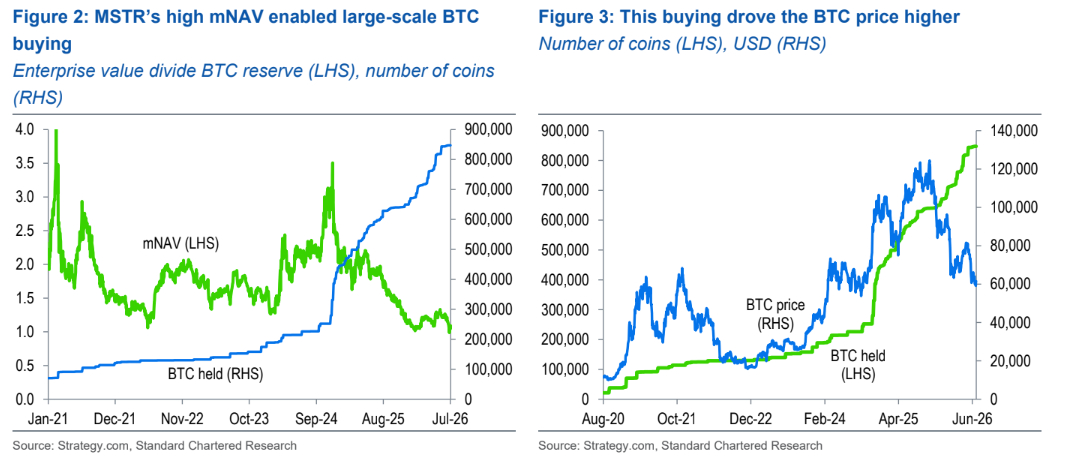
Standard Chartered’s head of crypto research, Geoffrey Kendrick, cast Bitcoin’s sell-off as a potential buying opportunity in a research note shared with Decrypt. While Kendrick acknowledged Strategy’s 32 BTC sale catalyst, he expects the company to buy back a multiple of what it sold.
“I suspect the buying following the selling will be more aggressive – I think either 10x (+ 320 BTC) or 100x (+3200 BTC),” he said. “ If I am right … I would see it as a tentative sign the low has been printed.”
Kendrick also noted that the ETF holdings have remained “structurally strong,” falling only from 682K BTC to 674K BTC since February—far less than he had feared. “When we look back at the end of 2026 with BTC at $100k and ETH at $4k, we will say this was the buying zone we all wanted.”
Start every day with the top news stories right now, plus original features, a podcast, videos and more.
Bitcoin’s in trouble. Not a crash, not a panic — just a slow, grinding bleed that’s wearing down anyone still holding from the spring rally.
That’s basically the picture Bitfinex painted in its latest market analysis. The firm called it a “slow bleed regime,” and it’s hard to argue with the label. Volatility is falling. Open interest is shrinking. Sellers are running the show, and buyers — institutional or otherwise — are pretty much nowhere to be found right now.
Bitcoin did manage to push above $82,000 early in May. That mattered for about a week. By the time the month closed, it had given back 12.5% from that peak — a sharp reminder that early-month strength doesn’t always stick. The rally didn’t have the structural backing to hold. Spot demand was thin. Institutional desks stayed quiet. And the options market, which can sometimes act as a pressure valve, wasn’t offering much either.
Per Bitfinex, sellers of volatility took control during May. When that happens, big price swings in either direction become less likely. It’s not the kind of market that wipes out positions overnight — it’s the kind that just slowly erodes them. Day after day. Small candles. Grinding lower.
And the ETF numbers made it worse. Spot Bitcoin ETFs saw roughly $3 billion in outflows over just three weeks. That’s a meaningful number. Those products were supposed to be one of the main structural pillars keeping demand steady, and watching $3 billion walk out the door in less than a month sent a clear signal about where institutional appetite actually sits right now.
It’s not just spot buyers sitting on their hands. Options traders have pulled back too. Implied volatility has been dropping, and when that happens, traders don’t want to pay elevated premiums for protective hedging. Why buy insurance when the market feels flat? The problem is that this behavior feeds on itself — less hedging activity, less volatility, less reason for big players to engage, and the cycle continues.
Short-term holders made things worse by taking profits into whatever strength appeared. That selling pressure, layered on top of the distribution-driven dynamics Bitfinex flagged, stripped away some of the supports that had helped Bitcoin recover earlier in the year. Without those supports, the market’s sitting in a vulnerable spot.
Read also: Bitcoin ETF Flows Reveal Institutional Caution as Prices Dip
Geopolitical noise hasn’t helped either. The Iran conflict specifically got a mention in the Bitfinex analysis as a factor disrupting typical seasonal patterns. Historically, May tends to close with positive returns for Bitcoin — data going back to 2013 backs that up. But geopolitical uncertainty has a way of scrambling those patterns, and this year was no exception.
So what flips it? Bitfinex sees a few scenarios. A strong wave of ETF inflows would help — not a trickle, but a genuine structural shift in institutional participation. Aggressive spot buying could do it too. If buyers step in with conviction at current levels, the distribution pressure eases and the dynamic changes pretty quickly.
But none of that has materialized yet. And until it does, the market stays in this uncomfortable middle ground — not collapsing, not recovering, just bleeding.
The internal dynamics are probably the bigger story here. It’d be easy to blame macro conditions or geopolitical headlines, but Bitfinex’s read is that the primary drivers are coming from inside the market itself. Distribution-led selling. Reduced demand across spot and institutional channels. Options traders sitting out. Short-term holders cashing in. All of it adds up to a market that can’t find its footing.
Related: XRP Eyes $2.50–$4.00 by Late June as Bitcoin Hyper Presale Tops $32 Million
Institutional investors specifically took a hit in the analysis. Their absence removed what Bitfinex called a crucial pillar of support. When the big money isn’t showing up, Bitcoin’s price movements get choppier and the market’s resilience gets tested in ways it can’t always pass.
June could break differently if something changes. It probably won’t look like May if ETF flows reverse or a major structural buyer enters the picture. But “could” and “probably” are doing a lot of work in that sentence. Right now, the distribution dynamics are still in charge, the demand side is still weak, and the $3 billion ETF outflow number is still sitting there as a reminder of how fast sentiment can shift.
Spot Bitcoin ETFs recorded roughly $3 billion in net outflows over three weeks in May.
Bitfinex used the term to describe a market environment where declining volatility and open interest combine with distribution-driven selling pressure, producing a slow, grinding price decline rather than a sharp crash.
Per Bitfinex, a strong inflow from ETFs and institutional investors, or aggressive spot buying, could potentially reverse the current trajectory and break the distribution-led selling pressure.
The cryptocurrency market is enduring a sharp narrative shift, but the real growth is happening away from the spotlight, according to the co-founder of Solana-native yield protocol Solstice Labs.
Ben Nadareski argued that the industry’s biggest asset is experiencing structural confusion in an interview with CoinDesk on Tuesday.
“Bitcoin BTC
Decentralized finance’s “silent” growth is heavily challenged by ongoing exploits, according to Nadareski, a flaw he blamed on developers frequently building innovative code while completely ignoring the core responsibilities of managing capital.
“They don’t quite realize you’re now also a financial asset manager if you’re working in DeFi,” Nadareski stated. “That doesn’t mean you’re in tech. That means you’re building tech in financing, which adds two aspects of risk to the market.”
OpenZeppelin co-founder and former CTO Manuel Aráoz said “DeFi is not safe anymore” last month noting that AI coding agents have made smart contracts fatally vulnerable.
Drift Protocol and Kelp Dao were hacked by North Korean cybercriminals in April in two exploits that drained nearly $600 million from the two lending crypto pools. In February 2025, Bybit suffered a $1.46 billion attack, described as the biggest hack of all time.
Nadareski said that to bridge this trust gap, DeFi platforms must hold themselves to traditional banking standards, implementing real-time proof of reserves and automated multi-signature time locks rather than relying on unproven code layers.
The entry of legacy banking giants does not mean crypto natives have lost the space, Nadareski said. Instead, he pointed to market structure where Wall Street uses faster digital rails for its operational back offices, while decentralized platforms preserve direct user access.
“The convergence is already among us. The institutions have been coming for years and now they are here,” he highlighted.
Winning platforms will be those that accommodate large financial entities while maintaining low fees and equal access for everyday retail users. Since its launch, Solstice has scaled past $500 million in total value locked (TVL) from over 40 institutional allocators, including Galaxy Digital and Susquehanna.
Solstice has also unveiled a strategic partnership with big-data analytics platform ApexE3, which is backed by Consensys and Tensorix.
Treating decentralized networks as a financial utility rather than a tech playground is the only path forward, according to Nasareski.
“Expect more out of DeFi than you do TradFi,” he concluded. “The average retail end-user anywhere in the world should expect 10 times more of an output of transparency, trust, and optimization of their capital.”
Despite the growing institutional presence in crypto, retail sentiment is just as important as it was when Wall Street was largely on the sidelines, according to Swan Bitcoin CEO Cory Klippsten.
“It still does. You have to remember it’s not like BlackRock owns the Bitcoin and Fidelity owns the Bitcoin. It’s a bunch of retail accounts mostly that actually buy that,” Klippsten said during an interview with Cointelegraph published to YouTube on Tuesday.
Cory Klippsten spoke to Cointelegraph at BitcoinVegas 2026. Source: Cointelegraph
“You know they’re buying it in a wrapper. But they still have to take real supply and custody it. And it comes out of the supply. So, you know, it’s still it is real demand in ETFs,” Klippsten said, adding:
“There are some paper products and futures and things like that that are weird and take a little while to kind of work through the system. There is something to the idea that there is more supply in certain ways. But at the end of the day, if you want real on-chain Bitcoin, the fact that you can get it is what makes Bitcoin unique.”
US-based spot Bitcoin ETFs have posted a combined $2.90 billion in net outflows since May 15, according to Farside data, while Bitcoin has slid approximately 9.5% over the same period. At the time of publication, Bitcoin is trading at $73,630, according to CoinMarketCap.

Bitcoin is down 2.87% over the past 30 days. (CoinMarketCap)
Meanwhile, sentiment toward the crypto market has been volatile in 2026. The Crypto Fear & Greed Index, which measures overall crypto market sentiment, posted an “Extreme Fear” score of 23 on Friday, signaling that investors are taking a cautious approach to the crypto market.
Klippsten said his outlook on Bitcoin hitting a new all-time high in 2026 is now looking slim.
Related: Bitcoin falls out of the global top 10 assets as market cap dips below $1.5T
He said he thought there was around a 50% chance we’d see a new all-time high this year when Bitcoin was still trading around $95,000 earlier this year, but given it has declined around 23% since then, his odds have gone down.
“I thought there was probably like a 50% chance that we’d see a new all-time high this year. And I’d say, given that we’re still in the 70s and, you know, and that we went all the way down to 60, I’d probably handicap that down to like 20 or 25% chance that we get a new [high]” he said.
Magazine: ETH bears growling, Tom Lee’s buying, XRP to ‘explode’: Market Moves
Bitcoin Cloud Mining is becoming a popular way for users to participate in Bitcoin mining without buying expensive mining machines or managing complex hardware. In 2026, more users are looking for simple, flexible, and beginner-friendly online mining solutions.
AJC Mining provides cloud mining services that allow users to access remote computing power through online contracts. With no need to purchase ASIC miners, handle electricity costs, manage cooling systems, or maintain equipment, AJC Mining makes Bitcoin Cloud Mining easier for both beginners and experienced crypto users.
Bitcoin Cloud Mining allows users to rent cloud computing power from professional mining facilities. Instead of operating mining hardware personally, users can select a cloud mining contract online and participate in Bitcoin mining through the platform.
This model helps reduce many barriers of traditional mining, including hardware cost, technical setup, electricity management, machine maintenance, noise, and heat control. For users in Europe, North America, and other global markets, cloud mining offers a more convenient way to enter the Bitcoin mining ecosystem.
AJC Mining focuses on providing a simple and accessible Bitcoin Cloud Mining experience. Users can choose suitable mining contracts based on their budget, contract duration, and profit goals.
Key advantages of AJC Mining include:
No need to buy mining equipment.
No electricity, cooling, or maintenance concerns.
Easy online registration and contract activation.
Daily profit settlement according to contract terms.
Fully automated cloud mining operations.
Flexible short-term and long-term mining contracts.
AJC Mining is designed for users who want to explore Bitcoin mining without the complexity of traditional mining operations.
Users can register an account via the official AJC Mining website. Upon successful registration, new users will receive a $15 reward.
(Click here to register now and claim your reward.)
The platform offers a variety of short-term and long-term cloud mining contracts. Users can choose based on:
Budget
Contract duration
Profit goals
Once selected, the system automatically deploys cloud computing power. Earnings are settled daily according to the contract terms, requiring no manual operation from the user.
| Contract Name | Price | Daily Profit | Days | Principal + Total Return |
|---|---|---|---|---|
| New User Experience Contract | $100 | $4 | 2 | $100 + $8 |
| Avalon Miner A15 | $500 | $6.25 | 5 | $500 + $31.25 |
| Litecoin Miner L9 | $1,000 | $13 | 10 | $1,000 + $130 |
| Bitcoin Miner S21 XP Imm | $5,000 | $70 | 25 | $5,000 + $1,750 |
| Bitcoin Miner S21e XP Hyd | $10,000 | $150 | 35 | $10,000 + $5,250 |
| ANTSPACE HW5 | $50,000 | $900 | 45 | $50,000 + $40,500 |
These contracts represent different levels of computing power and investment strategies. AJC Mining emphasizes fixed-term contracts, daily profit settlements, and fully automated mining operations.
(Click to view more cloud mining contracts.)
AJC Mining may be suitable for users who want to participate in Bitcoin Cloud Mining but do not own mining machines. It is also a practical option for beginners who want to learn about online mining, users who do not want to handle electricity or maintenance, and crypto users looking for a flexible cloud mining solution.
Before choosing any cloud mining contract, users should carefully review the contract details, platform rules, fees, payout terms, and market risks.
Bitcoin Cloud Mining is convenient, but it is not risk-free. Mining results may be affected by Bitcoin price changes, network mining difficulty, platform fees, market volatility, and contract terms. Users should make informed decisions based on their budget and risk tolerance.
AJC Mining encourages users to understand the mining process clearly before selecting a contract.
Bitcoin Cloud Mining offers a simpler way to participate in Bitcoin mining without buying hardware or managing mining machines. AJC Mining provides an online mining solution for users who want convenience, flexibility, and automated cloud mining services.
Register with AJC Mining today, claim your new user reward, and start exploring Bitcoin Cloud Mining in 2026.
AJC Mining Official Website: https://ajcmining.com/
Sequans Communications (NYSE: SQNS), the Paris-based cellular IoT semiconductor company, has completed the full redemption of its remaining convertible debt, funded by the sale of a portion of its Bitcoin holdings — bringing a short-lived and costly digital asset treasury experiment to a close.
The company now holds approximately 658 BTC, described as “fully unencumbered,” following the retirement of all convertible notes issued in July 2025. Sequans said it plans to monetize the remaining Bitcoin over time, though it did not specify a timeline or method.
The retreat caps a strategy that began in June 2025, when Sequans announced plans to raise $385 million through debt and equity to start a Bitcoin treasury.
By late July, CEO Georges Karam described Bitcoin as a “long-term store of value for our shareholders,” with a target of accumulating 3,000 BTC within weeks. The company crossed that threshold by month’s end.
The unwind began in November 2025 after Bitcoin fell from an all-time high above $126,000 to roughly $80,000. Sequans sold 970 BTC that month, followed by 125 BTC in February 2026, and another 1,025 BTC during the first quarter — reducing holdings to 1,114 BTC as of April 30. Thursday’s announcement confirmed a further reduction to 658 BTC, reflecting total sales of more than 80% of peak holdings.
Investors who bought shares at the height of Bitcoin enthusiasm last July are sitting on losses of more than 90%. SQNS shares rose 10% on Thursday following the announcement.
With the debt retired, Sequans transitions to what it calls a “near debt-free balance sheet,” giving the company greater financial flexibility heading into the second half of 2026. The move eliminates collateral obligations tied to Bitcoin’s price volatility, a risk that management had flagged in prior filings.
“We have strengthened our balance sheet, simplified our capital structure, and are now fully focused on scaling our IoT semiconductor business,” Karam said in Thursday’s statement.
Sequans’ renewed focus centers on its 4G LTE-M and Cat-1bis chipsets, which serve markets including smart metering, asset tracking, telematics, security, and industrial IoT. The company is also advancing its 5G eRedCap platform — a next-generation cellular IoT standard — as a long-term growth driver.
Karam framed Thursday’s announcement as the start of a focused operational phase. “Execute on our growing 4G and RF transceiver product portfolio, accelerate our path to profitability, and advance our 5G roadmap,” he said.
Bitcoin’s cycle map is putting one month at the center of its next major turning point. The premise of everything changing in one month is not based on one chart alone but on a combination of cycle timing, HODL wave behavior, drawdown patterns, and on-chain bottom signals that have always characterized the final stage of previous Bitcoin bear phases.
Technical analysis shows that Bitcoin may still be moving through the final part of a bear market sequence, and it may not be until October that everything changes.
Bitcoin is trading around $76,000 to $77,000 in the last week of May 2026, down by 39% from the all-time high it set in October 2025. Fear and Greed readings are now back to fear, retail sentiment is now fragile, and various technical signals are pointing to the fact that the real bottom hasn’t arrived yet.
As shown in the technical chart below, which depicts Bitcoin’s repetition fractal cycle, the cryptocurrency has created a cycle of bottoms, moving through accumulation, entering a strong markup phase, topping out, and then spending months pushing through a bear market before the next major bottom formed.

Bitcoin Repetition Fractal Cycle. Source: @CryptoTice_ On X
The 2018 and 2022 cycle lows both arrived only after traders had already spent months believing the worst was behind them, but that is the warning behind the current analysis. The chart shows Bitcoin already deep into its present cycle, but it does not yet suggest that the final bottom has been fully confirmed.
Instead, the projected structure places the next major bottom around October 2026. According to a crypto analyst that goes by the name Tice on the social media platform X, every major signal is converging on the same month. These signals include cycle timing, HODL Wave analysis, on-chain bottom indicators, and historical drawdown patterns.
The average length of previous bear market corrections has always come up to somewhere around 12 months. Based on the average length of prior bull and bear markets, analysts calculating from the October 6, 2025 all-time high of $126,000 estimate four more months of corrections before Bitcoin’s price bottoms, a timeline that points to mid-October 2026.
There are multiple analyses using previous cycles that show Bitcoin still needs to create a lower low before the correction timeline ends. However, history does not have to repeat with perfect precision, and the projected timeline does not automatically mean Bitcoin must break below its early February bottom near $63,000.
The bottom may already be in place, but the correction timeline suggests Bitcoin could be stuck in a continued consolidation phase before the next major bull rally begins around October 2026. At the time of writing, Bitcoin is trading at $76,640.
Featured image created with Dall.E, chart from Tradingview.com
Editorial Process for bitcoinist is centered on delivering thoroughly researched, accurate, and unbiased content. We uphold strict sourcing standards, and each page undergoes diligent review by our team of top technology experts and seasoned editors. This process ensures the integrity, relevance, and value of our content for our readers.
Author: Henrik Anderson, Senior Blockchain Analyst at btcecosystem
The cryptocurrency market is entering another phase of high-volatility expansion—and Solana is once again in the spotlight.
From viral “meme coins” to AI-integrated blockchain projects, billions of dollars in speculative liquidity are rapidly flowing back into the market. Retail investors are chasing the next blockbuster token, while social media is flooded with discussions about Solana-based ecosystems, low-market-cap boutique projects, and high-speed decentralized exchanges.
However, behind the “meme coin” craze, a larger trend is quietly emerging. Infrastructure is becoming one of the most important sectors in the next cryptocurrency cycle. Market focus is also shifting towards platforms like the BTC Ecosystem.
The True Engine Driving Crypto Boom
Every blockchain ecosystem—be it Bitcoin, Ethereum, or Solana—ultimately relies on the same element: computing power.
As transaction activity on global crypto networks intensifies, the demand for scalable infrastructure, mining operations, and energy-efficient computing systems is surging at an unprecedented rate. This is particularly crucial as artificial intelligence (AI), decentralized finance (DeFi), and next-generation blockchain applications are converging to build a rapidly expanding digital economy.
BTCEcosystem positions itself precisely at the heart of this evolutionary wave.
The company focuses on building renewable energy-driven blockchain infrastructure and distributed computing systems, aiming to provide robust support for the long-term development of Web3 technologies. According to the platform, its infrastructure network integrates renewable energy resources from multiple regions, including Texas, Canada, and Australia, thereby contributing to sustainable blockchain operations globally.
While many crypto projects still rely solely on short-term market hype cycles, BTCEcosystem chooses to focus on cultivating and building long-term infrastructure needs.
Why “smart money” is turning its attention beyond memes
Undoubtedly, Solana has once again become one of the hottest ecosystems in the crypto space. Its lightning-fast trading experience, low fees, and viral meme culture have created an ideal environment for retail speculation. Platforms like pump.fun have significantly accelerated the token creation process, pushing its activity to record highs and making Solana one of the most active blockchain ecosystems on the market.
However, experienced investors know that truly significant long-term opportunities often lie behind the scenes. While traders are busy chasing market fluctuations, infrastructure service providers often capture value from the entire ecosystem itself.
This is why blockchain infrastructure, cloud mining, distributed computing, and energy-efficient mining operations (such as the BTC Ecosystem) are rapidly attracting the attention of institutional investors. Ecosystems focused on infrastructure development can benefit from the continued expansion of the entire digital asset industry—regardless of which memecoin dominates the headlines next month. People are increasingly adopting this perspective.
Renewable Energy Will Define the Future of Crypto Infrastructure
A powerful narrative is emerging in the blockchain space: sustainability. As governments and institutions worldwide continue to assess the long-term scalability of blockchain technology, renewable energy-based infrastructure is increasingly becoming a key competitive advantage.
BTCEcosystem places particular emphasis on integrating hydropower, solar, and wind power systems into its mining and computing infrastructure strategy. This strategy aligns perfectly with the broader industry trend towards cleaner, more sustainable blockchain operating models.
As global energy discussions intensify, companies that can tightly integrate blockchain business growth with renewable energy infrastructure will be the most strategically positioned players in the next generation of digital finance.
The market is evolving.
The previous crypto cycle was primarily driven by speculation. The next cycle may be driven by infrastructure ownership. As blockchain adoption increases globally, investors are increasingly seeking projects related to:
✅ Scalable computing resources
✅ Infrastructure systems integrating AI technology
✅ Sustainable mining ecosystems
✅ Decentralized computing networks
✅ Blockchain applications with long-term practical value
This transformation is reshaping the flow of capital throughout the crypto industry. Many market participants are no longer focusing solely on short-term token hype but are prioritizing ecosystems that can support the entire digital economy. This is precisely the area where the BTC Ecosystem is striving to establish its position.
Building the Next Era of Web3
Memecoin may be dominating headlines today. However, what truly determines tomorrow’s winners is often infrastructure. As Solana continues to attract speculative liquidity and new blockchain users flood the market, the demand for reliable, scalable, and sustainable infrastructure is expected to grow in tandem.
From many perspectives, the next major opportunity in the crypto space may no longer stem solely from the various tokens that traders are currently eager to buy and sell—but rather from the infrastructure that operates quietly behind the scenes, providing a powerful impetus for the future of decentralized technology.
To learn more about BTCEcosystem and explore its vision for a renewable energy-driven blockchain infrastructure, please visit: https://btcecosystem.com/