U.S. Treasury yields retreat from the highest levels in decades, while bitcoin holds above $64,000.


 Live Chat
U.S. Treasury yields retreat from the highest levels in decades, while bitcoin holds above $64,000.

Edelman Financial Engines has disclosed a $34 million position in spot Bitcoin ETFs — a stake that now exceeds some of the firm’s other holdings in major tech companies.
While the position is still tiny in the investment advisor’s portfolio, it is still larger than its $25 million position in Amazon.
The position — held in BlackRock’s iShares Bitcoin Trust and Grayscale’s flagship product — tracks closely with the public views of its founder, Ric Edelman.
Edelman has been advocating for Bitcoin ETFs since 2019, years before the SEC approved spot products in January 2024. He also founded the Digital Assets Council of Financial Professionals, an organization built to educate financial advisors on crypto and blockchain technology.
And Edelman Financial isn’t the only one: In a filing submitted this afternoon, Tudor Investment Corporation, the firm run by legendary macro trader Paul Tudor Jones, reported owning 688,529 shares of IBIT as of June 30, valued at $22.9 million.
That’s up from the 579,083 shares Tudor reported the previous quarter.
It’s worth remembering that few investors have built a career reading inflation cycles and their historical patterns as successfully as Jones, making the size of the add notable in its own right.

Bitcoin (BTC) declined into Friday’s Wall Street open as traders increasingly saw a BTC price breakdown next.
Key points:
Data from TradingView showed BTC/USD down 1.3% on the day at $62,570, near its lowest levels month-to-date.
BTC/USD four-hour chart. Source: Cointelegraph/TradingView
Despite encouraging US inflation data lifting risk assets and reducing the odds of interest-rate hikes, Bitcoin failed to follow US equities, which closed Thursday’s session at all-time highs. The S&P 500 and tech-heavy Nasdaq Composite Index were both green at the time of writing, up 0.11% and 0.14%, respectively.
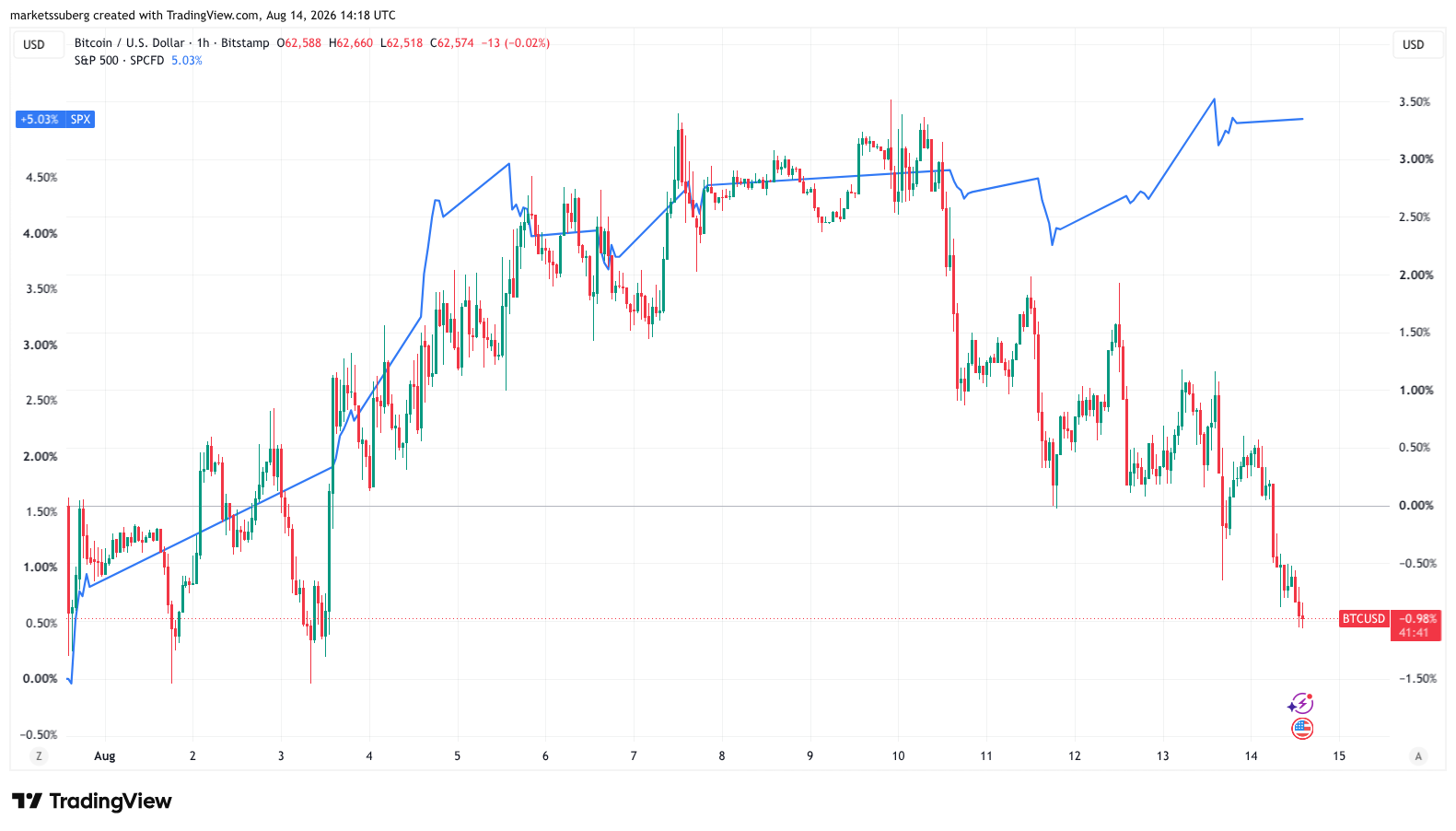
BTC/USD vs. S&P 500 one-hour chart. Source: Cointelegraph/TradingView
Commenting on Bitcoin price performance, trader and analyst Rekt Capital warned that Sunday’s weekly close needed to be above $63,220.
“A Weekly Close below the orange level would probably set price up for a breakdown,” he wrote in a post on X.
The analyst noted that $63,000 was now failing as support after weakening throughout August, having previously noted that the 50-month exponential moving average (EMA) at $65,827 was back as resistance, copying the 2022 bear market.
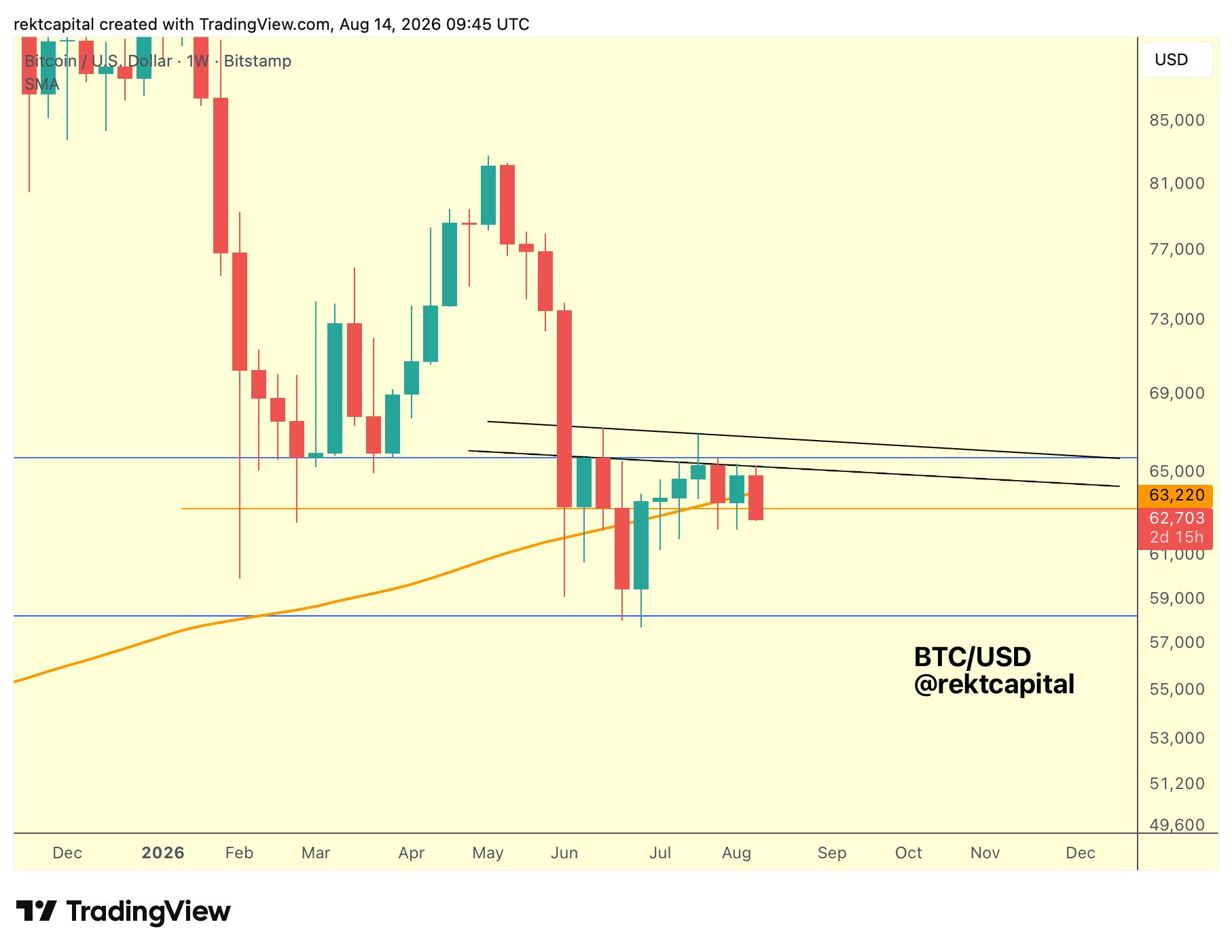
BTC/USD one-week chart. Source: Rekt Capital on X.com
Cointelegraph previously reported on increasing chances of a long liquidation event for Bitcoin as it approaches an area of liquidity around $61,000 amid growing open interest (OI) in derivatives markets.
“Traders have added substantial risk, most of it long, into a market that shows no matching demand,” onchain analytics platform Glassnode summarized in the latest edition of its regular newsletter, The Week Onchain.
In its latest analysis, trading and investment company QCP Capital drew attention to crypto markets’ refusal to rally on improving US inflation conditions — a phenomenon it described as “increasingly important.”
Related: Bitcoin speculators keep BTC price ‘pinned’ below $68.7K: Glassnode
“Last week, BTC demonstrated resilience in absorbing several negative headlines without a sustained breakdown,” it wrote, adding:
“This week has reinforced the distinction between resilience and momentum: the range remains intact, but softer inflation data have so far generated only a muted response from crypto.”
QCP added that macro traders are now focused on the Aug. 26 Personal Consumption Expenditures (PCE) index release, known as the Federal Reserve’s preferred inflation gauge. The index’s last print in July marked its first monthly decline since 2020, per data from the Bureau of Economic Analysis.

US PCE data percentage change (screenshot). Source: BEA

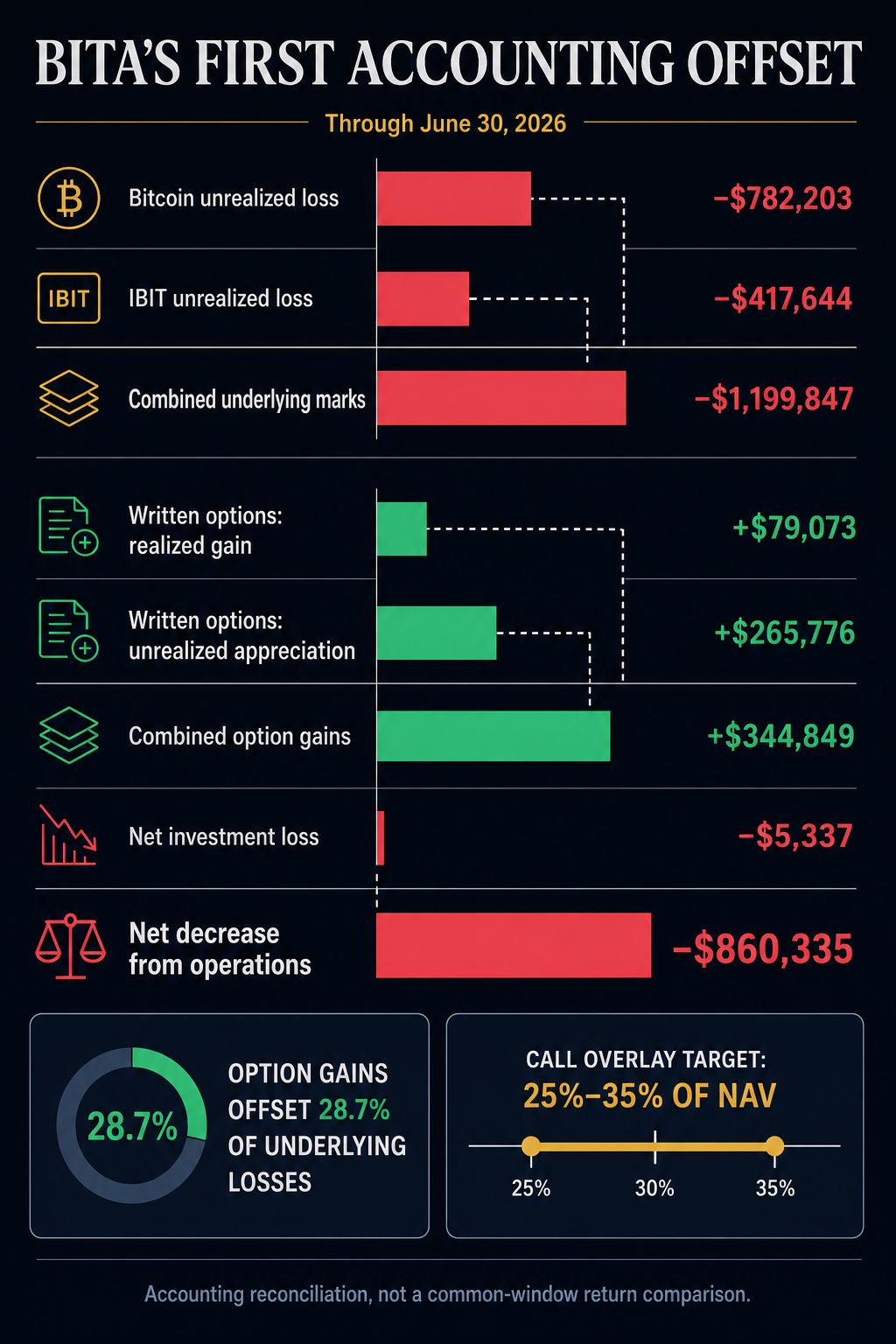
BlackRock’s iShares Bitcoin Premium Income ETF (BITA) recorded $79,073 of realized gains and $265,776 of unrealized appreciation on written options in its first operating period, helping offset losses on its Bitcoin holdings and shares of the iShares Bitcoin Trust ETF (IBIT).
BITA posted an $860,335 decrease in net assets from operations through June 30, its first quarterly filing shows. IBIT is BlackRock’s spot Bitcoin fund and one of BITA’s underlying investments.

BlackRock’s BITA recorded $782,203 of unrealized losses on Bitcoin and $417,644 on IBIT, for a combined $1,199,847. Its $344,849 of realized and unrealized option gains offset about 28.7% of those marks. A $5,337 net investment loss resulted in an overall decrease from operations of $860,335.
Comparative downside protection remains unmeasured because the performance figures use different windows.
BITA’s financial-statement NAV per share fell 3.08%, from $50 on the April 21 seed date to $48.46 on June 30. The filing separately says Bitcoin fell 4.43% and IBIT fell 4.75% from the fund’s initial purchases on June 9 through quarter-end.
A direct comparison requires one common start date, and the filing’s three metrics cover different periods. Its third figure is a negative 5.61% total return from the June 12 start of public trading through June 30.
The options entries show how the income strategy affected BITA’s accounts while Bitcoin and IBIT were falling. Relative performance over a common window remains unmeasured.
BITA’s prospectus targets written-call notional equal to 25% to 35% of NAV. Selling those calls produces premiums that can offset losses, and the covered holdings retain their downside exposure while surrendering gains above the options’ exercise prices.
A roughly three-week record is too short to establish how that trade-off behaves through a major drawdown, a rapid rebound or a full Bitcoin market cycle.
BITA ended June with $42.6 million in net assets, but capital contributions created that scale. The fund received $43.5 million as shares rose from 2,000 to 880,000, including 198,000 additional seed shares and 680,000 created shares.

A July 1 filing declared a $457,924.72 distribution for premiums or other income received from June 9 through June 30. That was $113,075.72 more than BITA’s combined GAAP option gains.
BITA’s first period shows that option gains can absorb part of an underlying loss inside the fund. The record remains too short to tell whether that relief compensates investors for the upside they surrender.

Bitcoin infrastructure company Blockstream has announced a new feature allowing users to make trustless swaps.
Dubbed Blockstream Swaps, the idea is that Bitcoiners will be able to quickly move between the main chain and Lightning network.
It comes after non-custodial Bitcoin swap provider Boltz suspended its service after it said attackers were finding vulnerabilities faster than its team could fix using AI.
“In support of the broader Bitcoin and Liquid ecosystem, Blockstream is launching Blockstream Swaps,” Blockstream said.
“This initiative was already under development to ensure a resilient suite of utility for the ecosystem, and it complements the providers already doing this work rather than replacing any one of them.”
The idea, added Blockstream, is users can move funds across layers while never losing full control over their funds.
To use Lightning, users will not need to run a node or channel — as is normally needed with Lightning — and can simply hold a Bitcoin or LBTC balance and let a swap convert at the moment of payment.
LBTC is the native asset of the Liquid Network, a Bitcoin layer-2 sidechain created by Blockstream.
“This initiative was already under development to ensure a resilient suite of utility for the ecosystem, and it complements the providers already doing this work rather than replacing any one of them,” added Blocksteam’s announcement.
Boltz this month suspended its Bitcoin swap service. It said that a surge in AI-assisted attacks left it unable to continue operating safely.
Crypto hacks have surged, with security experts warning that cybercriminals are using AI to search for bugs in crypto projects and then take advantage of errors auditors may have missed.
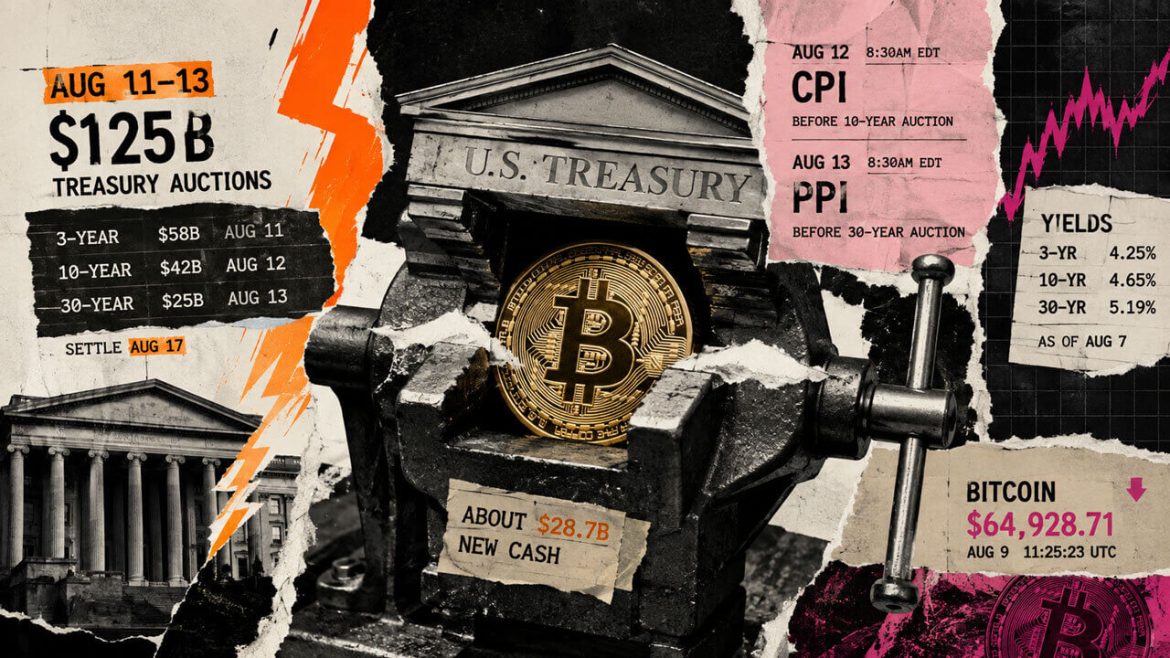
The Treasury auctions will total $125 billion from Aug. 11 through Aug. 13, while two inflation reports land hours before the corresponding 10-year and 30-year sales. The sequence will show whether softer bond demand and any resulting rise in yields coincide with pressure on Bitcoin.
The Treasury refunding plan starts with $58 billion of 3-year notes at 1 p.m. EDT on Aug. 11. It continues with $42 billion of 10-year notes at the same time on Aug. 12 and $25 billion of 30-year bonds on Aug. 13. All three settle Aug. 17.
The gross total is not a $125 billion liquidity drain. About $96.3 billion will refinance privately held debt maturing Aug. 15, leaving approximately $28.7 billion of new cash to raise from investors.

The Bureau of Labor Statistics calendar places July CPI at 8:30 a.m. EDT on Aug. 12, four and a half hours before the 10-year auction. July PPI arrives at 8:30 a.m. the following day, the same interval before the 30-year sale. Together, the releases and Treasury auctions create a tightly timed test of bond demand and Bitcoin’s response.
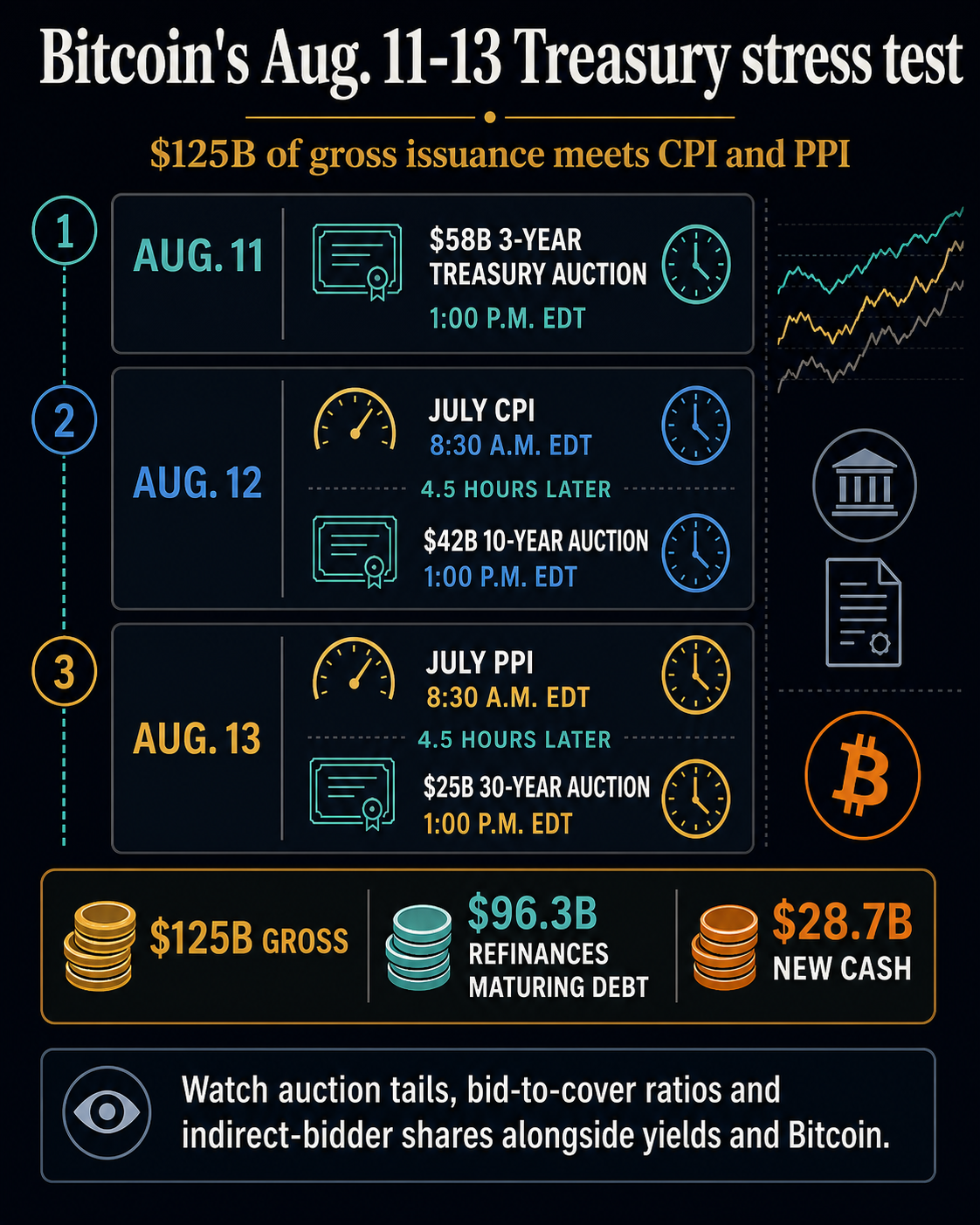

At the latest official business-day cutoff on Aug. 7, the Treasury’s par-yield curve showed 3-year, 10-year and 30-year yields at 4.25%, 4.65% and 5.19%, respectively. A CryptoSlate snapshot retrieved Aug. 9 at 11:25:23 UTC showed Bitcoin at $64,928.71; the live price is timestamp-sensitive.
The Sunday Bitcoin quote and Friday Treasury fixing do not provide simultaneous market evidence. Any link between yields and Bitcoin must be judged around the same inflation releases and auction results.
The July results set a baseline for the August Treasury auctions.

FinancialJuice reported that the July 3-year and 10-year sales stopped through their when-issued yields by 0.6 basis point each, while the 30-year sale stopped through by 0.3 basis point. Treasury does not publish when-issued levels, so the tail comparison is a secondary benchmark rather than an official statistic.
A comparatively weak August result would combine a positive tail with a lower bid-to-cover ratio and lower indirect-bidder share than the matching July sale. One reading alone is not decisive, and auction size plus the July reopening status of the longer securities affect the comparison.
The sharper Bitcoin risk case is conditional: inflation pushes yields higher, several auction metrics point to softer demand, yields remain elevated, and Bitcoin falls in the same event window. Firm auctions or a stable Bitcoin price would weaken that case. New York Fed research found Bitcoin broadly disconnected from monetary and macro news in its historical sample, underscoring why the Treasury auctions should be read as a test of conditions, not an automatic sell signal for Bitcoin.
BTCPay Server confirmed that attackers exploited a critical flaw to steal funds from users running any version prior to 2.4.2 and urged operators to update immediately.
The self-hosted Bitcoin payment processor released version 2.4.2 to close the vulnerability. The issue allowed an unauthenticated remote attacker to obtain .macaroon credential files for LND, a common Lightning Network implementation.
The stolen credentials could hand an attacker full control of an LND node. From there, the attacker could move funds directly out of the node.
“We have confirmed that attackers exploited this vulnerability. Users were affected and funds were stolen. We are not publishing technical details yet because operators still need time to update,” the team said.
Follow us on X to get the latest news as it happens
The risk applies specifically to deployments using LND. Other Lightning setups and non-Lightning users face no credential exposure, though the project still urged them to update. BTCPay Server’s own on-chain and hot wallets remain unaffected.
Operators who use LND should update to version 2.4.2 and LND 0.21.1 through the maintenance dashboard. The update regenerates macaroons automatically. Those unable to patch immediately were told to take their servers offline.
The project also advised LND users to review node activity for unfamiliar peers, unexpected channel closures, and payments they did not make.
The disclosure follows another major security incident. Galaxy Research confirmed on Friday that 1,719 Bitcoin (BTC), worth roughly $111 million, has been stolen from Coldcard users so far. The firm expects total losses to exceed $130 million once outstanding cases are verified.
Neither incident touched the Bitcoin protocol itself. Both instead exposed weaknesses in the tools built around it.
Subscribe to our YouTube channel to watch leaders and journalists provide expert insights
The post Bitcoin Payment Tool BTCPay Urges Update After Attackers Steal Funds appeared first on BeInCrypto.
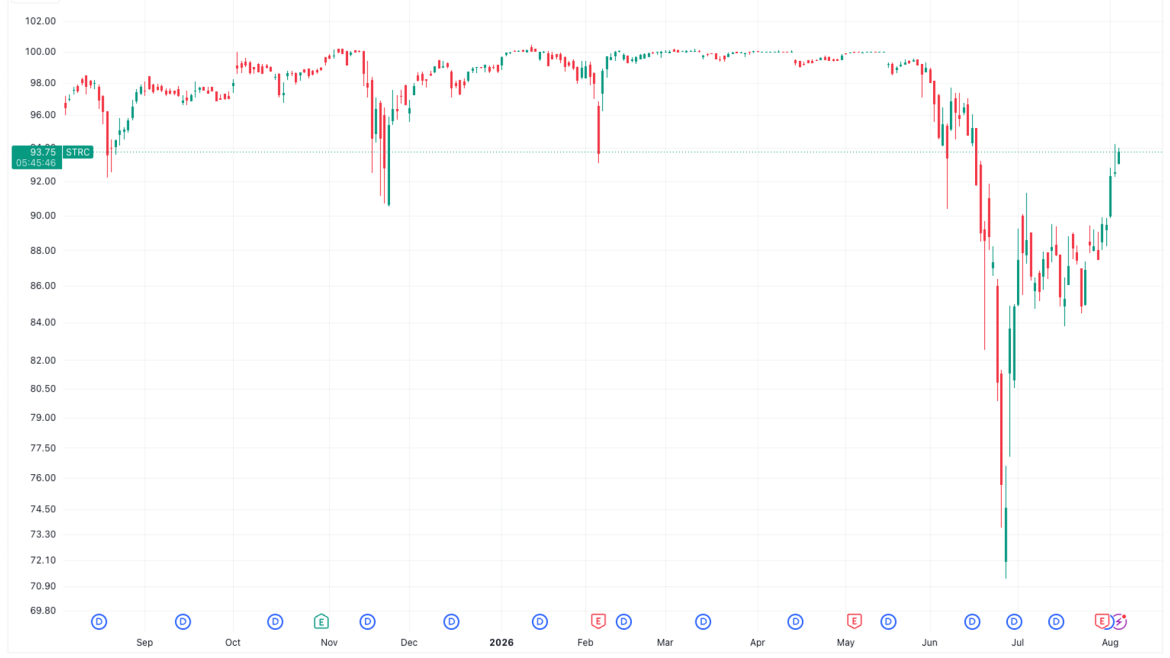
Strategy’s (MSTR) perpetual preferred stock, Stretch (STRC), has risen more than 30% from its June low. It is currently trading around $94, after gaining another 1% on Wednesday.
STRC bottomed in late June around $71 as bitcoin fell below $60,000. Since then, Strategy has sold 5,226 BTC for $321 million across three separate transactions, reducing its bitcoin holdings from 847,363 BTC to approximately 842,137 BTC. The sales were intended, in part, to demonstrate that the company can use bitcoin to meet its dividend obligations, rather than treating it as an idle asset.
Strategy has also repurchased $106 million of STRC as it seeks to return the preferred stock to its $100 stated value.
In addition, the company increased its U.S. dollar reserve by another $250 million on Monday, bringing the total to $4 billion. This provides approximately 2.3 years of coverage for dividend obligations on its preferred securities. Meanwhile, Strategy maintained STRC’s annualized dividend rate at 12%.
As for bitcoin, the price has at least stopped falling, stabilizing above $60,000 for several weeks in a row.

Most people don’t realize that an air-gapped Bitcoin wallet can keep a private key away from the internet for years and still be vulnerable from the moment its seed was created.
Coldcard’s newly disclosed random-number-generation failure makes the contradiction plain. A wallet running affected firmware could produce a normal-looking 12- or 24-word recovery phrase, store it offline, and sign transactions in isolation. Predictable generation shrank the universe behind those words, allowing an attacker to reproduce candidates somewhere else and identify matching Bitcoin addresses.
I see a wallet’s most consequential security decision at the beginning. It comes before the PIN, the steel backup, the tamper-evident bag and the air-gapped signing flow: how unpredictable was the seed?
A sound modern random-number generator can supply enough entropy. Physical dice give the owner a source of randomness that can be seen, controlled and kept separate from the manufacturer’s code.
CryptoSlate’s first report on the Coldcard flaw explained the attack path. Candidate seeds can be generated away from the device, converted into public addresses and checked against activity on Bitcoin’s public ledger.

The technical cause was almost painfully small. A March 1, 2021 code change moved Coldcard’s seed generation into a new library. Production firmware defined a setting called MICROPY_HW_ENABLE_RNG as zero, meaning disabled, while the integration checked only whether the setting existed. Its presence sent generation to MicroPython’s deterministic Yasmarang fallback in place of the intended hardware random-number generator. The affected path shipped in firmware 4.0.0 on March 17, according to Block’s coordinated analysis.
Ordinary-looking wallet output concealed a drastically reduced search space. Coinkite’s preliminary estimate puts affected Mk2 and Mk3 seeds at roughly 40 bits of effective search space and affected Mk4, Mk5 and Q seeds at roughly 72 bits. Block identified a separate limit for later devices: at most 2^32 securely distinguished streams when the fallback state and call history were fixed. Coinkite’s figures estimate the effective space an attacker might search. Block’s narrower bound describes one part of reseeding under fixed conditions, without claiming an end-to-end attack benchmark.
Both analyses place later pre-fix devices inside the affected range. Coinkite’s security advisory lists Mk4 and Mk5 firmware before standard 5.6.0 or Edge 6.6.0X, and Q firmware before standard 1.5.0Q or Edge 6.6.0QX. For Mk2 and Mk3, Coinkite lists versions 4.0.1 through 4.1.9, while Block says the path began in 4.0.0. I would treat that disputed boundary conservatively.
Updating to a fixed release protects future seed generation. An existing seed keeps the entropy it received at birth, and every address derived from it shares the same root secret. Anyone who used an affected version should check the advisory and create an entirely new seed with fixed software and trustworthy entropy when the private-dice exception cannot be established. The funds then need to move to the new wallet. A new address from the old mnemonic preserves the weakness.
The incident’s scale needs equally careful language. Bitcoin Optech reported an evolving estimate above 1,000 BTC on July 31. As of Aug. 2, Galaxy Research estimated a suspected 1,367.05 BTC across 4,585 addresses. An X user posting as Graham_Quantum also said 18.25245043 BTC left wallets on July 29. That post establishes the first-person account; transaction linkage and Coldcard causation remain unverified.
A much larger figure describes defensive movement. CryptoSlate’s second Coldcard report found that 77,402 BTC moved from older UTXO bands after the disclosure. The total covers gross old-coin movement that included precautionary migration. It measures a wave of self-rescue, while Galaxy’s smaller figure is an evolving estimate of suspected loss.
| Figure | Classification | Scope | Important limit |
|---|---|---|---|
| 1,367.05 BTC | Suspected loss | Galaxy Research’s Aug. 2 estimate across 4,585 addresses | Evolving, attributed estimate with no finalized incident total |
| 77,402 BTC | Precautionary movement | Gross movement from older UTXO bands after disclosure | Includes defensive migration and is separate from theft or sales totals |
A security failure can create two shocks at once: theft and a much larger wave of rational migration. On-chain data records the movement. The motive requires context.
Coldcard’s dice documentation calculates about 2.585 bits of entropy for each independent roll of a fair six-sided die. Fifty rolls provide about 129.25 bits of raw roll entropy, conventionally targeting 128-bit security. Ninety-nine provide about 255.91 bits, roughly the target for 256-bit security, before the wallet applies its documented conversion procedure.
Those numbers line up with BIP-39, the widely used mnemonic standard. A 12-word phrase encodes 128 bits of entropy plus a 4-bit checksum. A 24-word phrase encodes 256 bits plus an 8-bit checksum.
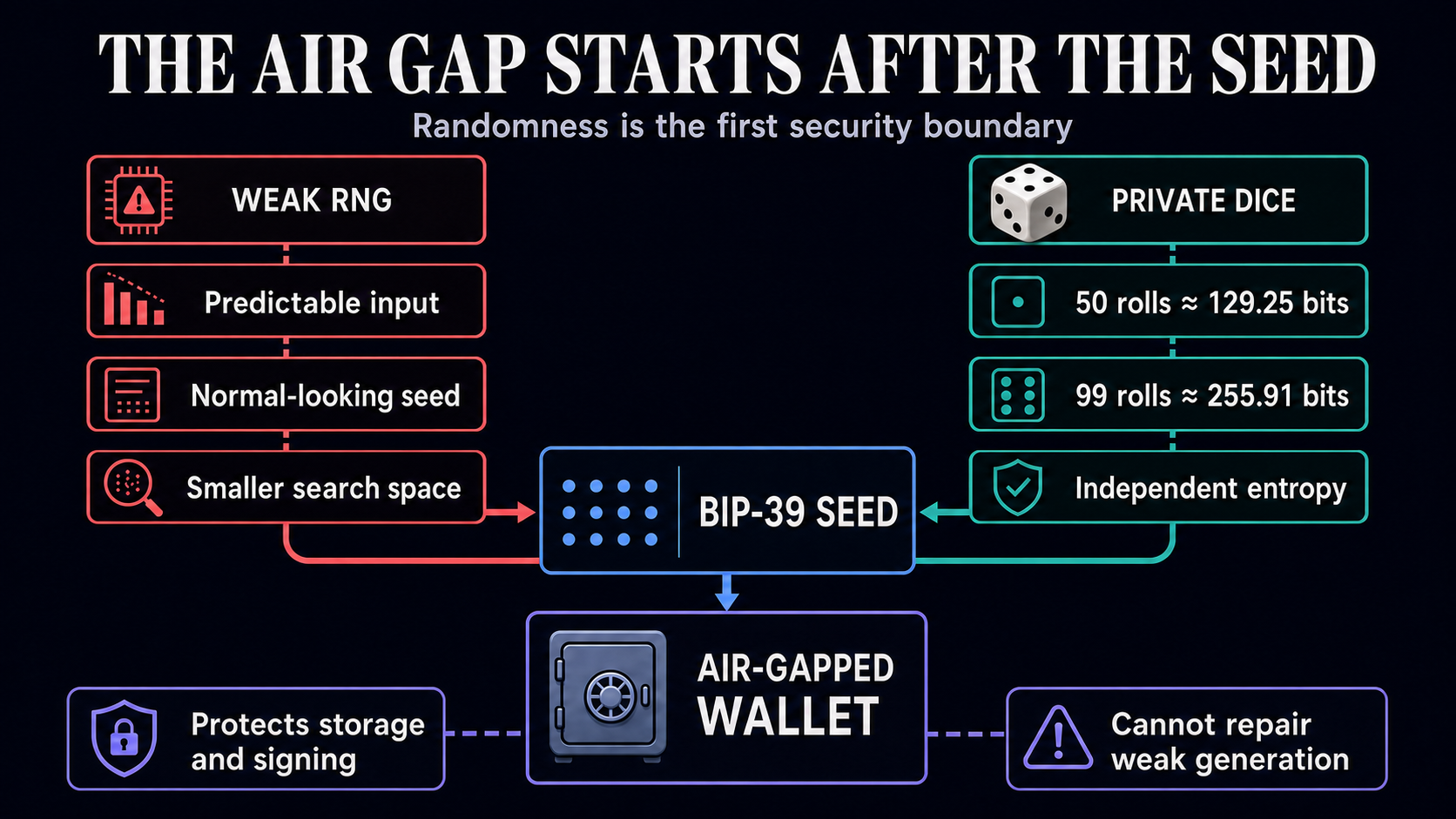
The checksum detects errors while contributing zero new unpredictability. Hashing or formatting weak input into longer output preserves the underlying ceiling on possible secrets. Twelve familiar-looking words can therefore represent a tiny subset of the space they appear to offer.
Physical rolls help only when the wallet’s documented procedure incorporates them correctly. The die must be suitable for the task, each roll must be genuine and independent, and the sequence must stay private. Reused patterns, photographs, cloud notes and entry on a normal networked computer can undermine the rolls’ independence or secrecy.
For this Coldcard incident, Coinkite says migration may be unnecessary only when the user can establish that the final seed incorporated at least 50 fair, independent and private dice rolls. Its advice for uncertainty is migration.
For me, dice matter because device-generated randomness asks the owner to trust the hardware, firmware, build process and integration code as one chain. A documented dice-entry flow adds owner-controlled entropy from outside that chain. Roughly 50 fair rolls target 128 bits and 99 target about 256 bits, but users should follow the device’s exact procedure instead of improvising a conversion.
A strong, unique BIP-39 passphrase changes the attack in a different way. It adds an independent secret that an attacker must discover after finding the mnemonic. The mnemonic’s original entropy stays unchanged. Every passphrase, including a typo, derives a valid-looking wallet, so loss of the exact passphrase can strand the intended funds. A device PIN serves a different purpose.
The passphrase creates a genuine tradeoff. It can provide a powerful second barrier when the owner can reproduce and protect it. Poor backup turns the same feature into a way to lock oneself out.
Coldcard is the current warning, and the same root failure has appeared in very different wallets.
In 2023, Ledger Donjon disclosed that certain Trust Wallet browser-extension versions used a WebAssembly path seeded with a 32-bit Mersenne Twister value. The apparently normal mnemonics came from about four billion possible starting values. The affected scope was specific: browser-extension versions 0.0.172 through 0.0.182 using Trust Wallet Core before 3.1.1. The National Vulnerability Database records exploitation in December 2022 and March 2023.
The Milk Sad disclosure showed a more intuitive version of the same danger in Libbitcoin Explorer 3.x. Its bx seed command used a 32-bit, time-seeded Mersenne Twister and could produce the same mnemonic under the same clock conditions. Knowledge of the approximate creation time gave an attacker a much smaller range to search than the recovery words suggested.
Researchers found more than 2,600 actively used Bitcoin wallets in the affected ranges and estimated more than $900,000 in related theft across multiple chains at August 2023 prices. More than 2,550 of those wallets shared an automated pattern and may have belonged to one owner, and the researchers said some drains could have involved other weaknesses.
The implementations differed: an accidental firmware fallback, a browser-extension Wasm path and a time-seeded command-line tool. Each produced output that looked like a full-strength wallet secret while exploring only a fraction of the apparent space.
Bitcoin custody advice often begins after the seed exists: keep it offline, use durable backups, separate responsibilities and test recovery. All of that still matters. The Coldcard failure moves the starting line back one step.
An air gap protects the secret you give it. The randomness has to come first.

The persistent discount suggests US spot buyers have remained less aggressive than overseas traders even as US Bitcoin ETF inflows turned positive in July.


