Sam Altman-backed World has rolled out biometric verification badges for Zoom enterprise users, aiming to combat AI deepfake impersonation and fraud.

 Live Chat

Sam Altman-backed World has rolled out biometric verification badges for Zoom enterprise users, aiming to combat AI deepfake impersonation and fraud.
None of the four investors is new to OKX. Standard Chartered already holds the BlackRock BUIDL shares OKX clients post as margin, and Ripple’s RLUSD trades across the exchange’s order book.
OKX announced Tuesday that Circle (CRCL), Ripple, Qube Research & Technologies (QRT), and SC Ventures by Standard Chartered have invested in the exchange at a $25 billion valuation.
The exchange said the round extends the stake NYSE parent Intercontinental Exchange (ICE) took in March, and it described this week’s valuation as pre-money, before counting the new capital.
Each of the four firms already supports one layer of its business, from stablecoin issuance to liquidity, collateral, and custody. QRT, a multi-strategy investment manager, is an institutional counterparty that supplies liquidity and risk capacity to the exchange.
Meanwhile, Ripple’s RLUSD stablecoin trades across OKX’s unified order book. RLUSD went live on more than 280 OKX trading pairs in April, including against XRP.
“Our investment reflects our conviction in what they’re building and opens the door to deepen our work together across stablecoins, payments and institutional markets,” said Jack McDonald, SVP of Stablecoins at Ripple.
Standard Chartered’s link runs through BlackRock’s BUIDL tokenized Treasury fund. On April 28, OKX, BlackRock and the bank launched a framework that lets VIP and institutional clients post BUIDL as trading collateral. The bank holds those fund shares in custody off the exchange while the clients trade on OKX Middle East.
The round landed two days after OKXICE, the joint venture between OKX and ICE, filed with the SEC to offer 63 tokenized NYSE stocks to US users on October 4. Those tokens must carry the same dividend and voting rights as the underlying shares. Listed companies have 30 days to opt out before trading can begin.
OKX also launched OKX Money on Tuesday, a standalone app for saving, sending and spending dollar stablecoins. OKX Money users can fund accounts in more than 50 currencies and hold USDG, USDC or Tether’s USDT. Qualifying customers can earn up to 10% a year on eligible USDG balances, with no staking or lockup. Those USDG rewards, like the app itself, are available only in select regions for now.
Founder and CEO Star Xu said the new capital will help OKX keep growing and tokenize real-world assets.
“The exchange was our starting point, and we are evolving into a broader global financial technology platform,” Xu said.
Block has joined the x402 Foundation and contributed a Bitcoin Lightning payment specification, adding a Bitcoin option to an open standard for payments by AI agents, the company announced Sept. 24. The x402 repository merged the specification on Sept. 23. Its author, Ben Carman, is a Bitcoin and… Read the full story at The Defiant
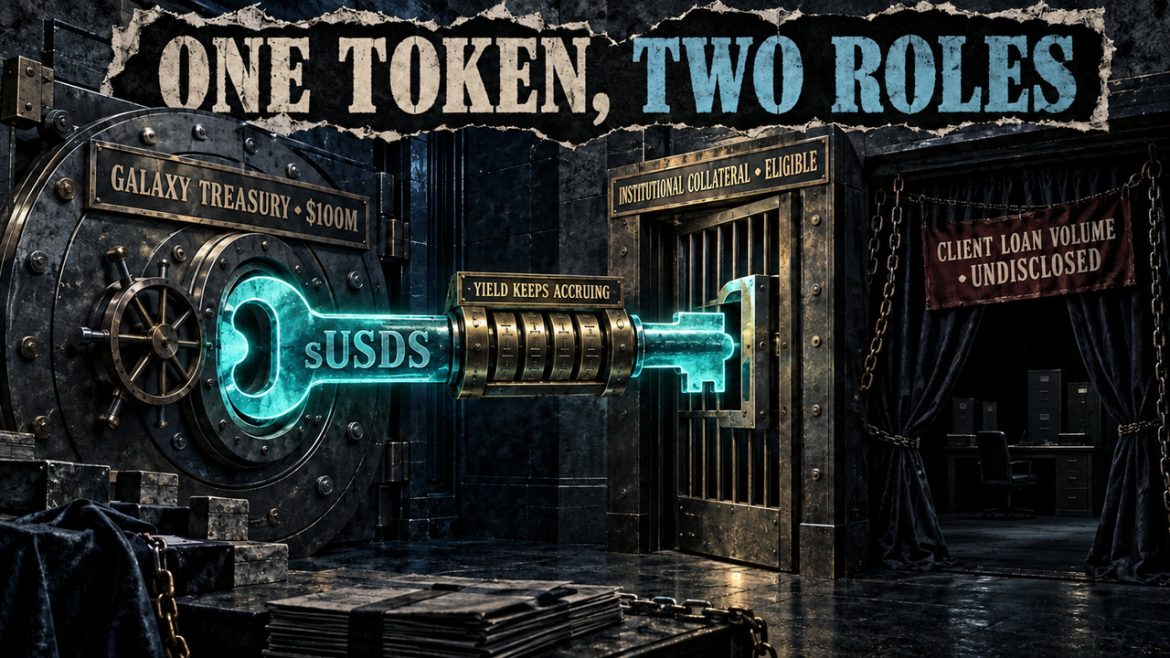
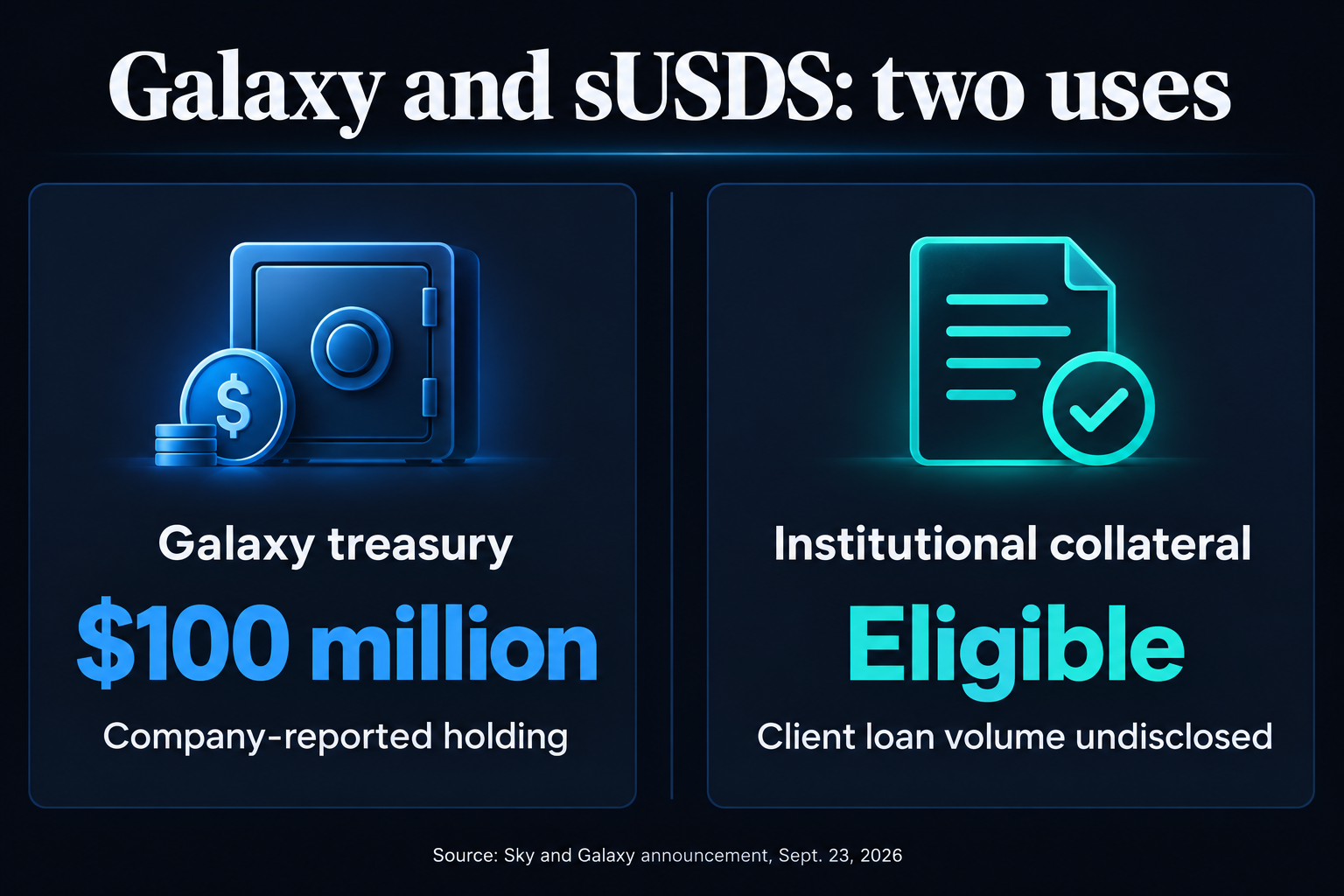
Galaxy Digital has added $100 million of sUSDS, Sky Protocol’s yield-bearing savings token, to its corporate treasury and approved it as collateral for institutional clients, the companies said Sept. 23.
Galaxy and Sky described the treasury position as complete, but their announcement gave no figure for client lending secured by sUSDS or the first completed loan. The decision makes the token eligible across Galaxy’s institutional trading business, with actual client uptake still undisclosed.
The attraction is a token that continues to accrue a savings return when pledged. Under the announced arrangement, clients who post sUSDS against a loan keep accruing the Sky Savings Rate on the full position while the loan runs.
Sky says governance sets that rate and funds it from aggregate protocol surplus, and that holders keep the same number of sUSDS tokens as the amount of USDS redeemable for each token increases as it accrues. The savings rate can change, so future accrual is not fixed.
For a borrower, that design could offer access to credit while retaining a savings position. The financial result would depend on the loan terms and the rate available over its life. The announcement does not provide those details for any completed sUSDS-backed borrowing, and it also leaves open how much collateral clients might eventually post.
The companies’ relationship already includes credit financing through Grove, a Sky ecosystem agent. In July, Grove announced a $500 million warehouse facility that supplies capital for institutional loans Galaxy originates.
Grove is the warehouse lender, supplying USDS capital, while Galaxy originates and services the loans. Borrower collateral in that facility is limited to Bitcoin and Ethereum, including staked forms of Ethereum.
A Sky Frontier Foundation update published Sept. 17 said Sky agents held about $304 million with Galaxy as of Sept. 1, driven by the Grove facility. That figure describes Sky-side exposure to Galaxy before the new announcement.
The treasury allocation gives the partnership a stated balance-sheet footprint today. The collateral approval could extend sUSDS into Galaxy’s client lending, where an identified loan or disclosed outstanding balance would show whether institutions use the token beyond Galaxy’s own holdings.
miami, united states, September 22nd, 2026, Chainwire
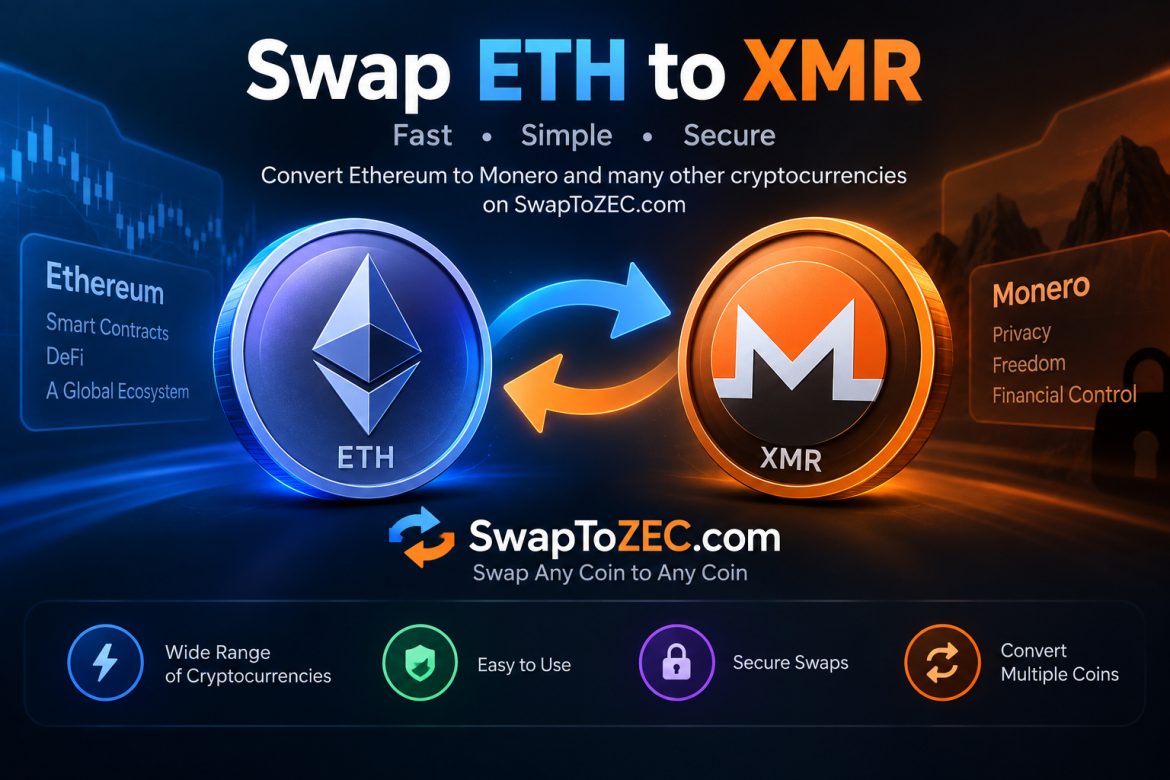
SwapToZEC.com, a cryptocurrency exchange platform, provides cryptocurrency-to-cryptocurrency conversion services across supported digital assets, including an Ethereum (ETH) to Monero (XMR) exchange route.
The ETH-to-XMR route enables users to convert Ethereum into Monero without requiring a separate fiat-currency conversion. Availability, exchange rates, network requirements, transaction limits, and applicable fees are determined by the platform’s current operating conditions.
Ethereum and Monero operate on separate blockchain networks and have different technical characteristics. Ethereum’s network supports smart contracts and decentralized applications, while Monero incorporates protocol-level privacy features designed to limit the visibility of transaction information on its blockchain.
ETH-to-XMR Conversion
An ETH-to-XMR transaction involves sending Ethereum through an exchange service that supports the conversion and receiving Monero at a designated XMR wallet address.
The process generally requires users to select ETH as the sending asset and XMR as the receiving asset, enter the amount to be exchanged, provide a compatible Monero wallet address, and follow the platform’s deposit instructions.
Before initiating a transaction, users are advised to review the quoted exchange rate, applicable charges, minimum or maximum transaction requirements, supported networks, and wallet information. Cryptocurrency transactions can be irreversible, and sending assets through an unsupported network or to an incorrect address can result in the loss of funds.
The final amount of XMR received may vary according to the applicable exchange rate, liquidity, network conditions, and fees. Processing times may also vary depending on blockchain confirmations and exchange processing requirements.
Multi-Cryptocurrency Exchange Services
Despite its Zcash-related name, SwapToZEC.com states that its services extend beyond Zcash and include conversion routes involving multiple supported digital assets.
The platform provides cryptocurrency-to-cryptocurrency exchange functionality for available asset pairs. Supported cryptocurrencies, networks, exchange rates, and transaction conditions may change over time and should be confirmed through the platform before a transaction is initiated.
The ETH-to-XMR route forms part of this broader exchange functionality, allowing users to convert between two separate cryptocurrency ecosystems through a single exchange interface.
Monero Privacy Considerations
Monero incorporates privacy technologies intended to obscure certain transaction details recorded on its blockchain. However, exchanging Ethereum for Monero does not by itself guarantee anonymity.
Exchange providers may maintain transaction records or collect information in accordance with their applicable procedures and requirements. Ethereum transactions conducted before a conversion also remain recorded on the Ethereum blockchain.
Users considering an ETH-to-XMR transaction should therefore distinguish between Monero’s protocol-level privacy characteristics and the information that may be associated with an exchange transaction.
About SwapToZEC.com
SwapToZEC.com is a cryptocurrency exchange platform designed to facilitate conversions between supported digital assets.
The platform offers multiple cryptocurrency conversion routes, including an Ethereum-to-Monero exchange option. Available assets, trading pairs, networks, rates, transaction limits, and other conditions are subject to the platform’s current offerings.
More information about the ETH-to-XMR conversion route is available through the platform’s Ethereum-to-Monero exchange page.
Website: https://swaptozec.com/
ETH-to-XMR: https://swaptozec.com/swap/eth-to-xmr
William Campbell
support@swaptozec.com

Willemstad, Curacao, September 17th, 2026, PlayNewswire
1win, a leading crypto casino and betting platform, is introducing Provably Fair technology that lets crypto players independently verify game fairness. The technology becomes available on Coin Flip and Dice on September 17, 2026, and will expand to more of 1win’s crypto games in the coming months.
Provably Fair is a cryptographic system widely used in crypto-native gaming. Its core principle is simple. Before a round begins, the platform commits to the data used to determine the result. This commitment is cryptographically secured, as the server automatically records the original game input after a player places a bet. This digital fingerprint can later be used to verify that the results have not been manipulated.
With the introduction of Probably Fair technology, 1win commits to a fundamental principle of crypto-native entertainment: transparency backed by cryptography.
This way, 1win players can check the results themselves. For example, after playing a round of Coin Flip or Dice, a player can verify the round data and confirm the server did not replace the original input after the bet was placed.
The launch of Provably Fair for Coin Flip and Dice marks the first stage of a wider rollout across 1win’s crypto gaming portfolio. Additional instant games are expected to include Provably Fair functionality by year-end.
About 1win
Founded in 2016, 1win is a crypto entertainment platform in the global gaming industry. Operating across Asia, Latin America, and Africa, 1win offers a wide range of entertainment products adapted to regional audiences. The brand actively collaborates with international public figures, including UFC legend Ilia Topuria, Olympic champion and UFC fighter Gable Steveson, rapper Tyga, reggaeton star Nicky Jam, and UFC interviewer Nina Drama—all of whom have 1win VIP community membership.
Press Office
1win
press@1win.pro

The expansion gives institutional and automated traders real-time access to Kalshi’s political markets as election betting activity continues to grow.
New York City, United States, August 18th, 2026, Chainwire
Integration lets users hold Robinhood Chain assets in self-custody, move them across chains through Tria’s BestPath routing and use supported assets to top up the Tria Card
Tria, the leading self-custodial neofinance platform, today announced support for Robinhood Chain, connecting one of the fastest-growing new networks for tokenized real-world assets to Tria’s cross-chain infrastructure and global payment ecosystem.
The integration allows users to hold supported Robinhood Chain assets in wallets they control, move assets across chains using Tria’s BestPath routing technology, and route supported assets through Tria to top up the Tria Card for spending in more than 150 countries. Users can move Robinhood Chain assets across chains through BestPath without manually selecting bridges, finding routes, or managing separate gas tokens.
Robinhood launched the public mainnet of Robinhood Chain on July 1, an Ethereum Layer 2 built using the Arbitrum platform and purpose-built for real-world assets. The network launched with Uniswap as a day-one ecosystem partner and deep integrations with major infrastructure providers including Chainlink and BitGo. Robinhood Stock Tokens are available through Robinhood Wallet in more than 120 countries, with availability varying by jurisdiction.
Tokenized equities have quickly become a significant source of activity on the new network. Robinhood Chain averaged $29.7 million in daily decentralized-exchange volume for tokenized equities during a seven-day period in late July, exceeding the combined volume of Solana-based xStocks and Backpack Sunrise during the same period.
“Tokenization becomes much more powerful when assets can move freely beyond the environment where they were issued,” said Vijit Katta, Co-founder of Tria. “Robinhood Chain is bringing real-world assets onchain at meaningful scale. Tria gives users a self-custodial way to connect those assets to the rest of their financial lives—whether that means moving them across chains or ultimately using supported assets for everyday spending.”
From Tokenized Ownership to Real-World Utility
Robinhood Chain was designed to bring real-world assets onchain, with Robinhood Stock Tokens enabling eligible users to access tokenized equities through Robinhood Wallet. Tria’s integration adds another layer of utility by connecting assets on the network to its broader cross-chain and payments infrastructure.
Rather than maintaining Robinhood Chain assets in a separate wallet or manually determining how to move them between networks, users can manage supported assets alongside other holdings within Tria. BestPath automatically determines cross-chain routes behind the scenes, removing the need for users to select bridges or manage the technical steps normally required to move assets between blockchain networks.
Supported Robinhood Chain assets can also be routed through Tria to top up the Tria Card, which operates in more than 150 countries and offers up to 6% cashback on eligible purchases. This creates a path between assets held on Robinhood Chain and everyday payments while preserving Tria’s self-custodial model.
Unlike models that require users to borrow against their portfolios to access spending power, Tria does not require users to open a collateralized loan against their position. Users maintain control of their assets until they choose to move or spend them.
“Crypto has built increasingly sophisticated markets for owning and trading assets, but using those assets still involves too much friction,” Katta added. “Our goal with BestPath and the Tria Card is to make the underlying chain increasingly invisible to the user. You should be able to hold an asset where you want, move it where you need it and use it when you want without becoming your own cross-chain infrastructure engineer.”
Robinhood Chain support is live on Tria beginning today.
About Tria
Tria is a self-custodial neofinance platform built for crypto-native users. Tria brings trading, earning, swapping, payments and travel into a single self-custodial experience, including the Tria Card with up to 6% cashback, futures trading via Hyperliquid and Decibel, Earn across more than 100 protocols, Swap powered by BestPath routing, on/off ramps and Tria Travel. Tria is currently in private beta.
Jon Phillips
PhillComm Global
Tria@phillcomm.global
NEAR has launched a staking-based payment model for NEAR AI, giving users a way to lock NEAR tokens and receive monthly compute credits instead of paying through traditional cloud billing or credit-card rails.
According to the validated notes, the system gives users access to 43 hosted AI models, including models from OpenAI, Anthropic, and Google. The key detail is that tokens are not consumed. Users lock NEAR and receive compute credits proportional to their stake size.
That makes this more interesting than a simple payment integration.
NEAR is trying to tie token utility directly to AI usage. Instead of asking users to buy a token for speculative reasons, the model gives the token a role in accessing compute.
The question is whether users will actually adopt it at scale. But as a design direction, it is worth watching.
For more details, visit the official Near platform.
AI usage has a very real payment problem.
Users and developers often pay through cloud accounts, credit cards, subscriptions, invoices, or platform credits. That works fine in traditional software, but it does not map neatly to autonomous agents, crypto-native users, or applications that want programmable access without conventional billing.
NEAR’s model tries to solve that by using staking as the payment layer.
Instead of spending tokens directly, users lock them. The locked stake determines monthly compute credits. That creates a different relationship between token ownership and product access.
The user is not simply paying a fee. They are committing capital to the network and receiving AI compute access as a benefit.
That could make sense for developers, agent builders, or users who already hold NEAR and want a reason to use it beyond staking yield or governance.
The fact that tokens are not consumed is important.
If the model required users to spend NEAR every time they used an AI model, it would look more like a normal pay-per-use system. Locking tokens changes the economics because users retain ownership while receiving credits.
That may make the system feel less expensive for users, though there is still an opportunity cost. Locked tokens cannot be freely used elsewhere while committed, and their market value can move.
The model therefore resembles a membership or access system backed by staking.
That is a different kind of token utility, and crypto networks have spent years searching for utility models that do not rely only on speculation or inflationary rewards.
The autonomous-agent angle is where this gets more forward-looking.
If AI agents are going to operate independently, call models, use tools, pay for services, and make decisions in software environments, they need payment rails that are programmable. Traditional billing can work for human-managed accounts, but it becomes clunky when software agents are expected to act continuously.
Crypto rails may be useful there.
A staking-based compute model could let an agent or developer environment access AI resources based on locked capital rather than repeated card payments or centralized credentials.
That is still early. There are many open questions around permissions, safety, abuse controls, cost predictability, and user experience. But the direction fits NEAR’s broader focus on AI and agent infrastructure.
The caution is simple: launch is not the same as adoption.
NEAR may have a clever compute-credit model, but the market still needs to show whether users prefer it. Developers will compare it with direct API billing, cloud credits, open-source models, enterprise contracts, and other crypto-native compute markets.
The model also needs to be clear.
How many credits does a given stake generate?
Which models are available at what cost?
How predictable are credits over time?
Can teams build around it without worrying about token volatility?
Does the system attract users who were not already in the NEAR ecosystem?
Those questions will determine whether this becomes a real use case or a niche experiment.
What makes the NEAR AI payment model interesting is that it gives the token a practical role.
Crypto has often struggled to explain why a token needs to exist beyond governance, gas, staking, or incentives. Linking token staking to AI compute access gives NEAR a more concrete utility narrative.
That does not guarantee success. But it is more useful than vague AI branding.
If users can lock NEAR and receive compute credits for models they actually use, then the token becomes part of a product loop. That is exactly what many networks are trying to build: token demand connected to real usage rather than just market cycles.
NEAR’s staking-based compute payments are still early, but they point toward a crypto-AI model that is more practical than most of the hype around the sector.
This article is based on NEAR AI materials describing staking-based compute credits and model access.
This article was written by the News Desk and edited by Samuel Rae.

Bybit said on Friday that it had upgraded its Dual Asset product with a new investment simulator, a simplified interface and broader access to products carrying VIP-tier annual percentage rates.
The Dubai-based company, which describes itself as the world’s second-largest cryptocurrency exchange by trading volume, said the changes are intended to make the short-term structured investment product easier to understand and use.
Bybit Dual Asset is a non-principal-protected product that allows users to set a target price for buying or selling cryptocurrency.
Investors earn APR rewards on their principal at settlement, regardless of whether the selected target price is reached.
The main addition is a simulator that lets users preview potential outcomes before placing an order. Traders can choose a token from a searchable list, enter their investment amount and select from the available durations.
The tool displays the two possible settlement scenarios side by side in a single illustration, giving users a clearer view of the product’s possible outcomes.
A “Match My Assets” filter also highlights coins based on a user’s existing holdings.
Bybit said this feature is designed to make product selection more efficient. Users can reach the simulator by switching on “Beginner Mode” under “Choose Product Plan”.
The company has also redesigned the wider Dual Asset interface. The updated layout reduces the number of steps needed to compare product terms and place an order.
Bybit is also expanding access to Dual Asset products previously limited to VIP customers. Every Friday, all users will be able to access selected VIP-exclusive products with enhanced APR rates without holding a VIP membership.
The weekly access window extends the higher-rate offering to a broader section of the exchange’s user base while retaining the existing product structure.
Bybit said users can earn a competitive yield when a target trade is executed, settling at the preset price while also receiving APR rewards.
The product may also allow users to buy at a lower price or sell at a higher price than through a direct trade when the target price is reached.
When the target is not triggered, users receive their principal back together with the APR rewards accrued during the investment period.
The company noted, however, that the product remains non-principal-protected and that terms, eligibility requirements and potential restrictions apply.


