The trading infrastructure runs on LayerZero’s Zero blockchain, backed by Citadel Securities with DTCC and ICE exploring institutional market applications.


 Live Chat
The trading infrastructure runs on LayerZero’s Zero blockchain, backed by Citadel Securities with DTCC and ICE exploring institutional market applications.

Confidence has returned to crypto markets after Bitcoin saw a sudden rally to gain more than 23% this week to trade around $77,559 at the time of writing. It was the best weekly percentage gain (23.5%) since March 2023 and the largest weekly gain measured in US dollars. The price briefly topped $79,000 on Friday.
Charting platform Barchart highlighted on Thursday that Bitcoin’s (BTC) price had crossed above its 200-day moving average for the first time since November 2025.
The 200-day moving average is widely used to gauge longer-term market trends, with moves above the indicator viewed as a sign of bullish momentum. Many now believe/hope the cycle has finally flipped positive.
Ethereum gained 31%, Solana gained 28% and XRP surged an astonishing 53%.
The Bitcoin and Ether ETFs took more than $2.61 billion in inflows between them last week, and Micheal Saylor’s Bitcoin investments via Strategy have crossed the breakeven point of $75,385 — officially returning him to the status of far-sighted Bitcoin visionary, rather than degenerate financial engineer. Polymarket odds of Bitcoin reaching $90,000 before 2027 hit 48%.
Bitcoin’s weekly price chart. Source: CoinMarketCap
The rally in crypto prices was also reflected in the share prices of publicly listed crypto related firms including Canaan, Metaplanet, Coinbase and Robinhood which all saw double digit gains.
The US debt pile crossed $40 trillion this week, and there’s absolutely no plan to balance the budget or to pay it down apart from a vague aspiration to grow the economy. The annual cost of paying interest on the debt has exceeded the cost of Medicare and is second only to social security as the Government’s largest expense.
The Kobeissi Letter attributed the rapid gains in precious metals and crypto to a combination of inflation, deficit spending and US Treasury policy. Record government deficit spending and the Treasury Department’s pledge to at least double the size of certain debt buyback operations to $4 billion helped drive the rally in both asset classes, Kobeissi argued.
The founder of the Bridgewater Associates hedge fund, Ray Dalio, believes investors should allocate around 15% of their portfolios to gold and “a bit of Bitcoin” to position for the impending fallout from the US’s debt problems.
“My guess, which I suppose will be a bad one, is that [a US debt crisis] will come in three years, give or take two, if the course we’re on is not changed,” said Dalio.

US President Donald Trump has once again called for the passage of the CLARITY Act, following a meeting with crypto company executives including Coinbase CEO Brian Armstrong and Gemini co-founders Cameron and Tyler Winklevoss. Trump said.
He urged members of Congress to pass “a fair version” of the bill to keep the US “ahead of China.” The market structure bill, passed by the House of Representatives in July 2025, is up for a procedural vote on September 15 that will require 60 votes in favor.
“It’s very bipartisan, I would say,” said Trump. “Lot of Democrats support.”
However Democrat Senators appear unlikely to pass the bill without further concessions on ethics provision by Trump. “I think, unfortunately, what the President means is fair to him,“ said Senator Ruben Gallego. “The president doesn’t just get to decide what level of regulation he gets.“
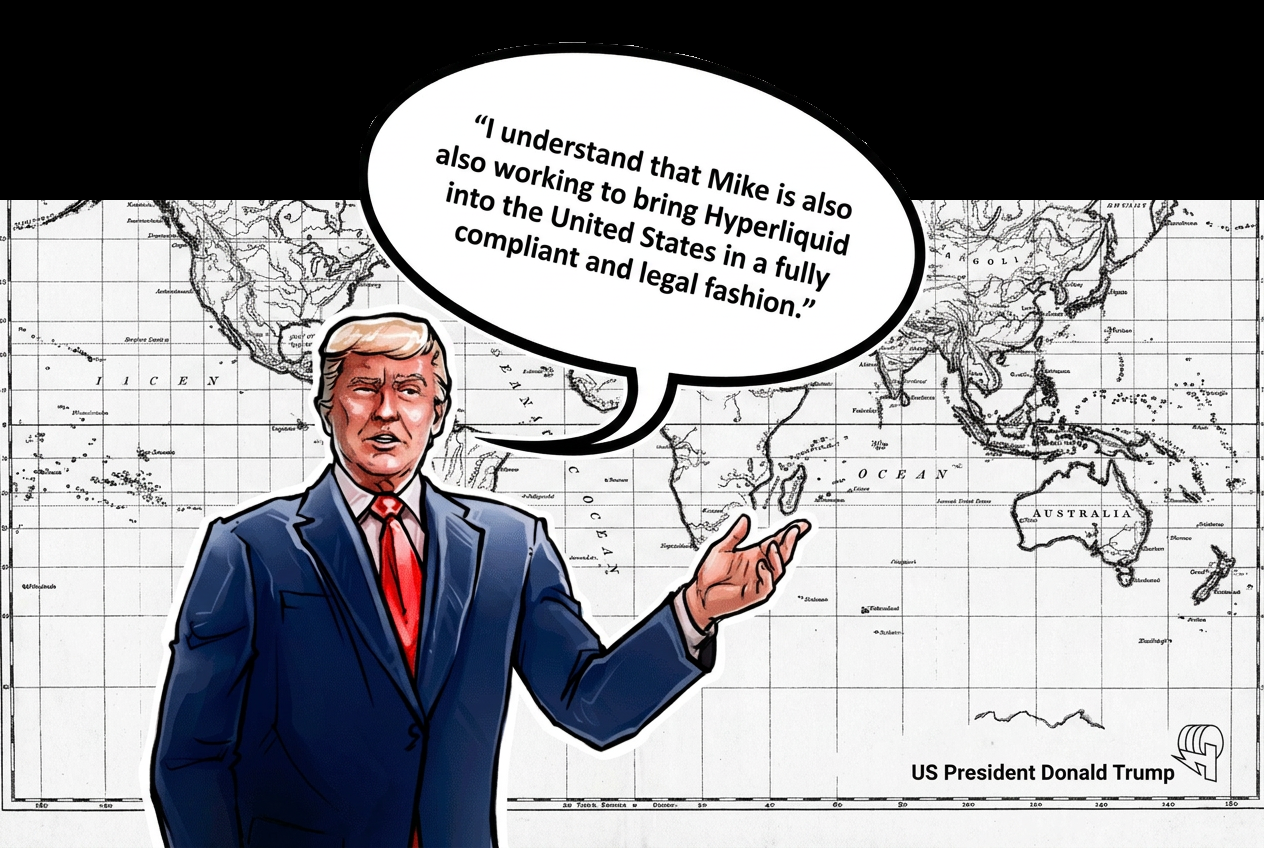
Trump also managed to goose the price of Hyperliquid by 20% at the meeting by revealing: “I understand that Mike [Selig, CFTC chair] is also working to bring Hyperliquid into the United States in a fully compliant and legal fashion.”
The US Securities and Exchange Commission (SEC) has proposed new rules for the cryptocurrency industry that could put pressure on lawmakers to pass the CLARITY Act or spark a new Initial Cryptocurrency Offering boom.
Currently open for a 60 day comment period, the rules offer exemptions to crypto projects that allow the issuance of up to $5 million in tokens during a four-year period, and up to $75 million during a 12-month period with stricter reporting and structure rules. There is also a safe harbor proposal exempting cryptocurrencies from being treated as ”investment contracts.”
Commissioner Hester M. Peirce said that a “whole generation has struggled” with the SEC’s application of, “a set of inapt rules to crypto.” She added the SEC’s new crypto guidelines mark an important step toward “putting clear, sensible, enforceable rules in place for crypto offerings.”
Michael Selig, who chairs the US Commodity Futures Trading Commission (CFTC), said the commission would move forward on crypto regulations if the CLARITY Act fails to pass the Senate. Selig said he had already directed staff to allow registered and non-registered entities to offer “crypto asset trading on a leveraged or margined basis” and explore developer protections.

“We’re going to give CLARITY its breathing room for a vote, but if the Democrats cannot support a bipartisan work product, which reflects compromises from both sides of the aisle, and ultimately send a fair version of the bill to the President’s desk, then rest assured, I will direct CFTC staff to move swiftly to propose these new rules for the industry,” said Selig.
At the end of the week, Bitcoin (BTC) is up 23.5% to trade at $77,559, Ethereum (ETH) is up 31.1% to trade at $2,456 and XRP (XRP) is up 53.3% to $1.52. The total market cap is at $2.63 trillion according to CoinMarketCap.
Among the biggest 100 cryptocurrencies, the top three altcoin winners of the week are Pump.fun (PUMP) with a 98.9% gain, Ethena (ENA) on 98.3%, and Stacks (STX) on 94.8%.
The top three altcoin losers of the week are JUST (JST) which was down 4.3%, MemeCore (M) down 2.9% and Sun (SUN) down 1%.
Bitcoin may move toward its all-time high of $126,000 before the end of the year, with the recovery potentially accelerating after Oct. 6, according to Geoff Kendrick, global head of digital asset research at Standard Chartered.
Kendrick said in a Friday note that the latest rally has been driven largely by short liquidations, while inflows into spot Bitcoin exchange-traded funds have also started to recover. He said low open interest could leave room for more investors to return as prices rise.
“For the first time this year there is now a risk my end year forecast (of USD100k) is too low,” Kendrick wrote.
A new poll conducted by Reuters/Ipsos found that a majority of respondents in the US believed it was not “appropriate” for US President Donald Trump and his family to earn billions through cryptocurrency investments while in office.
According to the results of the poll of 1,166 people between Aug. 14-17, 63% of the respondents said it wasn’t appropriate for Trump and his family to earn money from crypto. Notably, 69% of Republicans polled said it was appropriate, while an overwhelming majority of Democrats, 92%, responded negatively.
Bitget CEO Gracy Chen expects Bitcoin to remain broadly around current levels through the end of the year despite its recent surge, citing interest rates and broader macroeconomic conditions as key factors shaping the cryptocurrency’s outlook.
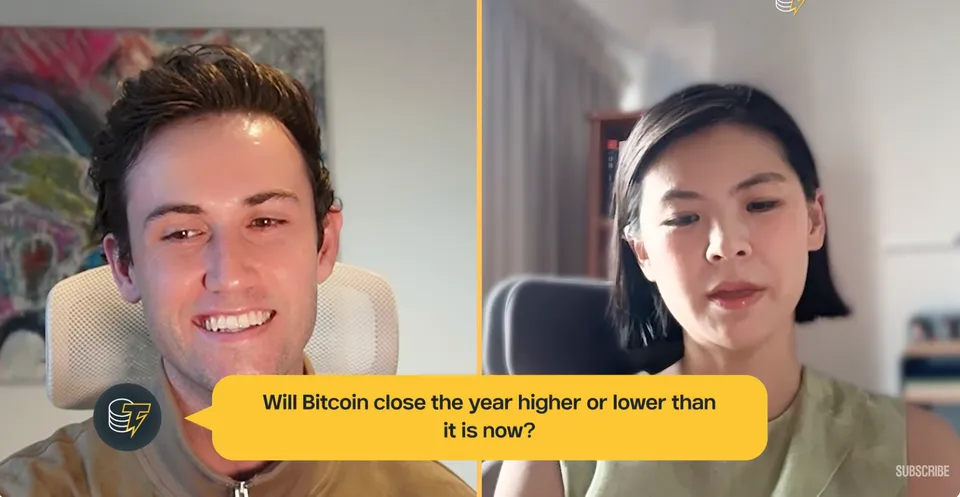
Cointelegraph host interviews Bitget CEO Gracy Chen. Source: Trade Secrets
She pointed to the possibility of higher interest rates as one of a number of factors that could pressure prices.
“If any of that happens, the price should go down, at least theoretically,” Chen said, adding that BTC has become increasingly integrated with traditional finance and sensitive to broader macroeconomic conditions.
Chen predicted that BTC could finish the year $10,000 to $20,000 above or below current levels.
MANTRA’s native token sank to an all-time low of $0.004126 around 11:00 pm UTC on Thursday shortly before MANTRA Chain stopped producing blocks and its team announced a precautionary halt over an unexplained incident.
MANTRA said Friday it was “aware of an incident affecting MANTRA Chain” and had halted the network as a precaution while it investigated. “We don’t have a root cause or timeline to share yet,” the project said, adding that all endpoints and transactions were frozen.
The halt prevents assets from moving on MANTRA Chain and has prompted affected exchanges to pause deposits and withdrawals, with no timeline given for either service to resume. On Aug. 22 MANTRA said it the “vulnerability in the Cosmos-EVM module has been fixed, the network has resumed, and no user funds were affected.”
Apate’s 200,000 fake AI ‘victims’ are so good at scam baiting, the company has a monthly KPI for how many F-bombs scammers drop at the infuriating bots.

A scam baiting bot (Source: O2)
USDT is disappearing from regulated European platforms, but there is little sign that it has resulted in weakening global demand for Tether.
Brussels is reviewing whether crypto lending should fall under MiCA, but DeFi lending vaults are making it harder to determine who, exactly, should be regulated.
Cointelegraph publishes long-form journalism, analysis and narrative reporting produced by Cointelegraph’s in-house editorial team with subject-matter expertise. All articles are edited and reviewed by Cointelegraph editors in line with our editorial standards. Some articles contain affiliate links, from which Cointelegraph may earn a commission. These relationships do not influence which products we review or our editorial conclusions. Content published in here does not constitute financial, legal or investment advice. Readers should conduct their own research and consult qualified professionals where appropriate. Cointelegraph maintains full editorial independence.
Binance, the world’s largest crypto exchange with more than 300 million registered users, on Thursday launched a platform that lets AI agents analyze markets and execute trades on users’ behalf, bringing autonomous AI directly into the business of managing real money.
Called Agent OS, the platform lets developers connect AI applications and agents to Binance’s financial infrastructure. It brings the exchange’s existing tools and services such as Binance APIs, Binance Wallet Agentic Hub, Binance x402 transaction verification and payment facilitator API, and Binance Skill Hub, along with newly introduced support for its Model Context Protocol (MCP). The platform also works with tools, including OpenAI’s ChatGPT and Codex, Anthropic’s Claude Code, and Cursor, allowing users to authorize agents to access market data, view account information, and execute trades.
However, as the AI race moves away from chatbots that answer questions to agents capable of taking action, Binance is putting much of the responsibility for keeping them in check on users, who ultimately have to decide what agents can access and trade and set limits on what they can do.
“Instead of total freedom, we put the power in users’ hands to give them the granular access control of what they can do through the agent,” said Jeff Li, vice president of product at Binance, in an interview. “We put [the control] at the account level to protect the users’ funds.”
Binance does that primarily through dedicated “subaccounts,” which users can assign to agents and configure for specific activities, such as spot or futures trading. Withdrawals from those subaccounts are blocked by default, Li told TechCrunch, creating a sandbox around an agent’s activity.
Users can also choose whether an AI agent must seek approval for every order or can execute trades autonomously once its permissions are configured, a Binance representative said. Binance does not impose a separate cap on how much an AI agent can trade or lose, so the amount a user transfers into the subaccount effectively serves as the limit.

Asked whether Binance can see what leads an agent to make a particular trade, Li said the reasoning happens outside its systems, either on the user’s computer or within their chosen AI application. “We really cannot see the reasoning of what the user’s action is,” he said.
That means Binance can monitor an agent’s resulting trading activity but has limited visibility into whether a decision was influenced by faulty information or manipulation.
Li again pointed to the subaccount as the main line of defense when asked what would happen if an agent was manipulated through a prompt-injection attack or otherwise compromised. Binance also said its existing security, risk-control, and anti-money-laundering policies for subaccount APIs apply to Agent OS at launch.
Trading is one of the first use cases Binance is targeting. Nonetheless, Li said agents could monitor markets, conduct research and risk analysis, react to signals, and autonomously place orders or execute strategies such as arbitrage.
Agent OS is also designed to connect agents to payments and on-chain activity. Through Binance’s x402 integration, agents can send and settle payments, while its Agentic Wallet allows them to interact with tokens and decentralized-finance protocols.
Unlike exchange trading, where Binance does not impose a separate cap on how much an agent can trade or lose within its subaccount, Agentic Wallet transactions carry Binance-set daily limits. Regular swaps are capped at $50,000 a day, DeFi transactions have a default $100,000 daily limit, and x402 payments are limited to $20 a day, according to the company.
Li said Agent OS was Binance’s “first step” toward giving developers a platform to build AI-powered applications that can act across crypto and traditional markets.
Binance is not alone in opening its infrastructure to AI agents. Rival crypto exchanges have been moving in the same direction, using MCP and other developer tools to give AI applications direct access to market data and trading systems.
In March, Kraken launched an open source command-line tool with a built-in MCP server that allows AI agents to execute actions, including spot and futures trades. Coinbase followed in June with Coinbase for Agents, which connects AI agents directly to users’ accounts and allows them to trade, make payments, and execute other financial workflows within user-set limits. Similarly, OKX enabled agentic trading on its platform by bringing an open source MCP toolkit earlier this year.
When you purchase through links in our articles, we may earn a small commission. This doesn’t affect our editorial independence.
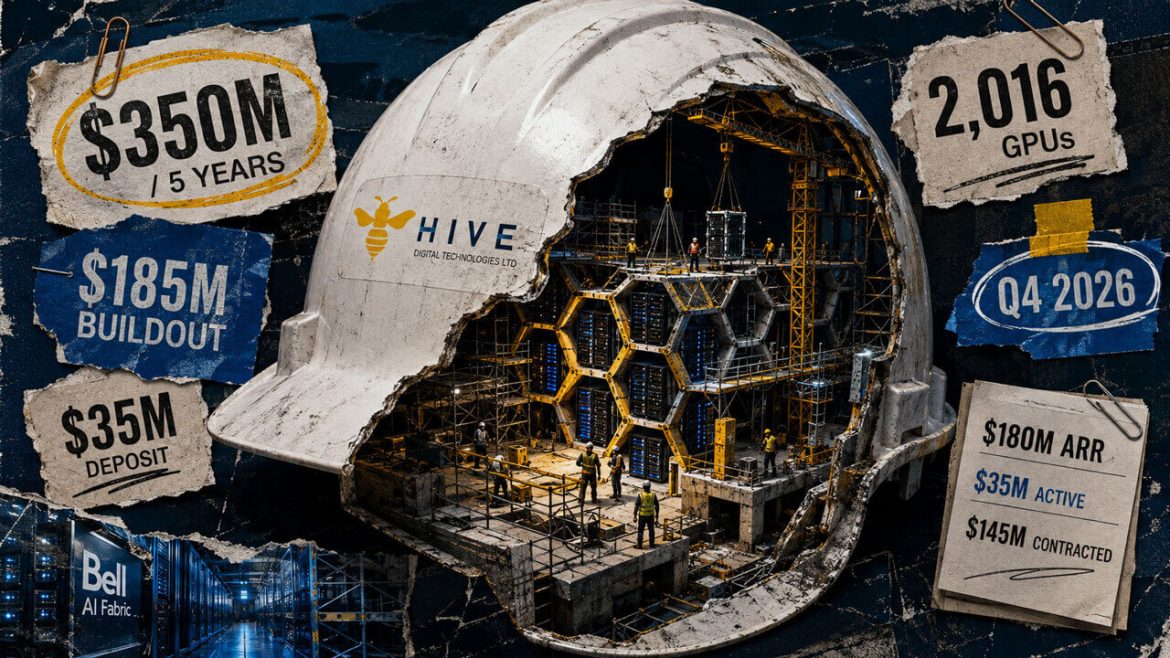
HIVE Digital Technologies’ $350 million AI cloud contract depends on a $185 million GPU buildout that must be completed in the fourth quarter before most of the revenue can begin.
The five-year agreement, signed by HIVE’s BUZZ High Performance Computing unit with an unnamed investment-grade enterprise customer, is expected to generate about $70 million in annualized revenue once the infrastructure is deployed.
BUZZ plans to install 2,016 NVIDIA Blackwell Ultra GPUs in GB300 NVL72 systems at HIVE’s Bell AI Fabric facility in Merritt, British Columbia. HIVE expects the hardware, related equipment, and service warranties to cost about $185 million, with deployment targeted for calendar Q4 2026.
The customer has agreed to provide an upfront deposit equal to roughly 10% of the contract value, or about $35 million. HIVE has not disclosed whether it has already received that payment.
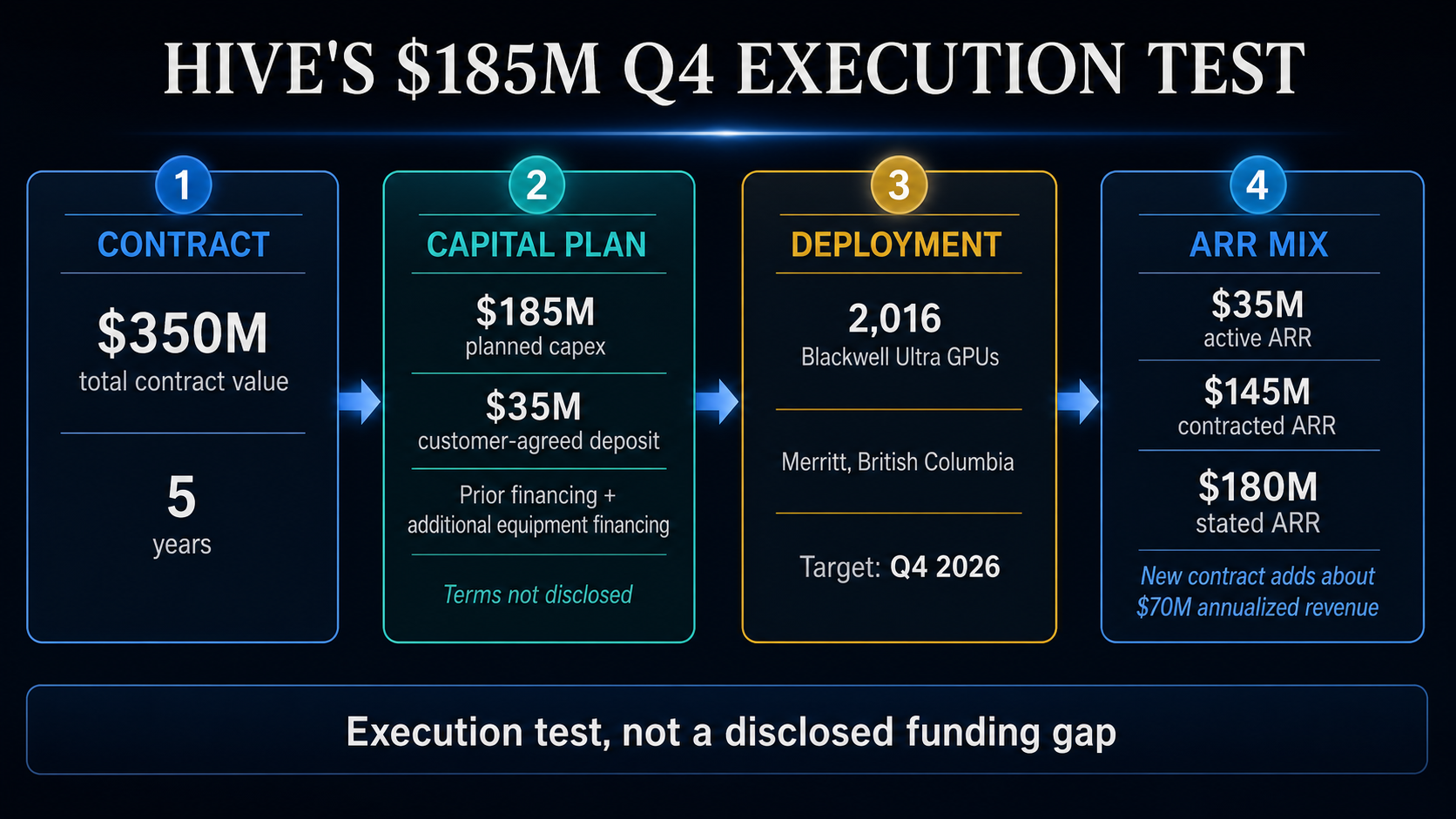
That leaves the company relying on existing financing and additional equipment funding to complete the buildout.
HIVE raised $130 million from zero-percent exchangeable senior notes in June and said it raised $245 million from zero-percent notes during the quarter. Chief Executive Officer Aydin Kilic said proceeds from the bond and debt financing would help fund the GPU purchase.
The company has not disclosed how much of those proceeds remains available for the project or the terms and closing status of additional equipment financing.
The deal lifts BUZZ’s reported annual recurring revenue to about $180 million, but only around $35 million of that is currently active.
Another $145 million is contracted and expected to come online through the fourth quarter, meaning most of HIVE’s projected AI revenue still depends on hardware delivery, installation and commissioning.
HIVE defines ARR as annualized weekly, daily or quarterly revenue rather than reported revenue and warns that projected figures may not reflect future cancellations, discounts or service reductions.
Once the new infrastructure is operating, HIVE expects its HPC and AI business to generate about $500,000 of daily revenue.
The company recently reported $208 million of cash, though it has not disclosed how much is earmarked for the GPU deployment.
The contract therefore gives HIVE a significant pipeline of committed AI demand, but the economics now depend on execution: securing the remaining financing, receiving and commissioning the GPUs on schedule, and converting contracted capacity into live revenue by year-end.

Bitcoin wallet manufacturer BitBox has told users it was able to fix “severe vulnerabilities” with its hardware wallet’s firmware, and reassured users that no funds were taken. Yet it still urged users to upgrade carefully.
Writing in a blog post Tuesday, the Swiss company said that one of the vulnerabilities would have allowed an attacker to manipulate users into installing firmware that could lead a criminal to steal funds.
Users should update firmware through the official BitBoxApp, ideally by clicking the in-app update prompt rather than searching for it, BitBox said.
“There are no reports of stolen user funds and there is no reason for users to panic,” the company said. “We recommend all users to update their BitBox devices to the latest firmware version, which fixes all security issues described in this article.”
It added that another “severe vulnerability” discovered was related to memory corruption. In its post, BitBox said the finding was related to the Multi edition of the BitBox, and could enable arbitrary code execution and the subsequent installation of malicious firmware and potential loss of funds.
BitBox also mentioned that the Bitcoin-only edition of the BitBox was not affected, as its firmware does not contain the affected code.
Bitcoiners are still reeling after users of the popular Coldcard product, designed by Canadian company Coinkite, had their funds drained due to a firmware bug in the devices that lead to a weak seed generation (RNG). Unlike the Coldcard hack, users or BitBox do not need to migrate funds, only update the firmware.
Hackers have since stolen a confirmed $115 million in bitcoin, according to Galaxy Research’s latest figures — but the figure could be much higher.
Canadian company Coinkite first warned users on July 31 that a firmware bug in Coldcard Mk3 devices — starting with version 4.0.1 in March 2021 — caused seed generation to fall back to a weak software Pseudorandom Number Generator instead of the hardware true random number generator, allowing hackers to essentially guess investor seedphrases.
The number has slowly risen as the criminals have targeted more recent devices while Coinkite and other Bitcoiners have urged Coldcard users to immediately move their funds.

James Ding
Aug 17, 2026 09:57
Tesla Tokenized Stock is coiling at $343.74 with momentum completely flatlined directly beneath a brutal resistance cluster at $345–$347; bulls have a narrow window to convert or face a high-probab…
The price action on TSLA right now is a textbook standoff at a critical inflection point. At $343.74, the stock is trading above both its 7-day and 20-day moving averages — that’s the one clean positive the bull camp can legitimately claim. But the 50-day SMA at $358.43 and the 200-day SMA at $388.44 loom overhead like an iron ceiling, and nothing in the current setup suggests bulls have the firepower to crack either level right now.
The MACD histogram has flatlined to zero. This isn’t a bullish signal — it’s a momentum vacuum, the market equivalent of a held breath before a decision. The Stochastic %K pushing into the high 70s tells you the short-term rally off the SMA 20 is running on borrowed time, not accumulating fresh energy. Meanwhile, the Bollinger Band %B reading of 0.83 places price squarely near the upper band at $352.58. Historically, that’s where momentum fades and mean-reversion gravity kicks in — the middle band at $326.45 is the magnet if bulls fail to convert. The ATR of $8.04 is the one wildcard: this is not a passive instrument. A single macro catalyst or corporate headline can erase an entire week of grinding price action in a single session. That’s the nature of trading high-beta equity exposure, even in tokenized form.
As Blockchain.news has tracked across tokenized RWA markets, the 24/7 trading nature of instruments like TSLA on Binance means risks that would normally materialize as weekend gaps in traditional equity markets become live, liquid events with real liquidation consequences. That structural reality amplifies both opportunity and risk for active traders here.
The $11.65 million in 24-hour Binance volume is respectable for a tokenized equity but falls well short of the kind of conviction number you’d want to see ahead of a genuine breakout. What’s far more diagnostic is the positioning data sitting underneath the price. The global long/short ratio is a lopsided 3.45 — 77.5% of retail positions are net long. Smart money? Even more extreme at 80.5% long with a top-trader ratio of 4.14. That level of one-sided positioning is a double-edged sword: it confirms broad bullish bias, but it also means the upside squeeze fuel is largely spent while the liquidation cascade risk on any downside break is substantial.
The taker buy/sell ratio at 0.9635 is the tell that undermines the bull narrative most directly. Real-time aggressive order flow is tilted slightly toward sellers — buyers are not hitting the ask with conviction. Pair that with open interest growing a modest 0.65% over 24 hours on a neutral funding rate of 0.002%, and you get a market that is waiting for a trigger rather than building one. There is no leveraged long pile-up screaming “squeezable” here, but there’s also no panic short positioning that screams “buy the fear.” It’s a market in deliberate, cautious suspension.
The $345.44–$347.13 resistance cluster is where this entire setup resolves. Price has repeatedly approached and retreated from this zone. Without a clean daily close above $347.13 on expanding volume, the technical read is distribution near the upper Bollinger Band, not accumulation ahead of a sustainable leg higher.
The institutional anchor on TSLA is meaningful and should not be glossed over. Zacks Investment Research carried a 6-to-12-month price target of $514 on TSLA, against a Rank 3 Hold designation. That $514 target implies roughly 49% upside from current levels — but the Hold rating is the honest signal here. Wall Street sees the long-term thesis intact but doesn’t feel urgency to add aggressively at $343. They’re not pounding the table; they’re watching.
For a tokenized equity like TSLA, the Wall Street fundamentals are the entire story — there is no on-chain utility or protocol narrative to hide behind. Tesla’s equity thesis runs on three interconnected rails: EV market share trajectory in an increasingly price-competitive global landscape, the Optimus humanoid robotics program and its commercialization timeline, and energy storage revenue growth as a margin diversifier. Any credible acceleration on FSD regulatory approvals, Optimus factory deployment at scale, or Gigafactory capacity expansion would be the catalyst that starts closing the gap between $343 and that $514 consensus target with real force.
Blockchain.news provides ongoing coverage of tokenized RWA equity markets, and the macro context here is unavoidable: TSLA as a high-multiple, high-growth equity is acutely sensitive to Fed policy. Any credible pivot signal or softer inflation print compresses the discount rate and rips this stock toward the 50-day SMA and beyond. Sticky inflation or a hawkish Fed surprise does the opposite, compressing the multiple and sending this back toward $300.
Here is how the next 7–30 days play out in probability-weighted terms, and this is not a hedge — it’s a call.
Bull Case — 35% probability, 30-day target: $358–$372. TSLA breaks through the $345.44–$347.13 resistance cluster decisively on a volume expansion session. The 50-day SMA at $358.43 is the first meaningful target, with $372 achievable if a macro tailwind materializes — think a softer CPI print, a Fed communication shift, or a concrete Optimus production update. This scenario requires a real external trigger, not just drift.
Base Case — 45% probability, 30-day target: $325–$340. Momentum stays flat. The heavily long positioning unwinds slowly as impatient traders exit near the upper Bollinger Band. Price gravitates back toward the 20-day SMA at $326.45, which has acted as reliable support in the current structure. This is not bearish — it’s a healthy reset that sets up a cleaner, more sustainable breakout attempt. The $340.77 strong support level is the key line here; a daily close above it keeps the base case intact.
Bear Case — 20% probability, 30-day target: $300–$310. Strong support at $340.77 breaks on volume. The crowded long book accelerates the move as stop-losses trigger in sequence. The lower Bollinger Band at $300.32 becomes the gravitational target. This requires either a macro shock — a surprise hawkish Fed move or a broader equity market selloff — or a company-specific negative catalyst like an earnings miss or regulatory setback on FSD or Optimus.
The $347.13 level is the binary pivot for the entire near-term thesis. Every session TSLA spends trading below it with zero MACD momentum and net-selling taker flow adds weight to the base and bear case. The bulls have the positioning advantage on paper, but positioning without follow-through price action is just a future liquidation event. Watch the close, watch the volume, and watch whether the fundamental narrative out of Detroit and Beijing — EV demand data — confirms or denies the optimism baked into that 80% long book.
For traders monitoring TSLA’s tokenized equity action around the clock, Blockchain.news remains a key resource for bridging traditional equity catalysts with on-chain market structure analysis as the RWA space matures.
Fundamental data, analyst ratings and price targets are sourced from Yahoo Finance as of August 17, 2026 and reflect consensus estimates, not investment advice.
Image source: Shutterstock

The contracts traded just 1.6% apart on average when both markets were active, and traded near $92 and $94 most recently, translating to a more than 300% upside from the IPO price.
That fourfold premium also means Unitree could have a blockbuster debut and still leave leveraged bulls nursing steep losses.
“Unitree can open at twice its IPO price and still liquidate a third of long exposure,” Allium said.
An opening around $45, double the IPO price, would still be about 52% below the current perp price and could liquidate roughly 33% of long exposure, the analysts said. At the other extreme, a $128 opening price (nearly 6x from the IPO price) could liquidate an estimated 53% of the short positions, the report said. If shares open at around where the perps trade, nothing moves, and neither side is liquidated.
Positioning on Trade.xyz, the bigger market of the two, is almost evenly split, with $6.5 million long and $6.6 million short. However, smaller traders are more bearish: bets below $50,000 are 70% short by value.
“Any open away from today’s price forces one side of this market out,” Allium said.
Read more: Hyperliquid is taking crypto perps deep into DeFi’s ‘money LEGO’ land
Bitcoin (BTC) declined into Friday’s Wall Street open as traders increasingly saw a BTC price breakdown next.
Key points:
Data from TradingView showed BTC/USD down 1.3% on the day at $62,570, near its lowest levels month-to-date.
BTC/USD four-hour chart. Source: Cointelegraph/TradingView
Despite encouraging US inflation data lifting risk assets and reducing the odds of interest-rate hikes, Bitcoin failed to follow US equities, which closed Thursday’s session at all-time highs. The S&P 500 and tech-heavy Nasdaq Composite Index were both green at the time of writing, up 0.11% and 0.14%, respectively.
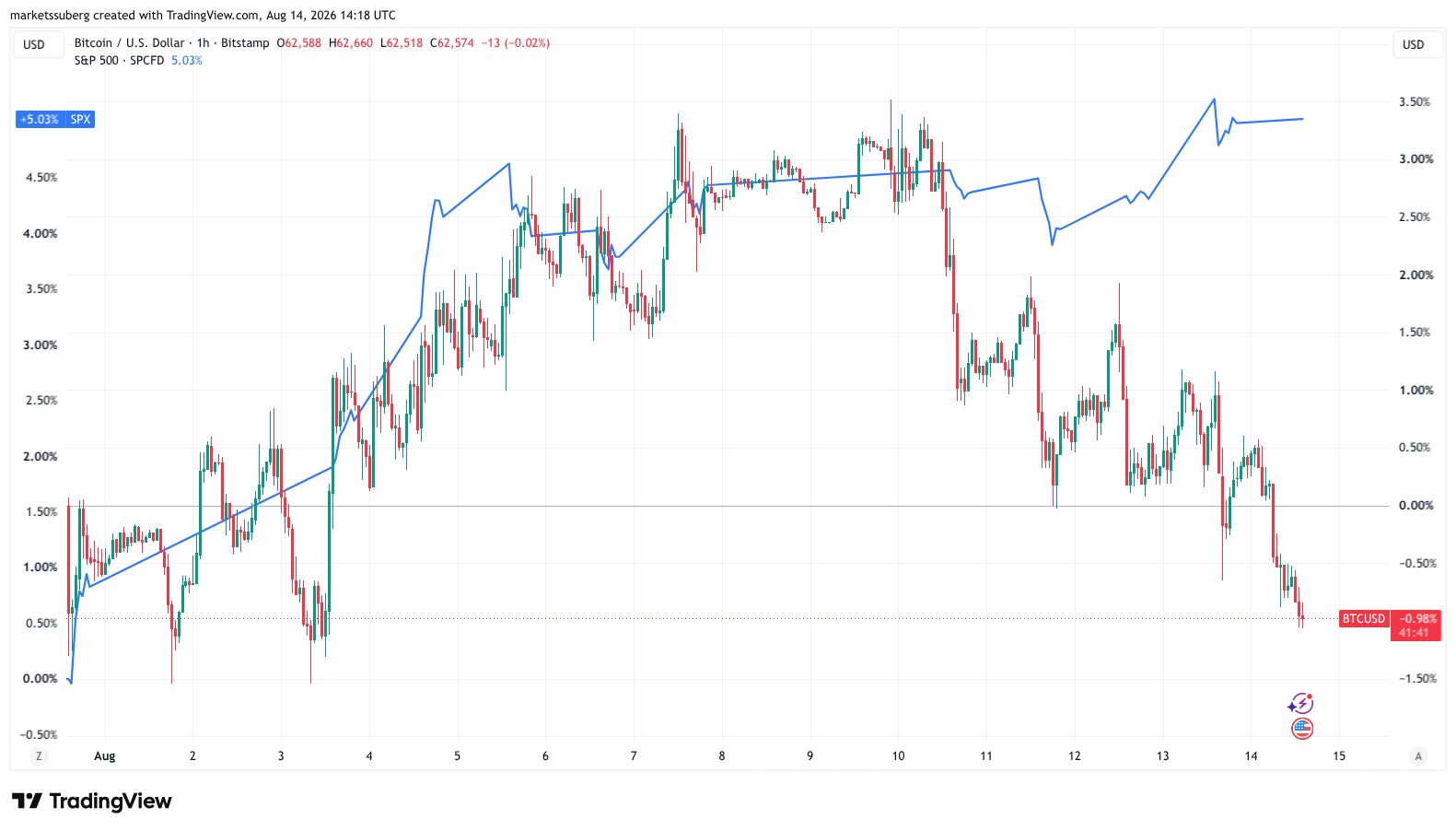
BTC/USD vs. S&P 500 one-hour chart. Source: Cointelegraph/TradingView
Commenting on Bitcoin price performance, trader and analyst Rekt Capital warned that Sunday’s weekly close needed to be above $63,220.
“A Weekly Close below the orange level would probably set price up for a breakdown,” he wrote in a post on X.
The analyst noted that $63,000 was now failing as support after weakening throughout August, having previously noted that the 50-month exponential moving average (EMA) at $65,827 was back as resistance, copying the 2022 bear market.
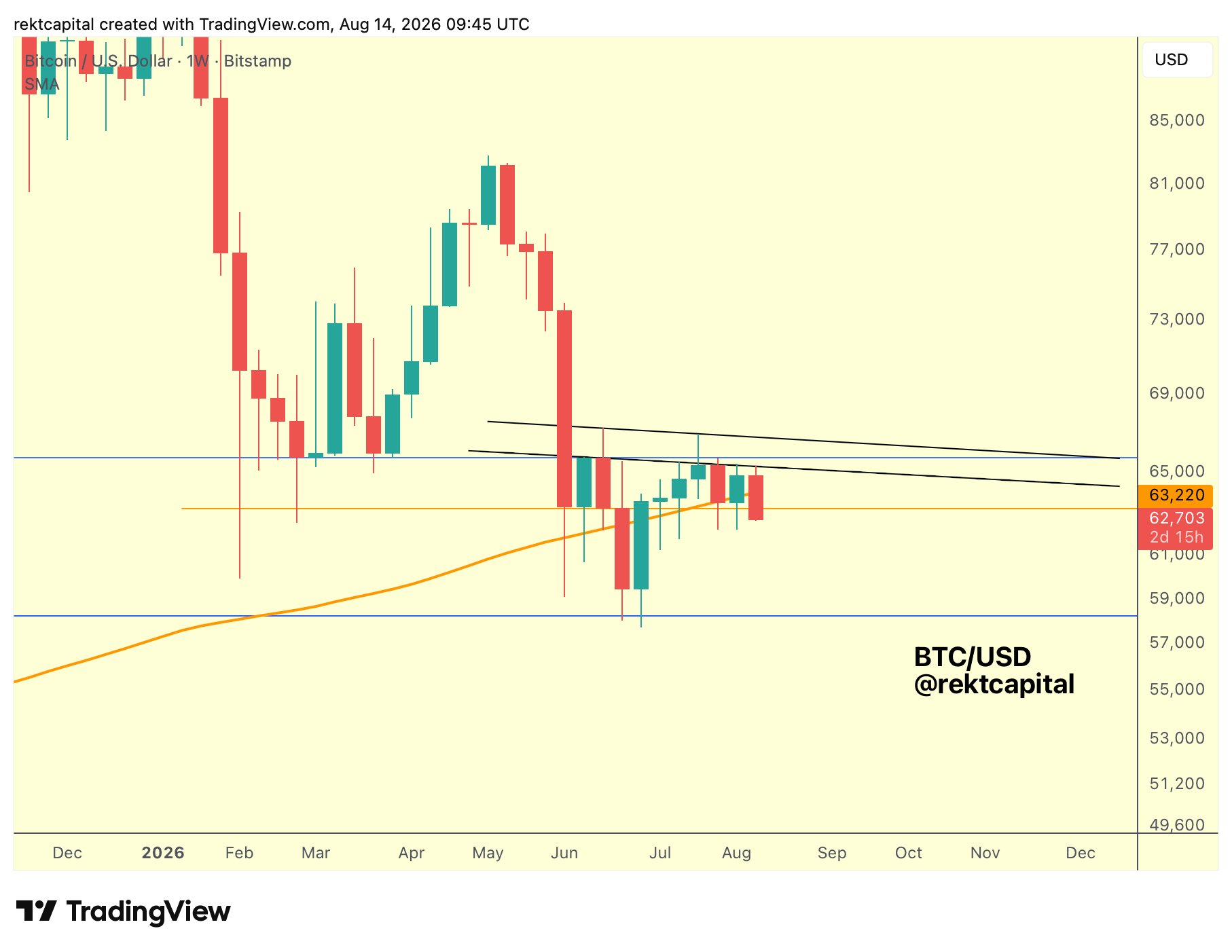
BTC/USD one-week chart. Source: Rekt Capital on X.com
Cointelegraph previously reported on increasing chances of a long liquidation event for Bitcoin as it approaches an area of liquidity around $61,000 amid growing open interest (OI) in derivatives markets.
“Traders have added substantial risk, most of it long, into a market that shows no matching demand,” onchain analytics platform Glassnode summarized in the latest edition of its regular newsletter, The Week Onchain.
In its latest analysis, trading and investment company QCP Capital drew attention to crypto markets’ refusal to rally on improving US inflation conditions — a phenomenon it described as “increasingly important.”
Related: Bitcoin speculators keep BTC price ‘pinned’ below $68.7K: Glassnode
“Last week, BTC demonstrated resilience in absorbing several negative headlines without a sustained breakdown,” it wrote, adding:
“This week has reinforced the distinction between resilience and momentum: the range remains intact, but softer inflation data have so far generated only a muted response from crypto.”
QCP added that macro traders are now focused on the Aug. 26 Personal Consumption Expenditures (PCE) index release, known as the Federal Reserve’s preferred inflation gauge. The index’s last print in July marked its first monthly decline since 2020, per data from the Bureau of Economic Analysis.
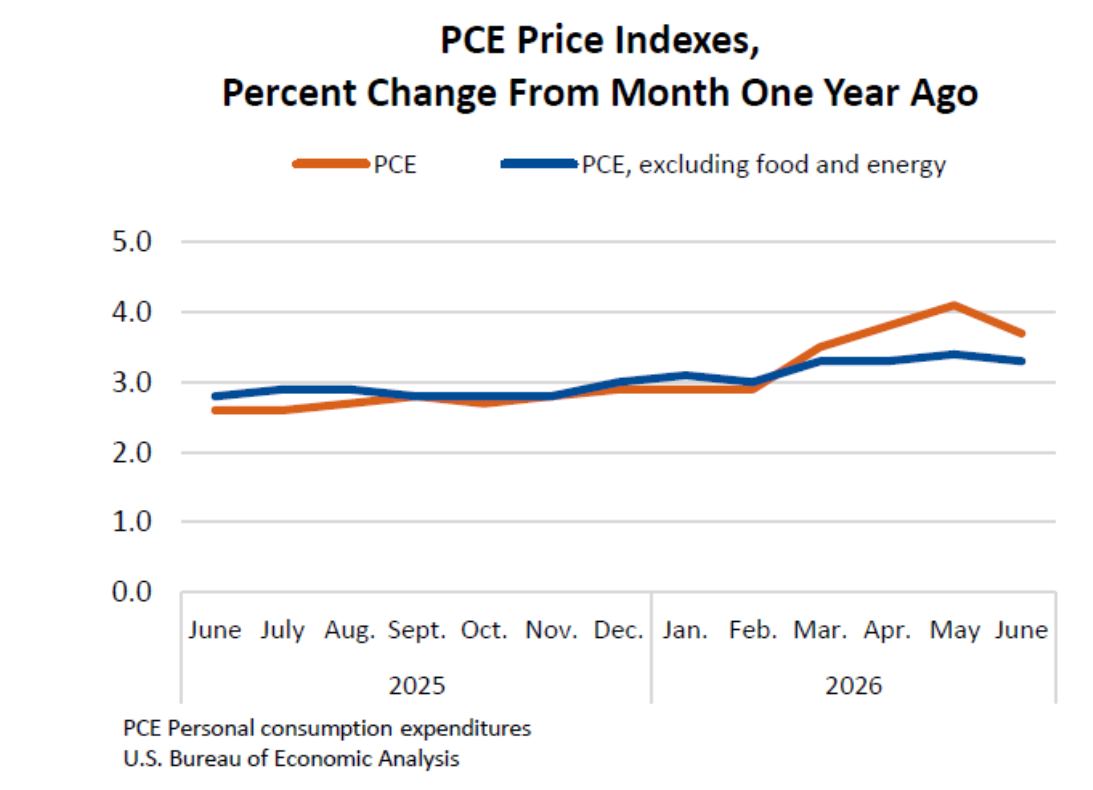
US PCE data percentage change (screenshot). Source: BEA
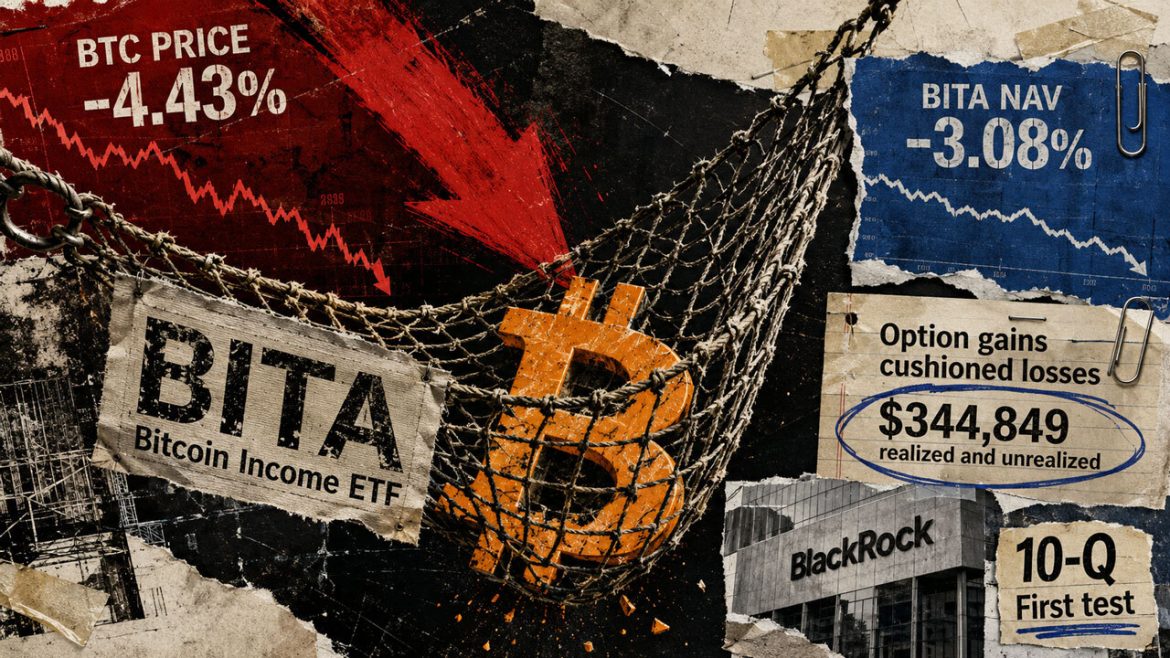
BlackRock’s iShares Bitcoin Premium Income ETF (BITA) recorded $79,073 of realized gains and $265,776 of unrealized appreciation on written options in its first operating period, helping offset losses on its Bitcoin holdings and shares of the iShares Bitcoin Trust ETF (IBIT).
BITA posted an $860,335 decrease in net assets from operations through June 30, its first quarterly filing shows. IBIT is BlackRock’s spot Bitcoin fund and one of BITA’s underlying investments.
BlackRock’s BITA recorded $782,203 of unrealized losses on Bitcoin and $417,644 on IBIT, for a combined $1,199,847. Its $344,849 of realized and unrealized option gains offset about 28.7% of those marks. A $5,337 net investment loss resulted in an overall decrease from operations of $860,335.
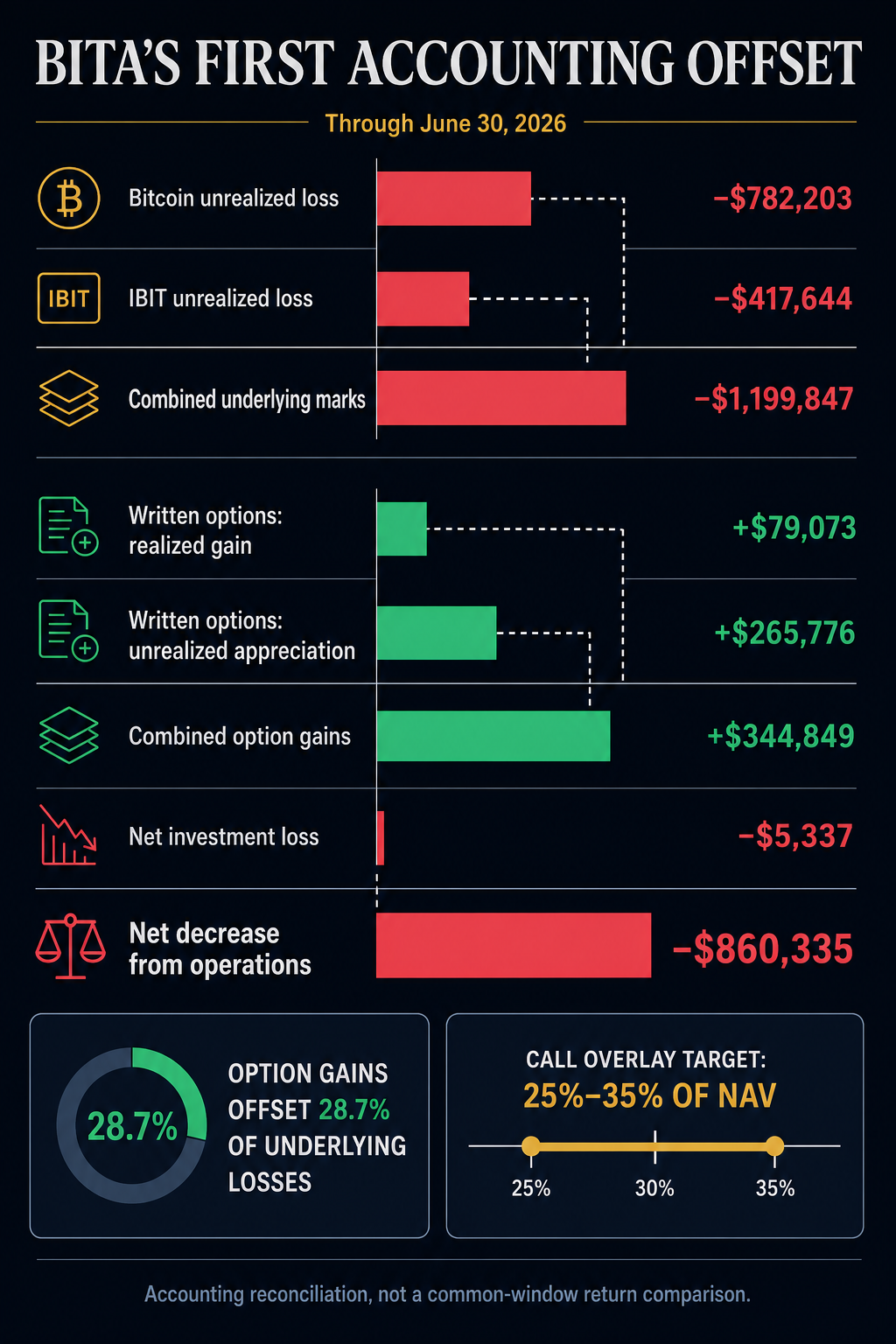
Comparative downside protection remains unmeasured because the performance figures use different windows.
BITA’s financial-statement NAV per share fell 3.08%, from $50 on the April 21 seed date to $48.46 on June 30. The filing separately says Bitcoin fell 4.43% and IBIT fell 4.75% from the fund’s initial purchases on June 9 through quarter-end.
A direct comparison requires one common start date, and the filing’s three metrics cover different periods. Its third figure is a negative 5.61% total return from the June 12 start of public trading through June 30.
The options entries show how the income strategy affected BITA’s accounts while Bitcoin and IBIT were falling. Relative performance over a common window remains unmeasured.
BITA’s prospectus targets written-call notional equal to 25% to 35% of NAV. Selling those calls produces premiums that can offset losses, and the covered holdings retain their downside exposure while surrendering gains above the options’ exercise prices.
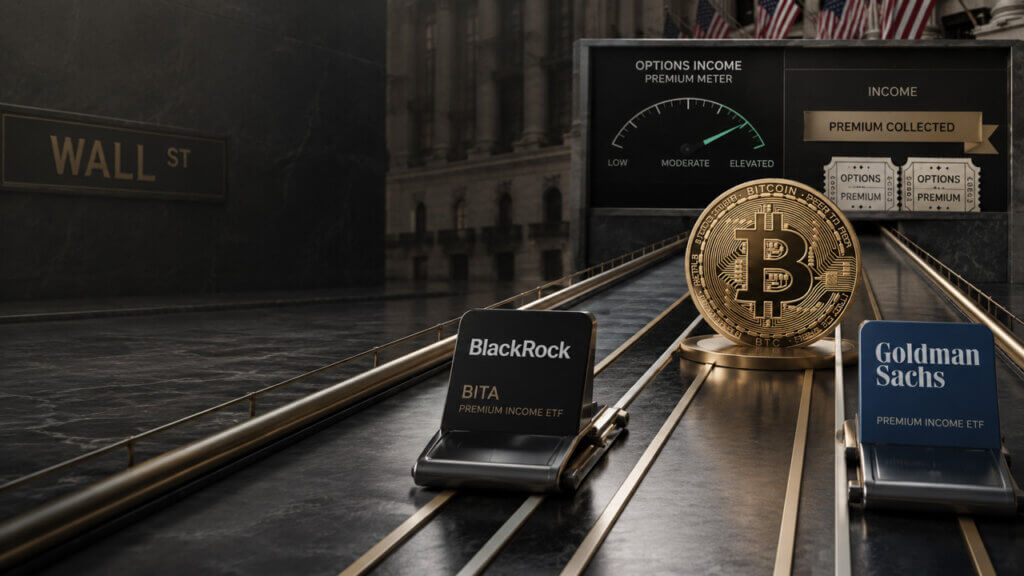
A roughly three-week record is too short to establish how that trade-off behaves through a major drawdown, a rapid rebound or a full Bitcoin market cycle.
BITA ended June with $42.6 million in net assets, but capital contributions created that scale. The fund received $43.5 million as shares rose from 2,000 to 880,000, including 198,000 additional seed shares and 680,000 created shares.

A July 1 filing declared a $457,924.72 distribution for premiums or other income received from June 9 through June 30. That was $113,075.72 more than BITA’s combined GAAP option gains.
BITA’s first period shows that option gains can absorb part of an underlying loss inside the fund. The record remains too short to tell whether that relief compensates investors for the upside they surrender.

Bitcoin infrastructure company Blockstream has announced a new feature allowing users to make trustless swaps.
Dubbed Blockstream Swaps, the idea is that Bitcoiners will be able to quickly move between the main chain and Lightning network.
It comes after non-custodial Bitcoin swap provider Boltz suspended its service after it said attackers were finding vulnerabilities faster than its team could fix using AI.
“In support of the broader Bitcoin and Liquid ecosystem, Blockstream is launching Blockstream Swaps,” Blockstream said.
“This initiative was already under development to ensure a resilient suite of utility for the ecosystem, and it complements the providers already doing this work rather than replacing any one of them.”
The idea, added Blockstream, is users can move funds across layers while never losing full control over their funds.
To use Lightning, users will not need to run a node or channel — as is normally needed with Lightning — and can simply hold a Bitcoin or LBTC balance and let a swap convert at the moment of payment.
LBTC is the native asset of the Liquid Network, a Bitcoin layer-2 sidechain created by Blockstream.
“This initiative was already under development to ensure a resilient suite of utility for the ecosystem, and it complements the providers already doing this work rather than replacing any one of them,” added Blocksteam’s announcement.
Boltz this month suspended its Bitcoin swap service. It said that a surge in AI-assisted attacks left it unable to continue operating safely.
Crypto hacks have surged, with security experts warning that cybercriminals are using AI to search for bugs in crypto projects and then take advantage of errors auditors may have missed.


