Dormant BTC activity fell to its lowest level since Q3 2022, suggesting long-term holders have slowed distribution after heavy profit-taking.

 Live Chat

Dormant BTC activity fell to its lowest level since Q3 2022, suggesting long-term holders have slowed distribution after heavy profit-taking.

World, the online verification startup co-founded by OpenAI’s Sam Altman, has raised $52.5 million through a crypto token sale to strategic investors.
Participating investors joined a 12-month lockup sale of World’s token, WLD. Lockup periods prevent asset buyers from selling or trading their tokens for a set period of time. The yearlong lockup demonstrates investors’ “long-term commitment to World’s continued growth and utility,” the company said Friday in a press release.
The money will go to the World Foundation, an exempted limited guarantee foundation based in the Cayman Islands, created to steward the expansion of World’s network.
The sale’s lead buyer is Pantera Capital, a venture capital firm focused on digital assets. Other companies involved in the sale included Eightco Holdings, Bain Capital Crypto, Susquehanna Crypto, and Selini Capital, among others.
The World project is operated by Tools for Humanity (TFH), a startup based in San Francisco and led by CEO and co-founder Alex Blania. Altman is the company’s other co-founder.
World is an unusual business that revolves around online verification and sells access to what it calls “proof of human” tools. The idea is that, as bots and AI generate much of the content online, it will become increasingly important to know who is really human and who isn’t. World’s mission is to popularize its World ID, an anonymous digital marker that verifies whether a human — not a bot or an AI agent — is behind a particular account.
To get a verified World ID (the highest level of verification within World’s system), users must have their eyes scanned by an Orb, a metallic ball that converts a user’s iris into a distinct cryptographic identifier. World’s Orbs are located at its offices and have also been deployed at partner stores around the world.
The project began as a more overtly crypto-based experiment under the name “Worldcoin” — the same name of the crypto asset involved in the recent sale. Users can trade or hold the token through World’s app, which also serves as a custodial wallet. The company later rebranded to World amidst a broader backlash against the crypto industry.
In April, the project launched a new version of its app and announced partnerships with companies, including Tinder, Zoom, and Docusign. Yet, despite its global ambitions, World has struggled to scale its business or convince consumers to care much about its mission. In June, TFH conducted a round of layoffs.
Correction July 24: An earlier version of this story incorrectly stated that World has a partnership with Ticketmaster. It does not. We regret the error.
When you purchase through links in our articles, we may earn a small commission. This doesn’t affect our editorial independence.

Bitcoin trades near $65,978, below the $69,000 level Glassnode treats as the average cost basis for short-term holders, and the Federal Reserve’s July 28-29 meeting will decide if this disconnect can be closed.
June payrolls rose by only 57,000, unemployment stayed at 4.2%, and revisions cut April and May payrolls by a combined 74,000.
Core CPI held flat month over month and slowed to 2.6% annually, giving traders grounds to expect a less restrictive Fed, with the headline reading, more exposed to energy costs, at 3.5% annually.
Brent crude futures settled around $94 this week, with an intraday high of $95.47. The 10-year Treasury yield climbed to about 4.67%, and the 30-year yield has now spent 11 consecutive sessions above 5%, its longest stretch since May.
Market pricing for a July rate increase has moved into the roughly 25% to 33% range, with one CME-based reading putting the odds at 33.7%, up from 25.7% the previous day.
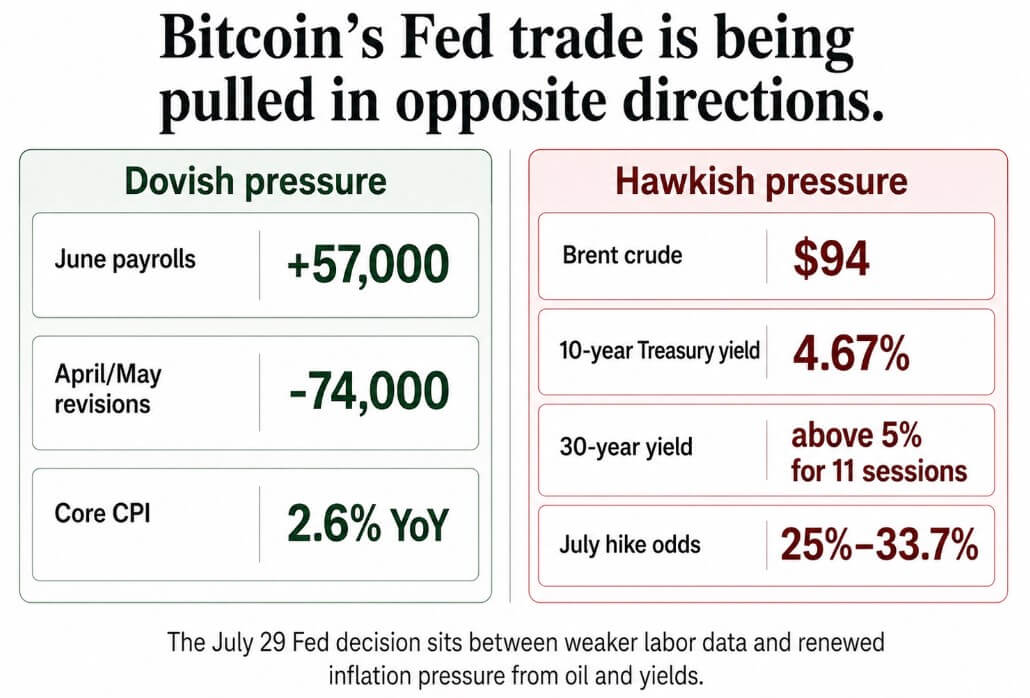
Glassnode’s on-chain data show Bitcoin has already priced the optimistic outcome for weak labor data and a fresh oil shock converging on the same Fed decision.
Short positions have closed, downside hedging has collapsed, exchange inflows have faded to multi-week lows, and Bitcoin has outperformed equities through the oil shock. Spot Bitcoin ETFs posted six straight positive sessions from July 14 through July 21, adding roughly $930.2 million and reversing a $424.7 million outflow from July 13.
Glassnode’s cohort data show wallets holding between 1,000 and 10,000 BTC, the range typical of funds and large trading desks, drive most of the recent accumulation. Mid-sized holders are distributing again, and Glassnode’s composite market gauge still reads risk-off.
A narrow set of large buyers and fresh ETF demand are carrying a rally resting on a Fed pivot that has yet to happen, keeping the current trade conditional.
If the Fed disappoints, the ETF buyers and the 1,000-10,000 BTC cohort now carrying the rebound absorb the reversal first, since broader participation from smaller holders has not returned.
| Signal | Current reading | What it says | Article implication |
|---|---|---|---|
| BTC spot price | ~$65,978 | Below short-term-holder cost basis | Rebound is not confirmed yet |
| Short-term-holder cost basis | ~$69,000 | Recent buyers still need breakout confirmation | Key test for Fed-pivot trade |
| Demand shelf | ~$63,000 | Around 10% of supply sits nearby | Main downside audit zone |
| ETF flows | +$930.2M over six positive sessions | Institutional bid has returned | Supportive, but not yet proven durable |
| July 13 ETF flow | -$424.7M | Recent outflow shock was reversed | Shows flows can turn quickly |
| Main accumulating cohort | 1,000–10,000 BTC wallets | Large holders driving the rebound | Rally remains narrow |
| Mid-sized holders | Distributing again | Broader participation is missing | Recovery lacks breadth |
| Glassnode market compass | Risk-off | Composite regime has not flipped | Rally remains conditional |
Bond yields add a constraint beneath the $69,000 area, as the 10-year Treasury yield near 4.67% and the 10-year TIPS yield near 2.36% both keep the discount rate on risk assets elevated.
Brent’s three-month timespread widened to about $9.26, the steepest backwardation since May 22, pointing to traders expecting near-term supply to stay tight.
That structure usually accompanies tighter physical markets and feeds into headline inflation expectations, the same input that pushed July hike odds higher this week.
Glassnode’s research frames Bitcoin as a dollar-liquidity asset now, pointing to a deepening inverse relationship with the dollar. The firm set a 10-year yield ceiling near 4.45% and a dollar ceiling near 99 as thresholds for risk assets in its prior report.
The 10-year yield sits at 4.67%, and the dollar index reads about 101.14.
In the bull case, the Fed holds rates and frames labor weakness as the dominant risk. Brent cools toward the EIA’s July forecast of $74 for the third quarter, and the 10-year yield retreats below the 4.45% ceiling Glassnode flagged as decisive.
ETF inflows persist, exchange inflows stay low, and accumulation broadens past whale wallets, carrying Bitcoin through $69,000 into the $84,000 zone Glassnode identifies as the next open range.
In the bear case, the Fed holds rates and leaves room for a later hike if oil stays elevated. Brent holds near $94, the 30-year yield stays above 5%, and real yields keep the cost of holding a non-yielding asset high.
ETF inflows fade or reverse, exchange inflows pick back up, and $69,000 rejects. Bitcoin would probably retest the $63,000 shelf, where about 10% of supply sits.
| Scenario | Fed/oil/yield trigger | On-chain confirmation | BTC zone to watch | Meaning |
|---|---|---|---|---|
| Bull case | Fed prioritizes labor weakness; Brent cools toward EIA’s $74 Q3 forecast; 10-year yield falls below 4.45% | ETF inflows persist, exchange inflows stay low, accumulation broadens beyond whales | $69,000 → $84,000 | Bitcoin’s rebound becomes a real liquidity trade |
| Bear case | Fed stays hawkish because oil remains near $94; 30-year yield remains above 5%; real yields stay elevated | ETF inflows fade, exchange inflows rise, whale-led accumulation fails to broaden | $69,000 rejection → $63,000 | Rally looks like a tactical Fed-pivot wager |
| Failure point | Bond market rejects the dovish interpretation | $63,000 shelf breaks or absorbs heavy supply | Below $63,000 | Institutional bid fails its first major stress test |
The EIA’s July outlook expects Brent to average $74 a barrel in the third quarter and $65 in 2027, a full $20 to $30 below the current price.
The IMF’s July update projected 3.0% global growth for 2026, and that projection assumed the Strait of Hormuz reopens by mid-July and normalizes by March 2027, with oil averaging about $89 across the year, an assumption spot Brent has already broken.
The Fed’s July 29 decision will decide whether the ETF buyers and large wallets now carrying Bitcoin’s rebound represent a genuine return of institutional demand or a short-lived bet on a dovish outcome, and a reclaim of $69,000 with broader participation confirms the first read.
Should Bitcoin reject the $69,000 and drop back toward the $63,000 shelf once shorts, hedges, and sellers have already cleared out, the on-chain data will show that the bond market is still pricing in inflation risk and subdued crypto-native demand.
That shelf, holding about 10% of supply, becomes the market’s audit of whether the new institutional bid is durable or just a tactical wager on July 29.
The White House is pushing Senate Democrats to accept a conflict-of-interest agreement that President Donald Trump worked out with Republicans, a move that negotiators hope will settle the last major dispute in the Digital Asset Market Clarity Act.
A White House official, who spoke on the condition of anonymity, told CoinDesk that Trump “has agreed to the most comprehensive and wide-ranging ethics provision in history.”
No details have emerged on what crypto restrictions Trump has consented to, and Democrats have been kept out of the loop on the provision.
The ethics section would restrict senior government officials from personal business ties to the crypto industry, including Trump, whose family holdings have generated more than $2 billion in new wealth since he returned to office, according to Reuters. Release of the final draft has stalled for several days as negotiators work through the language.
Democratic lawmakers have not received a briefing on the concession, though Republicans and the crypto industry have begun a sales campaign that casts Democrats as the obstacle.
“If Senate Democrats block this historic legislation after the administration has bent over backward to accommodate their concerns, stakeholders should make no mistake: It is the Democrats who are blocking this legislation because they were never serious about a legislative outcome,” the White House official said.
Treasury Secretary Scott Bessent has added his voice to the push, saying that lawmakers stood at the “1-yard line” on the Clarity Act and urging Congress to pass the bill before the recess.
Democratic negotiators such as Senators Kirsten Gillibrand, Ruben Gallego and Angela Alsobrooks have not seen details of the agreement with Trump, who met with Republican senators at the White House last week.
Many of the Democrats have drawn a line that the ethics provision needs to be strong. Trump has pressed the Senate to pass the Clarity Act, and his disclosure that he made more than $1 billion from crypto in 2025 has given critics fresh ammunition.
The Clarity Act’s text cleared the Senate Banking Committee in a 15-9 vote, with Gallego and Alsobrooks joining Republicans to advance it.
Both said in May they would not back the final passage without an ethics provision. During the committee markup, an amendment from Senator Chris Van Hollen to bar the president, vice president and members of Congress from crypto business ties failed 11-13.
The industry expects full circulation of the legislative text this week, according to CoinDesk.
The Senate has fewer than three weeks to finish the bill and clear a floor vote before Majority Leader John Thune’s August 7 deadline, when lawmakers break for their reelection campaigns and enter a narrow stretch to finish the bill.
Galaxy Research puts the odds of passage at 50-50.

Joerg Hiller
Jul 20, 2026 06:33
A macro roundup said Andy Burnham is set to enter Downing Street as the U.K.’s new prime minister as North Sea oil policy debate heats up.
Polymarket traders are leaning harder toward “0 Fed rate cuts in 2026,” with the leading ladder strike priced at 84.55% (up 2.45pp) on $44.24M in volume. The move comes as a broad macro-news cycle pushed oil and risk headlines, and this market’s per-strike pricing shows how little probability traders assign to multiple cuts.
A macro roundup said Andy Burnham is set to enter Downing Street as the U.K.’s new prime minister, with debate around North Sea oil policy. It also said crude prices were higher after intensified U.S.-Iran attacks and reported U.S. military casualties, alongside broader conflict updates and separate corporate and sports items.
This is a ladder (price_ladder) market: each strike is its own Yes/No contract on the number of 2026 Fed cuts, so the 84.55% “Yes” on 0 (0 bps) is not “the” market price, it is the implied chance that 2026 ends with zero cuts (No 15.45%). The rest of the ladder is heavily compressed: 1 cut is priced at 11.50% Yes / 88.50% No, while 2 cuts is 2.25% Yes / 97.75% No, signaling traders see very limited tail risk of an easing cycle. The day-over-day tape supports a consensus move rather than a one-off blip: historical_summary shows +2.4pp over both 24h and 7d, “consensus: strengthening,” with moderate volatility and reversal_detected flagged—consistent with chop earlier and then renewed confidence in the zero-cuts outcome. With $44.24M in matched volume, the market is effectively saying that even after headline-driven macro noise, the modal path remains no easing through the 2026 calendar year, with only small probability mass allocated beyond one cut.
Watch whether the ladder starts allocating meaningfully more probability to the 1-cut (25 bps) strike versus 0-cuts, since that is the closest “alternative path” and would be the first place a shift in easing expectations should show up ahead of the 2026-12-31 resolution.
Beyond the year-ahead ladder, traders often cross-check shorter-dated rate expectations and big non-macro headlines to see where sentiment is firming or cracking. On Polymarket, “Fed Decision in July?” is currently led by 93.35% on “No change” on $72.85M volume, while “Fed Decision in September?” has “No change” at 58.5% on $3.72M—useful waypoints for how the path to year-end pricing is being sketched meeting by meeting. And for a very different kind of momentum read, “Ballon d’Or Winner 2026” has Harry Kane leading at 39.2% on $10.72M, a reminder that the platform’s most-watched contracts can swing on entirely different catalysts than macro prints.
| Window | Change (pp) |
|---|---|
| 24h | +2.4 |
| 7d | +2.4 |
Top strike rungs
| Strike | Yes | No |
|---|---|---|
| 0 (0 bps) | 84.5% | 15.4% |
| 1 (25 bps) | 11.5% | 88.5% |
| 2 (50 bps) | 2.2% | 97.8% |
| 3 (75 bps) | 1.1% | 99.0% |
+9 more strikes not shown
Image source: Shutterstock
Dollar-linked stablecoins already account for roughly 90% of crypto transaction volume in Brazil, most of it used for payments and settlement, according to tax authority data.
Brazil processes between $6 billion and $8 billion in crypto each month, much of it using dollar-denominated stablecoins instead of the country’s own currency.
However, even as dollar stablecoins have proliferated, Brazil’s central bank has moved to limit their role in regulated cross-border payments. Resolution 561, effective October 1, is set to bar payment firms from settling cross-border payments in stablecoins or other crypto, closing a back-end channel that had routed reais through dollar tokens. The central bank has cast stablecoins as a threat to monetary sovereignty, tax enforcement and anti-money laundering controls.
Pix now faces pressure from both sides after Washington named it a trade barrier, while Brazilian regulators shield it from growing competition from dollar-backed stablecoins.
Pix, however, may not be competing with stablecoins.
“In practice, they are complementary,” Rodrigo Caggiano, founder of Brazilian real-world asset monitoring platform RWA Monitor, told CoinDesk. “Pix has addressed domestic instant payments well, while stablecoins expand what is possible by operating on blockchain networks.”
U.S. pressure is likely to accelerate Brazil’s regulatory debate on stablecoins and digital financial infrastructure, Caggiano said, as the central bank builds its own tokenized-settlement system, Drex, on similar programmable rails.

Trump Media, the company that operates the Truth Social network, said Thursday it was launching a new paid-for API that gives Wall Street firms “the fastest” access to posts from the most influential Truth Social accounts, including US President Donald Trump.
The API is targeted to be available to institutional customers from Aug. 1, 2026, and is aimed at high-frequency and algorithmic trading firms that require a low-latency, machine-readable feed, said the company on Thursday.
“Markets already move on Truth Social posts,” said Kevin McGurn, interim CEO of TMTG in a statement. “Truth API delivers a direct, licensed, real-time feed of the platform’s most market-moving Truths while advancing our strategy to monetize proprietary assets through a high-margin, recurring revenue stream.”
Posts from Trump’s Truth Social account have moved markets, with the most recent examples being his posts relating to the ongoing conflict between Iran and the US. Other major accounts on Truth Social include Donald Trump Jr, Eric Trump and FBI Director Kash Patel.
“Companies have previously tried to scrape data from Truth Social, which is in violation of its terms of service,” McGurn said, according to CNN.
“We’re going to create a lot of friction for those folks that aren’t coming to us directly,” he added.

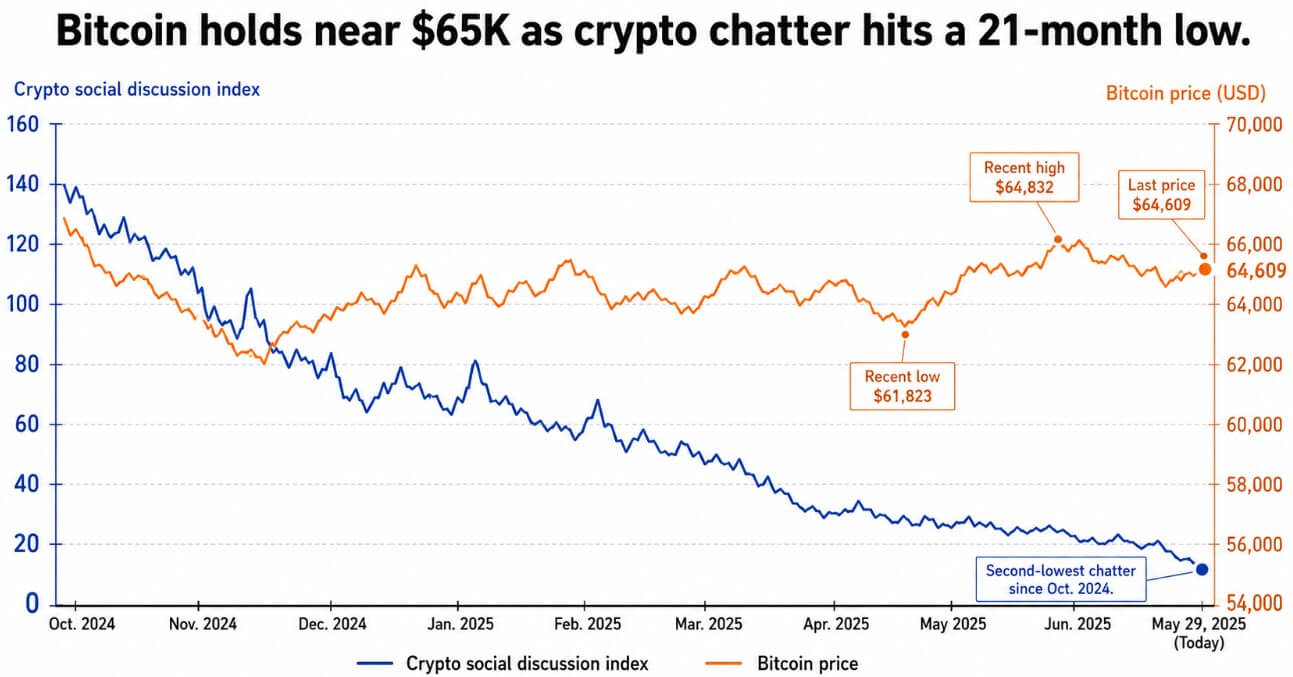
Crypto discussion across X, Reddit, Telegram, and other major social channels has fallen to its second-lowest daily level since October 2024, according to Santiment.
Bitcoin holds near $64,609 through that same stretch, with an intraday high of $64,832 and a low of $61,823 in recent sessions.
That combination usually reads as a setup in which retail traders stop chasing every price move, making positioning less crowded and allowing larger investors to accumulate before public attention returns, at least in theory.
CryptoQuant found that wallets holding 100 to 1,000 BTC distributed roughly 67,000 BTC on July 13, the cohort’s strongest selling activity since February.
At current prices, that comes to about $4.3 billion moving out of those wallets in a single day, equal to roughly 0.33% of Bitcoin’s circulating supply of nearly 20 million BTC.
A separate CryptoQuant analysis points out that newer whale wallets have continued accumulating, with supply rotating away from older whale cohorts toward these newer ones.
That split describes a redistribution of Bitcoin’s supply between large-holder cohorts, two groups making different bets on the same asset at the same moment.
| Cohort / signal | Recent behavior | Scale | Market read |
|---|---|---|---|
| 100–1,000 BTC wallets | Distributed BTC on July 13 | ~67,000 BTC / ~$4.3B | Major holder cohort used the rebound to reduce exposure |
| Newer whale wallets | Continued accumulating | Not specified in article | Suggests supply is rotating to newer large holders |
| Circulating supply comparison | 67,000 BTC versus nearly 20M BTC supply | ~0.33% of supply | Large enough to matter as a flow signal, not enough alone to define the market |
| Core implication | Whale behavior is divided | N/A | Bitcoin is undergoing redistribution, not uniform accumulation |
Santiment frames extremely low levels of discussion as a form of market quiet that can precede turning points, the logic being that a less crowded trade leaves more room for a modest move in demand to push price further.
The firm pairs this with its caution about macro uncertainty, ETF flow swings, and a still-cautious risk appetite that is working against Bitcoin.
Low attention becomes a genuine marker only if the wallets buying during the quiet stretch are absorbing the supply the crowd left behind, the question the CryptoQuant split leaves open.
Farside Investors’ data shows US-traded spot Bitcoin ETFs pulled in about $197.4 million over the July 6-10 week, a positive stretch that reversed hard on July 13, with roughly $424.7 million in net outflows that day.
Glassnode’s tracking puts 30-day ETF net flows in negative territory, with daily trading volume running $650 million to $950 million, about 80% below the October 2025 peak.
Measured against the $4.3 billion the 100-to-1,000 BTC cohort moved in a single day, that week’s entire ETF inflow was roughly 22 times smaller.
Institutional demand has shown signs of life, at a scale still well short of what’s needed to absorb the volume that large holders are distributing.
Bitcoin has spent about five months below both the short-term holder cost basis near $72,200 and the True Market Mean near $76,600, the two levels Glassnode uses to define a completed recovery.
Long-term holder realized losses peaked near $280 million a day, the highest since December 2022, evidence of how far capitulation has already run, with the pace still too hot to call the process finished.
The Fed held its target range at 3.50% to 3.75% at its June 17 meeting, and June CPI cooled to 3.5% year over year from 4.2% in May, easing some of the strain that had weighed on risk assets.
Glassnode’s report also flags oil shocks and risk-off behavior as live threats, noting Bitcoin has recently traded in close step with broader risk assets, behaving as one more risk asset among many.
US M2 supply has risen to a record $22.8 trillion. In comparison, the Fed’s balance sheet sits roughly $2 trillion below its 2023 peak, leaving Bitcoin caught between expanding broad liquidity and a still-restrictive real-yield environment.
If new-whale accumulation persists, distribution from the 100-to-1,000 BTC cohort cools, and ETF flows turn positive for several consecutive weeks, Bitcoin has a path toward reclaiming both the $72,200 cost basis and the $76,600 True Market Mean.
That is a territory which Citi’s July forecast treats as an $82,000 base case with real room to run beyond it.
| Path | What needs to happen | Key BTC levels | Forecast context | Interpretation |
|---|---|---|---|---|
| Bullish repair | New-whale accumulation persists, 100–1,000 BTC distribution cools, ETF flows turn positive for several weeks. | Reclaim $72,200, then $76,600 | Citi base case: $82,000 | The silence was accumulation before attention returned |
| Incomplete rebound | BTC holds low-$60Ks, but ETF flows remain choppy, and whale cohorts stay divided | Fails below $72,200 | Range-bound recovery | Market is bottom-building but not confirmed |
| Bearish failure | Distribution continues; ETF flows revert to negative; LTH capitulation remains elevated. | Lose low-$60Ks | Citi bear case: $53,000 | Low chatter was not contrarian; it reflected weak demand |
If that distribution continues, ETF flows revert to negative again, and long-term holder capitulation stays elevated, Bitcoin risks losing the low-$60,000s entirely.
Citi’s July revision, which cut its 12-month target to $82,000 from $112,000, citing weak investor appetite and stalled US crypto legislation, puts its bear case at $53,000 under those recessionary conditions.
What happens next comes down to whether the wallets accumulating during the silence can absorb the supply still leaving the hands of holders choosing to exit before that bottom gets confirmed.

Bitcoin closed the second quarter of 2026 mired in its deepest and longest downturn since the last bear market, according to Bitwise Asset Management’s newly released Q3 2026 Crypto Market Review.
Yet the $9 billion crypto asset manager frames the pain as a setup rather than a collapse, arguing the industry has never been sturdier beneath the surface.
Bitcoin fell 13.4% in Q2 and is down 32.9% for the year, dropping below $60,000 in June for the first time since 2024 and landing roughly 52% under its October peak of $126,080. That extends what Bitwise calls “crypto winter” to nine months and marks the third straight quarter of negative returns for the broader Bitwise 10 Large Cap Crypto Index, its longest losing streak since 2022.
Chief Investment Officer Matt Hougan does not sugarcoat it, writing that “the vibes in crypto are among the worst I’ve seen in my eight years in this industry.”
Even so, bitcoin held up far better than most of its peers. Its 32.9% year-to-date decline was the shallowest drawdown among major large-cap tokens, easily beating Ethereum’s 46.9% slide, Solana’s 40.6% and Cardano’s 56.5%.
Bitcoin now commands a 64.2% share of the roughly $1.88 trillion total crypto market and carries a 77.4% weight inside the Bitwise 10 index, cementing its status as the sector’s relative safe haven even in a broad selloff.
The quarter’s most jarring statistic came from the exchange-traded product complex that has anchored bitcoin’s institutional era. U.S. spot bitcoin ETPs bled $4.9 billion in Q2, their worst quarter since launching in January 2024, according to Bitwise.
Assets under management still stand at $72.4 billion, with $53.4 billion in cumulative net flows since inception, but the reversal underscored how quickly professional sentiment can sour.
Filings show investment advisors hold about 43% of professionally owned ETP shares and hedge fund managers another 28%, with Jane Street ($1.8 billion) and Millennium ($1.0 billion) the largest reported holders.
Structural demand nonetheless continued to outstrip new issuance. Bitwise noted in their report that spot ETPs and public companies have together bought roughly 3.6 times the bitcoin mined since the ETFs debuted — about 1.55 million BTC of demand against just 455,416 BTC of new supply.
Public-company bitcoin treasuries grew to 1.28 million BTC, up 11.3% quarter over quarter and equal to 6.11% of the 21 million cap, even as the number of firms holding bitcoin slipped by three to 184. Companies added 130,467 BTC in Q2. Strategy remains the runaway leader at 846,842 BTC, trailed by XXI (43,514), Metaplanet (40,177), MARA Holdings (35,303) and Bitcoin Standard Treasury Company (30,021).
The most symbolically loaded move belonged to Strategy, which sold bitcoin for the first time since 2022 — offloading $218 million late in the quarter to fund dividend obligations while keeping holdings valued at $52.3 billion and a $2.55 billion cash reserve. Falling prices punished the equity harshly: Strategy’s stock (MSTR) dropped 30.3% in Q2 and 42.8% year to date, making it one of the worst performers among crypto equities.
The report also touched on several developments that are reshaping bitcoin’s market plumbing. The CFTC approved the first bitcoin perpetual futures at a U.S.-regulated exchange, Kalshi, pulling crypto’s dominant derivative onshore.
Charles Schwab launched retail spot BTC trading, and E*Trade extended access to its 8.6 million users. On the regulatory front, the market-structure CLARITY Act stalled in the Senate over ethics provisions, with prediction markets pricing its 2026 passage odds at just around 20%, down from 75% in May.
Bitwise argues that if CLARITY passes it would likely mark the bottom, and if it fails the industry keeps building under friendly regulators.
Hougan’s core argument is one of cycle-over-cycle progress. Bitcoin’s seasonality data offers modest near-term hope, with July historically averaging a 10.7% gain.
And the firm’s portfolio work still shows a 5% bitcoin allocation adding to a traditional 60/40 mix in 100% of three-year rolling windows since 2014.
“The market is quoting bear-market prices on an industry that is twice the size it was at the last cycle’s bottom,” Hougan writes — a foundation, he says, that “determines what grows in the spring.”
Bitcoin is trading below $62,000 today.

Jessie A Ellis
Jul 12, 2026 08:28
Ukraine’s General Staff said it struck Russia’s Syzran oil refinery in Samara and hit Sea of Azov maritime targets, with fires reported and damage under assessment.
Polymarket traders are still pricing United Russia (ER) as the most likely winner in the “most seats” Russian parliamentary election market, but the leader’s implied probability has drifted down to 53.5% on $15.20M volume. The move comes alongside fresh reporting on Ukrainian strikes on Russian energy and maritime logistics, offering a read on how quickly prediction pricing absorbs geopolitical catalysts.
Ukraine’s General Staff reported strikes on Russia’s Syzran oil refinery in Samara, plus maritime targets in the Sea of Azov including 10 tankers and four ferries, with explosions and fires noted at the refinery and damage still being assessed. The report also referenced a strike on a fuel train near Tokmak and damage to an oil processing unit at the NOVATEK-Ust-Luga complex. Russian officials were cited as not officially commenting on the refinery attack, while a regional governor described separate drone activity affecting a tanker and said air defenses intercepted drones.
This Polymarket contract is a multi-outcome “most seats” market: each listed party is effectively a separate Yes/No bet on whether that party ends up with the most seats at resolution, so the leader being 53.5% does not mean certainty—just that ER is priced as the single most likely winner. At the current snapshot, United Russia (ER) sits at Yes 53.5% / No 46.5%, while New People (NL) is the main alternative at Yes 40.2% / No 59.8%; the rest are long-shots such as LDPR at Yes 4.3% / No 95.7% and KPRF at Yes 2.05% / No 97.95%. The leader’s price is down 2.0 percentage points versus the prior reading (55.5% to 53.5%) on $15,202,957 in volume, which looks more like mild de-risking than a decisive rotation into another outcome. The historical summary flags a bearish, moderately volatile tape with reversal_detected=true, and the latest odds sitting below the recent average (53.5% vs avg_last_5 of 57.9) suggests near-term uncertainty has widened even though consensus is described as stable. Because the market stays continuously tradable into 2026-09-20, it can incorporate catalysts quickly, but the pricing here implies traders are assigning only a modest marginal impact to the latest developments rather than repricing the whole outcome tree.
Watch whether the ER–NL gap keeps narrowing (a structural shift) or snaps back toward the recent average (a short-term reversal), and monitor if volume accelerates as new election-specific signals emerge closer to the 2026-09-20 resolution date.
Zooming out from this election tape, Polymarket’s broader dashboard shows how traders stitch political risk to macro and crypto-sensitive chokepoints via parallel contracts. In “Next leader out of power before 2027? (No Orban),” the market is heavily skewed at 97.9% on $64.21M volume, while the shipping-risk complex has stayed lopsided too, with “Strait of Hormuz traffic returns to normal by July 31?” at 95.5% and “Strait of Hormuz traffic returns to normal by August 31?” at 81.5%. The longer-horizon escalation bet “Will the U.S. invade Iran before 2027?” is priced at 83.0%, and the date-specific “Iran military action against a gulf state on…?” is led by “July 12” at 77.0%—a reminder that flows often migrate across timelines and contract types as traders try to express the same underlying uncertainty in different ways.
| Window | Change (pp) |
|---|---|
| 24h | -2.0 |
| 7d | -2.0 |
Top strike rungs
| Strike | Yes | No |
|---|---|---|
| United Russia (ER) | 53.5% | 46.5% |
| New People (NL) | 40.2% | 59.8% |
| Liberal Democratic Party of Russia (LDPR) | 4.3% | 95.7% |
| Communist Party of the Russian Federation (KPRF) | 2.0% | 98.0% |
+3 more strikes not shown
Image source: Shutterstock


