Bitcoin’s latest oversold RSI mirrors 2020 and February 2026 setups that preceded 50% and 30% rebounds, putting $70K back in focus.

 Live Chat

Bitcoin’s latest oversold RSI mirrors 2020 and February 2026 setups that preceded 50% and 30% rebounds, putting $70K back in focus.

A Casascius coin tied to 25 BTC moved this week, converting a 2011 physical Bitcoin artifact into spendable BTC during a broader market selloff.
Galaxy Research identified the item as an S1-COIN-25 Casascius physical Bitcoin, a large-denomination piece from the era when Bitcoin could still be handed across a table as a loaded coin. The reported alert valued the 25 BTC at about $1.78 million at the time.
The on-chain sequence is more precise than a simple cash-out. The watched address received a 25 BTC output in block 156,413 on Dec. 7, 2011. It later accumulated small dust outputs before spending its funded outputs this week.
The first 2026 spend landed on June 3 at block 952,159. That transaction spent 25.00002187 BTC from the address and returned 24.98998 BTC to the same address after fees and dust handling.
A second transaction on June 4 at block 952,267 moved 24.98996629 BTC to a SegWit address, leaving the watched address with no balance.
The event proves a status change rather than a confirmed sale. Bitcoin, once attached to a physical collectible, became spendable via a normal wallet path. The chain shows movement away from the old address without any evidence of an exchange deposit, custodian route, or sale.
The June 3 transaction matters because it exposed activity from an address that had carried its original 25 BTC output since 2011. The spend returned most of the value to the same address, so a one-line address history can overstate what changed.
The June 4 transaction completed the visible move. The final spend sent 24.98996629 BTC from the watched address to bc1qn5snfwq447vge9ynnz66xqm9kpam9eu34z52dk. The fee was 1,371 sats.
After that, Blockstream’s address view showed no remaining balance. The holder’s reason remains unknown, and the available record ends with a transfer to another Bitcoin address.
That boundary matters for market interpretation. Old coins moving can look like holder behavior during a selloff, while the available data only establishes transfer to a recipient address.
CryptoSlate applied a similar standard to Mt. Gox-linked wallet movements, treating the first transfer as a warning light until later routing showed more. The same discipline applies here, where the next useful signal is onward routing.

For now, the address history supports the following conclusion: a long-dormant, Casascius-attributed 25 BTC address became active, then sent nearly all of its remaining balance away from the original address.
Casascius attribution and on-chain proof do separate jobs. The visible chain proves the key was used. Galaxy-attributed secondary coverage supplies the label that makes it a physical-coin event.
Keeping those layers separate preserves the cultural hook without turning a tracker alert into more certainty than the record can carry.
A move from an old address becomes supply-only if subsequent routing points to a venue where coins can be sold or financed.
Until then, the strongest verifiable signal is a custody transition. A private key once hidden in a physical object has been used, and the BTC now sits outside the original Casascius-attributed address.
Casascius coins occupy a strange place in Bitcoin history because they turned a purely digital bearer asset into a physical object. The original site describes pieces with their own Bitcoin address and a redeemable private key sealed inside.
The Casascius FAQ explains the tamper-evident hologram and the rationale behind making a physical Bitcoin as a proof-of-concept and conversation piece.
That design created a trade-off outside ordinary wallet custody. Leaving the hologram intact preserves the object as a loaded collectible. Peeling it gives the holder control over the BTC, but changes the item from a funded artifact into a spent collectible.
The owner is choosing between numismatic scarcity and direct wallet liquidity. That choice makes this move more distinctive than a dormant wallet transfer.
A standard wallet can sit idle for years and then move without changing its form. A Casascius redemption changes the nature of the thing itself.
The coin can still exist as a physical object, but its main economic value has shifted back to Bitcoin on-chain.
CryptoSlate covered a larger version of that tension in 2025, when a holder unlocked about $10 million from a rare Casascius bar. That case also forced a choice between keeping a scarce, loaded relic and redeeming the BTC.
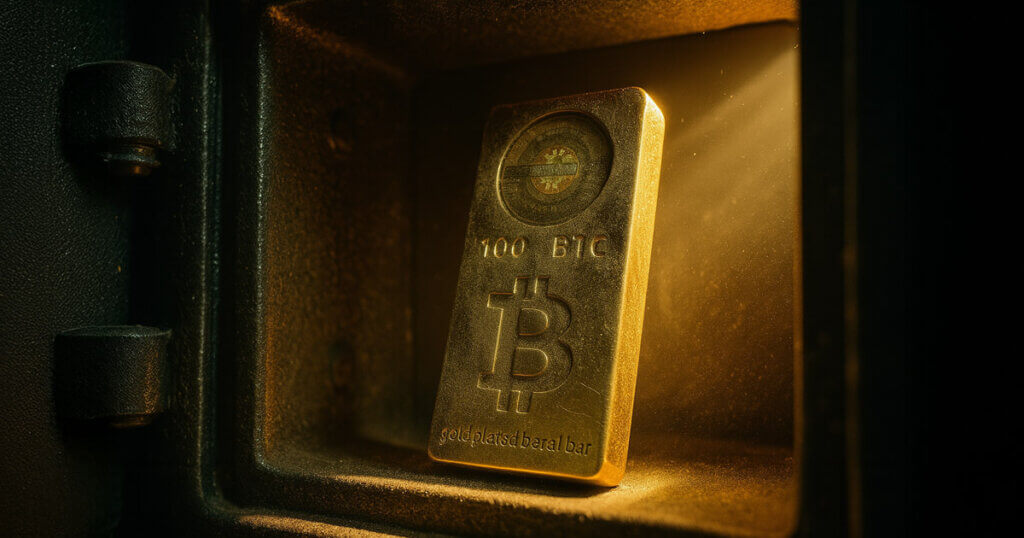
The current 25 BTC move lands differently because of timing. Bitcoin was already under pressure, and old-wallet activity carries a sharper edge when leverage is unwinding.
CryptoSlate’s Bitcoin price page shows BTC near $63,000 on June 4, down 5.7% over 24 hours, 13.8% over seven days, and 22% over 30 days.
At that snapshot price, 25 BTC is worth about $1.58 million, which is already below the $1.78 million recently reported in the Galaxy-attributed alert.
Bitcoin fell from $71,765 to $67,895 on June 2, triggering about $394 million in one-hour liquidations as leveraged long positions unwound.
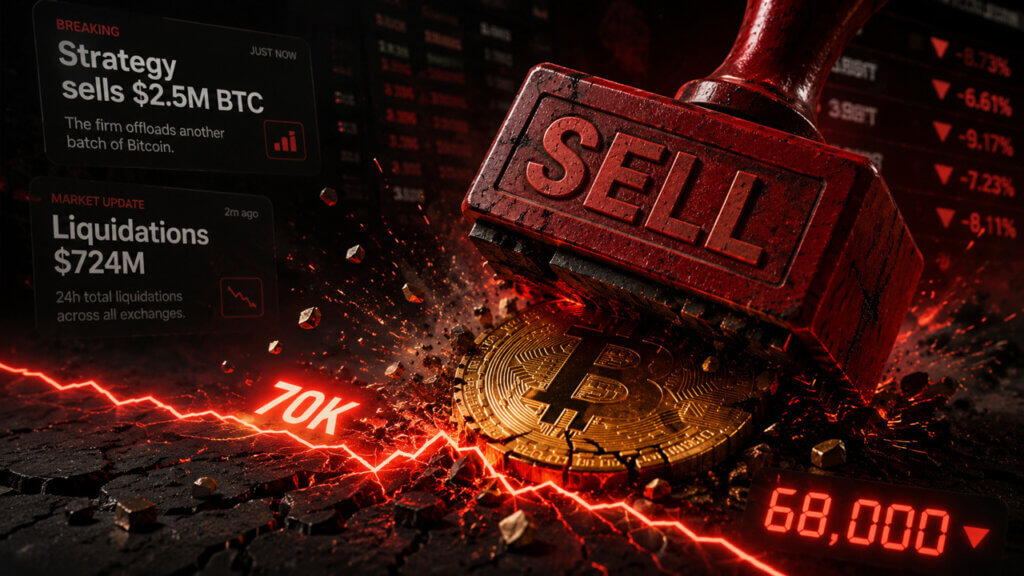
That selloff makes any movement from old BTC addresses feel more consequential than it would during a calm rally.
The cultural signal and the trading signal are different. The cultural signal is clear: one of Bitcoin’s early physical storage formats appears to have rejoined the ordinary liquidity layer.
The trading signal remains unresolved. The watched BTC has left the original address, while the available data leaves open whether it will be sold, stored, pledged, or moved again.
Casascius redemptions connect the Bitcoin of forums, holograms, and physical experiments with the Bitcoin of ETFs, market-cap dashboards, and institutional liquidity.
A physical coin from 2011 can sit untouched for years, then become on-chain BTC in a market where every old coin movement is scanned for supply pressure.
It is a small event compared with Mt. Gox balances, ETF flows, or miner selling, but it is vivid because the holder had to alter a collectible to make the BTC liquid.
The next signal is simple. If the June 4 recipient address routes funds toward an exchange, custodian, mixer, or known liquidity venue, the signal moves from culture and custody into market supply.
If it stays parked, the event remains a clean example of Bitcoin’s long memory: old keys, old objects, and old storage habits can still wake up when the asset around them has become a global market.

SpaceX is set to debut on Nasdaq under the ticker SPCX as early as June 12, 2026, after filing its S-1 with the SEC on May 20. Elon Musk has agreed to lock 100% of his shares for 366 days.
The arrangement has redrawn how crypto venues price the company before listing. Hyperliquid, Binance, OKX, Bitget, and BingX each run synthetic SPCX perpetuals while accredited investors access real shares through Forge Global and EquityZen at a $1.75 trillion valuation.
The following are some of the questions and answers investors must have, even as Elon Musk locks up 100% of his SpaceX holdings for a year.
Follow us on X to get the latest news as it happens
Direct ownership remains off the table for anyone outside the cap structure.
Synthetic perpetuals listed on Hyperliquid, Binance, Bitget, OKX, and BingX simply mirror an implied valuation through derivative contracts and confer no shareholder rights.
Secondary platforms such as Forge Global and EquityZen require accredited or qualified institutional status, locking out smaller buyers.
Crypto perpetual contracts therefore stand as the sole entry point for non-accredited traders looking to position around crypto markets pricing SpaceX ahead of June 12.
Pricing flows from a constructed oracle rather than a live exchange feed, because no public market for SPCX exists yet.
The oracle blends comparables from recent private tender offers, mention-weighted public-company proxies, and likely midpoints from Polymarket and Kalshi prediction markets.
Funding payments then nudge the contract back toward the anchor whenever traders push it too far in either direction.
The setup leaves SPCX-USDC more vulnerable to oracle disputes and forced unwinds than a typical listed instrument.
Once SPCX prints on Nasdaq, deployers will either retire the pre-IPO contracts or migrate them to perpetuals tied to the live share price.
The Hyperliquid HIP-3 upgrade gives Trade.xyz the flexibility to convert or sunset the market entirely. Bitget, OKX, and BingX have stayed silent on what comes next for their pre-IPO products.
Tokenized SpaceX shares from Ondo, Backed Finance, and Dinari are queued for release within hours of the bell, creating a parallel 24/7 access layer.
The S-1 filed with the SEC on May 20, 2026, is the controlling source, and that document records 18,712 Bitcoin (BTC) on SpaceX’s balance sheet.
Arkham Intelligence has publicly identified only 8,285 BTC tied to labeled SpaceX Bitcoin treasury holdings through April 2026, leaving a substantial portion unlabeled.
Analysts attribute the shortfall to corporate addresses that have not yet been mapped on-chain.
“Elon’s SpaceX holding 18,712 BTC isn’t the real story. The real deal is that on-chain trackers only saw the tip of the iceberg. Arkham Intelligence had it pegged SpaceX Bitcoin holdings at ~8,000–8,285 BTC. So… how much Bitcoin are public companies actually hiding?” a popular user on X posed.
SpaceX values the position at $1.293 billion, against an acquisition cost of $661 million, with an embedded gain of nearly $632 million.
The HIP-3 standard allows independent deployers to spin up perpetual venues without waiting for a centralized listing review, thereby dramatically compressing the launch cycle.
CEX rivals must clear internal compliance and risk processes that typically take weeks.
Hyperliquid captured the resulting head start in volume, clearing $33 million on launch day on May 18 as the contract briefly hit $216 before resetting near $203.
Trade.xyz, the deploying entity, is part of Hyperliquid’s tokenization arm, Hyperunit.
The cleanest split is to anchor every fact against the SEC filing and treat everything outside it as market interpretation.
The S-1 sets the legally binding inputs, including the 366-day Musk lock-up, the staggered 180-day terms for other shareholders, the 5% friends-and-family carve-out, and the 18,712 BTC treasury.
Synthetic perpetual prices, oracle constructions, and tokenized wrapper roadmaps sit in the second category and can move on sentiment alone.
Pegging positions to the filing first, then layering venue-specific risks on top, keeps trading narratives from contaminating the underlying valuation thesis.
The 366-day Musk lock-up cuts back near-term insider selling pressure. Other shareholders face staggered 180-day restrictions with early release triggers tied to earnings reports and share price performance above the IPO price.
The S-1 carves out roughly 5% of shares for employees and a friends-and-family pool with no lock-up.
For institutions weighing how to invest in SpaceX pre-IPO, the gulf between synthetic exposure and real equity stays wide until shares trade.
Musk retains roughly 85.1% of voting power through dual-class stock, keeping control concentrated even after listing.
Whether the constructed oracle pricing on crypto venues converges with the Nasdaq print after June 12 will be the cleanest test of how well these markets handled price discovery for a $1.75 trillion company.
The post 6 Questions Investors Must Ask as Elon Musk Locks 100% SpaceX Shares Before IPO appeared first on BeInCrypto.

Putting real-world investments onchain, a process called tokenization, is moving out of the testing phase and into everyday business.
Citi’s new report Tokenization 2030: Wall Street On-Chain shared with CoinDesk ahead of Proof of Talk in Paris, shows that the global market for thse digital investments sits at just $17 billion today.
However, Citi expects this market to increase to $5.5 trillion by 2030 in its base forecast. Depending on how fast adoption take place, that could land anywhere from a low end estimate of $2.7 trillion to a bullish forecast of $8.2 trillion, Citi said.
As the report points out, this is a major turning point: “You’re seeing the full weight of American financial power and the global reserve currency moving on change at scale,” Citi says in the report. “When DTCC and the NYSE embed tokenization into capital markets, this marks a tipping point.”
According to Citi, three big shifts are driving this trillions of dollars move.
First, the traditional companies that run the world’s stock markets are building this technology directly into their regular trading systems.
In early May, Wall Street giant Depository Trust & Clearing Corporation (DTCC) announced it would start limited production trades of tokenized securities in July, with a broader launch of its platform set for October. Nasdaq is working on a framework for companies to issue blockchain-based shares with a potential launch as early as 2027. Intercontinental Exchange, which owns the New York Stock Exchange, also has plans for tokenized stocks.
Nasdaq also received regulatory approval to allow certain stocks to be issued and traded in this digital onchain form.
Second, the rise of trusted digital cash is providing the missing piece to make thse trades settle instantly. Standard stablecoins are expected to grow to $1.9 trillion market by 2030, working alongside digital bank deposits to allow assets and cash to swap at the exact same moment. The report expects that the growth of stablecoins alone could create about $1 trillion in new demand for U.S. government bonds, because the companies issuing stablecoins back their digital cash with these real bonds.
Third, the government rules are getting clearer, with a key piece of U.S. digital asset legislation moving forward to a full U.S. Senate vote. On May 14, the Senate Banking Committee managed to end a four-month stall with a 15-9 bipartisan approval by the committee, which advanced the Clarity Act to its next step.
The Citi report notes that the growth they forecast will happen in mainstream public markets, such as U.S. stocks and government bonds, rather than private markets, which are harder to trade and change slowly.
Citi assumes that 10% of the U.S. Treasury bill market and 3% of the U.S. public stock market will be tokenized by 2030. If just 10% of everyday U.S. investors switch to these new digital trading platforms, it would create $2.6 trillion in demand for digital stocks.
On the other side, complex areas like private credit and private equity are each expected to reach a much smaller $100 billion globally by 2030.
The shift will not happen overnight, Citi noted, saying that instead, old and new financial systems will have to run side by side for a while.
The report compares this to how highways adopted electronic toll tags like E-ZPass. Toll roads did not become fully automated in one day. Instead, states built wider roads with parallel lanes for both cash and automated drivers, which added extra cost and confusion before everyone eventually switched over to the fully automated system.
Ultimately, this new setup will give a major advantage to “Structural Orchestrators”. These are the specific big banks and investment firms that control both the real assets and the digital cash rails used to pay for them, allowing them to handle the entire trade inside their own network.

A security analyst suggested that DxSale’s old locker contract may have contained an unverified backdoor vulnerability.
More than 1,400 liquidity pools tied to old DxSale contracts on BNB Chain were drained in a $7.3 million exploit flagged by blockchain security firms on May 29.
The attack adds to a growing list of DeFi breaches this month, as security experts warn that aging smart contracts and weak access controls are leaving protocols exposed.
According to on-chain security account PeckShieldAlert, a user named “Tahax” first identified the exploit. Per their report, attackers targeted at least 1,400 old DxSale liquidity pool contracts on BNB Chain, draining about $7.3 million worth of crypto from them, which they then routed through AnySwap in an attempt to obscure their trail.
PeckShield added that an address identified as “0xC457…FA69” had transferred 2,958 BNB from the hack, worth $1.87 million, into two main wallets, which then moved the funds through several deposit addresses on Binance.
DxSale is a launchpad platform that lets crypto projects create tokens and liquidity pools without building their own infrastructure. It was pretty big about five years ago, with many of the projects launching tokens on BNB Chain locking their LPs with the protocol.
According to Tahax, the locker was still holding LPs from projects that had not been touched for years, with founders and holders believing it was safe. However, nearly nine months ago, the DxSale deployer transferred ownership of the locker to a new wallet with no public announcement or migration notice. The on-chain degen claims that the locker contract was unverified and it probably contained a backdoor, which the attacker took advantage of.
Two days ago, 0xC457…FA69, a brand new wallet funded from Bybit and possibly routed through AnySwap, reportedly took ownership of the locker and, within hours started draining the LPs.
DxSale itself was yet to make a statement regarding the exploit.
The DxSale hack hasn’t happened in isolation, with the crypto sector losing at least $650 million in April from similar incidents. May has also had its fair share of attacks, including one last week, where a person stole more than $11 million from the Verus bridge after exploiting a flaw in how it verified payment amounts. According to security researchers, the attacker submitted a tiny transaction that passed verification checks while still unlocking large withdrawals from the bridge’s reserves.
Earlier in the month, liquidity provider TrustedVolumes was also hit for about $5.9 million after a hacker abused weaknesses in its custom settlement system, with analysts pointing out that the exploit worked because the protocol checked authorization against one address while pulling funds from another.
THORChain was also a victim, with on-chain sleuth ZachXBT saying it may have lost more than $10 million, which sent its RUNE token plummeting 15% within minutes.
This steady stream of exploits has elicited a reaction, with OpenZeppelin co-founder Manuel Aráoz declaring “all of DeFi unsafe,” arguing that AI-assisted attackers are finding vulnerabilities faster than security teams can patch them.
LIMITED OFFER for CryptoPotato readers at Bybit: Use this link to register and open a $500 FREE position on any coin!

Sequans Communications (NYSE: SQNS), the Paris-based cellular IoT semiconductor company, has completed the full redemption of its remaining convertible debt, funded by the sale of a portion of its Bitcoin holdings — bringing a short-lived and costly digital asset treasury experiment to a close.
The company now holds approximately 658 BTC, described as “fully unencumbered,” following the retirement of all convertible notes issued in July 2025. Sequans said it plans to monetize the remaining Bitcoin over time, though it did not specify a timeline or method.
The retreat caps a strategy that began in June 2025, when Sequans announced plans to raise $385 million through debt and equity to start a Bitcoin treasury.
By late July, CEO Georges Karam described Bitcoin as a “long-term store of value for our shareholders,” with a target of accumulating 3,000 BTC within weeks. The company crossed that threshold by month’s end.
The unwind began in November 2025 after Bitcoin fell from an all-time high above $126,000 to roughly $80,000. Sequans sold 970 BTC that month, followed by 125 BTC in February 2026, and another 1,025 BTC during the first quarter — reducing holdings to 1,114 BTC as of April 30. Thursday’s announcement confirmed a further reduction to 658 BTC, reflecting total sales of more than 80% of peak holdings.
Investors who bought shares at the height of Bitcoin enthusiasm last July are sitting on losses of more than 90%. SQNS shares rose 10% on Thursday following the announcement.
With the debt retired, Sequans transitions to what it calls a “near debt-free balance sheet,” giving the company greater financial flexibility heading into the second half of 2026. The move eliminates collateral obligations tied to Bitcoin’s price volatility, a risk that management had flagged in prior filings.
“We have strengthened our balance sheet, simplified our capital structure, and are now fully focused on scaling our IoT semiconductor business,” Karam said in Thursday’s statement.
Sequans’ renewed focus centers on its 4G LTE-M and Cat-1bis chipsets, which serve markets including smart metering, asset tracking, telematics, security, and industrial IoT. The company is also advancing its 5G eRedCap platform — a next-generation cellular IoT standard — as a long-term growth driver.
Karam framed Thursday’s announcement as the start of a focused operational phase. “Execute on our growing 4G and RF transceiver product portfolio, accelerate our path to profitability, and advance our 5G roadmap,” he said.

Bitcoin is facing renewed selling pressure as uncertainty continues dominating global financial markets, but bulls have so far managed to defend the critical $75,000 region. The asset remains trapped below key resistance levels after failing to reclaim momentum above $80,000 earlier this month, leaving traders searching for signs that the current correction is either stabilizing or preparing for another leg lower.
While the recent weakness has raised concerns across the market, top analyst Darkfost believes one of the most important signals is not price itself — but the dramatic collapse in spot trading activity happening beneath the surface.
According to data from Darkfost, Bitcoin spot trading volumes have now fallen to levels historically associated with bear markets. The analyst notes that investors must go back to July 2023 to find a period where BTC spot volumes were this low across major exchanges. Binance, which remains the dominant venue in the crypto market, currently processes around $36.4 billion in trading volume. In October 2025, that figure stood at approximately $198.6 billion.
Bitcoin Spot Trading Volume | Source: CryptoQuant
The collapse is severe. Binance volumes are now nearly five times lower than they were at the cycle peak, representing an 81% decline. Other exchanges show similar weakness, with Gateio volumes falling nearly 80% and Bybit recording a 66% drop in activity.
Darkfost explains that the collapse in Bitcoin spot trading activity reflects a broader macroeconomic environment that has become increasingly hostile toward risk assets such as cryptocurrencies. Rising inflationary pressures, persistent uncertainty surrounding global monetary policy, and the US/Iran conflict lasting longer than markets initially expected have pushed investors toward safer or more traditional assets. Commodities, energy markets, and major equity indices have absorbed a large portion of capital flows that previously rotated into crypto during periods of stronger risk appetite.
The result has been a sharp contraction in participation across spot crypto markets. Lower trading activity often reflects declining enthusiasm, weaker speculative demand, and reduced institutional engagement. However, Darkfost argues that the current setup may not be entirely bearish from a structural perspective.
Historically, prolonged declines in spot volume have frequently coincided with the later stages of corrective phases rather than the beginning of major collapses. As participation fades, aggressive selling pressure also begins to weaken because fewer market participants remain actively distributing positions into the market.
The analysis points specifically to the 2023 bear market structure, where spot volumes collapsed to similarly depressed levels shortly before Bitcoin stabilized and volatility returned. That period of extreme inactivity ultimately became the foundation for the recovery phase that followed, as exhausted sellers gradually lost control of the market.
Bitcoin continues trading above the critical $75,000 support region despite persistent selling pressure and weakening market participation. The daily chart shows BTC consolidating near $76,800 after rejecting from the $82,000 resistance zone earlier this month, with price now trapped between major moving averages as traders wait for a decisive breakout or breakdown.

Bitcoin consolidates above key price level | Source: BTCUSDT chart on TradingView
Technically, Bitcoin remains above the 50-day moving average, which is currently acting as short-term support around the mid-$75,000 area. That level has become structurally important because it aligns closely with the broader horizontal demand zone between approximately $73,000 and $75,000 highlighted on the chart. Bulls have repeatedly defended this region throughout May, preventing sellers from regaining full control of the trend.
However, the broader structure still reflects caution. The 100-day and 200-day moving averages continue sloping downward overhead, reinforcing the idea that Bitcoin remains inside a larger corrective environment despite the recovery from February’s capitulation lows near $63,000.
For now, Bitcoin remains in a compression phase. A decisive reclaim of the $80,000–$82,000 region would strengthen bullish momentum, while losing the $75,000 support zone could expose BTC to a deeper retrace toward the $70,000 area.
Featured image from ChatGPT, chart from TradingView.com

The US Securities and Exchange Commission has reportedly postponed its plan to allow trading of tokenized stocks after stock exchange officials raised concerns over how the plan would be implemented.
Bloomberg reported on Friday, citing sources familiar with the matter, that the SEC’s “innovation exemption” for crypto-based stocks was expected to be released during the week, with SEC staffers having already reviewed a draft of the tokenized stock trading proposal.
The SEC has reportedly received input from hundreds of market participants on how to best implement the rules, but it has not made a decision to change its proposal.
Under the SEC’s proposal, platforms offering tokenized stocks would need to guarantee investors receive the same rights as traditional shareholders, including dividends and voting rights.
Market participants reportedly raised concerns to the SEC over the potential proliferation of unauthorized third parties issuing tokens without the consent of public companies and how ownership would be verified on semi-pseudonymous blockchains.
The SEC has been more open to crypto-powered financial products under the Trump administration, which has coincided with Wall Street having a growing interest in tokenization and stablecoins.
Data from RWA.xyz shows that $34 billion worth of real-world assets have been tokenized, including $1.55 billion in tokenized equities, but adoption has lagged expectations by Citibank and McKinsey, which respectively predicted in 2022 and 2024 that tokenization would become a multi-trillion-dollar market by 2030.
Crypto industry executives have backed the SEC’s decision to delay the exemption. Carlos Domingo, the CEO of crypto tokenization platform Securitize, said in a post to X on Friday that it is important to ensure the “exemption applies to the right instruments.”
“Better delay it than get it wrong and unleash all sort of problems.”
Related: Kraken parent Payward sees revenue surge as tokenization expands
Tom Farley, the CEO of crypto exchange Bullish posted to X that the SEC was “realizing that public companies are the only entity who can issue tokens that are a share of stock! Great job delaying and getting this right.”
Source: Tom Farley
The delay came after SEC Commissioner Hester Peirce said on Thursday that she expected the exemption to be “limited in scope” and would only support “digital representations” of equity securities, similar to what investors can currently purchase in the secondary market.
In January, the SEC made distinctions between types of tokenized securities, classifying them into “custodial” and “synthetic” forms.
Custodial tokenized securities are issuer-sponsored tokenized stocks custodied by regulated intermediaries and have full shareholder rights, while synthetic tokenized securities provide price exposure without actual ownership of the underlying shares.
Magazine: eToro founder timed Bitcoin top perfectly due to belief in 4 year cycles


Cardano could lose a core group of scientists if Input Output fails to secure treasury funding for a slate of research and infrastructure proposals that are still awaiting approval.
Last month, Input Output, the development firm behind the Cardano network, revealed that it was seeking $46.8 million to finance its operations for the 2026 development cycle.
However, the funding request has encountered significant resistance as the May 24 voting deadline approaches. A look at the major proposals shows that they face weak support, heavy abstentions, and large blocs of votes left uncast, leaving the network’s technical future hanging in the balance.
The escalating tension prompted a stark warning from Cardano founder Charles Hoskinson, who cautioned that failing to approve the treasury withdrawal could trigger an exodus of top talent and potentially shutter the network’s flagship research laboratory.
The $46.8 million request is fractured across several specialized workstreams, each requiring a 67% ratification threshold from the network’s DReps. As the voting window narrows, almost none are on track for approval.
The largest line item is the Cardano Maintenance Initiative, an ask of more than 62.1 million ADA designed to cover continuous core maintenance from the third quarter of 2026 through the first quarter of 2027.
The proposal covers nine functional areas, including bug fixing, disaster recovery, mainnet monitoring, and incident response.
Despite its critical nature, described by developers as the protective foundation that ensures network uptime and security, the proposal currently holds just 46.58% affirmative votes. A massive 9.25 billion ADA is logged as abstaining, while 45.61% of voting power has yet to weigh in.
Other critical infrastructure proposals are faring even worse. A 10.4 million ADA request to fund Layer 2 scalability solutions, including a data availability solution and the launch of Midgard, the network’s first permissionless optimistic rollup, sits at just 16.08% approval.
Layer 2 architecture is widely considered the only viable path to achieving the 10,000-plus transactions per second and sub-cent fees necessary to attract high-frequency decentralized finance and artificial intelligence micropayments in the current cycle.
A $2.95 million pitch to build “Pogun,” an end-to-end Bitcoin liquidity and credit engine meant to capture a share of the $1.5 trillion Bitcoin asset class, is polling at 19.04% in favor, weighed down by 24.15% active rejections and overwhelming abstentions.
The hesitation among DReps extends to proposals that target developer experience and smart contract capabilities, areas where Cardano has historically struggled to gain ground against rivals like Ethereum and Solana.
A 13 million ADA proposal to bring automated formal verification to decentralized applications has performed the best thus far, but still trails the needed supermajority at 57.79%.
The initiative aims to extend the Blaster verification tool across multiple smart contract languages, lowering the barrier for developers to mathematically prove their code’s correctness.
Similarly, an 11.8 million ADA request to expand the capabilities of Cardano’s native Plutus smart contract language, aimed at reducing script costs and improving expressiveness, is hovering around 32% approval.
A separate 3.6 million ADA pitch explicitly designed to boost developer growth by 30% over the next year, by streamlining onboarding and documentation, sits below 30%.
Also struggling is Project Cayley, a 7.92 million ADA initiative aimed at decentralizing data indexing. Currently, indexing the entire Cardano blockchain dataset requires massive computational resources, a burden that will only grow as the network scales.
Project Cayley introduces decentralized slice indexing, allowing node operators to index only specific portions of the chain. This lowers the barrier to entry and prevents data-serving infrastructure from centralizing around a few well-funded providers.
Yet, the proposal is languishing at 13.83% approval, with nearly 30% of active voters rejecting it outright.
Finally, a 13.1 million ADA proposal that would introduce Babel Fees, allowing users to pay transaction costs in any native asset, such as stablecoins, rather than holding ADA, has garnered nearly 60% support but remains shy of the 67% hurdle.
The upgrade is widely viewed as essential for removing onboarding friction for new users.
For years, Cardano has staked its reputation on rigorous, peer-reviewed academic research and formal methods. This methodical approach has occasionally drawn criticism for moving too slowly, but it has cultivated a fiercely loyal community.
However, the stakes of the treasury vote also appear to be impacting a research-focused proposal called “Cardano Vision 2026: Human Centered, Scalable, Post Quantum Secure – IO Research.”
This proposal seeks nearly 33 million ADA tokens, approximately $8 million, to “preserve Cardano’s evidence-based approach” and “ensure that research outputs translate more reliably into measurable ecosystem growth.”
However, YUTA, a Cardano Drep, stated that the “proposal is a mix of a waste of funds and a potentially excellent proposal for Leios and quantum resistance research.”
In response, Hoskinson stated:
“We are deeply saddened that some Japanese dReps voted against our research proposal…If this proposal does not pass, we want the entire Japanese community to fully recognize that Cardano will lose its scientists, and our lab will be forced to close.”
Hoskinson emphasized that building the organization’s research apparatus took more than a decade and hundreds of millions of dollars.
He warned against dismantling the world’s strongest cryptocurrency research group over “piecemeal funding support,” asserting that the organization’s scientists would simply leave for ecosystems offering greater certainty and professional respect.
He added:
“This doesn’t have anything to do with me. This has to do with destroying the entire core of our ecosystem. Cardano is the science coin. That’s our brand. We spent hundreds of millions of dollars and a decade to earn the right to say that. You don’t throw it away.”
As of press time, the proposal has secured only a 13% support, and its voting is expected to close on June 8.
The funding friction is particularly notable given that Input Output explicitly scaled back its financial demands for this cycle.
The 2026 treasury request represents a nearly 50% reduction from the previous year’s budget, signaling an intent to transition the ecosystem toward long-term self-sufficiency.
Yet, even this tightened fiscal belt has failed to win immediate favor from the newly empowered governance body.
The gridlock illustrates the double-edged sword of Cardano’s decentralized governance era. By placing the keys to the treasury directly in the hands of token holders and elected DReps, the ecosystem has achieved a level of financial decentralization rarely seen in major blockchain networks.
However, the current voting impasse highlights the vulnerability of that model. With large swaths of voting power either abstaining or remaining dormant, funding for vital infrastructure is essentially frozen.
For Input Output, the proposals represent a bare-minimum operational baseline to keep the network secure and competitive. For the DReps, the vote is an exercise in budget discipline and accountability, requiring the software laboratory to justify every dollar.
If the proposals fail to cross the 67% threshold by the May 24 deadline, Cardano faces an unprecedented scenario. Without the requested treasury disbursements, key upgrades could be delayed, and essential maintenance operations may be forced to scale back.
More critically, as Hoskinson warned, the talent pipeline that built Cardano’s sophisticated, academically rigorous architecture could begin to fracture, fundamentally altering the ecosystem’s trajectory.
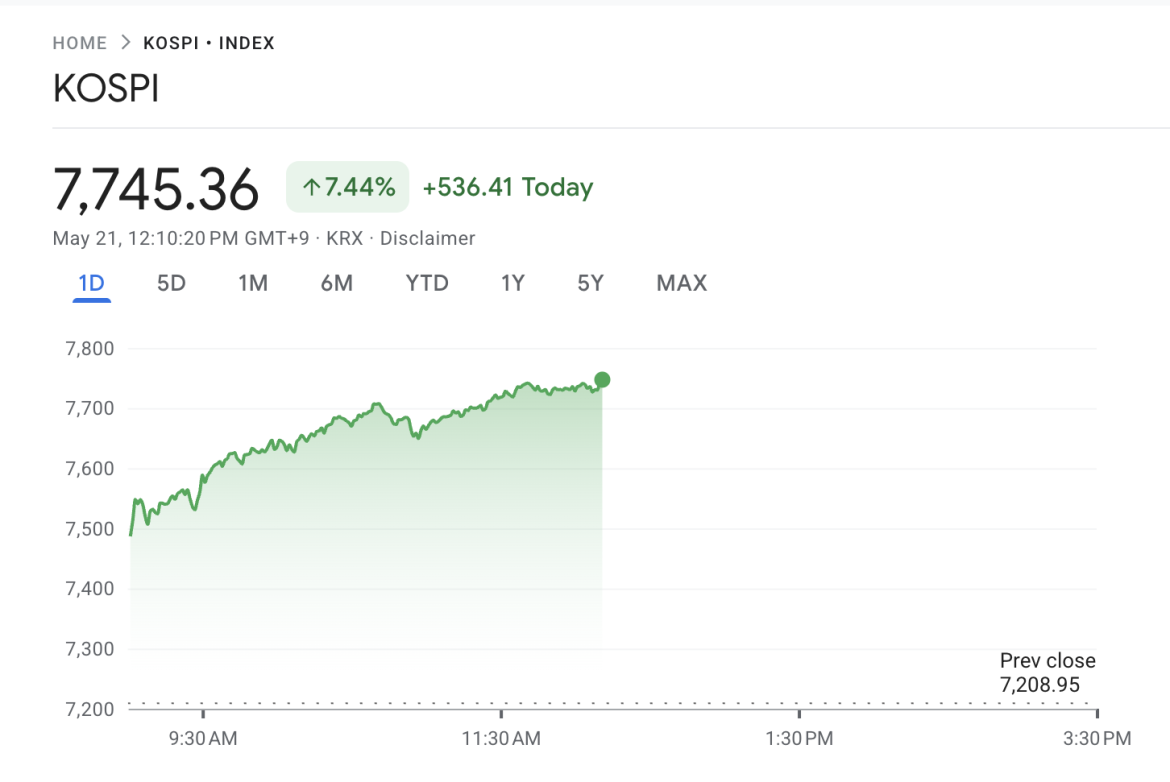
South Korea’s KOSPI surged 7% on Thursday, snapping a multi-day losing streak as Asia-Pacific markets tracked Wall Street’s gains.
The benchmark had fallen 9.35% after hitting an all-time high above 8,000 last Friday.
Earlier-week declines came as President Donald Trump signaled possible US strikes on Iran, rattling investors. Sentiment has since reversed, with Trump saying Washington is now in the “final stages” of negotiations with Tehran.
In addition, Samsung Electronics and its worker union reached a last-minute wage agreement late Wednesday. The deal suspended an 18-day strike scheduled to begin Thursday.
Samsung shares climbed more than 6%, while memory rival SK Hynix jumped 11%. Semiconductor names also lifted after Nvidia’s latest earnings showed revenue climbing 85% year-on-year to $81.62 billion.
Follow us on X to get the latest news as it happens
The KOSPI has tripled in less than 18 months. According to the Financial Times, the pace beats the Nasdaq Composite’s dotcom-era climb by roughly six months.
The rally is fueled largely by the country’s two heaviest-weighted listed companies, Samsung Electronics and SK Hynix. The pair now make up a record 42% of the benchmark, with Samsung up roughly 130% this year and SK Hynix climbing nearly 170%.
Surging memory-chip demand from AI hyperscalers has anchored the run. Notably, Goldman Sachs, Citigroup, and JPMorgan have raised their year-end KOSPI targets in recent weeks.
Subscribe to our YouTube channel to watch leaders and journalists provide expert insights
The post South Korea’s KOSPI Stages 7% Comeback Powered by 3 Catalysts appeared first on BeInCrypto.


