Crypto infrastructure providers are drawing renewed investor interest as Wall Street deepens its push into digital assets.


 Live Chat
Crypto infrastructure providers are drawing renewed investor interest as Wall Street deepens its push into digital assets.

CoinGecko data revealed that Bitcoin outperformed on US holidays during 11 of the past 14 calendar years analyzed historically.
A new study by CoinGecko found that buying Bitcoin on US holidays has historically delivered much stronger short-term returns compared to regular trading days.
The analysis examined Bitcoin’s forward returns across different calendar days between May 1, 2013, and May 8, 2026, focusing on single-day gains after purchase.
According to the data, US holidays recorded an average next-day Bitcoin return of 0.77%, compared to just 0.19% on non-holidays. CoinGecko found that holidays outperformed regular days in 11 of the 14 calendar years included in the study. Among regular weekdays, Mondays and Wednesdays posted the highest average next-day return at 0.38%, while Thursdays were the only day to produce a negative average return of 0.09%.
The report identified New Year’s Day as the strongest-performing holiday for Bitcoin purchases, with an average next-day return of 2.01% across 13 observations and a win rate of 84.6%, meaning Bitcoin rose the following day in 11 out of 13 years. Columbus Day posted the same 84.6% win rate alongside an average return of 1.70%, while Christmas generated a 1.46% average next-day gain with a 53.8% win rate.
CoinGecko said the New Year’s Day pattern may indicate the broader January momentum effect often seen in traditional financial markets, where investors deploy fresh capital at the start of a new year. The study added that Bitcoin may also benefit from a shift away from December tax-loss selling into renewed January positioning. The report noted that Bitcoin’s price on January 1 ranged from $313 in 2015 to $93,507 in 2025, yet the pattern of next-day gains remained relatively consistent throughout the period.
However, not all holidays produced positive results. Martin Luther King Jr. Day recorded the weakest performance with an average next-day negative return of 0.84%, largely influenced by Bitcoin’s 18.65% drop following January 15, 2018, during the early phase of the crypto bear market. Independence Day also averaged a negative return at 0.26%. Veterans Day showed an average gain of 1.75%, but CoinGecko warned that the figure was distorted by a few unusually large rallies, while the holiday’s win rate remained below 50%.
The study also found little meaningful difference in Bitcoin performance between weekdays and weekends. Weekdays averaged a 0.21% positive next-day return compared to 0.22% on weekends, which CoinGecko described as statistically insignificant due to Bitcoin’s 24/7 trading structure.
Over a one-year holding period, the day of purchase had almost no impact on long-term returns, as average annual gains across all weekdays remained within a narrow 2.4 percentage point range. CoinGecko added that while holiday purchases also showed slightly stronger one-year returns, the effect was likely indicative of broader market cycles rather than a continued holiday-driven trend.
As for Bitcoin’s latest price action, the asset is currently trading back above $80,000 after briefly slipping below that level earlier this week. Market experts said the decline was driven by several pressures hitting the market at once. On-chain data showed that Bitcoin exchange outflows had dropped sharply before the selloff, leaving more coins on trading platforms and increasing available sell-side supply.
At the same time, derivatives traders were aggressively building short positions while leveraged long exposure remained high. Once prices started falling, a wave of long liquidations accelerated the move downward. Rising inflation concerns following fresh US CPI and PPI data, alongside heavy whale selling, added further pressure to the market.

The Bitcoin Open, a combined golf and poker tournament organized by Bitcoin Sports Network and Satstreet, is scheduled for June 8, 2026, at Glen Abbey Golf Club in Oakville, Ontario. The event will take place at the club during its 50th anniversary year.
Glen Abbey Golf Club, designed by Jack Nicklaus and opened in 1976, is one of Canada’s most recognized golf venues. It has hosted the Canadian Open multiple times and is known for its championship-level layout and history in professional golf. The course is located approximately 30 minutes west of Toronto and serves as a public golf facility with a significant legacy in Canadian sports.
The Bitcoin Open consists of a scramble-format golf tournament on the main championship course during the day, followed by a Texas Hold’em poker tournament in the evening. The golf portion uses a team scramble format, typically with groups of four players. The field size is limited, with organizers noting strong demand and a reduced number of remaining team spots as of mid-May 2026.
Prizes for the event include two separate hole-in-one awards, each consisting of one Bitcoin. Additional golf prizes cover the longest drive and closest to the pin. Golf winners will also receive tickets to the 2027 Bitcoin Golf Championship, scheduled to take place in Nashville, Tennessee, ahead of the 2027 Bitcoin Conference. The winner of the poker tournament receives $5,000 CAD in stablecoins.
A list of hole sponsors for the event has been announced. These include APX Lending, Tetra Digital Group, The Canadian Bitcoin Conference, Satstreet, True North Airways, Ledn, Gator Mining Inc., Wealthsimple, CAD DIGITAL, PRIVATEDEBT Partners, McCarthy Tetrault, and Samara Asset Group.
Bitcoin Sports Network operates as an organizer of Bitcoin-themed sports and lifestyle events, including golf tournaments held in conjunction with major Bitcoin conferences. Satstreet, a Canadian Bitcoin-focused company, is co-hosting the event and serving as one of the hole sponsors. The two organizations are collaborating on this Canadian edition of The Bitcoin Open.
The event is open to participants from the Bitcoin community, including builders, investors, and others active in the industry. Registration is handled through the official event website, with tickets covering both the golf and poker components. The schedule includes on-course activities, meals, and networking periods at the venue.
This marks the first time The Bitcoin Open is held at Glen Abbey. Previous Bitcoin Sports Network golf events have taken place in locations such as Las Vegas, often timed near larger Bitcoin conferences. The Canadian event is positioned as a standalone gathering in the Toronto area.
Glen Abbey’s 50th anniversary provides additional context for the timing. Since its opening, the club has been a central part of Canadian golf, training professionals and hosting amateur and professional competitions.


Jane Street sharply reduced its Bitcoin ETF exposure in the first quarter of 2026, cutting holdings in BlackRock’s IBIT and Fidelity’s FBTC while increasing positions in Ether ETFs and several crypto-linked equities. The move has revived speculation that one of the market’s largest trading firms may have been a major force in Bitcoin’s recent price dynamics — and that a lighter reported position could remove a key overhang for BTC.
According to the latest 13F filings, Jane Street cut its IBIT position by roughly 71% and its FBTC position by about 60% in Q1. Parker White, the Chief Operating Officer (COO) and Chief Investment Officer (CIO) of DeFi Development Corp (DFDV), renewed his thesis from February and argued via X that the filing may help answer questions that have circulated since a major IBIT trading dislocation on February 5 when BTC price saw a massive -18% drawdown.
“It is now apparent that Jane Street cut their IBIT and FBTC holdings by roughly 70% in Q1 based on 13F filings,” Parker wrote on X. “Did they just outright sell or more likely, did they make a HUGE profit on their short derivatives, which they don’t have to report? We are still waiting for the final shoe to drop with one of the likely culprits of the blowup.”
It is now apparent that Jane Street cut their IBIT and FBTC holdings by roughly 70% in Q1 based on 13F filings. Did they just outright sell or more likely, did they make a HUGE profit on their short derivatives (which they don’t have to report)?
We are still waiting for the… https://t.co/67XxlwZEGm
— Parker (@TheOtherParker_) May 13, 2026
The filing does not show Jane Street’s derivatives exposure, nor does it establish whether the firm was directionally bearish, hedged, or engaged in ETF arbitrage and market-making activity. That limitation is central to the debate. A 13F captures certain long holdings at quarter-end, but it does not give a complete view of options, swaps, futures, or short exposure that could materially change the economic interpretation of the reported cuts.
Still, the reduction has become a focal point because of earlier claims that Bitcoin’s price discovery may have been distorted by the mechanics of spot ETF trading. Bitwise advisor Jeff Park wrote that Jane Street had “slashed its Bitcoin ETF exposure in Q1 2026,” cutting IBIT by approximately 71% and FBTC by approximately 60%, before adding: “Price discovery is back on the menu.”
Park’s broader argument is not that one firm explicitly suppressed Bitcoin’s price, but that the ETF structure creates a complex market-making environment in which authorized participants can use creation and redemption mechanics, derivatives, and futures hedges in ways that may weaken the link between ETF demand and spot Bitcoin buying. In a prior post, he framed the issue as structural rather than conspiratorial.
JANE STREET SLASHED ITS BITCOIN ETF EXPOSURE IN Q1 2026, CUTTING IBIT BY ~71% AND FBTC BY ~60%, ACCORDING TO ITS LATEST 13F FILING
Price discovery is back on the menu https://t.co/ed41KhlQC4
— Jeff Park (@dgt10011) May 13, 2026
“The short answer is that no AP explicitly suppresses Bitcoin price,” Park wrote. “What the AP structure can suppress is the integrity of the price discovery mechanism itself. Those are not the same thing—but the second is arguably more consequential than the first.”
That distinction matters for the bullish interpretation. If Jane Street’s reported Bitcoin ETF exposure has already been reduced substantially, some traders may read the filing as evidence that a large source of ETF-related pressure has been partially cleared. Parker went further, suggesting Jane Street “likely doesn’t want to be short BTC forever” and that observers should “look for them to begin re-accumulating in Q2.”
The thesis is speculative, but it is not without a clear market logic. If a large trading firm had been involved in strategies that created persistent ETF or derivatives pressure, a reduction in reported Bitcoin ETF holdings, combined with any eventual unwind of related positions, could shift the market’s balance back toward cleaner spot-led price discovery. That is the bullish setup implied by the posts: not simply that Jane Street sold, but that the trade may already have played out.
At the same time, Jane Street did not exit crypto exposure broadly. The firm increased holdings in BlackRock and Fidelity Ether ETFs and added to positions in Riot Platforms, Coinbase, and Galaxy Digital, while trimming Strategy and several Bitcoin mining names.
At press time, BTC traded at $79,783.
Featured image created with DALL.E, chart from TradingView.com

Exodus Movement reported a net loss of $32.1 million for the first quarter of 2026, more than double the $12.9 million loss recorded in the same period last year, as the crypto wallet company liquidated the bulk of its Bitcoin treasury to fund acquisitions.
Total revenue came in at $22.7 million for the three months ended March 31, down 36.8% from $36 million a year earlier, the company announced Monday. Exchange aggregation, the company’s main business line, drove most of the decline, sliding $13.8 million, or 40.8%, as user trading volumes dried up.
Monthly active users dipped to 1.5 million from 1.6 million a year ago, while quarterly funded users fell more sharply, dropping 22.2% to 1.4 million from 1.8 million.
The company cited macroeconomic pressures, including the Federal Reserve’s revised growth outlook and uncertainty around the administration’s tariff policy, as primary drivers of the market-side damage. “The Company expects that volatility in digital asset prices will continue and may result in significant fluctuations in the Company’s results of operations in future periods,” it added.
Related: How AI became crypto’s favorite reason to cut staff
Exodus held 1,704 BTC at the end of December 2025. By March 31, that position had been cut to 628 BTC, a reduction of roughly 63% in unit terms. The company raised $73.2 million through the sales during the quarter, nearly all of which was earmarked to fund its push to acquire W3C Corp., the holding company behind fintech firms Monavate and Baanx.
The company’s broader digital asset portfolio swung to a net loss of $36.4 million, reflecting $76.8 million in unrealized losses partly offset by $40.4 million in realized gains on asset exchanges.
At the end of the quarter, the company held $72.9 million in cash and cash equivalents, up from $4.9 million at year-end 2025.
Exodus shares drop. Source: Yahoo! Finance
Exodus shares fell 5.75% to $7.71 on May 12 and slipped a further 3.11% to $7.47 in pre-market trade.
Related: Bitcoin exchange reserves fall to two-year low after $8B exodus
As Cointelegraph reported, Exodus has rolled out XO Cash, a Solana-based stablecoin toolkit built with MoonPay that lets AI agents spend money through Visa’s payment rails without exposing a user’s private keys.
Developers can spin up agent-linked wallets, cap daily spending, restrict merchants and issue virtual debit cards through Exodus Pay balances. Payments settle automatically in USDC (USDC) or USDt (USDT) via infrastructure from Monavate, and transactions carry no fees.
Magazine: AI-driven hacks could kill DeFi — unless projects act now


The rsETH crisis resulted in $200 million in bad debt on Aave’s books, despite not a single line of its contracts misbehaving.
On Apr. 18, attackers that Chainalysis preliminarily linked to Lazarus compromised RPC infrastructure, forced a failover to poisoned nodes via DDoS, and injected false data into a 1-of-1 DVN configuration on KelpDAO’s rsETH bridge.
The forged message released approximately 116,500 rsETH, and Aave’s incident report confirmed that Ethereum accepted nonce 308 while the Unichain source endpoint never advanced past 307.
The attacker supplied the compromised rsETH to Aave and borrowed against it, resulting in bad debt and serving as a frame for the current state of DeFi’s security.
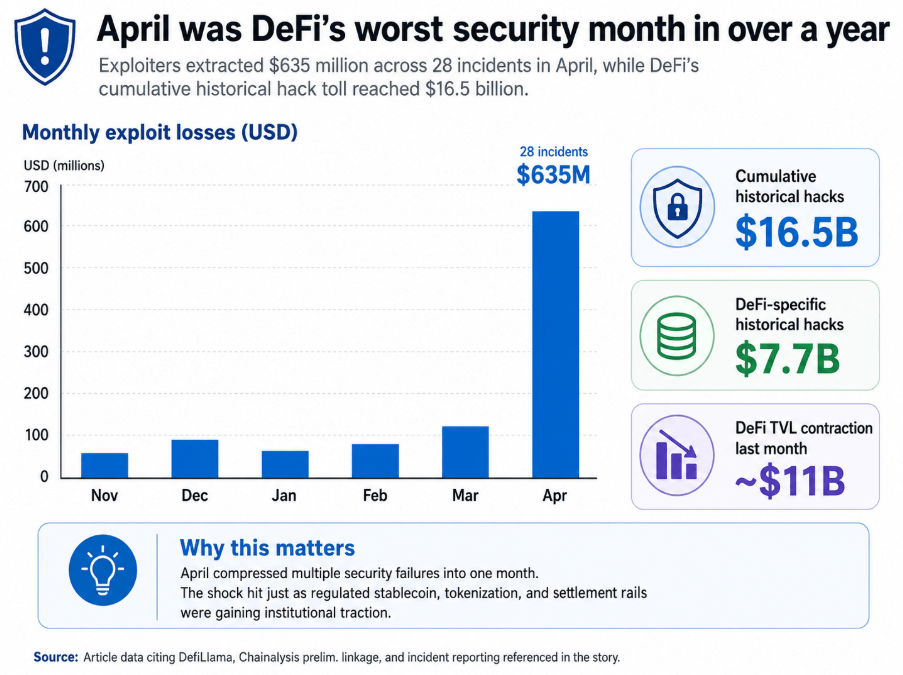
Exploiters extracted over $635 million across 28 incidents in April, the worst monthly total in over a year. DefiLlama puts the cumulative historical cost of hacks at $16.5 billion, with $7.7 billion specifically targeting DeFi.
The high-profile exploits on Drift and the KelpDAO bridge resulted in DeFi losing nearly $11 bilion in total value locked last month.
That contraction occurred as stablecoin rails, tokenized treasuries, and regulated settlement layers gained institutional traction in the same capital markets.
Mitchell Amador, CEO of Immunefi, told CryptoSlate that DeFi has historically rewarded growth, integrations, liquidity, and speed over security maturity.
A protocol that adds a new asset, bridge, oracle, adapter, or external dependency gains immediate utility. The risk that integration carries produces no visible price signal until an exploit materializes, because the absence of an incident is invisible while it holds.
That asymmetry kept audit cycles and isolation practices secondary to shipping velocity for years, until April concentrated the consequences into a single month.
Amador said the most overlooked practices were multisig hygiene and management, supply chain hardening, real-time monitoring, and emergency response procedures.
Too many teams treated multisig as a security solution in itself, when its actual strength depends on signer count, the independence of those signers, their operational setup, and the processes around transaction review.
A low-threshold multisig, weak signer security, or a poorly monitored bridge or oracle can become a systemic exposure because DeFi protocols are composable by default. In this landscape, risk travels through integrations as efficiently as liquidity does.
While that culture was forming inside DeFi, a different model was being built in parallel.
Solstice Finance CEO Ben Nadareski assessed:
“The gap in output per person tells you what happens when you strip away everything that isn’t the core financial function. The teams that win this round will be the ones built on compliance and security from day one, ready to ship faster than a bank can call a meeting about it.”
DeFi built composable rails for over half a decade before Wall Street recognized them as the actual infrastructure layer of the next financial system.
The cost of that early market position was a security culture calibrated for speed over operational discipline.
Kasper Pawlowski, CTO of Euler Finance, names the governance dimension of the same failure in his post-incident analysis.
He said:
“DeFi treats risk assessment as a one-time onboarding decision, when in reality risk is dynamic.”
The 1-of-1 DVN configuration that enabled the KelpDAO exploit existed in production for years. Kelp says it was the default LayerZero shipped and reviewed across multiple integration meetings, while LayerZero says Kelp downgraded to it.
Whichever account is accurate, the configuration persisted unflagged through every integration with every downstream protocol. LayerZero has since banned the configuration on a protocol-wide basis, acknowledging that allowing its DVN to act as the sole verifier for high-value transactions was a mistake.
| Stage | What happened | Why it mattered |
|---|---|---|
| RPC infrastructure compromised | Attackers compromised RPC infrastructure tied to the rsETH bridge setup | The attack began outside the core smart contracts, showing how off-chain infrastructure can become the entry point |
| DDoS forced failover | Traffic was pushed onto poisoned nodes through a forced failover | That let attackers control the data environment seen by the bridge verifier |
| False data injected into 1-of-1 DVN | Poisoned nodes fed false data into a single-verifier DVN configuration | A 1-of-1 verifier setup meant there was no independent check to stop the forged message |
| Forged bridge message accepted | The forged message released about 116,500 rsETH | Fake collateral was effectively minted into circulation |
| Fake rsETH supplied to Aave | The attacker deposited compromised rsETH into Aave as collateral | Aave treated the asset as valid and allowed borrowing against it |
| Borrowing created bad debt | The attacker borrowed other assets and left Aave with roughly $200 million in bad debt | Losses from a bridge failure migrated into a lending market and were socialized across the pool |
The more consequential point is that a critical bridge-security parameter was normalized across the entire dependency chain until a $292 million exploit surfaced it.
Pawlowski argued:
“The operational machinery DeFi has built — DAO governance, external risk service providers, and monthly review cycles — doesn’t move at the speed the underlying risk surface does. In many cases, the people doing the reviewing aren’t structurally independent of the assets they’re reviewing.”
That structural conflict produced the specific governance failure Pawlowski dissected. Aave’s 25,000 ETH treasury recovery proposal was authored by TokenLogic, a paid Aave service provider that publicly lists Kelp as a client and operates an Aave delegate platform.
For reference, TokenLogic is the same firm voting on its own proposals. On the same day Aave expanded rsETH to a 93% loan-to-value ratio in eMode, SparkLend deprecated the asset entirely, bundling the move with routine cleanup of underused positions.
Three months later, that routine pruning was the only separation between Spark’s depositors and the bad debt Aave now carries.
One protocol’s independent risk judgment outperformed another’s full-stack risk advisory apparatus. DeFi’s review machinery generated worse outcomes than a single asset manager doing portfolio hygiene.
Before the exploit, Aave was the largest DeFi protocol by total value locked, with over $26 billion in deposits.
Pawlowski noted:
“Aave was the gold standard. If Aave can carry $200 million-plus in bad debt from a bridge exploit on a different protocol, the market has to recalibrate what ‘safe’ actually means in DeFi lending.”
The pooled lending model is only as strong as its weakest accepted collateral, and when that collateral breaks, the entire shared pool absorbs the damage. The exposure reaches every depositor in the broader market, extending well past the vault that held the position.
| Protocol | Decision on rsETH | Risk posture | Outcome |
|---|---|---|---|
| Aave | Expanded rsETH to a 93% loan-to-value ratio in eMode | More aggressive onboarding and collateral treatment | Ended up exposed to the compromised asset and now carries bad debt |
| SparkLend | Deprecated rsETH as part of routine cleanup of underused positions | More conservative portfolio and listing hygiene | Avoided the exposure that later hit Aave |
Pawlowski pointed out that the structural reality had been “muted by years of ‘battle-tested’ and ‘blue-chip’ marketing.”
Amador broadened the exposure map beyond the mechanics of KelpDAO. The attack surface in DeFi now covers governance, signers, privileged roles, integrations, bridges, oracles, custody arrangements, and every external system a protocol depends on.
The most dangerous operational assumption a team can hold is that audited smart contracts equal a safe protocol. Immunefi’s own research shows that DeFi losses declined by as much as 80% over the last several years, because the sector hardened its code and attackers adapted.
Amador added that they now study the entire risk chain for the weakest points, and those points are now off-chain, governance-adjacent, or buried in dependency stacks that no single audit covers.
For institutions, April forced a specific reset. Amador described the checklist now: how admin keys are managed, who can pause markets, what dependencies exist, what the incident response process looks like, and how quickly a threat can be contained.
Pawlowski made the same point from the capital side, saying institutions will continue to enter on-chain credit because the demand for tokenized markets, transparent settlement, and programmable financial infrastructure is real.
However, the institutional investors will move toward isolated markets, permissioned or curated vaults, stricter asset onboarding, better insurance, continuous monitoring, and formalized emergency controls.
Aave Horizon, a permissioned market for tokenized securities and RWAs launched in August 2025, has grown to more than $440 million in deposits.
Morpho’s vault ecosystem added ARCHITECT, the first FINMA-licensed investment manager to curate vaults at scale, and Flowdesk launched an institutional AUSD vault in March 2026, using tokenized equities as collateral.
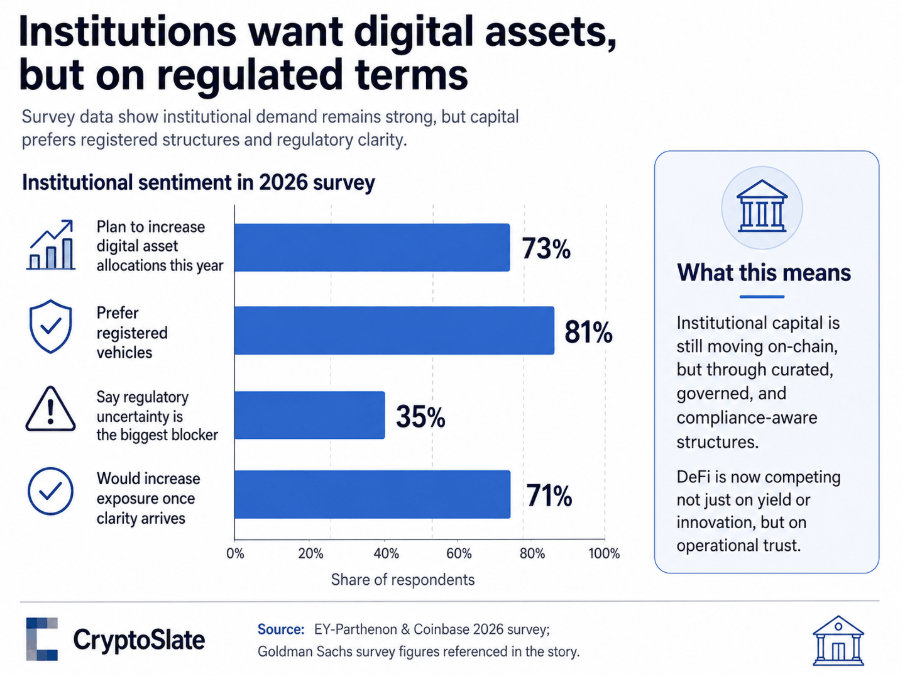
EY-Parthenon and Coinbase’s 2026 survey found 73% of institutional respondents plan to increase digital asset allocations this year, but 81% prefer registered vehicles. Capital is moving on-chain through curated, governed, and compliance-aware structures.
The regulated alternative is accelerating on the other side of that same preference.
The GENIUS Act created the first federal framework for US stablecoins, with mandatory 100% reserve backing, no rehypothecation, and custody standards that Nadareski said “read like something a compliance desk could approve.”
A Goldman Sachs survey found 35% of institutional investors named regulatory uncertainty their biggest blocker, and 71% said they would increase exposure once clarity arrived.
Nadareski said, “The floor is in place, the capital is waiting.” The CLARITY Act, which would define jurisdictional and custodian standards for digital assets, including tokenized securities, awaits consideration by the Senate Banking Committee as of May 14.
When that passes, Nadareski argued that “the last item on most institutional checklists gets checked off. The waiting ends.” DeFi is competing for institutional capital against a nearly complete regulatory framework.
Pawlowski named the full list of DeFi recovery tools: governance combined with proper market isolation, automated and AI-assisted risk monitoring, selective timelocks on parameters that warrant them, circuit breakers, KYC when required by regulation, application-specific sequencing, and policy-aware block builders.
He added:
“What’s been missing is the willingness to use them, because every one [of the tools] involves a tradeoff against the maximalist version of decentralization the industry has marketed itself on.”
Abandoning that marketing position is the starting point, but it’s not easy.
Pawlowski noted that “the crypto industry has spent years pretending it can have everything”, such as full decentralization, censorship resistance, institutional-grade safety, and retail accessibility, without tradeoffs.
It was “that fantasy that produced the conditions for these exploits.” A regulated institutional credit facility on-chain is a different product from a permissionless retail lending market, and governing both under the same orthodoxy created the conditions that let aggressive rsETH listings clear governance while structural bridge-security parameters sat unflagged for years.
Pawlowski believes the structural fix requires ending “the conflicts that let aggressive listings get waved through low-turnout governance votes by service providers with commercial relationships on both sides of the trade.”
SparkLend’s independent pruning, versus Aave’s eMode expansion on the same day, is proof that different risk philosophies yield different outcomes.
DeFi needs to institutionalize that distinction, build governance structures around it, and make the tradeoffs explicit to every user and institution evaluating the protocol.
Amador’s operational prescription attacks the same problem from the execution layer.
DeFi must professionalize security in the same way it professionalized liquidity incentives via continuous audits, live bug bounty programs, formal verification where appropriate, independent security councils, stronger multisig thresholds, hardware-backed key management, real-time monitoring, public incident response playbooks, and mandatory risk reviews for every major integration.
Circuit breakers and isolation mechanisms should be built so that losses from a compromised asset, adapter, or dependency stay bounded within the affected market.
The benchmark for evaluating protocols should expand to cover security posture alongside yield and total value locked: who audited it, what the active bounty size is, how admin keys are managed, what dependencies exist, what the emergency procedure covers, and how quickly a threat can be contained.
Users and institutions should be able to compare protocols on those dimensions the way they compare APR.
| Capability | Why it matters | What it looks like in practice |
|---|---|---|
| Market isolation | Prevents one compromised asset or dependency from contaminating a shared pool | Isolated markets, curated vaults, bounded-loss design |
| Governance independence | Reduces conflicts in asset onboarding and risk decisions | Independent risk councils, external review, lower-conflict voting structures |
| Real-time monitoring | Helps detect fast-moving failures before losses spread | Live monitoring, AI-assisted surveillance, dependency tracking |
| Emergency controls | Gives protocols a way to contain incidents quickly | Circuit breakers, timelocks, pause functions, emergency councils |
| Stronger key management | Reduces admin-key and signer risk | Higher multisig thresholds, hardware-backed keys, better signer hygiene |
| Continuous security review | Keeps risk assessment dynamic rather than one-time | Mandatory reviews for major integrations, recurring audits, formal verification where appropriate |
| Incident response readiness | Improves containment and recovery when something breaks | Public response playbooks, recovery guardians, predefined recovery procedures |
| Security transparency | Lets users and institutions compare protocols beyond yield | Clear disclosure of audits, bounty size, dependencies, admin controls, and response plans |
A reform is already underway, as KelpDAO has begun migrating rsETH to Chainlink CCIP, LayerZero has banned 1-of-1 verifier configurations protocol-wide, and Aave Proposal 477 authorized liquidation of attacker positions, with recovered assets routed to a Recovery Guardian multisig.
Phase II of that proposal covers burning excess rsETH on Arbitrum, restoring bridge backing, reopening withdrawals, and compensating affected users.
Arbitrum’s Security Council separately froze 30,766 ETH tied to the attacker’s downstream funds.
That recovery required emergency councils, DAO votes, multisigs, and court proceedings, comprising a crisis-management stack drawn from the institutional finance playbook, deployed within a system that describes itself as permissionless.
DeFi reaches for those tools when losses get large enough, and protocols can embed them in advance or reconstruct them while a crisis unfolds.
Nadareski identified the specific prize at stake for institutions choosing between DeFi and regulated alternatives.
Compliance officers want circuit breakers, time-locks, and custody standards that match their existing playbooks, and Wall Street has been building that wrapper for years.
Nadareski said:
“The banks that move fastest will be the ones that stop trying to build everything in-house. Spinning up on-chain settlement with legacy teams puts you at 2028 if everything goes right. The play that ships this year is pairing established distribution and customer relationships with teams who already have the rails built.”
Composability is DeFi’s strongest argument for keeping the rails it built. A single protocol that executes a trade, manages collateral, routes liquidity, and automatically settles a transaction within seconds represents a capability that traditional finance can only replicate by rebuilding from the ground up.
Composability works as an institutional argument only if failures stay local. Once a bridge verifier, a governance vote, or a compromised oracle can transmit losses across shared liquidity pools at scale, composability operates as contagion infrastructure.
Amador noted:
“Trust the code is not enough when protocols depend on bridges, multisigs, governance processes, or external assets. The new standard has to be: assume every layer can fail, and design systems so one failure does not cascade into the entire market.”
Pawlowski framed the necessary changes as “growing up,” describing a sector that must accept and publish explicit tradeoffs, build genuinely independent governance structures, and make security a product feature that users and institutions can evaluate and compare.
DeFi built the composable infrastructure that tokenized markets are now adopting. Stablecoin rails, lending primitives, and liquidity mechanisms that originated inside permissionless DeFi are being packaged into products that Wall Street is shipping under regulatory cover.
If DeFi builds the operational maturity to match its technical architecture, composability remains the one capability beyond the reach of regulated wrappers. If DeFi fails to build that maturity, Wall Street captures the stablecoin and tokenization layer and, with it, the argument that open composable finance lacked the operational discipline serious capital requires.

Ethereum whale Garrett Jin deposited $178 million worth of ETH into Binance on May 8. BlackRock and Fidelity also sent a combined 35,394 ETH to Coinbase Prime within hours.
The combined flow exceeded 113,000 ETH valued at nearly $260 million. The transfers hit exchange-linked platforms as US spot Ether exchange-traded funds (ETFs) absorbed $103.5 million in outflows the day before.
The whale, tagged on-chain as #BitcoinOG1011, still holds 303,618 ETH worth roughly $692.5 million. The address also retains 9,343 bitcoin (BTC).
Jin moved 165,000 ETH to Binance two days earlier in a similar pattern. The former BitForex chief executive built his reputation on outsized directional bets.
His track record includes a $735 million BTC short placed before the October 2025 crash. The wallet has rotated between BTC and ETH multiple times in 2026.
Whether the latest deposit reflects spot selling, hedging, or portfolio rebalancing is not visible on-chain.
Elsewhere, BlackRock’s iShares Ethereum Trust sent 11,475 ETH worth $26.27 million to Coinbase Prime three hours before the whale move. Fidelity followed with 23,919 ETH worth $54.44 million within the next hour.
ETF deposits to Coinbase Prime do not always translate into spot sales. Issuers regularly use the platform for redemption baskets, custody shifts, and authorized participant flows tied to investor activity.
However, moving coins to exchanges may also signal intention to sell, in which case the moves by Gareth, BlackRock, and Fidelity could ultimately translate into selling.
Both moves coincide with $103.51 million in net outflows from US spot Ether ETFs on May 7. Fidelity’s FETH led with $62.26 million in redemptions, followed by BlackRock’s ETHA at $26.31 million.
ETH traded near $2,289 as of this writing. Traders will watch ETF flow updates and Binance order books for signs the deposits convert into visible spot-market selling.
The post Ethereum Price Braces For a Major $260 Million Shock appeared first on BeInCrypto.

Bitcoin
The rally is not just about price, but about the ripples beneath the surface.
Further gains look likely because bitcoin has topped two levels that on-chain analysts consider among the most important in the market: The True Market Mean at $78,200 and the Short-Term Holder Cost Basis at $79,100.
Here is why those numbers matter. The True Market Mean is the average price active bitcoin investors paid for the coins they currently hold. The metric doesn’t count every bitcoin ever mined, including those sitting dormant for years or lost, but focuses on coins that are actually changing hands between investors.
That makes it a cleaner estimate of the level that matters most to people that are active in the market. When bitcoin trades above it, most active investors are in profit, and when it falls below it, many are underwater. That’s why analysts use it to gauge sentiment, spot periods of market stress or euphoria, and identify potential mean-reversion zones.
Speaking of the short-term holder cost basis, it represents the average acquisition cost for people who acquired coins less than six months ago. Again, this tells us the price that matters to traders, not long-term dormant holders.
Hence, when the spot price breaks above both these levels, it is said to reflect a bullish outlook.
“Should price sustain above these two levels in the coming week, the deep value regime that persisted from early February 2026 through now would rank among the shortest episodes of its kind in Bitcoin market history,” analysts at research firm Glassnode said in a report.
“Attention now shifts to the next major resistance at the Active Realized Price near $85.2k, which tracks the cost basis of all non-dormant supply and represents the next structural threshold the market must reckon with,” they added.
As of writing, bitcoin traded near $80,800, well above the true market mean and the short-term holder cost levels.
A subtle shift is underway in the futures market that could help push bitcoin higher.
The signal comes from funding rates, the small recurring payments traders make to keep leveraged futures bets open. For most of the past three months, funding rates were negative, indicating unusually heavy demand to bet against bitcoin in futures markets.
Much of that activity likely came from hedge funds and institutional traders running a popular arbitrage strategy: buying bitcoin or spot bitcoin ETFs while simultaneously shorting futures contracts. That trade created steady selling pressure in the futures market even as bitcoin rallied.
Now, funding rates have flipped back to neutral or slightly positive. That suggests many of those short positions have already been closed, removing a key source of downward pressure on the market.
It also raises the possibility of a short squeeze. If bitcoin continues rising, traders still betting against it may be forced (squeezed) to buy back futures contracts to exit their positions, which can accelerate gains.
“The flip toward neutral doesn’t invalidate the carry trade; it indicates that shorts paying for the privilege are no longer present at scale. Either funding migrates back negative as new ETF capital recreates the trade or the squeeze has further to run,” analysts at OG exchange Bitfinex said, explaining potential for more gains ahead.
The third signal comes from the options market, where traders use contracts to position for or protect against price moves. Calls are bullish bets that give upside exposure if bitcoin rises, while puts are used as insurance against downside risk.
Options positioning is now set up in a way that could amplify the current move higher.
Market makers, the firms that provide market liquidity, have what’s known as “short gamma” exposure around the $82,000 level, with roughly $2 billion sitting near current prices, according to Glassnode.
Short gamma matters because it forces these dealers to hedge in the direction of the prevailing trend, which is bullish, to stay balanced.
In practice, that means as bitcoin pushes higher, dealer hedging itself can add incremental buying pressure, potentially accelerating the rally toward $85,000. Market makers make money by providing liquidity, meaning they try to stay neutral on price direction rather than betting on it.
But this cuts both ways. If the market turns lower, these same dealers would likely have to hedge in the opposite direction, selling into the decline, which can add to downside pressure.
“Short gamma means dealers are positioned in a way that forces them to hedge in the direction of the move, buying as price rises and selling as it falls. This creates a feedback loop that can accelerate price action, which helps explain the recent push toward $83K,” Glassnode explained.
None of the things discussed above happens in a vacuum. Bitcoin still trades closely with U.S. tech stocks, so if equities suddenly turn risk-off, it can quickly slow the momentum or even pause the trend altogether.

According to a recent local report from Bits Media, Russia’s largest securities exchange is planning to start calculating and publishing indexes tracking the performance of some of the most popular altcoins, such as XRP, SOL, TRX, and BNB.
The data for the new products will come as follows: 50% from Binance, 20% from Bybit, and 15% from OKX and Bitget.
Russia’s Largest Securities Exchange to Launch SOL, XRP, TRX and BNB Crypto Indexes
The Moscow Exchange will begin publishing four crypto indexes tracking SOL, XRP, TRX and BNB from May 13, using pricing data from Binance (50%), Bybit (20%), OKX (15%) and Bitget (15%).
Existing… pic.twitter.com/SIUCvugd4D
— Wu Blockchain (@WuBlockchain) May 5, 2026
The update reveals that already existing indexes such as MOEXBTC and MOEXETH will display time-sensitive information every 15 seconds during trading sessions. As of now, they are being updated only once per day, and the results are published no later than 18:00 Moscow time.
The Moscow Exchange will also expand its crypto benchmarks to 10 in the near future, with some of the potential names being: Dogecoin, Cardano, Hyperliquid, and Chainlink.
It’s worth noting that these instruments are available only for professional investors, the report clarified.
The exchange’s head product manager, Maria Silkina, recently informed that the company also plans to launch certain derivatives tracking the performance of the two largest cryptocurrencies by market cap.
The new indexes tracking SOL, XRP, BNB, and TRX come in a rather positive time for the digital asset industry, as prices have headed north over the past few weeks. BTC is up to a multi-month peak at over $80,000, while some altcoins are trying to follow suit.
The post Ripple (XRP) Sees Big Adoption Boost in Russia: Here’s What You Need to Know appeared first on CryptoPotato.

On stage, co-founder and CEO JP Richardson opened by talking about the company’s derailment at the New York Stock Exchange in May 2024, when Exodus flew 130 employees, friends, and family to Manhattan only to learn the night before that regulators had pulled its listing.
He described the reversal as a rule change at “the 11th hour” that left a room of supporters stunned and forced the company back into private status despite having, in his telling, followed the playbook.
That episode ended months later after the U.S. election, when Exodus finally listed on NYSE American in January with the same team, ticker, and business, but under a new administration more open to digital asset companies.
Richardson framed that saga as proof that Exodus can absorb political and regulatory shock while holding to a single principle: money belongs under user control.
Exodus, founded in 2015 in Omaha, built a self-custodial wallet that stores keys on user devices and routes swaps across multiple liquidity providers, offering access to Bitcoin and other assets without ever holding customer funds in company accounts.
The CEO argued that crypto still fails normal users on basic usability. He recounted an early experience helping a friend download four different wallets and write a 12-word seed phrase on a cocktail napkin, a ritual he said still defines too many products a decade later. Richardson called this the “pub test”: if a friend in a bar cannot safely set up a wallet without resorting to napkins, the industry has missed the mark.
He extended that critique to chain tribalism, insisting that consumers do not care whether payments settle on Solana, Ethereum, Arbitrum, or Base as long as the experience works.
To make the point concrete, he asked the audience to pull out their phones and count how many apps they use for money. The typical screen, he said, shows a bank app, person-to-person payment apps, a brokerage account, and often a separate crypto wallet.
He cast this fragmentation as a structural problem that leaves consumers juggling providers who do not share their interests.
Exodus wants to replace that cluster with “one app” that holds digital assets, connects to card networks, and routes payments while keeping users in self-custody.
A central reveal at the summit was the closing of the Monavate and Baanx UK acquisitions, a move that shifts Exodus from “renting the rails to owning them,” in Richardson’s phrase.
Monavate and Baanx supply regulated card issuing, acquiring, and processing infrastructure in the UK and EU, including BIN sponsorship, Visa and MasterCard membership, and fraud systems that already support crypto brands such as Ledger and MetaMask.
Exodus previously agreed to acquire their parent, W3C Corp, in a roughly $175 million deal aimed at building an on-chain payments stack; the company later enforced a $70 million secured loan against that group in UK receivership to protect its position.
With those assets, Exodus gains the ability to issue and process cards directly rather than acting as a program that rides on third-party rails.
CFO James Gernetzke said the combined platform now supports six layers of activity, from the core wallet and swap engine to stablecoin issuance, card programs, and banking rails, giving Exodus “owner economics” on each step of a transaction.
On stage, he walked through a £100 purchase example, explaining that where Exodus once retained a fraction of the economics as a client of Monavate and Baanx, it now captures a larger share through interchange, processing fees, and interest on float.
Richardson and Gernetzke both made it clear that Exodus is trying to grow past a trading‑centric model after a peak year in 2025, when it generated $121.6 million in revenue and $11 million in adjusted EBITDA on a base of roughly 1.5 to 1.6 million monthly active users.
In early 2026, the limits of that dependence on crypto cycles came into sharper focus: preliminary first‑quarter results show revenue falling to $22.7 million from $36.0 million a year earlier, a $36.4 million net loss on digital assets, and a 22% quarter‑over‑quarter drop in exchange volume to $1.18 billion, even as monthly active users held at 1.5 million and funded users slipped to 1.4 million.
Gernetzke described the tight correlation between trading revenue and Bitcoin’s price as a ceiling the company needs to break.
Exodus Pay, now live in all 50 states, is the clearest expression of that strategy. Embedded in the core wallet, it lets users spend USD‑backed stablecoins, Bitcoin, and other assets anywhere Visa or Apple Pay works, while keeping keys in self‑custody and turning every checkout into interchange, processing, and float income.
Later in the Summit at a fireside chat, Richardson cast that stack as infrastructure not only for today’s users but for AI agents that will execute autonomous payments across the same rails.


