

A home-scale Bitcoin miner with roughly 161 terahashes per second (TH/s) of computing power found block 975,427 on Wednesday and collected the full reward of 3.154 BTC, worth about $231,800 at current prices.
The block was mined at 11:08 UTC on Nov. 11 through CKPool’s solo service, which is labeled “Solo CK” in mempool.space’s block data. It is another reminder that solo mining bitcoin is still a live option on an open network, even in an industry dominated by publicly listed giants.
What the Blockchain Shows About Block 975,427
Block data from mempool.space confirms the basics. Block 975,427 carried 3,414 transactions. The coinbase paid out 3.15405535 BTC, made up of the 3.125 BTC block subsidy plus 0.02905535 BTC in transaction fees.
The payout went to a single address ending in “g4m7.” In solo mining that is the whole point: the miner who finds the block keeps the entire reward instead of sharing it with thousands of other pool members.
The CKPool solo operator said the find was the service’s 321st block since launch. He estimated that a miner of this size has about a one in 126 chance of solving a block in a year.
At Bitcoin’s price of roughly $73,509 on Wednesday, the reward came to about $231,800. That is a life-changing sum for a hobbyist, and it was paid within one block of being mined, with no bank, broker or permission involved.
How Long Were the Odds for a Solo Miner?
Bitcoin produces a new block about every 10 minutes, or around 52,560 blocks a year. Each block is effectively a fresh draw, and a miner’s chance of winning it equals its share of total network hashrate.
Mempool.space put the network’s hashrate at about 960 exahashes per second (EH/s) on Wednesday. Against that, a 161 TH/s machine controls about 0.00002% of the network. That works out to roughly a 1 in 6 million chance of finding any single block.
Over a full year, the odds improve sharply. Our calculation, assuming the network’s hashrate stays flat, gives a 161 TH/s miner about a 0.88% chance of at least one block in 12 months, or roughly 1 in 114. That is close to the operator’s own estimate. The small gap mainly comes from which hashrate figure is used.

ADVERTISEMENT
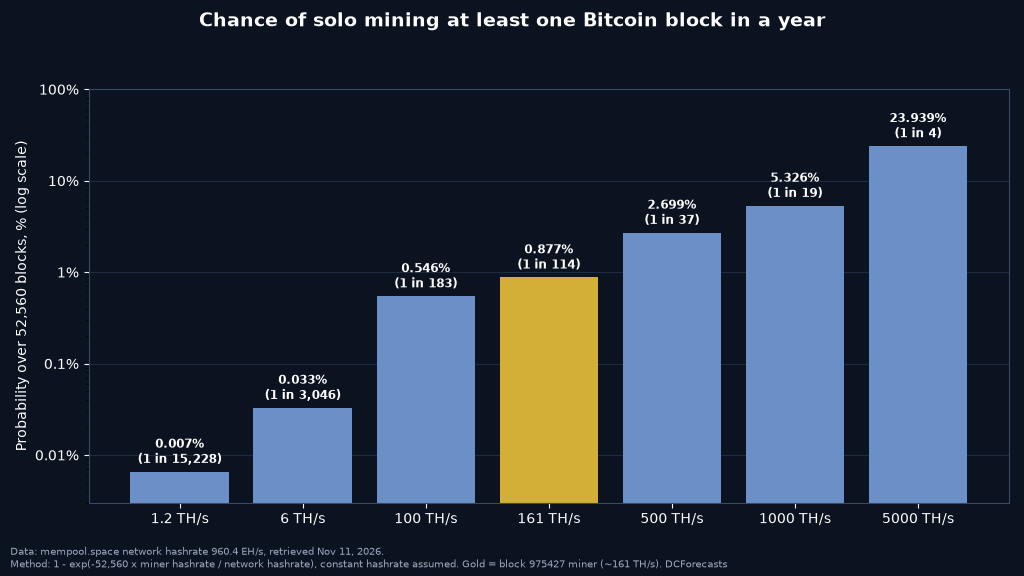
The chart shows how steeply the odds scale. A 1.2 TH/s miner faces odds of about 1 in 15,000 per year. A 5,000 TH/s miner, around 5 petahashes, would have roughly a one in four chance.
For comparison, the odds of winning the Powerball jackpot with one ticket are about 1 in 292.2 million. A single 10-minute Bitcoin draw at 161 TH/s is around 49 times more favorable than one Powerball ticket, and the Bitcoin lottery runs 144 times a day.
Solo Mining Bitcoin Pays the Same on Average, Just Unevenly
Solo mining doesn’t raise a miner’s expected income. It changes how that income arrives.
At Wednesday’s hashrate, a 161 TH/s rig would expect to find about 0.0088 blocks a year on average. At 3.15 BTC per block, that is roughly 0.028 BTC a year, the same expected value a pool would pay out in small, steady installments before fees.
The solo miner gives up those regular payouts for a small chance at the full block reward. Most solo miners will never hit a block. A few, like the owner of the “g4m7” address, will collect years of expected earnings in one go. Power bills arrive either way, so it is a bet on variance, not a shortcut to profit.
That choice is only possible because Bitcoin has no gatekeeper. Any machine pointed at the network competes on equal terms for every block, with no application, license or minimum size.
How Many Blocks Do Solo Pools Find?
Solo wins are still rare in absolute terms. In mempool.space’s 12-month pool ranking, which covered 52,284 blocks, pools tagged as solo services found 21 blocks between them.
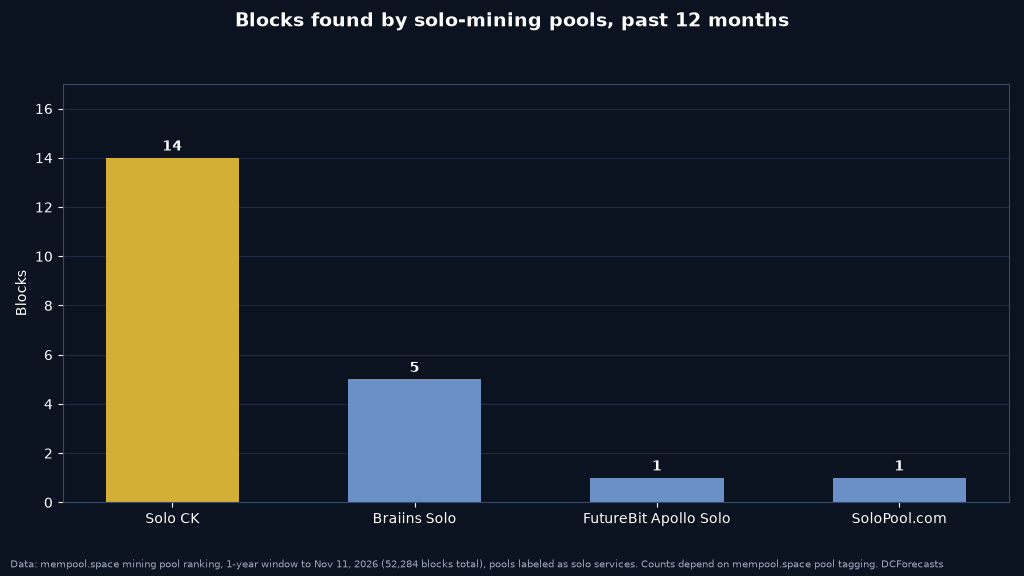
Solo CK led with 14 blocks, followed by Braiins Solo with five. FutureBit Apollo Solo and SoloPool.com had one each. Together, they found about 0.04% of all blocks in the period.
Those tallies are based on how mempool.space tags each block, so they may not match counts published by the operators themselves. Even so, the trend is clear: independent miners are still landing full blocks on a regular basis.
Why Small Miners Matter for Bitcoin
Large pools find the vast majority of blocks, and most hashrate is concentrated in big data centers. Each solo block is a visible sign that the protocol still treats every participant the same.
That matters for decentralization. Solo miners build their own block templates through their pool software, which adds independent voices to the process of choosing which transactions go into blocks.
The timing is also friendly to newcomers. As DCForecasts reported, Bitcoin’s mining difficulty is heading for its biggest cut since June, which would slightly improve every miner’s odds per hash. Fees have stayed low, too, with blocks nearly full at around 1 satoshi per vByte. That is why this block’s fees added only about 0.029 BTC to the subsidy.
A $231,800 Reminder That the Network Is Open
Block 975,427 won’t change Bitcoin’s hashrate distribution. Pools will keep winning most blocks, and most solo miners will keep waiting.
But every solo win shows something no other financial system offers: a person with a single machine competing directly with industrial operators under the same rules, and being paid in full the moment they win.
With roughly 52,560 draws a year and a protocol that doesn’t care who holds the ticket, the next solo winner could appear at any time.
DC Forecasts is a leader in many crypto news categories, striving for the highest journalistic standards and abiding by a strict set of editorial policies. If you are interested to offer your expertise or contribute to our news website, feel free to contact us at [email protected]


