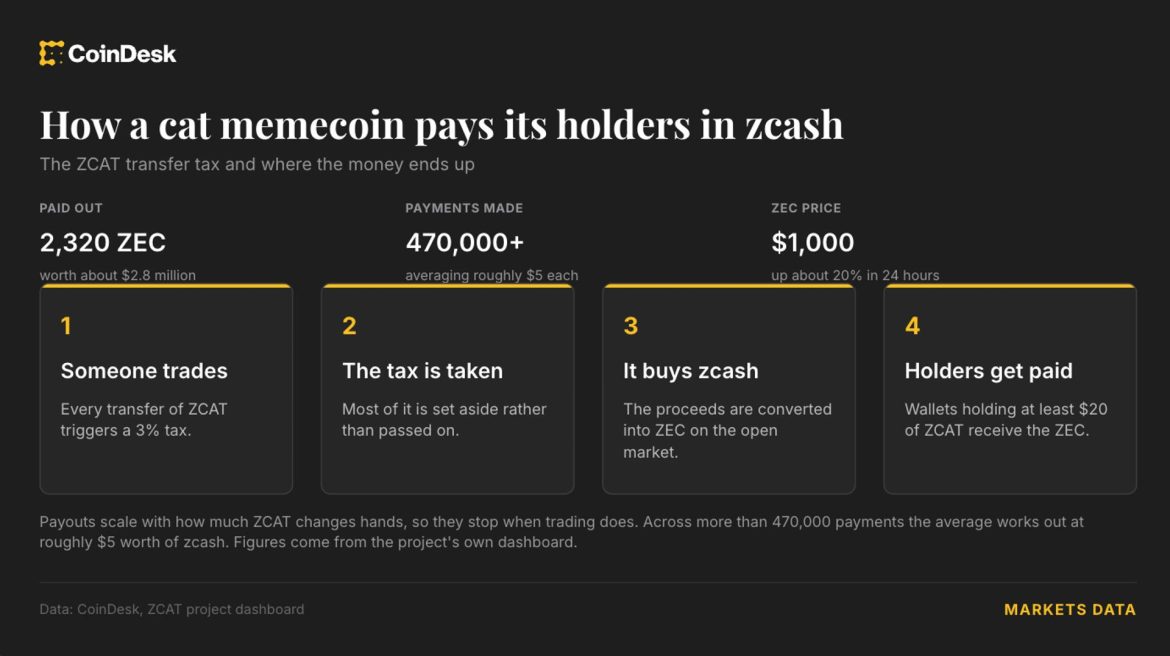
A brand new ZCAT token charges a 3% tax whenever the token moves and uses the proceeds to distribute ZEC to holders, creating an unusual link to one of crypto’s hottest assets.
ZEC
Social chatter around ZEC hit six times its August baseline before the price peak, then vanished as the ETF launched.
Zcash has been one of the best-performing assets this year. It has managed to attract significant institutional capital. This week, asset manager Grayscale Investments launched the first exchange-traded fund that tracks the spot price of ZEC.
But interest in the privacy-focused token peaked shortly before its price reached a recent high.
Zcash Crowd Showed Up Early
Data shared by Santiment revealed that social chatter faded by the time the ZEC spot ETF launched. Grayscale converted its 2017 Zcash trust into a spot ETF, which began trading on NYSE Arca on August 25.
Ahead of the launch, the asset climbed from around $509 on August 18 to about $878 on August 23, posting a gain of roughly 72%. Social mentions reached 232 on August 22, which is around six times the usual August baseline. However, that surge in attention did not last.
Mentions had returned to their baseline level by the ETF’s launch day. According to Santiment, social activity peaked one day before ZEC’s price high, which suggested that much of the crowd interest arrived ahead of the market’s high.
Since reaching about $878, the token has pulled back to roughly $789, a decline of around 10% from the recent peak.
Zcash Challenging Bitcoin?
Grayscale Research believes ZEC could emerge as a serious challenger to Bitcoin’s network effects as demand for financial privacy grows. In a report by Head of Research Zach Pandl, the firm said Bitcoin remains dominant among digital currencies. While alternatives such as Litecoin have emerged, none has seriously challenged BTC’s position.
You may also like:
Grayscale, however, stated that Zcash could be different because it combines Bitcoin-like characteristics with privacy features that may become more important as AI-powered surveillance expands. The report also points to the ecosystem’s active development, which aims to address cybersecurity risks, including potential threats to traditional cryptography from quantum computing.
Another advantage is its cross-chain reach through “intents” technology built into modern blockchain wallets, which allows Zcash to function as a private asset hub without requiring broad merchant adoption. ZEC has already gained around 19 times over the past year but remains worth less than 1% of Bitcoin’s market capitalization. Grayscale said Zcash’s financial privacy and other features may be undervalued, thereby leaving room for further upside.
BitMEX co-founder, Arthur Hayes, liquidates all his ZEC, HYPE, and NEAR tokens
- Hayes exited ZEC after an Orchard privacy bug raised supply doubts.
- He also liquidated HYPE and NEAR while rotating his portfolio.
- The Zcash flaw was patched, but future exploitation cannot be ruled out.
Arthur Hayes, co-founder of BitMEX, has fully exited his positions in Zcash (ZEC), Hyperliquid (HYPE), and NEAR Protocol (NEAR).
The decision comes at a time when the crypto market is still digesting the implications of a flaw found in the Orchard shielded pool, a core component of Zcash’s privacy system.
The move has drawn attention across the digital asset space, not only because of Hayes’ profile as a macro investor, but also due to the nature of the vulnerability, which raised questions about the integrity of ZEC’s supply mechanics inside its shielded environment.
Orchard vulnerability triggers uncertainty in Zcash
The trigger for the sell-off was a vulnerability discovered in the Orchard shielded pool, which is designed to enable private transactions on the Zcash network using zero-knowledge proofs.
The issue raised concerns that, under certain conditions, it may have been theoretically possible to create counterfeit ZEC within the shielded system without immediate detection.
While Zcash developers moved quickly to deploy an emergency patch, the core concern was not just the existence of the bug itself, but the inability to verify whether it had ever been exploited before it was fixed.
Because shielded transactions are designed to be private, there is no straightforward way to retroactively audit all activity in a way that could definitively rule out past abuse.
Market reaction was immediate and sharp.
ZEC experienced a heavy sell-off, with its price falling by over 45% during the height of the reaction.
Liquidity thinned quickly as traders rushed to reduce exposure to an asset suddenly carrying uncertainty around its supply integrity.
The incident reignited a long-running debate around privacy-focused blockchain systems.
While zero-knowledge proofs are widely regarded as one of the strongest cryptographic tools available for privacy, they also introduce complexity that can make historical verification of state changes significantly more difficult compared to transparent blockchains.
Arthur Hayes exits ZEC, HYPE, and NEAR positions
Against this backdrop, Arthur Hayes confirmed that he had fully liquidated his ZEC holdings.
Hayes also closed positions in HYPE and NEAR, signaling a broader portfolio adjustment rather than a single-asset reaction.
Hayes described the situation in blunt terms, stating that what he previously referred to as his “Holy Trinity” thesis no longer held.
The key issue for Hayes was not confirmed exploitation. Instead, it was the presence of unresolved uncertainty.
Even with a patch in place, the inability to definitively prove whether counterfeit issuance had occurred prior to the fix created a level of risk he was no longer willing to carry in a privacy asset.
The Holy Trinity is dead. Sadly due to the Orchard Pool exploit, I had to dump our entire $ZEC bag.
– While I think it’s extremely unlikely of any minting, it cannot be formally cryptographically proved impossible
– The privacy from AI, govt, big tech narrative demands perfection…— Arthur Hayes (@CryptoHayes) June 5, 2026
Alongside the ZEC exit, Hayes also liquidated positions in HYPE and NEAR.
While no direct technical link was identified between those assets and the Zcash vulnerability, the simultaneous sell-off suggests a broader repositioning of capital rather than an isolated reaction.
Share this article
Categories
In brief
- Created in response to Bitcoin’s perceived limitations, Zcash offers privacy with zk-SNARK tech.
- In 2025, Zcash undergoes its halving, a funding overhaul, and a software migration—its biggest test yet.
- A decade on, Zcash is one of the privacy coins fighting for private, and decentralized payments.
For many years, Bitcoin was used to buy drugs online because it was believed to be anonymous. Turns out, it’s surprisingly easy to track Bitcoin transactions. Zcash, on the other hand, is a cryptocurrency that promised something Bitcoin couldn’t deliver: privacy.
How Zcash works
Zcash is designed to hide key transaction details, such as the sender, recipient, and amount. By using cryptographic techniques, transfers can be made that can’t easily be traced on a public ledger while remaining verifiable by the network.
Zcash allows transactions to be either transparent, like Bitcoin, or private using zero-knowledge proofs known as zk-SNARKs. This cryptography verifies that a transaction is valid without exposing the sender, recipient, or amount. It is a fungible cryptocurrency when coins are fully shielded, meaning tokens in the private pool are not linked to transaction history. However, most Zcash coins exist in the transparent pool, which, like Bitcoin, maintains a visible history.
The network maintains two pools of addresses: transparent (t-addrs) and shielded (z-addrs). Wallets such as ECC’s Zashi now default to shielding funds, encouraging greater privacy.
Who invented Zcash?
Zcash launched in October 2016 as a privacy-focused cryptocurrency developed by the Electric Coin Company (ECC), led by Zooko Wilcox-O’Hearn, drawing on research from Johns Hopkins, MIT, Tel Aviv University, and other institutions. Like Bitcoin, Zcash (ZEC) has a maximum supply of 21 million coins and block reward halvings every four years.
While ECC initiated Zcash, it does not own or control the blockchain. All upgrades require community approval, keeping development decentralized and open rather than directed by a single entity.
Did you know?
At its launch, Zcash relied on a “trusted setup ceremony” in which six participants each generated and destroyed a portion of a private key. This prevented anyone from being able to counterfeit ZEC.
In April 2022, Edward Snowden was revealed as one of the participants in the ceremony. “He did it as a service, as a public good, and believing in privacy,” Josh Swihart, former CEO of the Electric Coin Company, told Decrypt.
Key dates
- May 2013: Zerocoin proposal at Johns Hopkins marks the start of privacy-focused crypto research that leads to Zcash.
- January 2016: Zooko Wilcox formally announces the Zcash project as a privacy-oriented Bitcoin fork.
- October 2016: Zcash launches after its trusted setup ceremony, and the network goes live. Zcash reached an all‑time high of $5,941.80.
- October 2018: The Sapling upgrade activates, improving the speed and efficiency of shielded transactions.
- December 2019: The Blossom network upgrade takes place, increasing block frequency.
- November 2020: Zcash goes through its first halving.
- May 2022: Network Upgrade 5, including the Orchard upgrade, rolls out, reducing reliance on earlier complex setup “ceremonies” for new shielded pools, and allowing Zcash users to make private digital cash payments on mobile phones with a new address format called unified addresses.
- April 2022: Edward Snowden is publicly revealed as “John Dobbertin,” a participant in the original launch ceremony who contributed to the trusted setup but was not an architect.
- November 2024: The second Zcash halving takes place.
- January 2026: The Zcash Foundation announces that the SEC has ended its investigation into the nonprofit without recommending enforcement action.
- January 2026: The CEO of the Electric Coin Company announces that his entire team was “constructively discharged” following a disagreement with its non-profit board members.
- November 2028: Zcash’s third halving is scheduled to take place.
How is Zcash produced?
Zcash, like Bitcoin, uses proof-of-work (PoW) to validate transactions, but it runs on the Equihash algorithm—a memory-hard hashing function designed to make mining fairer and more resistant to ASIC hardware, and the consensus mechanism Zcash originally adopted to secure its network.
Currently, Zcash miners receive 80% of each block reward, while 20% goes to development funds that support the Electric Coin Company (ECC), the Zcash Foundation, and community grants. This development funding structure is governed by community decision and is set for renewal or revision after the upcoming halving.
Zcash is a peer-to-peer cryptocurrency designed for everyday payments. Users can choose between transparent transactions that are regulator-friendly and shielded transactions that enhance privacy. This optionality has helped Zcash remain listed on more major exchanges than some other privacy coins, such as Monero, which are avoided by certain platforms due to regulatory constraints.
Bitcoin has heavily influenced Zcash. Like the number one cryptocurrency, Zcash is designed to be used for everyday purchases. Its various privacy features mean it can also be used to send or receive transactions hidden from prying eyes.
Zcash, regulators and law enforcement
Around the world, regulators and law enforcement agencies have increased scrutiny of privacy coins, arguing that their anonymity features can be misused for money laundering or sanctions evasion. In the United States, the Treasury Department’s Financial Crimes Enforcement Network has proposed tighter rules for “anonymity-enhanced cryptocurrencies.”
“Several types of [anonymity-enhanced cryptocurrencies]—including Monero, Zcash, Dash, Komodo, and Beam—are growing in popularity and use technologies that make it difficult for investigators to trace blockchain transactions or connect them to individuals involved in illicit activity,” regulators wrote in 2020.
As enforcement of the cryptocurrency market ramped up, exchanges began delisting privacy coins. In November 2020, privacy-centric exchange ShapeShift delisted Monero, Dash, and Zcash to limit the company’s regulatory risk. In January 2021, Bittrex delisted Zcash, Monero, and Dash, and in 2023, OKX delisted the same privacy coins—only to relist Zcash in November 2025 during the cryptocurrency’s price surge. As of 2026, Zcash was still listed on Binance, but in April 2025 it was added to the exchanges’ list of cryptocurrencies that the community could vote on to delist.
The future of Zcash
With regulators tightening surveillance of digital assets and privacy coins facing mounting scrutiny, Zcash is entering its most pivotal period yet. A halving, a major funding overhaul, and a migration to new software are converging to test whether a privacy-focused cryptocurrency can survive under pressure.
Nearly a decade after its launch, Zcash returned to the spotlight for market reasons. In November 2025, the token surged to a high of $698.87, according to CoinGecko data. Its rise was fueled in part by prominent figures on social media highlighting Zcash’s community, privacy design, and technical improvements.
By December 2025, Zcash was again in the spotlight and seeing renewed institutional interest, including Zcash founder Zooko Wilcox taking an advisory role at a firm building a large ZEC treasury.
In January 2026, Zcash entered a turbulent stretch marked by sharp price swings, internal conflict, and regulatory development, with the Zcash Foundation announcing that the U.S. Securities and Exchange Commission had closed a long-running investigation without recommending enforcement action.
What excitement the SEC decision may have drawn was short-lived. In early January, the entire team at Electric Coin Company said it had been “constructively discharged” following a disagreement with the majority of Bootstrap’s board members, a 501(c)(3) nonprofit created to support Zcash.
Following their departure, former ECC CEO Josh Swihart announced that he and his former colleagues would launch a new project, cashZ, set to focus on full-stack Zcash development including a new Zcash-focused wallet.
Elsewhere, independent Zcash development group Shielded Labs, whose contributors include Zooko Wilcox, received approximately $1.16 million in funding from Gemini and Facebook founders Tyler and Cameron Winklevoss, with the goal of “strengthening the long-term security, sustainability, and scalability of the Zcash network.”
Zcash’s next halving is scheduled for November 2028. The current development fund ends at the same time, and the community is debating new mechanisms. ECC is deprecating the C++ full node “zcashd” in favor of the Rust-based “zebrad,” with a new wallet called Zallet also in development.
These changes will shape Zcash’s cryptography, funding model, and user experience for years ahead.
This article was updated in January 2026 to reflect recent developments.
Daily Debrief Newsletter
Start every day with the top news stories right now, plus original features, a podcast, videos and more.
A key Zcash developer has published the first detailed blueprint for a dynamic fee market, opening a community discussion about how the decade-old network should price transactions as ZEC’s price, user activity and institutional interest climb.
The Monday proposal, released by Shielded Labs, lays out a shift away from Zcash’s historically static fee model — originally 10,000 ‘zatoshi,’ later cut to 1,000 — which worked during low demand but eventually contributed to “sandblasting” spam episodes that clogged wallets and congested the chain.
An earlier ZIP-317 proposal’s move to action-based accounting fixed the abuse vector, but retained predictable, low fees that don’t adjust to usage.
Action-based accounting treated every Zcash transaction component — such as spends, outputs, JoinSplits, Orchard actions — as a single uniform “action,” letting fees scale with activity rather than byte size.
Developers say that with ZEC’s recent resurgence, new retail onboarding and the emergence of Zcash digital-asset treasuries, the status quo is becoming less tenable.
It said some users have started to report rising transaction costs in ZEC terms, and edge-case scenarios — like large sets of tiny user transactions costing double-digit ZEC to shield — show how fee rigidity breaks down when token prices climb.
The proposed mechanism introduces a simple, stateless dynamic fee design built around “comparables,” or the median fee per action observed over the prior 50 blocks, padded with synthetic transactions to simulate always-on congestion.
The median becomes the standard fee, bucketed into powers of ten to reduce linkability and avoid leaking user information. Under stress, a temporary priority lane opens at 10× the standard fee, giving users a way to compete for block space without redesigning the protocol.
The system is designed to roll out in phases. First is off-chain for monitoring, then as wallet policy, and only later — if approved — as a simple consensus change with expiry-height limits and power-of-ten fee rules.
That avoids the complexity and fork risk of EIP-1559-style mechanisms while keeping Zcash’s privacy constraints intact.
Other ideas floated include using mining difficulty as a long-term heuristic for USD-denominated fees to tune prices based on mempool pressure.
ZEC traded around $395 on Tuesday, up more than 12% in 24 hours as traders digested the first concrete roadmap for fee reform since ZIP-317.