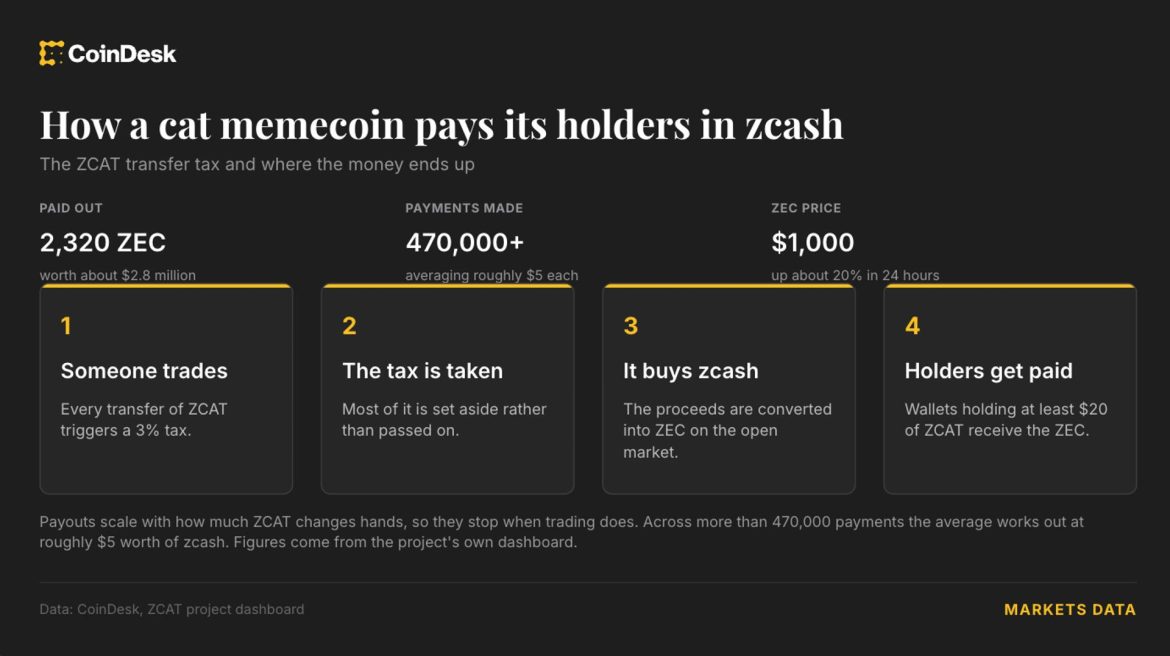
A brand new ZCAT token charges a 3% tax whenever the token moves and uses the proceeds to distribute ZEC to holders, creating an unusual link to one of crypto’s hottest assets.

 Live Chat
A brand new ZCAT token charges a 3% tax whenever the token moves and uses the proceeds to distribute ZEC to holders, creating an unusual link to one of crypto’s hottest assets.
Social chatter around ZEC hit six times its August baseline before the price peak, then vanished as the ETF launched.
Zcash has been one of the best-performing assets this year. It has managed to attract significant institutional capital. This week, asset manager Grayscale Investments launched the first exchange-traded fund that tracks the spot price of ZEC.
But interest in the privacy-focused token peaked shortly before its price reached a recent high.
Data shared by Santiment revealed that social chatter faded by the time the ZEC spot ETF launched. Grayscale converted its 2017 Zcash trust into a spot ETF, which began trading on NYSE Arca on August 25.
Ahead of the launch, the asset climbed from around $509 on August 18 to about $878 on August 23, posting a gain of roughly 72%. Social mentions reached 232 on August 22, which is around six times the usual August baseline. However, that surge in attention did not last.
Mentions had returned to their baseline level by the ETF’s launch day. According to Santiment, social activity peaked one day before ZEC’s price high, which suggested that much of the crowd interest arrived ahead of the market’s high.
Since reaching about $878, the token has pulled back to roughly $789, a decline of around 10% from the recent peak.
Grayscale Research believes ZEC could emerge as a serious challenger to Bitcoin’s network effects as demand for financial privacy grows. In a report by Head of Research Zach Pandl, the firm said Bitcoin remains dominant among digital currencies. While alternatives such as Litecoin have emerged, none has seriously challenged BTC’s position.
Grayscale, however, stated that Zcash could be different because it combines Bitcoin-like characteristics with privacy features that may become more important as AI-powered surveillance expands. The report also points to the ecosystem’s active development, which aims to address cybersecurity risks, including potential threats to traditional cryptography from quantum computing.
Another advantage is its cross-chain reach through “intents” technology built into modern blockchain wallets, which allows Zcash to function as a private asset hub without requiring broad merchant adoption. ZEC has already gained around 19 times over the past year but remains worth less than 1% of Bitcoin’s market capitalization. Grayscale said Zcash’s financial privacy and other features may be undervalued, thereby leaving room for further upside.
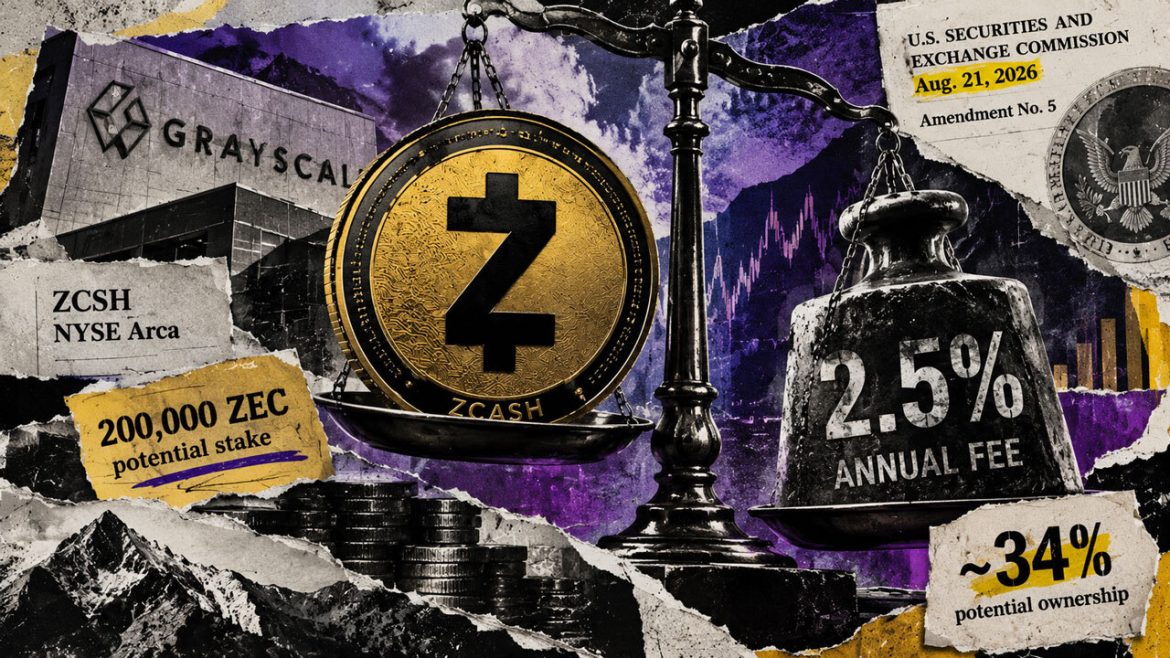
Grayscale’s proposed Zcash ETF would carry a 2.5% annual fee. Under one dated ownership calculation, a DCG affiliate could receive about 34% of the fund. If effective, the Aug. 21 SEC amendment would rename the existing trust “The Zcash ETF” and list it on NYSE Arca under ZCSH. The registration remains preliminary. The securities cannot yet be sold under it, and the SEC has neither approved nor disapproved them.
The ETF structure aims to fix the trust’s long-running price-tracking problem. To do that, large market intermediaries called authorized participants would create or redeem 10,000-share baskets when ZCSH’s market price moves away from the net value of the Zcash tokens, or ZEC, held by the fund. Grayscale expects that arbitrage to bring the two prices closer together.
The historical gaps were extreme. From Oct. 18, 2021, through June 30, 2026, ZCSH recorded a maximum 240% premium and a maximum 55% discount to net asset value. ZCSH’s average premium was 53%, and its average discount was 19%. The shares closed below NAV on 700 days. The filing placed the discount at 1% on Aug. 20, before the proposed ETF structure was operating.
Amendment No. 5 adds investor economics to the conversion’s market-structure case and its regulated-privacy question. The sponsor fee already applies to the trust. It accrues daily at 2.5% a year and is paid in ZEC. Over time, that reduces the tokens represented by each share. For up to 12 months after effectiveness, Grayscale intends to use all fees it receives for trust marketing and initiatives supporting Zcash development, marketing and education. The plan is voluntary, revocable and leaves the 2.5% fee intact.
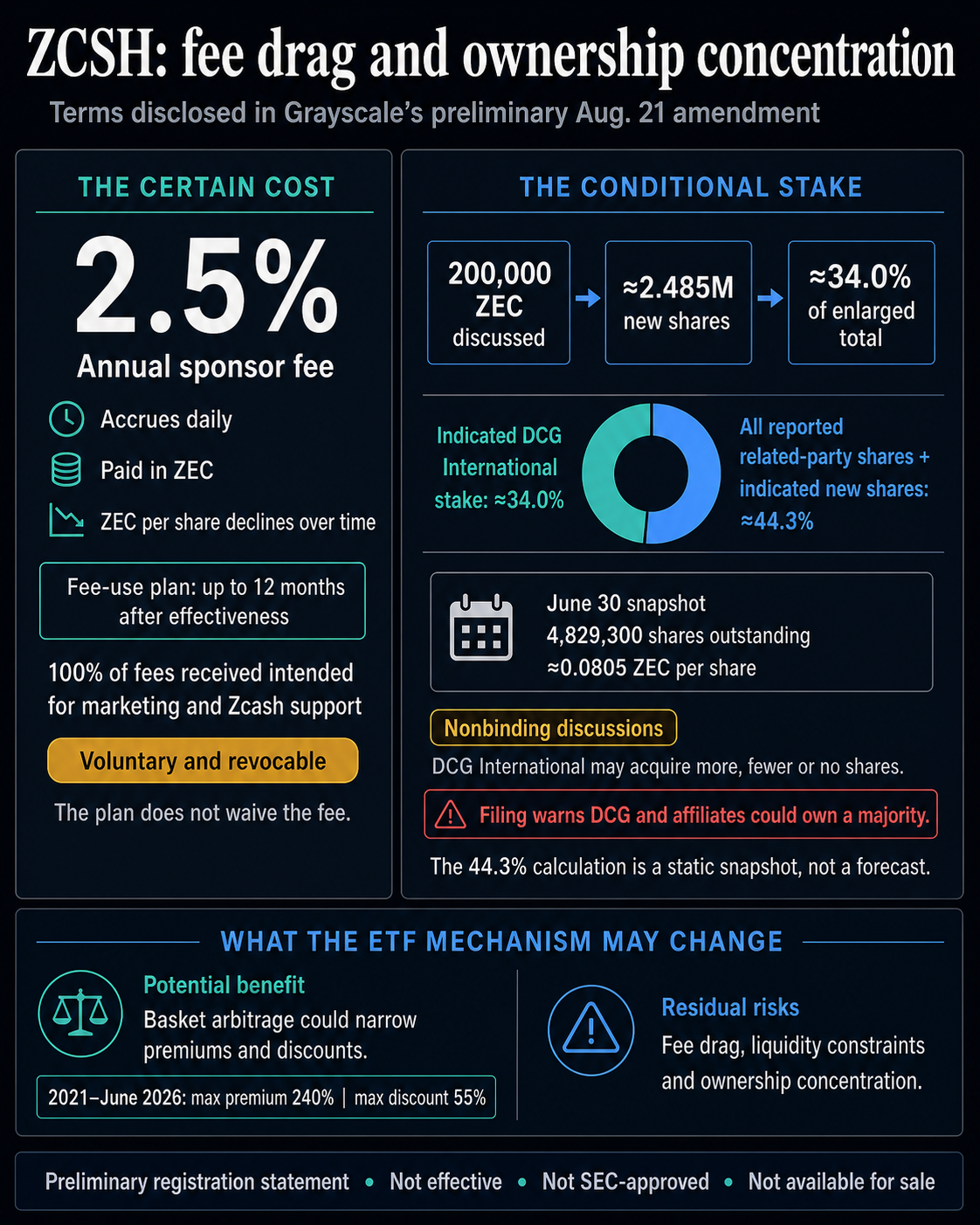
The filing warns that Digital Currency Group could own a majority through DCG International Investments Ltd. and other affiliates. That position could let the group control the trust’s limited shareholder votes and create conflicts with other investors. The warning is conditional: Grayscale’s discussions with DCG International are nonbinding, and the affiliate may acquire more, fewer or no shares.
The June 30 accounts provide a static way to test the indicated amount. The trust had 4,829,300 shares outstanding, each representing about 0.0805 ZEC. At that ratio, 200,000 ZEC would create about 2.485 million shares, or roughly 34% of the enlarged total, assuming no other creations, redemptions or ratio change.
The quarterly report classified 757,202 shares as related-party holdings. Adding them together produces about 44.3%, below 50%. This figure treats those shares as a collective group without attributing them to one DCG holder and serves only as a snapshot. A different contribution, affiliate holdings, or share base could produce a different result.
The basket process aims to keep ZCSH closer to NAV. Perfect tracking remains uncertain, however. Cash-order constraints, unavailable liquidity providers, suspended creations or redemptions, and limited ZEC-market liquidity could disrupt arbitrage. Concentrated ownership could also impede active trading. Large sales, or the perception of them, could cause volatility, price declines, and fresh discounts.

Dash, a layer-1 blockchain protocol with privacy-preserving features, announced on Thursday the integration of Zcash’s “Orchard” shielded pool into the Dash Evolution chain, a secondary layer on the L1 network that supports smart contract functionality.
The integration will go live following the completion of cybersecurity audits and is expected to launch in March, according to an announcement shared with Cointelegraph.
Initially, the integration will support basic transfers of Zcash (ZEC) from one party to another on the Evolution chain, with subsequent upgrades adding Orchard’s privacy features for tokenized real-world assets (RWAs), the announcement said.
The price of the DASH (DASH), the native token of the network, surged by over 125% in January. Dash briefly reached a local high of about $96 on the Binance crypto exchange before retracing to current levels.
Onchain privacy protocols and privacy blockchain tokens gained significant momentum in 2025 and early 2026, with proponents of the technology framing it as a response to increased financial surveillance from governments and corporations.
Related: Starknet taps EY Nightfall to bring institutional privacy to Ethereum rails
“Lack of Privacy may be the missing link for crypto payments adoption,” according to Changpeng Zhao (CZ), the co-founder of the Binance cryptocurrency exchange.
Businesses will not adopt blockchain technology unless privacy-preserving tools can shield payments, which contain sensitive information about employee compensation, CZ said.
Transaction data could also reveal information about key partnerships and other trade secrets to competitors, Avidan Abitbol, a former business development specialist for the Kaspa cryptocurrency project, told Cointelegraph.
Agata Ferreira, assistant professor at the Warsaw University of Technology, argues that true financial privacy is achieved through a combination of regulation, culture and code, rather than simply protecting onchain metadata.
User anonymity can still be breached, and ownership of privacy tokens can be determined through forensic analysis and law enforcement investigation, according to critics of the technology, like author and Bitcoin (BTC) advocate Saifedean Ammous.

In January 2026, Dubai’s Financial Services Authority (DFSA), a financial regulator for the emirate, banned privacy tokens, including ZEC and XMR (XMR), the native token of the Monero privacy protocol.
The ban does not prevent citizens from holding the tokens, but does prohibit regulated crypto exchanges from selling the tokens to new users, highlighting the tension between state regulators and privacy technology.
Magazine: 2026 is the year of pragmatic privacy in crypto: Canton, Zcash and more
Start every day with the top news stories right now, plus original features, a podcast, videos and more.
The Zcash protocol remains unaffected despite the governance clash and restructuring with Bootstrap.

Zcash (ZEC) tumbled to lows of $190, with its double-digit declines reflecting widespread market unease.
Triggered by macroeconomic pressures, most coins plummeted to key levels, including Bitcoin, which retested the $105,500 area.
Zcash, the privacy-focused cryptocurrency launched in 2016, experienced a sharp decline on Friday.
The token dipped to support around the $190 mark as a broader crypto market retracement ensued to see total market liquidations surpass $1 billion.
ZEC, one of the outperformers in recent weeks, fell below the key support level of $200.
Moreover, the price declines are accompanied by rising trading volume to reinforce the profit taking.
Per CoinMarketCap, the daily trading volume for the privacy-focused coin has jumped 26% to over $742 million.
Meanwhile, the price has fallen nearly 20% in the same time frame.

Zcash has climbed 260% over the past month, outperforming nearly all of the top 100 cryptocurrencies by market capitalisation.
The market-wide pullback reflects broader macroeconomic factors, including renewed tensions in the US-China trade dispute and the ongoing US government shutdown.
Investors who had recently entered Zcash appear to be taking profits after a strong rally fueled by optimism surrounding its zero-knowledge proof technology.
Zcash has seen a notable surge in institutional interest in recent weeks.
Grayscale’s Zcash Trust has been a key driver, with assets under management exceeding $92 million — a signal of rising adoption.
The trust allows traditional investors to gain exposure to ZEC, one of the leading privacy coins, without the operational complexities of holding the asset directly.
Major declines across the market came as investors, spooked by the latest news from US regional banks, exited positions.
Specifically, reports on Friday indicated that two US regional banks have hit the rocks with bad loans.
Jitters around banking sector risks saw a sharp dump for bank stocks cascade into futures trading on Wall Street.
A slip for the S&P 500 and the Nasdaq also sent crypto nosediving.
But Bitcoin’s drop could allow some capital rotation to revive ZEC price, one analyst pointed out on X.
Correlation among shielded transactions adoption gives this strength.
Bitcoin dropped $500B.
Zcash dropped $1.6B.
What are the chances a slice of that $500B lost in Bitcoin rotates back into $ZEC, as shielded Zcash emerges as Encrypted Bitcoin?$ZEC what’s next? pic.twitter.com/5ijKj430c7
— Michelangelo.zec ⓩ🛡️ (@BTCTurtle) October 17, 2025
Market analysts point to overbought conditions in the short term.
A look at the Relative Strength Index (RSI) shows a dip into oversold territory, which means a potential reversal.
Overall, while the $190 mark signals a key demand zone, the $240 mark represents a crucial hurdle.
ZEC price reached highs of $295 earlier in the month.
Key takeaways:
Zcash and Dash are leading a post-crash “privacy revival,” breaking multi-year downtrends.
Monero did not join the rally due to major exchange delistings.
Privacy-focused cryptocurrencies, Zcash (ZEC) and Dash (DASH), have been among the strongest gainers following the crypto market rout on Friday and Saturday that liquidated a record $20 billion or more in positions.
As of Thursday, ZEC had bounced by over 66% from its Oct. 9 low to $246. It was also up by almost 350% year-to-date (YTD), including 230% gains in October alone.
DASH rebounded by over 65% since the crash, trading for almost $50 as of Thursday. Its returns in the past month, meanwhile, were close to 150%.

Even Litecoin (LTC), which underwent a privacy upgrade, dubbed “Mimblewimble,” in 2021, has jumped by over 80% from its local lows. However, it has lagged behind most privacy coins on the year, down about 7.50% in 2025.

These recent price surges have prompted some traders to proclaim a so-called “dinosaur coin season,” where older coins (pre-2017) with a history of underperforming the crypto market for years are seeing a bullish revival.
But what is driving this rally?
The total market capitalization of privacy coins has increased by 36.70% since Oct. 1, reaching over $7 billion as of Thursday, according to Messari’s list of 151 such tokens.
Privacy coins started rallying after renowned investor Naval Ravikant called Zcash an “insurance against Bitcoin” in an Oct. 1 post, with ZEC jumping by more than 60% on the day.

After the crash wiped out billions in leveraged positions, the altcoin market hit its most oversold levels since April, creating an attractive setup for dip buyers.

So when Zcash rebounded sharply, fueled by oversold conditions and the nod from Ravikant, it signaled to traders that the privacy coin market was ready for a rebound.

The result was a classic relief rally, where privacy tokens bounced sharply.
Related: ShapeShift revives privacy focus with Zcash shielded support
Monero (XMR), the leading privacy coin by market cap, missed out on such sharp rebounds. It remains delisted or restricted on most major exchanges, including Binance and OKX, as well as several European trading platforms, due to its opaque design.

These delistings have drastically reduced its liquidity and visibility, limiting its upside during broad market rebounds.
The “dino” coins that have surged recently are breaking out of multi-year downtrends, marking a long-awaited shift in momentum. It is similar to the way XRP broke out of its seven-year consolidation trend in November 2024, rallying over 630% afterward.
Both Zcash and Dash have broken from multi-year falling wedge patterns, a bullish reversal setup that often precedes strong upside continuation.
ZEC confirmed its breakout this month after surging past the $200–$220 resistance zone, which it has now flipped into new short-term support. The move marks the end of a seven-year downtrend and opens the door to a potential rally toward $490 in the coming months.

DASH has already entered its own breakout phase, reclaiming the $50 mark for the first time since early 2024.

A sustained close above this zone, further gauged by DASH’s 50-month EMA (the red wave), could validate the wedge breakout, setting sights on $760 or higher in the coming months or years.
DASH’s pullback from the 50-month EMA resistance may invalidate or delay the multimonth breakout setup.
LTC remains inside an ascending triangle pattern, defined by a series of higher lows since 2022.

It has repeatedly failed to break above the $100-$150 range. But a decisive breakout above this ceiling could trigger a measured move toward the 1.0 Fibonacci retracement level near $375, marking a full recovery of its previous cycle losses.
Collectively, these structures reinforce the “privacy revival” narrative, with ZEC and DASH currently leading the way.
This article does not contain investment advice or recommendations. Every investment and trading move involves risk, and readers should conduct their own research when making a decision.


