“Given everything happening with safety, right now would be an ill-advised moment to go public,” OpenAI CEO Sam Altman told Fortune.


 Live Chat
“Given everything happening with safety, right now would be an ill-advised moment to go public,” OpenAI CEO Sam Altman told Fortune.

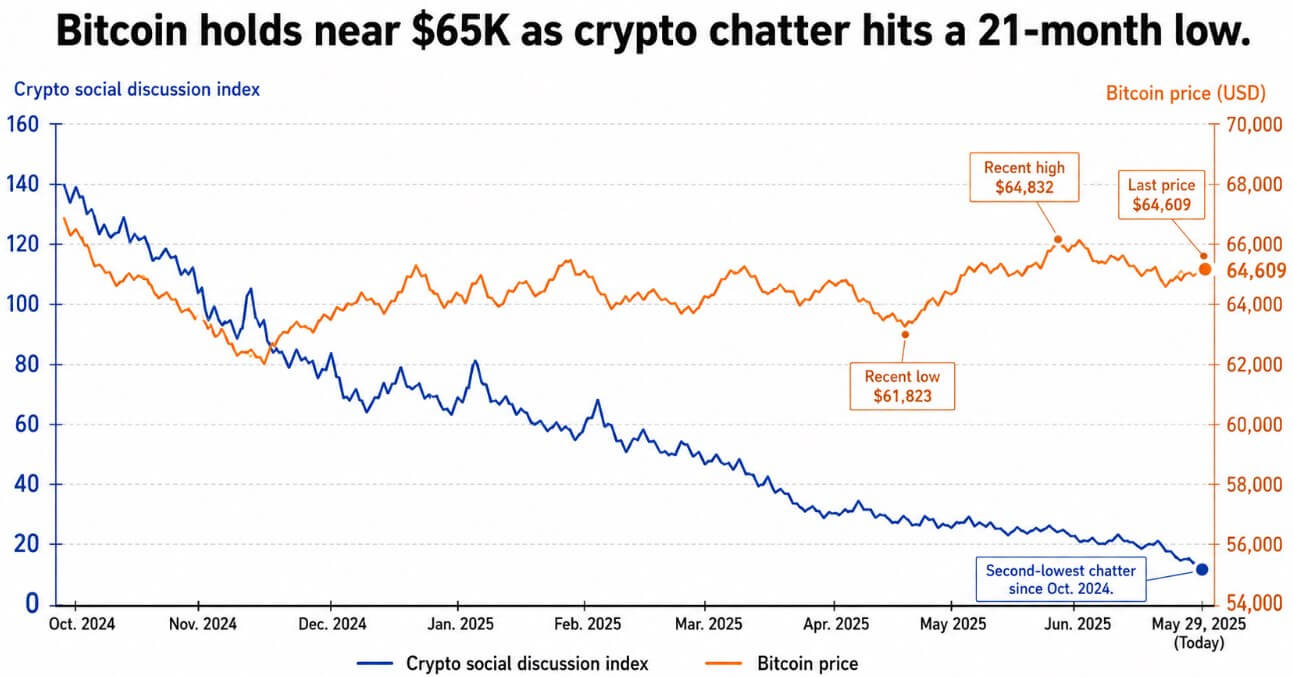
Crypto discussion across X, Reddit, Telegram, and other major social channels has fallen to its second-lowest daily level since October 2024, according to Santiment.
Bitcoin holds near $64,609 through that same stretch, with an intraday high of $64,832 and a low of $61,823 in recent sessions.
That combination usually reads as a setup in which retail traders stop chasing every price move, making positioning less crowded and allowing larger investors to accumulate before public attention returns, at least in theory.
CryptoQuant found that wallets holding 100 to 1,000 BTC distributed roughly 67,000 BTC on July 13, the cohort’s strongest selling activity since February.
At current prices, that comes to about $4.3 billion moving out of those wallets in a single day, equal to roughly 0.33% of Bitcoin’s circulating supply of nearly 20 million BTC.
A separate CryptoQuant analysis points out that newer whale wallets have continued accumulating, with supply rotating away from older whale cohorts toward these newer ones.
That split describes a redistribution of Bitcoin’s supply between large-holder cohorts, two groups making different bets on the same asset at the same moment.
| Cohort / signal | Recent behavior | Scale | Market read |
|---|---|---|---|
| 100–1,000 BTC wallets | Distributed BTC on July 13 | ~67,000 BTC / ~$4.3B | Major holder cohort used the rebound to reduce exposure |
| Newer whale wallets | Continued accumulating | Not specified in article | Suggests supply is rotating to newer large holders |
| Circulating supply comparison | 67,000 BTC versus nearly 20M BTC supply | ~0.33% of supply | Large enough to matter as a flow signal, not enough alone to define the market |
| Core implication | Whale behavior is divided | N/A | Bitcoin is undergoing redistribution, not uniform accumulation |
Santiment frames extremely low levels of discussion as a form of market quiet that can precede turning points, the logic being that a less crowded trade leaves more room for a modest move in demand to push price further.
The firm pairs this with its caution about macro uncertainty, ETF flow swings, and a still-cautious risk appetite that is working against Bitcoin.
Low attention becomes a genuine marker only if the wallets buying during the quiet stretch are absorbing the supply the crowd left behind, the question the CryptoQuant split leaves open.
Farside Investors’ data shows US-traded spot Bitcoin ETFs pulled in about $197.4 million over the July 6-10 week, a positive stretch that reversed hard on July 13, with roughly $424.7 million in net outflows that day.
Glassnode’s tracking puts 30-day ETF net flows in negative territory, with daily trading volume running $650 million to $950 million, about 80% below the October 2025 peak.
Measured against the $4.3 billion the 100-to-1,000 BTC cohort moved in a single day, that week’s entire ETF inflow was roughly 22 times smaller.
Institutional demand has shown signs of life, at a scale still well short of what’s needed to absorb the volume that large holders are distributing.
Bitcoin has spent about five months below both the short-term holder cost basis near $72,200 and the True Market Mean near $76,600, the two levels Glassnode uses to define a completed recovery.
Long-term holder realized losses peaked near $280 million a day, the highest since December 2022, evidence of how far capitulation has already run, with the pace still too hot to call the process finished.
The Fed held its target range at 3.50% to 3.75% at its June 17 meeting, and June CPI cooled to 3.5% year over year from 4.2% in May, easing some of the strain that had weighed on risk assets.
Glassnode’s report also flags oil shocks and risk-off behavior as live threats, noting Bitcoin has recently traded in close step with broader risk assets, behaving as one more risk asset among many.
US M2 supply has risen to a record $22.8 trillion. In comparison, the Fed’s balance sheet sits roughly $2 trillion below its 2023 peak, leaving Bitcoin caught between expanding broad liquidity and a still-restrictive real-yield environment.
If new-whale accumulation persists, distribution from the 100-to-1,000 BTC cohort cools, and ETF flows turn positive for several consecutive weeks, Bitcoin has a path toward reclaiming both the $72,200 cost basis and the $76,600 True Market Mean.
That is a territory which Citi’s July forecast treats as an $82,000 base case with real room to run beyond it.
| Path | What needs to happen | Key BTC levels | Forecast context | Interpretation |
|---|---|---|---|---|
| Bullish repair | New-whale accumulation persists, 100–1,000 BTC distribution cools, ETF flows turn positive for several weeks. | Reclaim $72,200, then $76,600 | Citi base case: $82,000 | The silence was accumulation before attention returned |
| Incomplete rebound | BTC holds low-$60Ks, but ETF flows remain choppy, and whale cohorts stay divided | Fails below $72,200 | Range-bound recovery | Market is bottom-building but not confirmed |
| Bearish failure | Distribution continues; ETF flows revert to negative; LTH capitulation remains elevated. | Lose low-$60Ks | Citi bear case: $53,000 | Low chatter was not contrarian; it reflected weak demand |
If that distribution continues, ETF flows revert to negative again, and long-term holder capitulation stays elevated, Bitcoin risks losing the low-$60,000s entirely.
Citi’s July revision, which cut its 12-month target to $82,000 from $112,000, citing weak investor appetite and stalled US crypto legislation, puts its bear case at $53,000 under those recessionary conditions.
What happens next comes down to whether the wallets accumulating during the silence can absorb the supply still leaving the hands of holders choosing to exit before that bottom gets confirmed.

Sequans Communications (NYSE: SQNS), the Paris-based cellular IoT semiconductor company, has completed the full redemption of its remaining convertible debt, funded by the sale of a portion of its Bitcoin holdings — bringing a short-lived and costly digital asset treasury experiment to a close.
The company now holds approximately 658 BTC, described as “fully unencumbered,” following the retirement of all convertible notes issued in July 2025. Sequans said it plans to monetize the remaining Bitcoin over time, though it did not specify a timeline or method.
The retreat caps a strategy that began in June 2025, when Sequans announced plans to raise $385 million through debt and equity to start a Bitcoin treasury.
By late July, CEO Georges Karam described Bitcoin as a “long-term store of value for our shareholders,” with a target of accumulating 3,000 BTC within weeks. The company crossed that threshold by month’s end.
The unwind began in November 2025 after Bitcoin fell from an all-time high above $126,000 to roughly $80,000. Sequans sold 970 BTC that month, followed by 125 BTC in February 2026, and another 1,025 BTC during the first quarter — reducing holdings to 1,114 BTC as of April 30. Thursday’s announcement confirmed a further reduction to 658 BTC, reflecting total sales of more than 80% of peak holdings.
Investors who bought shares at the height of Bitcoin enthusiasm last July are sitting on losses of more than 90%. SQNS shares rose 10% on Thursday following the announcement.
With the debt retired, Sequans transitions to what it calls a “near debt-free balance sheet,” giving the company greater financial flexibility heading into the second half of 2026. The move eliminates collateral obligations tied to Bitcoin’s price volatility, a risk that management had flagged in prior filings.
“We have strengthened our balance sheet, simplified our capital structure, and are now fully focused on scaling our IoT semiconductor business,” Karam said in Thursday’s statement.
Sequans’ renewed focus centers on its 4G LTE-M and Cat-1bis chipsets, which serve markets including smart metering, asset tracking, telematics, security, and industrial IoT. The company is also advancing its 5G eRedCap platform — a next-generation cellular IoT standard — as a long-term growth driver.
Karam framed Thursday’s announcement as the start of a focused operational phase. “Execute on our growing 4G and RF transceiver product portfolio, accelerate our path to profitability, and advance our 5G roadmap,” he said.

Abu Dhabi, UAE, May 14th, 2026, Chainwire
MSU 2.0 to unveil IP expansion strategy, featuring AI creation tools and a unified on-chain content hub.
MapleStory N marks its first anniversary with major gameplay milestones, sustained ecosystem growth, and new updates to deepen player engagement.
MapleStory Universe (MSU), the blockchain-powered expansion of Nexon’s iconic MapleStory franchise, today marks its first anniversary following the launch of MapleStory N on May 15, 2025. Over the past year, the platform has recorded more than 150 million cumulative on-chain transactions and surpassed 3.82 million accounts registered, reflecting sustained participation from a global player base and continued development of the ecosystem.
One year in, MSU is entering its next phase with the introduction of MSU 2.0, an expansion designed to transform how intellectual property (IP), builders, and players interact in a shared digital environment, supported by AI creation tools and on-chain infrastructure. MSU 2.0 will be implemented throughout 2026 to 2027, as new features will be progressively developed and released for the builders.
A Benchmark Launch That Set a New Standard
MSU launched in May 2025 as one of the largest debuts in the Web3 gaming ecosystem. Built on the MapleStory IP, the pre-launch Scroll NFT campaign recorded approximately 1.7 million scrolls minted, officially confirmed as the largest NFT mint in Avalanche network history. On launch day, MSU-related weekly active addresses on the Avalanche network increased by 549 percent, reflecting strong user interest and anticipation surrounding the title’s release.
Following launch, the marketplace has continued its strong performance, with more than 446,716 buyers and sellers transacting daily on average. To date, MSU has accounted for 23.3% of total activity on the Avalanche network, representing a substantial share of activity across leading chains. MSU’s native NXPC token was also listed on seven major exchanges at launch, including Binance, Bybit, Upbit, and Bithumb.
Sunyoung Hwang, CEO, Nexpace, said: “What began as one of the largest launches in Web3 gaming has developed into a platform built for long-term participation. In the past year, we focused on building the infrastructure and discipline required to support our community over the long term. Ever since then, MSU has evolved beyond a single game into infrastructure for creation, commerce, and participation. That shift defines what it means for an IP to become an economic system and a foundation for the next generation of online worlds.”
Introducing MSU 2.0, the Next Chapter for MapleStory Universe
MSU is now advancing into its next phase through the rollout of MSU 2.0, an expansion designed to turn IPs from friction-heavy, abstract assets into programmable, on-chain commerce. Designed to broaden participation across the ecosystem and support new forms of creation, distribution, and commercialization, MSU 2.0 reflects the continued evolution of MapleStory Universe from a single game environment into a scalable platform.
Hwang added: “MSU 2.0 is the next phase of our growth journey. Our goal is to expand the role of IP from something people experience to something they can actively build with, share, and grow together, akin to an infinite IP playground. From here, our priority is to build the infrastructure that will support a larger and more connected IP ecosystem.”
At the core of MSU 2.0 is VIBE IP, a new tech stack built on two foundational pillars that redefine what it means to build with IP on-chain. The first pillar transforms IP access by providing builders access to gameplay and behavioral data from MapleStory N through dedicated APIs, turning IP from brand assets to living, data-rich foundation to create on in accordance with applicable privacy laws. The second pillar establishes an on-chain builder economy on the Henesys chain, built on an Avalanche L1streamlining IP licensing, revenue settlement, and payments into a single system.
Together, these pillars are supported by blockchain infrastructure and AI-powered creation tools. Blockchain allows seamless licensing, payment and settlement, fully on-chain, while AI-powered “vibe coding” allows anyone’s idea to become a full-scale product, enabling broader participation in building and launching IP-driven content. This foundation positions MSU to onboard additional Nexon IPs over time, building an AI-powered and On-chained IP multiverse, with the VIBE IP tech stack gradually rolling out in phases over the coming months.
MapleStory N One-Year Anniversary Update
MapleStory N, the flagship game by MSU, has delivered a series of milestones over the past year that reflect sustained player engagement across the ecosystem. The year-end winter update generated more than 130,000 user inflows, with approximately three-quarters representing new users. This update also drove in-game spending to its highest level since the immediate post-launch period, with player spending outpacing rewards distributed, reflecting a more active and sustainable in-game economy driven by deeper engagement.
Building on this momentum, MapleStory N is now more accessible to mainstream players. Casual users can engage with the game like any traditional MMORPG, with less blockchain hurdle. Web3 features have been refined to deliver meaningful value while maintaining a seamless gameplay experience, making the platform easier for a broader audience to adopt.
As MapleStory N enters its second year, the development team will roll out waves of in-game updates at an accelerated pace, expanding gameplay and introducing new challenges. This will be supported by a steady cadence of major releases throughout the year, including highly anticipated Black Mage update and other milestone content. MSN will also introduce a new MVP system designed to provide ongoing benefits to dedicated players and keep them motivated to continue playing. Starting with the MVP system, MSN plans to continuously expand the program by introducing more diverse criteria and rewards, ensuring that a wider range of players can be recognized and rewarded over time. For more information, users can visit the official website.
About NEXPACE
NEXPACE, an innovative blockchain company based in Abu Dhabi, pioneers an IP-expansion initiative powered by blockchain technology and NFTs to build a community-driven ecosystem. With a mission to redefine interactive entertainment, NEXPACE creates a vibrant space for exploring, sharing, and engaging with diverse content and gameplay crafted by community members.
At the heart of NEXPACE’s ecosystem are principles of transparency, security, and trust, empowering builders to freely share their ideas and enabling users to enjoy immersive experiences. By fostering a culture of creative expression, NEXPACE envisions a secure, collaborative environment that unites ecosystem participants in a thriving digital community.
PR Manager
Bee Shin
Wachsman
bee.shin@wachsman.com

When you find the best crypto margin trading exchanges, you protect your capital from avoidable risks. You also secure your edge by choosing a crypto trading platform with fair fees, strong liquidity, and tools that match the way you trade. The wrong exchange can make margin trading harder than it needs to be. High borrowing costs, weak risk controls, and poor execution can quickly cut into your gains.
In this article, we take you through the top crypto margin trading platforms, our quick picks, and full reviews of the leading exchanges. We’ll also explain how crypto margin trading works, compare cross margin and isolated margin, break down fees and leverage, and cover the biggest risks to watch for. If you want to find the right platform and avoid costly mistakes, keep reading to see which exchange fits your needs best.
| Exchange | Best For | Max Leverage | Trading Fees | Margin Types | Supported Coins | Overall Rating |
| Binance | Best Overall Margin Trading Exchange | Up to 10x isolated, 5x cross | Spot fees vary by tier; margin borrow interest is separate | Cross, Isolated | 500+ | 4.8/5 |
| Bybit | Best for Derivatives & Leverage Trading | Up to 10x on spot margin | Spot base fee commonly starts at 0.10% maker / 0.10% taker; borrowing costs apply separately | Spot Margin, Perpetuals | 300+ | 4.7/5 |
| OKX | Best for Advanced Traders | Margin rates and leverage are tiered by asset and account mode | Spot base fee commonly starts at 0.08% maker / 0.10% taker; margin interest is separate | Cross, Isolated, Multi-currency modes | 350+ | 4.6/5 |
| Kraken Pro | Best for Regulated Margin Trading | Up to 10× on margin trading for selected assets. | Margin opening and rollover fees apply, plus normal trade fees | Spot Margin | 120+ | 4.5/5 |
| dYdX | Best Decentralized Margin Trading Exchange | Up to 20x for perpetual contracts. | Tiered perpetual fees by 30-day volume | Isolated margin perps | 180+ markets | 4.4/5 |
| Bitget | Best for Copy Margin Trading | Margin fees and leverage vary by product and pair | Spot margin base fee starts at 0.10% maker / 0.10% taker; interest charged hourly | Cross, Isolated, Futures | 1300+ | 4.4/5 |
| KuCoin | Best for Altcoin Margin Trading | Up to 10x isolated, 5x cross | Spot/margin base fee often starts at 0.10% maker / 0.10% taker | Cross, Isolated | 750+ | 4.4/5 |
| Phemex | Best for Low-Fee Margin Trading | Up to 100x on select futures | Futures base fees can start around 0.01% maker / 0.06% taker | Spot Margin, Futures | 600+ | 4.3/5 |
| Gate.io | Best for Margin Trading Variety | Up to 100x on some futures | Futures fee examples show taker rates around 0.075%, with lower VIP rates | Cross, Isolated, Futures | 4,400+ | 4.3/5 |
| MEXC | Best for High-Leverage Margin Trading | Up to 500x on select futures | Futures examples show maker around 0.01% and taker around 0.02%; spot promos may differ | Cross, Isolated, Futures | 3,000+ | 4.3/5 |
We have reviewed our top 10 best crypto trading exchanges to help you decide on the most appropriate platform. Our platform choices include:

Founded in 2017, Binance is the world’s largest cryptocurrency exchange, renowned for its extensive trading options and robust liquidity. As one of the best margin trading platform, Binance offers traders the ability to amplify their leveraged positions with maximum leverage. It caters to both beginners and seasoned traders, offering risk management features to maximize returns. Its user-friendly interface, strong security measures, and global liquidity solidify Binance’s reputation as a top-tier platform for margin trading.

| Condition | Details |
| Max Leverage | Up to 10x for isolated margin and 5x for cross margin trading |
| Opening Fee | Spot trading fees start at 0.1% for both makers and takers |
| Rollover Fee | Interest on borrowed funds is calculated hourly |
| Available Pairs | Over 500 cryptocurrencies and 1,300+ trading pairs |
| Collateral Options | Major cryptocurrencies like Bitcoin (BTC), Ethereum (ETH), Binance Coin (BNB), and others. |
| Interest Rate | Dynamic rates based on market conditions |
| Pros | Cons |
| Up to 10x isolated and 5x cross margin | Dynamic interest rates |
| Spot trading starts at 0.1%, with BNB discounts | Restricted in some countries |
| Over 500 cryptocurrencies and 1,300 pairs | Not available in the U.S. and the U.K. |
| Cross and isolated margin, plus risk management features | Can feel overwhelming for beginners |
| SAFU fund, 2FA (two-factor authentication), and cold storage | Ongoing issues in some jurisdictions |

Bybit is one of the most recognized names in crypto trading, especially for traders who want access to derivatives and higher-risk leverage tools. Founded in 2018, the platform combines spot trading, spot margin, perpetual contracts, and futures in one place. Bybit is best known for high-leverage derivatives, with some perpetual products offering up to 125x leverage, while spot margin is much lower and depends on the pair and account setup.

| Condition | Details |
| Max Leverage | Up to 10x for margin trading and up to 100x for perpetual futures |
| Opening Fee | Spot trading starts at 0.10% maker / 0.10% taker for many non-VIP users |
| Rollover Fee | Bybit does not use a traditional flat rollover fee. |
| Available Pairs | Bybit supports spot and derivatives trading across a broad list of crypto markets. |
| Collateral Options | Collateral can include major crypto assets and, depending on product setup, stablecoins such as USDT. |
| Interest Rate | Interest rates are dynamic and depend on the borrowed asset, product type, and market demand |
| Pros | Cons |
| High leverage available on selected derivatives | Not available in several jurisdictions, including the U.S. and Canada |
| Competitive entry-level trading fees for many users, with spot fees starting at 0.10% maker / 0.10% taker. | Borrowing costs and other trading charges can change based on the asset, product, and market conditions. |
| Strong fit for active traders who want spot, margin, futures, and perpetuals in one place. | High leverage can increase liquidation risk very quickly, especially for inexperienced traders. |
| Wide market access and advanced trading tools make it attractive for derivatives-focused users. | Fiat availability depends on third-party providers and jurisdiction |
| Well suited to traders who want a more advanced trading environment. | The interface and product range can feel overwhelming for beginners. |

OKX is a leading cryptocurrency exchange renowned for its advanced trading features and robust margin trading options. It caters to experienced traders with its tiered leverage system, offering flexibility based on asset and account type. The platform supports a wide range of cryptocurrencies and trading pairs, ensuring diverse opportunities for margin traders.

| Condition | Details |
| Max Leverage | Up to 10x on margin trading, though the exact cap depends on the trading pair, position tier, and account mode. |
| Opening Fee | OKX uses a tiered fee model. Standard spot trading fees commonly start around 0.08% maker and 0.10% taker, though rates vary by tier and region. |
| Rollover Fee | There is no flat listed like some brokers use. Instead, traders pay margin interest on borrowed funds. |
| Available Pairs | OKX supports margin trading across a wide range of spot markets, but availability depends on the asset and local region. |
| Collateral Options | In supported account modes, traders can use assets in their trading account as collateral. |
| Interest Rate | Interest rates are dynamic and asset-specific. OKX publishes current margin interest rates on its fee pages |
Pros & Cons
| Pros | Cons |
| Advanced trading setup with cross margin and isolated margin support | More complex interface than beginner-friendly exchanges |
| Up to 10x leverage for margin traders | Margin costs are not fixed and can rise with changing borrowing demand |
| Tiered fees can be competitive for active traders | Exact margin pair availability can vary by region and asset |
| Flexible collateral handling in multi-currency margin mode | Better suited to experienced users than complete beginners |
| Strong choice for traders who want deeper control over margin strategy | Some products may not be available in every jurisdiction, as OKX notes in its help content. |

Kraken Pro is a highly advanced cryptocurrency trading platform tailored for professional traders. It offers a seamless interface that integrates spot, margin, and derivatives trading, along with staking options. With over 400 supported assets and a focus on regulatory compliance, Kraken Pro ensures a secure and efficient trading experience. The platform is known for its deep liquidity, competitive fees, and robust risk management tools, making it a top choice for traders seeking a regulated environment.
| Condition | Details |
| Max Leverage | Up to 10× on margin trading for selected assets. |
| Opening Fee | Maker fees start at 0.02%,
and taker fees start at 0.05%, depending on trading volume. |
| Rollover Fee | Interest rates are calculated hourly and vary based on the asset and market conditions. |
| Available Pairs | Over 150 margin trading pairs, including BTC/USD, ETH/USD, and more. |
| Collateral Options | Major cryptocurrencies like Bitcoin (BTC), Ethereum (ETH), and stablecoins like USDT. |
| Interest Rate | Dynamic rates based on the borrowed asset and market demand. |
| Pros | Cons |
| Regulated platform with strong compliance standards | Limited leverage options compared to some competitors |
| Competitive fees for both spot and futures trading | Not available in all countries |
| Wide range of supported assets and trading pairs | Complex interface may be challenging for beginners |
| Advanced tools for risk management and order customization | Hourly interest rates can add up for long-term positions |
| High liquidity and robust security measures | Limited fiat deposit and withdrawal options in certain regions |

dYdX is a leading decentralized platform for margin trading, offering up to 20x for perpetual contracts. It supports perpetual contracts with high leverage and advanced trading tools. The platform is built on Ethereum, ensuring transparency and security. dYdX is ideal for traders seeking decentralized solutions for crypto leverage trading.
| Condition | Details |
| Max Leverage | Up to 20x for perpetual contracts. |
| Opening Fee | Tiered fees based on 30-day trading volume, starting at 0.05%. |
| Rollover Fee | Funding rates apply for perpetual contracts, updated every 8 hours. |
| Available Pairs | Focused on major assets like BTC, ETH, and other top cryptocurrencies. |
| Collateral Options | USDC is the primary collateral for all trades. |
| Interest Rate | Dynamic funding rates based on market conditions. |
| Pros | Cons |
| Fully decentralized and trustless platform | Limited collateral options (USDC only) |
| High leverage for perpetual contracts | Requires knowledge of DeFi and wallets |
| Transparent and secure with Ethereum blockchain | Fewer trading pairs compared to centralized exchanges |
| No KYC required for trading | Funding rates can fluctuate significantly |

Bitget is a user-friendly platform known for its copy trading feature, allowing users to replicate strategies of experienced traders. It supports a wide range of assets and offers competitive fees. Bitget is ideal for beginners and those looking to learn from professional traders. The platform also provides high leverage for futures trading.

| Condition | Details |
| Max Leverage | Up to 125x for futures trading. |
| Opening Fee | Maker: 0.02%, Taker: 0.06%. |
| Rollover Fee | Hourly interest rates apply for borrowed funds. |
| Available Pairs | Over 800 trading pairs, including major and altcoins. |
| Collateral Options | Supports multiple cryptocurrencies and stablecoins. |
| Interest Rate | Dynamic rates based on asset and market demand. |
| Pros | Cons |
| Easy-to-use copy trading feature | High leverage increases risk for beginners |
| Wide range of supported assets | Hourly interest rates can add up |
| Competitive fees for futures trading | Limited advanced tools for professional traders |
| Supports multiple collateral options | Copy trading may lead to over-reliance on others |

KuCoin is a popular platform for trading altcoins, offering a vast selection of assets and trading pairs. It supports margin trading with competitive fees and multiple leverage options. KuCoin is ideal for traders looking to explore emerging cryptocurrencies. The platform also provides advanced tools for experienced users.

| Condition | Details |
| Max Leverage | Up to 10x for isolated margin and 5x for cross margin. |
| Opening Fee | Maker: 0.02%, Taker: 0.06%. |
| Rollover Fee | Interest rates vary by asset and are calculated hourly. |
| Available Pairs | Over 900 trading pairs, including many altcoins. |
| Collateral Options | Supports a wide range of cryptocurrencies and stablecoins. |
| Interest Rate | Dynamic rates based on asset and market conditions. |
| Pros | Cons |
| Extensive selection of altcoins | Limited leverage compared to some platforms |
| Competitive fees for margin trading | Complex interface for beginners |
| Supports multiple collateral options | Hourly interest rates can increase costs |
| Advanced tools for experienced traders | Not available in all regions |

Phemex is known for its low fees and user-friendly interface, making it a great choice for cost-conscious traders. It supports high leverage for futures trading and offers a variety of trading pairs. Phemex is ideal for both beginners and experienced traders looking for a low-cost platform.

| Condition | Details |
| Max Leverage | Up to 100x for select futures contracts. |
| Opening Fee | Maker: 0.01%, Taker: 0.06%. |
| Rollover Fee | Funding rates apply for perpetual contracts, updated every 8 hours. |
| Available Pairs | Over 200 trading pairs, including major and altcoins. |
| Collateral Options | Supports multiple cryptocurrencies and stablecoins. |
| Interest Rate | Dynamic funding rates based on market conditions. |
| Pros | Cons |
| Low trading fees | Limited selection of trading pairs |
| High leverage for futures trading | Funding rates can fluctuate significantly |
| User-friendly interface | Fewer advanced tools for professional traders |
| Supports multiple collateral options | Not available in all regions |

Gate.io offers a wide variety of margin trading options, including spot and futures trading. It supports a vast selection of assets and provides competitive fees. Gate.io is ideal for traders looking for diverse trading opportunities. The platform also offers advanced tools for experienced users.

| Condition | Details |
| Max Leverage | Up to 100x for select futures contracts. |
| Opening Fee | Maker: 0.02%, Taker: 0.05%. |
| Rollover Fee | Interest rates vary by asset and are calculated hourly. |
| Available Pairs | Over 1,400 trading pairs, including major and altcoins. |
| Collateral Options | Supports a wide range of cryptocurrencies and stablecoins. |
| Interest Rate | Dynamic rates based on asset and market conditions. |
| Pros | Cons |
| Extensive selection of trading pairs | Complex interface for beginners |
| Competitive fees for margin trading | Hourly interest rates can increase costs |
| Supports multiple collateral options | Limited leverage compared to some platforms |
| Advanced tools for experienced traders |

MEXC is an exchange designed for high-leverage trading, offering up to 500x leverage on select futures contracts. It supports a wide range of assets and provides competitive fees. MEXC is ideal for experienced traders looking to maximize their trading potential. The platform also offers advanced tools for risk management.

| Condition | Details |
| Max Leverage | Up to 500x for select futures contracts. |
| Opening Fee | Maker: 0.02%, Taker: 0.06%. |
| Rollover Fee | Funding rates apply for perpetual contracts, updated every 8 hours. |
| Available Pairs | Over 1,000 trading pairs, including major and altcoins. |
| Collateral Options | Supports multiple cryptocurrencies and stablecoins. |
| Interest Rate | Dynamic funding rates based on market conditions. |
| Pros | Cons |
| Extremely high leverage for futures trading | High leverage increases risk significantly |
| Wide range of supported assets | Funding rates can fluctuate significantly |
| Competitive fees for margin trading | Limited advanced tools for professional traders |
| Supports multiple collateral options | Not available in all regions |
Crypto margin trading is a trading style where you borrow funds to increase your buying power. It allows you to trade larger positions than your account balance. This approach amplifies both potential profits and losses. It is commonly used for trading major cryptocurrencies and altcoin margin trading, offering opportunities to capitalize on market movements with leverage.
When evaluating the best crypto margin trading exchanges, several critical factors come into play. From the leverage offered to the security measures in place, each platform has unique strengths that cater to different trading needs. Whether you’re focused on crypto leverage trading or seeking the best leverage trading platform for crypto, understanding these elements is essential. Here’s how to choose your best crypto margin platform:
The leverage offered by a platform determines how much you can amplify your positions. Look for exchanges that provide flexible leverage options and a wide range of trading pairs, including major cryptocurrencies and altcoins, to maximize your opportunities.
Competitive crypto margin trading fees are crucial for profitability. Evaluate the platform’s maker and taker fees, as well as funding rates for perpetual contracts, to ensure cost efficiency in your trades.
A secure platform is non-negotiable when margin trading crypto. Opt for exchanges with robust security measures like two-factor authentication, cold storage, and regulatory compliance to protect your assets.
High liquidity ensures smooth order execution with minimal slippage. The best crypto exchange for leverage will have deep order books and fast execution speeds, especially for high-volume trades.
A user-friendly interface with advanced tools is essential for effective trading. Platforms offering customizable dashboards, risk management features, and real-time data are ideal for both beginners and experienced traders.
| Aspect | Crypto Margin Trading | Spot Trading |
| Definition | Trading with borrowed funds to amplify position size. | Direct purchase or sale of assets without leverage. |
| Leverage | Offers leverage to increase potential profits and risks. | No leverage; trades are limited to available funds. |
| Risk Level | Higher risk due to amplified losses and liquidation potential. | Lower risk as trades are fully funded by the trader’s balance. |
| Cost | Includes interest on borrowed funds and crypto margin trading fees. | Only involves trading fees, typically lower than margin trading costs |
When deciding between Isolated margin and a cross margin, it’s essential to understand their core differences. Isolated margin trading limits the risk to the specific position you’re trading. If the position is liquidated, only the margin allocated to that trade is lost, making it ideal for beginners or those trading volatile assets.
On the other hand, Cross Margin shares the margin across all open positions in the same account. This method reduces the risk of liquidation by utilizing the entire account balance as collateral. For advanced traders managing diverse portfolios, this strategy can be effective. Whether you’re trading or managing the different types of crypto wallets, choosing the right margin type depends on your risk tolerance and trading strategy.
To begin margin trading cryptocurrency, follow these five simple steps. This process ensures you’re prepared to trade effectively while managing risks. Here’s how to get started:
Select a platform with high liquidity, robust security, and competitive crypto margin trading fees. Ensure the exchange supports your preferred assets and offers the leverage you need.
Create an account on the exchange and complete any required KYC verification. Deposit funds into your margin account, ensuring you meet the minimum margin requirements.
Choose the leverage level that aligns with your risk tolerance. Pick a trading pair, such as BTC/USDT or ETH/USD, based on your market analysis.
Decide whether to go long (buy) or short (sell) based on market trends. Use stop-loss and take-profit orders to manage risks and lock in profits.
Regularly check your trade and margin levels. Be prepared to add funds or close positions if the market moves against you to avoid liquidation.
Crypto margin trading carries significant risks due to the amplified impact of leverage. While it can magnify profits, it equally increases potential losses, often leading to liquidation if the market moves against your position. High volatility in cryptocurrency markets further heightens the risk, making it crucial to use stop-loss orders and manage leverage wisely. Without proper risk management, traders can lose more than their initial investment, emphasizing the need for caution and strategy.
The legality of crypto margin trading varies by country and is subject to local regulations. Some regions, like the US, impose strict rules or outright bans, while others permit it under regulated conditions. Always verify the legal status and compliance of the platform in your jurisdiction before trading. Using licensed exchanges ensures adherence to laws and protects your investments.
Crypto margin trading offers the potential for amplified profits but comes with significant risks due to leverage and market volatility. You need to choose a reliable platform, understand the mechanics of margin trading, and implement robust risk management strategies. While it can be a powerful tool for experienced traders, beginners should approach it cautiously, starting with low leverage and thorough research.
The best crypto exchange for margin trading depends on your needs, but platforms like Binance, Kraken, and Bybit are popular for their features, security, and leverage options.
The maximum leverage on top crypto exchanges varies, with some offering up to 100x leverage for futures trading.
Margin trading crypto is not entirely safe for beginners due to high risks and potential losses; beginners should start with low leverage and proper risk management.
If your margin trade gets liquidated, the exchange closes your position to recover the borrowed funds, resulting in the loss of your initial margin.
The difference between margin trading and futures trading is that margin trading uses borrowed funds for spot trades, while futures trading involves contracts to buy or sell assets at a future date.
The crypto exchange with the lowest margin trading fees varies, but platforms like Binance and Phemex are known for competitive fee structures.

Bitcoin is closing out 2025 near $87,000, ending the year in a narrow trading range after months of fading momentum. Thin holiday liquidity and a lack of fresh catalysts left the market drifting into the final session of the year, capping a period marked less by explosive gains than by consolidation and unmet expectations.
At the time of writing, bitcoin was trading just below $88,000, roughly flat over the past week and modestly lower than where it began the year. The price has spent much of December oscillating between the low $80,000s and the high $80,000s, with repeated attempts to reclaim $90,000 failing to attract sustained follow-through.
The muted year-end action stands in contrast to the optimism that defined the start of 2025. Bitcoin entered January trading in the mid-$90,000 range, buoyed by strong inflows into spot bitcoin exchange-traded funds, expanding institutional participation, and expectations that easier monetary policy would push risk assets higher.
For a time, those narratives appeared intact.
Bitcoin went on to post a strong rally through the first half of the year, supported by steady ETF demand and continued accumulation by corporate treasuries and long-term holders. That advance culminated in October, when bitcoin briefly surged to a new all-time high above $125,000. The move was fueled by improving macro sentiment, positioning ahead of expected rate cuts, and renewed speculative interest across derivatives markets.
The rally, however, proved unsustainable. As the fourth quarter unfolded, tighter financial conditions, rising bond yields, and a stronger dollar began to weigh on risk appetite. Bitcoin rolled over alongside equities and other growth assets, giving back a significant portion of its gains.
By early December, the price had fallen more than 30% from its peak, re-entering a range that had defined much of the year’s trading.
Macro forces played a central role in shaping bitcoin’s performance in 2025. Inflation proved more persistent than many investors anticipated, prompting central banks to maintain a restrictive stance longer than expected.
That environment favored cash and yield-bearing assets over speculative exposure, limiting upside across crypto markets. Bitcoin, often framed as a hedge against monetary debasement, struggled to attract marginal buyers while real yields remained elevated.
Liquidity conditions also deteriorated into year-end. Trading volumes declined sharply in December as market participants stepped away for the holidays.
With fewer buyers and sellers active, price movements became choppy and conviction waned. The lack of strong inflows into spot ETFs during the final weeks of the year reinforced the sense of caution.
On-chain data reflected a similar dynamic. Long-term holders largely remained inactive, while short-term traders dominated flows, contributing to range-bound price action. Large holders reduced aggressive accumulation after the October peak, while retail participation ticked higher during pullbacks, a pattern consistent with consolidation rather than trend formation.
Still, 2025 was not without structural progress for bitcoin. The market continued to mature, with deeper derivatives liquidity, improved custody solutions, and broader integration into traditional financial infrastructure.
Spot bitcoin ETFs ended the year with tens of billions of dollars in assets under management, anchoring a new class of long-term demand even as short-term flows fluctuated.
Bitcoin also maintained its position as the dominant digital asset by a wide margin, outperforming most alternative cryptocurrencies on a relative basis.
While it lagged gold’s strong performance during periods of macro stress, bitcoin remained one of the most liquid and widely traded assets globally, reinforcing its role as the benchmark for the broader crypto market.
As bitcoin heads into 2026, the focus is shifting to whether the prolonged consolidation can resolve to the upside. Traders are watching the $90,000 level as a key psychological and technical threshold, while support in the low $80,000s has so far held.
A meaningful change in macro conditions, renewed ETF inflows, or a resurgence in institutional accumulation could provide the catalyst needed to break the stalemate.
For now, bitcoin enters the new year subdued, trading around $87,000 and searching for direction.

Start every day with the top news stories right now, plus original features, a podcast, videos and more.
The restarted Senate is moving forward with certain crypto initiatives, but how much time is left compared to how much work is left, really?
You’re reading State of Crypto, a CoinDesk newsletter looking at the intersection of cryptocurrency and government. Click here to sign up for future editions.
Now that Congress is back from the government shutdown, all eyes are on how it will proceed on crypto issues. There are a few components to this: Mike Selig’s nomination to run the Commodity Futures Trading Commission, market structure legislation and other crypto matters.
Time is starting to run out for the crypto industry to lock in its wins from the 2024 election. While the GENIUS Act was a strong start for crypto businesses, and the Securities and Exchange Commission and CFTC are continuing their efforts to create new rules for the industry, the market structure bill is still far from completion. Congress has less than 40 days left this year and just a handful of months next year before it disperses for the midterm elections.
The Senate Agriculture Committee voted 13-11 to advance CFTC Chair nominee Mike Selig’s name to the full Senate for a floor vote; if he secures a majority of votes, he should get sworn in shortly after. This may happen in the coming weeks.
Selig said crypto is an important issue for the CFTC to look into, speaking to specific issues like onchain markets and the role of intermediaries, among other things.
“The CFTC has a critical mission to protect these markets,” he said at his hearing on Wednesday. “This is a real opportunity to develop a framework that can allow for software developers to thrive, for new exchanges to crop up that are going to protect investors and have the types of controls that you would expect in an exchange and make sure that we have the right disclosure requirements that we have typically in our financial markets.”
The Senate Banking Committee also advanced the nomination of Federal Deposit Insurance Corporation Acting Chair Travis Hill to be the regulator’s fully confirmed chair to the Senate, among other nominees.
But the main event — market structure legislation — remains largely in the same public position it was in last week.
As noted last week, the Agriculture Committee’s new draft includes a few provisions that may prove controversial, including one touching on conflicts of interest. This discussion draft will clearly see updates before the committee can hold a markup and vote. The Trump family’s various crypto businesses are unlikely to leave Democrats’ focus either — Senators Elizabeth Warren and Jack Reed asked Treasury Secretary Scott Bessent and Attorney General for information about allegations that the Trump-linked World Liberty Financial sold some of its tokens to “illicit actors,” including in sanctioned regions.
The Banking Committee may be closer to a markup — while the committee hasn’t published a revised draft bill in a while, negotiations do appear to be ongoing between Republicans and Democrats.
Sen. Tim Scott, who chairs the Banking Committee, said Democrats had been “stalling” the bill’s progress in an interview with Fox News’ Maria Bartiromo earlier this week.
“The Democrats have been stalling and stalling and stalling because they don’t want President Trump to make America the crypto capital of the world,” he said. “They don’t want to give them the win. It’s not just for President Trump. It’s for the American people, single moms like the one that raised me.”
Still, he said the bill might still get to the Senate floor in early 2026.
“Next month, we believe we can mark up in both committees and get this to the floor of the Senate early next year, so that President Trump will sign the legislation making America the crypto capital of the World, protecting consumers while increasing the likelihood of America being the most dominant economic power for the next 100 years,” Scott said.
Congress has a limited amount of time left in the year to get anything done — lawmakers will be out of session next week for Thanksgiving, and will have just a few weeks in December before Christmas and New Year’s.
If you’ve got thoughts or questions on what I should discuss next week or any other feedback you’d like to share, feel free to email me at [email protected] or find me on Bluesky @nikhileshde.bsky.social.
You can also join the group conversation on Telegram.
See ya’ll next week!

Despite a record-setting crash late last week, crypto traders are piling into new bets that Bitcoin will blow past $130,000 before the year’s end.
Data from Glassnode, a crypto analytics platform, shows a dense cluster of call positions around the $130,000 price level.
Options calls pay out if the price of the underlying asset rises above the trader’s strike price, which is $130,000 in this case.
Market data from Deribit, a crypto derivatives exchange, also mirrors the same trend. There’s $1.7 billion in bets that Bitcoin’s price will trade between $140,000 and $150,000 before the end of the year.
Analysts at the crypto exchange Bitfinex have warned that sentiment and speculative activity, rather than key US economic data, are behind the latest wave of exuberance.
The US Bureau of Labour Statistics, for instance, has halted its monthly jobs reports and delayed its inflation data due to the ongoing government shutdown.
Without that compass, Bitfinex analysts say traders and investors should brace for potential price volatility ahead.
That’s because the analysts say the absence of data may be “masking underlying fragility,” which could amplify volatility when the numbers are eventually released.
Despite the data blackout, Bitcoin investors remain bullish.
Apart from options traders, punters on Polymarket, a platform where crypto traders bet on real-world outcomes, are also enthusiastic about Bitcoin’s price trajectory this year.
Data from the crypto betting platform shows users have stacked more than $33 million into bets on Bitcoin’s price this year.
The $130,000 price bet is the most popular among optimistic punters on the platform, with 52% of the betting activity on that price level in favour of the outcome.
Bitcoin traded at $111,600 on Wednesday, down 11% from its recent peak of $126,000.
Osato Avan-Nomayo is our Nigeria-based DeFi correspondent. He covers DeFi and tech. Got a tip? Please contact him at osato@dlnews.com.

Cryptocurrency projects have poured over $1.4 billion toward token buybacks in 2025, with just 10 projects capturing 92% of the total expenditure.
Hyperliquid, a decentralized perp exchange protocol, led the market with roughly $645 million committed. That represented nearly half of all token buyback activity recorded across the crypto market this year.
Sponsored
According to the latest report by CoinGecko, 28 cryptocurrency projects devoted substantial resources to token buybacks this year. The pace picked up in the second half of 2025, with buyback spending surging by 85% month over month in July.
“Although a jump in token buyback spending was attributed to September, this was due to the one-off LayerZero repurchase announcement, which did not specify when it was carried out. Excluding the ZRO buyback, September only saw $168.45 million in token buyback spending,” CoinGecko’s research analyst Yuqian Lim noted.
By mid-October, buyback spending had already reached $88.81 million. This suggests the market is on track for a fourth straight month exceeding the first-half monthly average of $99.32 million.
On average, around $145.93 million has been spent each month, signaling growing enthusiasm for the mechanism across the sector.
Sponsored
Hyperliquid stands out as the undisputed leader in token repurchases this year. The project has spent more than $644.64 million in revenue through its Assistance Fund. This amount equals the combined total of the next nine largest projects.
Furthermore, the protocol accounted for 46% of all token buyback activity in 2025. So far, the network has bought back 21.36 million HYPE tokens, representing 2.1% of the total supply.
According to earlier OAK Research estimates, Hyperliquid’s model has the potential to repurchase up to 13% of its total supply each year.
LayerZero followed Hyperliquid with a $150 million one-off buyback of ZRO tokens, acquiring 5% of its supply. Pump.fun invested $138 million in PUMP repurchases since July, covering 3% of supply.
“While this puts PUMP buyback spending on the lower end compared to HYPE so far, it is worth noting that Pump.fun has already bought back a higher 3.0% share of total supply,” Lim highlighted
Sponsored
Meanwhile, Raydium directed $100 million toward buybacks and burns of RAY tokens. Lastly, rounding out the top 10 list were Sky Protocol (SKY), Jupiter (JUP), Ethena (ENA), Rollbit (RLB), Bonk (BONK), and Aave (AAVE).
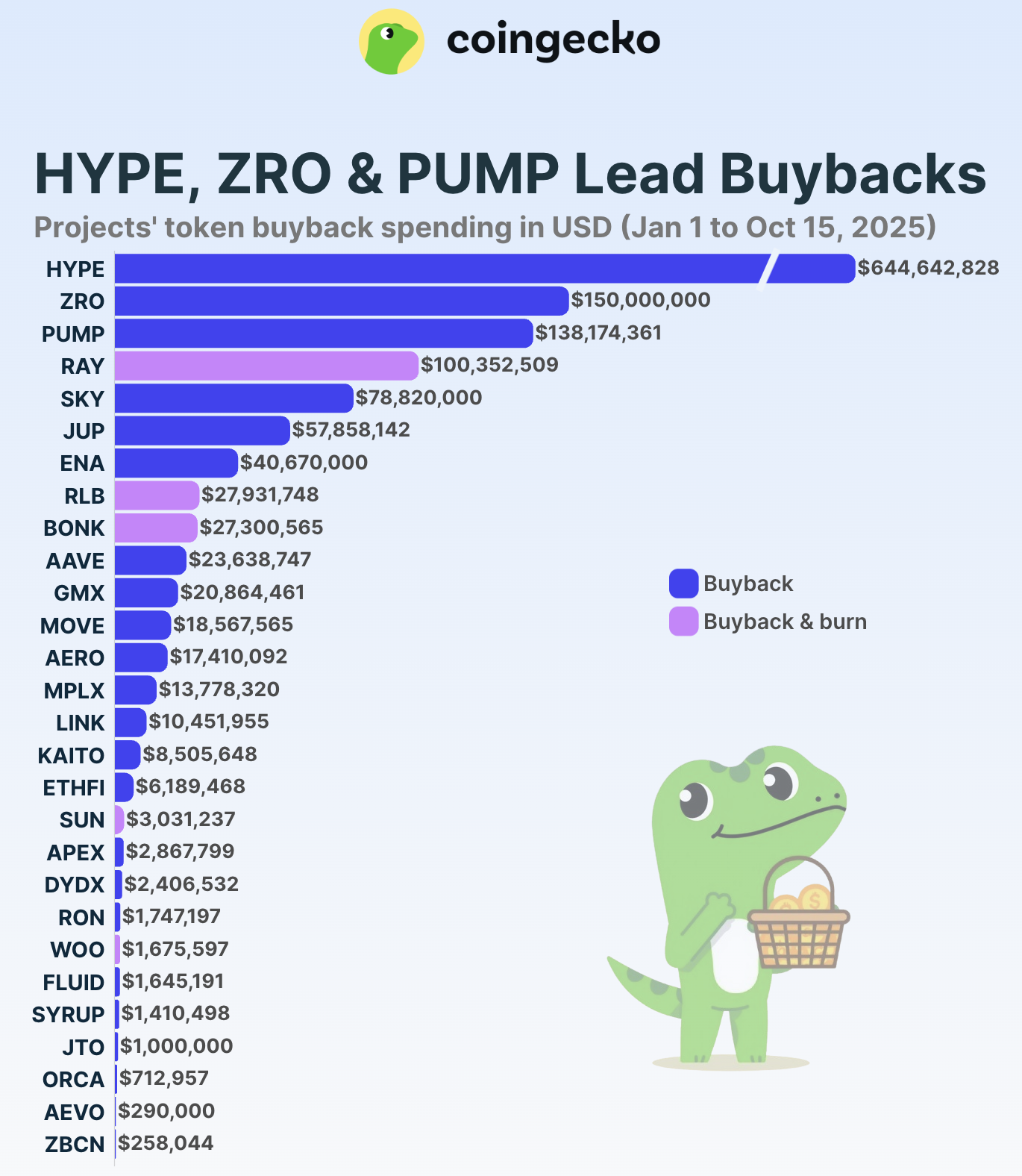
In terms of the share of supply retired, GMX outperformed with repurchases equating to 12.9% of its supply for $20.86 million, highlighting efficiency in smaller-scale efforts.
“Excluding buyback-and-burn programs, the 23 token buybacks examined here have repurchased on average 1.9% of their respective total supply. So far, 14 out of the 23 projects have only bought back less than 1.0% of total supply,” the report added.
Sponsored
Several forces fueled the 2025 buyback boom. According to DWF Labs, the surge stemmed from a convergence of profitability, governance maturity, and market psychology across the Web3 space.
“With an increasing number of projects achieving profitability, buybacks have become an essential strategy to reward long-term users, reduce circulating supply, and generate positive feedback loops that benefit both users and projects,” the report read.
As more decentralized protocols achieved sustainable revenue, they began channeling earnings into token repurchases to reinforce long-term value and community trust. DWF pointed out that mature DAO governance and disciplined treasury management—such as Aave’s structured “Aavenomics” buybacks—helped institutionalize these practices.
At the same time, investors gravitated toward scarcity-based token models following a volatile 2024. Meanwhile, automated on-chain systems from projects like Hyperliquid and Raydium turned buybacks into transparent, continuous mechanisms.
Together, these dynamics transformed buybacks into a hallmark of disciplined tokenomics and a defining trend in 2025’s decentralized economy.


