Developers can now build XRPL wallets into apps via Privy, with support for XRP, RLUSD, AI agent payments and x402.


 Live Chat
Developers can now build XRPL wallets into apps via Privy, with support for XRP, RLUSD, AI agent payments and x402.

New York, USA, September 30th, 2026, Chainwire
Integration lets users hold XRP, RLUSD, and USDC and use XRP to fund Tria cards and Hyperliquid or Decibel trading accounts without manually bridging or swapping.
Tria, the self-custodial neofinance platform for trading, earning, spending and moving assets across chains, today announced native support for the XRP Ledger, making XRP directly usable across Tria’s wallet, card and trading products.
Users can now receive, hold and send XRP, RLUSD and USDC on the native XRP Ledger, use XRP to book or top up a Tria card, and fund futures trading accounts on Hyperliquid or Decibel—all from inside Tria.
The integration removes the manual bridging and swapping that typically sits between an onchain balance and where a user wants to put it to work. Tria handles the underlying routing, allowing users to move from holding XRP to spending or trading without navigating multiple networks and applications themselves.
“XRP has one of the largest and most established communities in digital assets, but holding an asset and being able to use it seamlessly are still very different things,” said Vijit Katta, Co-founder and CEO of Tria. “With XRP Ledger support inside Tria, users can keep control of their assets while moving directly into spending or trading without stitching together bridges, swaps and separate apps.”
For card users, XRP can be used for both initial card booking and subsequent top-ups. For traders, XRP Ledger balances can fund futures accounts on Hyperliquid or Decibel. Tria displays both an estimated amount and guaranteed minimum before users confirm a card or trading top-up.
Transactions directly on the XRP Ledger typically settle in approximately three to five seconds, while cross-network card and trading top-ups generally take between one and three minutes.
The launch supports XRP, RLUSD and USDC on the native XRP Ledger. New XRP Ledger accounts require a 1 XRP reserve, with an additional 0.2 XRP reserve for each enabled token. Those reserves remain in the user’s account and are not paid to Tria. Tria recommends an initial deposit of at least 2 XRP to allow for reserve requirements and transaction fees.
Support is limited to the native XRP Ledger. XRP transferred through Ethereum, BNB Chain or the XRPL EVM sidechain is not supported by the integration.
The launch expands Tria’s broader push to make digital assets usable across financial products without forcing users to manage the infrastructure underneath each transaction. Tria brings spending, trading and cross-chain money movement into a single self-custodial interface designed to make assets portable across networks and applications.
XRP Ledger support is available now in the Tria app, with no access code required.
About Tria
Tria is a self-custodial neofinance platform that lets users trade, earn, spend and move assets across chains from a single interface. Tria combines consumer financial products with cross-chain infrastructure designed to make digital assets usable without requiring users to manually navigate bridges, networks and fragmented applications.
For more information, visit tria.so.
Jon Phillips
PhillComm Global
Tria@PhillCommGlobal

Veteran trader Peter Brandt called October 4 as the day Bitcoin’s bear market would end, but now he thinks the market beat him to it.
“There’s a good possibility we have seen the low and now are entering a new bull market cycle in Bitcoin,” Brandt tells Cointelegraph on the latest episode of Trade Secrets.
In July, Brandt warned that prices could fall into the high-$40,000 range. Bitcoin was trading near $64,000 when that interview was published and climbed to almost $85,000 by his latest appearance.
With the benefit of hindsight, Bitcoin’s fall to around $58,000 in late June may have already marked the cycle bottom.
But that doesn’t rule out a sharp drop first, says Brandt, who is on the lookout for a possible pullback toward $65,000 or $66,000 in early October.
“One thing that could happen, of course, is we just had too many people now chase the market,” he says. “They have bought the idea that the Bitcoin low is in and they have loaded up on the rally.”
A pullback could shake out those late buyers and give investors an opportunity to build their positions.
“We all know Bitcoin doesn’t go straight up.”
Related: Bitcoin’s ‘narrative vacuum,’ Ethereum now inevitable: Trade Secrets
Brandt has also raised his sights for Bitcoin’s next peak, putting a late-2029 high of between $300,000 and $600,000, up from the $250,000 to $300,000 range he outlined in July.
“The bull market cycle this time has a very good chance of reaching half a million,” he says.
A million-dollar Bitcoin by 2030 isn’t impossible in his view, but he doesn’t need that target to come true for the trade to work. Brandt says he hasn’t invested all the money he has earmarked for Bitcoin. He would be content with 70% of that allocation in the market for 70% of the move into the projected 2029 highs.
“If Bitcoin’s $350,000 in late 2029, I’m not gonna be a million-dollar bull,” he says.
Brandt is also wary of using headlines about the CLARITY Act or other events to explain every price move. He looks at the timing and pace of previous market cycles to gauge what could come next.
“Markets do something, traders need to create a narrative. More often than not, the narrative is at least partially wrong,” he says. “Let price be king.”
His model places the halving roughly halfway in time between the bear market low and the next peak. He expects gains to accelerate toward the end, with the final three or four months potentially delivering about 30% of the total increase.
Brandt’s forecast assumes a new bull market is already underway and that Bitcoin’s historical cycle patterns broadly hold. For now, finding the next buying opportunity with manageable risk matters more to him than whether Bitcoin reaches $100,000 by year-end.
“It’s unimportant,” he says. “I think more important is can we identify the next tradable spot where one can have somewhat of a measured risk?”
Brandt is famously dismissive of many altcoins and he says the thesis of investors tipping money into “some fool coin” like XRP is often wrong.
XRP’s usefulness for payments and Ripple’s banking partnerships don’t automatically make it a winning investment in his eyes.
“Just because something is transactional, that doesn’t mean automatically that it must be more valuable,” he says, comparing it to the US dollar.
It works for payments, but people don’t buy it simply because they expect its transactional usefulness to push up its value.
Related: HYPE price could suffer as Binance takes its revenue: Alice Liu
Ether and Solana get a warmer reception, with room for both alongside Bitcoin in his suggested crypto portfolio allocations. Chasing the next new token is another matter.
“Don’t be sold on the new upstarts, don’t be conned into the latest fast horse in the game,” he says.
For financially secure investors, he suggests a crypto allocation of up to 10%, with Bitcoin taking the largest share.
“I believe that trading is a marathon, not a sprint.”
Magazine: THORChain under fire over Bitget, ETH evolves beyond blockchain: Hodler’s Digest
Cointelegraph publishes long-form journalism, analysis and narrative reporting produced by Cointelegraph’s in-house editorial team with subject-matter expertise. All articles are edited and reviewed by Cointelegraph editors in line with our editorial standards. Some articles contain affiliate links, from which Cointelegraph may earn a commission. These relationships do not influence which products we review or our editorial conclusions. Content published in here does not constitute financial, legal or investment advice. Readers should conduct their own research and consult qualified professionals where appropriate. Cointelegraph maintains full editorial independence.
The total crypto market cap hit a multi-month peak at over $2.9 trillion after the latest rally.
Bitcoin went on a wild run on Monday, surging by over $7,000 on the heels of massive ETF inflows and topping $87,000 for the first time since late January before it finally calmed at around $86,000.
Most altcoins registered similar or even more impressive gains, including Ripple’s XRP, which flew past $1.50, and DOGE, which has neared $0.10.
There was very little evidence last week of what would transpire in the crypto markets, starting from Friday and culminating on Monday evening, at least for now. The CLARITY Act was voted down in the US Senate, marking the first major blow against the industry. A day later, the Federal Reserve increased rates for the first time since July 2023. Both of these developments led to short-term declines for BTC, which slumped to $75,000 on a couple of occasions.
However, it reacted well on Thursday and especially on Friday. The BOJ’s decision to mimic the Fed didn’t harm bitcoin. Just the opposite; the asset rebounded to over $78,000 before it initiated another leg up that afternoon to over $80,000. It climbed to almost $82,000 on Wednesday, when the new escalation in both major wars led to a brief retracement to $80,300.
Monday, though, belonged to the bulls. BTC began its gradual ascent in the morning and culminated in the evening with a surge past $87,000 as the ETF inflows rocketed, which became an eight-month peak. After gaining $7,000 in less than 24 hours, bitcoin was due for a pullback. It dipped to $85,000 earlier today before it recovered to $86,000 as of now.
Its market cap has risen to $1.730 trillion on CMC, while its dominance over the alts stands above 59%.
Ethereum touched $2,800 briefly for the first time since the start of the year before it slid to $2,750. BNB tapped $800, but it’s now down to $788. Ripple’s XRP has reclaimed the key $1.50 resistance after another 4% run in the past 24 hours. Naturally, analysts have flipped bullish again, outlining some major predictions.
Dogecoin has neared $0.10 after a similar increase; ADA is close to $0.25, while NEAR has tapped $4.50. SHIB, CRO, HBAR, TAO, and PEPE have risen the most over the past day. In contrast, MORPHO, RAIN, UNI, ENA, BTW, and AAVE are in the red.
The total crypto market cap is up by over 3.5% today to $2.9 trillion on CMC.
Disclaimer: Information found on CryptoPotato is those of writers quoted. It does not represent the opinions of CryptoPotato on whether to buy, sell, or hold any investments. You are advised to conduct your own research before making any investment decisions. Use provided information at your own risk. See Disclaimer for more information.
US-listed spot Bitcoin exchange-traded funds (ETFs) have recorded their strongest three-week inflow stretch of 2026 as Bitcoin traded around $80,000.
The funds attracted $986.9 million in the week ending Friday, bringing net inflows over the past three weeks to $3.8 billion, according to SoSoValue data.
Total net assets across the funds stood at $101.3 billion on Friday after briefly rising to $103.3 billion a day earlier, while cumulative net inflows reached $55.6 billion.
ETF demand marks a sharp turnaround from heavy outflows earlier in 2026, though year-to-date net flows remain roughly $1 billion negative.
US spot Bitcoin ETFs attracted $174.6 million in net inflows on Friday, down sharply from the nearly $731 million recorded a day earlier.
BlackRock’s iShares Bitcoin Trust (IBIT), the largest spot Bitcoin ETF by assets, drew $117.4 million on Friday, accounting for about 67% of the day’s total net inflows, according to Farside Investors data.
Daily spot Bitcoin ETF flows from Monday through Friday. Source: SoSoValue
Fidelity’s Wise Origin Bitcoin Fund (FBTC) was the only other fund to record net inflows, attracting $57.2 million, while all other US spot Bitcoin ETFs recorded no net flows for the day.
Related: Surprise nonfarm payrolls print sends Bitcoin back below 80K
The slowdown came as Bitcoin fell from around $81,200 to briefly below $79,000 on Friday. Bitcoin traded at $79,716 at the time of publication, still up about 2.6% over the past seven days, according to CoinGecko.
Compared with the previous week, Bitcoin ETF inflows increased about 7%, while inflows into US spot Ether and XRP ETFs fell about 74% and 83%, respectively.
Spot Ether ETF inflows dropped to $218.4 million from $824.4 million, while XRP ETF inflows declined to $19 million from $110.5 million, according to SoSoValue.
Despite weaker inflows, Ether and XRP ETFs remain in positive territory for the year. US spot Ether ETFs have recorded about $863 million in net inflows year-to-date, while XRP ETFs have attracted roughly $515 million.
Magazine: BTC will hit $1M by 2030… but Arthur Hayes is buying ETH instead

XAO DAO has not yet disclosed the final mechanics or timetable for implementing all the proposed governance changes.
XAO DAO is preparing a series of governance changes for the XRP Ledger over the next two to three months, according to Fabio Marzella, the organization’s co-founder.
The planned changes would let members delegate voting power, adjust quorum rules, and access community mini-grants, as the DAO looks to make participation easier and more representative, at a moment when several XRPL projects have already scaled back or shut down.
Marzella said the first change would introduce wallet delegation, allowing members to hand their voting power to others when they lack the time or expertise to vote on individual proposals.
The DAO is also reviewing its quorum requirements, including how inactive wallets count toward proposal thresholds. The stated aim is to prevent inactive participation from blocking decisions while keeping governance tied to the active community.
Community mini grants are another planned addition. Under the proposal, members would be able to submit smaller initiatives and seek funding for projects that contribute to the XRPL ecosystem.
“These aren’t changes for the sake of change,” Marzella wrote. He said the broader goal is to create a DAO where the community has “the ability to act” rather than simply having a vote.
The timing comes as questions around developer support have grown within the XRPL community. On August 13, Marzella said the shutdown of Gen3’s retail platforms showed that funding developers alone does not solve the problem of building lasting businesses.
Gen3, an XRPL infrastructure team, said on August 12 it would spin down two of its retail products, aigent.run and AxiomProtocol, citing weak user demand and rising infrastructure costs. Gen3 said the platforms will stay live for another month, until September 13, so users can withdraw remaining funds, and that it will keep running its core XRPL infrastructure and take part in the ledger’s amendment process.
Marzella pointed to the Gen3 news as evidence of a bigger problem, arguing that funding developers only solves half the issue if there’s no path from a funded project to a sustainable business. Builder Handy Andy, replying in the same thread, described colleagues quietly calculating how much longer they can keep funding their own work without support, calling it “the last roll of the dice” for some.
The reshuffle comes as XRP closed near a 21-month low this week, and Santiment data shows daily active addresses averaging 35,700 in August, up from 26,400 in July, even though the number of new wallets has stayed almost flat.
That distinction may matter for XAO DAO’s participation plans. More activity among existing users does not automatically mean a larger pool of people taking part in governance.
As it stands, Marzella has not provided a final timetable or detailed voting mechanics for the proposed changes, instead promising that more information will follow as each initiative progresses, leaving the community to see how delegation, quorum changes and mini grants are eventually implemented.
The Ripple case is no longer in its earliest, most explosive phase, but it still has the market’s attention because the ending matters. A remedies timeline brings the dispute closer to final judgment, and XRP watchers are paying attention to what that final shape looks like.
At this stage, the market is less focused on whether the case exists and more focused on what the court ultimately requires Ripple to pay or change.
For more details, visit the official Ripple platform.
Remedies can sound like a technical legal afterthought, but they are often where the practical consequences of a case become clear. Penalties, injunctions, and conduct restrictions all shape how a company operates after the headline ruling.
Ripple has argued for a much lower civil penalty than the SEC sought, and that gap remains central to how the market reads the outcome.
XRP has already lived through years of legal uncertainty. That means each procedural step carries emotional weight for holders, even when the filing itself is not dramatic.
A final judgment could help reduce uncertainty, but only if it is clear enough for exchanges, institutions, and counterparties to interpret confidently.
The next phase will be watched for timing, penalty language, and any restrictions that could affect Ripple’s institutional sales or market activity. Traders will also look for whether the result has read-through to other token cases.
For now, the remedies timeline keeps the case in the final stretch. It is not over yet, but the market is getting closer to the point where speculation gives way to a concrete outcome.
The useful way to read this story is not as a standalone headline about Judge Torres, but as part of the wider pressure building around Ripple coverage this week. Markets have been jumping quickly from one catalyst to the next, so the cleaner value for readers is in separating the actual development from the instant reaction around it. In this case, the source material gives us a concrete event to work from, rather than a loose rumour or a recycled social-media talking point.
That distinction matters because crypto readers are being asked to process a lot at once: ETF flows, regulatory actions, exchange listings, protocol upgrades, wallet movements, and political signals. A story like this is most useful when it helps them understand where SEC v Ripple fits into that broader map. It does not need to be inflated into a guaranteed price call to be worth covering. It simply needs to explain what changed, who is affected, and why the market is paying attention today.
The caveat is also important. Even clean source-backed developments can be overinterpreted when traders are hunting for a fast narrative. A listing does not automatically create lasting demand, a regulatory update does not immediately settle every legal question, and an on-chain movement does not always translate into a finished sale. The better read is to treat the development as a fresh data point and then watch whether follow-up activity confirms the direction of travel.
For Bitcoinist readers, that means keeping the focus on what can actually be verified from the source and avoiding the temptation to turn every update into a sweeping market verdict. The story is strong enough on its own terms: it gives investors and traders another piece of context around Ripple, while leaving room for the next filing, dashboard update, wallet movement, governance vote, or exchange notice to decide whether the angle grows into something bigger.
This article is based on information from Ripple.
This article was written by the News Desk and edited by Samuel Rae.

Editorial Process for bitcoinist is centered on delivering thoroughly researched, accurate, and unbiased content. We uphold strict sourcing standards, and each page undergoes diligent review by our team of top technology experts and seasoned editors. This process ensures the integrity, relevance, and value of our content for our readers.

The cryptocurrency market finds itself in a peculiar position where calmness masks potential turbulence. As
The crypto market has gone quiet. After a brutal stretch of selling pressure, major digital assets — Shiba Inu, Cardano, and XRP — have all compressed into tight trading ranges that traders know well. Too well, actually. That kind of stillness rarely lasts. Buyers and sellers are basically in a standoff right now, and the market is waiting on something — anything — to break the deadlock and pick a direction.
It’s not just a vague feeling. The technical picture across these three assets is pretty much the same story: reduced volatility following heavy selling, narrow price bands, and no clear catalyst in sight. That combination tends to mean one thing in crypto. A big move is probably coming. Nobody knows which way.
We’ve been here before. Late 2018 is the obvious parallel — Bitcoin and the broader market spent months grinding sideways after the wreckage of the 2017 bull run. Volatility dropped, volume dried up, and a lot of people called it dead. Then 2019 happened. The breakout came, and the next cycle started building from exactly that kind of low-energy base.
Mid-2021 is another one worth remembering. After Bitcoin’s initial surge earlier that year, the market hit a consolidation wall. Months of stagnation followed. And then, gradually, recovery. A new all-time high came after that. The pattern isn’t guaranteed to repeat — crypto doesn’t work that cleanly — but the setup rhymes. Calm stretches in this market have a habit of ending loudly.
So when Shiba Inu, Cardano, and XRP all start flashing compressed volatility at the same time, it’s probably worth paying attention. Maybe it goes nowhere for another few weeks. Maybe it doesn’t.
For anyone holding Shiba Inu or Cardano right now, the consolidation is a double-edged thing. On one hand, it’s a window — a chance to reassess positions before the next significant move forces a decision under pressure. On the other hand, the longer this drags on, the more fragile sentiment gets. New money tends to stay on the sidelines when direction is this murky, and that can become a self-reinforcing problem.
XRP’s situation is a bit different and, honestly, more concerning. Its volatility has dropped to levels that some traders describe as dangerously low. That kind of near-zero movement can mean two things: either the market has basically lost interest in the asset, or pressure is quietly building under the surface before a sharp move. The difference between those two outcomes is enormous. One path leads to what some have started calling “zombie asset” territory — low volume, low relevance, slow fade. The other leads to a breakout that resets the narrative entirely.
The stakes aren’t small. Whichever direction these assets break, it’ll create winners and losers fast. Complacency in a setup like this tends to be expensive.
A few things are worth tracking closely over the next month.
The volatility index for crypto over the next 30 days is the first one. A sharp spike there would likely signal the start of something bigger — not just for these three assets, but for the broader market.
Shiba Inu’s resistance levels are the second. The asset is sitting below three key resistance points. Breaking through all of them would be a meaningful signal — not just for Shiba Inu holders, but as a read on overall market confidence. It won’t be easy. But it’s the kind of move that tends to pull other assets along with it.
XRP’s trading volume is the third. Sustained low volume over the coming weeks could cement the “zombie asset” label in the eyes of the market. That’s not just a technical problem — it raises real questions about XRP’s utility and liquidity going forward. If volume doesn’t return, the perception problem becomes a real one.
And it’s worth watching Cardano’s ability to claw back recovery ground. Cardano’s trajectory right now depends heavily on external catalysts — macro shifts, broader risk appetite, or a sentiment flip somewhere in the market. Without one of those, the stagnation probably continues.
The interplay between these signals and investor behavior will be pretty telling. Right now, market participants are watching the same charts, waiting on the same triggers. The pressure is building on all sides. Shiba Inu needs to clear resistance. Cardano needs a reason to move. XRP needs volume to come back before the dormancy narrative sticks for good.
Hub: Cardano price, news, and analysis
The next 30 days will probably tell us a lot. Volatility this low doesn’t stay this low — not in crypto, not for long.
Post Views: 13
Several key metrics of XRP are starting to change course, falling drastically along with the ongoing bearish performance of the altcoin’s price. As the downside pressure mounts, the Realized Profit to Loss Ratio has experienced a sharp decline to levels that reflect the intensity of the current bear market phase.
The price of XRP is still trapped below $1.2, as bearish pressure returns to the market following a brief upswing. Investors are still feeling the impact of the persistent downside action of the leading altcoin, which is triggering a shift in market dynamics.
In light of this significant price decline, the XRP’s Realized Profit to Loss Ratio is notably dropping to negative levels. As seen in the chart shared by Glassnode, a popular on-chain data analytics platform, the metric on the 90-day time frame has fallen to 0.38, indicating a decrease in profitability among investors.
Furthermore, a change in market mood and investor behavior is reflected in the drop as an increasing number of transactions are being completed at a loss compared to those realized in profit. During this period, an inflection or more selling pressure is highly likely, which will be vital for the possible next major move.
According to the platform, for every dollar of loss being realized in the market, only 38 cents of profit are being taken. At the 2025 peak, this ratio reached level 50, implying that profit-takers were overwhelming loss sellers by a factor of 50x, but that key dynamic has completely inverted.
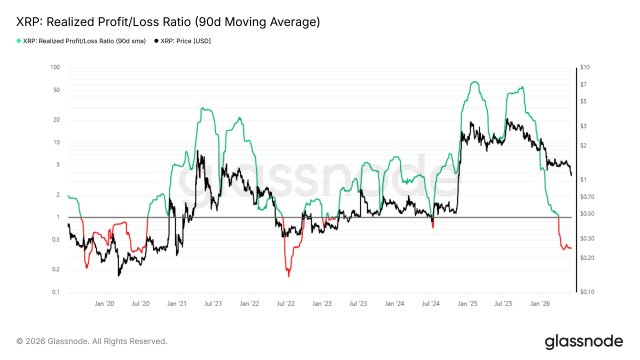
Glassnode highlighted that when a ratio drops deep below 1, it reflects a market where the majority of participants who are moving coins are doing so at a loss. This trend is a clear indication of a hallmark of intense capitulation.
Despite the waning price performance, XRP spot trading is picking up pace. Data shows that this rise in spot trading is being led by large investors or big whales, and has maintained this dominance since July 2022.
An important aspect of this development is that these traders often lead the spot market trading in periods of accumulation phases rather than making significant orders during the uptrend phases. In addition, Glassnode highlighted that the cohort has been leading spot trading very actively since October last year.
XRP investors’ sentiment and behavior are experiencing a key shift as the altcoin is starting to leave cryptocurrency exchanges. One of the major exchanges where this trend is being spotted is the Korea-based leading trading platform, Upbit.
The reserves appear to be slightly declining, but subtly. CW noted that in periods when XRP’s reserves on Upbit grow, it has generally coincided with bearish trends. Meanwhile, when the reserves decrease on the platform, the altcoin has displayed notable rallies. As a result, the data analyst believes that a bounce could be on the horizon if this trend continues.
Featured image from Pixabay, chart from Tradingview.com
Editorial Process for bitcoinist is centered on delivering thoroughly researched, accurate, and unbiased content. We uphold strict sourcing standards, and each page undergoes diligent review by our team of top technology experts and seasoned editors. This process ensures the integrity, relevance, and value of our content for our readers.
XRP is approaching a decisive liquidity zone after a brutal market-wide crypto flush, with analyst Will Taylor (@CryptoinsightUK) arguing that downside liquidity has largely been swept while larger pools may now sit above price. The setup comes as crypto sentiment has deteriorated sharply following roughly $5 billion in liquidations across the market.
In the latest edition of The Weekly Insight, Taylor framed the current XRP structure as part of a broader capitulation event rather than an isolated altcoin breakdown. Bitcoin, Ethereum and XRP have all moved into areas where major liquidity has been taken, according to the analyst, raising the question of whether the market is preparing for another leg lower or setting up for a violent reversal.
For XRP, the key level remains the liquidity band near $1. The analyst noted that the token still has downside liquidity in that region, but argued that it looks modest when measured against the larger liquidity pools sitting above current price.
“The discussion is very similar for XRP,” Taylor wrote. “If you zoom in slightly further on the XRP liquidity chart, there is still a liquidity band sitting around the $1 area. However, when you zoom out and compare it to the larger timeframe liquidity pools above us, it becomes relatively insignificant.”
That does not mean the chart has already resolved bullishly. Taylor emphasized that XRP remains trapped in a broader downtrend that has been in place since August 2025, making the current area a critical test of market structure. A failure to reclaim momentum could leave the $1 liquidity band exposed. A successful hold, however, would support the argument that sellers have already done most of their work.
The analyst’s broader thesis is that the market has entered a liquidity-driven inflection point. Bitcoin has swept key hourly downside liquidity, Ethereum has backtested a trend line while clearing much of its daily liquidity below price, and XRP’s remaining lower pool appears less significant than what sits above. In that context, the recent liquidation wave may have reset positioning enough to create the conditions for a stronger move.
“One positive factor is that we have just experienced a significant liquidation event, with roughly $5 billion worth of liquidations across the market,” Taylor wrote. “Historically, events of that magnitude tend to occur very close to important lows, if not directly at them. Again, that does not mean we cannot see another flush lower, a marginally lower low, or even continued downside.”
The caution is important. The analyst repeatedly stressed that crypto could still see continued volatility, especially if instability in equities spills over into digital assets. The newsletter pointed to a stronger DXY, US 10-year yields near 4.532%, and an overextended Nasdaq as macro factors that could continue pressuring risk assets.
Yet the report also argued that the crypto market may be closer to a transition point than sentiment suggests. Taylor said the next phase of the market could be defined less by broad speculation and more by utility, with institutions assigning value to networks based on usage rather than narrative alone.
“My view remains the same,” the analyst wrote. “I continue to believe that all of this is happening because the next phase of the market is going to be the utility phase. The institutions entering this market are not playing the same game that retail has been playing for the last decade.”
At press time, XRP traded at $1.14.
Featured image created with DALL.E, chart from TradingView.com


