PayMe users will be able to activate a stablecoin wallet in-app in the coming days for peer-to-peer and peer-to-merchant payments.


 Live Chat
PayMe users will be able to activate a stablecoin wallet in-app in the coming days for peer-to-peer and peer-to-merchant payments.
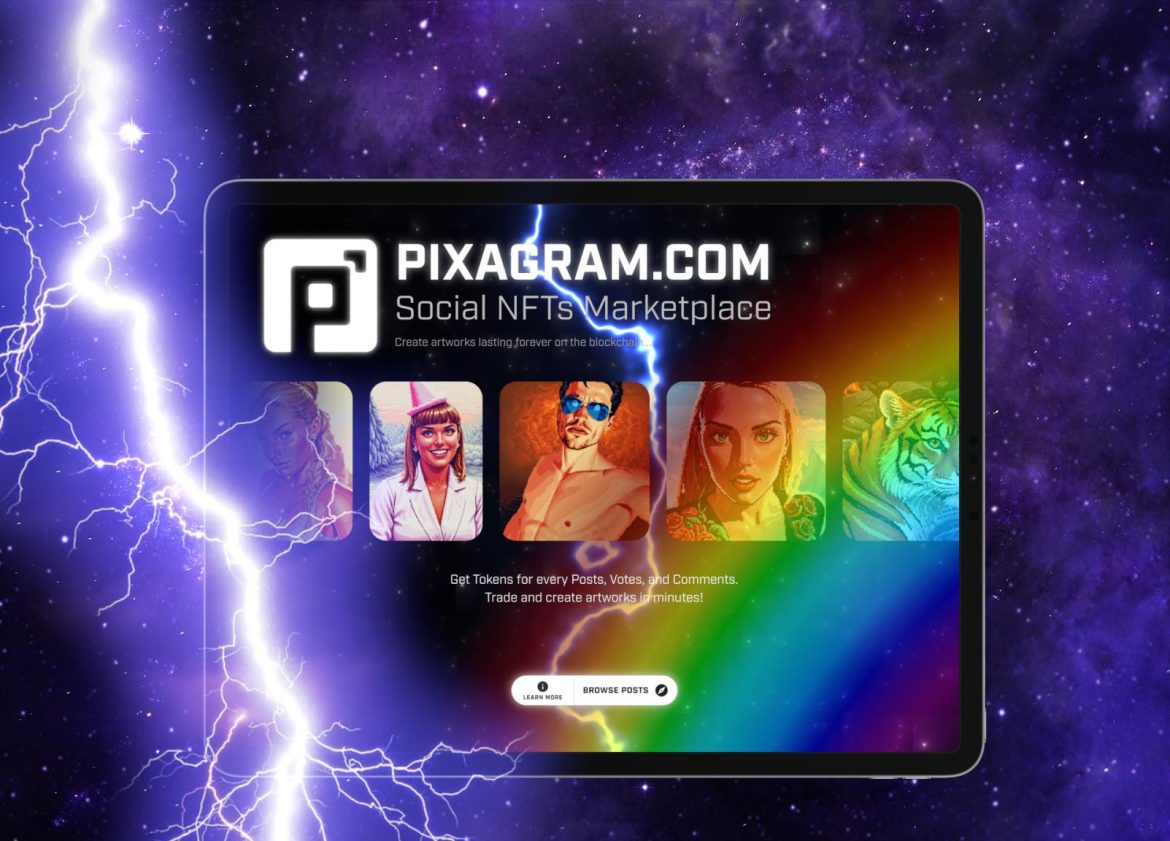
Panama City, Panama, October 15th, 2026, Chainwire
Pixagram announces free account creation for up to 250 new members daily through the end of 2026. Built on the standalone Layer-1 Pixa blockchain, Pixagram is an anti-hierarchy social network where every post, vote, and comment is recorded as a signed on-chain transaction, with no ads and no cryptocurrency purchase required to get started.
Pixagram will cover the 20 PIXA network fee for up to 250 new members daily through the end of 2026. New members can claim a free @username at Pixagram.com and join the platform’s on-chain community for creators.
► Quit Renting the Spotlight — Users can register at http://pixagram.com
An On-Chain Username and Wallet Address
Opening a Pixa chain account normally costs around 20 PIXA. Pixagram is covering this fee for up to 250 new members daily through the end of 2026.
Not Really Anti-Social, Truly Anti-Hierarchy
Mainstream social media serves advertisers while gatekeepers decide who sees your work. Pixagram—alongside platforms like Hive and Mastodon—is a SIGMA platform built for creators who prefer agency over status games. Your posts, art, followers, and feeds live directly on-chain with nothing in between, allowing you to reach every follower automatically.
NFT Platform Storage and Artwork Permanence
On many NFT platforms, the token sits on-chain while the image lives on a cloud server or IPFS—meaning a token can easily outlive its art.
On Pixa, every artwork is stored directly on-chain inside its post as a lossless image. Compact pixel art lives permanently on the blockchain and renders up to 4K resolution as a painting, CRT filter, hexagonal shapes, or square pixels.
► Less Lurking. One Original Post. Start at Pixagram.com
Proof-of-Brain and Community Curation
Instead of relying on the computational process used in Proof-of-Work systems, Pixagram uses Proof-of-Brain, a mechanism that allocates rewards based on posting, commenting, and voting activity.
Censorship-Resistant by Design
Built on the Hive codebase with Steem lineage, the Pixa chain started from a clean genesis block with no airdrop and produces a block every three seconds. While an application interface can hide a post from its view, it can never erase the transaction record from the chain.
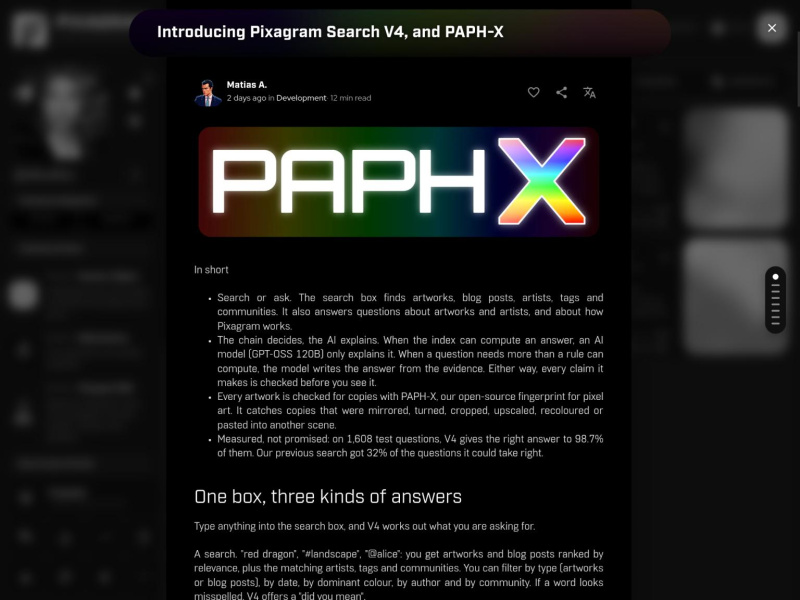
Furthermore, every artwork is checked for copies using PAPH-X (an open-source perceptual fingerprint for pixel art) and indexed by the Search V4 engine.
“The old internet wants you trapped in feed fog, renting reach from gatekeepers who track every click. Today information is king, and Pixagram operates outside that hierarchy… Don’t believe the hype. Create it.” — Matias Affolter, Co-Founder of Pixa
“The strongest rebellion is a working alternative. We’re covering the network fee for 250 new accounts a day so any creator can step into build mode at zero cost. Claim your permanent @username now—because once a handle is written to the chain, it’s gone forever.” — Mathiew Estepho, Co-Founder of Pixa
Pixagram Account Registration and Developer Resources
Pixagram offers fee coverage for up to 250 new accounts daily through the end of 2026. Eligible new members can register and claim an @username at Pixagram.com. Additional technical information is available in the developer documentation at pixa.org.
About Pixagram
Pixagram is an on-chain pixel art and blog network developed by Pixagram AG (Zug, Switzerland) and operated by Pixa Rex S.A. (Panama City, Panama).
Owner
Pixa Omnibus Foundation
Pixa Rex S.A.
contact@pixarex.net

DUBAI, UAE, Oct. 12, 2026 /PRNewswire/ — Bybit, the New Financial Platform trusted by more than 80 million users worldwide, announced that stocks are now available for trading through Bybit, giving eligible users access to more than 1,000 U.S.-listed stocks and ETFs, including Apple (AAPL), NVIDIA (NVDA), Tesla (TSLA), Micron Technology (MU) and the Invesco QQQ ETF (QQQ).
The development expands Bybit’s multi-asset platform, bringing access to U.S. equities alongside its existing digital asset and traditional market offerings. Eligible users in permitted jurisdictions who have completed the required KYC verification can trade supported U.S. stocks and ETFs using USDC.
“Stocks are an important part of our evolution into The New Financial Platform. Financial markets have long been separated across different products and platforms, but users increasingly expect a more connected experience,” said Ben Zhou, Co-founder and CEO of Bybit. “With stocks now available through Bybit, we are doing more than adding another asset class. We are giving people broader access to financial markets and greater freedom to pursue opportunities.”
Access to U.S. Stocks and ETFs
Stocks trading enables eligible users to buy and sell supported U.S. stocks and ETFs using USDC, bringing equity exposure into the same environment used for digital assets. Unlike price derivatives or synthetic instruments, Stocks trading gives eligible users an economic interest in the underlying securities they purchase.
Orders are routed through Bybit’s regulated brokerage infrastructure and executed through Alpaca, a U.S. self-clearing broker-dealer and a global leader in agent-first infrastructure. Additionally, the underlying securities are held in custody by Alpaca.
“Bybit’s expansion into U.S. stocks and ETFs is a major step forward in offering its global users a more complete, multi-asset trading experience,” said Yoshi Yokokawa, Co-Founder and CEO of Alpaca. “We’re thrilled to partner with Bybit and help power this next wave of global market access.”
Key features at launch include:
Eligible holders of supported U.S. stocks and ETFs can receive the economic benefits associated with their holdings, including cash and stock dividends, subject to applicable security and corporate-action terms. Cash dividends are converted from USD into USDC and credited to the user’s Unified Trading Account (UTA), while stock dividends are reflected directly in the user’s position.
Stock splits are also reflected in users’ holdings in accordance with the applicable corporate action. Voting rights are planned for launch in a future phase.
Building a Broader Multi-Asset Platform
The addition of stock services adds to the exchange’s growing range of products across traditional and digital markets. Alongside crypto spot and derivatives trading, Bybit offers access to traditional markets through its MT5 platform, tokenized equities and TradFi perpetuals.
“We believe the next chapter of finance is one where the walls between crypto and traditional markets no longer exist. Bybit is built to operate in both worlds and proves that tokenizing real-world assets at scale is not a future ambition. It is something we are delivering today,” added Ben.
Disclaimer:
Bybit Stocks: Bybit Stocks service is provided by Infra Capital Limited (introducing broker), regulated by the Financial Services Commission, Mauritius (GB23202169). US securities clearing, settlement, and custody services are provided by Alpaca Securities LLC (dba “Alpaca Clearing”), a FINRA/SIPC member. Some corporate actions may be restricted at this time. Access and ownership are subject to the Bybit Stocks Terms & Conditions. Capital at risk – you may get back less than you invested. Please read the Risk Disclosures before investing.
#Bybit / #NewFinancialPlatform
About Bybit
Bybit is The New Financial Platform.
We believe every person should have access to every financial opportunity on earth. That’s why we’re building the first intelligent platform that connects anyone, anywhere to the world’s finance.
Trusted by more than 80 million users worldwide, Bybit brings together investing, trading, payments, and wealth-building in a single secure and intelligent ecosystem. Through the combination of AI-powered technology, deep global liquidity, robust security, and transparent operations, Bybit makes global finance more accessible, efficient, and empowering for everyone.
Built for everyone. Powered by intelligence. Open to the world.
Learn more at Bybit.com.
For more details about Bybit, please visit Bybit Press
For media inquiries, please contact: media@bybit.com
For updates, please follow: Bybit’s Communities and Social Media
Facebook | Instagram | LinkedIn | Reddit | Telegram | TikTok | X | Youtube


Mutsamudu, Comoros, September 22nd, 2026, Chainwire
MEXC, a pioneer in 0-fee digital asset trading, has expanded its Opportunity Compass education initiative by introducing the MEXC Stock Trading Handbook, a new guide designed to help crypto traders bridge the knowledge gap as they enter the stock market. The Handbook reflects a broader evolution in how MEXC empowers users, moving beyond access to Wall Street to help users understand the market, navigate trading tools, and build long-term trading systems.
Opportunity Compass is MEXC’s global markets education initiative, guided by the core message, “Know the Market, Know Your Opportunities,” and designed to help crypto-native users build a more systematic understanding of traditional and crypto markets. For users exploring stocks and other traditional markets, differences in market dynamics, asset behavior, trading tools, and strategies can create a learning curve. The Stock Trading Handbook extends this learning journey with a structured resource focused on stock markets, helping users build market knowledge and develop a more informed approach to stock trading.
The Handbook provides practical guidance across five key areas:
Beyond Opportunity Compass, MEXC has also introduced a series of initiatives to help users break down traditional barriers to financial markets and pursue infinite opportunities. Its recent Trade Wall Street, Without Walls campaign addressed five traditional barriers to market participation, including the Access Wall, Fee Wall, Time Wall, Capital Wall, and Direction Wall, making traditional market participation more accessible. MEXC also introduced MEXC Wall Street DNA to help users identify their trading preferences. Together, these initiatives help users move from accessing stock markets and understanding their own trading preferences to building the knowledge and strategies needed to navigate different markets.
The digital edition of the MEXC Stock Trading Handbook is now available for download from MEXC. In addition, a limited physical edition will also be distributed at TOKEN2049 Singapore.
About MEXC
Founded in 2018, MEXC is a leading global multi-asset trading platform built as your 0-fee gateway to infinite opportunities. Serving users across 170+ markets, MEXC provides simple and efficient access to crypto, stocks, tokenized assets, derivatives, and a growing range of TradFi-linked opportunities through one account and one gateway.
With 0 trading fees, deep liquidity, broad asset coverage, and a high-performance trading experience, MEXC is designed for retail users who want to discover earlier, act faster, and trade with fewer barriers. As crypto and traditional finance continue to converge, MEXC is committed to making global opportunities more accessible, helping users trade freely and MEXCmize every opportunity.
MEXC Official Website| X | Telegram |How to Sign Up on MEXC
Risk Disclaimer:
This content does not constitute investment advice. Given the volatility of financial markets, including digital assets, tokenized assets, and traditional financial products, investors should carefully assess market conditions, underlying asset fundamentals, and potential financial risks before making any investment or trading decisions.
MEXC PR team
media@mexc.com
PANAMA CITY, Panama, September 15th, 2026, Chainwire
BingX today announced its strategic evolution into a multi-asset trading platform and will further its strategy through “Connect Markets. Unlock Opportunities.”, bringing crypto and traditional markets together through an integrated trading experience. The move reflects BingX’s ambition to help traders identify emerging market opportunities, understand the forces shaping them and act across asset classes through a united platform.
Guided by its mission to empower traders to navigate and act on global markets, BingX envisions a world where every market is within reach. The company’s expanded offering reflects this vision, bringing together crypto and traditional markets in one place as the boundaries between asset classes continue to narrow.
As economic developments, market narratives and investment opportunities become increasingly interconnected, monetary policy, macroeconomic conditions and market sentiment can influence both digital and traditional assets. BingX is expanding beyond its crypto-native foundations, combining broader market access with deep liquidity, AI-powered trading tools and market expertise.
The BingX multi-asset platform is built around four strategic pillars:
Trading: Trade Confidently with Multi-Asset Market Access
BingX combines its crypto-native offering, including crypto futures, spot and copy trading, with an expanding range of TradFi products across stocks, forex, indices and commodities. The platform offers one of the industry’s broadest perpetual futures selections across traditional assets, alongside deep order-book liquidity across selected major TradFi futures assets.
Experience: Connecting Market Intelligence with Execution
AI-powered insights, signals and trading tools help traders navigate market developments and identify potential opportunities. TradingView integration provides advanced charting and analysis, while deep liquidity supports execution across key markets. Together, these capabilities give traders a more direct path from market analysis to execution.
Opportunities: Capture What’s Moving Across Markets
BingX brings together market research, industry expertise, educational resources and community engagement to give traders a broader view of developments across crypto and traditional finance. By covering the narratives and forces shaping different markets, BingX aims to make it easier for users to identify areas of interest and explore opportunities beyond a single asset class.
Reliability: Built on Trust
As BingX broadens its market coverage, reliability remains a core foundation of the platform. BingX supports its trading environment with 100% Proof of Reserves and its Shield Fund. These measures reflect the company’s continued focus on security, transparency and operational resilience as it evolves into a multi-asset trading platform.
“Our evolution into multi-asset is a natural progression for BingX as markets become increasingly interconnected,” said Kevin Lee, Chief Strategy Officer at BingX. “Traders today are not necessarily thinking in terms of one asset class. They are looking at the broader market and considering where conditions, narratives and opportunities are developing. Our role is to give them access, infrastructure and perspective to navigate that landscape from one platform.”
About BingX
Founded in 2018, BingX is the world’s leading multi-asset trading platform, serving more than 40 million users worldwide. From crypto to traditional markets, BingX connects users with a broad range of assets and opportunities across global markets through one unified platform.
With perpetual futures, TradFi offerings, spot trading and copy trading, alongside AI-powered innovations, BingX delivers a reliable, intelligent, and responsive trading experience designed to help traders navigate evolving markets and act on opportunities with greater confidence and efficiency.
BingX has been the Principal Partner of Chelsea FC since 2024 and became the Official Team Partner of Scuderia Ferrari HP in 2026.
For media inquiries, users can contact: media@bingx.com
For more information, users can visit: https://bingx.com/
BingX Media
BingX
media@bingx.com

TON Foundation says Telegram Web3 mini-apps have passed 100 million monthly active users, marking another major distribution milestone for one of crypto’s most consumer-facing ecosystems.
That number is big enough to grab attention, but it needs a careful read.
Monthly active users in Telegram mini-apps can include off-chain bot interactions, app sessions, and wallet-adjacent activity. It should not be treated as the same thing as 100 million on-chain TON wallets all making direct transactions.
Still, even with that caveat, the scale is impressive.
TON has something most crypto networks badly want: access to a massive messaging platform where users already spend time.
For more details, visit the official Ton platform.
Crypto adoption usually struggles with distribution.
Projects build wallets, exchanges, apps, games, and payment systems, then spend huge amounts trying to attract users. TON starts from a different place because it is closely tied to the Telegram environment.
That does not guarantee adoption.
But it gives TON a user funnel most chains do not have. If people can discover mini-apps inside a messaging app they already use, onboarding feels less alien than downloading a new wallet and learning a new ecosystem from scratch.
That is a real advantage.
The mini-app category is broad.
Some apps may involve games, rewards, bots, payments, trading, social features, or wallet interactions. That means the 100 million MAU number is not a pure measure of on-chain financial activity.
And that is fine, as long as it is explained clearly.
The point is that Telegram-based Web3 apps are reaching a large user base. The next question is how much of that activity converts into durable wallet usage, transactions, payments, and application revenue.
TON Space gives the ecosystem a self-custody wallet route inside Telegram.
That matters because mini-app engagement becomes much more powerful if users can move from playing, earning, or interacting into actual wallet activity without leaving the environment. The smoother that step is, the stronger TON’s consumer crypto case becomes.
Most chains have to build consumer distribution from scratch.
TON can build inside a platform where communication and app discovery already happen.
The source materials note that MAU counts include off-chain Telegram bot interactions alongside direct on-chain wallet transfers.
That caveat should not be buried.
Bot-driven ecosystems can produce huge engagement numbers, but not every interaction has the same economic value. A user clicking inside a mini-app is different from a user holding assets, making payments, or interacting with DeFi.
The quality of activity matters.
Still, engagement is the first step. Without users, none of the deeper metrics can follow.
TON’s 100 million MAU milestone shows why the network remains one of the most interesting consumer crypto plays.
The number is not a clean on-chain wallet count, and it should not be treated like one. But it does show that Telegram mini-apps are operating at a scale most crypto products never reach.
Now the real test begins.
Can TON convert attention into lasting wallet adoption, useful payments, real transaction volume, and sustainable apps?
That is the question. But reaching 100 million monthly active mini-app users gives the ecosystem a serious platform to work from.
This article draws on TON Foundation materials and Tonstat ecosystem data.
This article was written by the News Desk and edited by Samuel Rae.

Editorial Process for bitcoinist is centered on delivering thoroughly researched, accurate, and unbiased content. We uphold strict sourcing standards, and each page undergoes diligent review by our team of top technology experts and seasoned editors. This process ensures the integrity, relevance, and value of our content for our readers.
Five-season program brings together industry partners to help crypto-native users better understand global markets, asset classes and emerging financial opportunities
Mutsamudu, Comoros, September 8, 2026 – MEXC, a pioneer in 0-fee digital asset trading, today officially launched Opportunity Compass, a global markets education initiative aimed at advancing the market understanding as crypto and traditional finance become increasingly connected. Guided by the core message, “Know the Market, Know Your Opportunities,” the initiative is designed to help crypto-native users build a more systematic understanding of traditional and crypto markets while bringing together perspectives from across the broader financial and digital asset ecosystem.
The initiative comes as crypto users increasingly look beyond digital assets. Recent research from MEXC and CoinGecko found that trading volumes for traditional financial assets on crypto exchanges reached $1.45 trillion in the first half of 2026, nearly 10 times the total recorded for all of 2025.
Key findings from MEXC’s user survey include:
The findings suggest that access is expanding faster than understanding. As crypto-native users move across stocks, ETFs, commodities and digital assets, many are still developing the knowledge needed to understand market cycles, industry trends, asset behavior and investment risk. Greater access to financial opportunities therefore creates a growing need for more structured market education.
“Finding opportunities is important. What matters even more is having a systematic way to understand, evaluate and act on them,” said Vugar Usi Zade, CEO of MEXC. “As financial markets become more connected and users gain exposure to a wider range of assets, they need more than access alone. Opportunity Compass is designed to help users understand what drives different markets, evaluate opportunities and risks, and ultimately build their own framework for navigating a more complex financial landscape.”
Opportunity Compass is designed not only as an MEXC education program, but as a broader industry education initiative that brings together perspectives from across the evolving financial ecosystem. The group of participating partners includes xStocks by PAYWARD, Plume, Tether, Pyth, Optimism, CMT Digital and RootData, representing different parts of the digital asset and financial ecosystem.
With participation from industry partners alongside MEXC’s educational content, Opportunity Compass aims to connect foundational market knowledge with broader industry perspectives, helping users better understand both established markets and the emerging models shaping the evolution of global finance.
Featuring five seasons and 30 episodes, Opportunity Compass takes users from understanding global markets and major asset classes to interpreting macroeconomic and industry trends, exploring emerging financial models and evaluating market opportunities. Rather than focusing on individual products or investment recommendations, the program aims to help users understand how markets work and what drives opportunities and risks.
Opportunity Compass will roll out progressively from September through December 2026, with new episodes released regularly across all five seasons through a dedicated Opportunity Compass education hub.
Extending MEXC’s Infinite Opportunities philosophy into education, Opportunity Compass aims to help users not only discover more financial opportunities, but also develop the knowledge needed to understand and evaluate them more independently.
All Opportunity Compass content is intended for educational purposes only and does not constitute financial or investment advice.
Founded in 2018, MEXC is a leading global multi-asset trading platform built as your 0-fee gateway to infinite opportunities. Serving users across 170+ markets, MEXC provides simple and efficient access to crypto, stocks, tokenized assets, derivatives, and a growing range of TradFi-linked opportunities through one account and one gateway.
With 0 trading fees, deep liquidity, broad asset coverage, and a high-performance trading experience, MEXC is designed for retail users who want to discover earlier, act faster, and trade with fewer barriers. As crypto and traditional finance continue to converge, MEXC is committed to making global opportunities more accessible, helping users trade freely and MEXCmize every opportunity.
MEXC Official Website| X | Telegram |How to Sign Up on MEXC
Media contact
media@mexc.com
Binance, the world’s largest crypto exchange with more than 300 million registered users, on Thursday launched a platform that lets AI agents analyze markets and execute trades on users’ behalf, bringing autonomous AI directly into the business of managing real money.
Called Agent OS, the platform lets developers connect AI applications and agents to Binance’s financial infrastructure. It brings the exchange’s existing tools and services such as Binance APIs, Binance Wallet Agentic Hub, Binance x402 transaction verification and payment facilitator API, and Binance Skill Hub, along with newly introduced support for its Model Context Protocol (MCP). The platform also works with tools, including OpenAI’s ChatGPT and Codex, Anthropic’s Claude Code, and Cursor, allowing users to authorize agents to access market data, view account information, and execute trades.
However, as the AI race moves away from chatbots that answer questions to agents capable of taking action, Binance is putting much of the responsibility for keeping them in check on users, who ultimately have to decide what agents can access and trade and set limits on what they can do.
“Instead of total freedom, we put the power in users’ hands to give them the granular access control of what they can do through the agent,” said Jeff Li, vice president of product at Binance, in an interview. “We put [the control] at the account level to protect the users’ funds.”
Binance does that primarily through dedicated “subaccounts,” which users can assign to agents and configure for specific activities, such as spot or futures trading. Withdrawals from those subaccounts are blocked by default, Li told TechCrunch, creating a sandbox around an agent’s activity.
Users can also choose whether an AI agent must seek approval for every order or can execute trades autonomously once its permissions are configured, a Binance representative said. Binance does not impose a separate cap on how much an AI agent can trade or lose, so the amount a user transfers into the subaccount effectively serves as the limit.

Asked whether Binance can see what leads an agent to make a particular trade, Li said the reasoning happens outside its systems, either on the user’s computer or within their chosen AI application. “We really cannot see the reasoning of what the user’s action is,” he said.
That means Binance can monitor an agent’s resulting trading activity but has limited visibility into whether a decision was influenced by faulty information or manipulation.
Li again pointed to the subaccount as the main line of defense when asked what would happen if an agent was manipulated through a prompt-injection attack or otherwise compromised. Binance also said its existing security, risk-control, and anti-money-laundering policies for subaccount APIs apply to Agent OS at launch.
Trading is one of the first use cases Binance is targeting. Nonetheless, Li said agents could monitor markets, conduct research and risk analysis, react to signals, and autonomously place orders or execute strategies such as arbitrage.
Agent OS is also designed to connect agents to payments and on-chain activity. Through Binance’s x402 integration, agents can send and settle payments, while its Agentic Wallet allows them to interact with tokens and decentralized-finance protocols.
Unlike exchange trading, where Binance does not impose a separate cap on how much an agent can trade or lose within its subaccount, Agentic Wallet transactions carry Binance-set daily limits. Regular swaps are capped at $50,000 a day, DeFi transactions have a default $100,000 daily limit, and x402 payments are limited to $20 a day, according to the company.
Li said Agent OS was Binance’s “first step” toward giving developers a platform to build AI-powered applications that can act across crypto and traditional markets.
Binance is not alone in opening its infrastructure to AI agents. Rival crypto exchanges have been moving in the same direction, using MCP and other developer tools to give AI applications direct access to market data and trading systems.
In March, Kraken launched an open source command-line tool with a built-in MCP server that allows AI agents to execute actions, including spot and futures trades. Coinbase followed in June with Coinbase for Agents, which connects AI agents directly to users’ accounts and allows them to trade, make payments, and execute other financial workflows within user-set limits. Similarly, OKX enabled agentic trading on its platform by bringing an open source MCP toolkit earlier this year.
When you purchase through links in our articles, we may earn a small commission. This doesn’t affect our editorial independence.
Mutsamudu, Comoros, August 11th, 2026, Chainwire
MEXC, a pioneer in 0-fee digital asset trading, has released its report, “The Next-Generation Investor: Behavioral Migration from Traditional Finance to Crypto Exchanges.”
The report reveals that traditional asset trading is gradually shifting toward crypto exchanges. Among surveyed users with a traditional finance background, 74.2% have moved some or all of their traditional asset trading activities to crypto exchanges. Meanwhile, 83.3% of all respondents plan to further increase their traditional asset trading volume on crypto exchanges. Crypto exchanges are evolving beyond digital asset trading platforms to become important gateways for multi-asset trading.
The survey collected 6,185 responses across 13 languages, including 2,874 respondents with traditional finance backgrounds. The report examines the investment behaviors of both crypto-native users and users with traditional finance backgrounds, exploring how trading activities are migrating between traditional financial platforms and crypto exchanges.
Traditional Finance User Migration Emerges as a Key Trend
Beyond the 74.2% of users who have already migrated, another 16.5% of users with a traditional finance background are considering migration, while only 9.2% indicated that they will continue using traditional platforms. This trend is not limited to any specific investment channel: the migration rate among users who have previously invested through commodity ETFs reached 77.8%, while the rate among users who have invested through brokerages or retail banks stood at 73.8%.
Migration is not limited to traditional finance users. Among users whose first investment experience came from the crypto market, 61.9% have already traded traditional assets on crypto exchanges, while 53.4% said crypto exchanges have become their primary venue for trading precious metals, rather than traditional brokerages.
Trading Hours and Fees Are the Two Main Drivers Behind User Migration
The two aspects that respondents were most dissatisfied with when using traditional brokerages were limited trading hours (58.8%) and high fees (54.7%), followed by complex account opening processes and slower execution speeds.
Their reasons for switching to crypto exchanges directly align with these pain points. The top two reasons were likewise 24/7 market access (64.7%) and more competitive fees (53.8%). Other factors included greater asset flexibility, a smoother account opening process, and faster execution speeds. Users are not being attracted by new asset categories alone, but by the significant differences in trading hours, fees, and execution efficiency.
Among all respondents, 83.3% plan to further increase their traditional asset trading volume on crypto exchanges, indicating that migration has not yet peaked.
Nearly 70% of Users Have Missed Trading Opportunities Due to Market Closures
When major macroeconomic events occur over weekends or holidays, traditional markets are often closed, leaving investors unable to respond in a timely manner. The report shows that 69.2% of respondents have experienced this situation.
An increasing number of users are choosing to position themselves ahead of market openings. 73.3% stated that they have used crypto exchange futures to establish positions before traditional markets open, while 58.0% consider this ability to position ahead of time as the greatest advantage of crypto exchanges. Whether users have experienced such situations directly impacts how they evaluate this capability. Among users who frequently miss opportunities due to market closures, 71.3% regard the ability to position ahead of market openings as the greatest advantage; among those who have never encountered such situations, the figure is 37.0%.
MEXC CEO Vugar Usi stated: As more users trade Bitcoin, gold, and U.S. stocks on the same day, a financial infrastructure better aligned with today’s user needs is taking shape. MEXC is committed to building an all-day, 0-fee, single-account, low-friction multi-asset trading platform, bringing users unlimited trading opportunities.
The full report is available at the link.
About This Survey
The survey collected 6,185 valid responses across 13 languages. Among respondents, crypto-native users (those whose first investment experience occurred in the crypto market) accounted for 53.5% of the sample. Users with a traditional finance background (those who had invested through brokerages, banks, or commodity ETFs before using crypto exchanges) accounted for 46.5% (n=2,874).
About MEXC
MEXC is the world’s fastest-growing cryptocurrency exchange, trusted by more than 40 million users across 170+ markets. Built on a user-first philosophy, MEXC offers industry-leading 0-fee trading and access to over 3,000 digital assets. As the Gateway to Infinite Opportunities, MEXC provides a single platform where users can easily trade cryptocurrencies alongside tokenized assets, including stocks, ETFs, commodities, and precious metals.
MEXC Official Website| X | Telegram |How to Sign Up on MEXC
MEXC PR team
media@mexc.com

Hardware wallet maker Foundation and the Bitcoin zine Citadel21 both said their nodes were swept, in some cases hours before the project’s public alert. BTCPay says the flaw under attack is not the one disclosed in its changelog.
Attackers emptied Lightning nodes belonging to BTCPay Server users on Friday, including one run by hardware wallet maker Foundation, after the self-hosted bitcoin payment processor warned that a critical vulnerability was being actively exploited and told merchants to update to version 2.4.2 or shut their servers down.
Because BTCPay is self-hosted, there is no operator who can patch on behalf of its users. Every merchant, exchange and wallet running the software has to apply the fix on its own machine, and the thefts were already underway before the warning went out. The software sits behind bitcoin checkout for Namecheap, which ran $73 million in BTC revenue across 1.1 million transactions through BTCPay between May 2020 and October 2024, along with hundreds of smaller merchants and several wallet backends.
“There is a critical vulnerability being actively exploited on BTCPay Server, which can result in the loss of funds,” the project wrote at 11:51 a.m. ET. “If you are unable to update right away, turn off your BTCPay Server to prevent unauthorized access until you can update.” The post passed 550,000 views within five hours.
Founder Nicolas Dorier published release 2.4.2 the same morning with a one-line warning at the top: “This release contains fix of a critical vulnerability that is being actively exploited. You need to update as fast as you can.” The notes also tell integrators to upgrade NBXplorer, BTCPay’s wallet-tracking backend, to version 2.6.10.
Zach Herbert, chief executive of Foundation, the company behind the Passport hardware wallet, said his node was gone before he read the alert. “How many BTCPay lightning nodes were swept? Our Foundation node was drained overnight by attackers,” he wrote at 2:01 p.m. ET.
Herbert narrowed the damage an hour later: “This was just our BTCPay server that we use for payment processing, the hot wallet was untouched – only the lightning node was drained. All channels were closed and funds were swept.”
hodlonaut, the pseudonymous bitcoin commentator behind the zine Citadel21, reported the same pattern. “This is an ongoing attack on BTCPayserver users. Citadel21’s lightning node was just swept,” he wrote. “Fortunately there were not much funds there.”
At least one other operator described closed channels and drained funds in the replies to BTCPay’s warning. Neither Herbert nor hodlonaut disclosed amounts, and no one has published a tally of how many nodes were hit or how much bitcoin moved.
The flaw surfaced because someone got robbed. Dorier credited Craig Raw, the developer of Sparrow Wallet, for working out what was happening.
“We got extremely lucky that a dev was impacted who could analyze the logs to understand what was going on,” Dorier wrote. “Somehow, this wasn’t found AI scans, but by him losing money. :(“
That cuts against the premise of the Bitcoin Red Team, the volunteer group that has spent this week running AI-assisted audits across bitcoin’s open-source stack and that BTCPay thanked for the disclosure. Dorier said the group’s scans missed it.
“The AI report we got from red team didn’t include this one,” he wrote. “But this bug was really sneaky, I am not surprised a simple scan didn’t find it, or thought it was low risk.”
BTCPay has not said which flaw is being exploited, and Dorier ruled out the one authentication bug the changelog does disclose. After a user posted a Grok-generated explanation pinning the attack on that bug, Dorier replied: “This bug was found by the Red team, this isn’t the critical bug in question.”
The disclosed bug is a two-factor authentication bypass in Greenfield, BTCPay’s API, fixed on Aug. 4. The handler checked only for FIDO2 hardware keys before enforcing a second factor, so accounts protected by an authenticator app could be reached with an email and password alone and receive an unrestricted permission claim. The browser login screen enforced 2FA correctly the whole time.
Dorier followed that with a breaking change switching off Greenfield basic authentication five minutes after an account is created, reasoning that the scheme is almost never used and that turning it off shrinks the blast radius of related bugs. The release also rate-limits public invoice creation on payment requests, and a commit landed on release day marked nine controller methods across five files as non-routable, removing endpoints reachable over HTTP by accident.
A technical writeup is coming. “We are working with Bitcoin Red Team to fully process the details of vulnerability and will follow up with detail technical post shortly,” core contributor Uncle Rockstar wrote. Dorier, asked about holding details back, said: “I am wondering if it makes sense to wait… now that it is exploited in the wild.”
Patching alone does not close the incident. BTCPay told users to completely refresh macaroons and macaroons.db, the credential files that authorize access to an LND Lightning node, and to refresh authentication strings for other Lightning backends. Anyone who generated a hot on-chain wallet inside BTCPay should move those funds and recreate the wallet.
Kaloudis, whose ZEUS wallet runs on LND, put it more bluntly: “Don’t assume you’re safe after upgrading.”
Stolen macaroons survive a software update. An attacker who copied them before the patch keeps node access until the credentials are destroyed and reissued, which matches what the victims describe: channels force-closed and balances swept rather than the server itself compromised again.
The alert lands nine days into the worst stretch for bitcoin infrastructure security in years.
A 2021 Coldcard firmware bug that routed seed generation to a weak software randomizer has drained roughly $114 million in BTC since July 30 across more than 5,200 addresses, with victims describing the loss of life savings. On Aug. 3, the swap bridge Boltz halted its service indefinitely, saying “attackers now iterate faster than a team our size can find and patch.”
The Bitcoin Red Team formed in response to Coldcard. Calle, who helps run it, said on Aug. 5 that 16 researchers had filed 4,962 findings across 390 projects in 27.5 hours, including 85 critical and 635 high-severity issues.
Bitcoin traded near $64,800 on Friday afternoon, up 0.7% over 24 hours and 2.6% on the week, per CoinGecko, showing no reaction to the disclosure.


