MSCI’s new non-operating company rules could exclude Strategy, Metaplanet and SharpLink. The final list of affected firms is due Nov. 11.


 Live Chat
MSCI’s new non-operating company rules could exclude Strategy, Metaplanet and SharpLink. The final list of affected firms is due Nov. 11.

Cardano’s onchain governance system has approved a new round of treasury allocations aimed at infrastructure and ecosystem development, giving the network another live test of its Voltaire-era decision process.
The important part is not only where the ADA goes.
It is how the decision gets made.
Cardano has spent years building toward a model where ecosystem funding and protocol decisions are increasingly handled through formal community governance.
The latest allocations put that framework to work.
Approved funding is aimed at core infrastructure and developer-focused initiatives, with disbursement structured around milestones rather than one unconditional transfer.
That approach is designed to give governance participants more oversight over whether funded projects actually deliver.
It also makes the treasury a strategic tool rather than simply a pool of ADA waiting to be spent.
Approval does not mean every ADA allocation is immediately released.
Milestone-based funding creates an additional layer between governance approval and full payment.
That is worth emphasizing because treasury votes can otherwise sound like instant transfers.
The broader significance is that Cardano’s governance architecture is now being used for real resource allocation.
That creates the same opportunities and problems faced by other DAOs: voter participation, accountability, technical complexity and the risk of funding projects that fail to produce useful results.
The difference is scale.
Cardano’s treasury and governance system are intended to support a large base-layer ecosystem rather than a single DeFi application.
The latest funding round will therefore be watched as much for execution as for the vote itself.
Voltaire governance becomes meaningful only if approved projects turn treasury capital into infrastructure and applications that users actually value.
Cardano’s approach also differs from governance systems where a small protocol treasury is controlled by a relatively narrow group of token holders. The ambition here is to use governance as a recurring layer for ecosystem-wide funding decisions. That makes process quality important: voters need enough information to judge proposals, milestones need to be measurable and unsuccessful projects need consequences. If those controls work, the treasury can become a long-term growth engine. If they do not, a large funding pool can just as easily become a source of waste and political friction inside the ecosystem.
This article was written by the News Desk and edited by Samuel Rae.

Editorial Process for bitcoinist is centered on delivering thoroughly researched, accurate, and unbiased content. We uphold strict sourcing standards, and each page undergoes diligent review by our team of top technology experts and seasoned editors. This process ensures the integrity, relevance, and value of our content for our readers.

The new ASSX fund offers 2x daily exposure to Strive shares, giving traders a leveraged way to bet on the Bitcoin treasury company.

Genius Group has announced a new plan to buy bitcoin — just months after selling its entire stash.
The NYSE-listed AI-powered education company said in a Thursday statement that it was aiming to build parallel AI and bitcoin treasuries worth a combined $1.6 billion, with total company assets targeted at $2 billion by fiscal year 2031.
Just in April, Genius Group sold its entire bitcoin reserves to repay $8.5 million in debt. The sale came as a number of digital asset treasuries were struggling due to a drop in crypto prices.
“Every dollar of preferred capital deployed into our bitcoin and AI Treasury that generates returns above the preferred dividend rate flows directly to our ordinary shareholders’ net asset value,” Genius Group CEO Roger James Hamilton said.
Genius Group first adopted a “Bitcoin first” strategy in late 2024, building a position that grew to 440 BTC by February 2025.
That effort was disrupted when a court order blocked the company from raising funds or issuing shares, forcing a series of sales that reduced its holdings — including roughly 86 BTC sold in a single month, leaving about 84 BTC by February 2026.
The company has now sold its remaining bitcoin entirely, using the proceeds to eliminate $8.5 million in debt. The liquidation reportedly came at a loss, leaving Genius Group with no crypto reserves.
Against that backdrop, the company is now proposing to rebuild a bitcoin treasury — this time alongside a similarly sized AI treasury — funded not through equity sales but through a new preferred stock offering.
Genius Group intends to draw on its $1.2 billion SEC-cleared shelf registration to issue Perpetual Preferred Securities, targeting an initial $12.5 million raise. Proceeds would be split between the AI treasury, the bitcoin treasury and a cash reserve covering about 18 months of dividend payments.
The plan mirrors moves by the biggest corporate holder of bitcoin, Strategy. The company has raised over $16 billion via perpetual preferred stock for its bitcoin holdings. Nasdaq-listed Strive Asset Management has raised more than $150 million similarly.
Genius Group says preferred capital will become its primary funding tool going forward, reducing reliance on its ordinary share ATM program.
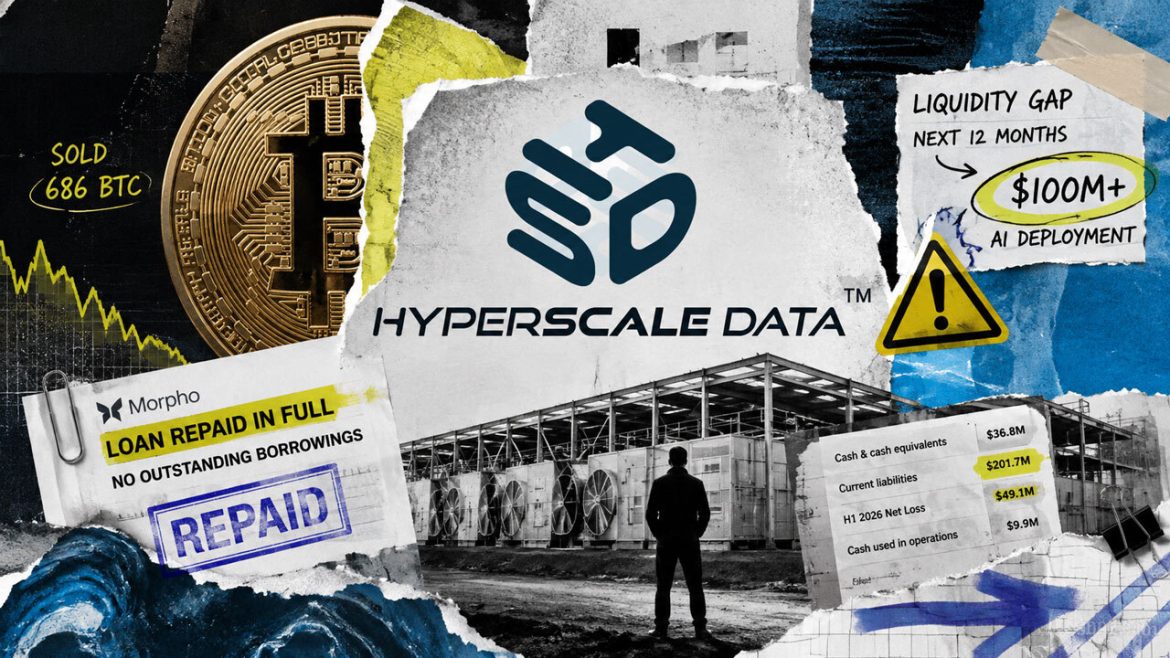
In August 2026, Hyperscale Data sold approximately 686 Bitcoin for about $43.4 million, then used part of the proceeds to repay all of its Bitcoin-backed loans on Morpho, a decentralized lending protocol, according to its quarterly filing.
The repayment released the pledged collateral and left the company with no outstanding Morpho borrowings, removing the immediate loan-related collateral exposure.
The result resolves one source of financing pressure, but leaves a larger problem flagged by the company. Hyperscale said its available liquidity is not expected to cover operating requirements, obligations, and planned capital expenditures for the next 12 months, raising doubts about its ability to continue as a going concern.
As of June 30, Hyperscale had roughly $16 million of Morpho borrowings secured by cbBTC with a carrying value of about $25.4 million. After the quarter ended, it received another $31.6 million in aggregate net proceeds from additional Bitcoin-backed borrowing through Morpho.
Hyperscale then sold the 686 Bitcoin in August 2026, and the filing says only that a portion of the $43.4 million in proceeds repaid the Morpho balances in full.

The completed repayment is the key change from Aug. 6, when an earlier 150.5-Bitcoin sale happened. The filing says Hyperscale received the additional borrowing after June 30, before eliminating the DeFi debt altogether in August.
Hyperscale reported $36.8 million in cash and cash equivalents against $201.7 million in current liabilities as of June 30. For the first half of 2026, it recorded a $49.1 million consolidated net loss and used $9.9 million of cash in operating activities.
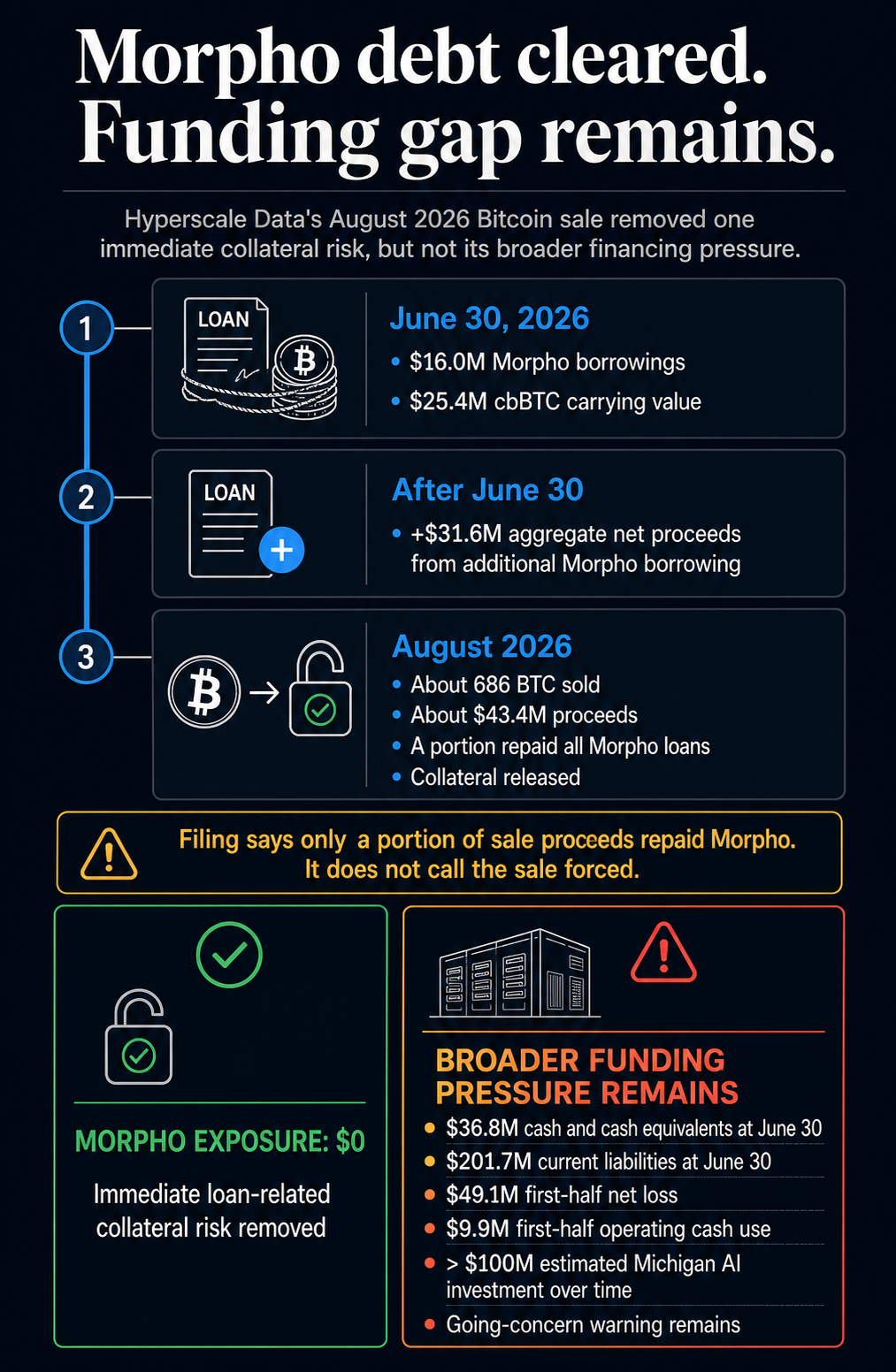
Management expects the roughly 20-megawatt deployment at its Michigan AI data center to require more than $100 million of investment over time. The timing and amount depend partly on financing availability, meaning the Morpho repayment removed a near-term collateral obligation without resolving how the build will be funded.
Hyperscale resolved its Morpho exposure, but the company must still raise or generate enough capital to meet its obligations and complete the Michigan deployment while operating under a going-concern warning.

BitMine’s ETH treasury grew to 5.82 million ETH, or about 4.8% of Ethereum’s total supply, while its weekly share buyback fell to 1.7 million shares, the third consecutive decline.
BitMine Immersion Technologies (BMNR) has repurchased 1.7 million common shares in the week ending August 16. This is the smallest weekly buyback since the program began on July 1 and the third consecutive weekly decline, while the company’s Ethereum (ETH) treasury grew to 5,815,164 tokens.
Total crypto, cash, and “moonshot” holdings came to $11.4 billion, down from $11.6 billion a week earlier, even though BitMine added 9,926 ETH over the period. The company marked its ETH at $1,893 per token on August 16, against $1,928 a week before. As reported, BitMine purchased a 7,391 ETH batch that took the treasury past 5.8 million tokens last week.
“We are encouraged to see the ETH/BTC ratio at 0.02994 and rising,” stated Thomas “Tom” Lee, Chairman of BitMine, who linked the move to tokenization and agentic-AI applications.
BitMine’s holdings equal 4.8% of the 120.7 million ETH supply, leaving it 96% of the way to its stated target of owning 5%. Lee said the company has bought ETH every week since the treasury strategy began on June 30, 2025.
BitMine has repurchased 20.8 million common shares since July 1 under a $4 billion authorization. Weekly totals disclosed in its filings peaked at 6.1 million shares in the week to July 26, then fell to 4.5 million, 3 million, and 1.7 million. Lee has called the stock undervalued or attractively valued in each of those three releases, and described the program as the largest ever executed by any crypto digital asset treasury.
Back in July, BitMine cut its weekly ETH buying to 7,430 tokens from more than 30,500, a slowdown Lee attributed at the time to capital redirected toward repurchasing shares.
Total cash and marketable securities stood at $78 million on August 16, a line that has declined in every weekly disclosure since June 28, when BitMine reported $527 million, passing through $482 million, $385 million, $268 million, $173 million, and $104 million.
Alongside the ETH, the company reported 210 Bitcoin (BTC), a $180 million stake in Beast Industries, and a $73 million stake in Eightco Holdings (ORBS).
BitMine’s board declared seventeen weekly cash dividends on its 9.50% Series A Perpetual Preferred Stock on August 14, most at $0.1847 per share, payable from September 4 through December 28.
That security trades on the NYSE as BMNP against a $100 stated value.
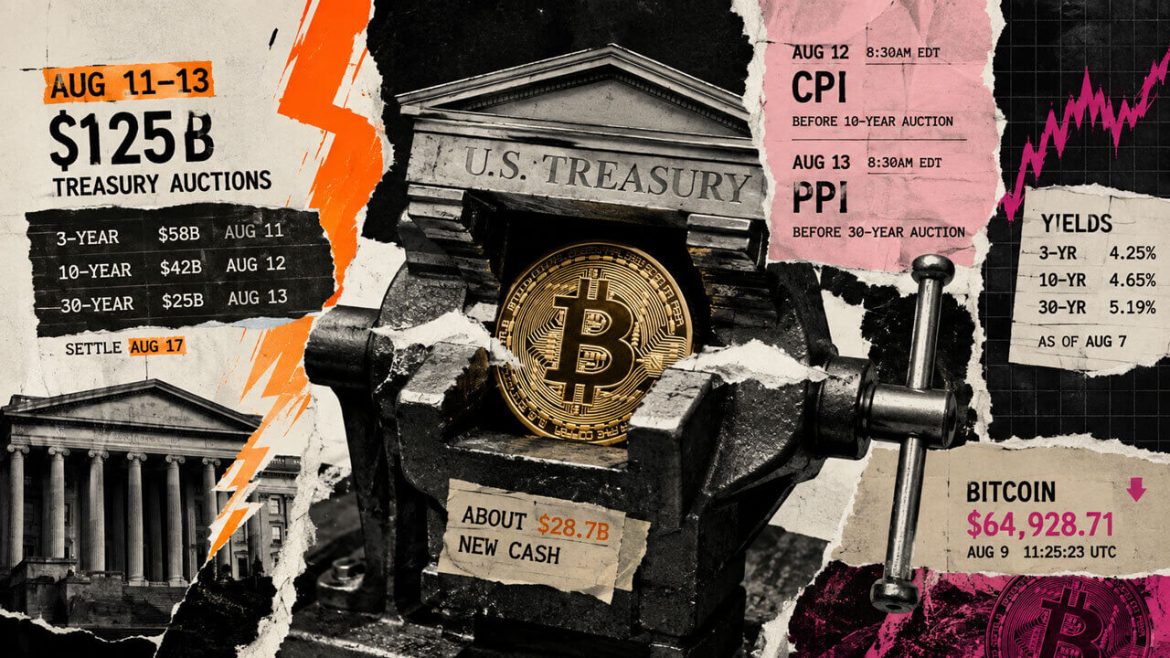
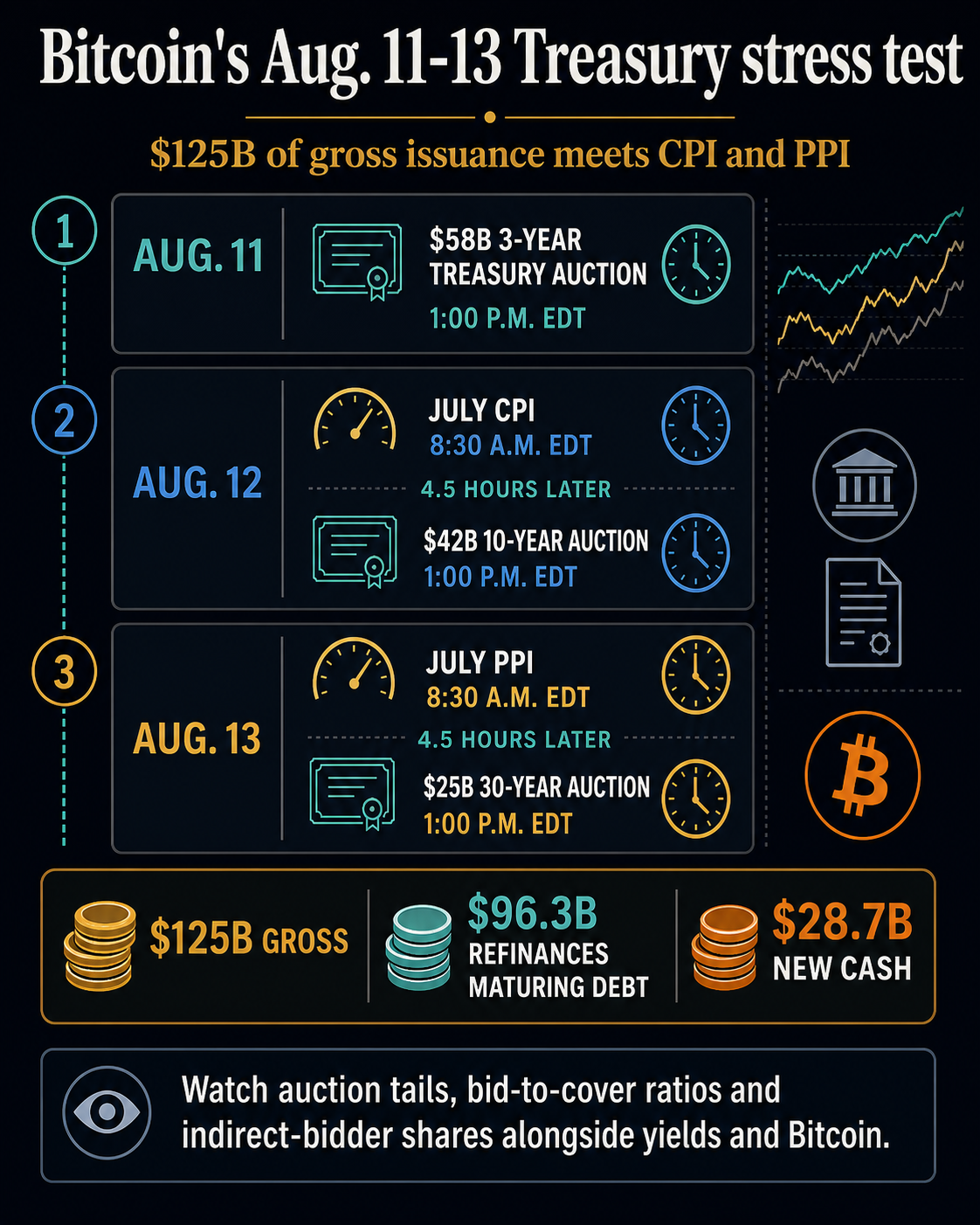
The Treasury auctions will total $125 billion from Aug. 11 through Aug. 13, while two inflation reports land hours before the corresponding 10-year and 30-year sales. The sequence will show whether softer bond demand and any resulting rise in yields coincide with pressure on Bitcoin.
The Treasury refunding plan starts with $58 billion of 3-year notes at 1 p.m. EDT on Aug. 11. It continues with $42 billion of 10-year notes at the same time on Aug. 12 and $25 billion of 30-year bonds on Aug. 13. All three settle Aug. 17.
The gross total is not a $125 billion liquidity drain. About $96.3 billion will refinance privately held debt maturing Aug. 15, leaving approximately $28.7 billion of new cash to raise from investors.
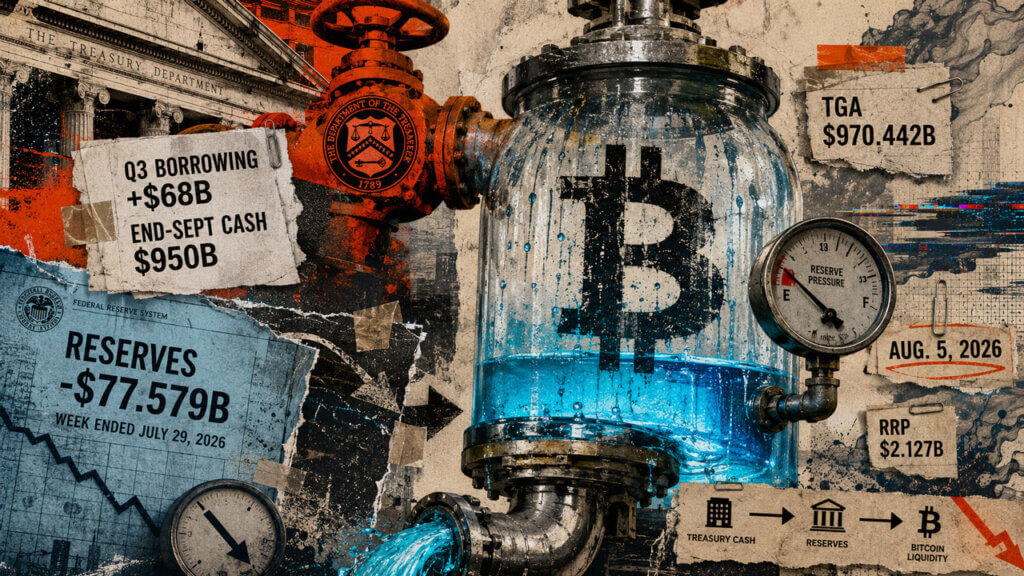
The Bureau of Labor Statistics calendar places July CPI at 8:30 a.m. EDT on Aug. 12, four and a half hours before the 10-year auction. July PPI arrives at 8:30 a.m. the following day, the same interval before the 30-year sale. Together, the releases and Treasury auctions create a tightly timed test of bond demand and Bitcoin’s response.

At the latest official business-day cutoff on Aug. 7, the Treasury’s par-yield curve showed 3-year, 10-year and 30-year yields at 4.25%, 4.65% and 5.19%, respectively. A CryptoSlate snapshot retrieved Aug. 9 at 11:25:23 UTC showed Bitcoin at $64,928.71; the live price is timestamp-sensitive.
The Sunday Bitcoin quote and Friday Treasury fixing do not provide simultaneous market evidence. Any link between yields and Bitcoin must be judged around the same inflation releases and auction results.
The July results set a baseline for the August Treasury auctions.

FinancialJuice reported that the July 3-year and 10-year sales stopped through their when-issued yields by 0.6 basis point each, while the 30-year sale stopped through by 0.3 basis point. Treasury does not publish when-issued levels, so the tail comparison is a secondary benchmark rather than an official statistic.
A comparatively weak August result would combine a positive tail with a lower bid-to-cover ratio and lower indirect-bidder share than the matching July sale. One reading alone is not decisive, and auction size plus the July reopening status of the longer securities affect the comparison.
The sharper Bitcoin risk case is conditional: inflation pushes yields higher, several auction metrics point to softer demand, yields remain elevated, and Bitcoin falls in the same event window. Firm auctions or a stable Bitcoin price would weaken that case. New York Fed research found Bitcoin broadly disconnected from monetary and macro news in its historical sample, underscoring why the Treasury auctions should be read as a test of conditions, not an automatic sell signal for Bitcoin.
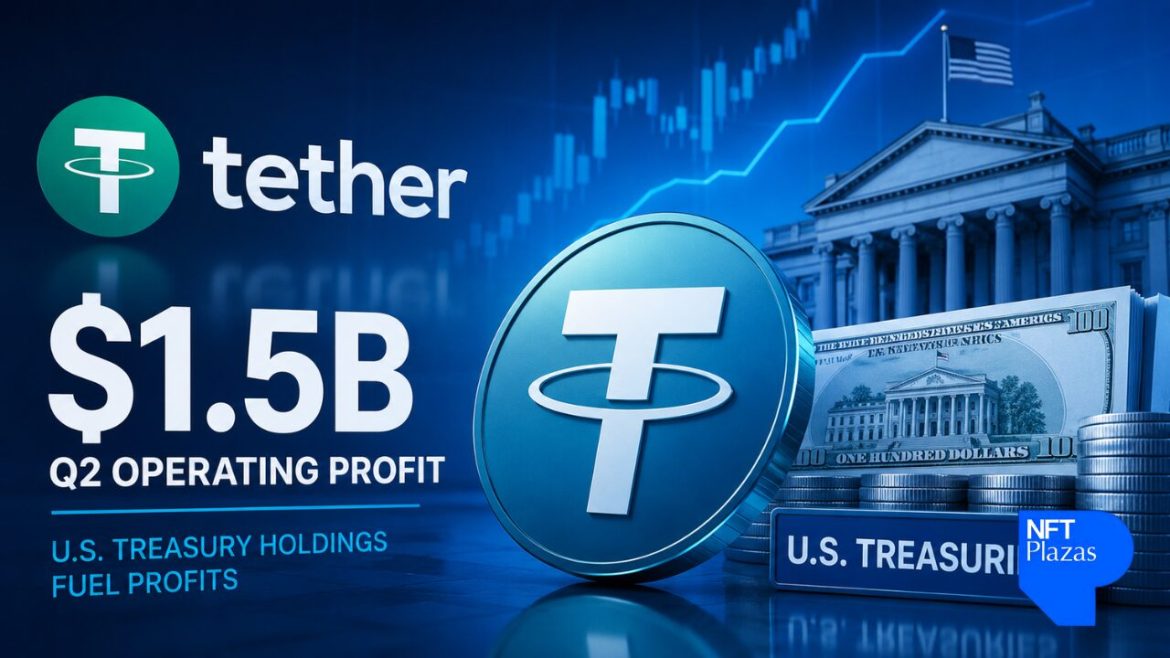
Tether, the issuer of the world’s largest stablecoin USDT, reported $1.5 billion in net operating profit for the second quarter of 2026, as returns from its U.S. Treasury portfolio continued to power earnings despite declines in the value of its Bitcoin and gold holdings.
According to the company’s latest quarterly attestation, verified by BDO, Tether held $187.75 billion in total assets against $183.64 billion in liabilities as of June 30, leaving $4.11 billion in excess reserves backing USDT. However, that reserve cushion fell sharply from more than $8.23 billion reported three months earlier, marking a decline of over $4 billion.

Tether earns $1.5B in Q2 2026
Tether said its earnings were primarily generated from income on U.S. Treasury bills and repurchase agreements (repos), which remain the foundation of its reserve strategy. The company has become one of the world’s largest holders of U.S. government debt among private firms, benefiting from elevated short-term interest rates that continue to generate strong recurring income.
Chief Executive Officer Paolo Ardoino said the second quarter tested Tether’s reserve strategy under difficult market conditions.
He acknowledged that some reserve assets were negatively affected during the quarter but stressed that USDT remained fully backed with more than $4 billion in excess reserves. Ardoino also highlighted Tether’s continued purchases of U.S. Treasuries, a reduction in secured lending exposure to $2.38 billion, and an increase in the company’s gold holdings.
One notable change in the Q2 report was Tether’s decision to report “net operating profit” instead of the “net profit” figure used in previous quarters.
The distinction is significant because operating profit excludes unrealized gains and losses from assets owned by the company, including Bitcoin and gold. Both assets lost value during the second quarter, meaning the reported operating profit does not capture the impact of those market declines.
The shift has drawn attention from industry observers, with some arguing it provides a clearer picture of Tether’s core business performance, while others believe it makes comparisons with previous quarterly reports less straightforward.
Tether continued expanding its reserve assets during the quarter despite falling market prices.
The company increased its physical gold holdings by approximately 14 metric tons, bringing total reserves to around 146.2 metric tons, up from 132.2 metric tons in the previous quarter. However, the value of those holdings declined to $18.84 billion from $19.84 billion as gold prices fell roughly 15% during the reporting period.
Tether also added approximately 1,796 BTC, increasing its Bitcoin holdings to 98,933 BTC. Even so, the reported value of its Bitcoin reserves fell to $5.80 billion, down from $6.62 billion, because the valuation price used in the report dropped to about $58,600 per BTC from $68,200 in Q1.
The lower valuations reflected market prices rather than asset sales, with Tether continuing to accumulate both assets during the quarter.

Tether’s Q2 2026 (left) and Q1 2026 (right) reserve asset reports.
Despite softer conditions across the broader crypto market, demand for USDT remained resilient.
Tether reported that the circulating supply of USDT increased by approximately $446 million during the quarter to $184.6 billion, allowing the company to maintain its position as the world’s largest stablecoin issuer with more than 60% of the global stablecoin market.
The steady growth highlights continued demand for dollar-backed digital assets across cryptocurrency trading, payments, and decentralized finance.
While Tether remained highly profitable, the most closely watched figure in the report was the sharp decline in excess reserves.
The company’s reserve surplus fell from more than $8.2 billion at the end of the first quarter to $4.1 billion by June 30. Tether did not explain the reason for the reduction, prompting questions about how capital was deployed during the quarter.

Tether’s Q2 2026 (left) and Q1 2026 (right) financial reports.
The lower reserve cushion also coincided with declines in the value of Bitcoin and gold, both of which fell by more than 10% during the period. Because Tether reported operating profit rather than net profit, those unrealized losses were excluded from its headline earnings.
Even so, the company emphasized that its assets continue to exceed liabilities by billions of dollars, ensuring that every USDT in circulation remains fully backed.
The latest results reinforce the strength of Tether’s Treasury-focused business model, which continues to generate significant income even during periods of crypto market weakness. At the same time, the shrinking reserve surplus and the company’s shift in reporting methodology are likely to remain key areas of scrutiny as investors and regulators continue to monitor the financial health of the world’s largest stablecoin issuer.
The executable draft adds Security Council oversight of Endowment transactions and narrows the Foundation’s initial token grant to 1 million ENS after delegates called the earlier plan a “governance attack.”
Katherine Wu, chief operating officer of ENS Labs, posted an executable draft Thursday of the proposal to establish an ENS Foundation, dropping a plan to shift the DAO’s operational wallet to the new entity after weeks of delegate opposition to an earlier version of the plan.
The draft, “[Draft] [Executable] Next Era of ENS DAO: Empowering the ENS Foundation,” keeps the DAO’s roughly 54.6 million ENS tokens and its operational wallet, holding an estimated $16 million in ETH and stablecoins, under tokenholder control. The only ENS token transaction in the proposal is a one-time transfer of 1 million ENS, restricted to Foundation employee compensation with multi-year vesting. The Foundation Board would gain administrative control of the roughly $65 million Endowment Safe, with every Endowment transaction now subject to a timelock and a Security Council cancellation right.
The draft follows a temp check Wu published June 19 that proposed a broader transfer of authority. ENS co-founder Nick Johnson, who holds one of the Foundation’s five board seats under the proposal, wrote on X that the changes responded to “difficult questions” and community feedback since that original post. The ENS DAO account summarized the revision as authorizing the Foundation “to administer the Endowment” while tokenholders “retain control over the protocol, remaining DAO-held ENS, the operational wallet, and the appointment and removal of Foundation directors.”
ENS traded at $4.34, up 4.2% over 24 hours, according to CoinGecko. The protocol generated $216,369 in fees over the past 30 days, according to DefiLlama.
The June 19 temp check, as The Defiant reported, proposed delegating management of the DAO’s operational wallet, its ENS token holdings and the Karpatkey-managed Endowment to Foundation governance. Thursday’s draft narrows that scope on two of those three fronts. The operational wallet, wallet.ensdao.eth, stays with the DAO, with existing funding streams continuing to draw from it. DAO-held ENS tokens stay under the same onchain mechanism and tokenholder control, apart from the 1 million ENS carve-out; any further use of the DAO’s token holdings would require a separate proposal through ordinary governance.
Only the Endowment Safe moves to Foundation-administered control, and the draft adds a new safeguard there: transactions pass through a timelock by default, and the Security Council can cancel any of them before execution, a check the current structure doesn’t have.
The scaled-back scope follows weeks of delegate opposition to the original temp check. Johnson said in June he would self-delegate his ENS holdings to support the measure, a move Rotki founder Lefteris Karapetsas said left Johnson “essentially becoming the DAO,” and Security Council member Brantly Millegan called the plan “the equivalent of treasury capture by ENS Labs,” The Defiant reported.
The proposed five-seat board is unchanged from the temp check: Johnson holds a permanent seat with succession to an ENS Labs representative if he departs, ENS Labs general counsel Alexander Urbelis is nominated as full-time executive director, and independent seats go to A.Capital Ventures partner Kartik Talwar, Prelude co-founder Brett Sun and Aragon CEO Anthony Leutenegger.
Independent directors are compensated 40,000 USDC per year, and any decision on ENS Labs funding requires a majority of independent directors’ approval in addition to a board majority, under the interim conflict-of-interest policy attached to the draft.
The Foundation would receive no operating budget under the proposal until its executive director publishes a budget to the DAO forum, and transfers from the Endowment are capped at $500,000 for standup costs until then.
Thursday’s draft is the latest turn in a monthslong dispute over control of ENS DAO’s treasury and governance. After Johnson said he would self-delegate to back the original Foundation plan, he used that same voting power to block an onchain vote renewing the DAO’s Security Council, a multisig empowered to cancel malicious proposals already in the timelock queue, The Defiant reported.
Christoph Jentzsch, who wrote code for the original 2016 “The DAO,” responded by proposing on X that ENS DAO dissolve itself outright. Separately, ENS co-founder Alex Van de Sande has proposed delegating 5 million ENS from the DAO’s dormant community treasury to outside stakeholders, an unrelated reform effort aimed at the same underlying concentration of voting power in the DAO.
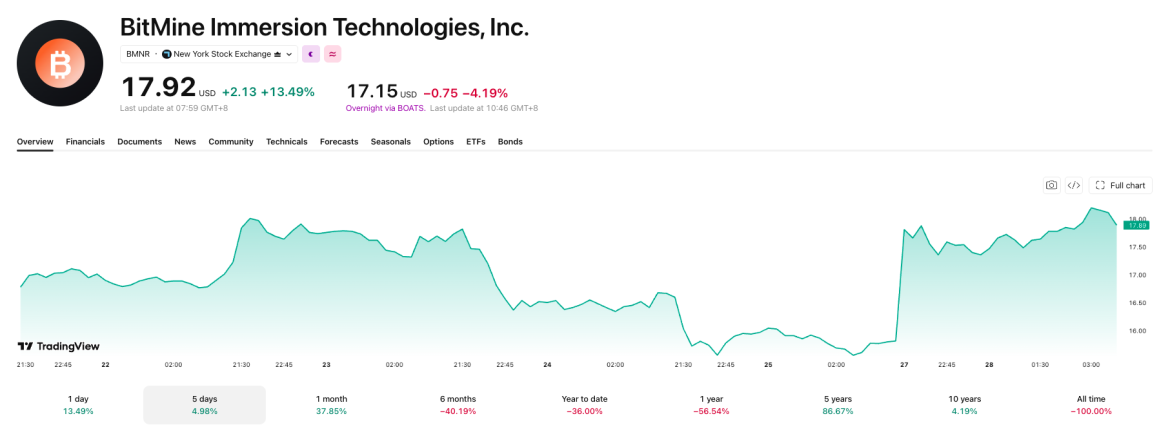
Bitmine Immersion Technologies (BMNR) shares popped 13% Monday after a fresh treasury update. It was the best-performing stock of the day on Wall Street. The Ethereum (ETH) firm’s $11.8 billion in crypto, cash, and equity stakes reassured Wall Street investors.
The company now holds 5.79 million ETH tokens, equal to 4.8% of Ethereum’s 120.7 million circulating supply. That puts Bitmine very close to its 5% accumulation target it set 13 months ago.
Bitmine repurchased 6.1 million shares last week, up from 5.5 million the week before. That brought total repurchases to 11.6 million shares since July 1, under a $4 billion buyback program. Bitmine unveiled that program at its April NYSE main-board debut.
Chairman Tom Lee framed the accumulation as a long-term commitment rather than opportunistic trading.
“Bitmine has bought ETH every week since the inception of the ETH Treasury Strategy on June 30, 2025.”
— Lee
The firm also runs MAVAN, its own Ethereum staking network, which now holds 4.9 million staked ETH. Bitmine currently projects $254 million in annualized staking revenue. That could reach $299 million once its entire ETH position is staked.
Backers including Cathie Wood’s ARK Invest, Pantera Capital, and Galaxy Digital have supported Bitmine’s strategy. That reflects institutional appetite for Ethereum treasury companies well beyond retail traders.
BMNR now ranks among the most actively traded US stocks by dollar volume, Fundstrat data show.
The rally comes as other Ethereum treasury firms, including SharpLink, keep building ETH positions despite a choppy year. Whether Bitmine’s buyback pace and staking revenue hold up may determine if Wall Street’s patience with crypto treasuries continues.
The post Bitmine Stock Pops 13% as ETH Treasury Bet Pays Off on Wall Street appeared first on BeInCrypto.


