Coinbase, Kraken and dYdX are adopting Pyth’s new indexes, which provide continuous pricing for US stocks, gold and oil outside market hours.
The US Securities and Exchange Commission has reportedly postponed its plan to allow trading of tokenized stocks after stock exchange officials raised concerns over how the plan would be implemented.
Bloomberg reported on Friday, citing sources familiar with the matter, that the SEC’s “innovation exemption” for crypto-based stocks was expected to be released during the week, with SEC staffers having already reviewed a draft of the tokenized stock trading proposal.
The SEC has reportedly received input from hundreds of market participants on how to best implement the rules, but it has not made a decision to change its proposal.
Under the SEC’s proposal, platforms offering tokenized stocks would need to guarantee investors receive the same rights as traditional shareholders, including dividends and voting rights.
Market participants reportedly raised concerns to the SEC over the potential proliferation of unauthorized third parties issuing tokens without the consent of public companies and how ownership would be verified on semi-pseudonymous blockchains.
The SEC has been more open to crypto-powered financial products under the Trump administration, which has coincided with Wall Street having a growing interest in tokenization and stablecoins.
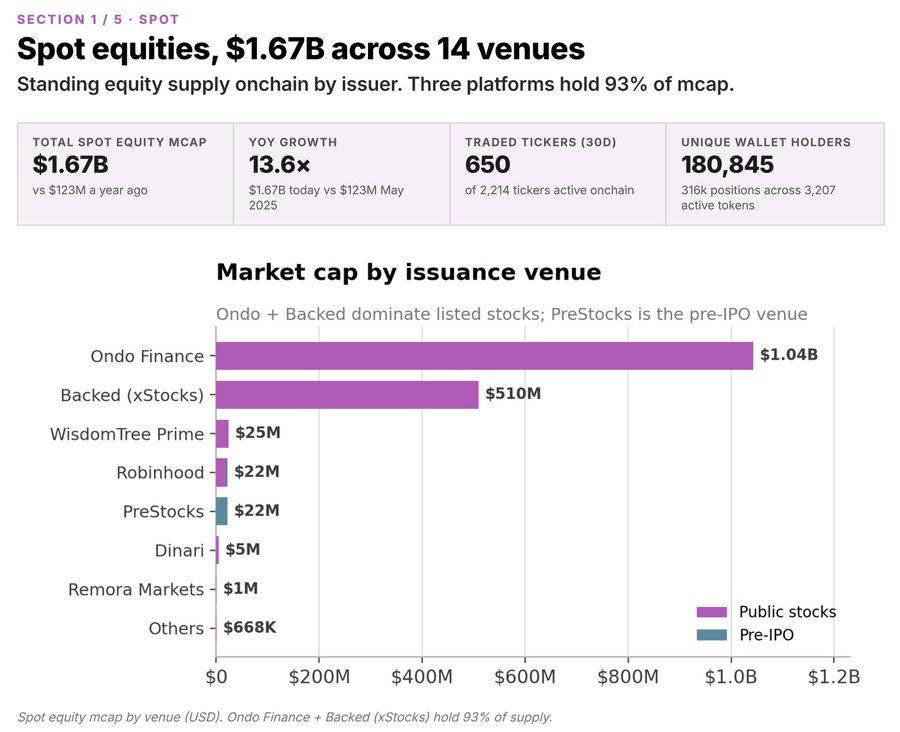
Data from RWA.xyz shows that $34 billion worth of real-world assets have been tokenized, including $1.55 billion in tokenized equities, but adoption has lagged expectations by Citibank and McKinsey, which respectively predicted in 2022 and 2024 that tokenization would become a multi-trillion-dollar market by 2030.
Crypto industry executives have backed the SEC’s decision to delay the exemption. Carlos Domingo, the CEO of crypto tokenization platform Securitize, said in a post to X on Friday that it is important to ensure the “exemption applies to the right instruments.”
“Better delay it than get it wrong and unleash all sort of problems.”
Related: Kraken parent Payward sees revenue surge as tokenization expands
Tom Farley, the CEO of crypto exchange Bullish posted to X that the SEC was “realizing that public companies are the only entity who can issue tokens that are a share of stock! Great job delaying and getting this right.”
Source: Tom Farley
The delay came after SEC Commissioner Hester Peirce said on Thursday that she expected the exemption to be “limited in scope” and would only support “digital representations” of equity securities, similar to what investors can currently purchase in the secondary market.
In January, the SEC made distinctions between types of tokenized securities, classifying them into “custodial” and “synthetic” forms.
Custodial tokenized securities are issuer-sponsored tokenized stocks custodied by regulated intermediaries and have full shareholder rights, while synthetic tokenized securities provide price exposure without actual ownership of the underlying shares.
Magazine: eToro founder timed Bitcoin top perfectly due to belief in 4 year cycles
Victoria, Victoria, May 21st, 2026, Chainwire
MEXC, a pioneer in 0-fee digital asset trading, has announced the launch of the Ondo Tokenized Stocks Carnival, featuring a $1,000,000 reward pool. This event is designed to lower the barriers to traditional markets, enabling crypto users to trade global assets through a familiar, crypto-native experience while achieving comprehensive portfolio diversification.
Event Mechanisms and Rewards
Users can participate in the carnival and share in the reward pool through the following mechanisms:
As a leading Real-World Asset (RWA) platform, Ondo Finance brings traditional assets such as US Treasuries, stocks, and ETFs on-chain through compliant infrastructure. Each tokenized stock acts as a “digital twin,” backed by corresponding real-world shares held under regulated custody. By supporting 24/7 trading, instant on-chain settlement, and fractional holding, Ondo significantly improves capital efficiency and offers greater flexibility compared to traditional markets.
With the US stock market continuing its strong performance, investor demand for globally diversified asset allocation has reached new heights. This event underscores MEXC’s commitment to bridging traditional finance and the digital asset ecosystem. By offering 0-fee trading to lower barriers and save on costs, MEXC continues to put its “User-First” philosophy into practice, helping users preserve more of their capital while making global investment opportunities more accessible. Moving forward, MEXC will continue expanding access to US stock assets, enabling users to capture infinite opportunities across global markets.
To learn more and join the event, please visit the MEXC Ondo Tokenized Stocks Carnival page
About MEXC
MEXC is the world’s fastest-growing cryptocurrency exchange, trusted by more than 40 million users across 170+ markets. Built on a user-first philosophy, MEXC offers industry-leading 0-fee trading and access to over 3,000 digital assets. As the Gateway to Infinite Opportunities, MEXC provides a single platform where users can easily trade cryptocurrencies alongside tokenized assets, including stocks, ETFs, commodities, and precious metals.
MEXC Official Website| X | Telegram |How to Sign Up on MEXC
For media inquiries, please contact MEXC PR team: media@mexc.com
Risk Disclaimer:
This content does not constitute investment advice. Given the highly volatile nature of the cryptocurrency market, investors are encouraged to carefully assess market fluctuations, project fundamentals, and potential financial risks before making any trading decisions.
MEXC PR team
media@mexc.com
The SEC is expected to release an innovation exemption for tokenized stocks as soon as this week.
SEC Chair Paul Atkins and Commissioner Hester Peirce had already sketched the plan in February, describing a temporary, limited framework with volume caps, white-listed buyers and sellers, automated market makers, and temporary relief while the SEC develops longer-term rules.
Atkins confirmed in April that the agency was “on the cusp” of releasing a cabined framework for compliant on-chain trading of tokenized securities.
Bloomberg Law reported the move on May 18, which represents the clearest crypto-adjacent securities policy signal in years, with implications that run well beyond token prices.


SEC mulls easing regulatory burden on tokenized securities to foster innovation.
May 8, 2025 · Oluwapelumi Adejumo
SEC staff defined tokenized securities in January 2026 as traditional securities represented as crypto assets, with crypto networks maintaining ownership records, in whole or in part.
The legal status of the asset follows it regardless of its form, so federal securities laws apply whether a share resides on a blockchain or in a DTC account.
The innovation exemption would allow qualifying firms to test tokenized securities trading on novel venues, including AMMs and, potentially, public permissionless blockchains, within defined parameters.
Atkins explicitly discussed embedding compliance checks directly into smart contract code, including resale restrictions and issuer-holder communications.
A tokenized security can include its own eligibility rules, transfer restrictions, and compliance logic, delivered automatically at the point of transfer.


US equities already moved from T+2 to T+1 settlement in 2024, and the SEC framed that move as making market plumbing more resilient by reducing time, credit exposure, and liquidity risk.
Tokenization extends this logic further with longer trading windows, near-instant settlement, fractional access, and programmable post-trade processing.


SEC redefines crypto landscape with new taxonomy, setting boundaries and granting room for privacy innovation.
Mar 19, 2026 · Oluwapelumi Adejumo
Nasdaq received SEC approval in March 2026 to allow certain DTC-eligible securities to trade in tokenized form on the same order book as traditional shares, with T+1 settlement preserved.
NYSE-parent ICE is separately developing a tokenized securities platform targeting 24/7 operations, instant settlement, dollar-sized orders, and stablecoin-based funding, pending regulatory approval.
Incumbent exchanges are building their own versions of the next pipe before crypto platforms can claim the market.
Coinbase sought SEC approval in 2025 to offer tokenized equities, a move that would reportedly put it in direct competition with retail brokerages.
Kraken’s xStocks platform already offers 100 fully backed tokenized US stocks and ETFs outside the US market, and Robinhood has launched EU stock tokens while building a layer-2 blockchain for real-world asset tokenization.
The SEC exemption would determine whether those crypto-native models can compete for US investors under a regulated framework.
DefiLlama data puts the on-chain RWA market at close to $30 billion, which represents just 0.02% of global equity value, against SIFMA’s 2024 global equity market capitalization of $126.7 trillion.
The stock-token segment is still early, and the exemption could determine if tokenized stocks expand into a regulated extension of US equities or stay a crypto side market.


SEC staff distinguishes issuer-sponsored tokenized securities, in which the token represents a direct claim on the underlying share, from third-party products, including custodial receipts, linked securities, and synthetic derivatives.
Robinhood’s EU stock tokens explicitly carry that distinction in their disclosures: they are derivatives that expose investors to counterparty and insolvency risks tied to Robinhood’s financial position.
A tokenized stock can look identical in an app and carry entirely different legal rights depending on its structure.
If pilots succeed and the exemption expands, issuer-sponsored tokenized shares and custodial tokenized securities will have clearer regulatory pathways, and crypto-native platforms will compete for tokenized equity flows alongside Nasdaq’s DTC-compatible model and ICE’s parallel digital venue.
Market-moving headlines and context delivered every morning in one tight read.
5-minute digest 100k+ readers
Free. No spam. Unsubscribe any time.
Whoops, looks like there was a problem. Please try again.
You’re subscribed. Welcome aboard.
Stablecoin settlement becomes a standard post-trade mechanism for liquid securities, and smart contract networks that carry tokenized equities become a durable infrastructure.
The winners extend beyond the firms that launch products. Stablecoin issuers gain a settlement use case inside regulated securities markets, and high-throughput programmable chains gain sustained demand from securities settlement activity.
Wallet providers and tokenization agents enter a market previously controlled by broker-dealers, and the crypto-native trading stack gains a securities-grade use case, legitimizing it across jurisdictions.
However, if the SEC allows tokenization primarily through Nasdaq’s DTC-compatible model and ICE’s regulated venue. The innovation exemption for crypto-native and AMM-based trading stays narrow, heavily volume-capped, or restricted to institutional participants.
Tokenization modernizes settlement mechanics, and the competitive opening for crypto-native platforms stays narrow.
Broad exemptions for tokenized trading could undermine investor protection and market stability if tokenized securities trade outside the long-standing protections of the securities markets.
Peirce warned that third-party tokenized stocks can expose holders to counterparty and insolvency risks tied to the tokenizing intermediary’s own financial position.
Those risks provide regulators with a durable justification for keeping crypto-native venues at the margins while incumbents absorb the technological upgrade.
Three models are now competing for the next securities pipe.
Nasdaq’s DTC-compatible approach keeps tokenized and traditional shares on the same order book, with incumbents controlling settlement. ICE’s parallel digital venue targets 24/7 operations and stablecoin funding. The crypto-native model tests whether securities can trade on-chain through crypto infrastructure under SEC conditions.
| Model | Main players | How it works | What it means |
|---|---|---|---|
| Nasdaq / DTC-compatible model | Nasdaq, DTC, broker-dealers | Tokenized and traditional shares trade on the same order book; T+1 settlement preserved | Incumbents modernize the pipe without changing the market structure too much |
| ICE / NYSE digital venue model | ICE, NYSE, regulated intermediaries | Parallel tokenized securities platform targeting 24/7 operations, instant settlement, dollar-sized orders, and stablecoin funding | Wall Street builds its own onchain venue before crypto platforms take the lead |
| Crypto-native model | Coinbase-style platforms, Kraken-style products, AMMs, wallets, tokenization agents | Tokenized securities trade through crypto infrastructure under SEC exemption conditions | Crypto rails get a chance to compete for stock-market flow |
The SEC exemption determines which of these models can legally compete, and the scope of that determination sets the boundary of the opening.
Atkins framed the exemption as letting the market discover whether crypto infrastructure can carry stocks more efficiently than the current venue-clearing-custody sequence.
That test, run under regulatory supervision with white-listed participants and volume limits, is the policy event Bloomberg reported.
The SEC is letting crypto rails compete for the business of carrying stocks, and the exemption will measure if they can win.
Key takeaways:
The US and Iran ceasefire boosted stock markets and Bitcoin, but BTC derivatives suggest limited bullish momentum.
Legislative setbacks and a “fragile truce” between the US and Iran keep bears active with a potential $68,000 correction on the cards.
Bitcoin (BTC) rallied 6% in less than four hours on Tuesday, following gains in global stock markets after the US and Iran reached a two-week ceasefire deal. The rally caught traders off guard, triggering a $280 million liquidation event in Bitcoin futures markets.
Bitcoin bears could be in trouble if the war in Iran effectively winds down, but BTC derivatives signal that sustainable bullish momentum above $80,000 could take longer than anticipated.
Bitcoin’s high correlation with the S&P 500 futures suggests that BTC’s rally was mainly led by the potential reopening of the Strait of Hormuz. US President Donald Trump said that Iran’s nuclear program will be deactivated in exchange for tariff and sanctions relief. However, Bitcoin bears’ hopes jumped after US Vice President JD Vance said that the Iran ceasefire is a “fragile truce.”
A sustainable de-escalation would likely lead to lower oil prices and reduced inflationary pressure, potentially paving the way for expansionist monetary policies. The US Federal Reserve has remained reluctant to trim interest rates despite signs of a weakening job market. Traders who previously exited risk markets changed their minds as the odds of a severe economic impact declined.
While $280 million in forced liquidations of bearish leveraged positions accelerated the rally, BTC derivatives positioning showed no major shifts.

Bitcoin futures aggregate open interest reached 593,930 BTC on Wednesday, up 2.5% from Tuesday. Crucially, liquidations of $200 million to $300 million are relatively common, having occurred five other times over the past 90 days. This $280 million instance remains minor compared to the total $42 billion aggregate futures position.

The Bitcoin futures annualized premium relative to regular spot markets stood at 3% on Wednesday, flat from two days prior. The lack of demand for bullish positions has pushed the indicator below the neutral 4% threshold since late January.

Demand for downside protection Bitcoin options has prevailed over the past two weeks. Premiums on put (sell) options have outpaced the buy (call) instruments, although distancing themselves from the extreme fear levels seen on March 26.
Bitcoin bulls’ confidence had already been hit from the Oct. 10, 2025, flash crash, the disappointment with regulation and the lack of progress on the US Strategic Bitcoin Reserve. The latest draft of the PARITY Act failed to include tax exemptions for small Bitcoin payments or deferred capital gains for mining. Additionally, David Sacks stepped down from his role as the White House AI and cryptocurrency czar on March 26.
Related: Iran is weighing crypto tolls for ships using Strait of Hormuz–Report
Despite multiple mentions from US Treasury Secretary Scott Bessent in 2025 regarding “budget neutral” strategies to acquire Bitcoin without adding new taxes, no clear path was ever disclosed. Simultaneously, the US Democratic Party has requested that regulators scrutinize the Trump family’s cryptocurrency ventures based on potential conflicts of interest.
There is no indication that Bitcoin bears are rushing to close their shorts despite the recent rally. Inflationary pressure has not yet faded, as Brent crude oil prices held at $95 per barrel, up from $72 per barrel in late February. More importantly, a two-week ceasefire is far from a long-term solution, leaving the odds of a correction to $68,000 wide open.
This article is produced in accordance with Cointelegraph’s Editorial Policy and is intended for informational purposes only. It does not constitute investment advice or recommendations. All investments and trades carry risk; readers are encouraged to conduct independent research before making any decisions. Cointelegraph makes no guarantees regarding the accuracy or completeness of the information presented, including forward-looking statements, and will not be liable for any loss or damage arising from reliance on this content.
Bitcoin BTC
The study, led by Rony Szuster, head of research at the Latin American crypto platform, examined 60-day windows after economic or geopolitical shocks such as the COVID-19 outbreak and U.S. tariff escalations. Bitcoin posted stronger returns than both gold and the S&P 500 in each of the periods analyzed.
In April last year, after the Trump administration announced sweeping tariffs, the price of bitcoin jumped 24% over the following 60 days. Gold rose 8%, and the S&P 500 gained 4%, the firm found.
A similar pattern emerged at the onset of the COVID-19 pandemic in March 2020, when BTC rose 21%, while the other assets trailed.
Szuster cautioned that judging bitcoin’s performance too soon after a crisis can be misleading.
“It’s like watching the first few minutes of a movie and thinking you already know how it ends,” he said. “In moments like this, investors sell positions to reduce risk or raise cash, and even defensive assets can fall.”
That happens as investors scramble for liquidity, yet bitcoin has consistently bounced back, the firm found. The pattern appears to be repeating in the current U.S.-Iran conflict, where bitcoin is the only one of the three assets in positive territory so far, according to Szuster.
Data backs this up. Since the war started, bitcoin has risen by more than 2.2%, from around $65,800 to $67,300 at the time of writing. Gold, the traditional safe haven, has meanwhile dropped around 11%, while the S&P lost 4.4% of its value in the index’s steepest monthly drop since 2022.
Despite its volatility, bitcoin was the best-performing asset over the past decade, he added.
Read more: Bitcoin’s recent crash to $60,000 warned stocks first – now they’re following
Oil futures surged above $110 a barrel Monday as escalating tensions in the Middle East rattled global markets, sending Asian stocks sharply lower, with all of the region’s markets opening deep in the red, even as bitcoin held steady near $67,000.
West Texas Intermediate crude jumped roughly 17% in 24 hours. Japan’s Nikkei 225 fell more than 6% and South Korea’s Kospi dropped about 8% as traders repriced energy costs across import-dependent economies.
The rally centers on the risk that fighting could restrict oil flows near the Strait of Hormuz, the chokepoint through which roughly 20% of global crude supply passes daily. Prediction markets on Polymarket assign a 76% probability that crude reaches $120 by the end of March.
Bitcoin traded around $67,000 with little sign of panic selling. Ether and solana posted modest gains, suggesting crypto markets have so far treated the spike as an energy-specific shock rather than a broad risk-off event.
Not all traders are convinced the move has legs. Funding rates on oil perpetual futures turned negative on Hyperliquid, indicating significant positioning for a pullback even as spot prices climb.
Markets still see little chance of an imminent rate cut.
Contracts on Polymarket show a roughly 98% probability that the Federal Reserve leaves rates unchanged at its March 18 meeting, with only about a 12% chance of a 25-basis-point cut by the end of April.
A sustained rally in crude would reinforce inflation pressures, something that the Fed would have to consider when setting rates.
Altcoins trade mixed as the total crypto market capitalization dips 0.5% to $3.19 trillion.
Crypto markets remained relatively calm heading into the weekend, with Bitcoin holding at around $91,000 as U.S. stocks rallied on Black Friday.
Bitcoin is flat over the past 24 hours after peaking at $92,800 earlier in the day, while ETH is up 0.5% and SOL is down 3.5% over the same period. Meanwhile, XRP is down 1.9% to $2.19.
The overall crypto market capitalization decreased by 0.5% to $3.19 trillion, according to Coingecko.
The Top 100 digital assets posted mixed performances over the last 24 hours, led by Quant (QNT), Bitcoin Cash (BCH), and Monero (XMR), which are up 10%, 3%, and 2%, respectively.
Meanwhile, Pi Network (PI), Zcash (ZEC), and Aptos (APT) are today’s biggest losers.
Around 111,000 leveraged traders were liquidated for a total of $289 million in the past 24 hours, according to CoinGlass. Bitcoin accounted for $89 million, while ETH positions made up $61 million.
While crypto markets consolidated after a week-long rally, stocks and gold gained ground on Friday. The S&P 500 and Nasdaq climbed 0.5%, while the yellow metal traded above $4200/oz for the first time in two weeks.
XStocks, a tokenized equity platform created by real-world asset (RWA) tokenization firm Backed and crypto exchange Kraken, has surpassed $10 billion in total transaction volume just over four months after its launch, signaling a growing appetite for tokenized investment products.
The platform debuted earlier this year with more than 60 tokenized equities, including Nvidia, Amazon, Tesla and Meta Platforms, as well as several exchange-traded funds (ETFs). Each xStock token is fully backed 1:1 by the underlying equity or ETF, issued by Backed in partnership with Kraken.
XStocks operates across Ethereum, Solana, BNB Chain and Tron, expanding accessibility across major blockchain ecosystems.
In addition to total trading volume, xStocks reported nearly $2 billion in onchain transaction activity and participation from over 45,000 onchain holders, with aggregate assets under management of $135 million.
The xStocks offering is one of several products with exposure to tokenized equities. Other players include Securitize, which issues tokenized shares, funds and other RWAs on the blockchain, and Robinhood Markets, which has also begun rolling out stock tokens in select markets.
Related: Kraken launches tokenized securities trading in Europe with xStocks
The rapid growth of tokenized equities has occurred even as the sector continues to operate in what some experts describe as a legal gray area, according to John Murillo, Chief Business Officer at fintech company B2Broker.
Murillo was referencing the fact that tokenized shares are typically digital representations of exposure to an underlying financial asset, rather than the shares themselves.
“It is crucial to understand that investors do not own actual shares; they hold tokens issued by intermediaries, which may entitle them to payouts if the underlying shares increase in value or are sold,” he told Cointelegraph.
Despite regulatory uncertainty, industry data indicate that the total value of tokenized public stocks currently held onchain is approximately $666 million, a figure that excludes cumulative trading volume.
Related: Private companies line up to join Robinhood’s tokenized equity platform: CEO
Robinhood has expanded its tokenization initiative on the Arbitrum blockchain, deploying 80 new stock tokens in the past few days and bringing the total number of tokenized assets close to 500.
According to data from Dune Analytics, Robinhood has tokenized 493 assets with a total value exceeding $8.5 million. Cumulative mint volume has surpassed $19.3 million, offset by around $11.5 million in burning activity, signaling a growing but actively traded market.
Stocks account for nearly 70% of all deployed tokens, followed by exchange-traded funds (ETFs) at about 24%, with smaller allocations to commodities, crypto ETFs and US Treasurys.
The latest batch of tokenized assets includes Galaxy (GLXY), Webull (BULL), and Synopsys (SNPS), research analyst Tom Wan said. “Robinhood EU users now have a wider range of US Stocks, Equities, and ETFs, thanks to Tokenization,” he noted.
Related: Ondo Finance to SEC: Hold off on Nasdaq’s tokenized securities plan
In June, Robinhood launched a tokenization-focused layer-2 blockchain built on Arbitrum, allowing EU users to trade tokenized US stocks and ETFs as part of its real-world asset (RWA) expansion.
The company’s stock tokens mirror the prices of publicly traded US securities but don’t represent direct ownership of the underlying shares. Instead, they are structured as blockchain-based derivatives regulated under MiFID II (Markets in Financial Instruments Directive II), according to the company.
The company also claims the stock tokens offer 24-hour market access, no hidden fees beyond a 0.1% FX charge and the ability to start investing with just 1 euro ($1.17).
However, the rollout has drawn scrutiny. In July, the Bank of Lithuania, which regulates Robinhood in the EU, requested clarification on how the tokens are structured. Tenev said the firm welcomes the review.
Related: Following US success, Robinhood eyes expansion of prediction markets overseas
Robinhood’s tokenization rollout came shortly after the brokerage firm launched micro futures contracts for Bitcoin (BTC), XRP (XRP) and Solana (SOL).
Earlier in May, the firm acquired Canadian crypto platform WonderFi in a $179 million deal, further expanding its global footprint. Robinhood has also been pushing for clearer tokenization regulations in the US, submitting a proposal to the Securities and Exchange Commission for a unified national framework governing RWAs.
Magazine: Back to Ethereum — How Synthetix, Ronin and Celo saw the light