Bernstein sees Robinhood’s crypto business shifting toward infrastructure as new products like prediction markets and perps gain ground.


 Live Chat
Bernstein sees Robinhood’s crypto business shifting toward infrastructure as new products like prediction markets and perps gain ground.

Morgan Stanley’s 16,000 financial advisors manage $6.2 trillion in client assets. That number has been sitting in the background of a major filing — and it explains a lot about why the bank set its proposed Bitcoin ETF fee where it did.
The bank filed an updated S-1 registration statement with the SEC on Friday, setting the fee for its proposed Morgan Stanley Bitcoin Trust at 0.14%.
If approved, that would make it the lowest fee of any spot Bitcoin ETF currently trading in the US market. Bloomberg ETF analyst Eric Balchunas said the fee was set with advisors in mind — at that price point, no one on the firm’s sales floor would feel awkward recommending the product to clients.
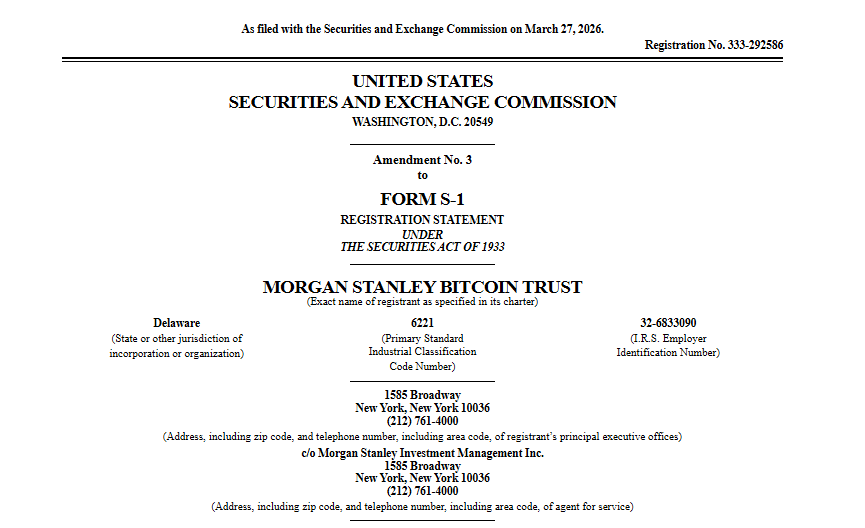
Morgan Stanley disclosed the 0.14% fee in its latest S-1 filing on Friday.
That is a practical calculation. Advisors who push high-fee products into client portfolios face questions. At 0.14%, those questions go away.
BlackRock’s iShares Bitcoin Trust charges 0.25%. The Grayscale Bitcoin Mini Trust sits at 0.15%. Morgan Stanley is going in one basis point below both of its nearest rivals.
Bloomberg ETF analyst James Seyffart called it a big move and said an early April launch is likely, pending regulatory approval.
WOW. We have the fee on Morgan Stanley’s spot bitcoin ETF $MSBT. Will charge just 0.14% !!! Big move here. They are not messing around. Likely to launch in early April. https://t.co/R0iA3wMB5N
— James Seyffart (@JSeyff) March 27, 2026
Image: Kitco
Approval would put Morgan Stanley in a category of one. No major bank has yet issued a spot Bitcoin ETF in the US. That distinction, combined with a rock-bottom fee and a distribution network of thousands of advisors, gives the product a strong early position if it clears the SEC.
The bank named Coinbase and Bank of New York Mellon as custodians for the fund. Those are two of the most established names in digital asset custody, and the pairing signals that Morgan Stanley is building this to last — not testing the waters.
Rivals will now face a decision. The $83 billion spot ETF market has operated with fees clustered around 0.20% to 0.25%. A new entrant coming in below all of them puts pressure on existing providers to respond or accept the risk of losing assets over time.
The Bitcoin ETF is one piece of a larger push. In January, Morgan Stanley also filed for a Solana ETF and a staked Ether ETF. Weeks later, it applied for a national trust banking charter that would allow it to custody digital assets, carry out trades, and offer staking services directly to clients.
Featured image from Unsplash, chart from TradingView

Editorial Process for bitcoinist is centered on delivering thoroughly researched, accurate, and unbiased content. We uphold strict sourcing standards, and each page undergoes diligent review by our team of top technology experts and seasoned editors. This process ensures the integrity, relevance, and value of our content for our readers.

Kevin Hassett is emerging as the most important name in global finance.
The 63-year-old economist — currently chief of the National Economic Council — is widely expected to become the next chair of the US Federal Reserve after President Donald Trump said he has already chosen his candidate and will announce the pick early next year.
On Tuesday, US President Donald Trump called Hassett a “potential Fed chair” and said the shortlist was down to one, The New York Times reported on Wednesday.
‘He can take strong, coherent economics and translate it into Trumpian gobbledygook.’
— Mark Spindel, chief investment officer at Potomac River Capital
The statement builds on Trump’s weekend remarks on Air Force One, where he said his mind has already been made up.
Prediction market Kalshi now gives Hassett 74% odds of winning the job, with banker Kevin Warsh far behind at 14%.
If that holds, markets will all be dealing with a Fed boss seen as more politically aligned with a president than any in modern history.
When asked by Fox Business if he would serve as Fed chair in November, Hasset replied: “Yes, I serve the president. That’s what I do.”
Hassett’s speedy rise matters because he is one of the few Fed contenders who has zealously argued for faster and bigger cuts to interest rates, which Trump has demanded for months.
If confirmed, he takes charge at a time when crypto and other risk assets like tech stocks are tightly bound to liquidity.
Fed chairs have historically been free of political pressure from the White House, and have a dual mandate to ensure maximum employment rates and price stability.
A more dovish Fed led by Hasset would inject more money into the financial system and push risk asset valuations higher by disincentivising investors from holding bonds.
But some see that as a risk to price stability through inflation.
Jerome Powell, the current Fed chair, finishes his turbulent eight-year term in May 2026.
Much of his time on the Fed throne was spent clashing with Trump on interest rate policy.
Hassett is Trump’s longest-serving policy adviser still in government, running the National Economic Council from the West Wing and effectively acting as the president’s in-house strategist on trade, tariffs and monetary policy.
The National Economic Council is responsible for coordinating domestic and international economic policy matters between top officials.
During Trump’s first term, Hassett chaired the Council of Economic Advisers, and during the pandemic, as a crisis adviser and was later brought back again to help tighten policies.
“He possesses a unique ability to simultaneously translate in both directions — Trumpian gobbledygook into strong, coherent economics,” Mark Spindel, chief investment officer at Potomac River Capital, told The New York Times.
“He can take strong, coherent economics and translate it into Trumpian gobbledygook.”
Beyond his close ties to the president, Hassett also has an extensive and conventional pedigree.
He spent two decades at the conservative American Enterprise Institute, advised multiple Republican presidential campaigns, and worked earlier in his career at Columbia Business School and the Fed’s own research division.
Treasury Secretary Scott Bessent has finished the interview process and is expected to officially deliver his recommendation soon.
Trump is expected to announce his pick in early 2026.
Lance Datskoluo is DL News’ Europe-based markets correspondent. Got a tip? Email him at lance@dlnews.com.

Steak ‘n Shake, a fast food restaurant company in the United States that accepts Bitcoin (BTC), announced on Saturday that it is expanding into El Salvador.
“We were honored to be in Bitcoin Country,” the company said in an X post following Steak ‘n Shake’s participation in the country’s Bitcoin Histórico event on Wednesday and Thursday.
Steak ‘n Shake started accepting BTC for payment at its stores in May, and the company’s chief operations officer, Dan Edwards, told Cointelegraph that the goal is to have BTC accepted at all of the company’s locations worldwide.
The company attributed a nearly 11% rise in same-store sales in Q2 to its decision to start accepting BTC at its restaurants.
The company has become iconic in the Bitcoin community and highlights the growing number of merchants accepting BTC for goods and services. Acceptance of BTC as tender for small, everyday purchases is also a precursor to mass adoption.
Related: Steak ‘n Shake Bitcoin reserve: Happy meal for hodlers or nothingburger?
Steak ‘n Shake polled its followers on the X social media platform in October, asking whether it should accept Ether (ETH) as payment at its locations.
53% of the 48,815 followers polled voted in favor of the proposal, sparking significant backlash from the Bitcoin community.
“ETH is centralized garbage. Bitcoin is freedom. Doing this would lose you all your Bitcoiner business, including mine,” Bitcoin maximalist Ron Sovereignty Swanson said in response.
Although initially promising to “abide by the results” of the social media poll, Steak ‘n Shake backtracked on the proposal to accept ETH.
“Poll suspended. Our allegiance is with Bitcoiners. You have spoken. Who even allowed this? I’m back at my desk,” the company said on October 11 — the same day the poll was initiated.

In November, the company celebrated strong Q3 sales, touting a 15% quarter-over-quarter increase in same-store sales.
Steak ‘n Shake managed to lead all other competitors in the fast food category for same-store sales increases in Q3, including McDonald’s, Burger King, Taco Bell, and coffeehouse Starbucks.
Magazine: Big Questions: Did a time-traveling AI invent Bitcoin?

Key takeaways:
ETH futures premium shows traders are staying cautious and avoiding heavy leverage even as banking stocks rebound from recent credit concerns.
Ether whale activity near $3,700 suggests limited bearish conviction, though confidence in a swift recovery toward $4,500 remains subdued.
Ether (ETH) dropped 9.5% on Friday, retesting the $3,700 level and triggering $232 million in leveraged long liquidations within 48 hours. The unexpected correction came amid a broader risk-off move fueled by credit concerns after two US regional banks announced write-offs on bad loans.
Ether derivatives data shows moderate unease among bullish traders, but whale positioning suggests most are not expecting a deeper decline. The key question now is whether the $3,700 support will hold as macroeconomic risks intensify.
Ether options’ 25-delta skew surged to 14% on Thursday, a level rarely sustained and often linked to periods of heightened fear. Traders are paying a premium for put (sell) options, signaling that market makers remain uneasy about downside risks. Under normal market conditions, the skew typically fluctuates between -6% and +6%.
The S&P Regional Banks Select Industry Index recovered part of Thursday’s losses, trading 1.5% higher on Friday. However, credit concerns have left marks on larger financial institutions such as JP Morgan (JPM) and Jefferies Financial Group (JEF), both of which reported losses tied to the automotive sector. According to Yahoo Finance, auto lending has shown the fastest growth among US banking segments.
Joachim Nagel, president of Germany’s Bundesbank and a member of the ECB’s governing council, warned of possible “spillovers” from the private credit market, calling it a “regulatory risk.” Nagel shared his concerns with CNBC as the global private credit market surpassed $1 trillion, adding that “we as regulators, we have to take a close look at it.”

The ETH monthly futures premium compared to spot markets slipped to 4%, below the 5% neutral threshold. Traders’ sentiment had already been shaken by the flash crash on Oct. 10, and the last notable bullish phase was in early February. Ether traders appear increasingly doubtful about the strength of any lasting bullish momentum.
Part of traders’ unease comes from the deteriorating relationship between the US and China, as the ongoing trade war enters a new phase involving export controls on rare earths and sanctions against a South Korean shipping company. US President Donald Trump said on Oct. 10 that the US could respond with an additional 100% tariff on Chinese goods starting Nov. 1.
To determine whether Ether whales are truly betting on further downside or simply hedging amid worsening macroeconomic conditions, it is useful to examine top traders’ positioning on derivatives exchanges. This metric combines data from futures, margin, and spot markets, offering a clearer view of short-term sentiment.

Top traders at Binance reduced their bullish bets (longs) Tuesday to Thursday but later reversed course, increasing their exposure to ETH despite ongoing price weakness. In contrast, top traders at OKX attempted to time the market by adding exposure near the $3,900 level but eventually exited as prices fell to $3,700 on Friday.
Related: How to catch market manipulation in altcoins before they crash
ETH derivatives markets show no alarming signs — quite the opposite. Bulls’ hesitation to take on leveraged positions appears healthy, particularly after the Oct. 10 extreme volatility. However, Ether’s path toward $4,500 will likely depend on clearer signals from credit conditions and US labor market data, meaning any recovery could take time.
This article is for general information purposes and is not intended to be and should not be taken as legal or investment advice. The views, thoughts, and opinions expressed here are the author’s alone and do not necessarily reflect or represent the views and opinions of Cointelegraph.

Bitcoin and crypto markets face a pivotal moment as Federal Reserve policymakers debate whether the next rate cut will be a cautious 25 or a bold 50 basis points. The outcome could reshape digital asset markets and challenge the long-standing 4-year Bitcoin cycle.
The Fed’s internal debate signals a major change in monetary policy as inflation cools and labor markets show signs of strain. Traders seek clarity, knowing the Fed’s move could affect liquidity and the performance of risk assets in the coming months.
Sponsored
Sponsored
The Federal Reserve remains split. Governor Chris Waller supports a modest 25 basis-point rate cut due to economic uncertainty and delayed government data. He favors caution, observing that growth persists even as the labor market softens.
“Based on all of the data we have on the labor market, I believe that the FOMC should reduce the policy rate another 25 basis points at our meeting that concludes October 29,” Waller noted.
Meanwhile, Stephen Miran argues for a sweeping 50 basis-point cut, concerned by US-China trade tensions and tariffs impacting consumers.
“My view is that it should be 50 basis points. However, I expect it to be an additional 25 and I think that we’re probably set up for three 25-basis-point cuts this year, for a total of 75 basis points this year,” Miran emphasized in his televised remarks.
Minneapolis Fed President Neel Kashkari also supports prudent action. He sees cuts as “insurance” against economic downturns.
The Fed’s interest rate decisions have a profound impact on the value of the US dollar and on the relative attractiveness of risk assets like Bitcoin, Ethereum, and other cryptocurrencies.
When the Fed cuts rates, it effectively lowers borrowing costs and increases liquidity in the financial system. This tends to weaken the dollar, making alternative assets more appealing to investors seeking higher returns.
Bitcoin, in particular, has developed a strong narrative as a hedge against fiat currency debasement and inflation. Lower interest rates typically reduce the opportunity cost of holding non-yielding assets like Bitcoin.
Sponsored
Sponsored
A 25 basis point cut may be viewed as a moderate move, enough to provide some support for crypto prices but not strong enough to ignite a full-blown rally.
It signals a Fed that is still somewhat cautious and data-dependent. For Bitcoin and Ethereum, this could mean steady gains but no dramatic shifts in dynamics.
Meanwhile, a 50 basis point cut could represent a more urgent pivot by the Fed to ease monetary conditions. This scenario has the potential to spark a sharper rally in crypto markets as liquidity floods back into risk assets.
However, it could also raise red flags about the economy’s underlying health, injecting some uncertainty into the market.
Sponsored
Sponsored
The crypto market often relied on the 4-year Bitcoin cycle and its halving events to forecast price trends. Now, many analysts and traders question its relevance, focusing instead on liquidity shifts as central banks update policies.
“THE 4-YEAR BITCOIN CYCLE IS DEAD? Bitcoin never moved on schedule. What truly drove every peak? – Liquidity – Easing – Capital rotation The Fed just flipped. The real driver is here again. And it’s monetary easing. That changes everything,” a crypto analyst wrote on X.
Another trader stated the Bitcoin 4-year cycle is likely over. These views illustrate a growing belief that Federal Reserve liquidity, not the programmed Bitcoin cycle, sets the stage for major rallies.
“The Fed has now started to do monetary easing, which means Bitcoin could peak in 2026. Always remember that it was never about a 4-year cycle but about liquidity,” investor Ted posted.
Sponsored
Sponsored
Recent data support these arguments. Bitcoin’s price declined in recent weeks while funding rates turned negative and then partially rebounded.
These shifts reveal trader uncertainty and suggest strong market moves could result if rate cuts affect risk appetite.
The current policy debate is more than a short-term issue. Historically, a dovish Fed sends capital into crypto, fueling prices.
However, a rapid shift might signal a weakening macro economy, so risks remain in both directions.
Looking forward, the 4-year Bitcoin cycle seems less relevant than ever. Market attention centers on policymakers, liquidity, and global economic currents. As central banks prepare for their next moves, the crypto markets wait for the next big catalyst.

Start every day with the top news stories right now, plus original features, a podcast, videos and more.


