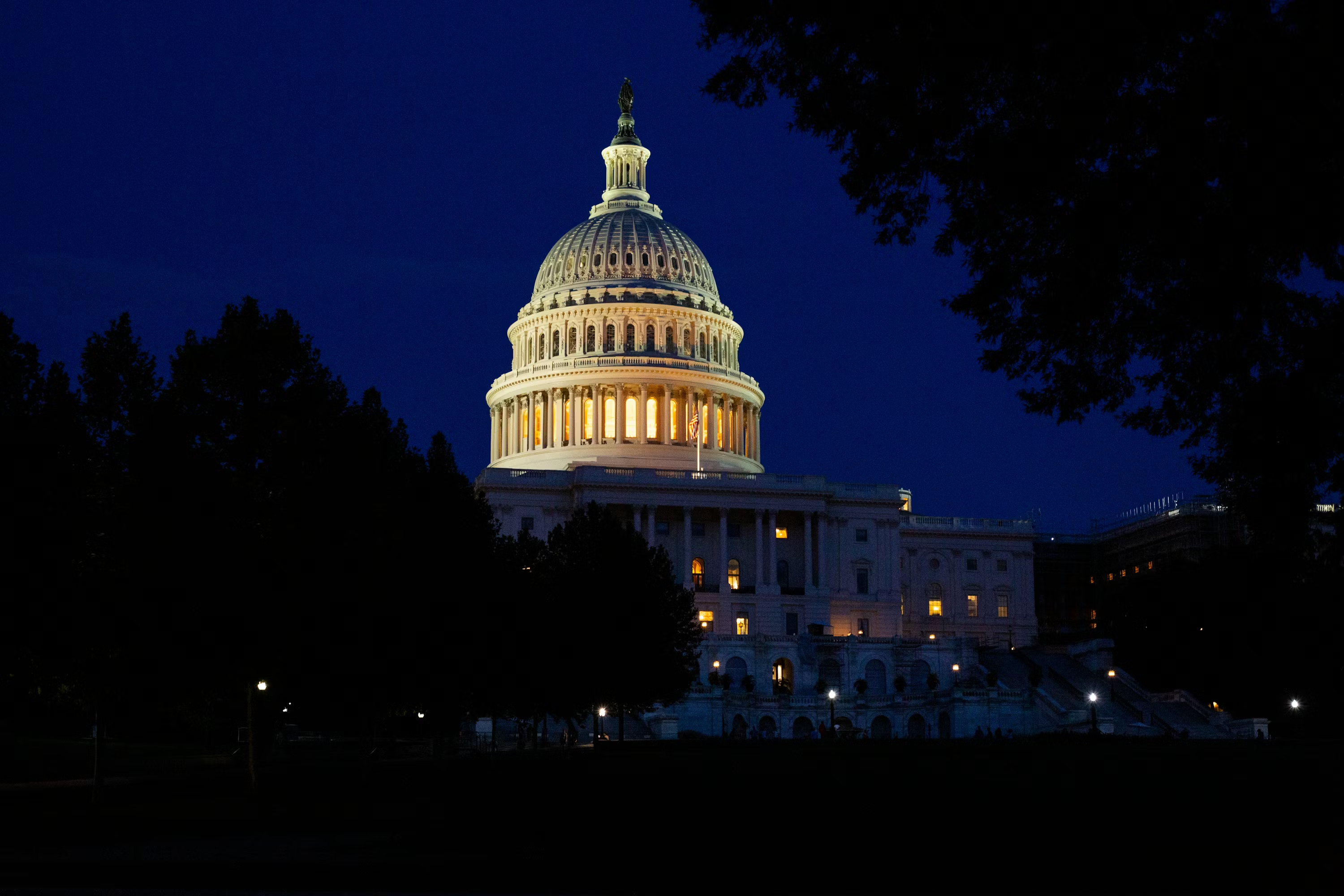
On Wednesday, Senate Republicans released the proposed text for the CLARITY Act, which has been met with pushback from Democrats regarding ethics provisions.
Connecticut Senator Richard Blumenthal questioned US authorities responsible for overseeing Binance about whether the company is complying with anti-money laundering laws and sanctions under its 2023 court-imposed monitoring program.
According to a report published by Fortune on Friday, Blumenthal sent letters to the Justice Department and the US Treasury’s Financial Crimes Enforcement Network (FinCEN), asking for details on Binance’s compliance.
Binance and its former CEO Changpeng “CZ” Zhao reached a deal in 2023, in which the exchange would pay $4.3 billion to settle civil regulatory enforcement actions, and CZ would plead guilty to one felony charge.
The deal also required that Binance be subject to monitoring and reporting requirements by US officials.
Blumenthal’s letter said he was concerned about “mounting allegations of dangerously lax anti-money laundering prevention by Binance.” Fortune reported that DOJ and FinCEN officials responsible for overseeing the exchange as part of the deal would not comment.
Related: Crypto billionaire to prison: CZ’s autobiography revisits turbulent Binance era
The letter followed reports that Binance was under scrutiny regarding US sanctions imposed on Iran.
The crypto exchange reportedly fired individuals responsible for telling Binance executives that $1 billion flowed through the platform to entities tied to Iran. A spokesperson for the exchange has denied the claims.
In February, a group of senators urged Treasury Secretary Scott Bessent and former Attorney General Pamela Bondi, who was fired by US President Donald Trump in April, to complete a “prompt, comprehensive review” of Binance’s compliance controls.
Some US lawmakers have alleged that connections between Binance and Trump create conflicts of interest for the US President and his family’s crypto businesses.
In March 2025, a United Arab Emirates-based entity purchased a $2 billion stake in Binance using the USD1 stablecoin issued by World Liberty Financial, the company co-founded by Trump and his sons.
Trump also pardoned Binance’s former CEO, CZ, in October 2025 after he served four months in prison as part of his 2023 guilty plea.
Magazine: Will the CLARITY Act be good — or bad — for DeFi?
Coinbase chief legal officer Paul Grewal said the CLARITY Act could be nearing a markup hearing in the Senate Banking Committee, but he tied that progress to one unresolved issue: the dispute over crypto and stablecoin yield.
That came as the broader push for the bill picked up new urgency from lawmakers and industry figures who fear the window for action is closing fast.
US Senator Cynthia Lummis said the country may not get another serious shot at the bill before 2030.
In a post on X on Friday, she said this was the “last chance” to pass the CLARITY Act until at least that year and warned against letting the country’s financial future slip away.
This is our last chance to pass the Clarity Act until at least 2030. We can’t afford to surrender America’s financial future.
— Senator Cynthia Lummis (@SenLummis) April 10, 2026
Her warning landed at a sensitive moment. Industry participants have grown more uneasy about the bill’s prospects this year, with November midterm elections threatening to shift congressional priorities and slow work on crypto legislation.
Lummis’ comments framed the fight as one that cannot sit on the shelf much longer.
David Sacks, the former White House AI and crypto czar, echoed that view a day earlier. He said Senate Banking, followed by the full Senate, should pass market-structure legislation and said he believes US President Donald Trump would sign it into law.
The GENIUS Act, signed by President Trump last year, established U.S. leadership on stablecoins.
The CLARITY Act, also known as market structure legislation, would do the same for all other digital assets by providing clear rules of the road.
Secretary Bessent is right: the… https://t.co/rBkE9b5Usq
— David Sacks (@DavidSacks) April 9, 2026
The pressure is not coming from lawmakers alone. Chris Dixon, a16z Crypto’s managing partner, said rules that are clearly defined help both consumers and entrepreneurs.
That line has become a common argument inside the industry, where many firms say clearer oversight would help the US pull in more innovation and more retail demand for crypto assets.
That view has spread across different corners of the sector. Immutable founder Robbie Ferguson said on April 3 that the CLARITY Act could make the past decade of gaming growth look small by comparison.
Coinbase CEO Brian Armstrong also shifted his tone on Friday, saying it was time for the bill to move after months of delays.
Even with that momentum, a key problem remains. Grewal said on April 2 that the bill may be close to a Senate Banking Committee markup, but he also said the path forward depends on agreement over stablecoin yield.
That issue has kept the legislation from moving cleanly, even as support has built among companies and some regulators.
Regulators are now adding their voices too. SEC Chairman Paul Atkins said the time had come for Congress to move market-structure legislation to Trump’s desk and to protect the system from what he called rogue regulators.
The CLARITY Act has since become a test of whether Washington can settle crypto rules before the political calendar closes in.
Featured image from Unsplash, chart from TradingView
Editorial Process for bitcoinist is centered on delivering thoroughly researched, accurate, and unbiased content. We uphold strict sourcing standards, and each page undergoes diligent review by our team of top technology experts and seasoned editors. This process ensures the integrity, relevance, and value of our content for our readers.
The US isn’t doing enough to stack its sats.
That’s according to one of Washington’s most pro-Bitcoin senators, Cynthia Lummis, who said Tuesday that she was “deeply concerned” about the government reportedly liquidating seized coins.
Following a report by Bitcoin Magazine that the Department of Justice had gotten rid of the Bitcoin seized in a criminal case, Senator Lummis said on X that the feds should be doing more to build up their crypto reserves.
“Why is the US gov still liquidating Bitcoin when @POTUS explicitly directed [that] these assets be preserved for our Strategic Bitcoin Reserve?” Senator Lummis wrote, referring to the Samourai Wallet case.
Why is the U.S. gov still liquidating bitcoin when @POTUS explicitly directed these assets be preserved for our Strategic Bitcoin Reserve? We can’t afford to squander these strategic assets while other nations are accumulating bitcoin. I’m deeply concerned about this report. https://t.co/XW5WxsfliA
— Senator Cynthia Lummis (@SenLummis) January 6, 2026
Why is the U.S. gov still liquidating bitcoin when @POTUS explicitly directed these assets be preserved for our Strategic Bitcoin Reserve? We can’t afford to squander these strategic assets while other nations are accumulating bitcoin. I’m deeply concerned about this report. https://t.co/XW5WxsfliA
— Senator Cynthia Lummis (@SenLummis) January 6, 2026
“We can’t afford to squander these strategic assets while other nations are accumulating Bitcoin. I’m deeply concerned about this report,” she added.
Samourai was a coin mixing app available on the Google Play store which allowed users to hide their Bitcoin transactions.
But feds in 2024 arrested developers Keonne Rodriguez and William Lonergan Hill and shut down the website, with the US Department of Justice alleging it was an “unlicensed money transmitting business” used by criminals.
Citing court documents Monday, Bitcoin Magazine reported that the US Marshall Service appeared to have sold the $6.3 million worth of Bitcoin that Rodriguez and Hill paid the Department of Justice as part of their guilty plea.
The magazine went on to say that this may have violated Executive Order 14233, which mandates that Bitcoin acquired via criminal or civil asset forfeiture proceedings should be held as part of the United States’ Strategy Bitcoin Reserve.
After the publication of this story, the United States Marshals Service told DL News that it “has not sold the Bitcoin mentioned” and it has “no idea how Bitcoin Magazine would get that information. But they did not fact check nor contact us for information.”
“USMS cryptocurrency liquidations go through a multi-level approval process to ensure only forfeited digital assets that meet the requirements of Section D of Executive Order 14233 are disposed,” the agency said.
US President Donald Trump in March 2025 signed an order for a Strategic Bitcoin Reserve — a bill Senator Lummis sponsored.
The idea, according to the bill, is that while the government won’t buy more Bitcoin, it also won’t sell the seized digital asset.
President Trump campaigned to help the industry and one of his promises was to establish a reserve of digital coins. The US government already has the biggest stash of crypto out of nation states, largely from seizures.
The DOJ did not immediately respond to DL News’ request for comment; Senator Lummis’ office would not respond to further questions.
Republican Senator Lummis earned the name “Bitcoin Senator” over the years for her pro-crypto approach on Capitol Hill.
The lawmaker — who announced her retirement in December — sponsored the Bitcoin Act for a Bitcoin strategic reserve, and was co-sponsor of the 2025’s GENIUS Act to regulate stablecoins.
A close ally of Trump, Lummis also in 2025 introduced legislation for a tax exemption on small Bitcoin transactions.
Update, January 6: This story has been updated with comments received from the United States Marshals Service.
Mathew Di Salvo is a news correspondent with DL News. Got a tip? Email at mdisalvo@dlnews.com.
Sen. Cynthia Lummis (R-WY), one of the crypto industry’s most reliable and powerful allies on Capitol Hill, announced Friday that she will not seek reelection when her term expires next year.
“Deciding not to run for reelection does represent a change of heart for me, but in the difficult, exhausting session weeks this fall I’ve come to accept that I do not have six more years in me,” Lummis said in a statement. “I am a devout legislator, but I feel like a sprinter in a marathon. The energy required doesn’t match up.”
Earlier this year, Lummis—who has been called the “Bitcoin Senator” for her crypto support and advocacy—was instrumental to the passage of the GENIUS Act, the first-ever major piece of crypto legislation signed into law. The bill, which established a federal framework for issuing and trading stablecoins, faced many dramatic starts and stops before ultimately getting over the finish line in late July.
Lummis has also been at the center of ongoing negotiations over the crypto industry’s coveted market structure bill, which has faced even more substantial hurdles to passage. The history of that bill, which would formally legalize most crypto activity in the United States, stretches back to 2022, when Lummis and Sen. Kirsten Gillibrand (D-NY) first drafted a version that was ultimately never passed.
The sprawling market structure bill currently faces numerous obstacles—among them growing dissension between factions within the crypto industry over the legislation’s content and necessity. Senate Republicans first aimed to see the bill passed by the end of summer, then by September, then by the end of this year—a target that has also now slipped by.
The legislation has not yet been marked up by the Senate Banking Committee, and Congress is expected to grind to a halt by spring in anticipation of the 2026 midterms. Whether the bill will manage to become law will likely become one of the final benchmarks of Lummis’ 18-year tenure in Congress.
In her time advocating for crypto-related issues, Lummis has also placed a particular emphasis on the importance of Bitcoin. Earlier this year, the senator introduced the Bitcoin Act, which would obligate the U.S. government to purchase some $80 billion worth of Bitcoin over a five-year period in the interest of bolstering a federal strategic Bitcoin reserve.
Lummis’ retirement announcement Friday immediately prompted messages of support from crypto industry leaders.
“Senator Lummis has been a leading champion for digital assets in Washington,” Ji Kim, CEO of the Crypto Council for Innovation, said in a statement shared with Decrypt. “The digital asset ecosystem is stronger because of her service, and we are grateful for her leadership.”
Lummis would have been up for reelection next year. She will retire from Congress in January 2027.
Start every day with the top news stories right now, plus original features, a podcast, videos and more.
The U.S. government recently executed a landmark seizure of 127,271 Bitcoin, valued at over $14 billion, following the dismantling of the Prince Group’s alleged forced-labor and cyber-fraud network in Cambodia. This massive action represents one of the largest cryptocurrency confiscations in history and marks a pivotal moment in the evolution of U.S. crypto policy.
Senator Cynthia Lummis (R-WY) praised the operation on October 14, emphasizing its dual significance: holding criminals accountable while laying the foundation for a national strategic approach to digital assets. She described the seizure as “a victory for human rights, financial integrity, and American leadership,” framing it as both a law enforcement milestone and a broader economic opportunity.
Senator Lummis outlined a vision in which seized cryptocurrencies are repurposed into a Strategic Bitcoin Reserve. This approach would allow the U.S. to transform ill-gotten gains into assets that can support national economic goals while safeguarding innovation.
“This seizure underscores two urgent priorities for Congress,” Lummis said:
Digital asset market legislation to empower law enforcement against illicit actors while protecting legitimate innovation.
Clear protocols for seized cryptocurrency, including secure storage, restitution to victims, and potential integration into a national reserve.
By converting confiscated Bitcoin into a strategic reserve, the U.S. could create a model of responsible blockchain governance that aligns law enforcement, economic strategy, and financial transparency. Analysts note that such a reserve could function similarly to traditional strategic commodities, acting as both a national asset and a stabilizing tool for digital markets.
The Prince Group’s criminal network, based in Cambodia, allegedly exploited forced labor and orchestrated widespread digital asset scams affecting victims across multiple countries. Federal prosecutors have charged Chen Zhi, the group’s chairman, with wire fraud and money laundering linked to the so-called “pig-butchering” crypto scheme.
Authorities described the operation as involving sophisticated crypto fraud tactics combined with human rights abuses, making it a case study in both criminal misuse of digital assets and the potential for policy-driven restitution. The confiscation of 127,271 Bitcoin not only disrupted the network but also provided a massive pool of digital assets that could now be legally leveraged for national purposes.
Lummis’ proposal reflects growing momentum in Washington to integrate cryptocurrency regulation into national economic and security policy. The senator emphasized the importance of codifying procedures for seized assets, including:
Transparent management and auditing of reserves
Mechanisms for returning value to victims
Secure, long-term storage in national digital vaults
Supporters argue that such legislation would enhance regulatory clarity, reduce misuse of cryptocurrencies in fraud schemes, and maintain the U.S.’s competitive edge in digital finance innovation. By establishing a Strategic Bitcoin Reserve, the country could set an international precedent for responsible cryptocurrency governance.
Industry analysts suggest that integrating seized Bitcoin into a national reserve could have multiple benefits:
Strengthening investor confidence in U.S.-regulated digital assets
Reducing market volatility by controlling large quantities of previously illicit holdings
Creating policy leverage for international collaboration on crypto crime prevention
At the same time, the proposal highlights the intersection of law enforcement, financial innovation, and macroeconomic strategy. If implemented, it could encourage other nations to consider similar policies, potentially positioning the U.S. as a global leader in both cryptocurrency security and strategic asset management.
The $14 billion Bitcoin seizure from the Prince Group illustrates a broader evolution in the perception and use of digital assets. Senator Cynthia Lummis’ push for a Strategic Bitcoin Reserve demonstrates how seized cryptocurrencies can be transformed from instruments of crime into national assets that strengthen economic resilience and innovation.
By codifying the management of seized digital assets, Congress can create a framework that protects victims, enforces financial integrity, and positions the U.S. as a global crypto governance leader. If successful, this initiative could signal a new era in which digital assets are treated not only as private investment vehicles but also as strategic national resources.
Post Views: 80