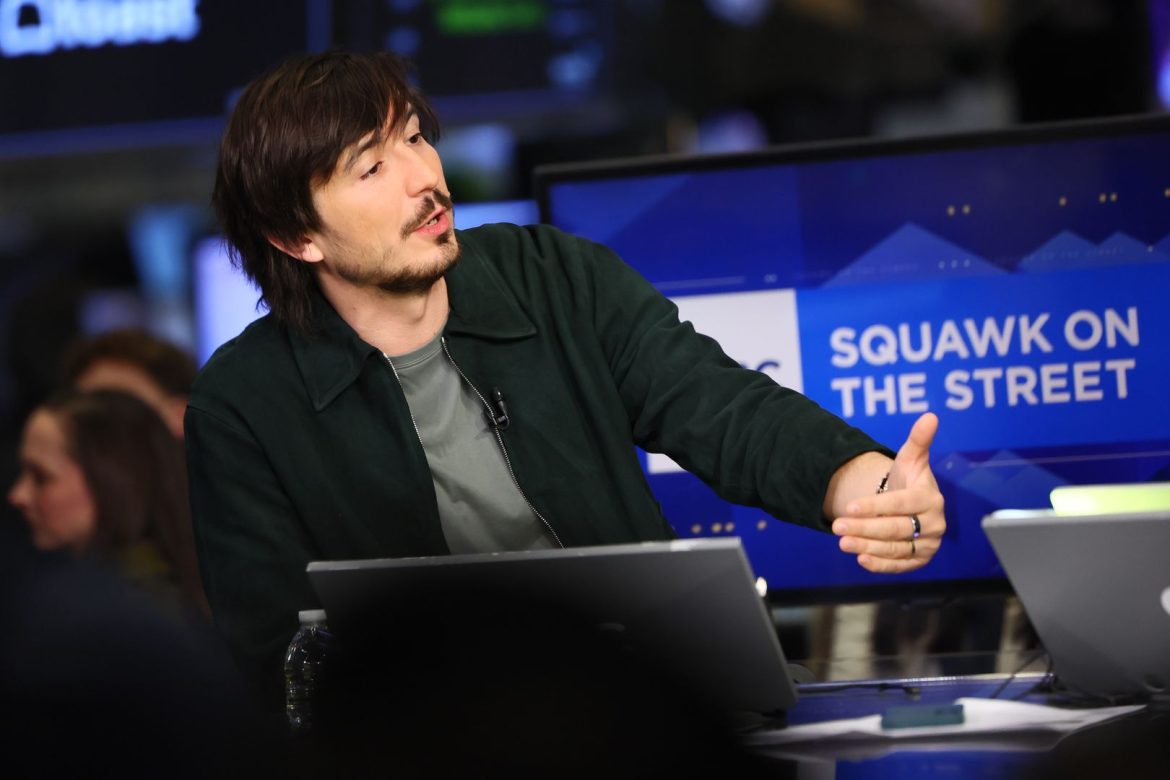
In a post on Friday, Vlad Tenev said securities issuers should control shareholder rights, but not separate products that track their publicly traded shares.

 Live Chat
In a post on Friday, Vlad Tenev said securities issuers should control shareholder rights, but not separate products that track their publicly traded shares.

New York City, United States, August 18th, 2026, Chainwire
Integration lets users hold Robinhood Chain assets in self-custody, move them across chains through Tria’s BestPath routing and use supported assets to top up the Tria Card
Tria, the leading self-custodial neofinance platform, today announced support for Robinhood Chain, connecting one of the fastest-growing new networks for tokenized real-world assets to Tria’s cross-chain infrastructure and global payment ecosystem.
The integration allows users to hold supported Robinhood Chain assets in wallets they control, move assets across chains using Tria’s BestPath routing technology, and route supported assets through Tria to top up the Tria Card for spending in more than 150 countries. Users can move Robinhood Chain assets across chains through BestPath without manually selecting bridges, finding routes, or managing separate gas tokens.
Robinhood launched the public mainnet of Robinhood Chain on July 1, an Ethereum Layer 2 built using the Arbitrum platform and purpose-built for real-world assets. The network launched with Uniswap as a day-one ecosystem partner and deep integrations with major infrastructure providers including Chainlink and BitGo. Robinhood Stock Tokens are available through Robinhood Wallet in more than 120 countries, with availability varying by jurisdiction.
Tokenized equities have quickly become a significant source of activity on the new network. Robinhood Chain averaged $29.7 million in daily decentralized-exchange volume for tokenized equities during a seven-day period in late July, exceeding the combined volume of Solana-based xStocks and Backpack Sunrise during the same period.
“Tokenization becomes much more powerful when assets can move freely beyond the environment where they were issued,” said Vijit Katta, Co-founder of Tria. “Robinhood Chain is bringing real-world assets onchain at meaningful scale. Tria gives users a self-custodial way to connect those assets to the rest of their financial lives—whether that means moving them across chains or ultimately using supported assets for everyday spending.”
From Tokenized Ownership to Real-World Utility
Robinhood Chain was designed to bring real-world assets onchain, with Robinhood Stock Tokens enabling eligible users to access tokenized equities through Robinhood Wallet. Tria’s integration adds another layer of utility by connecting assets on the network to its broader cross-chain and payments infrastructure.
Rather than maintaining Robinhood Chain assets in a separate wallet or manually determining how to move them between networks, users can manage supported assets alongside other holdings within Tria. BestPath automatically determines cross-chain routes behind the scenes, removing the need for users to select bridges or manage the technical steps normally required to move assets between blockchain networks.
Supported Robinhood Chain assets can also be routed through Tria to top up the Tria Card, which operates in more than 150 countries and offers up to 6% cashback on eligible purchases. This creates a path between assets held on Robinhood Chain and everyday payments while preserving Tria’s self-custodial model.
Unlike models that require users to borrow against their portfolios to access spending power, Tria does not require users to open a collateralized loan against their position. Users maintain control of their assets until they choose to move or spend them.
“Crypto has built increasingly sophisticated markets for owning and trading assets, but using those assets still involves too much friction,” Katta added. “Our goal with BestPath and the Tria Card is to make the underlying chain increasingly invisible to the user. You should be able to hold an asset where you want, move it where you need it and use it when you want without becoming your own cross-chain infrastructure engineer.”
Robinhood Chain support is live on Tria beginning today.
About Tria
Tria is a self-custodial neofinance platform built for crypto-native users. Tria brings trading, earning, swapping, payments and travel into a single self-custodial experience, including the Tria Card with up to 6% cashback, futures trading via Hyperliquid and Decibel, Earn across more than 100 protocols, Swap powered by BestPath routing, on/off ramps and Tria Travel. Tria is currently in private beta.
Jon Phillips
PhillComm Global
Tria@phillcomm.global
If I am an artist, I am rooting for the success of projects like Spritehood.
That may sound strange. The NFT market has endured more than its share of scammers, pump-and-dumps, undisclosed promotions, abandoned roadmaps, and founders who treated their communities like exit liquidity. Those behaviors did not merely hurt a few unlucky traders. They destroyed trust, drove collectors away, and helped collapse the market that had given thousands of digital artists their first meaningful audience.
We should not forget any of that.
But it is also possible to learn the wrong lesson from the last cycle. Speculation was not the only thing happening during the NFT boom, and eliminating it entirely would not automatically produce a healthier digital art market. At its best, the energy surrounding large collectible projects brought new people onchain, gave modest participants an opportunity to build capital, and turned some of those participants into serious collectors of art.
I know because I was one of them.
Spritehood is attracting attention partly because of the person behind it: Cole Villemain, better known online as ColeThereum, one of the original creators of Pudgy Penguins.
Cole’s history in NFTs is complicated, and skepticism is justified. The original Pudgy Penguins leadership became the subject of intense community criticism before the collection was ultimately sold to Luca Netz in 2022. Under Luca’s leadership, Pudgy Penguins completed one of the most remarkable turnarounds in Web3, expanding from an NFT collection into toys, retail distribution, games, licensing, and a globally recognizable character brand.
Credit for that transformation belongs primarily to Luca and the team that rebuilt the project. Still, Cole helped create the original collection, characters, and cultural spark from which the modern Pudgy Penguins empire grew. Whatever anyone thinks of his decisions, his projects have demonstrated an ability to capture attention—an increasingly scarce resource in today’s NFT market.
That is why Spritehood matters before we even know whether it will succeed.
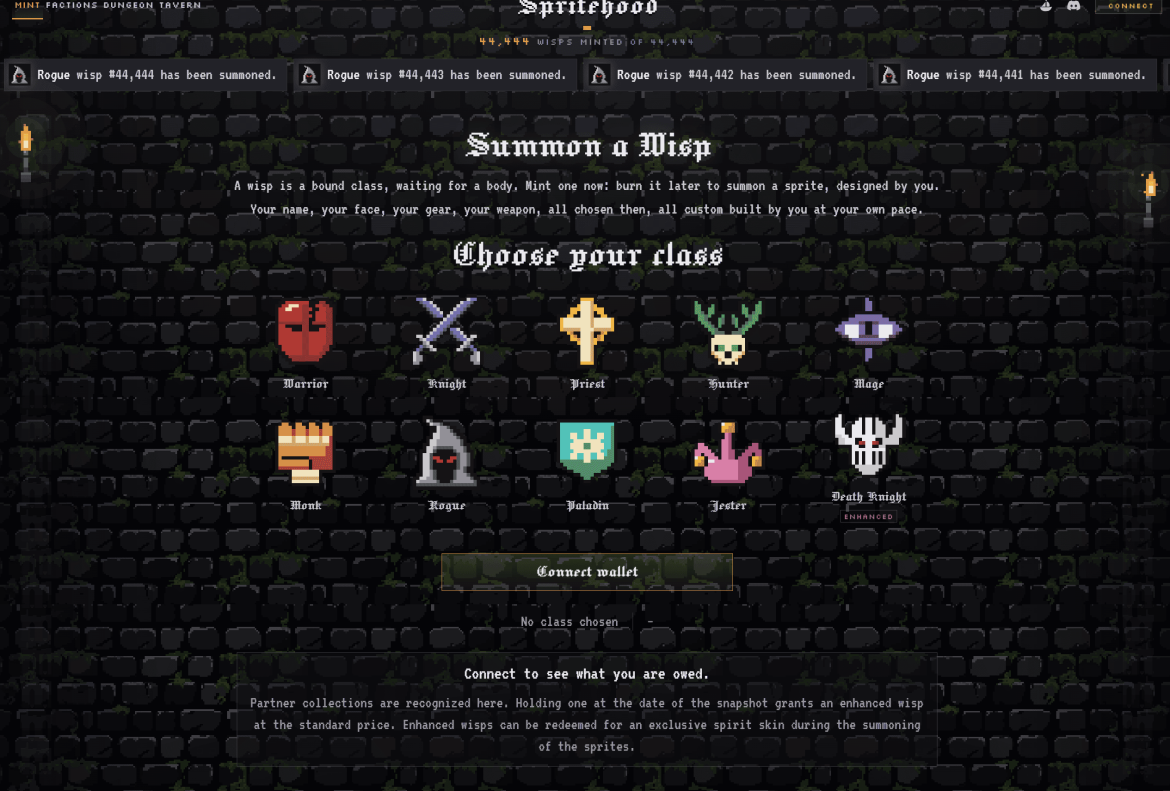
Spritehood is a fantasy, RPG-inspired NFT project built around customizable characters called sprites. Its first release was not a conventional finished PFP collection. Instead, collectors minted Wisps: tokens that represent a bound character class waiting for a body.
According to the project’s mint page, all 44,444 Wisps were summoned. Each Wisp belongs to one of ten classes: Warrior, Knight, Priest, Hunter, Mage, Monk, Rogue, Paladin, Jester, or Death Knight. The live summoning feed gave the release the energy of a game launch, announcing each new class as the collection moved toward its final mint.
The Wisp is only the beginning. A holder can later burn it to summon a sprite and choose the character’s name, face, gear, and weapon. The project describes the final sprite as custom-built by its owner, at the owner’s own pace. That structure transforms the mint from a one-time reveal into a longer creative process in which collectors participate in building their identities.
Spritehood also recognizes selected partner collections. Wallets that held an eligible collection at the project’s snapshot could mint an enhanced Wisp at the standard price. Enhanced Wisps can later be redeemed for an exclusive spirit skin while summoning a sprite. Beyond the mint, the project’s website introduces Factions, a Dungeon, and a Tavern—world-building elements that suggest the team is aiming for a participatory fantasy universe rather than a static gallery of profile pictures.
The collection can also be viewed on OpenSea, while project creator ColeThereum is documenting the rollout publicly.
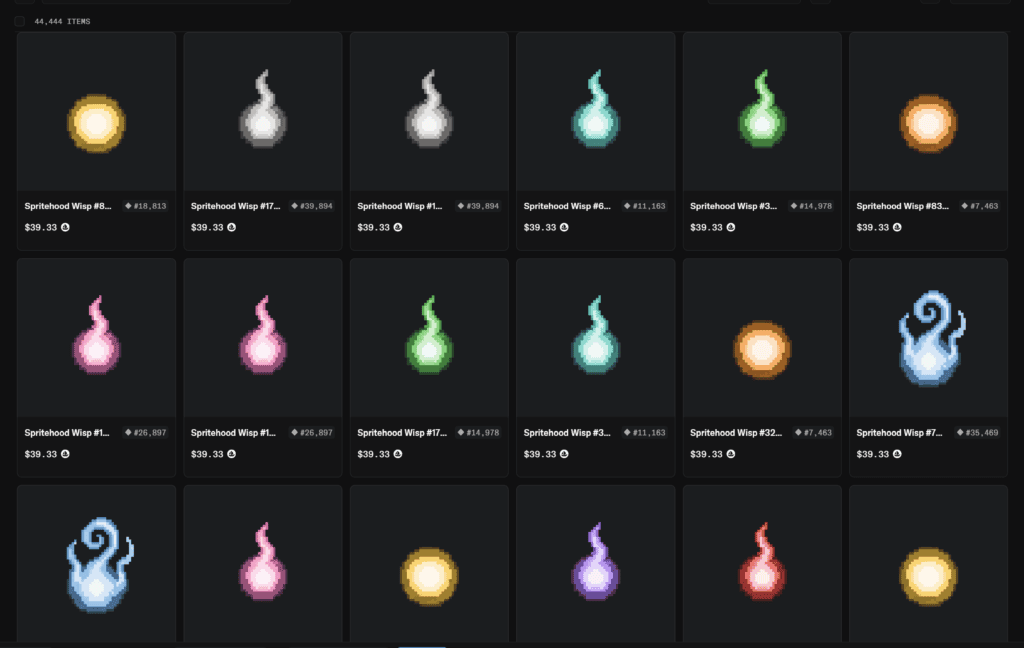
Spritehood is also notable for where it launched. The project is built on Robinhood Chain, Robinhood’s new permissionless Ethereum Layer 2. The network was developed using Arbitrum’s Layer 2 infrastructure, is compatible with standard Ethereum tools, uses ETH as its native gas token, and inherits security from Ethereum.
Robinhood launched the chain’s public mainnet in July 2026 with an initial emphasis on onchain financial services and tokenized real-world assets. Spritehood demonstrates that the network may support something broader: consumer crypto, digital identity, games, art, and online communities. A 44,444-item NFT mint gives the young chain a highly visible cultural use case at a moment when most of its public narrative has centered on finance.
That combination is worth watching. Robinhood already has a massive mainstream financial brand, while its chain gives developers an open, EVM-compatible environment connected to the Ethereum ecosystem. That does not mean every Robinhood user will suddenly become an NFT collector, nor does launching on Robinhood Chain imply an endorsement from Robinhood. It does, however, put Spritehood near infrastructure designed to make onchain participation more familiar to a much larger potential audience.
For NFTs, distribution has always been one of the hardest problems. The technology worked long before the experience felt accessible. Projects launching on chains associated with recognizable consumer platforms could help narrow that gap. Spritehood’s sellout is an early signal—not definitive proof—that collectible culture can find traction on Robinhood’s new Ethereum Layer 2.
For years, the NFT market has been waiting for a catalyst. We have seen impressive technological improvements, stronger infrastructure, lower transaction costs, and thoughtful work from committed artists. What has been harder to recover is the feeling that made people want to participate.
NFTs were never powered by technology alone. They grew because collecting felt alive. People discovered characters, joined communities, traded assets, formed friendships, learned about artists, and participated in a shared cultural moment. The best projects turned passive observers into active members of an ecosystem.
Spritehood appears to be tapping into some of that old energy. Cole has openly leaned into tactics associated with the 2021 era—including the humble NFT giveaway—but nostalgia alone is not the important signal. The signal is that people are once again debating a new NFT-native project, watching its development, sharing its artwork, and wondering what might happen next.
After a long period dominated by apathy, any genuine curiosity is meaningful.
One of the most common arguments against PFP and collectible projects is that they divert money away from “real art.” According to this view, every ETH spent on a speculative mint is ETH that could have supported an independent artist.
My experience was almost the opposite.
I was not a whale who entered the market with hundreds of ETH. I was a modest participant who bought into projects, made some good decisions, and earned enough ETH to begin collecting art seriously. Some of the capital I generated through larger projects eventually moved into the work of independent and emerging artists.
I know many other collectors whose stories followed a similar path.
They entered through an accessible PFP, a game, a collectible, or a community mint. They learned how wallets and marketplaces worked. They developed conviction, discovered generative art and one-of-one work, and eventually became patrons of artists they might never have encountered otherwise.
The speculative market did not simply extract value. In its healthier moments, it distributed capital and created collectors.
That distinction is important. A sustainable art ecosystem needs more than talented artists. It needs an active collector base with disposable capital, cultural curiosity, and the confidence to buy work. Major projects can act as the front door to that ecosystem, especially for people who do not initially identify as traditional art collectors.
The relationship between large projects and independent artists is not a zero-sum game. When the market functions properly, it behaves more like a flywheel:
This flow was visible during the last cycle. It was imperfect and often unfair, but it was real. Many artists found collectors because those collectors first arrived through CryptoPunks, Bored Ape Yacht Club, Art Blocks, Pudgy Penguins, Cool Cats, or dozens of smaller projects.
When collectible markets disappear, independent artists do not necessarily inherit all the capital that would have gone into them. Often, the capital leaves NFTs entirely. The collector buys memecoins, trades tokens, purchases physical collectibles, or simply returns to traditional investments.
Artists benefit from having more people emotionally and financially invested in the broader NFT ecosystem.
Rooting for Spritehood does not mean giving its team—or any team—a free pass.
The market cannot afford another cycle built on vague promises, manufactured scarcity, undisclosed incentives, and endless extraction. Founders must communicate clearly. Buyers must understand what they are purchasing. Communities must stop confusing price appreciation with guaranteed execution. Influence and promotion should be transparent.
Most importantly, projects need to recognize that trust is now part of the product.
The next NFT cycle will not succeed by pretending the last one never happened. It must preserve the creativity, fun, and open participation of 2021 while rejecting the worst behaviors that grew alongside them. That means healthier expectations, better accountability, more sustainable economics, and fewer promises designed solely to sell the next mint.
Optimism and scrutiny are not opposing positions. We can hope Spritehood succeeds while judging it by what the team actually delivers.
Spritehood may succeed, or it may fail. It is far too early to present it as proof of a wider NFT recovery. One popular collection cannot repair years of damaged trust, revive every marketplace, or solve the economic challenges confronting digital artists.
But market recoveries rarely begin with universal confidence. They begin with isolated pockets of energy: a project people enjoy, a new group of collectors arriving, an artist breaking through, or a community remembering why this technology felt exciting in the first place.
Spritehood could become one of those pockets.
The most important outcome would not be a high floor price or a profitable mint. It would be the creation of more active participants who remain in the ecosystem after the initial excitement fades. If some of those people become collectors, support independent artists, commission work, attend exhibitions, or fund the next creative experiment, the effects will extend far beyond Spritehood itself.
We do not need another reckless NFT cycle. We need a healthier one: fun projects that attract attention, transparent teams that earn trust, collectors who build capital, and more of that capital circulating toward artists.
If Spritehood can help restart that flywheel, I am rooting for it—and artists should be rooting for it too.
Spritehood sold out 44,444 class-based Wisps on Robinhood Chain, a new Ethereum Layer 2 built with Arbitrum technology and powered by ETH. Collectors can later burn their Wisps to create personalized sprites, giving the project a participatory identity beyond a standard PFP reveal. Skepticism around creator Cole Villemain is warranted, but large projects can onboard participants, distribute capital, and turn modest traders into meaningful collectors of independent art. Spritehood will not revive NFTs on its own, but its sellout, customization model, and launch on new consumer-facing infrastructure are welcome signs of life.

Robinhood said eligible US-based customers will soon be able to connect third-party AI agents to make crypto trades on their behalf, marking the latest expansion in autonomous trading after the company rolled out a similar product to equities and options traders in May.
“You can work with an agent to create a strategy with specific guardrails and not need to be constantly monitoring your account,” a Robinhood executive said during a presentation on Friday.
Robinhood didn’t set a date for when it would roll out the product to eligible US crypto traders but noted that its UK customers would be next in line to access the offering.
Equities traders can already ask AI agents to invest in crypto mining stocks on their behalf. Source: Robinhood
The push for autonomous crypto trading adds to Robinhood’s broader crypto strategy, which has primarily focused on real-world asset tokenization and the company’s Ethereum layer 2 Robinhood Chain, which launched earlier this month.
Robinhood’s senior vice president and general manager of crypto, Johann Kerbrat, said the new blockchain processed 17 million transactions from nearly 350,000 wallet addresses in its first week.
Meanwhile, over 70,000 agentic accounts have already been created by Robinhood equities and options traders since late May, when the platform launched a beta version of the product.
During the presentation, the Robinhood executive said the AI agents would enable retail users to base trades on data that they would have otherwise missed, putting them on a more equal playing field with institutions:
“This is another big step towards giving retail investors every advantage that institutions have enjoyed for decades.”
Robinhood offers the agentic accounts through several third-party AI companies, including Anthropic, OpenAI and SpaceX’s Grok.
Robinhood is also enabling eligible users to have credit card purchases made on their behalf by AI agents.
It comes as crypto industry executives like Coinbase CEO Brian Armstrong and Circle CEO Jeremy Allaire have tipped that AI agents will become the dominant users of blockchain payments in the next few years.
Several notable integrations advancing AI agent-driven stablecoin spending have emerged in recent months, including one by Amazon Web Services in May when it integrated Coinbase’s x402 payments protocol into Amazon Bedrock AgentCore, allowing agents to transact in the USDC (USDC) stablecoin.
Related: Robinhood Venture Fund invests $75M in OpenAI
In April, crypto wallet startup Oobit launched a Visa-supported virtual card for AI agents to make online purchases in USDt (USDT) on behalf of businesses.
Despite the integrations, data shows that AI-agent transaction activity on the blockchain remains relatively small, with Artemis data showing that only $2 million in transaction volume was facilitated through the AI agent-supported x402 protocol in June.
Features: The 5 types of real world assets being tokenized fastest onchain

Robinhood Markets Inc. broke from Bitcoin. Hard. For the first time in over six months, the NASDAQ-listed trading platform’s stock is moving on its own terms, no longer shadowing crypto’s most famous asset tick for tick.
For roughly half a year, watching Robinhood’s share price was basically watching a Bitcoin chart with a different label. The two moved together so tightly that traders started treating HOOD stock as a kind of proxy bet on crypto sentiment — a way to get indirect exposure without actually holding digital assets. That’s done now. The synchronization snapped, and Robinhood’s stock has started carving out its own path in ways that are catching the market off guard. It’s a big deal for a platform that built much of its identity around democratizing access to both equity and crypto markets simultaneously. The two were almost inseparable. Now they’re not.
The correlation didn’t drift gradually. It broke. And that kind of clean break after such a sustained period of synchronized movement tends to get people’s attention fast.
Robinhood has always straddled a weird line — it’s a stock, but it’s also pretty much a crypto sentiment vehicle for a lot of retail investors. Its user base is heavily involved in both equities and digital assets, which probably explains why the two moved so closely for so long. When Bitcoin ran, HOOD ran. When crypto sentiment soured, Robinhood felt it almost immediately. Traders leaned on that relationship. Some built strategies around it, using one as a signal for the other. That calculus is now broken, and nobody’s fully sure why.
The platform hasn’t said anything publicly. No press release, no statement, no executive comment. Robinhood hasn’t offered any official explanation for why its stock has stopped following Bitcoin’s lead, which leaves the market doing what markets always do when there’s a vacuum — speculating.
For investors who treated HOOD as a Bitcoin proxy, the rethink starts immediately. The strategies that worked over the past six months — using Robinhood’s movements to forecast or confirm crypto direction — probably need to get shelved. Or at least seriously questioned.
That’s not a small adjustment. Proxy trades are common in markets where direct exposure is complicated or undesirable. Robinhood filled that role cleanly for a stretch. Now it doesn’t, and the replacement isn’t obvious.
Analysts are watching both assets closely. The question they’re sitting with is whether Robinhood’s independent movement is a temporary blip or something longer-lasting. Could be a short-term anomaly driven by some company-specific factor that hasn’t surfaced publicly yet. Could be a structural shift in how Robinhood’s stock reacts to market forces — something that reflects changing user behavior on the platform itself, or shifting investor sentiment about the company’s fundamentals separate from crypto. Unclear.
Both traditional equities and cryptocurrencies have been volatile lately, which makes it harder to isolate cause. When everything’s moving, it’s tough to know what’s driving what. But the fact that Robinhood has decoupled specifically from Bitcoin, while broader market noise continues, is what’s drawing attention.
There’s a broader implication here that’s worth sitting with. Robinhood’s close relationship with Bitcoin made it a kind of barometer — not just for crypto, but for retail investor appetite more generally. When the two moved together, it told you something about how everyday traders were feeling about risk, about digital assets, about the market overall.
With that signal gone, or at least scrambled, market participants lose a data point. Not a huge one, maybe, but a real one. Some traders will look for alternatives. Others will just watch Robinhood and Bitcoin separately, as they probably should have been doing anyway.
And there’s a question about what Robinhood’s independent behavior actually says about the platform itself. It’s still one of the most popular trading apps in the country, still deeply tied to crypto through its trading products. But if its stock is reacting to different forces than Bitcoin, that might mean investors are starting to evaluate Robinhood more on its own fundamentals — revenue, user growth, product expansion — and less as a pure crypto sentiment trade.
That would actually be a more mature read of the company. But it’s a shift. And shifts like this one take time to fully understand.
Robinhood still hasn’t commented. The market’s watching both charts.
Hub: Bitcoin price, news, and analysis
Robinhood’s stock has broken its six-month correlation with Bitcoin’s price movements, though the company hasn’t released any official statement explaining the cause of the divergence.
Traders who used HOOD stock as a Bitcoin proxy will need to reassess their strategies, since Robinhood’s stock is now reacting to different market forces than Bitcoin’s price trajectory.

Robinhood is using the tournament to test its affiliated Rothera exchange, but some World Cup contracts will still route through Kalshi.
Robinhood is using the 2026 World Cup to bring Rothera deeper into its prediction markets business, expanding the app’s soccer offering just days after the Robinhood-backed exchange began powering its first event contracts.
The company said Thursday that it is launching World Cup markets covering individual matches, group and tournament winners, spreads, totals, player contracts and combos. Some of those contracts will be routed through Rothera, a CFTC-regulated exchange and clearinghouse formerly known as MIAXdx/LedgerX that is now controlled by a Robinhood and Susquehanna International Group joint venture.
“The World Cup is a global phenomenon and is the perfect event to launch Rothera,” JB Mackenzie, Robinhood’s vice president and general manager of futures and prediction markets, said in the announcement. “We’re now delivering even more value for customers as we continue on our mission to make Robinhood the best place to trade prediction markets.”
The World Cup rollout follows Robinhood’s first Rothera-linked markets late last week. Those included select Major League Baseball contracts, Core PCE Price Index markets and weekly jobless claims markets, matching the first Rothera contracts self-certified with the CFTC on May 13. Rothera’s soccer contracts were self-certified on May 27.
Robinhood’s World Cup rollout does not mean the company has moved all of its soccer contracts to Rothera.
The Robinhood app showed a dedicated World Cup section this week, with markets organized into categories including games, tournament outcomes, awards, group qualifiers, group winners, elimination, advancement, total goals, player goals and team goals. But the underlying contracts appear to be split between Rothera and Kalshi.
Rules links on Robinhood markets showed some World Cup contracts tied to Rothera terms, including the main World Cup winner market and some match-level outcome, spread and total-goals markets. Other World Cup-related markets still linked to Kalshi terms, including player contracts, parlay-style combinations and some tournament-prop markets such as first-time World Cup winner, group-to-win-the-tournament and award markets.
Bloomberg reported Thursday that some World Cup contracts on Robinhood will continue to be routed to Kalshi, including the player contracts and combinations. The company will make routing decisions during the tournament based on factors like liquidity and resolution clarity, Mackenzie told Bloomberg.
The split routing model is significant because Robinhood has been one of Kalshi’s most important distribution partners. Bloomberg reported that Robinhood users accounted for nearly a quarter of Kalshi’s overall trading volume in March.
Kalshi also has a large direct World Cup product. Its public World Cup hub showed more than 400 markets as of Friday morning, including individual games, group markets, tournament futures, awards, props and player/team goal markets.
Robinhood’s offering is harder to count from the outside. More than 50 World Cup-related event pages were publicly discoverable on Robinhood’s web product, though the web version did not show the same dedicated World Cup hub that was visible in the app.
That makes the launch less a full replacement of Kalshi than the start of a hybrid model. Robinhood has used Kalshi and ForecastEx contracts since launching its prediction markets hub in March 2025. At a recent investor conference, CFO Shiv Verma said Robinhood expects most of its prediction market flow to migrate to its own exchange over time, according to MarketBeat.
In a lengthy X post Thursday, Rothera framed the World Cup launch as a starting point rather than the full strategy, saying its event-contract infrastructure will eventually support markets tied to economic data, weather, policy decisions and geopolitical developments.
The post also nodded to contract-listing discipline at a time when prediction market operators are drawing more scrutiny from lawmakers and regulators. Rothera said it reviews contracts for “compliance, market integrity, liquidity and susceptibility to manipulation,” adding that it is “not here to list every possible event.”
Robinhood is also pitching the Rothera rollout as a lower-cost trading model for customers.
The company said it introduced a new prediction-market pricing model on June 1, with commission fees that vary based on contract price and order size. Robinhood said those fees are lower for contracts priced near $0.01 or $0.99 and will not exceed $0.01 per contract. For contracts routed through Kalshi or ForecastEx, trading costs can be higher because Robinhood’s commission is layered on top of the exchange’s own fee.
Customers with Robinhood Gold, the company’s paid membership plan, will receive up to 50% lower commission fees than non-Gold customers. Users who refer five friends to prediction markets will be able to unlock uncapped $0 commissions on World Cup trades beginning June 8, according to the Robinhood announcement.
The World Cup begins June 11, giving Robinhood and Rothera a quick test of the new exchange infrastructure ahead of one of the largest global sporting events of the year. The tournament runs through July 19 and includes 104 matches across the U.S., Mexico and Canada.
Other prediction market operators are also preparing for the tournament. For example, Fanatics Markets launched a dedicated World Cup hub last week through a partnership with ADI Predictstreet.
DeFi Rate estimated this week that Americans will trade more than $2.5 billion on 2026 World Cup prediction markets, including a projected $1.47 billion on Kalshi alone. The analysis found that Kalshi’s World Cup winner market is pacing ahead of its comparable March Madness market and projected it could reach about $253 million in volume by the end of the tournament.
DeFi Rate is tracking World Cup prediction market volume and contract odds throughout the tournament and has launched a free World Cup bracket challenge.

Mike Breen
Mike Breen has been a professional writer and editor covering a wide range of topics for more than 30 years. He’s been a freelance gaming industry writer since 2020, reporting on sports betting, online casinos, and more for various Catena Media sites, and he began reporting on prediction market industry news in 2025 for Prediction News. Prior to that, Mike was a founding editor at his hometown altweekly newspaper in Cincinnati, Ohio, where he extensively covered local arts, music and news.Mike’s published writing has received recognition and several awards from organizations like the Society of Professional Journalists and the Association of Alternative Newsmedia.When Mike is not working, he enjoys playing and listening to music, attending comedy shows, watching movies, and spending time with his family and three cats.

Stock and crypto trading platform Robinhood has entered the Canadian market after closing a $180 million stock acquisition of local crypto technology company WonderFi, gaining the company’s licenses and regulatory approvals in the country.
Robinhood said on Monday that the acquisition marks the platform’s entry into Canada and will see crypto exchanges Bitbuy and Coinsquare come under the company’s banner.
Bitbuy and Coinsquare are among Canada’s largest crypto exchanges. WonderFi disclosed in March that the platforms generated combined revenue of $49.8 million in 2025.
Johann Kerbrat, the general manager of Robinhood Crypto and International, said in a statement that WonderFi has “extensive experience operating regulated crypto platforms that serve beginner and advanced crypto users alike, making it an ideal partner to accelerate Robinhood’s mission in Canada.”
Source: Vlad Tenev
Crypto payments company Triple A estimated that roughly 4.1% of Canadians own crypto, while the analytics and consulting firm Grand View Research estimated that the Canadian crypto market generated around $263 million in revenue in 2025, driven by hardware. The firm also said Canada is the fastest-growing regional market in North America and projects total revenue will surpass $1 billion by 2033.
Robinhood said WonderFi’s employees, including the leadership team, will stay on as part of the deal. It also expects to gain about 300,000 funded customers from WonderFi.
Related: Robinhood announces $1.5B share buyback as stock struggles in 2026
WonderFi and Robinhood first entered into an agreement last May at 36 Canadian cents per common share ($0.26). WonderFi’s stock has been drifting between 34 and 36 Canadian cents for the last month, according to Google Finance.
Robinhood entered the US crypto trading market in February 2018. In April, the company was tapped to serve as brokerage and initial trustee for Trump Accounts, a new tax-advantaged investment account program for children.
The company also launched an Ethereum layer-2 network on a testnet in February with plans for a mainnet launch later this year. Robinhood CEO Vlad Tenev said the network processed 4 million transactions in its first week of public testnet activity.
Magazine: HYPE chases $100 target, ETH could dump below $1800: Market Moves

Start every day with the top news stories right now, plus original features, a podcast, videos and more.


That marks the largest single day deployment of stock based tokens ever recorded on the network. In total, the same deployer has now launched 1,997 stock tokens on Arbitrum, signaling a serious push toward tokenized equities.
Stock tokens are blockchain based representations of traditional equities. They track the value of real world stocks while using blockchain infrastructure for settlement and transfers. Instead of relying only on traditional market hours and clearing systems, tokenized stocks can move quickly and transparently on a public network.
BREAKING: @RobinhoodApp deploys 500 new tokenized stocks on @arbitrum overnight pic.twitter.com/peO9ZEqAzF
— 𝗵𝘂𝗻𝘁𝗲𝗿 (@BFreshHB) December 18, 2025
Arbitrum plays a key role here. As a leading Ethereum layer two network, it offers lower fees and faster transactions while maintaining Ethereum level security. This makes it attractive for large scale issuance. Deploying 500 stock tokens in one day shows that the infrastructure can handle volume at a pace closer to traditional finance.
According to Arbiscan, Robinhood: Deployer deployed 500 stock tokens on the Arbitrum network on December 17, marking the highest single-day deployment on record. To date, Robinhood: Deployer has deployed a total of 1,997 stock tokens on Arbitrum. https://t.co/Pi8lEnD9Ob pic.twitter.com/aLyaMQPxvN
— Wu Blockchain (@WuBlockchain) December 19, 2025
A simple example helps explain the impact. Imagine an investor who wants exposure to multiple U.S. stocks without waiting for market open or dealing with slow settlement times. With stock tokens on Arbitrum, those assets can be issued, transferred, and potentially traded in minutes rather than days. That speed reduces friction and unlocks new ways to manage portfolios.
Bitget announced that its tokenized stocks platform has reached $500 million in trading volume, achieved through a partnership with Ondo Finance. This milestone highlights growing interest in tokenized equities, where traditional stocks are represented as blockchain-based assets.
$500M in trading volume reached for Bitget tokenized stocks, in partnership with @OndoFinance.
Who still thinks tokenized stocks are niche? pic.twitter.com/MLzG23t21q
— Bitget (@bitget) December 18, 2025
By leveraging OndoFinance’s infrastructure, Bitget enables faster settlement, lower fees, and broader access to global investors. The achievement underscores the increasing adoption of tokenized financial products and signals that platforms combining blockchain technology with familiar investment assets are gaining traction in both retail and institutional markets.


The information provided by Altcoin Buzz is not financial advice. It is intended solely for educational, entertainment, and informational purposes. Any opinions or strategies shared are those of the writer/reviewers, and their risk tolerance may differ from yours. We are not liable for any losses you may incur from investments related to the information given. Bitcoin and other cryptocurrencies are high-risk assets; therefore, conduct thorough due diligence. Copyright Altcoin Buzz Pte Ltd.

ARK Invest closed out the week with a fresh round of accumulation across several of its flagship funds, picking up positions in Circle, Bullish, BitMine, Robinhood and Bitcoin ETFs as crypto-related equities rebounded.
The largest set of purchases targeted Bullish, with ARK Innovation ETF (ARKK), ARK Fintech Innovation ETF (ARKF) and ARK Next Generation Internet ETF (ARKW) expanding their exposure, according to trade notifications for Friday. Combined, these buys amounted to about $2 million, following Bullish’s 5.75% gain on the day.
ARK also continued accumulating BitMine, with purchases across ARKF, ARKK and ARKW totaling approximately $830,000. BitMine closed slightly lower on the day but remained within its recent trading range near $26.
Furthermore, the firm added small amounts of Circle and Robinhood. It acquired 3,529 Circle shares, worth $250,000, as the stablecoin issuer’s stock climbed more than 6%. ARK also added about $200,000 in new Robinhood shares.
Related: Cathie Wood’s ARK loads up on Circle, BitMine, Bullish as crypto stocks slide
On Friday, ARK increased its Bitcoin (BTC) ETF exposure by nearly $600,000, led by fresh purchases of the ARK 21Shares Bitcoin ETF (ARKB). The ARKF and ARKW funds together added more than 20,000 shares.
The purchase comes as the US spot Bitcoin ETF market is facing one of its sharpest downturns since its launch. The 12 funds collectively recorded nearly $1 billion in net outflows on Friday, marking the second-largest daily withdrawal to date and placing the group on pace for its weakest week since February.
Outflows have accelerated throughout the past month, with around $4 billion leaving the products as Bitcoin’s price has slipped roughly 30% from recent highs.
Related: ARK Invest scoops $10M in Bullish as it hits record low amid crypto stock rout
On Thursday, ARK made its largest daily acquisition of the week. The firm snapped up $10.1 million in Coinbase, $9.9 million in BitMine, $9 million in Circle and $9.65 million in Bullish, alongside additional purchases of $16.8 million in Nvidia and $6.8 million in Robinhood.
Prior to that, the firm also purchased $16.8 million worth of Bullish shares, roughly $15 million in Circle and about $7.6 million in BitMine across its ARKF, ARKW and ARKK ETFs on Wednesday.
Magazine: 2026 is the year of pragmatic privacy in crypto — Canton, Zcash and more


