Sentora has proposed operating independently curated lending markets on Aave V4, starting on Ethereum, with half of the instance's protocol revenue going to the Aave DAO. The Aave Request for Final Comments, or ARFC, remains at the community-feedback stage. It calls for a Snapshot vote followed, if… Read the full story at The Defiant
Revenue
AFX Shares Up To 50% Of Protocol Revenue With Traders As Cumulative Volume Approaches $1 Billion
ROAD TOWN, British Virgin Islands, June 25, 2026 /PRNewswire/ — AFX, a high-performance sovereign L1 purpose-built for decentralized derivatives, announced continued growth across its ecosystem as cumulative trading volume approached $1 billion, reaching $946.29 million alongside $20.71 million in Total Value Locked (TVL), according to on-chain data from DefiLlama.
This surge is directly driven by the protocol’s native VIP Program, which aligns active traders with ecosystem success by distributing 30% to 50% of platform fee revenue back to high-volume users. With annualized protocol revenue currently tracked at $1.07 million, the VIP reward pool distributes hard USDC yield directly back to participants, offering a sustainable, real-yield alternative to traditional inflationary token emission models.
The VIP program features tiered fee discounts scaling down to 0.001% Maker and 0.035% Taker at VIP 5, qualified via rolling 30-day volumes that consolidate master and sub-accounts. Operating natively on AFX’s sovereign L1 architecture, the program enables sub-100ms, zero-gas execution. Active traders can monitor their aggregated volume, tier status, and real-time reward pool allocations via the AFX VIP dashboard.
“The parabolic curves prove that capital and volume migrate to where incentives are structurally aligned,” said Ken C, Head of Growth at AFX. “Unlike exchanges that view customers to monetize, AFX treats them as growth partners and stakeholders in the ecosystem. By returning up to 50% of our real, annualized fee revenue back to our VIPs, we have created a self-reinforcing flywheel. Combined with our 45x capital velocity, we are proving that sovereign L1 orderbooks can deliver both institutional performance and true decentralized yield.”
The latest growth figures highlight increasing demand for decentralized derivatives infrastructure that combines professional trading performance with community-aligned economic incentives. As the protocol continues to expand its ecosystem, AFX remains focused on building a trading environment where active participation is directly rewarded through the value generated by the network itself.
About AFX
AFX is a high-performance sovereign L1 purpose-built for decentralized derivatives. By synthesizing the rapid execution of a centralized exchange with the immutable sovereignty of blockchain, AFX delivers a professional-grade Perp DEX environment characterized by sub-100ms finality, institutional liquidity, and unmatched capital efficiency.
Product availability varies by jurisdiction.

Pump Fun revenue slows as Collector Crypt’s $5.1M card-pack week reshapes Solana’s consumer loop
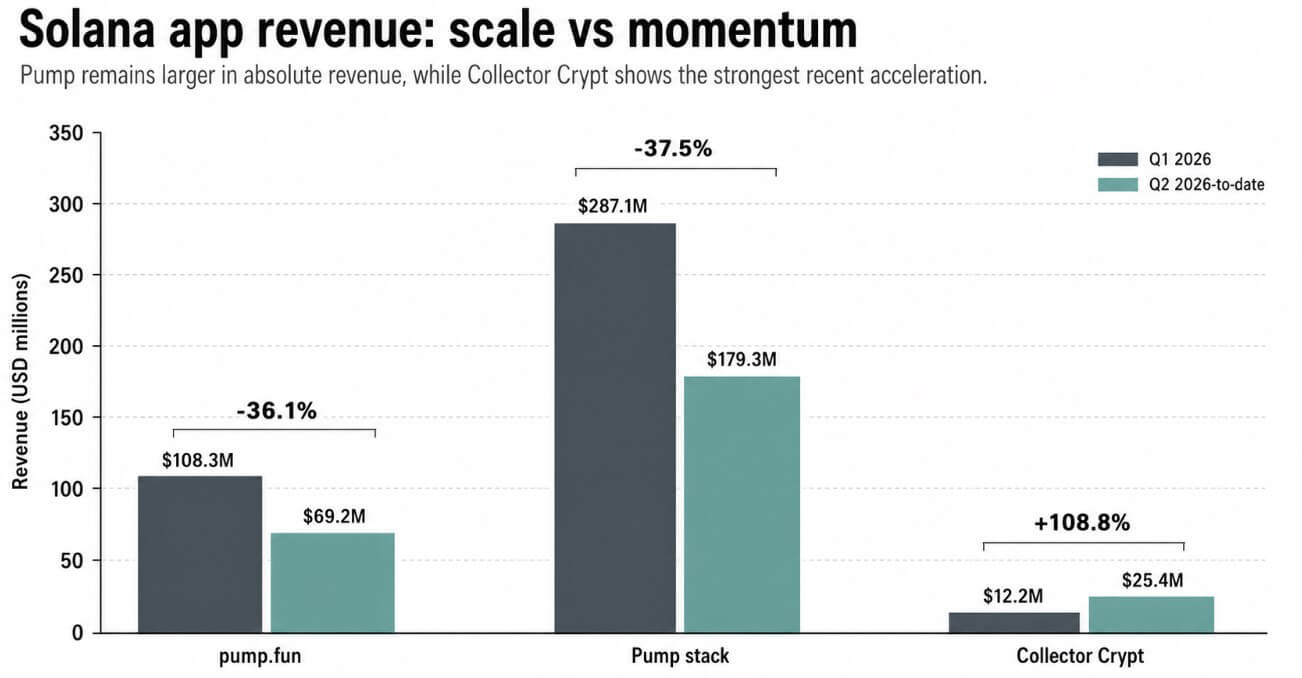
DefiLlama shows Pump.fun generated $108.3 million in gross revenue during the first quarter and $69.2 million in the second quarter to date, marking a 36.1% decline from the prior quarter’s pace.
The broader Pump stack, which includes PumpSwap and Terminal alongside Pump.fun, shows Q2-to-date gross protocol revenue of $179.3 million, 37.5% below the first quarter’s $287.1 million, while earnings fell from $120.9 million to $79.1 million over the same period.
Pump.fun’s scale ranks among the most profitable consumer applications ever built on Solana. Its cumulative revenue exceeds $1 billion, and the broader Pump stack has generated $1.18 billion since launch.
Its bonding-curve mechanism, which bootstraps initial liquidity for new token issuances and collects fees on trades, graduations, and Mayhem-mode activity, still processes hundreds of millions in DEX volume monthly.
The quarterly comparison shows a deceleration, with cumulative revenue and volume reflecting one of crypto’s most productive consumer loops.
The revenue conversation on Solana has widened as Collector Crypt’s quarterly numbers run in the opposite direction.

A different curve
Collector Crypt is a Solana protocol built around tokenized physical trading cards: users buy randomized digital packs tied to real, graded cards, trade tokenized cards on-chain, sell them back through the platform, or redeem the physical versions.
DefiLlama describes it as a protocol to sell RWA Pokémon cards on Solana, with revenue from gacha pack sales, marketplace fees, and royalties, net of gacha pack buybacks.
Collector Crypt opened over 215,000 tokenized TCG packs in a single week and crossed $50 million in cumulative revenue, with more than 30% of users redeeming physical cards.
DefiLlama shows Collector Crypt generated $12.3 million in the first quarter and $25.8 million in the second quarter to date, a 108.8% acceleration.
Its 7-day revenue of $5.1 million represents about 38% of its nearly $13.5 million 30-day total, a sharper recent concentration than Pump.fun’s 22.8% ratio.
Collector Crypt’s last 30 days also account for 88.3% of its approximately $123.5 million in cumulative DEX volume, compared with 1.4% for Pump.fun, which reflects a protocol whose measurable activity is recent and compressing upward rather than spread across years of cumulative issuance.
Collector Crypt’s 2026 revenue of $38.1 million is about 21.5% of Pump.fun’s $177.5 million, and 8.2% of the broader Pump stack’s $466.5 million.
The data show that a protocol generates its strongest activity precisely as the larger platform decelerates.
| Metric | pump.fun | Broader Pump stack | Collector Crypt | Readout |
|---|---|---|---|---|
| 2026 revenue | $177.5M | $466.5M | $38.1M | Pump remains much larger YTD |
| Cumulative revenue | $1.0B+ | $1.18B | $58.4M | Pump has the historical scale |
| 7d revenue / 30d revenue | 22.8% | ~23.0% | 38.0% | Collector Crypt has stronger recent concentration |
| 30d DEX volume / cumulative volume | 1.4% | N/A | 88.3% | Collector Crypt’s tracked activity is much newer |
| Main revenue loop | Token launches | Launches, swaps, terminal | Tokenized trading-card packs | Different consumer behaviors |
CARDS as the market’s attention proxy
CARDS, Collector Crypt’s token, has moved in tandem with the protocol’s revenue acceleration.
CoinGecko shows the token around $0.259, up 47% over seven days, with approximately $10.4 million in 24-hour trading volume, a market cap of around $66.83 million, and an all-time high of $0.38.
CARDS has become the liquid instrument traders use to express a view on Collector Crypt’s acceleration, but token holders should not assume revenue capture from that price action.
DefiLlama currently lists Collector Crypt holders’ revenue as zero and notes that tracking is disabled until the protocol’s buyback hub wallet receives official confirmation.
The broader tokenized trading card market provides context for why Collector Crypt’s activity curve looks the way it does.
The top seven tokenized trading-card platforms generated $230 million in gacha sales in May 2026, up sevenfold year over year, with Solana accounting for 64% of that volume.
Daily signals, zero noise.
Market-moving headlines and context delivered every morning in one tight read.
5-minute digest 100k+ readers
Free. No spam. Unsubscribe any time.
Whoops, looks like there was a problem. Please try again.
You’re subscribed. Welcome aboard.
That expansion points to a specific aspect of what Solana’s consumer app economy can now monetize.
Pump.fun’s model depends on a speculative issuance loop: new tokens launch, trade on bonding curves, graduate to open markets, and generate fees at each stage.
Collector Crypt’s model depends on a consumer loop different from Pump.fun’s, based on randomized pack openings tied to recognizable physical collectibles, on-chain secondary trading, and real-world redemption.
Both loops generate fees, volume, and token-market activity, but they draw on different user motivations and different definitions of what makes an on-chain asset worth holding.
Where the numbers go next
If Collector Crypt sustains its current revenue pace and the broader tokenized trading-card category continues to expand, the protocol becomes a durable fixture in Solana’s app-revenue rankings.
CARDS continues to serve as the liquid proxy for that acceleration, gacha pack demand remains elevated, and the 30-day revenue gap between Collector Crypt and Pump.fun narrows further.
The sevenfold year-over-year figure for the broader TCG gacha category supports this trajectory if user demand holds.
If gacha demand fades, CARDS volume drops, or multiple jurisdictions apply loot-box frameworks to scrutinize randomized-pack mechanics, Collector Crypt’s recent concentration of activity becomes a liability rather than proof of acceleration.
The protocol’s cumulative revenue base of $58.4 million is thin relative to Pump.fun’s $1 billion, which means a demand pullback would show up quickly in the weekly ratios that currently make Collector Crypt’s trajectory legible.
| Scenario | What happens | What to watch | Market meaning |
|---|---|---|---|
| Base case: broader attention, no replacement | Pump remains the larger revenue engine while Collector Crypt stays visible in app-revenue rankings | Pump 30d revenue stabilizes; Collector Crypt keeps elevated 7d/30d ratio | Solana consumer revenue diversifies beyond memecoin launches |
| Collector Crypt momentum holds | Gacha demand remains elevated, CARDS keeps acting as the liquid attention proxy, and 30d revenue gap narrows | Pack openings, 30d revenue, CARDS volume, redemption activity | Tokenized collectibles become a durable Solana consumer category |
| Pump reaccelerates | Memecoin issuance rebounds and PumpSwap/Terminal offset pump.fun cooling | Pump stack 7d revenue and DEX volume rebound | The divergence becomes a temporary momentum story |
| Collector Crypt cools | Gacha demand fades, CARDS volume drops, or loot-box scrutiny increases | Falling 7d/30d ratio, weaker pack demand, lower token volume | Recent concentration becomes a risk, not proof of durability |
Collector Crypt is building on the premise that users will pay for, trade, and return digital assets anchored to physical objects they recognize.
The second-quarter data show that this model and Pump.fun’s can both generate real fees on the same chain at the same time, and that Solana’s consumer revenue base is wider than it was at the start of the year.
Exodus Movement reported a net loss of $32.1 million for the first quarter of 2026, more than double the $12.9 million loss recorded in the same period last year, as the crypto wallet company liquidated the bulk of its Bitcoin treasury to fund acquisitions.
Total revenue came in at $22.7 million for the three months ended March 31, down 36.8% from $36 million a year earlier, the company announced Monday. Exchange aggregation, the company’s main business line, drove most of the decline, sliding $13.8 million, or 40.8%, as user trading volumes dried up.
Monthly active users dipped to 1.5 million from 1.6 million a year ago, while quarterly funded users fell more sharply, dropping 22.2% to 1.4 million from 1.8 million.
The company cited macroeconomic pressures, including the Federal Reserve’s revised growth outlook and uncertainty around the administration’s tariff policy, as primary drivers of the market-side damage. “The Company expects that volatility in digital asset prices will continue and may result in significant fluctuations in the Company’s results of operations in future periods,” it added.
Related: How AI became crypto’s favorite reason to cut staff
Exodus sells 63% of its Bitcoin stash
Exodus held 1,704 BTC at the end of December 2025. By March 31, that position had been cut to 628 BTC, a reduction of roughly 63% in unit terms. The company raised $73.2 million through the sales during the quarter, nearly all of which was earmarked to fund its push to acquire W3C Corp., the holding company behind fintech firms Monavate and Baanx.
The company’s broader digital asset portfolio swung to a net loss of $36.4 million, reflecting $76.8 million in unrealized losses partly offset by $40.4 million in realized gains on asset exchanges.
At the end of the quarter, the company held $72.9 million in cash and cash equivalents, up from $4.9 million at year-end 2025.
Exodus shares drop. Source: Yahoo! Finance
Exodus shares fell 5.75% to $7.71 on May 12 and slipped a further 3.11% to $7.47 in pre-market trade.
Related: Bitcoin exchange reserves fall to two-year low after $8B exodus
Exodus launches XO Cash in push into AI agents
As Cointelegraph reported, Exodus has rolled out XO Cash, a Solana-based stablecoin toolkit built with MoonPay that lets AI agents spend money through Visa’s payment rails without exposing a user’s private keys.
Developers can spin up agent-linked wallets, cap daily spending, restrict merchants and issue virtual debit cards through Exodus Pay balances. Payments settle automatically in USDC (USDC) or USDt (USDT) via infrastructure from Monavate, and transactions carry no fees.
Magazine: AI-driven hacks could kill DeFi — unless projects act now