PayMe users will be able to activate a stablecoin wallet in-app in the coming days for peer-to-peer and peer-to-merchant payments.


 Live Chat
PayMe users will be able to activate a stablecoin wallet in-app in the coming days for peer-to-peer and peer-to-merchant payments.

The Swiss Financial Market Supervisory Authority, or FINMA, announced Tuesday that it approved the country’s first retail fund that invests directly in Bitcoin.
It’s an exchange-traded fund or ETF, so its shares trade on an exchange like any listed stock. Under Swiss law, FINMA classified it as an “other fund for alternative investments” with a specific risk.
FINMA waived the applicable risk diversification rules for the fund, citing Bitcoin’s long trading history and particularly high trading volume compared with other cryptocurrencies.
“As Bitcoin has a long trading history and a particularly high trading volume compared with other cryptocurrencies, FINMA has approved an exemption from the applicable risk diversification rules in this case,” the regulator said.
FINMA cleared a crypto fund back in September 2021, the Crypto Market Index Fund, but sales were restricted to qualified investors rather than the general public. It invested mainly in a basket of crypto assets, not Bitcoin alone.
Institutions supervised by FINMA have to cut operational and custody risks, per guidance the regulator published on Jan. 12, 2026. That guidance flags cyberattacks and inadequate protection of private keys—the cryptographic credentials that control access to coins—as operational risks.

BitcoinBTC · USD
$82,660−0.91%
Oct 13Oct 15Oct 17Oct 19Oct 20
$83.7k$82.6k$81.4k$80.2k
24h HighHigh$83,249
24h LowLow$81,155
VolVol$1.1B
Market projectionsOdds by Myriad
 →
Under the guidance, a Swiss custodian bank generally has to hold a Swiss fund’s Bitcoin. It can hand safekeeping to a third-party custodian at home or abroad, but that custodian needs equivalent oversight of its financial soundness and equivalent bankruptcy protection for crypto assets. Translation: if the custodian goes under, the coins can be separated from its estate.
Firms selling the fund have to follow the conduct rules of Swiss financial services law at the point of sale. That means clear warnings about volatility and the risk of losing money, plus a check that the product suits the buyer. FINMA says that’s more protection than buying crypto directly.
Crypto exchange-traded products already have listing rules on both Swiss exchanges. FINMA’s January guidance treats them as structured products under financial services law. The new approval is a different animal: an investment fund under Swiss fund law.
U.S. spot Bitcoin ETFs, which track Bitcoin’s price and trade like stocks on a brokerage app, were down about $615 million for October through Friday. BlackRock’s IBIT, the largest of the 12 funds with $66.37 billion in net assets, took in $665.2 million on Monday and was the only one with net inflows. Total net inflows for the day were $526.6 million, per Decrypt’s ETF tracker.
FINMA’s release doesn’t name the Swiss fund or its issuer, and it gives no launch date. The regulator said only that other providers have submitted or announced applications for Bitcoin ETFs.
Start every day with the top news stories right now, plus original features, a podcast, videos and more.
Join 72,000+ readers

Key takeaways
Uniswap (UNI) faces intense selling pressure on Wednesday, falling nearly 9% after recording a 5% decline the previous day.
The pullback comes despite Uniswap’s continued product expansion, including the introduction of Continuous Clearing Auctions on Avalanche. The feature allows blockchain projects to conduct fully on-chain token auctions and establish initial liquidity through Uniswap v4.
However, declining social activity and derivatives demand suggest the launch has not been enough to offset the cryptocurrency market’s broader risk-averse mood.
Uniswap’s Continuous Clearing Auctions provide Avalanche developers with a new mechanism for launching tokens and bootstrapping liquidity onchain.
The model is designed to reduce friction during token distribution by allowing teams to conduct auctions transparently through smart contracts. Projects can then connect their newly distributed tokens with Uniswap v4 liquidity.
The launch expands Uniswap’s presence on Avalanche and strengthens its role as infrastructure for token issuance, trading and liquidity management.
It follows the recent launch of the TradePools platform on Robinhood, which allows users to deposit USDC, USDT or ETH in pursuit of yield.
While these developments may support Uniswap’s long-term utility, they have yet to produce a meaningful improvement in near-term demand for UNI.
Retail interest in Uniswap is weakening as traders prepare for the release of July’s US Consumer Price Index report, scheduled for Wednesday at approximately 12:30 GMT.
The CPI reading could influence the Federal Reserve’s next interest-rate decision and affect demand for risk assets. A hotter-than-expected report could strengthen expectations for tighter monetary policy, while softer inflation could improve sentiment across cryptocurrency markets.
Santiment data shows Uniswap’s social dominance fell to 0.08% on Tuesday from 0.19%. Social volume also declined to 40 from 152.
The sharp contraction indicates that UNI accounts for a smaller share of cryptocurrency discussions and is attracting less attention from retail traders.
Uniswap’s derivatives market reinforces the decline in retail participation.
CoinGlass data shows UNI futures open interest fell more than 3% over the past 24 hours to $261.60 million. The decline indicates traders are closing positions and reducing their leveraged exposure.
Long liquidations reached $2.88 million during the same period, significantly exceeding short liquidations of just $1,950. The imbalance shows that falling prices have disproportionately forced bullish traders out of their positions.
However, UNI’s open-interest-weighted funding rate improved to 0.0016% from negative 0.0054% the previous day.
The return to positive funding indicates that the remaining leveraged market carries a slight bullish bias. Still, falling open interest and heavy long liquidations suggest overall sentiment remains fragile.
Uniswap is testing its 100-day Exponential Moving Average at $3.55, an important near-term support level.
UNI remains below the 50-day EMA at $3.65 and the 200-day EMA at $3.93. These moving averages create overhead resistance and reinforce the prevailing bearish structure.
The Relative Strength Index has declined to 40, placing it below the neutral midpoint of 50 and indicating growing selling momentum. However, the indicator remains above the oversold threshold of 30.
The Moving Average Convergence Divergence indicator has also fallen below its signal line, while its expanding bearish profile suggests downside momentum is strengthening.
A decisive daily close below the 100-day EMA at $3.55 could extend Uniswap’s decline toward the 50% Fibonacci retracement level at $3.25. This level is measured from UNI’s advance between $2.31 and $4.57.

A successful defense of $3.55 could allow buyers to attempt a recovery. However, UNI must reclaim the 50-day EMA at $3.65 to ease immediate selling pressure.
Above that level, the 23.6% Fibonacci retracement at $3.89 and the 200-day EMA at $3.93 form a significant resistance cluster.
Until Uniswap recovers above these moving averages with stronger trading activity, the short-term outlook is likely to remain bearish.

Timothy Morano
Aug 09, 2026 09:51
HBAR is compressing into one of its tightest volatility windows on record, sitting 22% below its 200 SMA while smart money accounts position 57.6% long and aggressive taker buying runs at nearly 2:…
Hedera has been treading water at $0.07, posting a meager 0.70% gain in the last 24 hours on under $2 million in Binance spot volume. That’s not distribution — that’s stasis. And stasis in crypto typically resolves one of two ways: violently up or violently down.
What we’re looking at is a pure structure play. There are no verified KOL calls hitting the tape in the last 24 hours — the silence from Crypto Twitter is notable. What we have instead is a technical picture that is screaming for attention while retail traders look elsewhere. The network’s credibility as an enterprise-grade distributed ledger isn’t seriously in question; the question is purely whether the demand signal is building beneath the surface. Reporters and analysts at Blockchain.news have tracked Hedera’s institutional positioning and network growth throughout 2026, and the fundamental narrative hasn’t collapsed — price has simply gone cold.
That cold price is the setup.
Here’s what should have every serious trader’s attention: the Bollinger Bands have essentially converged to a single level at $0.07. Upper, middle, and lower bands are indistinguishable. When compression reaches this extreme, the market is coiling — and the statistical inevitability of a sharp directional resolution increases dramatically. Bollinger squeezes of this magnitude typically precede moves of 15–30%+ in either direction, often within days, not weeks.
The broader momentum picture is neutral-to-suspicious. RSI at 47 and a MACD that’s effectively zeroed out tells you no dominant trend currently owns this market. But the Stochastic has crossed — %K at 44.90 has moved above %D at 35.92, which historically functions as an early-cycle buy signal when it emerges from subdued territory. It’s not a slam dunk, but it’s a directional lean.
The 200 SMA at $0.09 is the elephant in the room. Price sitting 22% below it confirms the structural downtrend on a macro basis. Any sustained recovery doesn’t just need to touch that level — it needs to close above it on meaningful volume to flip the chart from bearish to neutral. That’s a real hurdle. Anyone telling you otherwise is selling something.
Flip to the derivatives data and the picture changes materially. The global long/short ratio sits at near-neutral 49/51, but that aggregated number obscures what matters: the top trader cohort — the accounts with deeper pockets and better information — is positioned 57.6% long against 42.4% short. That’s not a coin flip. That’s a directional conviction trade from the money that moves markets.
The taker buy/sell ratio reinforces it. At 1.60, aggressive market orders are buying at nearly twice the rate they’re selling. That is not passive accumulation. Someone is building exposure with urgency. Open interest has climbed 2.64% in 24 hours, meaning new capital is entering the trade, not exiting. The funding rate at 0.01% is effectively neutral — there’s no crowded long being squeezed, no over-extension to punish. This is room to run.
On the analyst target front, CoinCodex’s algorithmic model pegged HBAR at $0.1192 by December 2026 — a 76.5% gain from current levels. A separate projection from the same platform framed a more conservative path to $0.12, representing roughly 42% upside over the same window. These are model outputs, not individual KOL calls, but they contextualize the range. For traders following coverage at Blockchain.news, those targets suggest the $0.09 level — the 200 SMA — isn’t the destination. It’s the first checkpoint.
The bull case is built on that derivatives divergence holding. If smart money stays positioned long and the taker flow continues running at 1.60+, HBAR is set up for a squeeze toward the 200 SMA at $0.09 — a 28% move from here. Push through that convincingly on Binance spot volume north of $5 million daily, and the algorithmic year-end targets in the $0.11–$0.12 range shift from aspirational to base case over a 4–6 week horizon.
The bear case doesn’t disappear just because whales are bullish. HBAR is trading below every moving average that matters. That 200 SMA represents 22% of overhead supply waiting to sell. If the taker ratio flips and volume stays thin, price has minimal structural support below $0.07 — the order book is genuinely thin at these levels. A coordinated flush could happen fast.
The trigger is volume, full stop. Everything in this setup — the Bollinger compression, the whale positioning, the taker aggression, the rising open interest — is pointing toward an imminent resolution. But price will only follow if volume confirms the move. Below $2 million daily on spot, this is noise. Above $5 million, it’s signal. That’s the line traders need to draw in their decision tree.
The 60-day probability distribution, reading all available evidence: 65% chance HBAR tests $0.09 before it tests $0.065. The coil is real, the smart money is positioned, and the taker flow is already leaning into the move. Traders tracking on-chain activity and network fundamentals can find supporting context at Blockchain.news as the setup resolves. The setup is live — the execution is on you.
Image source: Shutterstock

Despite the growing institutional presence in crypto, retail sentiment is just as important as it was when Wall Street was largely on the sidelines, according to Swan Bitcoin CEO Cory Klippsten.
“It still does. You have to remember it’s not like BlackRock owns the Bitcoin and Fidelity owns the Bitcoin. It’s a bunch of retail accounts mostly that actually buy that,” Klippsten said during an interview with Cointelegraph published to YouTube on Tuesday.
Cory Klippsten spoke to Cointelegraph at BitcoinVegas 2026. Source: Cointelegraph
“You know they’re buying it in a wrapper. But they still have to take real supply and custody it. And it comes out of the supply. So, you know, it’s still it is real demand in ETFs,” Klippsten said, adding:
“There are some paper products and futures and things like that that are weird and take a little while to kind of work through the system. There is something to the idea that there is more supply in certain ways. But at the end of the day, if you want real on-chain Bitcoin, the fact that you can get it is what makes Bitcoin unique.”
US-based spot Bitcoin ETFs have posted a combined $2.90 billion in net outflows since May 15, according to Farside data, while Bitcoin has slid approximately 9.5% over the same period. At the time of publication, Bitcoin is trading at $73,630, according to CoinMarketCap.
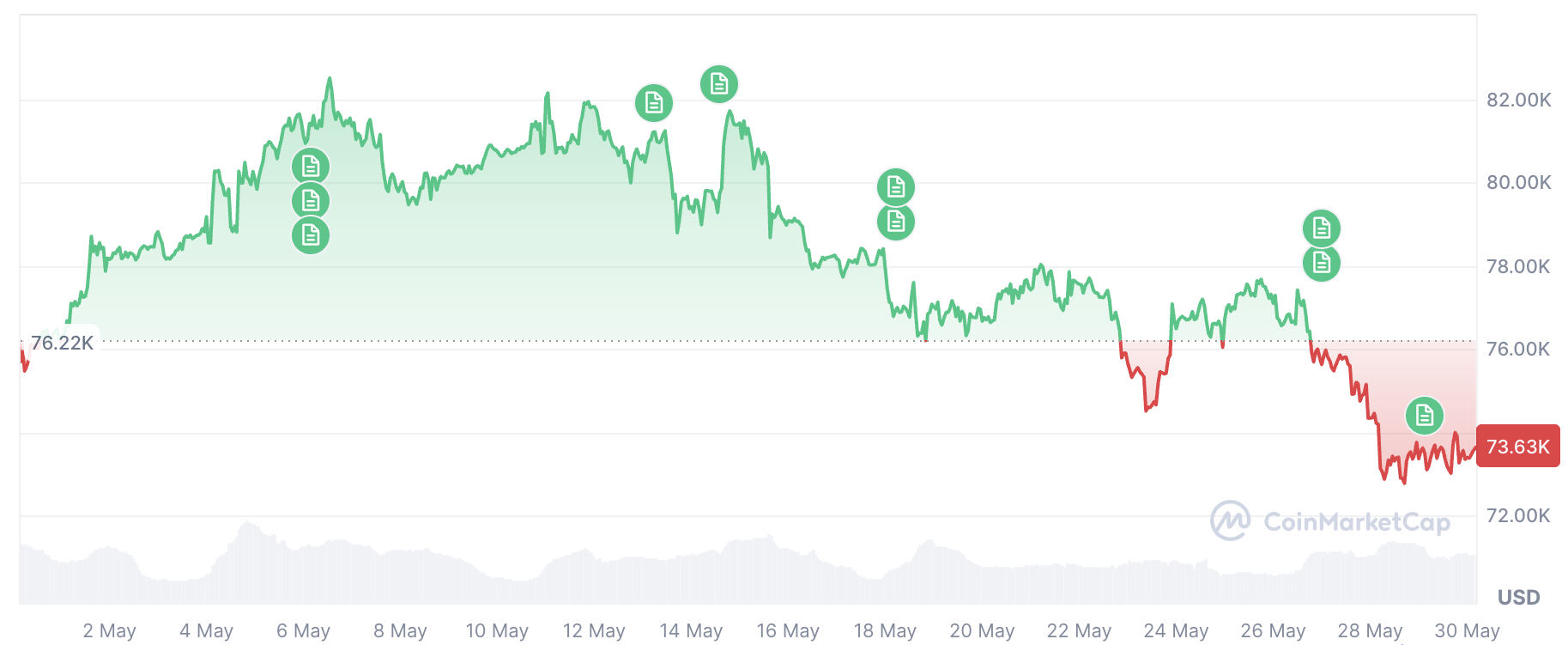
Bitcoin is down 2.87% over the past 30 days. (CoinMarketCap)
Meanwhile, sentiment toward the crypto market has been volatile in 2026. The Crypto Fear & Greed Index, which measures overall crypto market sentiment, posted an “Extreme Fear” score of 23 on Friday, signaling that investors are taking a cautious approach to the crypto market.
Klippsten said his outlook on Bitcoin hitting a new all-time high in 2026 is now looking slim.
Related: Bitcoin falls out of the global top 10 assets as market cap dips below $1.5T
He said he thought there was around a 50% chance we’d see a new all-time high this year when Bitcoin was still trading around $95,000 earlier this year, but given it has declined around 23% since then, his odds have gone down.
“I thought there was probably like a 50% chance that we’d see a new all-time high this year. And I’d say, given that we’re still in the 70s and, you know, and that we went all the way down to 60, I’d probably handicap that down to like 20 or 25% chance that we get a new [high]” he said.
Magazine: ETH bears growling, Tom Lee’s buying, XRP to ‘explode’: Market Moves

Automated yield protocols built DeFi’s most persuasive retail pitch that depositing into a vault was all a user needed to do, with the protocol handling everything else.
For users wanting exposure to Curve’s boosted yields without manually managing CRV locks, vote power, wrappers, gauges, and incentives, Stake DAO offered a product that packaged the full stack behind a simple interface and, in doing so, also packaged what could break.
According to Blockaid, an attacker minted over 5.4 trillion vsdCRV on Arbitrum through a suspected compromise of a deployer key and began swapping tokens for ETH.
The attacker altered LayerZero-related peer configuration to forge a cross-chain message before minting 5,446,744,073,709 vsdCRV, converting a portion into roughly 43.78 ETH, with liquidity constraining realized extraction far below the nominal mint.
Stake DAO told users not to interact with vsdCRV while the situation was active. The incident spread to Curve, which warned users in an affected Arbitrum LlamaLend market, and Beefy Finance paused a connected vault with exposure to Curve and Convex.
Stake DAO’s Liquid Lockers let users deposit governance tokens like CRV, receive liquid sdTokens, and access boosted yield and governance exposure without managing the Curve-locking stack directly.
The vault interface hides all of that and, in doing so, also hides the deployer keys, cross-chain messaging trust, wrapper-token accounting, and oracle dependencies that the exploit traveled through.
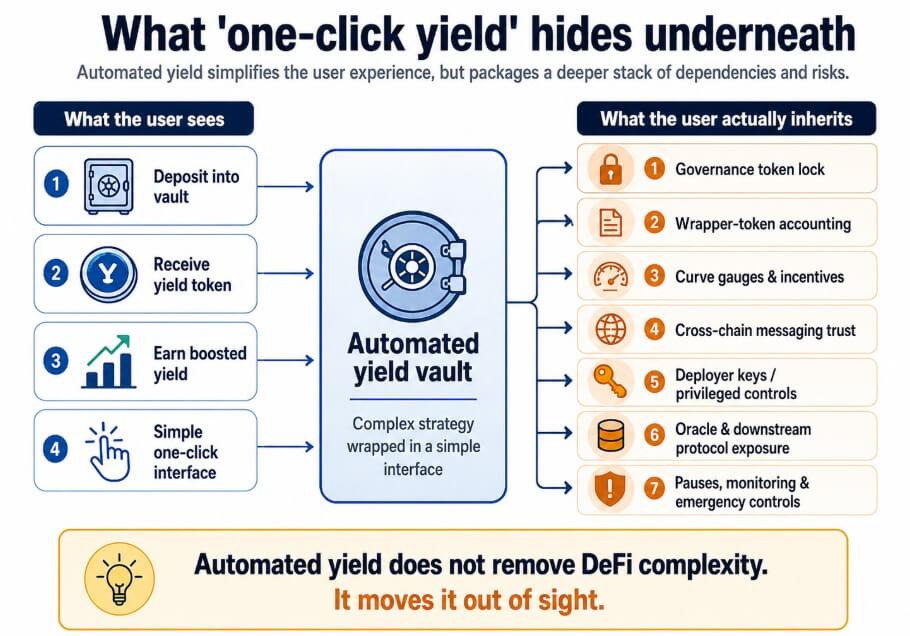
Automated yield moves DeFi complexity out of sight, a relocation that only becomes visible when something in the hidden layer breaks.
Ido Ben-Natan, co-founder and CEO of Blockaid, framed the security disconnect in a note:
“Wherever there is value on-chain, there will be attackers trying to exploit it, and that’s true regardless of how simple or complex a protocol’s strategy is. Two things matter here. First, whether protocols have the right governance infrastructure in place to ensure there is no easy point of failure to exploit. Second, having a real-time on-chain security tooling that validates every transaction before execution.”
April 2026 was DeFi’s worst month for exploits, with roughly $635 million extracted across 28 incidents, driven by social engineering, bridge spoofing, and AI-assisted reconnaissance.
Manuel Aráoz, who co-founded OpenZeppelin and served as its CTO until 2019, wrote that he now considers “all” of DeFi unsafe because AI coding agents have become “superhuman” at finding vulnerabilities, while defenders must fix every bug and attackers need only one.
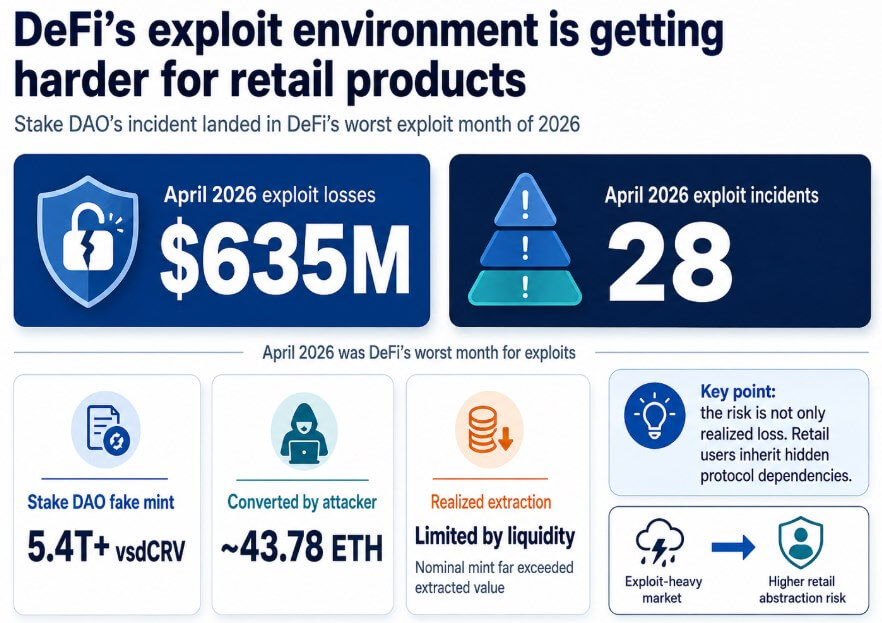
OpenZeppelin publicly rejected that claim, stating that Aráoz’s posts do not reflect the company’s position. The asymmetry he describes, though, has drawn serious attention beyond the attribution dispute.
Ben-Natan puts the defensive advantage in real-time tooling and adaptive threat detection:
“Hackers are increasingly leveraging AI to move faster and find new attack vectors. However, on-chain cybersecurity providers like Blockaid have deep experience using AI to stay well ahead. We continuously analyze and adapt to new threat patterns in real time, using AI agents for investigations, simulations, and malicious pattern matching.”
That real-time capability makes transaction validation a viable countermeasure to the speed edge attackers are gaining, and for automated yield protocols, governance controls, and monitoring have become the actual security layer that the vault interface depends on.
In the bear case, more key compromises, bridge incidents, oracle contagion, and vault pauses drive an abstraction discount into automated yield products.
Users demand higher returns to compensate for hidden stack risk, making it harder to sustain the one-click yield pitch without explicit risk disclosure, and smaller vaults lose TVL as integrations become risk-gated.
The incident pattern that defined April extends through the rest of the year, and each new incident reinforces the perception that yield automation bundles risks that users cannot independently evaluate.
In the bull case, protocols adopt the architecture Ben-Natan describes, consisting of governance controls that eliminate easy points of failure, real-time transaction validation, and continuous threat-pattern monitoring, and automated yield survives in a more standardized form.
Formal verification, multisig controls, and runtime monitoring become the default infrastructure, and the products that retain retail trust are those that disclose and manage the dependency stack.
Security vendors and risk dashboards are embedded in the vault interface itself, and the competitive edge moves from hiding complexity to proving which parts of it are under control.
| Scenario | What happens | Impact on users | Impact on protocols |
|---|---|---|---|
| Bear case | More key compromises, bridge incidents, oracle contagion, and vault pauses | Users demand higher yields for hidden risk | Smaller vaults lose TVL; integrations become risk-gated |
| Base case | Protocols add clearer disclosures, monitoring, and emergency controls | Retail still uses vaults, but with more caution | Security becomes part of the product UX |
| Bull case | Real-time validation, multisig controls, formal verification, and risk dashboards become standard | Users regain confidence in monitored products | Stronger protocols consolidate trust and liquidity |
The retail promise of automated yield was always about relocating complexity, and for years, the protocol absorbed that burden invisibly. The Stake DAO exploit shows what happens when the invisible layer breaks, and April’s record shows it breaking with increasing frequency.
The next automated yield product to win retail trust will earn it by showing users which parts of the stack are monitored, controlled, and isolated, and what the protocol does when any one part fails.


A fund manager, treasury desk, custodian, or regulated fintech function with vault accounts, policy-based approvals, granular access controls, audit trails, API access, and operational continuity when employees rotate.
That structure is reshaping how capital is allocated within DeFi, and it explains why Cardano’s latest infrastructure push via Iagon’s Cardano Vault, built with Fireblocks, is a bet on the operating model that serious capital actually requires.
Announced on May 8, the vault builds an enterprise control layer for Cardano-native operations comprising native assets, staking, reward withdrawals, and governance, inside a framework with vault accounts, controlled signing, approval workflows, and auditability that extends beyond a block explorer.
DeFi’s vault industry has consolidated around a three-tier structure consisting of protocols that provide the yield or liquidity rails, curators and risk managers that define mandates and risk limits for capital deployment, and distribution platforms that make the product usable for regulated capital.
Assets under management (AUM) across Morpho and Spark grew from $2.46 billion to $5.9 billion during 2025, and capital flowing into vault structures surpassed $6 billion last year.
Bitwise predicts on-chain vaults will double in AUM through 2026, framing them as “ETFs 2.0,” a product layer that abstracts complex on-chain mechanics into manageable, parameterized exposure.
RWA.xyz defines the core model as a smart contract allocation machine in which a risk manager or curator sets the strategy and parameters that govern how deposits move across isolated lending markets.
Gauntlet’s VaultBook frames vaults as non-custodial, transparent, and parameterized. They add that vaults are a critical integration layer for banks, fintechs, and payment providers moving on-chain.
The structural question both sources surface is which chains can fit inside a curator-led, risk-bounded, policy-enforced capital stack and deliver the auditability and workflow control that institutional risk teams demand.
Fireblocks’ April 2026 survey found 88% of financial institutions have committed or will commit budget to digital-asset infrastructure this year, with 53% spending at production scale. Yet, only 16% have actually reached production.
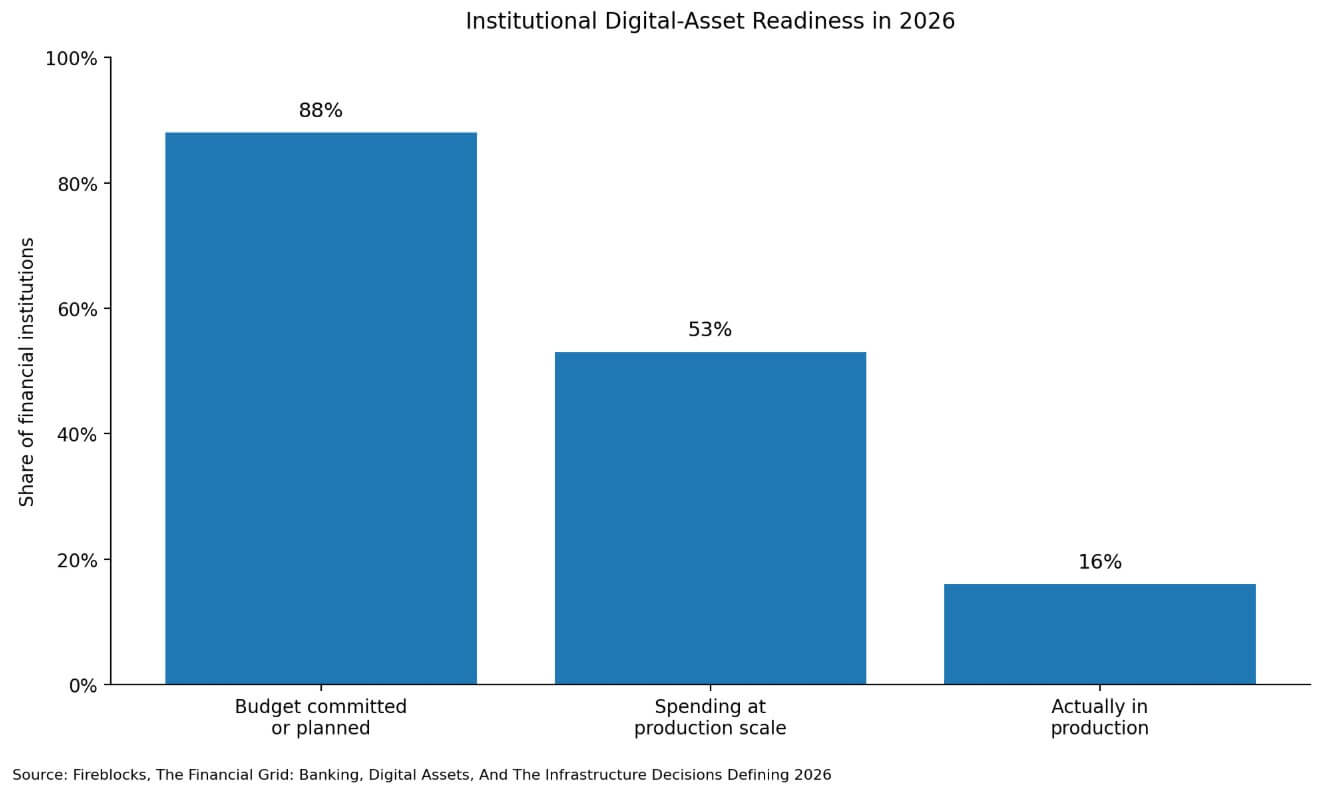
Infrastructure positioning at this stage determines which chains are included in the next allocation cycle and which are bypassed.
Ethereum currently holds the deepest institutional vault infrastructure. Protocols like Morpho have established curated lending markets with risk manager-defined parameters.
Meanwhile, Solana’s lower latency and expanding institutional DEX volumes position it as the performance layer for active strategies.
A curator selecting a vault deployment in 2026 defaults to Ethereum or Solana first, then evaluates alternatives based on demonstrated liquidity depth, exit reliability, and audit completeness.
Cardano built its native feature set with staking, governance, native assets, and programmable tokens for individual users.
Delegation to stake pools, voting through DReps, and minting native assets function cleanly from a personal wallet.
An institution running a treasury or custodial operation requires workflow authorization, MPC-secured signing, approval routing across counterparties, and audit records that satisfy internal compliance requirements.
Cardano’s moves have focused on creating tools for these institutional needs over the last 60-75 days. USDCx went live on Cardano on Feb. 27, with Circle xReserve backing and CCTP-based cross-chain flows providing the stablecoin foundation that institutional workflows require.
The Cardano Foundation announced in March that integration with Archax allows tokenized assets to operate inside an established regulatory framework.
CIP-0113 introduced a programmable tokens framework that embeds compliance logic directly into native assets, enabling on-chain enforcement of rules at the asset level through native protocol logic. The new Cardano Vault adds the custody and operational control layer above all of that.
| Layer | Current component | Institutional function | Constraint / caveat |
|---|---|---|---|
| Stablecoin rail | USDCx | Settlement / treasury movement | Still limited scale |
| Regulatory wrapper | Archax integration | Tokenized assets in regulated framework | Early-stage relevance depends on usage |
| Compliance logic | CIP-0113 | Rules embedded at token level | Needs adoption by issuers/curators |
| Operational control | Cardano Vault + Fireblocks | Approvals, signing, auditability, workflow control | Must prove real production use |
| Market depth | Current Cardano DeFi base | Liquidity and exit reliability | Still modest vs ETH/SOL |
The vault model also opens an opportunity in staking.
Ethereum-based vaults primarily allocate capital to lending markets and liquidity pools, while Cardano’s proof-of-stake design continuously generates ADA staking rewards, without lockup periods or exposure to slashing.
A curator running a vault mandated to hold ADA with a defined yield floor can automate delegation, reward withdrawal, and reallocation inside Cardano Vault’s approval framework. This yield profile is different from what Ethereum or Solana vault operators offer.
CIP-0113 extends that logic to any native asset, allowing curators to embed eligibility rules and compliance triggers at the token level within the native protocol.
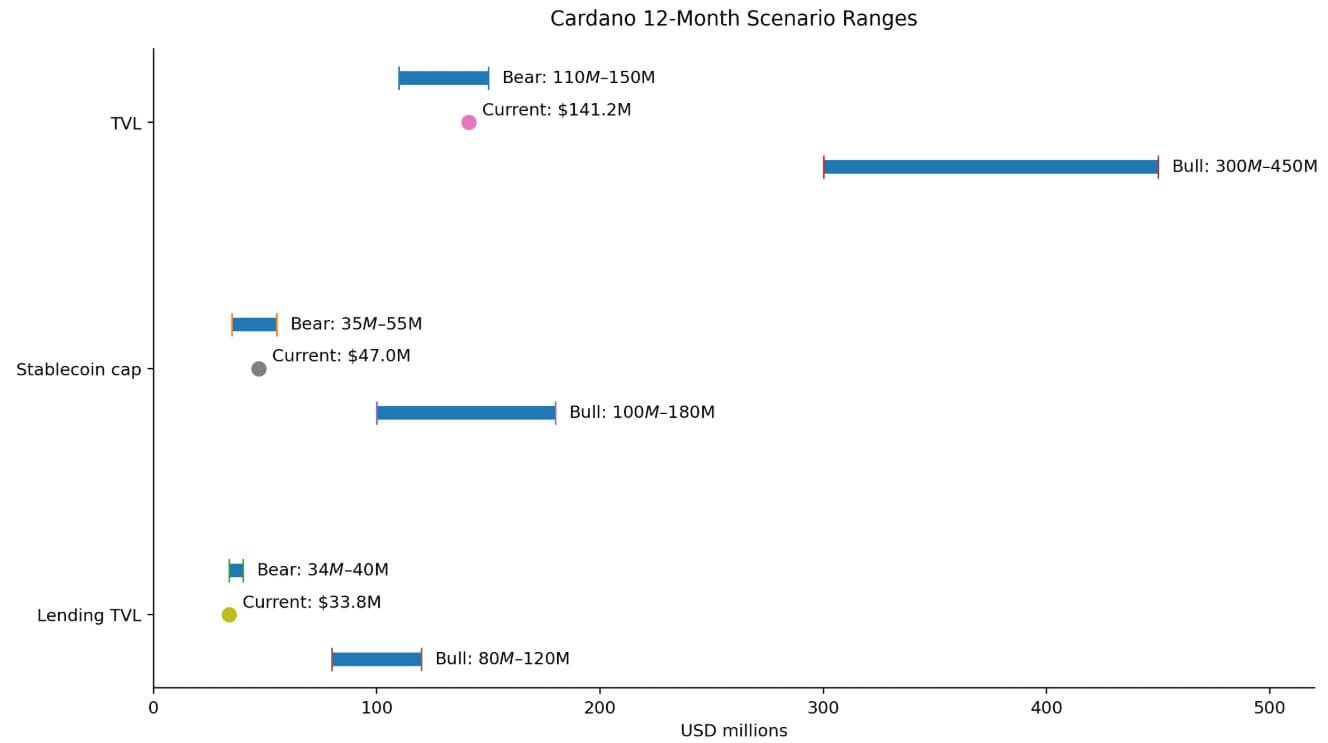
DefiLlama places Cardano’s total value locked (TVL) at approximately $141.2 million, stablecoin capitalization at nearly $47 million, and lending total value locked at $33.8 million. Those are modest numbers for an institutional-vault pitch, with seven-day DEX volume at $7.15 million, up 32.43% week over week.
The institutional infrastructure build is arriving before Cardano has institutional-scale on-chain depth, either reflecting a deliberate positioning or exposing a disconnect between announced rails and actual capital.
The bull case requires USDCx, Archax, CIP-0113, and Cardano Vault to function as a coherent stack.
If real treasuries, custodians, or fintech applications run ADA, native assets, staking, and governance through Cardano Vault’s control environment, and a few deployments reach production, Cardano’s TVL could reach $300 million to $450 million within 12 months.
Stablecoin capitalization could also reach $100 million to $180 million, and lending TVL could reach $80 million to $120 million. The operative mechanism is curated capital entering through controlled institutional workflows, the model that drove the leading vault platforms from $2.46 billion to $5.9 billion in AUM through 2025.
The bear case is durable, with Fireblocks integrating with more than 150 blockchain networks, and Ethereum and Solana having deeper liquidity, longer institutional track records, and larger curator networks.
If Cardano Vault stays as a demo or a narrow custody extension, and Fireblocks’ institutional clients continue allocating through deeper ETH- and SOL-centered vault structures, Cardano TVL holds in the $110 million-$150 million range, stablecoins edge between $35 million and $55 million, and lending barely moves.
Bitwise noted that the October 2025 volatility spike hit poorly managed vault strategies and argued that institutional-grade risk management is becoming a baseline requirement for vault participation.
That is a standard that Cardano’s thinner liquidity base makes harder to meet in any scenario where curators prioritize depth and exit reliability over native-asset features.
DeFi’s institutional phase belongs to the chains that can be operated inside the vault, policy, and risk-control infrastructure institutions already use, which is the stack Fireblocks, Gauntlet, Archax, and similar players provide today.
Cardano Vault is the network’s bid to build enough institutional depth before allocation decisions consolidate around Ethereum and Solana.

Start every day with the top news stories right now, plus original features, a podcast, videos and more.

Retail investors have been scooping up Bitcoin after it slipped below $70,000, but whale activity suggests the price could still head lower if past patterns repeat, according to crypto sentiment platform Santiment.
“The moment Bitcoin hit $74k, these key stakeholders began taking profit,” Santiment said in a report on Friday.
Santiment explained that whales — those holding between 10 and 10,000 Bitcoin (BTC) — “accumulated heavily” between Feb. 23 and Mar. 3, when Bitcoin was trading between $62,900 and $69,600.
Since Wednesday, when Bitcoin climbed past $70,000 and touched $74,000, the cohort has offloaded around 66% of their recent purchases, Santiment said. Meanwhile, retail investors — those holding below 0.01 Bitcoin — have been increasing their positions.
“When retail buys while whales sell, it typically signals that the correction is not yet over,” Santiment said. Bitcoin is trading at $67,984 at the time of publication, according to CoinMarketCap.
Bitcoin’s price decline led the Crypto Fear & Greed Index to fall 6 points, pushing it further into “Extreme Fear” territory with a score of 12 on Saturday.
MN Trading Capital founder Michael van de Poppe shared a similar outlook, saying a further decline is possible. “If Bitcoin doesn’t find support in this $67-68K region, then we’re likely going to retest the lows for liquidity before bouncing back upwards,” van de Poppe said in an X post on Friday.
The decline coincided with US-based spot Bitcoin ETFs posting their largest outflow day since Feb. 12, with a total of $348.9 million in net outflows across the 11 ETF products, according to Farside data.
Related: Trump’s National Cyber Strategy pledges to support crypto and blockchain
Bitcoin’s price fell as low as $60,000 on Feb. 6 during its downtrend from the October all-time high of $126,000 before showing a modest recovery. Economist Timothy Peterson suggests this level could be the floor for the time being.
“This valuation level has always marked a bottom for Bitcoin. About 99.5% chance it stays above $60k,” Peterson said in an X post, referring to the Bitcoin Price to Metcalfe Value chart.
Magazine: The debate over Bitcoin’s four-year cycle is over: Benjamin Cowen

ING Deutschland, one of Germany’s largest retail banks, has begun offering retail clients access to cryptocurrency-linked exchange-traded notes (ETNs) and products, allowing customers to gain exposure to bitcoin and other crypto directly through their existing securities accounts.
According to information published on ING’s website, the products are physically backed exchange-traded instruments issued by established asset managers including 21Shares, Bitwise, and VanEck.
The instruments track the performance of individual cryptocurrencies and trade on regulated exchanges via ING’s Direct Depot platform, which is typically used for stocks, ETFs, and mutual funds.
The bank said the bitcoin offering is intended to lower barriers to entry for crypto investing by integrating digital asset exposure into familiar banking infrastructure.
Clients do not need to set up third-party crypto exchanges, manage private keys, or operate self-custody wallets, as custody and execution are handled within the securities account framework.
“This creates another particularly low-threshold access to crypto investments via exchange-traded products,” said Martijn Rozemuller, CEO of VanEck Europe, in a translated press release. “Many investors want a solution that fits into existing depot structures and at the same time convinces them with transparent costs. That’s exactly what this partnership stands for.”
ING noted that the bitcoin and crypto ETNs receive the same tax treatment in Germany as directly held cryptocurrencies. Under current German tax rules, capital gains on crypto assets may be exempt if the position is held for more than one year, potentially making the products attractive to long-term investors.
Despite the expanded access, the bank emphasized that the products carry substantial risks. ING warned of “extreme” price volatility, the possibility of total loss in the event of issuer insolvency, liquidity risks, market manipulation, and ongoing regulatory uncertainty surrounding digital assets.
In educational materials published alongside the launch, ING took a notably cautious stance on the asset class itself.
“Cryptocurrencies are speculative products that have no intrinsic value,” the bank stated, adding that crypto prices are “strongly dependent on psychological effects,” which also influence exchange-traded crypto products.
Germany’s major banking groups are moving to bring crypto trading into the regulated retail banking system. DZ Bank has secured MiCAR approval and will roll out its “meinKrypto” platform across cooperative banks, allowing customers to trade and custody Bitcoin and other digital assets directly within existing banking apps, while also joining a consortium developing a regulated euro stablecoin.
In parallel, the Sparkassen-Finanzgruppe plans to launch Bitcoin and crypto trading for private customers by summer 2026, with technical support from DekaBank, marking a reversal from its earlier skepticism toward digital assets.


