The Treasury Department has withdrawn a controversial proposal that would have expanded requirements for cryptocurrency transactions.

 Live Chat
The Treasury Department has withdrawn a controversial proposal that would have expanded requirements for cryptocurrency transactions.
NEAR’s House of Stake passed HSP-029, which lowers the network’s maximum annual issuance rate from 2.5% to 1.6% over 24 months.
The U.S. Securities and Exchange Commission (SEC) has taken another step toward rewriting how investment advisers and funds can hold clients’ crypto assets, sending a new custody proposal to the White House for regulatory review.
The proposal, titled “Amendments to the Custody Rules” was submitted to the Office of Information and Regulatory Affairs (OIRA), part of the Office of Management and Budget (OMB), on August 25. The filing remains confidential, meaning the market does not yet know the precise changes the SEC is considering.
Still, the filing offers some clues about where the agency is heading.
The SEC’s regulatory agenda says the proposal would modernize custody requirements under the Investment Advisers Act of 1940 and Investment Company Act of 1940, including rules governing crypto assets. It also aims to address questions from investment advisers and investment companies about how digital assets can be held while complying with existing custody requirements.
Importantly, the proposal is classified as “Deregulatory” under Executive Order 14192. That does not reveal the substance of the coming rule, but it strongly suggests the SEC is looking to reduce regulatory burdens rather than impose another layer of restrictions. The agency also describes outdated provisions as candidates for removal where they are no longer necessary to protect investors given changes in markets and asset-holding practices.
The SEC’s current timetable targets October 2026 for publication of a proposed rule. That would begin a public comment period before the agency could consider a final version. The timing, however, is not guaranteed. The proposal is currently pending OMB review, and the SEC has previously missed regulatory deadlines by months.

The SEC has sent proposed crypto custody rule changes to the White House for review
The new effort marks a sharp change from the SEC’s approach under former Chairman Gary Gensler.
In 2023, the agency proposed expanding its custody requirements through what became known as the Safeguarding Rule. The proposal would have required investment advisers to keep client assets, including crypto, with qualified custodians meeting specific regulatory standards.
For traditional securities, that framework was relatively straightforward. Qualified custodians generally included banks and trust companies, registered broker-dealers and certain futures commission merchants.
Crypto created a much more difficult problem.
Many digital-asset platforms did not fit neatly into the existing definition of a qualified custodian, leaving advisers uncertain about how they could offer crypto exposure while remaining compliant. Gensler argued at the time that advisers could not simply assume crypto platforms qualified because of the way many of those businesses operated.
The proposal drew heavy criticism from both the financial and crypto industries. Opponents warned that the requirements could make crypto custody too expensive or impractical, particularly for smaller investment advisers. The Small Business Administration also raised concerns about the potential impact on small businesses.
The SEC ultimately withdrew the Safeguarding Rule in June 2025 after it failed to reach final approval during Gensler’s tenure.
The regulatory landscape has changed considerably since then.
One of the biggest differences is the growing number of financial institutions seeking permission to provide digital-asset custody services.
Crypto companies and financial firms have increasingly pursued bank and trust charters, giving the industry a broader pool of institutions capable of handling digital assets within the U.S. financial system. That development could give the SEC more flexibility as it considers how custody rules should apply to crypto.
The agency has also taken smaller steps to address the issue.
In September 2025, the SEC issued a no-action letter allowing certain state-chartered trust companies to serve as qualified custodians for digital assets under specified conditions. Those conditions included due diligence, independent audits, internal controls, asset segregation and restrictions on rehypothecation.
More recently, the SEC used another no-action approach to address custody arrangements involving Franklin Templeton’s OnChain Fund, showing that regulators are already experimenting with ways to accommodate digital assets within existing frameworks.
The new proposal could take those developments further by establishing broader rules rather than relying on individual regulatory relief.
The custody initiative is part of a much larger shift under SEC Chairman Paul Atkins, who has made clearer and more accommodating crypto regulation a central priority.
The agency has been working on rules covering token offerings, crypto market structure, broker-dealer activities and tokenized securities. In March, the SEC also issued an interpretation clarifying how federal securities laws apply to certain crypto assets and transactions, describing the move as part of its effort to provide greater regulatory certainty.
The custody proposal is particularly important because custody sits at the foundation of institutional crypto adoption. Asset managers may be willing to offer digital-asset products, but they still need a compliant way to safeguard those assets, manage private keys and demonstrate control to regulators and clients.
For now, the most important detail is what the SEC has not revealed.
The draft remains behind closed doors at OIRA, where it could be reviewed or revised before returning to the SEC. If the agency follows its current schedule, the market could get its first detailed look at the new framework in October.
After the failed 2023 approach, the next proposal will show whether the SEC has found a workable middle ground between investor protection and the practical realities of institutional crypto custody.

SharpLink CEO Joseph Chalom has come out against EIP-8363. This Ethereum proposal would burn validator rewards as the staking ratio rises, warning that the change would weaken decentralized finance and erase ETH’s native yield advantage over Bitcoin (BTC).
Joseph Chalom, a former BlackRock executive, laid out the opposition on Friday. Analysts, however, doubt the draft will pass.
Messari analysts explained that the proposal introduces a burn on part of each validator’s rewards tied to its assigned duties. The burn rate would increase as the amount of staked ETH grows, reaching 100% once staked ETH hits 60.25 million, or roughly half of the total supply.
The change would be implemented gradually over 18 months. As of August 7, 2026, the proposal’s pull request remains open. It would preserve the existing consensus-layer rewards and penalties.
“The proposal aims to stop consensus issuance from encouraging stake growth indefinitely while retaining strong incentives to perform validator duties,” the report reads.
Chalom opposed EIP-8363 for four main reasons. He said lower staking yields could weaken DeFi by raising on-chain borrowing costs and reducing liquidity.
The executive also argued that staking makes ETH more attractive to institutions by offering native yield alongside potential price gains. He said staking rewards also fund validators, infrastructure, developers, and other parts of Ethereum’s ecosystem.
Finally, Chalom criticized the proposal’s timing. He argued that Ethereum is gaining institutional momentum through stablecoins, tokenized assets, and major financial firms. Cutting yields now, he said, could weaken that momentum.
“EIP-8363 does not redirect that value. It destroys it. In fact, it could lead to institutions selling ETH as they unstake it,” he said.
Follow us on X to get the latest news as it happens
A Messari report calls EIP-8363 a solution in search of a problem. It notes that Ethereum’s issuance is already low, at about 0.85% per year, so the problem it targets is minor.
“EIP-8363 seeks to address valid concerns regarding stake centralization…However, the impact addresses nominal yield, when real yield from the demand side remains the core problem ETH faces,” the analysts added.
Supporters counter that the burn would curb dilution and resist staking centralization among large institutions. Messari still rates its odds of passing as low.
Subscribe to our YouTube channel to watch leaders and journalists provide expert insights
The post SharpLink CEO Warns Against New Ethereum Network Proposal EIP-8363 appeared first on BeInCrypto.

A group of six Ethereum researchers and developers, including Ethereum Foundation’s Justin Drake, has proposed changing the network’s issuance policy to cut validator rewards more sharply as the proportion of staked ETH rises.
The draft, called the Tapered Issuance Burn and currently being assigned the provisional number EIP-8363, would burn an increasing fraction of validators’ consensus rewards as the amount of staked ETH approaches a fixed threshold of 60.25 million ETH (around 50% of the current ETH supply), at which point the deduction hits 100%. The changes would phase in over 18 months.
Tapered Issuance Burn Ethereum Improvement Proposal. Source: Github
The proposal has triggered backlash from developers, stakers and DeFi founders, who warn that the reward cuts could force out solo validators before larger institutions are affected, weaken institutional demand for ETH, and disrupt DeFi markets built around staking yield.
One of the proposal’s authors, Jérôme de Tychey, said the changes are needed to address the rising share of Ether being staked, which passed 33% in April. The authors argue continued staking growth could concentrate ETH in large custodians and liquid staking providers, while unchecked issuance erodes Ether’s role as a neutral, trustless store of value.
“Ever-growing issuance is a dilution tax on every holder: stake, or be diluted. At high ratios, LSTs and other staking derivatives displace raw ETH as the ecosystem’s working money, thus swapping the most neutral, trustless asset for intermediated claims on issuers,” he said.
Although EIP-8363 remains an early draft, its publication just two days before a deadline for proposals targeting Ethereum’s Hegotá upgrade has also raised concerns about whether there is enough time to consider the impacts on Ethereum’s tokenomics.
The proposal’s authors argue that under the current curve, staking yield never drops below 1.5% even with all ETH in existence being staked.
“The incentive to stake never switches off. Where does it stop? It doesn’t,” said de Tychey.
With no changes, a worst-case scenario could see more than 55% of Ethereum supply locked in staking by 2028, he said.
“Maximal neutrality & minimal dilution: those are the two fundamentals of a store of value. This EIP not only hardens both, it sets a bar no other blockchain clears.”
The proposed policy would see issuance peak at 0.5% of ETH supply per year at its highest (around 20% of ETH is staked), declining to zero when the staking ratio of Ethereum hits the 60.25 million ETH threshold.
Related: Ethereum treasury firms lean on staking as ETF pressure builds: Report
“ETH supply growth will be bounded and more predictable. Combined with the EIP-1559 and Blob burn, the supply will more often decrease. Ethereum, the most mature of all the protocols, with a sustainable security budget, will also be the least dilutive of all protocols,” said de Tychey.
The proposal’s broader direction has also received support from Grayscale. In May, Grayscale’s head of research Zach Pandl said limiting staking incentives would be “positive for the price of Ether over time.”
Aave founder Stani Kulechov said reducing staking rewards would weaken institutional demand for ETH and borrowing activity across DeFi, arguing the proposal “doesn’t achieve the outcome it tries to achieve and is actually hurtful for Ethereum.”
Another argument is that the proposal would impact solo validators as they have generally higher relative costs and are more susceptible to reward changes, leading to a more concentrated validator set.
“This will self evidently push out solo stakers who aren’t subsidized by the EF or others,” said Mike Silagadze, CEO of Ether.Fi.
“It will essentially guarantee that the only ones staking are large centralized entities with zero cost of capital where users passively hold their ETH.”
De Tychey disputed this point, saying on the Ethereum Magicians forum that users of large staking providers must pay fees, making those services less attractive as rewards fall, though he acknowledged the research on this is still contested.
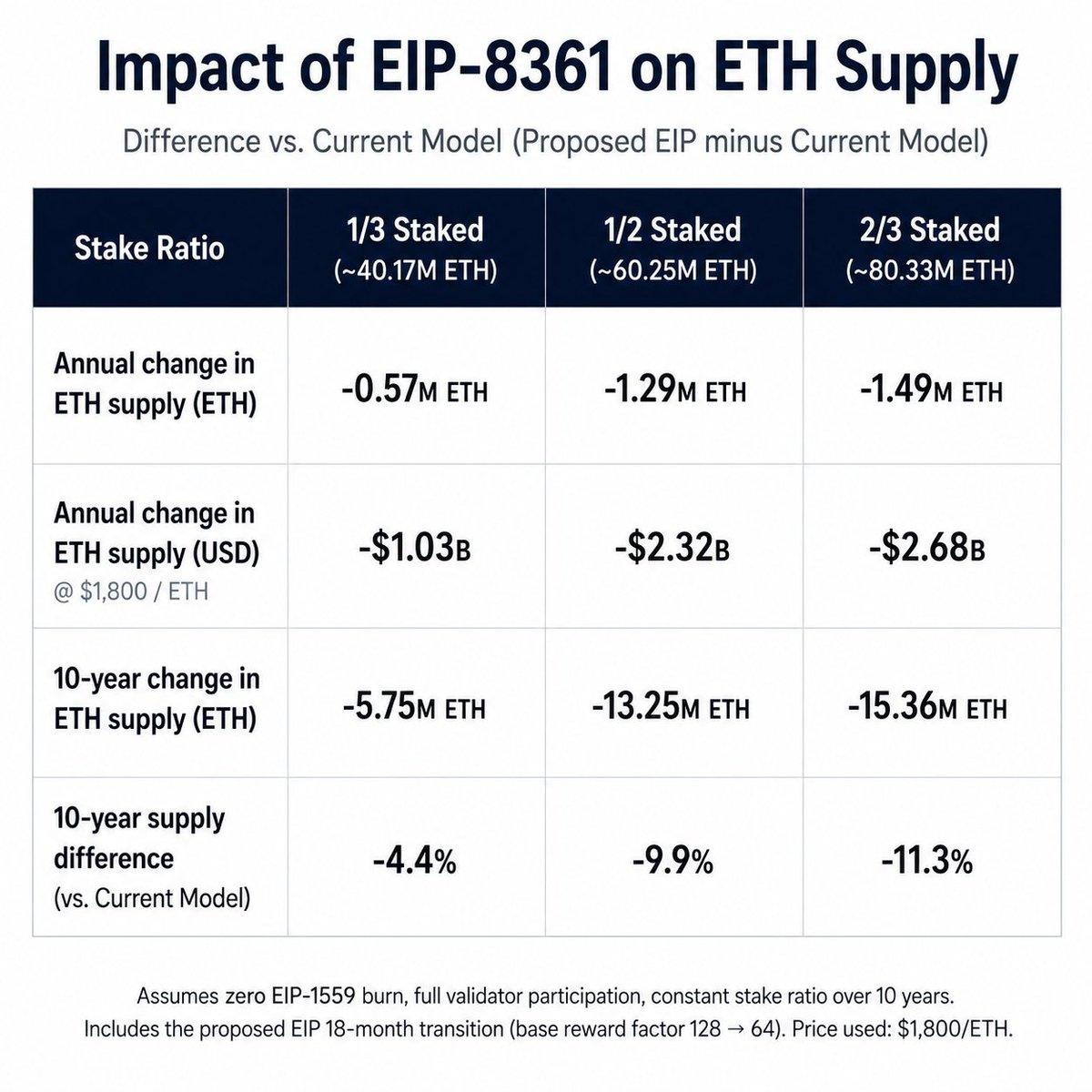
The proposed network update will lower ETH issuance and inflation. Source: Zach Pandl
Others pointed to the seemingly rushed timeline to consider the proposal, though this appears to be due to confusion over the upcoming deadline on Aug. 6.
“This clearly doesn’t leave adequate time for community review of a monetary policy change of this magnitude,” said Greg Koumoutsos, a co-author of EIP-8148 and EIP-8205.
The Tapered Issuance Burn proposal has not been approved, scheduled or included in Hegotá.
While there is an Aug. 6 deadline relating to this proposal, the deadline is for pull requests proposing additional EIPs for Hegotá, not a deadline for deciding which proposals will be included.
Ethereum community organizer Trent Van Epps said the selection process could continue until Nov. 8, and that Hegotá is likely to reach mainnet in the second quarter of 2027.
Magazine: The 100x obsession: Fundamentals grow in importance as crypto matures

On Wednesday, Senate Republicans released the proposed text for the CLARITY Act, which has been met with pushback from Democrats regarding ethics provisions.

24X National Exchange has put another tokenization proposal in front of US regulators, adding to the growing push to bring traditional securities onto blockchain-linked market infrastructure.
The exchange’s proposed rule change, listed as SR-24X-2026-20 in a Federal Register notice, would allow certain securities to trade in tokenized form as part of a Depository Trust Company pilot program. The proposal covers eligible securities such as Russell 1000 stocks and major exchange-traded funds, while preserving the existing market structure around order handling and trading priority.
The important point is that this is not a new crypto token market in the loose sense of the phrase. It is a proposed change to regulated securities trading rules. The filing describes how eligible members could indicate a preference for tokenized settlement while the securities continue to trade on the same book as their traditional counterparts.
Under the proposal, tokenized securities would not be treated as a separate class with a different execution priority. Instead, tokenized and traditional versions would trade alongside one another, provided they are fungible. That is an important design choice because it attempts to avoid splitting liquidity between two markets.
Participants that want tokenized settlement would use a digital flag when entering orders and provide wallet information where required. The actual clearing and settlement process would still be tied to DTC’s pilot framework, which is designed to test blockchain-based handling of eligible securities without abandoning the regulated clearing infrastructure that already supports US equity markets.
For crypto markets, this is the kind of development that matters because it moves tokenization out of theory and into the plumbing of traditional finance. The promise is not simply that stocks can be represented on-chain. The more meaningful question is whether regulated market participants can use blockchain rails while maintaining the investor protections, auditability, and settlement discipline expected in public securities markets.
Real-world asset tokenization has become one of the more durable crypto narratives because it connects blockchain infrastructure to markets that already have deep liquidity. Tokenized Treasuries, funds, and private credit products have gained traction, but public equities remain a much larger and more sensitive test case.
If proposals like 24X’s advance, they could help define how tokenized versions of mainstream securities are handled in the US. That would be especially important for institutions that want the operational benefits of tokenization without moving into loosely regulated offshore venues.
The filing also comes at a time when regulators are being pushed to clarify the boundary between crypto assets, securities, derivatives, and tokenized representations of existing financial products. A tokenized Russell 1000 stock is not the same thing as an altcoin. It is a representation of an existing security within a regulated framework, and that distinction is central to the proposal.
The caution here is simple: this filing should not be read as approval. It is a proposed rule change undergoing regulatory review. Until the SEC process is complete, there is no final green light for the market structure described in the filing.
Even so, the direction of travel is clear. Traditional exchanges and infrastructure providers are now actively exploring ways to bring tokenized settlement into regulated markets. That does not mean every proposal will be approved, but it does show that tokenization is becoming a market-structure issue rather than just a crypto-sector talking point.
For investors watching the RWA theme, 24X’s filing is another sign that the next phase of tokenization may be less about speculative tokens and more about making existing financial markets work differently behind the scenes.
This report is based on the Federal Register notice for File No. SR-24X-2026-20.
This article was written by the News Desk and edited by Samuel Rae.

A 45-day ceasefire plan and Strategy’s $330M Bitcoin purchase buoyed crypto markets.
Crypto markets rallied on Monday as mediators submitted a 45-day ceasefire plan to the U.S. and Iran, while Michael Saylor’s Strategy resumed buying BTC after a weeklong pause.
Bitcoin is trading at around $69,700, up 3.7% over the past 24 hours. ETH surged 4% to $2,150, while SOL climbed 2.5% to $82. Meanwhile, XRP added 3%.
Total crypto market capitalization rose 2.6% to $2.45 trillion, according to CoinGecko.
The broad-based rally came after Reuters reported that Egyptian, Pakistani, and Turkish mediators submitted a proposal to the U.S. and Iran calling for a 45-day ceasefire and the reopening of the Strait of Hormuz, the vital shipping lane that carries about a fifth of the world’s oil and has been effectively closed since the war began on Feb. 28.
President Donald Trump called the proposal “significant” but “not good enough” at a White House Easter event on Monday. He has set a Tuesday 8 p.m. ET deadline for Iran to reopen the Strait or face strikes on its power plants and bridges.
Iran rejected the temporary ceasefire, with state news agency IRNA reporting that Tehran sent a 10-point response through Pakistan demanding a permanent end to the war, a safe-passage protocol for the Strait, and the lifting of sanctions.
Despite the uncertain diplomatic backdrop, crypto markets responded to the mere existence of a framework for de-escalation, a dynamic that has repeatedly played out since the conflict began.
The rally triggered $331 million in leveraged liquidations over 24 hours, affecting more than 83,000 traders, according to CoinGlass. Short positions accounted for roughly $268 million of the losses in the past 12 hours, adding fuel to the move higher.
Michael Saylor’s Strategy disclosed in a securities filing Monday that it purchased roughly $330 million worth of Bitcoin between April 1 and April 5. The buy lifted the firm’s total holdings to 766,970 BTC at an aggregate cost of about $58 billion and an average price of roughly $75,644.
The purchase followed a one-week pause during which Strategy made no purchases or share sales. Strategy also disclosed a $14.5 billion unrealized loss for the first quarter as Bitcoin’s decline from its October all-time high pushed its holdings below the firm’s average cost basis. MSTR shares rose roughly 5% in early Monday trading.
Meanwhile, BitMine Immersion bought another 71,252 ETH in the past week, its largest single-week purchase since December.
The immediate catalyst is Trump’s Tuesday evening deadline. A deal or even a credible extension would likely boost risk assets further, while an escalation could reverse today’s gains.
Meanwhile, the Fed is widely expected to hold rates steady at its April 29 meeting, with CME FedWatch showing a 99.5% probability of no change.

The U.S. Department of Labor has unveiled a sweeping proposed rule that could significantly expand the range of investment options available in 401(k) retirement plans, marking a potential turning point for alternative assets — including crypto — within tax-advantaged retirement accounts.
Released Monday by the department’s Employee Benefits Security Administration, the proposal aims to reduce regulatory uncertainty and litigation risk for fiduciaries considering alternative investments.
The move follows an executive order from Donald Trump directing agencies to “democratize access” to non-traditional assets in retirement portfolios.
At its core, the rule reinforces that fiduciary responsibility under the Employee Retirement Income Security Act is grounded in process rather than outcomes.
Plan managers would retain broad discretion to include a wide array of investment options — provided they follow a prudent, well-documented evaluation process assessing factors such as fees, liquidity, valuation, and performance benchmarks.
Labor Secretary Lori Chavez-DeRemer said the proposal is designed to align retirement investing with modern financial markets. “This greater diversity will drive innovation and result in a major win for American workers, retirees, and their families,” she said.
The guidance could open the door for increased exposure to digital assets like Bitcoin within 401(k) plans — a development long sought by segments of the crypto industry. While plan sponsors have technically always been permitted to consider such assets, regulatory ambiguity and prior guidance had a chilling effect.
In 2022, the Biden administration issued a compliance release cautioning fiduciaries against offering cryptocurrency in retirement plans, citing volatility and investor protection concerns.
That stance is now being reversed, with Deputy Labor Secretary Keith Sonderling emphasizing neutrality. “The department’s days of picking winners and losers are over,” he said.
The proposal does not explicitly endorse crypto or any specific asset class. Instead, it establishes “safe harbor” frameworks designed to protect fiduciaries who undertake thorough due diligence when adding alternative investments to plan menus.
This process-based approach could make it easier for asset managers to introduce diversified funds that include exposure to private equity, real estate, or digital assets or Bitcoin.
Assets like Bitcoin could enhance long-term returns and provide a hedge against inflation, particularly for younger savers with longer time horizons.
The U.S. Securities and Exchange Commission and the U.S. Department of the Treasury both collaborated on the rulemaking, signaling a broader interagency effort to modernize retirement investing.

The US Commodity Futures Trading Commission has withdrawn a Biden administration-era proposal that would have banned sports and political prediction markets, some of the most popular event contracts today.
The recently confirmed CFTC chair, Mike Selig, said on Wednesday that the agency has withdrawn a 2024 notice of proposed rulemaking that sought to ban event contracts for sports, politics and war, among other topics, classifying them as “contrary to the public interest.”
Selig said the proposal “reflected the prior administration’s frolic into merit regulation with an outright prohibition on political contracts ahead of the 2024 presidential election,” adding that CFTC doesn’t plan to issue final rules on the proposal.
“The Commission is withdrawing that proposal and will advance a new rulemaking grounded in a rational and coherent interpretation of the Commodity Exchange Act that promotes responsible innovation in our derivatives markets in line with Congressional intent,” he added.
It’s the agency’s latest move affecting prediction markets such as Polymarket and Kalshi, which have surged in popularity for allowing bets on a wide range of events, most notably sports.
The platforms, including offerings from Coinbase and Crypto.com, have faced legal challenges from multiple states that argue they offer unlicensed gambling, a claim the platforms have pushed back on, arguing they’re regulated exclusively by the CFTC.
Selig said the CFTC also withdrew a September staff letter that reminded CFTC-regulated entities of their obligations when facilitating sports event contracts and of the need to be prepared for litigation.
The letter, which came ahead of a US government shutdown, told regulated entities to “be prepared for all foreseeable conditions that may result from facilitating the trading and clearing of sports-related event contracts.”
Related: US market regulators move to coordinate on crypto oversight
It added that CFTC staff were aware of various state regulatory actions and lawsuits around sports event contracts.
The letter warned that companies should be prepared to face such action with “appropriate contingency planning, disclosures, and risk management policies and procedures.”
Selig said the advisory “intended to highlight litigation considerations,” but it had “inadvertently created confusion and uncertainty for our market participants.”
“I look forward to working with staff on an event contracts rulemaking,” he added.
Magazine: How crypto laws changed in 2025 — and how they’ll change in 2026


