The crypto exchange was reportedly looking to use the additional funding to regain market share following Binance’s 2023 settlement with US authorities.

 Live Chat
The crypto exchange was reportedly looking to use the additional funding to regain market share following Binance’s 2023 settlement with US authorities.
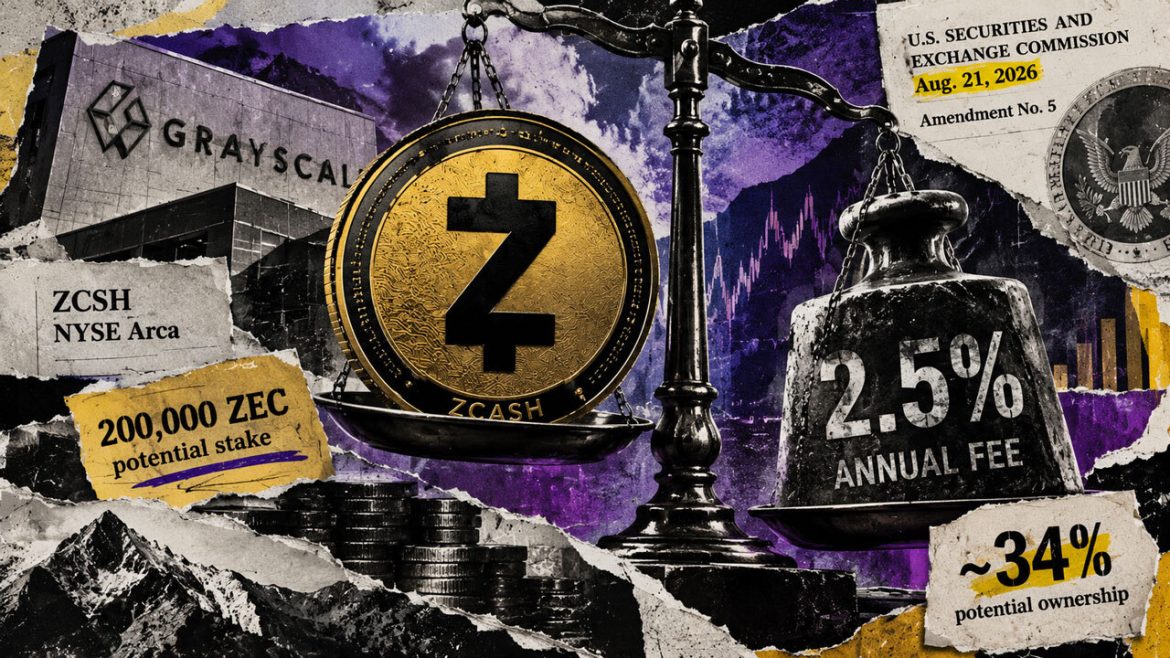
Grayscale’s proposed Zcash ETF would carry a 2.5% annual fee. Under one dated ownership calculation, a DCG affiliate could receive about 34% of the fund. If effective, the Aug. 21 SEC amendment would rename the existing trust “The Zcash ETF” and list it on NYSE Arca under ZCSH. The registration remains preliminary. The securities cannot yet be sold under it, and the SEC has neither approved nor disapproved them.
The ETF structure aims to fix the trust’s long-running price-tracking problem. To do that, large market intermediaries called authorized participants would create or redeem 10,000-share baskets when ZCSH’s market price moves away from the net value of the Zcash tokens, or ZEC, held by the fund. Grayscale expects that arbitrage to bring the two prices closer together.
The historical gaps were extreme. From Oct. 18, 2021, through June 30, 2026, ZCSH recorded a maximum 240% premium and a maximum 55% discount to net asset value. ZCSH’s average premium was 53%, and its average discount was 19%. The shares closed below NAV on 700 days. The filing placed the discount at 1% on Aug. 20, before the proposed ETF structure was operating.
Amendment No. 5 adds investor economics to the conversion’s market-structure case and its regulated-privacy question. The sponsor fee already applies to the trust. It accrues daily at 2.5% a year and is paid in ZEC. Over time, that reduces the tokens represented by each share. For up to 12 months after effectiveness, Grayscale intends to use all fees it receives for trust marketing and initiatives supporting Zcash development, marketing and education. The plan is voluntary, revocable and leaves the 2.5% fee intact.
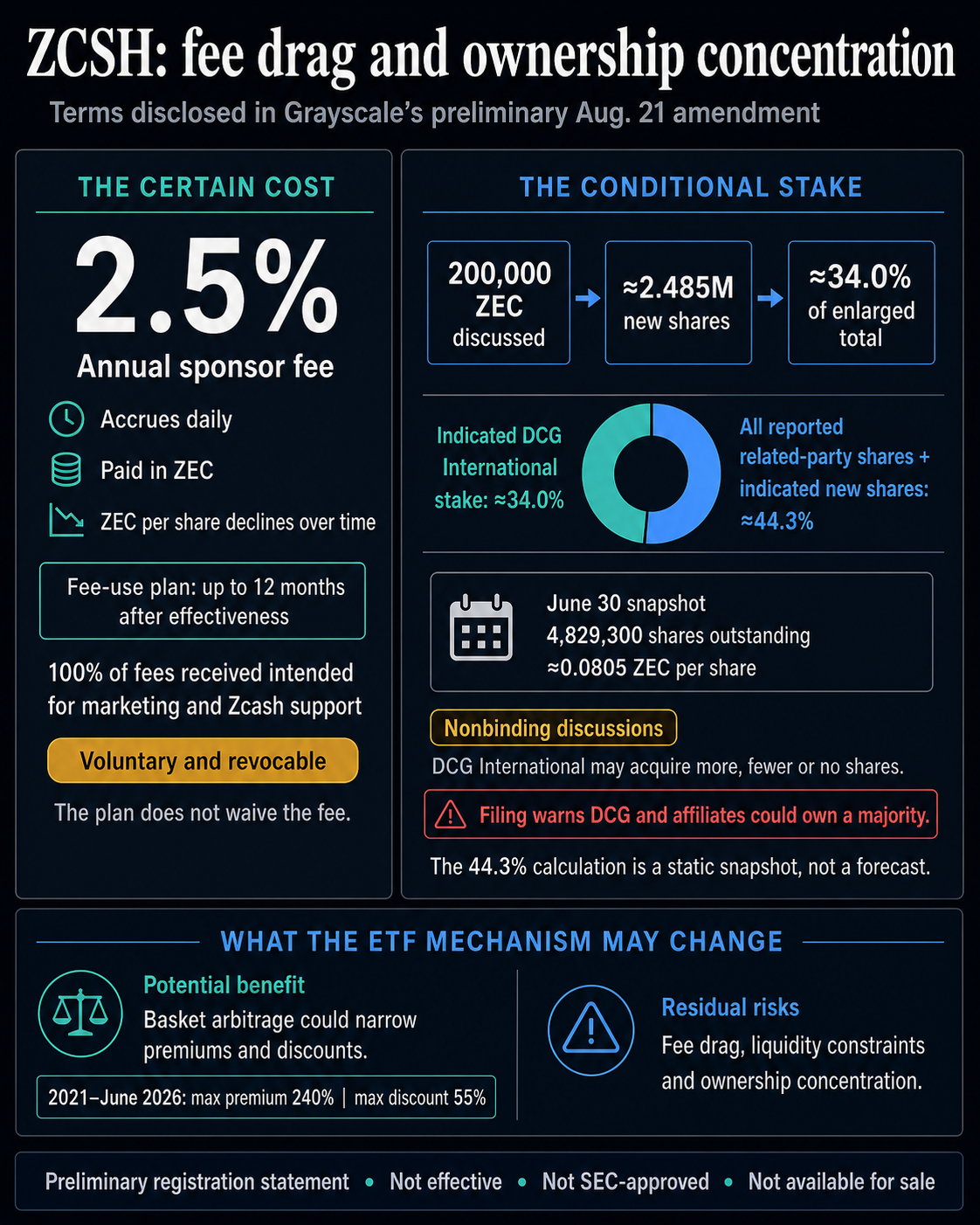
The filing warns that Digital Currency Group could own a majority through DCG International Investments Ltd. and other affiliates. That position could let the group control the trust’s limited shareholder votes and create conflicts with other investors. The warning is conditional: Grayscale’s discussions with DCG International are nonbinding, and the affiliate may acquire more, fewer or no shares.
The June 30 accounts provide a static way to test the indicated amount. The trust had 4,829,300 shares outstanding, each representing about 0.0805 ZEC. At that ratio, 200,000 ZEC would create about 2.485 million shares, or roughly 34% of the enlarged total, assuming no other creations, redemptions or ratio change.
The quarterly report classified 757,202 shares as related-party holdings. Adding them together produces about 44.3%, below 50%. This figure treats those shares as a collective group without attributing them to one DCG holder and serves only as a snapshot. A different contribution, affiliate holdings, or share base could produce a different result.
The basket process aims to keep ZCSH closer to NAV. Perfect tracking remains uncertain, however. Cash-order constraints, unavailable liquidity providers, suspended creations or redemptions, and limited ZEC-market liquidity could disrupt arbitrage. Concentrated ownership could also impede active trading. Large sales, or the perception of them, could cause volatility, price declines, and fresh discounts.

Prediction market platforms Kalshi and Polymarket are reportedly exploring new fundraising rounds that could value the companies at around $20 billion each, roughly double their most recent valuations.
Both platforms have held preliminary discussions with potential investors about raising fresh capital at the elevated valuation, the Wall Street Journal reported on Friday, citing people familiar with the matter. The report noted that the negotiations remain at an early stage and may not result in deals or secure the targeted valuation.
Kalshi currently operates in the United States and offers markets allowing users to wager on outcomes tied to sports, politics, the economy and cultural events. The company was last valued at about $11 billion in December when it raised $1 billion from investors including Paradigm and Sequoia Capital.
Founded in 2018 by Tarek Mansour and Luana Lopes Lara, Kalshi received approval from the US Commodity Futures Trading Commission in 2020 to operate as a regulated exchange for event-based markets. The platform has since expanded rapidly and recently surpassed a $1 billion revenue run rate, with some estimates placing the figure closer to $1.5 billion.
Related: Kalshi, Polymarket face trading halt in Nevada after court rulings
Polymarket, launched in 2020 by Shayne Coplan, remains inaccessible to US users without a virtual private network but plans to introduce a regulated domestic version of its platform later this year. The company was valued at roughly $9 billion in October after Intercontinental Exchange, the owner of the New York Stock Exchange, agreed to invest up to $2 billion.
Both platforms have drawn attention from lawmakers and regulators. As Cointelegraph reported, US Democratic lawmakers are drafting legislation to regulate prediction markets after suspiciously timed bets on the timing of US and Israeli strikes on Iran raised insider-trading concerns.
Senator Chris Murphy alleged that individuals close to the White House may have used advance knowledge of the attack to place bets, noting that several Polymarket accounts reportedly made about $1 million by wagering just hours before explosions were reported in Tehran.
Related: Kalshi founder provides update on Iran’s Khamenei market carveout
Polymarket has faced multiple insider trading allegations after several traders placed unusually well-timed bets on major events. A small group of crypto wallets recently made more than $1.2 million betting on a market tied to an onchain investigation into DeFi platform Axiom shortly before blockchain investigator ZachXBT published claims about insider trading linked to the project.
In a separate incident last month, another Polymarket account reportedly earned about $400,000 after placing a large wager on the capture of Venezuelan President Nicolás Maduro shortly before the news became public, further raising questions about whether some traders had advance information.
Magazine: Bitcoin may take 7 years to upgrade to post-quantum — BIP-360 co-author
Peter Zhang
Dec 31, 2025 11:15
VanEck’s Emerging Markets Bonds team explores the implications of gold replacing the US dollar as the reserve standard, estimating its valuation between $39k and $184k per ounce.
In a recent analysis by VanEck’s Emerging Markets Bonds team, the potential of gold replacing the US dollar as the global reserve standard was examined. The report suggests that if central bank money liabilities were matched to gold reserves, the precious metal could be valued between $39,000 and $184,000 per ounce, according to VanEck.
The valuation of gold at such high levels underscores its potential as a stable financial asset amidst economic uncertainties. The study by VanEck considers the global monetary supply and central bank gold purchases as key indicators for this valuation model. The SGLDWDUQ Index, which measures global gold demand based on central bank net purchases, and the Global M2 CIX Index, which assesses the global M2 money supply, were utilized to support their findings.
Should gold become the reserve currency, it would represent a significant shift in the global financial landscape. Such a change could affect international trade dynamics, monetary policies, and economic stability worldwide. The transition to a gold standard could also influence foreign exchange markets and the valuation of global currencies.
While the idea of gold as a reserve currency presents intriguing possibilities, it is not without risks. Gold investments are subject to market fluctuations and geopolitical influences, which can significantly affect their value. Moreover, investments in gold-related securities involve exposure to various risks, including those related to emerging markets, currency fluctuations, and political instability.
The potential revaluation of gold could have widespread effects on financial markets, impacting commodities, currencies, and investment strategies. Investors and policymakers would need to consider these dynamics when planning for economic growth and stability. As with any investment, the possibility of loss remains, and diversification strategies may not fully mitigate these risks.
VanEck’s analysis highlights the importance of considering alternative financial standards in a rapidly evolving global economy. While the future of gold as a reserve currency remains speculative, the discussion prompts further exploration into the role of precious metals in financial systems.
Image source: Shutterstock

The native token of the BNB Chain, BNB, climbed more than 3% in the last 24 hours, as a mix of institutional momentum and strategic selling shaped its trading session entering the weekend.
The token rallied from $1,056 to $1,087, peaking at $1,131 in early morning trading before pulling back slightly. It’s outperforming the wider crypto market, which rose 2.43% in the last 24 hours, based on the CoinDesk 20 (CD20) index.
Profit-taking near resistance levels could be the cause of the late dip. Trading volume hit 204,000 tokens, almost three times the daily average, underscoring active participation from market players, according to CoinDesk Research’s technical analysis data model.
Behind the price action is a wave of growing adoption. Coinbase recently added BNB to its list of assets being considered for full platform support after the launch of the exchange’s new “Blue Carpet” initiative.
On top of that, China Merchants Bank International (CMBI) tokenized its USD money market fund on the BNB Chain, issuing two tokens, CMBMINT and CMBIMINT, for accredited investors.
BNB Chain, the blockchain that BNB powers, also hit a milestone with over 3.6 million daily active addresses last week, according to DeFiLlama, the highest in its history.
Corporate accumulation has also grown, with Hong Kong-listed investment bank China Renaissance reportedly planning a $600 million to build a BNB-focused treasury.
Still, BNB remains 17% below its all-time high of $1,370. The token’s recent volatility, marked by a $79 intraday spread range, suggests traders are struggling to price-in rising demand against broader market unease.
Disclaimer: Parts of this article were generated with the assistance from AI tools and reviewed by our editorial team to ensure accuracy and adherence to our standards. For more information, see CoinDesk’s full AI Policy.

The Ethereum Layer 2 blockchain is preparing a community-focused token sale as ICOs regain popularity.
MegaETH, an Ethereum-compatible ‘real-time’ blockchain, appears to be planning an initial coin offering (ICO).
This potential public token sale would take place on Sonar, a self-hosted token launch platform created by crypto investor Jordan “Cobie” Fish, who is also a co-founder of Lido. “The First Real-Time Blockchain. Built for you. Owned by you. Register now,” MegaETH’s team shared on X earlier today.
ICOs – which are a way for crypto projects to raise funds – are making a comeback in 2025, with MegaETH’s move showing a shift toward community-focused, transparent sales to drive user engagement and ecosystem growth.
According to the project’s website, the registration window is open from today to Oct. 27. While MegaETH says details of a “potential crypto-asset offering” will be announced soon, it emphasized that registration does not guarantee allocation or constitute a sale. No terms of the potential deal have been disclosed.
Registration is open to anyone who completes identity verification on the Sonar platform, excluding MegaETH employees and users from prohibited areas. Individuals from the U.S. must also meet accredited investor requirements and will be subject to a 12-month lockup, MegaETH’s website notes.
Earlier this year, MegaETH announced plans to distribute its tokens through a new ICO model built around a soulbound NFT mint for its pioneer collection, The Fluffle. MegaETH said the NFT model was chosen to reward genuine community participation rather than speculative farming, The Defiant previously reported.
“A simple points program tied to an airdrop often creates perverse incentives—especially when deployed by a blockchain—driving inauthentic behavior and ‘farming,’ which raises questions about real value creation and leaves everyone dissatisfied,” the announcement noted.
This latest announcement also follows MegaETH Labs’ recent launch of MegaUSD (USDm), a native stablecoin developed in collaboration with Ethena Labs using its Stablecoin-as-a-Service stack.
“$USDM aligns incentives across stakeholders, letting users and apps enjoy the lowest fees possible while routing scalable value back to MegaETH,” MegaETH said in a post on X on Sept. 8.
MegaETH initially raised $10 million through Echo in December 2024.


