A judge stayed the CFTC’s civil case against a soldier who allegedly used nonpublic information for a Polymarket bet, but the regulator is trying to weigh in on the criminal case.
The CFTC is seeking public comment on how AI compute derivatives should be listed and overseen, including questions around liquidity, benchmark reliability, manipulation and customer protections, as Kalshi, CME, ICE, Polymarket US and Liquid Compute race to build markets around future computing costs
Polymarket US has self-certified a new class of contracts tied to the future price of artificial intelligence computing power, joining a growing race to build financial markets around one of the AI industry’s most important and expensive resources.
The filing comes as the Commodity Futures Trading Commission (CFTC) begins developing a regulatory framework for the emerging market. In a Bloomberg Television interview Thursday, CFTC Chair Michael Selig called compute “the most important commodity, I think, of our time” and “essentially a digital oil.”
“We want the prices to be discovered for this valuable commodity in the United States, the benchmarks to be here,” Selig said. “We’ve gotta have these markets here.”
Polymarket joins Kalshi, CME, ICE, Architect and prospective exchange Liquid Compute in pursuing different ways to trade or establish future prices for AI compute. The push comes as the CFTC’s new request for public comment raises questions about whether today’s fragmented and often opaque compute market is sufficiently liquid, standardized and resistant to manipulation to support a mature derivatives market.
AI compute refers to the processing capacity used to train and run artificial intelligence models. Much of the highest-value capacity today comes from GPUs, or graphics processing units, high-powered chips capable of performing huge numbers of calculations simultaneously. Nvidia‘s H100, H200 and newer B200 GPUs are among the chips most commonly used in large-scale AI infrastructure.
The emerging market is generally not about trading ownership of the chips themselves. AI companies, cloud providers and data-center operators buy or rent access to computing capacity, often priced by the GPU-hour, and the derivatives now being developed are designed to put a market price on what that access may cost in the future.
That could allow an AI company expecting to need large amounts of GPU capacity months from now to hedge against rising rental costs, while an infrastructure provider could manage the risk that future prices fall. The CFTC said in its request for comment that compute futures could aid risk management and price discovery and allow financial markets to “aggregate and reveal information about the future of the AI economy.”
Different exchanges are approaching that task in different ways. Conventional futures can track an index of GPU rental prices over time, while prediction market contracts can ask whether the price of a particular type of compute will be above or below a specified level on a future date. A series of contracts across different expiration dates can also be used to construct a forward curve, showing where traders collectively expect compute prices to be weeks or months ahead.
Selig put compute alongside prediction markets, crypto and other emerging products in his remarks at the CFTC’s Innovation Advisory Committee meeting Thursday, framing the initiative as “Winning the AI Race: Roadmap for Compute Market Dominance.” He tied the effort to the White House’s AI Action Plan, which calls for improving the financial market for compute to expand access to large-scale computing resources.
The CFTC is working with the Department of Commerce on that effort and plans to use feedback from its new request for comment to develop what Selig described as a “gold standard regulatory framework” for compute markets.
“Just as American markets helped establish the gold standard for trading the commodities that powered the industrial economy, we will do the same for the commodity that will power the intelligence economy,” Selig said in a separate statement Wednesday.
His Bloomberg comments a day later made clear that the objective extends beyond simply allowing exchanges to list new products. Selig said he wants the underlying price discovery and benchmarks established domestically, with compute trading on transparent U.S. markets and open order books.
“We’re working very hard together with Secretary (Howard) Lutnick and the Department of Commerce to set the standard here in the U.S.,” Selig said. “We want the best of the best, and we’re gonna lead in these markets.”
For all of Selig’s enthusiasm, the CFTC’s request for comment makes clear that regulators still see major challenges in turning compute into a mature derivatives market. The agency said compute pricing remains fragmented and is often set through “opaque bilateral transactions,” limiting the amount of public price data available to exchanges and regulators.
The Commission also questioned whether compute yet has the fungibility, standardization and liquidity typically associated with commodities underlying futures markets. Prices can vary widely depending on the GPU model, provider, region and contract terms, while dominant suppliers may have enough pricing power to influence the cash market or a benchmark derived from it.
One of the RFC’s sharpest questions asks whether trading should be permitted in a derivative whose settlement price relies on data the CFTC “may not be able to observe, verify, or surveil.” The agency is also asking what protections would prevent a compute provider from influencing an index by changing posted rates, directing capacity to or away from a venue or choosing whether to execute transactions during a settlement window.
The CFTC is seeking input on those issues along with customer protections, market surveillance and perpetual compute futures. Comments are due Oct. 20, after which Selig has said the agency will continue developing its regulatory framework for the market.
Polymarket US’s new filings cover binary contracts tied to future values of AI compute indexes. One specifically certified contract asks whether the Ornn Data H100 SXM GPU Price Index will be at least $2.50 per GPU-hour on March 15, 2027. A wider class certification would allow Polymarket US to list similar contracts tied to H100, H200, A100, RTX 5090 and B200 GPU indexes. The broader filing also covers Ornn indexes measuring the price of AI-model usage by the token.
The contracts can ask whether an index will be above, below, at least, at most, between or exactly a specified value at a future point. Polymarket said the products may be listed beginning Aug. 24, although it remains to be seen whether Polymarket will launch them immediately or whether the CFTC will intervene while its compute comment process is underway. That possibility is not purely theoretical: in July, the CFTC stayed a CME self-certified 24/7 crude-oil contract while a related agency comment process was underway.
Kalshi has been pursuing a related strategy. In July, the exchange said it was using weekly and monthly prediction markets extending as far as a year out to construct a compute forward curve, giving traders a view of where GPU rental costs are expected to move.
“We are using prediction markets to build the forward curve, which will provide the market a view of what compute costs will be in the future for different grades and time-frames of GPUs,” Kalshi Chief Risk Officer Udesh Jha told Bloomberg.
Jha said the curve could eventually support additional products, including futures and options. “It’s a key enabler for a lot of subsequent hedging, risk management and even speculative activities,” he said.
Prediction markets are only one part of the emerging competition. CME Group plans to launch H100 and B200 rental-index futures on Oct. 5, pending regulatory review, using benchmarks from Silicon Data. ICE has announced GPU compute futures based on Ornn indexes and a separate partnership with NATIVX for energy-normalized compute futures. Architect Financial Technologies is building a U.S. exchange for futures and options tied to GPU rental costs and other AI supply-chain inputs.
Another prospective exchange has been built around that idea from the start. DeFi Rate reported in February on the startup then operating as Pluto, whose pending designated contract market and clearinghouse applications are publicly listed under the names PMEX Markets and PMEX Clearing. The company has since rebranded as Liquid Compute, which describes itself as the “financial layer for AI compute” and is currently inviting market participants to request access while its U.S. exchange applications remain pending.
“The aim of the exchange is to turn compute into a financial asset just like oil, gold, (or) other commodities,” CEO Ronit Jain told DeFi Rate at the time. Liquid Compute has since highlighted an H100 OTC forward trade involving Wintermute and said this week that it is “live and booking swaps now.” The company has not publicly identified the entity or jurisdiction through which those transactions are being conducted.
The race now is to build the transparent, trusted pricing infrastructure needed for a mature AI compute market. The CFTC wants that market centered in the U.S., but its new comment process shows regulators are still deciding what standards those prices and products will need to meet.
Mike Breen
Mike Breen has been a professional writer and editor covering a wide range of topics for more than 30 years. He’s been a freelance gaming industry writer since 2020, reporting on sports betting, online casinos, and more for various Catena Media sites, and he began reporting on prediction market industry news in 2025 for Prediction News. Prior to that, Mike was a founding editor at his hometown altweekly newspaper in Cincinnati, Ohio, where he extensively covered local arts, music and news.Mike’s published writing has received recognition and several awards from organizations like the Society of Professional Journalists and the Association of Alternative Newsmedia.When Mike is not working, he enjoys playing and listening to music, attending comedy shows, watching movies, and spending time with his family and three cats.
Week 1 features two toss-ups according to prediction markets. Buffalo holds a narrow 51% edge over Houston, while Green Bay and Minnesota are near deadlocked. DeFiRate aggregates and compares Week 1 odds alongside prices from FanDuel, DraftKings, Kalshi, and Polymarket.
NFL Week 1 prediction market odds continue to fluctuate as we enter preseason games, with kickoff scheduled for Wednesday, Sept. 9. It’s a big game rematch of Patriots vs. Seahawks at 8:20 p.m. ET on NBC. NFL futures markets remain incredibly active at leading platforms, with volume on Kalshi already moving past week 1 of last year.
Week 1 opens with some of the NFL’s biggest rivalries already on the board. The Cowboys and Giants renew their NFC East battle under the Sunday night lights, the 49ers and Rams kick off the season in Australia, and the Bills and Texans are separated by just two percentage points in early trading. Below, we compare opening odds from Kalshi, Polymarket, FanDuel, and DraftKings for every Week 1 matchup.
Kalshi released Week 1 odds on May 16. Probabilities are updated weekly as volume grows with links to live odds feeds for each individual game. Polymarket odds remain TBD and will be updated as markets open.
| Game | Kalshi | Polymarket US | FanDuel | DraftKings |
|---|---|---|---|---|
| Patriots @ Seahawks | SEA 67% / NE 33% | TBD | SEA -198 / NE +166 | SEA -198 / NE +164 |
| 49ers vs. Rams (Australia) | LAR 64% / SF 36% | TBD | LAR -210 / SF +176 | LAR -180 / SF +150 |
| Saints @ Lions | DET 74% / NO 26% | TBD | DET -320 / NO +260 | DET -310 / NO +250 |
| Bears @ Panthers | CHI 57% / CAR 43% | TBD | CHI -146 / CAR +124 | CHI -148 / CAR +124 |
| Bills @ Texans | BUF 51% / HOU 49% | TBD | BUF -110 / HOU -106 | BUF -122 / HOU +102 |
| Ravens @ Colts | BAL 63% / IND 37% | TBD | BAL -200 / IND +168 | BAL -180 / IND +150 |
| Falcons @ Steelers | PIT 59% / ATL 41% | TBD | PIT -146 / ATL +124 | PIT -170 / ATL +142 |
| Buccaneers @ Bengals | CIN 63% / TB 37% | TBD | CIN -210 / TB +176 | CIN -198 / TB +164 |
| Jets @ Titans | TEN 55% / NYJ 45% | TBD | TEN -134 / NYJ +116 | TEN -155 / NYJ +130 |
| Browns @ Jaguars | JAX 76% / CLE 24% | TBD | JAX -405 / CLE +320 | JAX -380 / CLE +300 |
| Commanders @ Eagles | PHI 66% / WAS 34% | TBD | PHI -215 / WAS +180 | PHI -218 / WAS +180 |
| Packers @ Vikings | GB 50% / MIN 50% | TBD | GB -110 / MIN -106 | GB -115 / MIN -105 |
| Dolphins @ Raiders | LV 63% / MIA 37% | TBD | LV -210 / MIA +176 | LV -205 / MIA +170 |
| Cardinals @ Chargers | LAC 79% / ARI 21% | TBD | LAC -590 / ARI +440 | LAC -625 / ARI +455 |
| Cowboys @ Giants | DAL 56% / DAL 44% | TBD | DAL -152 / NYG +128 | DAL -148 / NYG +124 |
| Broncos @ Chiefs | KC 57% / DEN 43% | TBD | KC -146 / DEN +124 | KC -162 / DEN +136 |
Wednesday, Sept. 9
New England Patriots @ Seattle Seahawks | Lumen Field, Seattle, WA | Wednesday, Sept. 9 | 8:20 p.m. ET | NBC/Peacock
The Super Bowl LX rematch kicks off the 2026 season in what marks just the second time in 75 years the NFL has opened on a Wednesday. Seattle is favored, reflecting both the home field advantage and the perceived gap between the two teams. The storyline here is whether Drake Maye and company have closed the gap since February’s 29-13 defeat.
Thursday Night Football, Sept. 10
San Francisco 49ers vs. Los Angeles Rams | Melbourne Cricket Ground, Melbourne, Australia | 8:35 p.m. ET | Netflix
The NFL’s first-ever game in Australia is one of the tightest on the Week 1 slate by pricing. The Rams enter as a modest favorite. They’re currently favored in Super Bowl odds on Kalshi, and second behind the Seahawks at Polymarket. Both teams enter with genuine NFC West title ambitions and legitimate Super Bowl cases, making this a must-see matchup.
Sunday, Sept. 13 – 1 p.m. ET games
New Orleans Saints @ Detroit Lions | Ford Field, Detroit, MI | 1 p.m. ET | Fox
Detroit opens as one of the heaviest favorites of Week 1. They’re favored to win the NFC North this season and widely expected to rebound from last season’s fourth-place finish. New Orleans arrives as a 1% Super Bowl contender on Kalshi. Pricing suggests this is one of the clearest mismatches on the opening slate.
Chicago Bears @ Carolina Panthers | Bank of America Stadium, Charlotte, NC | 1 p.m. ET | Fox
Chicago opens as a slight road favorite, with Carolina aiming to prove last season’s NFC South crown wasn’t a fluke. The Bears are at 23% to win the NFC North on Kalshi. A clean Week 1 win on the road would be a strong early statement in what shapes up as a genuinely competitive division race with Detroit and Green Bay.
Buffalo Bills @ Houston Texans | NRG Stadium, Houston, TX | 1 p.m. ET | CBS
The tightest line of the early Sunday window, with Buffalo installed as a slight favorite. The Bills enter as the AFC East’s top choice at 58% on Kalshi. Houston is favored at 39% to win the AFC South. A Bills loss here would immediately tighten the AFC East market, while a Texans victory could spike their division and conference pricing.
Baltimore Ravens @ Indianapolis Colts | Lucas Oil Stadium, Indianapolis, IN | 1 p.m. ET | CBS
Baltimore opens as a road favorite against a Colts team still waiting on Daniel Jones to return from an Achilles tear. The Ravens lead the AFC North at 47% on Kalshi, the most dominant divisional position in the conference. Indianapolis is at 16% to win the AFC South at Polymarket, behind the Texans and Jaguars.
Atlanta Falcons @ Pittsburgh Steelers | Acrisure Stadium, Pittsburgh, PA | 1 p.m. ET | Fox
Pittsburgh is favored to get the home win, but heads to opening week with questions. The Steelers’ quarterback situation remains unresolved. Aaron Rodgers is still unsigned, contributing to the line discrepancy between books. Atlanta checks in at 21% to win the NFC South on Kalshi, last among the four teams.
Tampa Bay Buccaneers @ Cincinnati Bengals | Paycor Stadium, Cincinnati, OH | 1 p.m. ET | Fox
Cincinnati opens as the home favorite and looks to bounce back from a 6-11 finish. The Bengals sit at 32% to win the AFC North on Kalshi, second only to Baltimore’s 47%. A strong Week 1 performance at home against Tampa Bay would be an early signal that better days could be on the way for Cincinnati and potentially tighten division pricing.
New York Jets @ Tennessee Titans | Nissan Stadium, Nashville, TN | 1 p.m. ET
Tennessee opens as the favorite as they welcome a New York team that has lots of questions to answer following a 3-14 campaign. The Titans are at just 8% to win the AFC South on Kalshi, with the Jets at 5% to win the AFC East contender at 5%. Both franchises enter 2026 with low expectations and something to prove early.
Cleveland Browns @ Jacksonville Jaguars | EverBank Stadium, Jacksonville, FL | 1 p.m. ET | CBS
Jacksonville opens as one of the largest favorites of the week. They won the AFC South a season ago, while Cleveland finished in the basement of the AFC North. The Jaguars, at 33% to win the AFC South on Kalshi, are well-positioned to make a division title run. A dominant Week 1 home win could help set the tone, while a tighter game could impact expectations.
Sunday, Sept. 13 – Late games
Washington Commanders @ Philadelphia Eagles | Lincoln Financial Field, Philadelphia, PA | 4:25 p.m. ET | Fox
Kalshi has the NFC East as a dead heat between Dallas and Philadelphia at 35% each, with Washington at 17%. The game is being priced as a clear Eagles advantage in Week 1. A Commanders win here would shift the division market, a race the prediction markets are already pricing as one to watch.
Green Bay Packers @ Minnesota Vikings | US Bank Stadium, Minneapolis, MN | 4:25 p.m. ET | CBS
Kalshi has Green Bay at 30% and Minnesota at 20% to win the NFC North. Detroit (33%) and Chicago (23%) in the mix make this one of the most competitive chases on the board. Neither team can afford an early stumble in what shapes up as one of the more compelling matchups of the late Sunday window for Week 1.
Miami Dolphins @ Las Vegas Raiders | Allegiant Stadium, Las Vegas, NV | 4:25 p.m. ET
Las Vegas opens as a home favorite against a Dolphins team Kalshi views as the AFC East’s biggest longshot at 4%. Miami’s worst regular-season record odds of 31% on Kalshi make this a game the Raiders, at 8% to win the AFC West, genuinely need to win early to establish any credibility in a division where three teams are bunched within four points at the top.
Arizona Cardinals @ Los Angeles Chargers | SoFi Stadium, Inglewood, CA | 4:25 p.m. ET | CBS
The most lopsided line of Week 1 by a significant margin. The Chargers, at 34% to win the AFC West, open as heavy favorites in a game that should do little to move any market. The Cardinals, at 1% Super Bowl odds on Kalshi and 28% worst record odds, appear to be headed into the clearest mismatch on the slate.
Sunday Night Football, Sept. 13
Dallas Cowboys @ New York Giants | MetLife Stadium, East Rutherford, NJ | 8:20 p.m. ET | NBC (SNF)
Dallas opens as a road favorite for this divisional primetime showdown. The NFC East race is a virtual dead heat on Kalshi, with both Dallas and Philadelphia at 35% to win the division. The Giants are getting some market respect at 17%, up 4 points recently on Kalshi, under new head coach John Harbaugh. SNF is set to be a marquee game of the opening slate.
Monday Night Football, Sept. 14
Denver Broncos @ Kansas City Chiefs | Arrowhead Stadium, Kansas City, MO | 8:15 p.m. ET | ESPN/ABC (MNF)
Kansas City opens as a home favorite in the most strategically significant game of Week 1 from a division market standpoint. Kalshi has the AFC West as the tightest division race in football: Chargers 34%, Chiefs 32%, Broncos 30%. Patrick Mahomes’ availability is the central question. All signs point to him playing, but his recovery remains one of the offseason’s defining subplots.
K
Kalshi
★ US Approved
Trade $25, Get up to $500
Kalshi Terms & Conditions
Deposit and trade at least $25 on Kalshi within your first 7 days to claim a bonus of anywhere from $15 to $500. The bonus is available for trade only and is not cashable. Must be used within 7 days. Eligible US states only.
Up to $500 bonus for World Cup markets
Trade on winner, group stage and halftime
Must be 18+
Totals
Props
World Cup
The NFL preseason opens on Thursday, August 9, with Panthers vs. Cardinals in the Hall of Fame Game at 8 p.m. ET on NBC. Here is where the key markets stand as we get set for the return of football.
The Los Angeles Rams are the consensus Super Bowl favorites, trading at 16% on Kalshi and 15% on Polymarket. Behind them is a competitive chase for second place. The Bills, Ravens, Chiefs, and defending champion Seahawks are all jockeying for position, with prices moving between 6-8%.
On the conference side, the Rams are favored by a wide margin, with the Seahawks and Eagles priced as the biggest threats. Over in the AFC, probabilities are much tighter, with the Bills currently slightly ahead of the Ravens, Chiefs, and Chargers.
Division markets point to several compelling storylines. The AFC West is the tightest race on the board at Kalshi, with three teams trading within four points of each other: Chargers 34%, Chiefs 32%, Broncos 30%.
For the NFL MVP award, both platforms have it priced as a tight chase. Josh Allen (11%) is right ahead of Joe Burrow (10%) in current pricing on Kalshi. On Polymarket, it’s Allen at 13%, ahead of Lamar Jackson at 11%.
Kalshi’s Super Bowl LXI market has logged over $52.8 million in trading volume before a single game has been played. The figure speaks to the growing role prediction markets are playing in how NFL fans engage with the league during the offseason.
Polymarket’s Super Bowl market sits at $42.6 million in volume over the same period. Combined, the two platforms have seen more than $85 million traded on Super Bowl futures alone, with division and conference markets adding tens of millions more.
That number will climb steadily through training camp, the preseason, and into the regular season as even more markets open and weekly trading activity accelerates.
Prices continue to move for Bills vs. Texans, which has the potential to be one of Week 1’s most competitive showdowns. At the initial release, Houston was a slight favorite. It’s now listed as close to a coin flip, with Buffalo on top.
Probabilities have widened on the 49ers vs. Rams as the off-season moves along. Los Angeles opened as a pretty sizable favorite, but the spread widened after the club swung a blockbuster deal to bring Myles Garrett to town.
As the preseason moves along, there will be increased trading volume on all of the Week 1 matchups. The news cycle moves rapidly throughout August, and notable developments tend to translate into price moves.
The 2026 season represents another significant step in the growth of NFL prediction market trading. For traders, the practical implication is that the NFL is no longer just a sportsbook sport. It is a fully functioning prediction market ecosystem with real liquidity, regulated infrastructure, and a growing suite of contracts that will expand as the season progresses.
Trading will remain active throughout the offseason, with volume and pricing sharpening as kickoff approaches. The Super Bowl market, already past $85 million in combined volume, will continue to attract significant trading activity through every week of the regular season and into the playoffs.
Related: See daily trading volume on NFL markets
Christopher Feery
Christopher has been writing professionally since 2014, with a focus on casinos and sports betting. After New Jersey legalized sports betting in 2018, he shifted his full attention to the gambling industry, joining Catena Media in 2021. He contributes in-depth analysis and guides on many igaming sites.
UFC Fight Night descends on Belgrade for the first time for an early Saturday card. It’s Uros Medic vs. Daniel Rodriguez in the main event, with a clear favorite emerging at Kalshi and Polymarket.
UFC Fight Night Belgrade lands at the Belgrade Arena for the first time ever on August 1st with a welterweight bout for the main event. Vicious knockout artist Uros Medic takes on the dangerous Daniel Rodriguez in a fight that many expect to see a decisive finish.
The main card gets underway at 1 p.m. ET on Paramount+, with early prelims kicking off the action at 10 a.m. ET.
Kalshi and Polymarket traders are lining up almost identically across six main-card bouts, with only one two closely contested markets on the entire slate.
Here’s your full fight-by-fight breakdown through the lens of Kalshi and Polymarket, the two platforms redefining how fans engage with MMA outcomes.
| Platform | Sign-up bonus | Promo code | How to claim | |
|---|---|---|---|---|
|
Deposit $10, Get $20 Trading Bonus
Risk Disclaimer |
Use promo code RATE on sign up to be eligible. |
Claim Now! |
Uros Medic enters as the heavy favorite in Belgrade’s historic first main event, with Kalshi pricing him at 77¢ and Polymarket at 78¢, reflecting the hometown knockout artist’s power and the crowd advantage he’ll carry into the cage. Both men actually enter on three-fight win streaks, but Rodriguez’s layoff and off-cage turmoil appear to be weighing on trader confidence, leaving him priced at just 24¢ across both books.
The tight agreement between platforms suggests little disagreement here. Traders see Medic’s finishing power and home-field energy as the deciding factor in this five-round welterweight headliner.
Prediction Markets
$500
bonus
Trade $25, Get up to $500
Claim Now!
T&C’s apply.
The co-main pits former light heavyweight champion Jan Blachowicz against unbeaten short-notice replacement Navajo Stirling, and the market has firmly sided with the rising prospect, pricing Stirling at 76¢ on both platforms. Blachowicz trails at 26¢, a striking number given his championship pedigree, but it reflects growing trader belief that age and inactivity have caught up to the veteran against a hungry, undefeated younger fighter.
Some fans have already predicted this bout could push Blachowicz toward retirement if Stirling’s size and short-notice readiness translate into a dominant performance.
Aleksandar Rakic returns to the Octagon only to move up to the heavyweight division to take on veteran heavyweight Marcin Tybura, and the market gives the Austrian a clear edge at 77¢ on both platforms. Tybura sits at 24¢ across the board, with traders leaning toward Rakic’s dynamic striking and athleticism over the durable but grinding style of the longtime UFC heavyweight.
The near-identical pricing across both platforms shows little room for a contrarian angle, though Tybura’s chin and cardio make him live if the fight extends into the later rounds.
This middleweight matchup features one of the tighter markets on the card, with Robert Valentin favored at 61¢ over local Serbian fighter Dusko Todorovic, who sits at 41¢. The gap is notable given Todorovic will fight in front of a home crowd, suggesting traders are weighing Valentin’s technical tools more heavily than home-field emotion.
With a 20-cent gap rather than the lopsided pricing seen elsewhere on the card, this bout carries real live-underdog appeal for anyone backing the hometown fighter riding crowd energy.
Vlasto Cepo is a huge favorite in this middleweight fight, trading at 75¢ on Polymarket and 77¢ on Kalshi against Gilbert Urbina, who is trading for 26¢. The fact that the odds are the same on both platforms shows that traders believe Cepo can finish and will get the win against Urbina.
Urbina’s power still keeps him alive as an underdog value, but the market has come to a clear consensus that Cepo has the stylistic edge here.
The tightest market on the entire main card has Noah Gugnon as a slight favorite at 53¢ against local fighter Milos Janicic at 48¢ on both platforms. That near coin-flip pricing shows that traders are genuinely uncertain whether Janicic’s home-crowd advantage and upside finishing ability can outlast Gugnon’s overall skill set.
This final fight on the main card is the one most likely to see real line movement as fight time approaches, with less than 5 cents separating the two sides.
The preliminary card carries plenty of intrigue heading into UFC Belgrade. One of the standout matchups is L’udovit Klein taking on Tofiq Musayev in a lightweight bout that pits Klein’s well-rounded skill set against Musayev’s aggressive striking pace. Right alongside it, Oban Elliott squares off with unbeaten prospect Michael Oliveira in a welterweight clash worth tracking. Oliveira enters with a perfect 9-0 record and real finishing upside against a durable, experienced opponent.
Further down the card, the bantamweight pairing of Mark Vologdin and Borislav Nikolic deserves attention, as does the featherweight bout between Dennis Buzukja and Bogdan Grad, a matchup of two fighters looking to build momentum on the regional stage. The women’s bantamweight fight between Nina Milosevic and Hailey Cowan rounds out a deep prelim slate. Those give fans an early crowd-energy gauge before Belgrade’s historic first UFC main card gets underway.
Garrett Kerman
Garrett Kerman, known as “The Fight Analyst” in the MMA community, is a veteran sports journalist and expert analyst. Garrett has worked for top platforms, including Home of Fight and ClutchPoints. Garrett focuses on high-level statistical breakdowns and news coverage. His work spans from the stylistic intricacies of a UFC main event to the latest breaking news, bridging fight analysis and breakdowns for fans and bettors looking to beat the books.
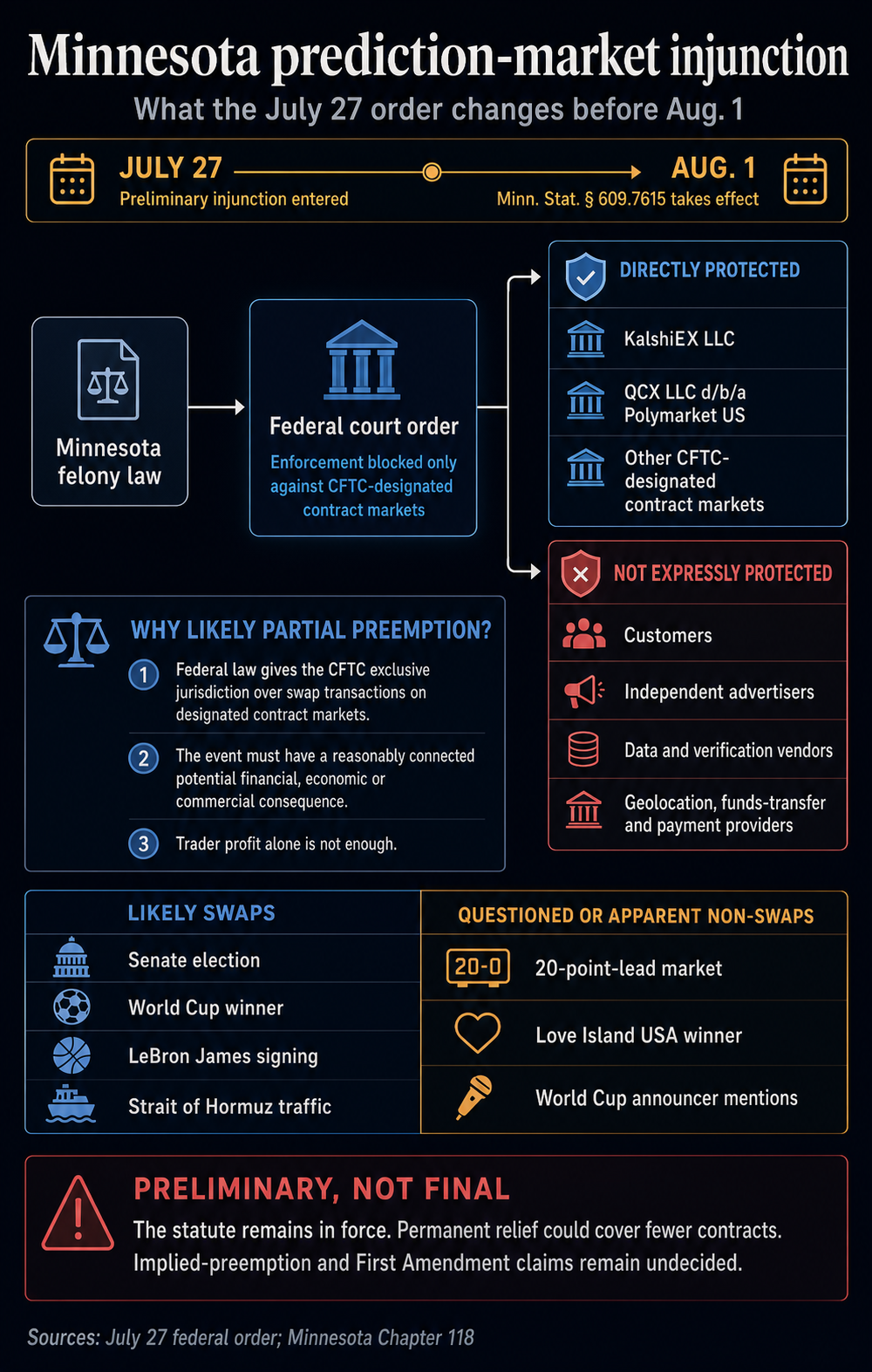
A federal judge has temporarily barred Minnesota from enforcing its new prediction-market felony law against federally regulated exchanges designated by the Commodity Futures Trading Commission as contract markets, including Kalshi and Polymarket US, days before the statute takes effect on Aug. 1.
Judge Katherine Menendez granted preliminary-injunction motions filed by the CFTC, KalshiEX and QCX, the registered entity doing business as Polymarket US. Her July 27 order prevents named Minnesota officials from enforcing Minn. Stat. § 609.7615 against CFTC-designated contract markets until the cases reach a final merits decision.

America’s gambling lobby says that prediction markets are draining public money from states and tribes, as US gambling revenue hits record highs.
May 31, 2026 · Andjela Radmilac
Menendez found the plaintiffs likely to prove that the Commodity Exchange Act expressly preempts part of Minnesota’s law. Federal law gives the CFTC exclusive jurisdiction over swap transactions conducted on designated contract markets, and the swap definition can include event contracts whose outcomes have a reasonably connected potential financial, economic or commercial consequence. A trader’s potential profit alone is not enough.
The order does not treat every event contract as a swap. Menendez identified markets tied to a Senate election, the World Cup winner, a LeBron James signing and Strait of Hormuz traffic as likely swaps. She questioned a 20-point-lead market and said contracts on the winning Love Island USA couple or words used by World Cup announcers appeared unlikely to qualify. Any permanent injunction could therefore apply to fewer contracts.


The SEC-CFTC comment process could decide which US venues can list crypto perps, event contracts, and hybrid derivatives.
Jun 21, 2026 · Liam ‘Akiba’ Wright
Chapter 118 replaced the prediction-market provisions enacted earlier in Chapter 97. The law remains scheduled to take effect Aug. 1 for crimes committed on or after that date.
Under its core offense, creating or operating a covered prediction market, or intentionally facilitating it through specified listing, funds, settlement, counterparty or pricing activity, is a felony when done for consideration and as part of a business. Other provisions cover providers who knowingly supply data directly to a market, or geolocation, funds-transfer or payment services to one, to enable or settle prohibited wagers. A separate clause criminalizes advertising or marketing financial or technological products that promote prohibited transactions.
Because the order protects only CFTC-designated contract markets, it does not expressly shield customers, independent advertisers or outside service providers. The statute remains in force, and the court has not decided the plaintiffs’ implied-preemption or First Amendment claims.
Market-moving headlines and context delivered every morning in one tight read.
5-minute digest 100k+ readers
Free. No spam. Unsubscribe any time.
Whoops, looks like there was a problem. Please try again.
You’re subscribed. Welcome aboard.


Polymarket US welcomed the ruling and said it expected to keep serving Minnesota users. Attorney General Keith Ellison said the state disagreed and would continue defending the law as the record develops.
By contrast, a New York court denied Kalshi interim protection from existing state gambling enforcement earlier in July. Both cases remain open, and the opposite preliminary results do not settle how federal registration interacts with state gambling laws nationwide.


From Hyperliquid to Kalshi to memecoin launchpads, trading venues are expanding beyond their original niches and converging on the same goal of owning the user’s entire speculative loop.
Apr 22, 2026 · Gino Matos
Joerg Hiller
Jul 20, 2026 06:33
A macro roundup said Andy Burnham is set to enter Downing Street as the U.K.’s new prime minister as North Sea oil policy debate heats up.
Polymarket traders are leaning harder toward “0 Fed rate cuts in 2026,” with the leading ladder strike priced at 84.55% (up 2.45pp) on $44.24M in volume. The move comes as a broad macro-news cycle pushed oil and risk headlines, and this market’s per-strike pricing shows how little probability traders assign to multiple cuts.
A macro roundup said Andy Burnham is set to enter Downing Street as the U.K.’s new prime minister, with debate around North Sea oil policy. It also said crude prices were higher after intensified U.S.-Iran attacks and reported U.S. military casualties, alongside broader conflict updates and separate corporate and sports items.
This is a ladder (price_ladder) market: each strike is its own Yes/No contract on the number of 2026 Fed cuts, so the 84.55% “Yes” on 0 (0 bps) is not “the” market price, it is the implied chance that 2026 ends with zero cuts (No 15.45%). The rest of the ladder is heavily compressed: 1 cut is priced at 11.50% Yes / 88.50% No, while 2 cuts is 2.25% Yes / 97.75% No, signaling traders see very limited tail risk of an easing cycle. The day-over-day tape supports a consensus move rather than a one-off blip: historical_summary shows +2.4pp over both 24h and 7d, “consensus: strengthening,” with moderate volatility and reversal_detected flagged—consistent with chop earlier and then renewed confidence in the zero-cuts outcome. With $44.24M in matched volume, the market is effectively saying that even after headline-driven macro noise, the modal path remains no easing through the 2026 calendar year, with only small probability mass allocated beyond one cut.
Watch whether the ladder starts allocating meaningfully more probability to the 1-cut (25 bps) strike versus 0-cuts, since that is the closest “alternative path” and would be the first place a shift in easing expectations should show up ahead of the 2026-12-31 resolution.
Beyond the year-ahead ladder, traders often cross-check shorter-dated rate expectations and big non-macro headlines to see where sentiment is firming or cracking. On Polymarket, “Fed Decision in July?” is currently led by 93.35% on “No change” on $72.85M volume, while “Fed Decision in September?” has “No change” at 58.5% on $3.72M—useful waypoints for how the path to year-end pricing is being sketched meeting by meeting. And for a very different kind of momentum read, “Ballon d’Or Winner 2026” has Harry Kane leading at 39.2% on $10.72M, a reminder that the platform’s most-watched contracts can swing on entirely different catalysts than macro prints.
| Window | Change (pp) |
|---|---|
| 24h | +2.4 |
| 7d | +2.4 |
Top strike rungs
| Strike | Yes | No |
|---|---|---|
| 0 (0 bps) | 84.5% | 15.4% |
| 1 (25 bps) | 11.5% | 88.5% |
| 2 (50 bps) | 2.2% | 97.8% |
| 3 (75 bps) | 1.1% | 99.0% |
+9 more strikes not shown
Image source: Shutterstock
Ted Hisokawa
Jul 17, 2026 22:25
A report cited explosions in Yazd and other parts of Iran during what it called a latest wave of U.S. strikes, renewing escalation concerns.
Polymarket traders sharply repriced the contract “Will the U.S. invade Iran before 2027?” with Yes implied odds rising to 27.5% from 11.5% (+16.0pp) on $44.1M in volume. The move follows a report of explosions in Yazd and elsewhere in Iran amid a latest wave of U.S. strikes, highlighting how quickly the market updates risk versus its longer-dated settlement.
A report described explosions in Yazd and other locations in Iran during what it called a latest wave of U.S. strikes. The headline framed the incidents as part of ongoing strike activity, adding fresh urgency to questions about escalation. No further detail is provided in the snippet.
This is a binary market: a Yes share at 27.5% represents the market’s current implied probability that the event criteria for “invade Iran before 2027” will be met by resolution, while No at 72.5% remains the modal outcome. The jump from 11.5% to 27.5% (+16.0pp) against $44,146,539 matched volume signals a meaningful increase in perceived escalation risk, even as traders still price invasion as the less-likely path. The available history shows a bearish/stable consensus regime with moderate volatility and a detected reversal; that matters because it indicates prior drift toward lower Yes odds can flip quickly on catalysts, amplifying short-term swings. Prediction-market pricing tends to incorporate headline risk immediately, but the contract’s long horizon means traders must translate near-term strike reports into whether the settlement definition of “invade” is actually crossed by 2026-12-31.
Watch whether Yes odds hold above the mid-20s or mean-revert toward the recent historical average (avg_last_5 at 17.9%), and whether follow-on headlines extend the reversal signal or fade it back into the prior bearish trend before the 2026-12-31 resolution.
Beyond the main contract, traders often cross-check positioning against adjacent Polymarket lines that price second-order knock-ons and timeline risk. Right now, 98.7% “No” leads the $17.6M market “Strait of Hormuz traffic returns to normal by July 31?”, while “US x Iran Effective Ceasefire by…? (2 week pause)” sits at 52.5% for “August 31” on $613.4K—useful for gauging whether participants see disruption persisting versus cooling. Longer-horizon political continuity also stays active, with “Iran leader end of 2026?” showing 77.55% for “Mojtaba Khamenei” on $30.4M and “Will the Iranian regime fall before 2027?” led by 90.5% “No” on $22.3M, giving traders a way to triangulate near-term escalation risk against regime-stability pricing.
| Window | Change (pp) |
|---|---|
| 24h | -2.0 |
| 7d | -2.0 |
Image source: Shutterstock
Polymarket promo code RATE is available for France vs. Spain today. Complete match preview and details on how to claim a $50 bonus.
The 2026 FIFA World Cup knockout stage continues today at AT&T Stadium, where France and Spain will battle in a win-or-go-home semifinal showdown for a berth in the finals.
Kickoff is scheduled for 3:00 p.m. ET on FOX.
Prediction markets price Les Bleus as a slight favorite to advance over the Spanish powerhouse. First-time Polymarket traders can enter promo code RATE to unlock a $50 bonus to use on the France vs. Spain fixture.
Enter the promo code RATE when creating a new Polymarket account to claim a $50 trading bonus for World Cup markets. Here are the steps to follow to sign up and claim the bonus:
| Platform | Sign-up bonus | Promo code | How to claim | |
|---|---|---|---|---|
| Deposit $20, Get $50 Bonus |
Use promo code RATE on sign up |
Claim Now! |
Full terms and conditions are available on our Polymarket promo code guide.
| Promo Code | Eligible States |
|---|---|
| RATE | All States + DC, excluding NV |
| Outcome | Prediction Odds | American Odds |
|---|---|---|
| France to advance | 59% | -144 |
| Spain to advance | 41% | +144 |
| Regulation time – France | 41% | +144 |
| Regulation time – Spain | 30% | +233 |
| Regulation time – Draw | 31% | +223 |
| Regulation time – France to win by 1.5 goals | 20% | +400 |
| Regulation time – Over 2.5 goals scored | 50% | +100 |
| Regulation time – Both teams to score | 60% | -150 |
Today’s colossal World Cup semifinal sees European giants France and Spain prepare to meet in a titanic clash with the stakes as high as they can be at AT&T Stadium. France is a slight favorite on Polymarket for this match, with a lethal knockout-stage record and a Kylian Mbappé in red-hot form. Didier Deschamps has his team playing with clinical efficiency and, with a clean bill of health, France looks set to book their ticket to a second consecutive final.
But standing in their way is a scintillating Spanish side who have dominated tournament possession metrics through the midfield mastery of Rodri and the explosive wing play of teen sensation Lamine Yamal. All this tactical chess match hinges on whether Spain’s high defensive line can withstand France’s deadly counterattacks.
History reads as a tight, high-octane affair. The sides met in the Euro 2024 semifinals, where Spain edged through 2-1. Spain followed that with a wild 5-4 win in the 2025 UEFA Nations League semifinal. Polymarket traders are watching the live volatility, as even a minor change in starting lineups can flip the Match Winner contracts. With the razor-thin margins of a single-elimination semifinal, smart money might look beyond the volatile 90-minute regulation market.
Polymarket’s wider tournament futures, such as the “World Cup Winner” outright market or the head-to-head match prices to simply “To Advance,” provide highly liquid alternatives to traders looking to hedge against the chaotic risk of extra time or a penalty shootout.
Polymarket offers traders a different way to get involved with France vs Spain than a straight pre-match pick, allowing you to buy and sell shares on outcomes as the game unfolds, rather than making a decision before kick-off. If France gets out to an early lead, you can respond in real time, closing a position for a profit or hedging against a change in momentum, which a traditional fixed odds wager just doesn’t allow.
The live, ongoing pricing model makes the match an evolving marketplace rather than a one-off bet, providing smarter traders with greater flexibility to manage risk and seize opportunities as they arise from swings. Traditional sportsbooks lock in your bet the second you make it, but Polymarket’s Orderbook-style trading is more like trading stocks than a traditional betting slip.
New users can also take advantage of a $50 bonus with promo code RATE to start building positions on France vs Spain and other World Cup markets now.
NOTE: Prediction markets involve risk, and prices can move quickly before and during live events. Users should trade only with money they can afford to lose, review the rules for each market before buying shares, and avoid chasing losses.
Garrett Kerman
Garrett Kerman, known as “The Fight Analyst” in the MMA community, is a veteran sports journalist and expert analyst. Garrett has worked for top platforms, including Home of Fight and ClutchPoints. Garrett focuses on high-level statistical breakdowns and news coverage. His work spans from the stylistic intricacies of a UFC main event to the latest breaking news, bridging fight analysis and breakdowns for fans and bettors looking to beat the books.
Jessie A Ellis
Jul 12, 2026 08:28
Ukraine’s General Staff said it struck Russia’s Syzran oil refinery in Samara and hit Sea of Azov maritime targets, with fires reported and damage under assessment.
Polymarket traders are still pricing United Russia (ER) as the most likely winner in the “most seats” Russian parliamentary election market, but the leader’s implied probability has drifted down to 53.5% on $15.20M volume. The move comes alongside fresh reporting on Ukrainian strikes on Russian energy and maritime logistics, offering a read on how quickly prediction pricing absorbs geopolitical catalysts.
Ukraine’s General Staff reported strikes on Russia’s Syzran oil refinery in Samara, plus maritime targets in the Sea of Azov including 10 tankers and four ferries, with explosions and fires noted at the refinery and damage still being assessed. The report also referenced a strike on a fuel train near Tokmak and damage to an oil processing unit at the NOVATEK-Ust-Luga complex. Russian officials were cited as not officially commenting on the refinery attack, while a regional governor described separate drone activity affecting a tanker and said air defenses intercepted drones.
This Polymarket contract is a multi-outcome “most seats” market: each listed party is effectively a separate Yes/No bet on whether that party ends up with the most seats at resolution, so the leader being 53.5% does not mean certainty—just that ER is priced as the single most likely winner. At the current snapshot, United Russia (ER) sits at Yes 53.5% / No 46.5%, while New People (NL) is the main alternative at Yes 40.2% / No 59.8%; the rest are long-shots such as LDPR at Yes 4.3% / No 95.7% and KPRF at Yes 2.05% / No 97.95%. The leader’s price is down 2.0 percentage points versus the prior reading (55.5% to 53.5%) on $15,202,957 in volume, which looks more like mild de-risking than a decisive rotation into another outcome. The historical summary flags a bearish, moderately volatile tape with reversal_detected=true, and the latest odds sitting below the recent average (53.5% vs avg_last_5 of 57.9) suggests near-term uncertainty has widened even though consensus is described as stable. Because the market stays continuously tradable into 2026-09-20, it can incorporate catalysts quickly, but the pricing here implies traders are assigning only a modest marginal impact to the latest developments rather than repricing the whole outcome tree.
Watch whether the ER–NL gap keeps narrowing (a structural shift) or snaps back toward the recent average (a short-term reversal), and monitor if volume accelerates as new election-specific signals emerge closer to the 2026-09-20 resolution date.
Zooming out from this election tape, Polymarket’s broader dashboard shows how traders stitch political risk to macro and crypto-sensitive chokepoints via parallel contracts. In “Next leader out of power before 2027? (No Orban),” the market is heavily skewed at 97.9% on $64.21M volume, while the shipping-risk complex has stayed lopsided too, with “Strait of Hormuz traffic returns to normal by July 31?” at 95.5% and “Strait of Hormuz traffic returns to normal by August 31?” at 81.5%. The longer-horizon escalation bet “Will the U.S. invade Iran before 2027?” is priced at 83.0%, and the date-specific “Iran military action against a gulf state on…?” is led by “July 12” at 77.0%—a reminder that flows often migrate across timelines and contract types as traders try to express the same underlying uncertainty in different ways.
| Window | Change (pp) |
|---|---|
| 24h | -2.0 |
| 7d | -2.0 |
Top strike rungs
| Strike | Yes | No |
|---|---|---|
| United Russia (ER) | 53.5% | 46.5% |
| New People (NL) | 40.2% | 59.8% |
| Liberal Democratic Party of Russia (LDPR) | 4.3% | 95.7% |
| Communist Party of the Russian Federation (KPRF) | 2.0% | 98.0% |
+3 more strikes not shown
Image source: Shutterstock
Joerg Hiller
Jul 06, 2026 06:15
The Philippine Senate has opened an impeachment trial of Vice President Sara Duterte, injecting fresh volatility into near-term politics.
The Philippine Senate’s move to open a politically volatile impeachment trial of Vice President Sara Duterte put renewed focus on leadership stability across multiple countries. On Polymarket’s “Next leader out of power before 2027? (No Orban)” market, traders continue to heavily favor Keir Starmer as the next leader to exit before 2027.
The Philippine Senate is opening a politically volatile impeachment trial of Vice President Sara Duterte, elevating uncertainty around the country’s political trajectory. The proceeding is expected to intensify partisan tensions and sharpen scrutiny of Duterte’s role and conduct in office. The trial adds to near-term political risk by putting a top official’s tenure under formal challenge in a high-profile venue. The start of the proceedings also raises the stakes for allies and rivals alike as lawmakers move the confrontation into a public, procedural phase.
Polymarket’s “Next leader out of power before 2027? (No Orban)” market shows a highly concentrated book, with “Starmer – UK PM” at 96.3% Yes versus 3.7% No on $47,040,925 in volume. The next-priced outcomes are far behind: “Petro – Colombia President” is 1.05% Yes / 98.95% No and “Merz – German Chancellor” is 0.6% Yes / 99.4% No, signaling minimal appetite to back alternatives. Long-tail selections remain near zero, including “Trump – USA President” at 0.15% Yes / 99.85% No and “None before 2027” at 0.2% Yes / 99.8% No, indicating traders are overwhelmingly positioned for Starmer to be the first to fall before the cutoff.
Watch for follow-on repricing in smaller outcomes if liquidity shifts away from the dominant Starmer contract ahead of the 2026-12-31 resolution date.
Beyond leadership-turnover wagers, Polymarket activity is also clustering around big-ticket election and regime-risk contracts. In “Republican Presidential Nominee 2028,” Robert F. Kennedy Jr. leads at 49.0% with $668,807,329 in volume, while “Presidential Election Winner 2028” has JD Vance on top at 20.05% on $646,705,611. Abroad, “Venezuela leader end of 2026?” prices Nicolás Maduro at 79.1% with $93,122,534 traded, underscoring how traders are spreading exposure across both U.S. politics and headline-driven country-risk markets.
| Window | Change (pp) |
|---|---|
| 24h | +27.6 |
| 7d | +27.6 |
Top strike rungs
| Strike | Yes | No |
|---|---|---|
| Starmer – UK PM | 96.3% | 3.7% |
| Petro – Colombia President | 1.1% | 99.0% |
| Merz – German Chancellor | 0.6% | 99.4% |
| Díaz-Canel – Cuba President | 0.5% | 99.5% |
+20 more strikes not shown
Image source: Shutterstock