Meta employees are testing Takes, a prediction app that rewards correct calls with credibility points.


 Live Chat
Meta employees are testing Takes, a prediction app that rewards correct calls with credibility points.

Singapore, Singapore, July 24th, 2026, Chainwire
Backed by Galaxy Ventures and Vitalik Buterin, the ultra-high-performance perp DEX has officially launched its public rewards program.
RISEx, the fully on-chain perpetuals exchange built on the high-throughput RISE Chain, has officially launched Ignite: Season 1, its core loyalty and ecosystem points program. Following an invite-only beta phase that generated over $3 billion in cumulative trading volume, the program marks the next major step in RISEx’s broader ecosystem rollout as the protocol builds toward long-term community ownership and future token distribution.
Launch week concluded today with the distribution of the Season 0 retroactive points, recognizing the users who traded on a merit-based, invite-only venue with no guarantee of reward.
The program also carries a claim no competing venue can make: 100% of RISE points are allocated to RISEx users, including traders, LPs, and builder code integrators. RISE is an exchange chain, and RISEx is its product. Rather than splitting rewards across a diffuse ecosystem, the entire network’s incentive weight routes through the venue where activity actually happens.
The launch arrives amidst a massive structural shift in crypto derivatives, with decentralized perpetuals rapidly devouring centralized venue market share. Following the successful live deployment of its core exchange infrastructure, including cross-asset netted-margining and native Real-World Asset (RWA) trading, the public opening of RISEx’s rewards system marks the platform’s formal transition into global scale and growth mode.
Ecosystem Traction: By the Numbers
Prior to opening public rewards, the RISEx closed beta cultivated organic, institutional-grade liquidity and deep user engagement over three months:
Source: DUNE
Product First, Incentives Second “Much to the frustration of our growth team, I was adamant that we would not launch an incentives program until our core exchange engine reached absolute stability,” said Sam Battenally, CEO and co-founder of RISE Labs. “Too often, points programs are deployed prematurely to mask unfinished infrastructure or buy empty, temporary volume. We spent the last few months doing the hard engineering work instead by stabilizing core features like reduce-only GTC and bootstrapping deep, quality liquidity. If you are fueling the engine, it has to perform. Now that our core architecture is fully live, optimized, and performing at a world-class level, we are ready to scale.”
Ignite Season 1 Structure & Timeline
Ignite runs according to a product roadmap, and that is RISEx’s commitment to the RISE mission. As the exchange ships and reaches milestones, the season moves with it. AutoYield, Permissionless Portfolio Margin, and equity listings are all part of a larger vision to bring full-scale composable finance on-chain.
This is a deliberate design choice. Rewards should track real product progress rather than a marketing calendar that forces a program to overspend early or thin rewards later, penalizing the early contributors and active traders who showed up first.
Inside the Ignite Mechanics
Engineered to reward genuine, long-term ecosystem participation over predatory Sybil farming and artificial wash trading, Ignite evaluates user contribution across multiple health metrics rather than volume alone.
Institutional-Grade Architecture
RISEx achieves centralized-exchange execution speeds with full self-custody by utilizing RISE Chain, an EVM-compatible Layer 2 network delivering unprecedented 5 Ggas/s throughput and 1-millisecond latency. Because the exchange and the underlying blockchain share the same state, users benefit from a fully on-chain orderbook where collateral and interconnected DeFi positions exist within a single, atomic execution environment.
With the core perpetual exchange engine stabilized, the platform’s mid-term product roadmap is shifting toward the launch of native EVM Spot trading, AutoYield, and Permissionless Portfolio Margin.
Traders can clear the gate, check their retroactive allocations, and begin earning Season 1 points by visiting rise.trade.
About RISEx
RISEx is a fully on-chain perpetuals exchange built on RISE Chain. Delivering centralized-exchange execution speeds with full self-custody, RISEx features an on-chain orderbook that shares state and liquidity with the entire RISE DeFi ecosystem in a single transaction. RISEx offers institutional-grade crypto perpetuals with flexible collateral, with plans to expand into equities, forex, and commodities.
About RISE Chain
RISE Chain is a next-generation Ethereum Layer 2 purpose-built for high-performance DeFi, delivering 5 Ggas/s throughput and Web2-like latency via its proprietary Shreds architecture. Developed by RISE Labs, the network is backed by Galaxy Ventures, Vitalik Buterin, Finality Capital Partners, EtherFi, OrangeDAO, DACM, P2 Ventures, Stani Kulechov, and other leading digital asset investors.
Grigory Prelovskiy
grigory@riselabs.xyz
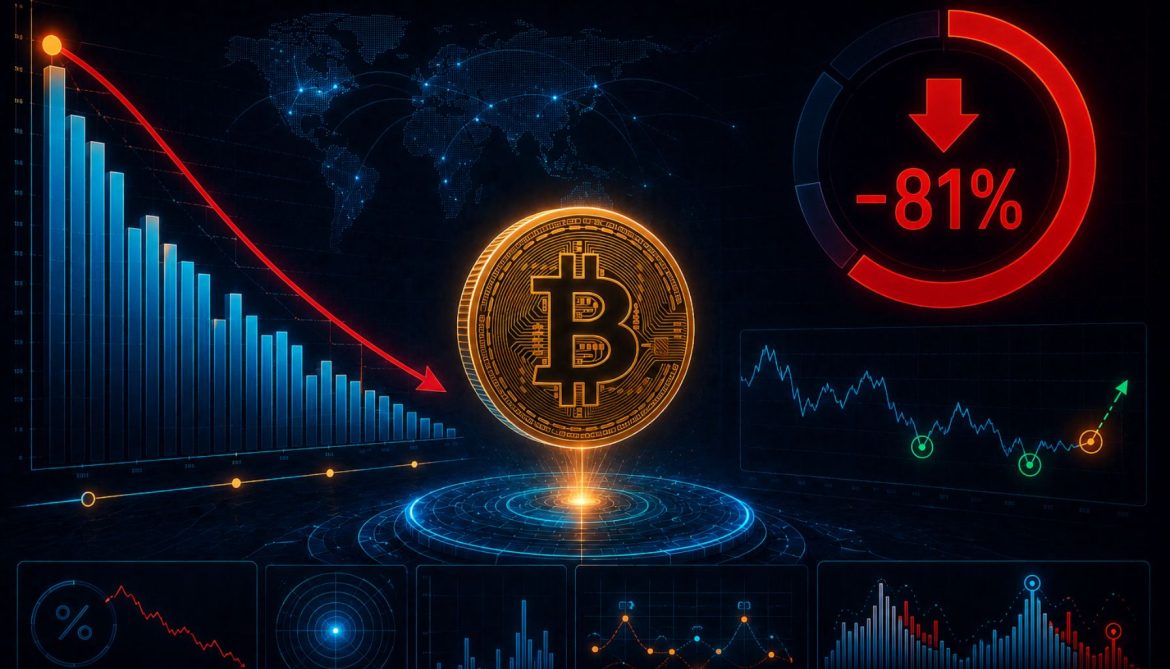
Bitcoin is facing renewed selling pressure as uncertainty continues dominating global financial markets, but bulls have so far managed to defend the critical $75,000 region. The asset remains trapped below key resistance levels after failing to reclaim momentum above $80,000 earlier this month, leaving traders searching for signs that the current correction is either stabilizing or preparing for another leg lower.
While the recent weakness has raised concerns across the market, top analyst Darkfost believes one of the most important signals is not price itself — but the dramatic collapse in spot trading activity happening beneath the surface.
According to data from Darkfost, Bitcoin spot trading volumes have now fallen to levels historically associated with bear markets. The analyst notes that investors must go back to July 2023 to find a period where BTC spot volumes were this low across major exchanges. Binance, which remains the dominant venue in the crypto market, currently processes around $36.4 billion in trading volume. In October 2025, that figure stood at approximately $198.6 billion.
Bitcoin Spot Trading Volume | Source: CryptoQuant
The collapse is severe. Binance volumes are now nearly five times lower than they were at the cycle peak, representing an 81% decline. Other exchanges show similar weakness, with Gateio volumes falling nearly 80% and Bybit recording a 66% drop in activity.
Darkfost explains that the collapse in Bitcoin spot trading activity reflects a broader macroeconomic environment that has become increasingly hostile toward risk assets such as cryptocurrencies. Rising inflationary pressures, persistent uncertainty surrounding global monetary policy, and the US/Iran conflict lasting longer than markets initially expected have pushed investors toward safer or more traditional assets. Commodities, energy markets, and major equity indices have absorbed a large portion of capital flows that previously rotated into crypto during periods of stronger risk appetite.
The result has been a sharp contraction in participation across spot crypto markets. Lower trading activity often reflects declining enthusiasm, weaker speculative demand, and reduced institutional engagement. However, Darkfost argues that the current setup may not be entirely bearish from a structural perspective.
Historically, prolonged declines in spot volume have frequently coincided with the later stages of corrective phases rather than the beginning of major collapses. As participation fades, aggressive selling pressure also begins to weaken because fewer market participants remain actively distributing positions into the market.
The analysis points specifically to the 2023 bear market structure, where spot volumes collapsed to similarly depressed levels shortly before Bitcoin stabilized and volatility returned. That period of extreme inactivity ultimately became the foundation for the recovery phase that followed, as exhausted sellers gradually lost control of the market.
Bitcoin continues trading above the critical $75,000 support region despite persistent selling pressure and weakening market participation. The daily chart shows BTC consolidating near $76,800 after rejecting from the $82,000 resistance zone earlier this month, with price now trapped between major moving averages as traders wait for a decisive breakout or breakdown.

Bitcoin consolidates above key price level | Source: BTCUSDT chart on TradingView
Technically, Bitcoin remains above the 50-day moving average, which is currently acting as short-term support around the mid-$75,000 area. That level has become structurally important because it aligns closely with the broader horizontal demand zone between approximately $73,000 and $75,000 highlighted on the chart. Bulls have repeatedly defended this region throughout May, preventing sellers from regaining full control of the trend.
However, the broader structure still reflects caution. The 100-day and 200-day moving averages continue sloping downward overhead, reinforcing the idea that Bitcoin remains inside a larger corrective environment despite the recovery from February’s capitulation lows near $63,000.
For now, Bitcoin remains in a compression phase. A decisive reclaim of the $80,000–$82,000 region would strengthen bullish momentum, while losing the $75,000 support zone could expose BTC to a deeper retrace toward the $70,000 area.
Featured image from ChatGPT, chart from TradingView.com
ROAD TOWN, British Virgin Islands, May 25, 2026 /PRNewswire/ — AFX, a high-performance sovereign L1 purpose-built for decentralized derivatives, has officially launched its Points Program, introducing a multi-season incentive system designed to reward genuine ecosystem participation ahead of the protocol’s future token launch.
Unlike traditional DeFi farming models that primarily reward raw trading volume, AFX’s points system is built around a different principle: rewarding real contribution. Active traders, liquidity providers, and community participants can now earn points through meaningful participation across the protocol, with all accumulated points eventually redeemable into tokens at TGE.
This program will run across three consecutive seasons, with each season featuring its own dedicated points pool. Importantly, points do not reset or expire between seasons. All accumulated points will be merged and redeemed together at a unified rate during TGE, encouraging long-term ecosystem participation rather than short-term farming behavior.
A Multi-Layered Incentive System Built for Real Participation
AFX users can earn points through three independent participation methods simultaneously:
The protocol evaluates trading contribution across multiple dimensions — including trade execution, position holding, and market diversity — rather than relying solely on trading volume. Liquidity providers who contribute capital to the AFX LP Vault are also rewarded based on their actual contribution to protocol liquidity depth, supporting healthier and more efficient market conditions for all participants.
Season 1 Now Live
Season 1 officially begins on May 25, 2026, and will run for eight weeks through July 20, 2026. During this phase, AFX will distribute points across two independent pools:
Points will be settled weekly and distributed every Monday at 00:00 UTC.
The launch of the Mainnet Points Program marks the next major step in AFX’s broader ecosystem rollout as the protocol continues building toward governance token launch and long-term community ownership.
About AFX
AFX is a high-performance sovereign L1 purpose-built for decentralized derivatives. By synthesizing the rapid execution of a centralized exchange with the immutable sovereignty of blockchain, AFX delivers a professional-grade Perp DEX environment characterized by sub-100ms finality, institutional liquidity, and unmatched capital efficiency.

CoinGecko data revealed that Bitcoin outperformed on US holidays during 11 of the past 14 calendar years analyzed historically.
A new study by CoinGecko found that buying Bitcoin on US holidays has historically delivered much stronger short-term returns compared to regular trading days.
The analysis examined Bitcoin’s forward returns across different calendar days between May 1, 2013, and May 8, 2026, focusing on single-day gains after purchase.
According to the data, US holidays recorded an average next-day Bitcoin return of 0.77%, compared to just 0.19% on non-holidays. CoinGecko found that holidays outperformed regular days in 11 of the 14 calendar years included in the study. Among regular weekdays, Mondays and Wednesdays posted the highest average next-day return at 0.38%, while Thursdays were the only day to produce a negative average return of 0.09%.
The report identified New Year’s Day as the strongest-performing holiday for Bitcoin purchases, with an average next-day return of 2.01% across 13 observations and a win rate of 84.6%, meaning Bitcoin rose the following day in 11 out of 13 years. Columbus Day posted the same 84.6% win rate alongside an average return of 1.70%, while Christmas generated a 1.46% average next-day gain with a 53.8% win rate.
CoinGecko said the New Year’s Day pattern may indicate the broader January momentum effect often seen in traditional financial markets, where investors deploy fresh capital at the start of a new year. The study added that Bitcoin may also benefit from a shift away from December tax-loss selling into renewed January positioning. The report noted that Bitcoin’s price on January 1 ranged from $313 in 2015 to $93,507 in 2025, yet the pattern of next-day gains remained relatively consistent throughout the period.
However, not all holidays produced positive results. Martin Luther King Jr. Day recorded the weakest performance with an average next-day negative return of 0.84%, largely influenced by Bitcoin’s 18.65% drop following January 15, 2018, during the early phase of the crypto bear market. Independence Day also averaged a negative return at 0.26%. Veterans Day showed an average gain of 1.75%, but CoinGecko warned that the figure was distorted by a few unusually large rallies, while the holiday’s win rate remained below 50%.
The study also found little meaningful difference in Bitcoin performance between weekdays and weekends. Weekdays averaged a 0.21% positive next-day return compared to 0.22% on weekends, which CoinGecko described as statistically insignificant due to Bitcoin’s 24/7 trading structure.
Over a one-year holding period, the day of purchase had almost no impact on long-term returns, as average annual gains across all weekdays remained within a narrow 2.4 percentage point range. CoinGecko added that while holiday purchases also showed slightly stronger one-year returns, the effect was likely indicative of broader market cycles rather than a continued holiday-driven trend.
As for Bitcoin’s latest price action, the asset is currently trading back above $80,000 after briefly slipping below that level earlier this week. Market experts said the decline was driven by several pressures hitting the market at once. On-chain data showed that Bitcoin exchange outflows had dropped sharply before the selloff, leaving more coins on trading platforms and increasing available sell-side supply.
At the same time, derivatives traders were aggressively building short positions while leveraged long exposure remained high. Once prices started falling, a wave of long liquidations accelerated the move downward. Rising inflation concerns following fresh US CPI and PPI data, alongside heavy whale selling, added further pressure to the market.

As of 2026, cryptocurrency regulation has moved from debate to enforcement. A total of 68 countries have enacted or proposed crypto specific legislation, a 62% increase in just two years, while over 92% of global jurisdictions have tightened rules in some form. From the EU’s MiCA framework to the US GENIUS Act and CARF aligned tax reporting now active across 48 countries, the regulatory infrastructure for digital assets is no longer emerging. It has arrived.
This page compiles the most up to date crypto regulation statistics available for 2026, covering global legal status, regional frameworks across Asia, Africa, and Latin America, stablecoin oversight, crypto tax rates by country, CBDC development, and enforcement trends. All data points are sourced from primary regulatory bodies, government publications, and leading industry research organizations.
The United States underwent one of the most dramatic regulatory pivots in crypto history in 2025 — from aggressive enforcement to a pro-innovation framework under new leadership.
As of early 2026, cryptocurrency tax regulations vary significantly by country, with rates ranging from 0% in crypto-friendly jurisdictions to over 50% in nations treating gains as high-income tax.
| Country | Tax Rate on Gains | Notes / Exemptions |
| Argentina | 5-15% | Varies |
| Australia | Up to 45% | Based on income |
| Austria | 27.5% | Fixed rate |
| Brazil | 15-22.5% | Progressive, >BRL 35k/mo |
| Canada | Up to 33% | 50% of gains taxed as income |
| Denmark | 37% – 52% | Very high taxation |
| Finland | ~30-34% | Capital gains tax |
| France | 30% | Flat rate, including social charges |
| Germany | 0% or ~45% | 0% if held >1 year; otherwise income rate |
| India | 30% | +1% TDS on transactions |
| Israel | 25% (Indiv) | Up to 47% for businesses |
| Italy | 26% | Flat rate, threshold exceptions |
| Japan | 15% – 55% | “Miscellaneous Income” |
| Nigeria | 10% | Flat rate |
| Norway | ~22% | Capital gains |
| Portugal | 0% or 28% | 0% for >1 year; 28% short-term |
| Singapore | 0% | No capital gains tax |
| Slovenia | Up to 50% | High rate for active traders |
| Spain | 19% – 26% | Progressive |
| Switzerland | 0% (Private) | Exempt for private investors; Wealth tax applies |
| UAE (Dubai) | 0% | No personal/capital gains tax |
| UK | 18% – 24% | Capital gains tax |
| USA | Up to 37% | Short-term; Long-term ~0-20% |
Central Bank Digital Currencies are now in active development in nearly every major economy, with China leading global adoption and the digital euro entering its final design phase.

Predict.fun is revolutionizing decentralized prediction markets by solving the “Idle Capital Problem” through a unique yield-bearing architecture. Backed by YZi Labs and led by the former Binance Head of Research, the dApp allows users to earn passive interest on their stakes while betting on market outcomes.
This step-by-step guide explores how to maximize your returns through its official Points Farming Campaign.
Learn more: dApps Definition – NFTPlazas Research

What is Predict.fun?
Predict.fun serves as a high-velocity prediction protocol built natively on the BNB Chain. While platforms like Polymarket dominated the headlines during the 2024 election cycle, they suffered from a fundamental flaw: capital inefficiency. When you place a bet on a traditional prediction market, your capital sits idle in a smart contract for weeks or months. You lose the opportunity to earn yield on those assets while waiting for the outcome.
Predict.fun solves this “Idle Capital Problem” through a revolutionary yield-bearing architecture. When you commit funds to a prediction, the protocol does not just hold the money. It routes the underlying liquidity into verified yield-generating protocols, which means your capital works for you in two ways simultaneously:
To qualify for the upcoming airdrop, follow the step-by-step instructions in the Predict.fun Airdrop Guide section below for further information.
Predict.fun carries significant “smart money” credentials, operating with a focus on institutional-grade liquidity and retail-friendly UI. As of late 2025, it manages over $11 million in Total Value Locked (TVL) and $100 million in Notion Volume, according to the analyst @datadashboards on Dune.
Notional Volume on @predictdotfun just crossed $100M!
2 days ago they also saw an ATH in transactions and users with 30K transactions and 6.15K Unique Users.
Their TVL also just legged up to over $11M this morning 👀 pic.twitter.com/nW0clhnpkX
— dash (@datadashboards) December 29, 2025
Predict.fun secured strategic funding from YZi Labs (a firm with deep historical ties to early-stage Binance Labs incubations). While the team keeps the exact valuation of the latest round confidential, on-chain data and treasury movements suggest a capitalization in the tens of millions of dollars.
The project carries an exceptional level of industry credibility due to its leadership. Dingalingts, the former Head of Research at Binance and the mastermind behind the creation of PancakeSwap, founded Predict.fun.
On December 4, 2025, Binance founder Changpeng Zhao (CZ) spotlighted the project on X. Although he labeled it a “non-endorsement,” the association with an ex-Binance founder triggered a massive influx of retail liquidity.

Predict.fun is available on Binance Wallet. Source: Predict.fun on X.
Predict.fun launched its official Points Farming Campaign on December 16, 2025, acting as the primary mechanism for its future token distribution, rewarding users based on activity, accuracy, and advocacy.
The protocol rewarded historical on-chain activity at launch. If you have historically used any of the following platforms, the protocol likely assigned you Reserved Points:
Fundamentally, Predict.fun employs a dynamic reward system where every $1 USD of trading volume generates a base point value, amplified by a 1.5x multiplier for maintaining a three-day winning streak and a potent 2x multiplier for providing liquidity to high-uncertainty markets.
To qualify for the upcoming token generation event (TGE), you must convert your “Reserved” points into “Active” points by following these steps:
Step 1: Activate Your Wallet

Visit Predict.fun HERE, sign up, and connect a compatible Web3 wallet.
Learn more: Crypto Wallet – Everything about Setting Up a Wallet
If the system detects your historical volume on other platforms, you will see a “Reserved Points” balance immediately. To unlock these, you must complete tasks including creating a profile, depositing $10, tweeting your referral link, verifying your account, and executing trades.

Predict.fun Airdrop Guide
Step 2: Execute High-Precision Trades
To maximize your earning potential, do not just create volume. Focus on these core strategies that signal you are a real user rather than a bot, ensuring your activity qualifies for the highest tier of rewards:
Step 3: The Referral Engine
Predict.fun uses a structured referral model that rewards users for growing the network. When your invited peers execute trades, you receive a 10% commission on their total point earnings without reducing the rewards of your invitees.
To further incentivize high-performance networking, the protocol awards exclusive “Point Boost” NFTs to the most successful referrers on the global leaderboard, providing long-term multipliers for your airdrop allocation.
What Is Predict.fun?
Predict.fun is a high-velocity prediction protocol built on the BNB Chain that allows users to bet on market outcomes. It solves the “Idle Capital Problem” by generating yield on staked funds through protocols like Venus while those funds are simultaneously used for betting.
How Do I Get Eligible For Predict.fun Airdrops?
To be eligible for Predict.fun airdrop, you must be active on the platform. Visit Predict.fun HERE, sign up, and connect your Web3 wallet. Predict.fun will reward users based on their activity, accuracy, and advocacy.
Who Is Behind Predict.fun?
Dingalingts, the former Head of Research at Binance and creator of PancakeSwap, founded the project. YZi Labs backs the platform, which has also gained public attention from Binance founder CZ.
How Do I Unlock My Reserved Points?
You must convert Reserved Points from past activity on other platforms into Active points by completing specific steps. Simply connect your wallet, deposit at least $10, and verify your account via social media. These tasks confirm your eligibility for the eventual airdrop.

Iris Coleman
Oct 18, 2025 15:08
ATOM price prediction shows potential recovery to $4.35 resistance level as oversold conditions and analyst targets suggest upside despite current bearish momentum.
• ATOM short-term target (1 week): $3.64 (+13.8%) – aligning with CoinCodex forecast
• Cosmos medium-term forecast (1 month): $3.76-$4.35 range with potential breakout scenario
• Key level to break for bullish continuation: $4.35 immediate resistance
• Critical support if bearish: $2.95 (52-week low) and $2.85 Bollinger lower band
The latest ATOM price prediction landscape reveals a divided analyst community with significantly varying targets. PricePredictions.com presents the most optimistic Cosmos forecast with a $12.78 medium-term ATOM price target, representing a massive 299% upside from current levels. This prediction relies heavily on Fibonacci retracements and moving average convergence scenarios.
In contrast, short-term focused analysts remain conservative. CoinCodex projects a modest $3.64 ATOM price target by November 12, while DigitalCoinPrice suggests an even more restrained $3.76 by today’s date. The consensus among short-term predictions indicates cautious optimism, with most analysts expecting ATOM to trade within a narrow range before any significant directional move.
The stark difference between short and medium-term predictions suggests analysts see current price action as a consolidation phase before a potential major breakout.
Current Cosmos technical analysis reveals ATOM trading at oversold levels with several indicators suggesting a potential reversal setup. The RSI reading of 35.60 sits in neutral territory but closer to oversold conditions, historically a favorable zone for ATOM price recoveries.
The MACD histogram at -0.0512 shows bearish momentum, but the relatively small negative reading suggests selling pressure may be waning. ATOM’s position at 0.1869 within the Bollinger Bands indicates the token is trading near the lower band support at $2.85, often a technical bounce zone.
Volume analysis shows $4.1 million in 24-hour Binance spot trading, which represents moderate interest but lacks the conviction seen during major trend reversals. The daily ATR of $0.39 suggests ATOM maintains healthy volatility for potential price movements in either direction.
The primary bullish ATOM price prediction centers on a recovery to the immediate resistance at $4.35, representing a 36% upside from current levels. This target aligns with recent price action and the EMA 12 at $3.48 serving as the first hurdle.
A successful break above $4.35 opens the door to test the SMA 50 at $4.17 and eventually the strong resistance at $4.89. The most optimistic scenario sees ATOM challenging the 52-week high at $5.38, though this would require significant volume confirmation and broader crypto market support.
For the bullish Cosmos forecast to materialize, ATOM needs to reclaim the SMA 20 at $3.77 and maintain above the pivot point at $3.19.
The bearish ATOM price prediction scenario focuses on a breakdown below the critical $2.95 support level, which represents the 52-week low. A decisive break below this level could trigger algorithmic selling and push ATOM toward the psychological $2.50 level.
The Bollinger lower band at $2.85 serves as immediate support, but sustained trading below this level would confirm bearish momentum. Risk factors include continued crypto market weakness, reduced staking rewards, or negative developments in the Cosmos ecosystem.
Based on current Cosmos technical analysis, the optimal buy or sell ATOM decision depends on risk tolerance and timeframe. Conservative investors should wait for a clear break above $3.48 (EMA 12) before considering long positions, with a stop-loss at $2.85.
Aggressive traders might consider accumulating ATOM near current levels around $3.20, anticipating a bounce from oversold conditions. Position sizing should remain modest given the mixed technical signals, with stops placed below the $2.95 support level.
The most prudent approach involves scaling into positions, buying 30% at current levels, 40% on any dip to $3.00, and the remaining 30% if ATOM tests the $2.85 Bollinger support.
The comprehensive ATOM price prediction analysis suggests a cautiously optimistic outlook with a medium confidence level. Technical indicators point to potential upside toward $4.35 within the next 30 days, supported by oversold RSI conditions and analyst forecasts.
Key indicators to monitor include the RSI breaking above 40 for bullish confirmation, MACD histogram turning positive, and volume increasing above $6 million daily. Invalidation of this Cosmos forecast would occur on a break below $2.85 with sustained selling pressure.
The timeline for this prediction centers on the next 2-4 weeks, with the first test coming at the $3.48 EMA 12 level. Traders should prepare for volatility as ATOM navigates between critical support and resistance levels in an evolving crypto market environment.
Image source: Shutterstock

Perpetual derivatives DEXs across DeFi were overwhelmed by intense volatility on Friday, leading to multiple platform outages.
Lighter, the second-largest decentralized perpetuals exchange, was one of many platforms that experienced platform outages during the crypto market’s flash crash on Oct. 10. To compensate affected users, Lighter has distributed points that will translate to a future token airdrop.
Lighter announced its reimbursement plan on Oct. 14, dropping 250,000 points to traders affected by the platform’s technical issues during and after the crash.
While points may seem like nebulous compensation for lost funds, Lighter points are in high demand, reaching as high as $100 per point on OTC markets before Friday’s events. As of Oct. 16, the highest bid sits at $81.
The team has faced some backlash over its compensation package, but in general, Lighter traders seem satisfied with the response, while depositors in the platform’s Lighter Liquidity Pool (LLP) are unimpressed.
When broken down, traders affected by the outage lost $25 million and received 150,000 points, LLP contributors got hit by a 5% loss (roughly 21.5 million) but received just 25,000 points, and then the platform suffered a post-crash sequencer outage where traders lost another $7 million, which was reimbursed with 75,000 points.
In summation, Lighter users lost roughly $50 million during the platform’s downtime and, as compensation, received $20 million worth of Lighter points. Of course, OTC prices are only indicative, and there’s no guarantee that Lighter tokens will fetch the same valuation after launch.
It is also worth noting that a significant portion of the $25 million lost in the crash during the outage was likely unsalvageable, as prices moved so quickly and violently that many traders would have been liquidated regardless of whether the platform was operational.
Despite the setback, Lighter remains the second-most-popular perps DEX in DeFi, only trailing Hyperliquid. The DEX still maintains over $1 billion in total value locked (TVL), and has processed $7.3 billion in volume over the last 24 hours, compared to Hyperliquid’s $8.8 billion


