Five intermediary addresses forwarded the tokens to one wallet, which returned 1.25 million HYPE to staking…. Read the full story at The Defiant

 Live Chat
Five intermediary addresses forwarded the tokens to one wallet, which returned 1.25 million HYPE to staking…. Read the full story at The Defiant
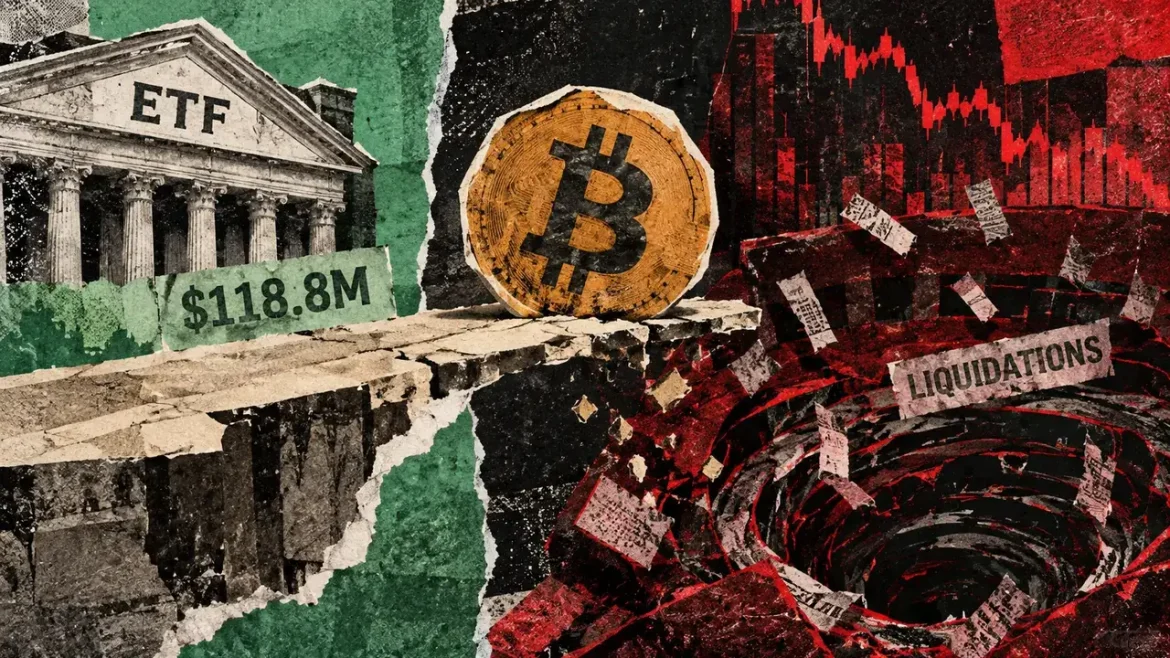
Bitcoin’s October 7 morning market readings showed roughly $143 million in Bitcoin futures positions liquidated over the preceding 24 hours and a price range that dipped below $84,000. The positive US ETF session could not predict whether leveraged positions would survive their margin tests.
CoinGlass reported a BTC futures liquidation total of $143,016,790 at 06:53 UTC.
The 24-hour price range included a low of $83,647. CryptoSlate’s Bitcoin price page showed the price at around $84,288 during EU trading hours, down 1.25% over 24 hours.
US spot Bitcoin ETFs recorded $118.8 million in net inflows for October 6, according to Farside Investors after a net outflow for October 5.
Liquidation responds to the trader’s margin position as prices change. Bybit’s liquidation rules use mark price, the exchange’s reference price for margin calculations, rather than the last trade. The trigger varies by margin mode.
Nor does a daily ETF inflow represent a standing bid at a guaranteed Bitcoin price. BlackRock’s iShares Bitcoin Trust ETF, or IBIT, uses authorized participants creating or redeeming baskets for cash or Bitcoin in its prospectus. While the fund seeks to track Bitcoin’s price, the flow figure alone cannot show when or where an equivalent spot purchase occurred.
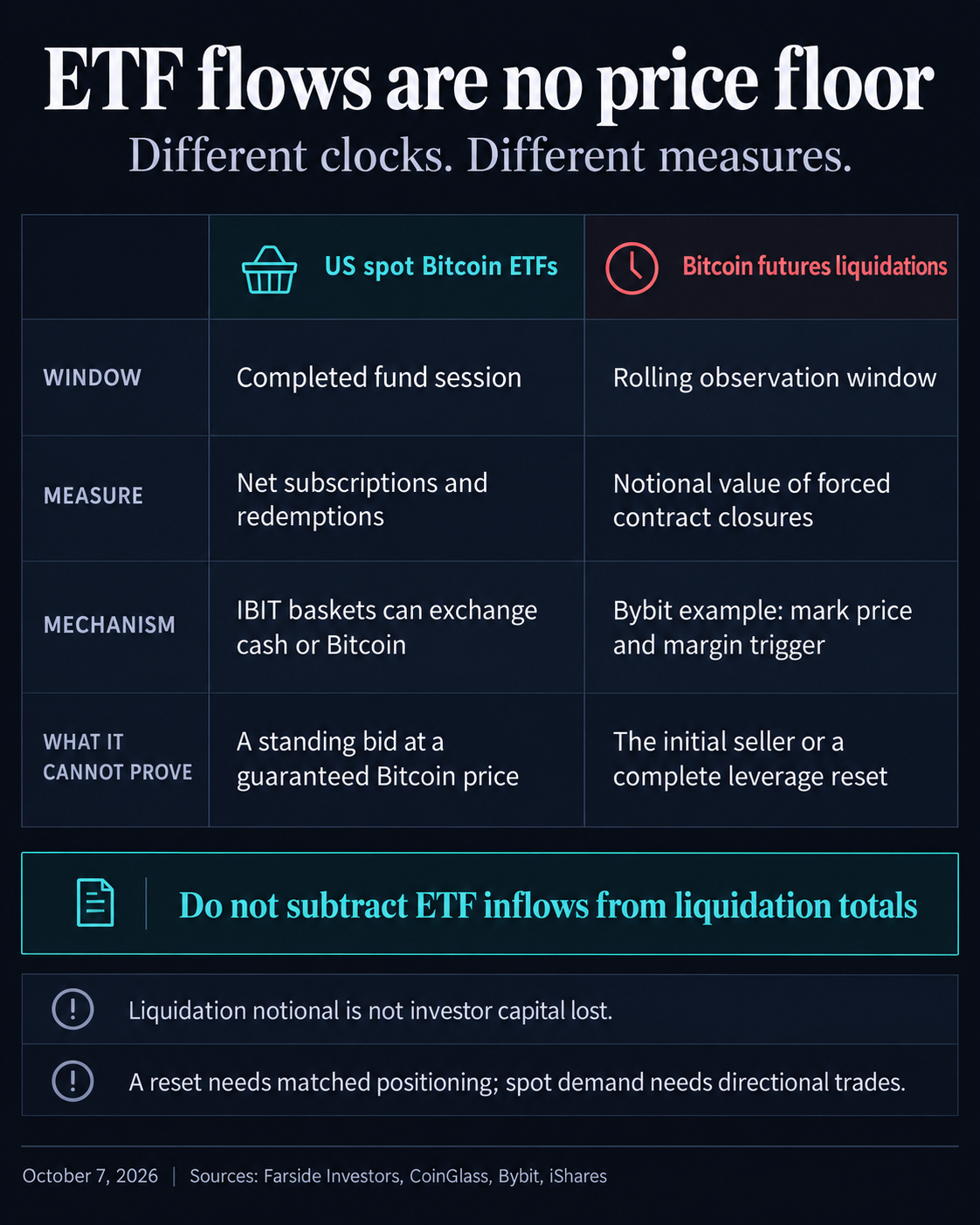
Subtracting ETF inflows from liquidation notional would therefore reveal no net buying or selling balance. Fund demand and forced closures can coexist without establishing that derivatives selling overwhelmed ETF buying.
For traders, the remaining question is whether enough leverage has cleared to ease further liquidation pressure. The fresh total confirms forced closures, but CoinGlass’s single open-interest reading, a measure of outstanding futures exposure, provides no comparable before-and-after view.
Gross spot volume leaves a similar gap: turnover alone does not show whether net buying weakened. The next useful signals are changes in outstanding positions and directional spot trading measured on the same venues over the same interval. Those would help distinguish cleared leverage from persistent selling pressure.
Bitmine owns 4.9% of the total ETH coin supply of 122.1 million
Bitmine is 99% of the way to the ‘Alchemy of 5%’ in just 15 months
Tom Lee to deliver the keynote at Token2049 on October 7, 2026 in Singapore
Bitmine was added to the Russell 1000 Large-cap index on June 26, 2026
Bitmine’s Series A Preferred Stock is trading on the NYSE under the symbol BMNP
Bitmine has 5,067,309 staked ETH, representing $13.8 billion at $2,726 per ETH. MAVAN (Made in America VAlidator Network) is a premier Ethereum staking destination for BMNR and institutional investors
Bitmine owns $117 million of Eightco (NASDAQ: ORBS), now one of the only publicly listed equities in the world to provide investors indirect exposure to OpenAI
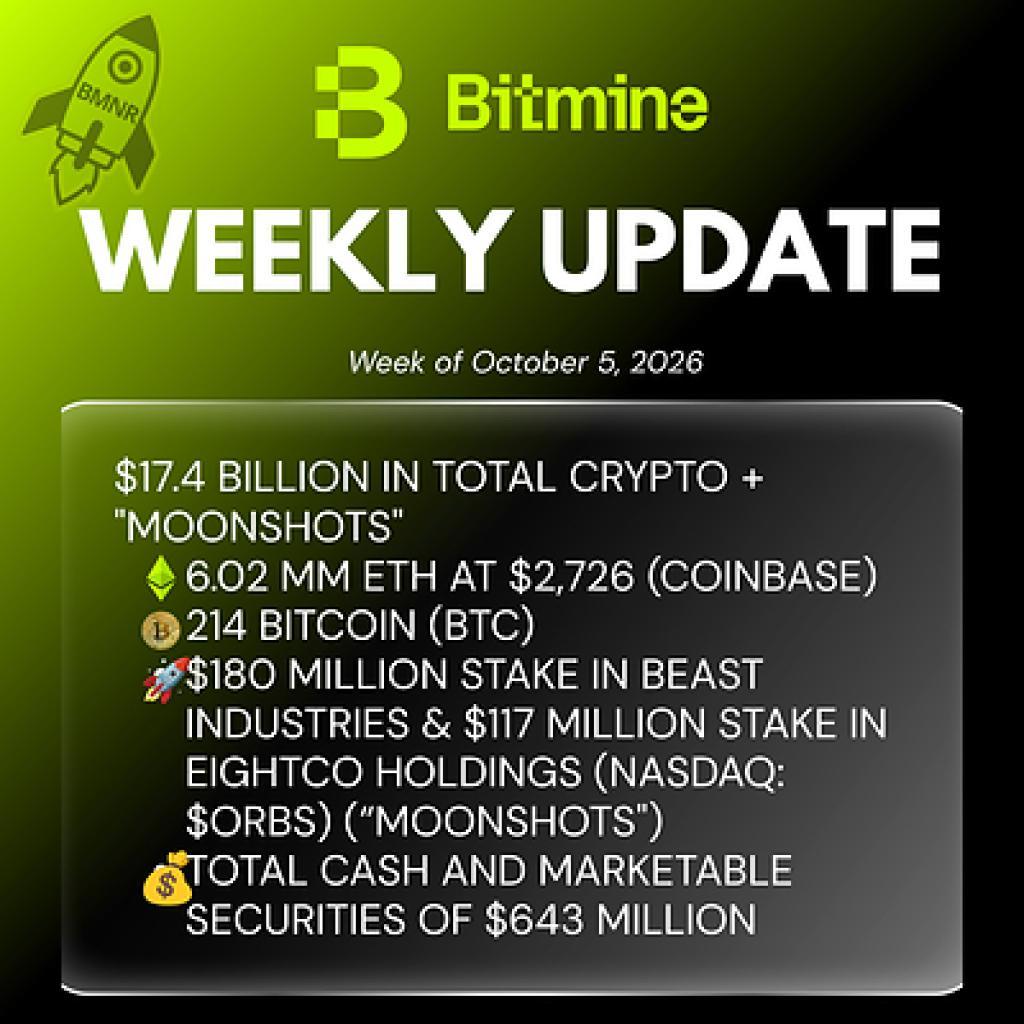
Bitmine Crypto + Total Cash Holdings & Marketable Securities + “Moonshots” total $17.4 billion, including 6.02 million ETH tokens, total cash & marketable securities of $643 million, and other crypto holdings
Bitmine remains supported by a premier group of institutional investors including ARK’s Cathie Wood, MOZAYYX, Founders Fund, Bill Miller III, Pantera, Kraken, DCG, Galaxy Digital and personal investor Thomas “Tom” Lee to support Bitmine’s goal of acquiring 5% of ETH
NORWALK, Conn., Oct. 5, 2026 /PRNewswire/ — (NYSE: BMNR) Bitmine Immersion Technologies, Inc. (“Bitmine” or the “Company”) a Bitcoin and Ethereum Network company with a focus on the accumulation of crypto for long term investment, today announced Bitmine crypto + total cash & marketable securities + “moonshots” holdings totaling $17.4 billion.
As of October 4, 2026 at 6:30pm ET, the Company’s crypto holdings are comprised of 6,016,414 ETH at $2,726 per ETH (per Coinbase NASDAQ: COIN), 214 Bitcoin (BTC), $180 million stake in Beast Industries, $117 million stake in Eightco Holdings (NASDAQ: ORBS) (“moonshots”) and total cash & marketable securities of $643 million. Bitmine’s ETH holdings are 4.9% of the ETH supply (of 122.1 million ETH).
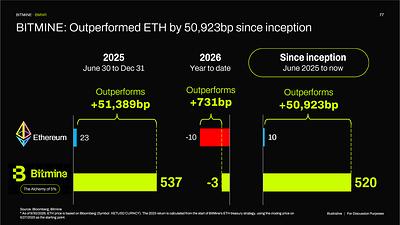
“We believe that as crypto enters a cycle we view as a bull market, what is notable is Bitmine’s share price outperformance of ETH during the bear market of 2025-2026. In the first 9 months of 2026, ETH declined 10% while BMNR was down by 3%, or outperformance of 731bp,” stated Thomas “Tom” Lee, Chairman of Bitmine.
“In our view, BMNR’s share performance reflects the Company’s commitment to optimize shareholder return. And we accomplished this via many actions including executing the largest ever crypto treasury equity buyback, acquiring 21 million shares in 2026 alone,” continued Lee.
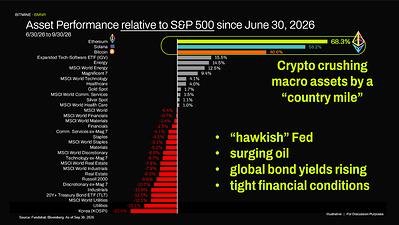
“The outperformance of ETH by 6,832bp relative to the S&P 500 in 3Q26 is notable considering the substantial macro headwinds that emerged in the quarter including a ‘hawkish’ Fed, surging oil, rise in global bond yields and general tightening of financial conditions. Quarter to date, ETH is outperforming by 6,832bp, dwarfing other macro assets,” stated Lee.
Tom Lee will also deliver the keynote at Token2049 on October 7 at 10:00 a.m. at Marina Bay Sands in Singapore. The 20-minute keynote is part of Token2049, the world’s largest crypto conference. Additional information is available on the Token2049 website.
“Over the past week, we acquired 15,112 ETH. Bitmine’s track record of consistent buying of crypto is unmatched by any public company in the world. Bitmine has bought ETH each and every week since the inception of the ETH Treasury Strategy on June 30, 2025,” stated Lee.
Bitmine will release the latest Chairman’s Message for October 2026 this week. The title of the Message is “Crypto bull underway — this cycle likely the largest.”
Earlier in 2026, Bitmine launched MAVAN (the Made in America VAlidator Network), the institutional-grade staking platform. While MAVAN was originally developed to support Bitmine’s own Ethereum treasury, MAVAN has expanded to serve institutional investors, custodians, and ecosystem partners seeking best-in-class staking infrastructure. A portion of Bitmine’s ETH is already staked on the MAVAN platform.
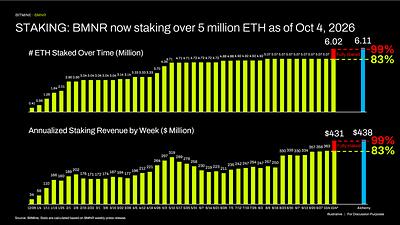
As of October 4, 2026, Bitmine total staked ETH stands at 5,067,309 ($13.8 billion at $2,726 per ETH). “Bitmine has staked more ETH than other entities in the world. At scale (when Bitmine’s ETH is fully staked by MAVAN and its staking partners), the projected ETH staking reward would be $431 million on an annualized basis (using 2.63% 7-day BMNR yield),” stated Lee.
“Annualized staking revenues are now projected at $363 million. And this 5.1 million ETH is 84% of the 6.02 million ETH held by Bitmine. Bitmine’s own staking operations generated a 7-day yield of 2.63% (annualized),” continued Lee.
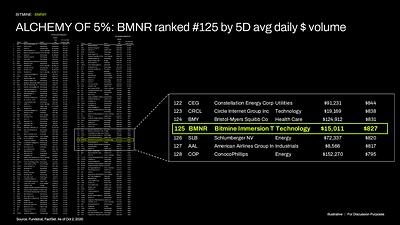
Bitmine is one of the most widely traded stocks in the US. According to data from Fundstrat, the stock has traded average daily dollar volume of $827 million (5-day average, as of October 2, 2026), ranking #125 in the US, behind Bristol-Myers Squibb Co (rank #124) and ahead of Schlumberger NV (rank #126) among 5,704 US-listed stocks (statista.com and Fundstrat research).
Bitmine’s crypto holdings reign as the #1 Ethereum treasury and #2 global treasury, behind Strategy Inc. (NASDAQ: MSTR), which reportedly owns 847,666 BTC valued at approximately $78 billion. Bitmine remains the largest ETH treasury in the world.
Bitmine management believes the GENIUS Act and the Securities and Exchange Commission’s (SEC) Project Crypto are as transformational to financial services in 2026 as the US action on August 15, 1971, which ended the Bretton Woods system and took the U.S. dollar off the gold standard 55 years ago. This 1971 event was the catalyst for the modernization of Wall Street, creating the iconic Wall Street titans and financial and payment rails of today. These proved to be better investments than gold.
The Chairman’s message can be found here:
https://www.Bitminetech.io/chairmans-message
The Fiscal Full Year 2025 Earnings presentation and corporate presentation can be found here: https://Bitminetech.io/investor-relations/
To stay informed, please sign up at: https://Bitminetech.io/contact-us/
About Bitmine
Bitmine Immersion Technologies, Inc. (NYSE: BMNR), together with its subsidiaries (“Bitmine” or the “Company”), is a blockchain technology infrastructure company operating across institutional digital asset staking and validation services, bitcoin mining, and strategic digital asset management. As the world’s leading Ethereum Treasury company, it implements an innovative digital asset strategy for institutional investors and public market participants. The Company provides institutional-grade staking and validation infrastructure—through which it earns staking rewards and validation income—alongside bitcoin mining activities. Bitmine holds digital assets strategically, generating yield on those holdings to support liquidity and capital formation. Since 2025, the Company has expanded its blockchain infrastructure capabilities, including developing and deploying MAVAN, its institutional staking and validation platform. The Company’s activities further include investments in early-stage blockchain opportunities (“moonshot” investments) and ancillary mining, hosting, and consulting services.
For additional details, follow on X:
Cautionary Note on Forward Looking Statements
This press release contains statements that constitute “forward-looking statements” within the meaning of the Private Securities Litigation Reform Act of 1995, as amended. Forward-looking statements include all statements that are not purely historical and can generally be identified by terms such as “expects,” “projects,” “intends,” “plans,” “believes,” “anticipates,” “estimates,” “may,” “will,” “would,” “could,” “should,” “view,” or similar expressions. This press release specifically contains forward-looking statements regarding: (i) the Company’s goal of acquiring 5% of the total ETH supply (the “Alchemy of 5%” initiative); (ii) the Company’s digital asset accumulation and treasury strategy, including statements regarding continued weekly ETH acquisitions and the Company’s status as the largest ETH treasury in the world; (iii) the Company’s staking operations, including projected annualized ETH staking rewards of approximately $431 million at scale and currently projected annualized staking revenues of approximately $363 million; (iv) MAVAN’s expansion to serve institutional investors, custodians, and ecosystem partners; (v) management’s beliefs regarding crypto market conditions and share price outperformance relative to ETH; (vi) ETH’s relative performance versus the S&P 500 and other macro assets; (vii) management’s belief that the GENIUS Act and SEC Project Crypto are transformational to financial services; and (viii) statements regarding the value of the Company’s crypto, cash, marketable securities, and “moonshot” holdings.
These forward-looking statements involve substantial risks and uncertainties that could cause actual results to differ materially from those expressed or implied. Factors that could cause or contribute to such differences include, but are not limited to: the extreme volatility and unpredictability of digital asset prices, including ETH and Bitcoin; the Company’s reliance on third-party pricing sources and reported market values, which may fluctuate materially; changes in market conditions affecting the trading price and volume of the Company’s securities; the Company’s ability to successfully execute its digital asset acquisition strategy and achieve its ETH accumulation targets, including the “Alchemy of 5%” goal; the Company’s ability to finance its business operations and MAVAN expansion; operational, security, and technological risks associated with the Company’s staking and validation operations, including network failures, slashing events, cybersecurity breaches, and protocol changes; the risk that actual staking yields, rewards, and revenues differ materially from projected amounts; competition in the digital asset treasury, staking, and mining industries; the Company’s dependence on key personnel; regulatory developments affecting digital assets, blockchain technology, and staking activities, including the ultimate enactment, implementation, and interpretation of the GENIUS Act and other pending legislation; actions by the SEC, CFTC, and other regulatory bodies; risks related to the Company’s “moonshot” investments, including in Eightco Holdings and Beast Industries; macroeconomic factors, including inflation, interest rates, and general economic conditions; changes to the Ethereum protocol; the performance of third-party service providers, exchanges, custodians, and staking partners; and the other risk factors described in the Company’s filings with the SEC.
The forward-looking statements contained in this press release are based on information available to management as of the date of this release and reflect management’s current expectations, estimates, and beliefs concerning future events. Actual results may vary materially from those expressed or implied based on the factors described above and in the Risk Factors section of the Company’s Annual Report on Form 10-K for the fiscal year ended September 30, 2025 filed with the SEC on November 21, 2025, the Company’s Quarterly Reports on Form 10-Q, and the Company’s other filings with the SEC, as amended or updated from time to time. Copies of these filings are available at www.sec.gov and at https://Bitminetech.io/investor-relations/. The Company cautions readers not to place undue reliance on any forward-looking statements, which speak only as of the date on which they are made. Bitmine expressly disclaims any obligation to update or revise any forward-looking statements except as required by applicable law.



The first reserve-yield payment awaits transfer to the Assistance Fund, adding buyback funding tied to USDC balances rather than trading volume…. Read the full story at The Defiant
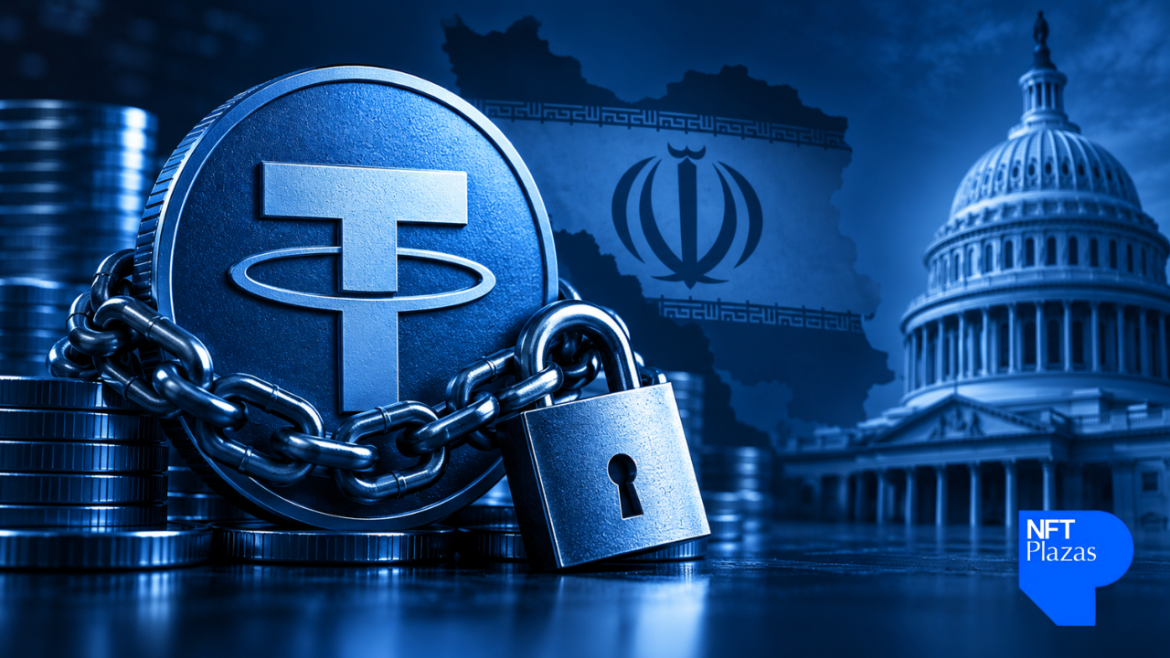
Tether says it helped authorities freeze nearly $550 million in Iran-linked USDT during 2026, highlighting the growing role of stablecoins in sanctions enforcement while drawing renewed scrutiny from U.S. lawmakers.
The company disclosed on September 28 its actions against wallets connected to Iran’s central bank and other sanctioned networks. The announcement followed a report from Democratic investigators on the Senate Permanent Subcommittee on Investigations alleging that USDT has become a major channel for Iranian entities to move money outside the traditional financial system.
The developments underscore a tension at the heart of stablecoins: the same infrastructure that enables fast cross-border transfers also gives investigators a transparent record of transactions.

Tether said it froze more than $344 million in USDT across two addresses in April after receiving information from the U.S. Treasury Department’s Office of Foreign Assets Control (OFAC) and U.S. law enforcement. OFAC added both addresses to its sanctions designation for Iran’s central bank the following day, citing links to the Islamic Revolutionary Guard Corps-Qods Force and Hezbollah.
In July, Tether froze more than $130 million across four TRON wallets after Treasury added those addresses to the same designation. Together, the two actions account for most of the company’s roughly $550 million in Iran-linked freezes this year.
The company stressed that freezing cryptocurrency is different from a government seizure. A freeze prevents USDT held at a specific address from being transferred, while ownership can be transferred to the government only through a separate legal process.
Tether CEO Paolo Ardoino said the company’s ability to respond to law enforcement requests shows the value of public blockchains in tracking financial activity.
“Tether has consistently demonstrated that USDT is not a haven for sanctioned actors, terrorist organizations or criminal networks,” Ardoino said.
Tether added that its cooperation with authorities worldwide has helped freeze more than $4.9 billion in assets, including more than $2.4 billion connected to U.S. authorities.
The Senate investigation takes a more critical view of USDT’s role in Iran-linked financial activity. Investigators examined 846 cryptocurrency wallets sanctioned or targeted for seizure over their connections to Iran and its proxies, and found that 84% had transacted exclusively or nearly exclusively in USDT. They also traced more than $600 million in USDT through the accounts of two sanctioned Iranian oil smugglers between 2021 and 2025.
The report argues that USDT’s liquidity and wide availability make it an important payment rail for Iranian networks seeking to bypass banking restrictions, and says some transactions connected Iranian banks with financial networks associated with Hezbollah and the Houthis.
Senator Richard Blumenthal called on the Treasury and Justice departments to investigate potential sanctions violations and examine Tether’s role in transactions involving Iranian networks.
The Senate findings are investigative allegations, not a legal determination that Tether violated U.S. law. Tether has rejected the characterization that USDT provides a safe haven for sanctioned actors, pointing instead to its cooperation with authorities and its record of freezing identified wallets.
The dispute comes as Washington expands its use of sanctions against Iran-linked cryptocurrency activity. In August, the Treasury Department launched Operation Economic Outcast, targeting financial networks supporting Iran, with digital assets included alongside technology, gold, aviation and shipping among the sectors facing expanded measures.
The campaign continued in September, when OFAC sanctioned BitBank, an Iranian digital-asset venture, along with its software developer and several associates of financier Babak Zanjani. Treasury alleged that Zanjani’s network used digital-asset businesses to move funds for the Islamic Revolutionary Guard Corps.
A separate Justice Department case shows how a Tether freeze can lead to forfeiture. In September, federal prosecutors sought forfeiture of about $61 million in USDT across 10 TRON addresses that Tether had previously frozen, alleging the funds were proceeds from Iranian oil sales intended to benefit Iran’s government and military-linked organizations. That case is not included in Tether’s $550 million figure.
The developments come as USDT continues to operate at enormous scale across global cryptocurrency markets. That scale creates a difficult compliance challenge. Stablecoins move value quickly across borders, and public blockchains leave records that help investigators trace suspicious flows. But the volume of activity means monitoring systems must flag sanctioned addresses and suspicious patterns before funds can be moved elsewhere.
That challenge could grow as faster blockchain infrastructure expands stablecoin payment capacity. StableChain, for example, has targeted speeds of up to 10,000 transactions per second, potentially supporting much larger payment flows.
For Tether, issuer-level controls remain a key enforcement mechanism. The blockchain itself does not determine whether a transaction complies with sanctions; issuers, exchanges, regulators and law enforcement each play a role in identifying and restricting illicit activity.
The Iran case highlights both sides of USDT’s growing importance. Blockchain transparency gives authorities a powerful tool for tracking illicit flows, while USDT’s liquidity and global accessibility can make it attractive to sanctioned networks.
Tether’s nearly $550 million in freezes shows that issuer intervention can block substantial funds once authorities identify targeted wallets. The Senate investigation, however, raises a broader question: whether those controls can keep pace with the growing use of stablecoins in sanctions-sensitive markets.
As U.S. authorities sharpen their focus on digital assets, Tether’s compliance practices are likely to face increasing scrutiny.
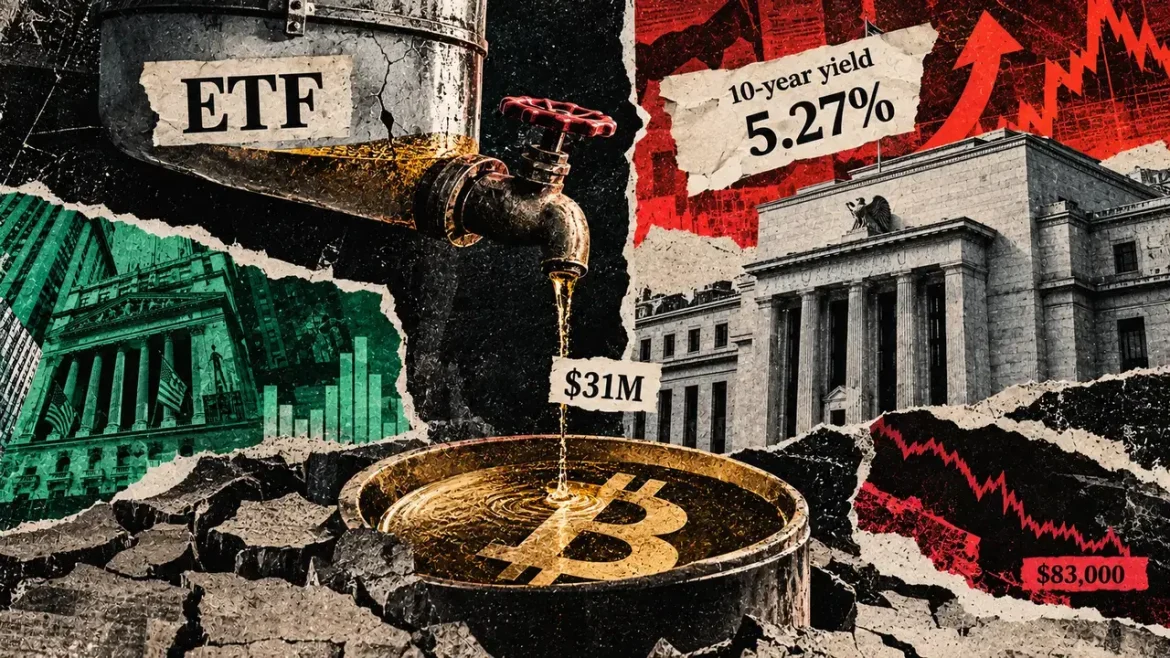
US Bitcoin exchange-traded funds drew just $31 million in inflows on Sept. 28 as institutional demand weakened while BTC stalled below a major supply barrier.
According to SoSoValue data, BlackRock’s iShares Bitcoin Trust (IBIT) led the session with $54.84 million in inflows, adding about 657 Bitcoin and lifting its holdings back above 800,000 BTC for the first time since May 26.
Grayscale’s Bitcoin Mini Trust (BTC) added another $10.32 million, while Fidelity’s Wise Origin Bitcoin Fund (FBTC) recorded $10.90 million in outflows and Grayscale’s GBTC lost $23.19 million. The remaining products registered no net flows during the session.
The $31.07 million intake extended the positive streak for US spot Bitcoin ETFs to eight trading sessions, but it also marked the weakest day of that run.
The trend has deteriorated steadily since Sept. 21, when daily inflows approached $1 billion. Flows declined through the remainder of last week before falling to just $31 million Monday, leaving the latest total about 97% below that peak.
That slowdown contrasts with the strength of the broader weekly figures. The funds attracted $2.4 billion last week, their strongest weekly inflow of 2026 and the largest since October 2025.
The surge was enough to flip year-to-date flows back into positive territory after the funds had been roughly $5.8 billion in the red as recently as July. Moreover, the latest inflow has lifted the products’ month-to-date flows to $2.73 billion and 2026 net inflows to about $1.01 billion, according to SoSoValue.
The slowdown in ETF demand is becoming more consequential as Bitcoin struggles to extend its recovery.
Bitcoin traded around $84,000 after retreating from last week’s move above $87,000, bringing it back toward a price zone where Glassnode says long-term-holder supply is heavily concentrated.
According to the analytics firm, more long-term-holder coins sit between $84,000 and $85,000 than at any other level on its cost-basis distribution. That concentration could increase selling pressure as holders return to breakeven or move back into profit.
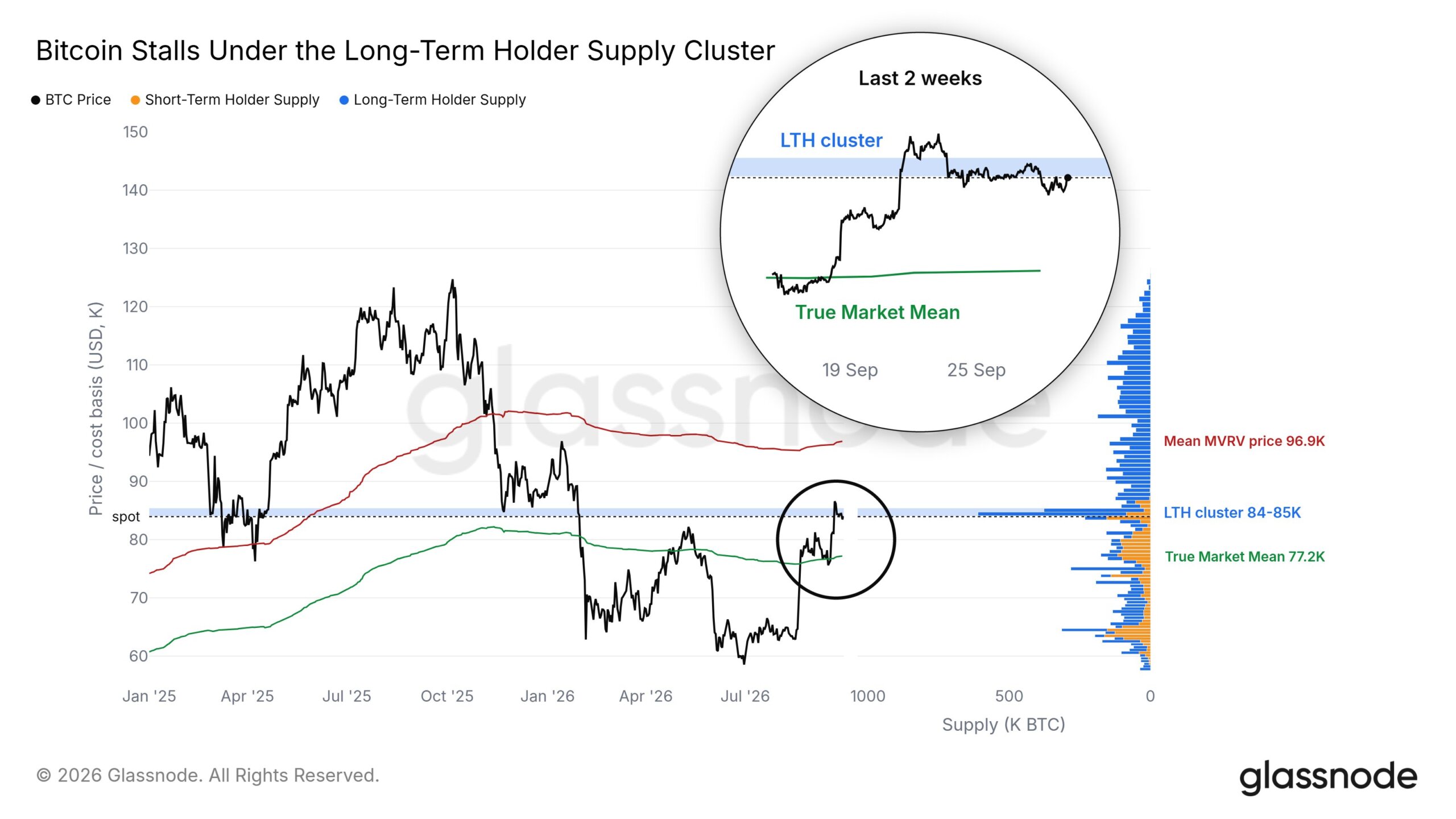
Glassnode said Bitcoin needs to break through the zone and hold above it for the rally to continue.
ETF demand has helped absorb that supply during the September advance. Glassnode said inflows supported last week’s roughly 4% gain even as perpetual-futures traders and profit-takers sold into the move.
The shrinking size of those inflows therefore leaves less institutional demand available as Bitcoin tests the supply cluster.
At roughly $84,000 per Bitcoin, Monday’s $31 million net inflow was equivalent in value to fewer than 400 BTC. By comparison, the nearly $1 billion entering the funds at the start of last week was equivalent to more than 11,000 BTC at similar prices.
ETF flows do not translate directly into an identical amount of same-day spot buying, but the comparison shows how sharply the marginal institutional bid has declined.
That puts the next several sessions in focus. A renewed pickup in ETF buying could help Bitcoin absorb supply around $84,000 to $85,000 and reopen the path higher. If inflows keep shrinking or turn negative, the cryptocurrency may struggle to clear the zone that has already stalled its latest advance.
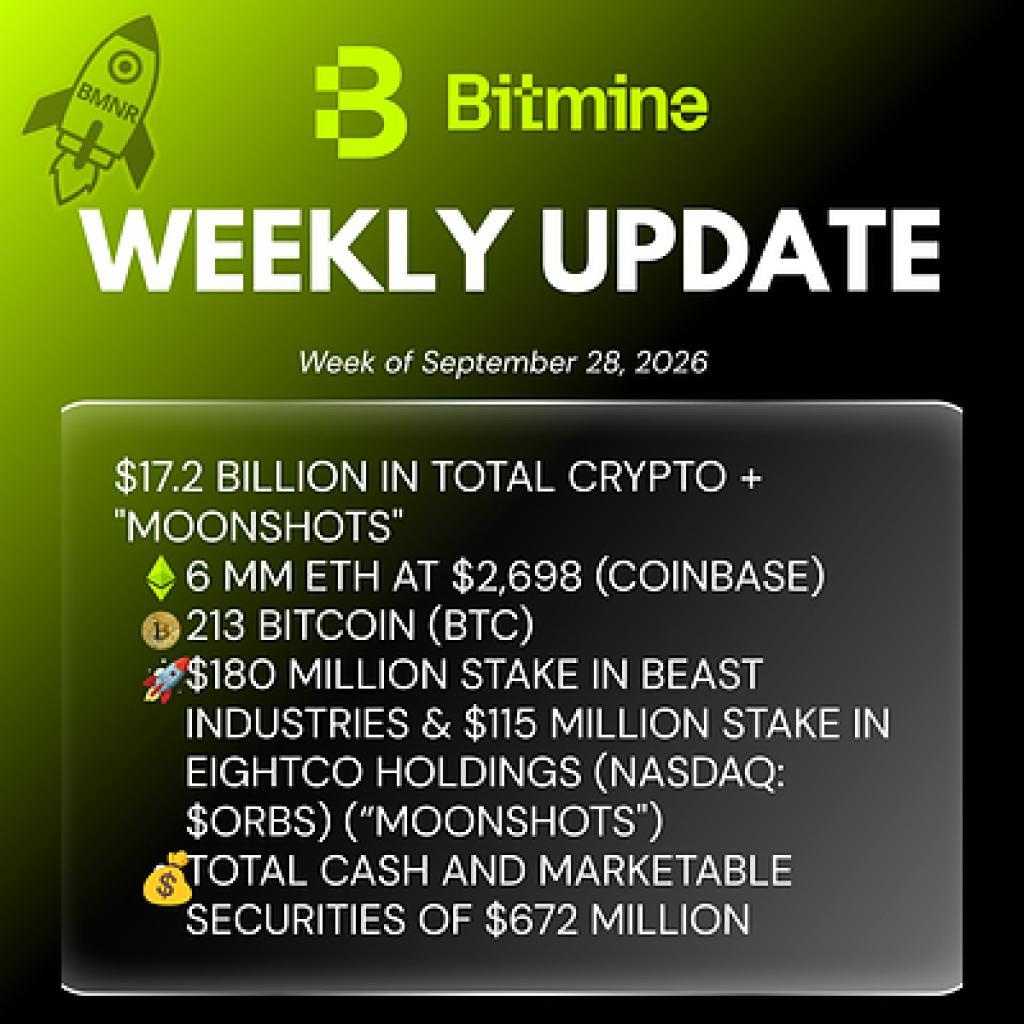
Bitmine owns 4.9% of the total ETH coin supply of 122.1 million
Bitmine is 98% of the way to the ‘Alchemy of 5%’ in just 15 months
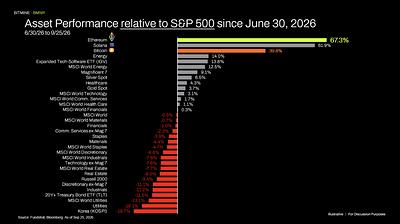
ETH is the best performing macro asset in Q3 of 2026 to date, outperforming the S&P 500 by 6,728bp
Tom Lee to deliver the keynote at KBW on September 30, 2026
Bitmine was added to the Russell 1000 Large-cap index on June 26, 2026
Bitmine’s Series A Preferred Stock is trading on the NYSE under the symbol BMNP
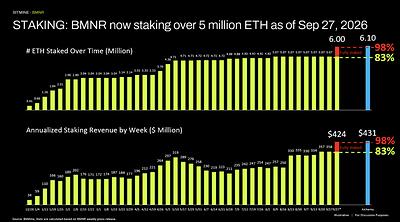
Bitmine has 5,067,309 staked ETH, representing $13.7 billion at $2,698 per ETH. MAVAN (Made in America VAlidator Network) is a premier Ethereum staking destination for BMNR and institutional investors
Bitmine owns $115 million of Eightco (NASDAQ: ORBS), now one of the only publicly listed equities in the world to provide investors indirect exposure to OpenAI
Bitmine Crypto + Total Cash Holdings & Marketable Securities + “Moonshots” total $17.2 billion, including over 6 million ETH tokens, total cash & marketable securities of $672 million, and other crypto holdings
Bitmine remains supported by a premier group of institutional investors including ARK’s Cathie Wood, MOZAYYX, Founders Fund, Bill Miller III, Pantera, Kraken, DCG, Galaxy Digital and personal investor Thomas “Tom” Lee to support Bitmine’s goal of acquiring 5% of ETH
NORWALK, Conn., Sept. 28, 2026 /PRNewswire/ — (NYSE: BMNR) Bitmine Immersion Technologies, Inc. (“Bitmine” or the “Company”) a Bitcoin and Ethereum Network company with a focus on the accumulation of crypto for long term investment, today announced Bitmine crypto + total cash & marketable securities + “moonshots” holdings totaling $17.2 billion.
As of September 27, 2026 at 3:00pm ET, the Company’s crypto holdings are comprised of 6,001,302 ETH at $2,698 per ETH (per Coinbase NASDAQ: COIN), 213 Bitcoin (BTC), $180 million stake in Beast Industries, $115 million stake in Eightco Holdings (NASDAQ: ORBS) (“moonshots”) and total cash & marketable securities of $672 million. Bitmine’s ETH holdings are 4.9% of the ETH supply (of 122.1 million ETH).
“Bitmine’s total ETH holdings now exceed 6 million. This is a tremendous achievement, accumulating this total in under 15 months. We are already seeing the synergies and positive network effects from our accumulating nearly 5% of ETH total supply.” stated Thomas “Tom” Lee, Chairman of Bitmine.
“Moreover, we continue to see affirming signs that a crypto bull market is underway, having started in late June. In our view, institutions are still underweight crypto and we expect them to be adding to their exposure in the final months of 2026. With only a little more than a week left in calendar third quarter (3Q26), the outperformance of Ethereum as a macro asset continues to strengthen. For the calendar quarter to date, ETH is outperforming by 6,728bp, dwarfing other macro assets.” stated Lee.
Tom Lee will also deliver the keynote at Korea Blockchain Week 2026 on September 30 at 11:20 a.m. (KST) at Walkerhill Hotels & Resorts in Seoul. The 25-minute keynote is part of Korea Blockchain Week, one of Asia’s leading blockchain and digital asset conferences. Additional information is available on the Korea Blockchain Week website.
“Over the past week, we acquired 17,362 ETH. Bitmine’s track record of consistent buying of crypto is unmatched by any public company in the world. Bitmine has bought ETH each and every week since the inception of the ETH Treasury Strategy on June 30, 2025,” stated Lee.
On July 16, 2026, Bitmine released the latest Chairman’s Message (link here) for July 2026, entitled “ETH is the cure for the Uncanny Valley of Wealth.”
Earlier in 2026, Bitmine launched MAVAN (the Made in America VAlidator Network), the institutional-grade staking platform. While MAVAN was originally developed to support Bitmine’s own Ethereum treasury, MAVAN has expanded to serve institutional investors, custodians, and ecosystem partners seeking best-in-class staking infrastructure. A portion of Bitmine’s ETH is already staked on the MAVAN platform.
As of September 27, 2026, Bitmine’s total staked ETH stands at 5,067,309 ($13.7 billion at $2,698 per ETH). “Bitmine has staked more ETH than other entities in the world. At scale (when Bitmine’s ETH is fully staked by MAVAN and its staking partners), the projected ETH staking reward would be $424 million on an annualized basis (using 2.62% 7-day BMNR yield),” stated Lee.
“Annualized staking revenues are now projected at $358 million. And this 5.1 million ETH is 84% of the 6.00 million ETH held by Bitmine. Bitmine’s own staking operations generated a 7-day yield of 2.62% (annualized),” continued Lee.
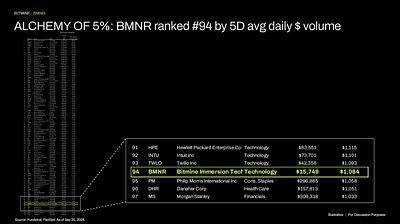
Bitmine is one of the most widely traded stocks in the US. According to data from Fundstrat, the stock has traded average daily dollar volume of $1.1 billion (5-day average, as of September 25, 2026), ranking #94 in the US, behind Twilio Inc (rank #93) and ahead of Philip Morris International (rank #95) among 5,704 US-listed stocks (statista.com and Fundstrat research).
Bitmine’s crypto holdings reign as the #1 Ethereum treasury and #2 global treasury, behind Strategy Inc., which reportedly owns 845,080 BTC valued at approximately $75 billion. Bitmine remains the largest ETH treasury in the world.
Bitmine management believes the GENIUS Act and the Securities and Exchange Commission’s (SEC) Project Crypto are as transformational to financial services in 2026 as the US action on August 15, 1971, which ended the Bretton Woods system and took the U.S. dollar off the gold standard 55 years ago. This 1971 event was the catalyst for the modernization of Wall Street, creating the iconic Wall Street titans and financial and payment rails of today. These proved to be better investments than gold.
The Chairman’s message can be found here:
https://www.Bitminetech.io/chairmans-message
The Fiscal Full Year 2025 Earnings presentation and corporate presentation can be found here: https://Bitminetech.io/investor-relations/
To stay informed, please sign up at: https://Bitminetech.io/contact-us/
About Bitmine
Bitmine Immersion Technologies, Inc. (NYSE: BMNR), together with its subsidiaries (“Bitmine” or the “Company”), is a blockchain technology infrastructure company operating across institutional digital asset staking and validation services, bitcoin mining, and strategic digital asset management. As the world’s leading Ethereum Treasury company, it implements an innovative digital asset strategy for institutional investors and public market participants. The Company provides institutional-grade staking and validation infrastructure—through which it earns staking rewards and validation income—alongside bitcoin mining activities. Bitmine holds digital assets strategically, generating yield on those holdings to support liquidity and capital formation. Since 2025, the Company has expanded its blockchain infrastructure capabilities, including developing and deploying MAVAN, its institutional staking and validation platform. The Company’s activities further include investments in early-stage blockchain opportunities (“moonshot” investments) and ancillary mining, hosting, and consulting services.
For additional details, follow on X:
Cautionary Note on Forward Looking Statements
This press release contains statements that constitute “forward-looking statements” within the meaning of the Private Securities Litigation Reform Act of 1995, as amended. Forward-looking statements include all statements that are not purely historical and can generally be identified by terms such as “expects,” “projects,” “intends,” “plans,” “believes,” “anticipates,” “estimates,” “forecasts,” “targets,” “goals,” “may,” “will,” “would,” “could,” “should,” “view,” “see,” or similar expressions, or the negative of such terms, or other comparable terminology. This press release specifically contains forward-looking statements regarding, among other things: (i) the Company’s goal of acquiring 5% of the total ETH supply (the “Alchemy of 5%” initiative) and statements that the Company is 98% of the way to achieving this goal in 15 months; (ii) the Company’s digital asset accumulation and treasury strategy, including statements regarding continued weekly ETH acquisitions since the inception of the ETH Treasury Strategy on June 30, 2025 and the Company’s status as the largest ETH treasury in the world; (iii) the Company’s staking operations, including projected annualized ETH staking rewards of approximately $424 million at scale (assuming Bitmine’s ETH is fully staked by MAVAN and its staking partners using 2.62% 7-day BMNR yield) and currently projected annualized staking revenues of approximately $358 million; (iv) MAVAN’s expansion to serve institutional investors, custodians, and ecosystem partners seeking best-in-class staking infrastructure, and its intended position as a premier Ethereum staking destination for BMNR and institutional investors; (v) statements regarding ETH’s performance as the best performing macro asset in Q3 2026 to date, outperforming the S&P 500 by 6,728bp; (vi) management’s belief that institutions are still underweight crypto and the expectation of institutional investors adding to their crypto exposure in the final months of 2026; (vii) management’s belief that a crypto bull market is underway, having started in late June; (viii) management’s belief that the GENIUS Act and SEC Project Crypto are as transformational to financial services in 2026 as the end of the Bretton Woods system in 1971 and that investments resulting therefrom will prove better than gold; (ix) statements regarding the Company’s investments, including that its investment in Eightco Holdings (NASDAQ: ORBS) provides investors indirect exposure to OpenAI and its $180 million stake in Beast Industries; and (x) statements regarding the value of the Company’s crypto, cash, marketable securities, and “moonshot” holdings, including aggregate holdings of $17.2 billion and ETH holdings representing 4.9% of the total ETH supply.
These forward-looking statements involve substantial risks and uncertainties that could cause actual results to differ materially from those expressed or implied. Factors that could cause or contribute to such differences include, but are not limited to: the extreme volatility and unpredictability of digital asset prices, including ETH and Bitcoin, and the speculative nature of digital asset investments; the risk that historical ETH price movements and relative performance versus other macro assets will not recur or are not indicative of future performance; the Company’s reliance on third-party pricing sources (including Coinbase) and reported market values in calculating the value of its crypto, cash, marketable securities, and “moonshot” holdings, and the risk that such values fluctuate materially after the date and time referenced in this release; changes in market conditions affecting the trading price and trading volume of the Company’s common stock and Series A Preferred Stock, and the risk that the Company’s inclusion in the Russell 1000 index does not produce anticipated benefits; the Company’s ability to successfully execute its digital asset acquisition strategy, continue its record of weekly ETH acquisitions, and achieve its ETH accumulation targets, including the “Alchemy of 5%” goal; the Company’s ability to finance its business operations, Ethereum treasury operations, and MAVAN expansion; operational, security, and technological risks associated with the Company’s staking and validation operations, including network failures, slashing events, cybersecurity breaches, and protocol changes; the risk that actual staking participation, yields, rewards, and revenues differ materially from the projected amounts described in this release, which are based on a 7-day yield and assume ETH is fully staked at scale; competition in the digital asset treasury, staking, and mining industries; the Company’s dependence on key personnel, including executive leadership; regulatory developments affecting digital assets, blockchain technology, and staking activities in the United States and globally, including the ultimate enactment, implementation, and interpretation of the GENIUS Act and other pending legislation and regulatory initiatives; actions by the SEC, CFTC, and other regulatory bodies affecting digital assets and related businesses; risks related to the Company’s investments in early-stage blockchain opportunities (“moonshot” investments), including the investments in Eightco Holdings (including the nature and extent of any indirect exposure to OpenAI) and Beast Industries; macroeconomic factors, including inflation, interest rates, Federal Reserve monetary policy, labor market conditions, war risks, rising yields, and general economic conditions affecting investor sentiment toward digital assets; the unpredictability of cryptocurrency market cycles and the accuracy of management’s expectations regarding institutional participation; changes to the Ethereum protocol, including staking mechanics, validator requirements, and reward structures; the performance of third-party service providers, exchanges, custodians, and staking partners; risks related to the concentration of the Company’s assets in digital currencies, particularly Ethereum; and the other risk factors described in the Company’s filings with the SEC.
The forward-looking statements contained in this press release are based on information available to management as of the date of this release and reflect management’s current expectations, estimates, forecasts, projections, views, and beliefs concerning future events and circumstances. Actual results may vary materially from those expressed or implied by forward-looking statements based on a number of factors, including those described above and in the Risk Factors section of the Company’s Annual Report on Form 10-K for the fiscal year ended September 30, 2025 filed with the SEC on November 21, 2025, the Company’s Quarterly Reports on Form 10-Q, and the Company’s other filings with the SEC, as amended or updated from time to time. Copies of these filings are available on the SEC’s website at www.sec.gov and on the Company’s website at https://Bitminetech.io/investor-relations/. The Company cautions readers not to place undue reliance on any forward-looking statements, which speak only as of the date on which they are made. Bitmine expressly disclaims any obligation or undertaking to update, revise, or supplement any forward-looking statements to reflect any change in its expectations or any change in events, conditions, or circumstances on which any such statements are based, except as required by applicable law or regulation.
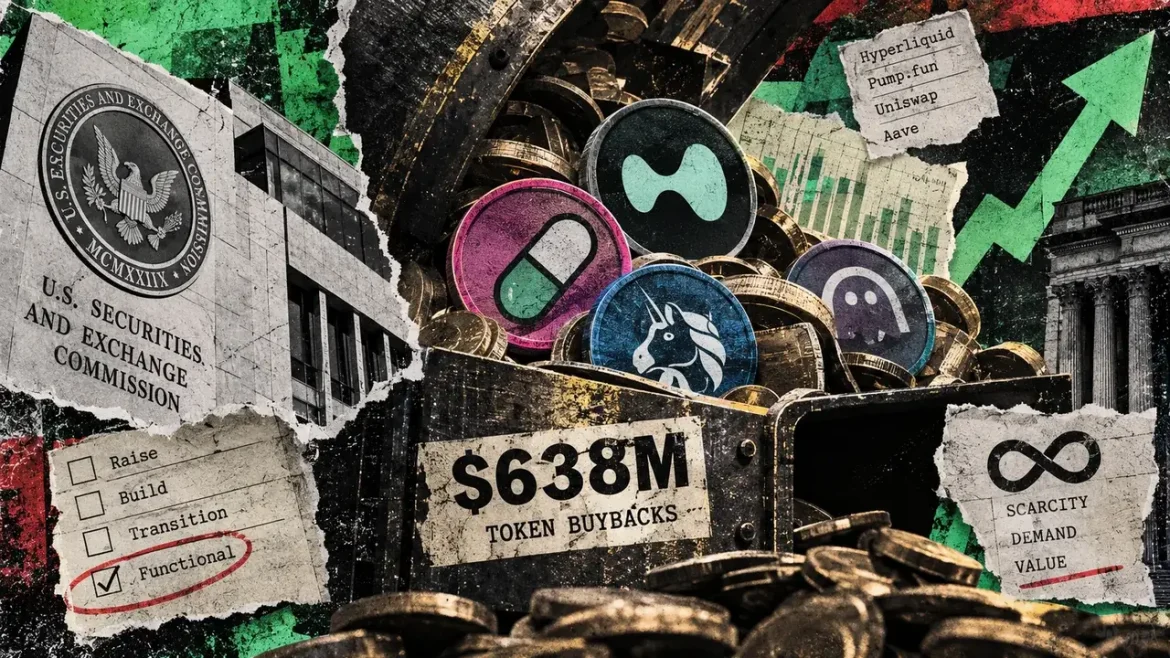
Crypto projects spent about $638 million with token buybacks through late August 2026, according to Allium Labs data.
That is already a record, up from $545 million over the same stretch of 2025. Hyperliquid accounted for roughly $370 million and Pump.fun for about $200 million, together close to 90% of the total.
On Sept. 25, staff at the Securities and Exchange Commission (SEC) addressed the legal tension that has shadowed those programs since they began. The more openly a project ties its token to business returns, the easier it becomes to argue that holders are investing in a security.
The SEC’s Division of Corporation Finance addressed buybacks in a new set of crypto FAQs covering networks that are already functional.
Staff said an issuer’s buyback announcement for a non-security crypto asset on such a network falls outside the promises of “essential managerial efforts” at the center of the Howey test for investment contracts.
The same answer warns younger projects that on a network yet to reach functionality, pitching a buyback as a source of yield or returns can feed into an investment-contract analysis.
The answer rests on two built-in assumptions, a functional system and a token that already sits outside securities law, and it carries the weight of staff views, which the SEC describes as lacking legal force.
Under the agency’s March interpretation, a network counts as functional when its native token can be used according to its programmed utility.
The SEC’s March interpretation says a token can be sold as part of an investment contract while a team raises money against promises of managerial work. That contract can end once buyers stop expecting profits from those promised efforts.
The pending Regulation Crypto Assets proposal would let projects raise up to $5 million over four years under a startup exemption. A larger fundraising exemption would allow up to $75 million every 12 months, with disclosure requirements attached to both.
Proposed Rule 400 adds a transition filing, the Form TR, in which an issuer certifies on EDGAR that it has completed or permanently ceased its promised managerial efforts and stopped making new ones.
The issuer files it directly, and the agency could later contest whether the conditions were met. In its paperwork estimates, the SEC assumes about 475 issuers a year could rely on that safe harbor, based on 15% of the roughly 3,165 projects launched in 2024. Comments on the proposal close Oct. 20.
Put together, the pieces sketch a path from securities-regulated fundraising to a mature network that can spend real revenue on its own token. The Form TR covers projects that abandoned their roadmaps as well as those that finished them, while the buyback FAQ applies only once a network is functional.
That structure rewards teams that define their build as a finite list of milestones they can eventually complete, and it discourages marketing that frames buybacks as returns before the product works.
| Stage | Regulatory position | What the project can do | Key constraint |
|---|---|---|---|
| Raise | Token sold as part of an investment contract | Raise capital against promised managerial work | Securities-law obligations attach to the fundraising arrangement |
| Build | Promised essential managerial efforts continue | Develop network and deliver disclosed milestones | Marketing returns or buybacks can contribute to Howey analysis |
| Transition | Promised efforts completed or permanently ceased | Proposed Form TR documents the transition | SEC can later challenge whether conditions were actually satisfied |
| Functional network | Token can perform its programmed utility | Operate without the original investment contract necessarily continuing | Token’s status still depends on facts and circumstances |
| Mature buybacks | SEC FAQ assumes a functional network and non-security token | Announce revenue-funded token repurchases | Buyback announcement alone is not an essential-managerial-efforts promise |
Pump.fun says half its revenue goes to buying and permanently burning PUMP. Its dashboard shows roughly $500 million in annualized revenue, about $462.5 million in cumulative purchases, and 167.7 billion tokens destroyed, equal to 16.8% of the original supply.
At the current run rate and allocation, that implies around $250 million in annual purchases,
about 6.4% of Pump.fun’s displayed $3.91 billion fully diluted valuation. The figure measures purchasing power against valuation, with the cash going into open-market token purchases.
Hyperliquid has bought and burned roughly $1.3 billion of HYPE since launch, and its documentation says more than $1 billion in annualized fees now flows into programmatic HYPE purchases.
Uniswap switched on protocol fees on Ethereum mainnet in December 2025 and has since extended them to other chains, with outside searchers collecting accumulated fees only by burning UNI in exchange.
Hyperliquid funds staking rewards from a reserve of future emissions even as trading fees burn HYPE. A protocol that burns 5% of supply while issuing 8% through emissions and unlocks ends up diluting holders despite a large headline buyback.
A more useful measure for these tokens is net burns against new issuance before comparing the result to valuation.
Aave’s program shows how quickly treasury needs can override a buyback. It acquired more than 205,000 AAVE, about 1.28% of supply, for roughly $42 million in its first ten months.
Governance then debated cutting the annual budget from $50 million to $30 million as revenue softened. The DAO paused purchases on April 19, after the rsETH bridge incident, to preserve balance-sheet flexibility.
Crypto’s record remains small next to Wall Street, where S&P 500 companies spent $1.02 trillion on repurchases in the 12 months through September 2025. The growth pace sets crypto apart, rising from about $366,000 in 2024 to $638 million in under eight months of 2026, with mechanisms that automatically convert revenue into market purchases.
| Protocol | Buyback / burn mechanism | Scale cited in article | What can offset or interrupt it |
|---|---|---|---|
| Pump.fun | 50% of revenue allocated to open-market PUMP purchases and permanent burns | ~$500M annualized revenue; ~$462.5M cumulative purchases; 167.7B PUMP destroyed | Revenue declines; future token issuance/unlocks |
| Hyperliquid | Trading fees fund programmatic HYPE purchases and burns | ~$1.3B bought and burned since launch; >$1B annualized fees flowing toward purchases | Staking rewards and future emissions can offset supply reduction |
| Uniswap | Protocol fees accumulate; searchers obtain assets by burning UNI | Fee mechanism active since Dec. 2025 and expanded across chains | Governance controls fee deployment and future mechanism |
| Aave | Treasury-funded open-market AAVE purchases | >205,000 AAVE / ~$42M in first ten months | Treasury needs; program paused after rsETH incident |
The rights attached to these tokens remain thin. Uniswap’s documentation says value reaches UNI holders through the burn mechanism and whatever future mechanisms governance approves, with protocol revenue staying under the protocol’s control.
The SEC’s March interpretation describes digital commodities as assets whose holders lack any inherent right to passive yield, future income, or profits. A buyback can reduce supply and create steady demand, and governance can redirect or pause it at any point.
The same distance from securities law that makes a mature token easier to trade also keeps it apart from the cash flows investors use to value it.
Bitcoin, which the SEC lists as a digital commodity, runs without an issuer or protocol revenue to recycle, so revenue multiples and buyback ratios apply to tokens like HYPE, PUMP and UNI.
If the SEC finalizes Regulation Crypto Assets close to its current form, teams can raise money under the exemptions, write finite roadmaps, file transition reports, and steer revenue into token purchases once their networks work.
Hyperliquid’s fee flows and Pump.fun’s allocation alone point to industry buybacks above $1 billion a year at current run rates. Revenue and dilution-adjusted buyback yield would become standard tools for valuing protocol tokens.
| Feature | Public-company shareholder | Mature protocol token holder |
|---|---|---|
| Ownership claim | Equity ownership in corporation | Generally no ownership of protocol/company merely from holding token |
| Right to profits | May receive distributions if declared; residual corporate rights defined by securities/corporate law | No inherent right to future protocol income or profits |
| Buyback effect | Company purchases outstanding shares | Protocol/DAO purchases or burns tokens, potentially reducing supply or adding market demand |
| Guaranteed buybacks? | No | No |
| Who can change the program? | Board/company subject to corporate and securities-law constraints | Governance, protocol rules or other authorized actors depending on design |
| New issuance can offset purchases? | Yes, through new share issuance/compensation | Yes — emissions, incentives and unlocks can overwhelm burns |
| Claim on underlying revenue | Share represents equity rights in the company | Buyback-linked token may have no contractual claim on the revenue funding purchases |
| Useful valuation metric | Earnings, free cash flow, buyback yield, dilution | Protocol revenue, gross buybacks and net issuance/dilution |
If the proposal stalls or emerges in weaker form, the nonbinding staff FAQ becomes the main source of comfort, and projects would keep return language out of their marketing while treating buybacks as discretionary.
Revenue-linked programs shrink mechanically when revenue falls, and a major exploit or bad-debt event could push other treasuries to conserve funds the way Aave did. Holders would then find that a buyback resembles a shareholder return in its market effect while remaining revocable, governance-dependent, and free of any contractual claim.
The SEC is building a route for crypto networks to spend their revenue on their tokens. Holders at the end of that route own an asset tied to a business’s success through scarcity and demand, while the business’s revenue stays with the protocol.

The US Department of Justice wants to keep $84.2 million that, according to a civil forfeiture complaint, moved through accounts used to process payments for Tether.
The complaint, filed July 15 in the Eastern District of California before Judge Dale A. Drozd, targets Capstone Ltd., a Montana-based payments firm. According to the complaint, Capstone operated as an unlicensed money transmitter—a business category regulators require a license for specifically because it moves other people’s money—in at least six states, and presented itself to banks as an ordinary IT services company.
Capstone’s owners, identified as Kotaro Shimogori and Mary Jeanne Thompson, are named in the complaint while the FBI executed a search warrant at a Sacramento residence. Their attorney said the company “denies any wrongdoing” and hopes to “resolve this matter quickly,” according to the Financial Times.
Of the $84.2 million at stake in the forfeiture, $79.11 million came out of a Wells Fargo Securities account in Capstone’s name on September 14. Civil forfeiture is a legal process that lets the government seize funds tied to an alleged crime without a criminal conviction against the money’s owner.
Another $2.06 million sat at JPMorgan Chase, $1.86 million in a separate Wells Fargo account, and just over $1.1 million was split across two wallets holding USDT, Tether’s stablecoin—a crypto token built to always trade for one dollar.
Behind Capstone sits EQIBank, a Dominica-licensed digital bank that prosecutors say directed how the processor moved money. EQIBank has already warned that losing those funds—roughly 80% of everything the bank holds—could push it into liquidation.

BitcoinBTC · USD
$84,180+3.65%
Sep 19Sep 21Sep 22Sep 24Sep 26
$87.2k$84.9k$82.6k$80.3k
24h HighHigh$85,208
24h LowLow$83,230
VolVol$1.2B
Market projectionsOdds by Myriad
 →
Tether confirmed EQIBank handled its USDT purchase and redemption transfers, but insisted it had “no knowledge of the conduct by Capstone alleged by the Department of Justice,” in a statement provided to Reuters. A spokesperson put total exposure at under 0.034% of group assets—a share that feels like nothing against the $187.75 billion in assets Tether reported at the close of the second quarter.
This isn’t the first time Tether and its sister company Bitfinex have landed in a prosecutor’s crosshairs over how they move money. In 2021, both companies reached a settlement with the New York Attorney General after admitting USDT wasn’t always backed dollar-for-dollar as advertised, paying an $18.5 million fine and agreeing to stop trading in the state.
Capstone and EQIBank have already filed an innocent-owner defense over the seized funds. Under Supplemental Rule G, which governs these forfeiture cases, any claimant has 21 days to answer the government’s complaint once a formal claim is filed with the court.
Start every day with the top news stories right now, plus original features, a podcast, videos and more.

New York, New York, September 24th, 2026, Chainwire
Led by Left Lane Capital, the round will extend HIFI’s stablecoin settlement platform into tokenized capital markets and card issuance.
HIFI, the financial infrastructure company for stablecoin payments and tokenized assets, today announced $37 million in Series A funding led by Left Lane Capital. The financing will support the scaling of HIFI’s tokenized capital markets infrastructure and the expansion of its broader product suite, including stablecoin payments and card products.
HIFI was selected as a participant in DTCC’s July production trades using DTC-tokenized assets, alongside BlackRock, Goldman Sachs and Nasdaq. In September, the company announced a partnership with Visa to expand money movement and card capabilities using its stablecoin settlement platform, beginning with stablecoin-funded payouts to over 4 billion Visa cards worldwide.
HIFI’s infrastructure moves over $7 billion in annualized volume and has onboarded more than 10,000 businesses and 200,000 end users while its payment capabilities reach across 87 countries. Sumitomo, a Fortune Global 500 conglomerate, is rebuilding its cash management and trading operations on HIFI’s rails; Dapper is building new digital marketplaces on the platform; and Arival Bank is powering stablecoin payment experiences for its customers.
Citi projects the stablecoin market could reach $1.9 trillion by 2030, up from roughly $300 billion today, underpinning as much as $100 trillion in annual onchain settlement volume. Public equities are expected to lead capital markets onto that infrastructure, with Citi estimating approximately 3% of the U.S. equity market will be tokenized by the end of the decade. Rules for digital assets are arriving market by market rather than all at once, and each new jurisdiction adds its own banking partners, stablecoin issuers, payment networks and compliance requirements. HIFI absorbs that coordination so its customers can build once and operate across every rail and jurisdiction it supports.
“We think of settlement as one problem, not three,” said Zach Walsh, CEO of HIFI. “Whether it’s a stablecoin settling a payment, a tokenized receivable funding a card, or a tokenized security clearing a trade, the underlying event is identical: value moves and settles at the same instant, instead of moving now and settling days later. Payments, spending, and capital markets have historically needed separate infrastructure. We built one layer that solves it for all three.”
“The growth HIFI has demonstrated reflects both the strength of the team and the speed at which stablecoins have become a core part of global financial infrastructure,” said Matthew Miller, Managing Partner at Left Lane Capital, which led HIFI’s Series A. “HIFI is building an important layer in that market, giving developers the infrastructure to create products that can operate across networks and borders. We believe HIFI will become a foundational platform for the next generation of financial applications.”
About HIFI
Founded in 2022, HIFI is a New York-based financial technology company building entirely new infrastructure for money in the internet economy. Its composable API platform enables developers, fintechs and global businesses to build next-generation financial products that move, convert, route and program value across stablecoins, bank rails and payment networks through a single integration. HIFI brings together global money movement, programmable controls, compliance and settlement infrastructure, allowing companies to build products with tokenized money. HIFI’s infrastructure serves over 10,000 businesses and 200,000 end users today, with payouts supported across 87 countries.
Users can learn more at HIFI.com.
About Left Lane Capital
Founded in 2019, Left Lane Capital is a New York and London-based venture capital and growth equity firm investing in high-growth internet and consumer technology businesses globally. Left Lane’s mission is to partner with extraordinary entrepreneurs who create category-defining companies across growth sectors of the economy. Select investments include Bilt Rewards, Lemfi, Kast, M1 Finance, Wayflyer, Talkiatry, Blank Street, and more.
For more information, users can visit www.leftlane.com.
Jon Phillips
PhillComm Global
HIFI@PhillComm.Global


