Crypto infrastructure providers are drawing renewed investor interest as Wall Street deepens its push into digital assets.


 Live Chat
Crypto infrastructure providers are drawing renewed investor interest as Wall Street deepens its push into digital assets.
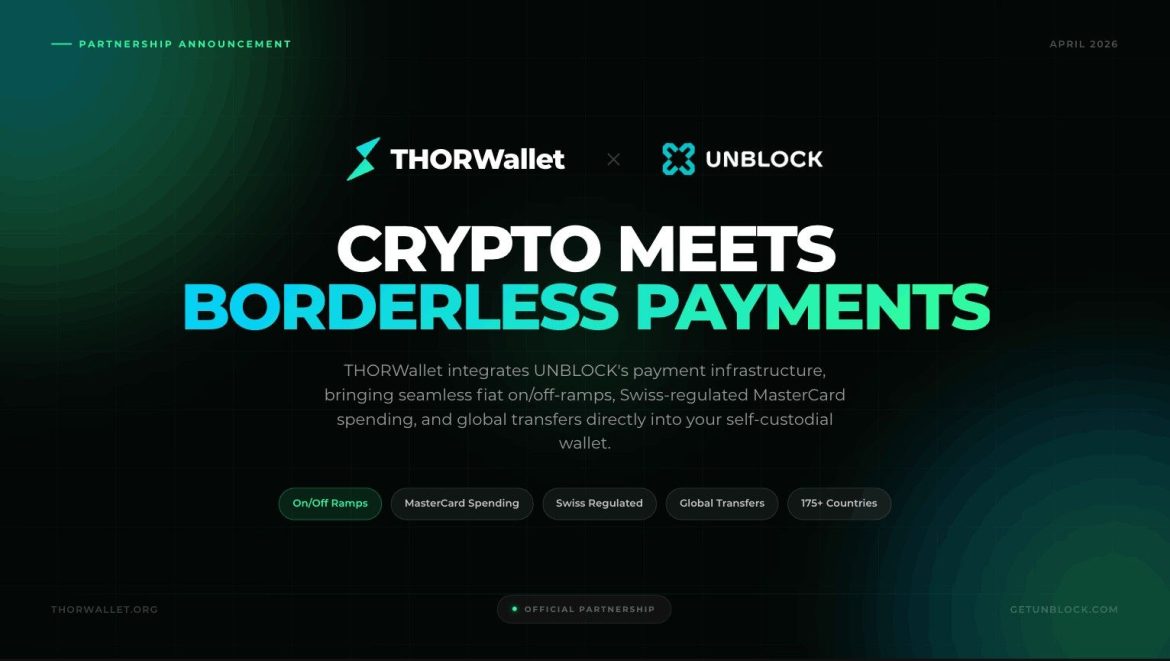
The Web3 neobank narrative is accelerating fast. Stablecoins, crypto cards, self-custody finance and stablecoin settlements are moving from niche crypto products into everyday payment infrastructure. Recent market activity shows how serious traditional payment networks and fintech players have become about stablecoin-powered finance, with global payment companies increasingly investing in crypto settlement, wallet infrastructure and digital asset payment rails.
THORWallet is now taking another major step in this direction through a strategic partnership with Unblock, a Swiss-regulated payment infrastructure provider with a global footprint across Switzerland, Latin America, and the United States.
Rather than choosing one of the larger established crypto card players such as ether.fi or Kulipa, THORWallet selected Unblock for a very specific reason: flexibility, regulatory alignment, and global reach.
Unblock is headquartered in Switzerland, operates under a Swiss regulatory framework and maintains offices in Panama, Medellin, and Miami. This international setup allows the company to support efficient card issuance and delivery across more than 175 countries, giving THORWallet the ability to serve users in almost every region of the world.Unblock is headquartered in Switzerland, operates under a Swiss regulatory framework and maintains offices in Panama, Medellin, and Miami. This international setup allows the company to support efficient card issuance and delivery across more than 175 countries, giving THORWallet the ability to serve users in almost every region of the world. With this extensive reach, we are uniquely positioned to scale globally with speed and efficiency, reaching users in markets that remain inaccessible to most competitors.
For THORWallet, the partnership is especially strategic because it is Unblock’s first non-custodial wallet partnership. This means both teams can build the product from a clean slate, instead of adapting THORWallet to an existing custodial model. The result is significantly more flexibility around user experience, card functionality, stablecoin rails and future premium features.
THORWallet was among the first wallets to offer a real non-custodial Mastercard experience. With Unblock, the company is now expanding that offering into a much broader global payment and remittance product.
The vision is clear: allow users to hold assets in self-custody, access stablecoin rails and spend through virtual and physical Mastercard products almost anywhere in the world.
For users in emerging markets, freelancers, digital nomads, crypto native teams and global businesses, this combination could become especially powerful. Stablecoins already provide fast global settlement. Mastercard acceptance adds everyday usability. THORWallet’s non-custodial infrastructure keeps users in control of their assets.
Together, THORWallet and Unblock aim to turn crypto from something users hold into something they can actually use daily.
As stablecoin payments continue to gain traction and Web3 neobanks become one of the strongest narratives in crypto, THORWallet’s partnership with Unblock positions the company to become a global payment and remittance powerhouse built on self-custody, stablecoins and real-world card access.
THORWallet is a Swiss-based non-custodial DeFi wallet built to bring on-chain finance to everyday users.
The platform combines self-custody, cross-chain swaps, DeFi access, stablecoin rails and card-based spending in one mobile-first application. THORWallet allows users to swap native assets across multiple blockchains without relying on wrapped assets, centralized exchanges or traditional bridge infrastructure.
Since launching, THORWallet has positioned itself as one of the leading mobile gateways for cross-chain DeFi, giving users access to protocols such as THORChain, Maya Protocol and other decentralized liquidity networks. The app also offers real-world finance features, including Swiss IBAN account access, crypto card functionality and DeFi yield opportunities.
THORWallet’s long-term vision is to become a self-custodial on-chain finance platform where users can hold, swap, earn and spend digital assets globally while remaining in control of their funds.
Unblock is a Swiss regulated payment infrastructure provider building crypto enabled financial services for users and businesses worldwide.
Headquartered in Switzerland, with offices in Panama, Medellin and Miami, Unblock combines regulatory alignment with international operational reach. Its infrastructure supports fiat and crypto payment flows, card issuance and global distribution across more than 175 countries.
Unblock provides the payment and card infrastructure needed to connect digital assets with real world spending. Through its global setup, Unblock enables partners to launch virtual and physical card products, support stablecoin based payment flows and reach users across both developed and emerging markets.
Through its partnership with THORWallet, Unblock is entering the non custodial wallet sector for the first time, helping build a new generation of payment products where users can access global spending infrastructure while maintaining self custody of their assets.
The post THORWallet Partners with Unblock to Expand Global Non-Custodial Mastercard Access appeared first on BeInCrypto.
The partnership aims to enable settlements using the Ripple USD (RLUSD) stablecoin for Mastercard and WebBank payments.
Ripple has announced that it is collaborating with Mastercard, WebBank, and Gemini to explore the use of its RLUSD stablecoin on the XRP Ledger (XRPL).
The initiative is designed to enable RLUSD to make blockchain-based payments between Mastercard and WebBank.
Sherri Haymond, Mastercard’s Global Head of Digital Commercialization, said in a November 5 press release that the goal is to use its global network to help bring regulated stablecoin payments into the financial mainstream.
“Guided by our commitment to consumer choice and a principled approach to stablecoins, one that emphasizes strong consumer protections, a level playing field, and full regulatory compliance, we’re enabling settlement today while exploring how stablecoins can support future use cases,” she noted.
Once implemented, it will mark one of the first collaborations where a regulated U.S. bank clears traditional card transactions using a regulated stablecoin on a public blockchain. This effort also expands on Ripple’s existing work with Gemini and WebBank on the Gemini Credit Card, which launched an XRP edition earlier this year.
WebBank President and CEO Jason Lloyd stated that banks are well-positioned to integrate blockchain technology with the traditional financial system. He explained that the collaboration enables their firm to explore how stablecoins can facilitate faster and more efficient institutional payments while maintaining the security that customers expect.
In the coming months, the group will begin initial RLUSD onboarding on XRPL after receiving the necessary regulatory green light and will start integration planning within the existing Mastercard and WebBank remittance systems.
Ripple highlighted how XRPL’s low costs, rapid processing, and a decade of reliable performance provide a trusted foundation for digital transactions. On the other hand, XRP also helps secure the network and supports efficient transactions as new assets, such as RLUSD, expand their use.
The announcement comes as the XRP Ledger continues to show growth in network activity. During the third quarter of 2025, average daily transactions increased by 8.9% from 1.6 million in Q2 to 1.8 million in Q3. The total number of addresses on the network also grew by 6.1% to reach 6.9 million. RLUSD has also surpassed a market capitalization of $1 billion per CoinGecko data, more than doubling in just three months after rising from $400 million in August.

Circle, the world’s second-largest stablecoin issuer, launched the public testnet for Arc, its open layer-1 blockchain network built to bring global financial infrastructure onchain.
The rollout, which Circle calls the “Economic Operating System for the internet,” includes participation from over 100 major companies spanning banking, capital markets and fintech — among them BlackRock, Goldman Sachs, Visa, Mastercard and State Street, according to a Tuesday announcement.
“With Arc’s public testnet, we’re seeing remarkable early momentum as leading companies, protocols, and projects begin to build and test,” Circle CEO Jeremy Allaire said. “Combined, these companies reach billions of users, move, exchange, and custody hundreds of trillions in assets and payments,” he added.
Arc is designed to provide predictable US dollar-based fees, sub-second finality and optional privacy controls, directly integrating with Circle’s USDC (USDC) stablecoin and payments stack. It aims to support a broad range of financial applications, from lending and capital markets to global payments and foreign exchange (FX).
Related: ClearBank to become one of first EU banks to join Circle Payments Network
The testnet launch has drawn engagement from major institutions such as Apollo, BNY Mellon, Intercontinental Exchange and Deutsche Bank, as well as global payment firms Mastercard, FIS, Paysafe and Nuvei.
Circle said Arc’s purpose-built architecture connects local markets across continents, from Africa to the Americas and Asia, offering enterprise-grade infrastructure for both traditional financial institutions and Web3-native projects.
Another important feature of Arc is its role in stablecoin infrastructure. The network supports fiat-pegged tokens, tokenized funds and FX liquidity. Issuers from seven countries, including JPYC (Japan), BRLA (Brazil), MXNB (Mexico) and PHPC (Philippines), have joined the testnet.
Arc’s ecosystem extends beyond finance, integrating with leading developer and infrastructure providers such as MetaMask, Fireblocks, Chainlink, Alchemy and LayerZero, alongside crosschain bridges like Wormhole and Stargate.
AI integration is also on the roadmap, with Anthropic’s Claude Agent SDK enhancing the developer experience through AI-powered tools.
Related: Tempo, Stripe’s new blockchain, hits $5B valuation in $500M funding round
Allaire said Arc is “purpose-built to connect every local market to the global economy,” adding that it presents the opportunity for every type of company to “build on enterprise-grade network infrastructure.”
Circle said the long-term goal is to transition Arc into a community-governed network, expanding validator participation and establishing transparent governance.
Circle announced plans to launch Arc in August. At the time, the company said the network was set to use USDC as its native gas token. Last week, Allaire also announced that Circle is building private stablecoins on Arc.

Magazine: Back to Ethereum — How Synthetix, Ronin and Celo saw the light


