The expansion gives institutional and automated traders real-time access to Kalshi’s political markets as election betting activity continues to grow.

 Live Chat

The expansion gives institutional and automated traders real-time access to Kalshi’s political markets as election betting activity continues to grow.
Global markets whipsawed last week on a hot US labor report, persistent oil price pressure and steep single-stock declines in Tesla and Lululemon.
Zoomex, a leading global derivatives exchange built around user-friendly design, transparent balance and rule mechanisms, and fair access to legitimate earnings, is highlighting a week of sharp market swings as an example of the kind of environment its platform was purpose-built to serve. From a surprise US jobs print to oil market tension and double-digit drops in major US equities, this week offered traders no shortage of opportunity, and Zoomex users had a refined, easy to use venue ready to help them respond in real time.
The US economy added 162,000 jobs in August, nearly three times the 53,000 economists had forecast. The number forced a rapid repricing of Federal Reserve expectations, as investors weighed the possibility that a labor market running this hot could keep the Fed from cutting rates, or even push it toward another hike. Stock indices slid into the end of the week and the yield on the 10-year US Treasury climbed above 4.78%, tightening financial conditions across the board.
Source: Fool
This is precisely the type of macro shock that moves crypto derivatives markets alongside equities, and it is where Zoomex’s focus on derivatives, rather than a scattered product lineup, gives traders an edge. On Zoomex, users can react to shifting rate expectations through BTC and ETH perpetual contracts with adjustable leverage, all executed under the same fair, rule-based system that applies equally to every account on the platform. There is no privileged order flow and no hidden mechanics, only transparent, verifiable execution that traders can rely on when headlines move fast.
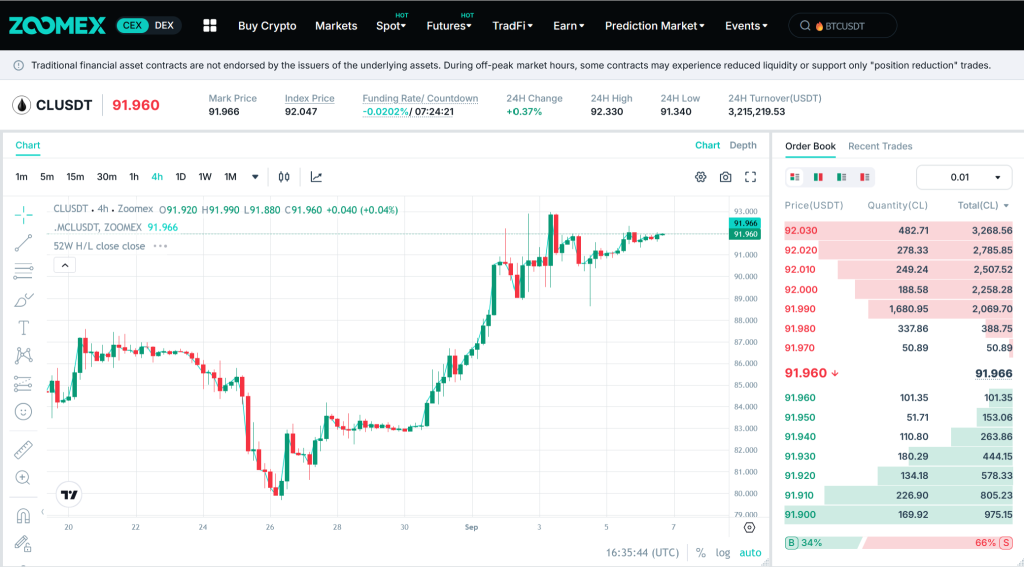
Crude oil held above $90 per barrel this week, supported by ongoing Middle East tensions and continued concern over the security of the Strait of Hormuz, a chokepoint for a large share of the world’s seaborne oil supply. Elevated crude prices remain one of the biggest inflation risks facing the global economy, and that uncertainty tends to ripple straight through into digital asset markets.
Source: Zoomex
Zoomex was built for moments like this. As a platform focused squarely on derivatives, Zoomex gives traders the tools to position around macro-driven volatility, whether that means going long or short on major crypto pairs or using Zoomex’s expanding suite of Stock Perpetuals to trade the broader market reaction directly. Every position is backed by Zoomex’s commitment to verifiable trust assets and transparent balance mechanisms, so users always know exactly what they are trading and on what terms.
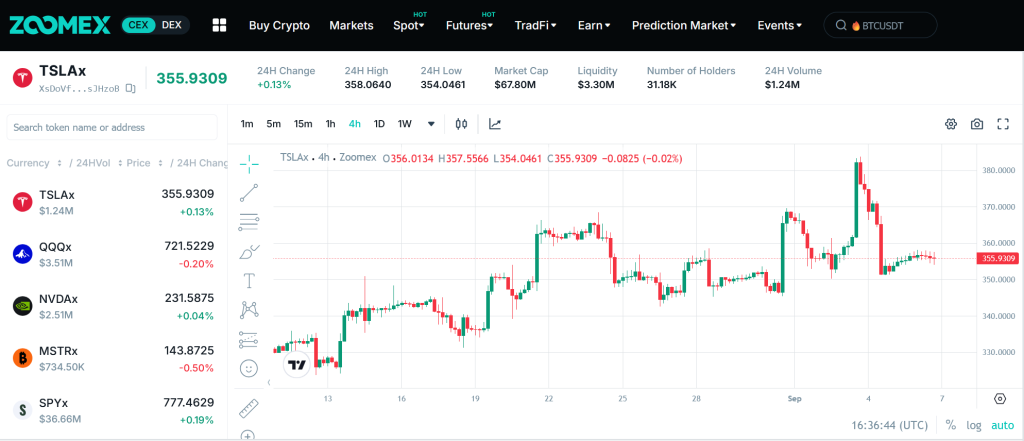
Tesla (NASDAQ: TSLA) shares dropped 6% this week after the National Highway Traffic Safety Administration confirmed a new investigation into the technical data and certification behind the company’s autonomous “Cybercab” vehicle. Regulatory scrutiny of Tesla’s self-driving ambitions has repeatedly moved the stock, and this latest probe was no exception.
Source: Zoomex
Rather than sitting on the sidelines, Zoomex users can trade Tesla’s price action directly through Zoomex Stock Perpetuals, one of the fastest-growing additions to the Zoomex product suite. Built with the same easy to use interface and refined trading experience found across the platform, Zoomex Stock Perpetuals let traders take a leveraged position on TSLA around news like this, with fair access and rule-based execution applied consistently to every order.
Between a hot jobs report, sustained oil price pressure and double-digit swings in major US stocks, this week was a reminder of how quickly markets can move and how much traders stand to gain, or lose, when they do. Zoomex was designed from the ground up to meet that moment: a platform focused on derivatives, easy to use for traders at any experience level, transparent by design in every balance and rule mechanism, and committed to fair access and rule-based execution for every single user.
Traders looking to act on this week’s volatility, whether through crypto derivatives, Zoomex Stock Perpetuals on names like TSLA and LULU, or other instruments across the Zoomex platform, can do so with the confidence that comes from verifiable trust assets and a trading experience refined for exactly this kind of market.
About Zoomex
Founded in 2021, Zoomex is a global cryptocurrency trading platform focused on derivatives trading. The platform serves over 3 million users across 35+ countries and regions, offering access to 700+ trading pairs. Built around easy to use, transparency, fairness, and speed, Zoomex provides a clear and efficient trading experience for users worldwide.
Through its high-performance matching engine, clear asset and order displays, and transparent fee and rule mechanisms, Zoomex helps users better understand their account status, order execution, trading costs, and results. Zoomex maintains registrations, licenses, and regulatory statuses across multiple jurisdictions, including the U.S. MSB, Canada MSB, U.S. NFA, and Australia AUSTRAC, and has completed security audits conducted by blockchain security firm Hacken. The platform also continues to strengthen its trust framework through Proof of Reserves, Security & Transparency, Compliance Information, and Fees / Rules Transparency initiatives.
Beyond trading, Zoomex builds a refined brand experience through elite sports partnerships, including the TGR Haas F1 Team, World Cup-winning goalkeeper Emiliano Martínez, and world-class tennis events such as Wimbledon. The values of speed, precision, discipline, fair play, and rule-based execution are closely aligned with Zoomex’s approach to derivatives trading.
At Zoomex: Easy to Use. Transparent balance. Fair access to your earnings.
Frequently Asked Questions
Singapore, Singapore, August 27th, 2026, Chainwire
TermMax, a fixed-rate lending protocol built by Term Structure Labs, announced on August 26 that it has received a strategic investment from YZi Labs. Terms were not disclosed.
TermMax was selected for YZi Labs’ EASY Residency Season 3 and has raised more than $8 million to date. Its earlier backers include Cumberland DRW — which led the 2023 seed round — HashKey Capital, Decima Fund, Longling Capital and MZ Web3 Fund.
The protocol has been live on mainnet since April 2025 and now runs across 10 EVM-compatible chains, with 60 fixed-rate markets, 40 strategy vaults, tens of millions of dollars in total value locked and more than 1.5 million registered wallets. Keyrock, Hardcore Labs, Edge Capital and Origami serve as Curators, managing strategy vaults on the protocol. The $TMX token completed its TGE on August 25.
The investor’s own public position points to the gap this investment is meant to fill. In an August 14 post describing what it wants to see built, YZi Labs wrote that tokenized blue-chip equities have reached meaningful volume, but that the financial application layer around them — credit, collateral management, risk transfer and structured products — remains underdeveloped, and that options and other risk-transfer products in particular remain conspicuously absent.
YZi Labs placed this investment precisely where that gap sits.
“When I left banking, there were a few hundred billion dollars of assets sitting on-chain without a single directly observable interest rate curve between them. In traditional markets, that would be unheard of. That is what made me decide to build this infrastructure on-chain.” – Jerry Li, Co-founder and CEO, TermMax.
Tokenized equities are the fastest-growing asset class on-chain, now at $2.48 billion, with holder count up 165% in 30 days.
TermMax integrated Ondo Global Markets in January 2026 to launch the first fixed-rate borrowing market to accept tokenized U.S. equities as collateral, then added Binance’s bStock. In August it went live on Robinhood Chain, where QQQ, SPY and NVDA can be posted against USDG.
But financing is only half of what tokenized equities need. Nearly all of this year’s tokenized-equity infrastructure has gone into perpetual futures, and almost none into options.
TermMax Alpha is where that changes: physical delivery options, with no liquidation before expiry. The conversion price is fixed when the position is opened, and the position is settled by physical delivery at expiry. A directionally correct position therefore cannot be knocked out by a few minutes of volatile trading in thin liquidity — the failure mode that makes perpetuals unsuitable at the illiquid end of tokenized equities.
This no-liquidation design rests on a choice running through the whole protocol: when liquidation does happen, it settles by physical delivery, with collateral delivered directly to the lender rather than sold into the market. The usual assumption — that collateral can be sold at fair value on demand — holds for ETH and fails for a tokenized equity with a few million dollars of depth.
On the institutional side, TermPrime completed its first live trade on Canton Network at the end of June and has since grown its counterparty network to nine institutions.
TermMax runs an early validator node on Canton, and TermPrime is ready to support lending business for institutions there through open markets.
TermMax holds a DeFiSafety Process Quality Review score of 93%, matching Aave V3.
“What we set out to do is not to teach traditional institutions DeFi. It is to let DeFi grow into something professional enough to genuinely serve finance.” – Jerry Li, Co-founder and CEO, TermMax.
What TermMax wants to be is not another lending protocol, but the on-chain interest rate curve itself.
About TermMax
TermMax is a fixed-rate, fixed-term borrowing and lending marketplace built by Term Structure Labs, live on mainnet since April 2025 and deployed across 10 EVM-compatible chains, where it runs 60 fixed-rate markets and 40 strategy vaults. The protocol splits debt into three tradable tokens: FT (principal), XT (interest and option value) and GT (an ERC-721 receipt for leveraged positions). Professional Curators set target APR ranges across isolated markets and manage strategy vaults, and liquidations settle by physical delivery of collateral. Co-founder and CEO Jerry Li has 25 years in global financial markets and served as Managing Director at Deutsche Bank, running fixed income and FX for Greater China.
Website: https://ts.finance/
About YZi Labs
YZi Labs manages over $10 billion in assets globally. Our investment philosophy emphasizes impact first — we believe that meaningful returns will naturally follow. We invest in ventures at every stage, prioritizing those with solid fundamentals in Web3, AI, and biotech. YZi Labs’ portfolio covers over 300 projects from over 25 countries across six continents. Some notable portfolios include Trust Wallet, CoinMarketCap, Polygon, Injective, Ethena, SafePal Wallet, Better Payment Network, Aster, XAI, and more. More than 65 of YZi Labs’ portfolio companies have gone through our incubation program, EASY Residency. For more information, follow YZi Labs on X (@yzilabs).
TermMax Marketing Team
hello@cipherdance.com

The CFTC is seeking public comment on how AI compute derivatives should be listed and overseen, including questions around liquidity, benchmark reliability, manipulation and customer protections, as Kalshi, CME, ICE, Polymarket US and Liquid Compute race to build markets around future computing costs
Polymarket US has self-certified a new class of contracts tied to the future price of artificial intelligence computing power, joining a growing race to build financial markets around one of the AI industry’s most important and expensive resources.
The filing comes as the Commodity Futures Trading Commission (CFTC) begins developing a regulatory framework for the emerging market. In a Bloomberg Television interview Thursday, CFTC Chair Michael Selig called compute “the most important commodity, I think, of our time” and “essentially a digital oil.”
“We want the prices to be discovered for this valuable commodity in the United States, the benchmarks to be here,” Selig said. “We’ve gotta have these markets here.”
Polymarket joins Kalshi, CME, ICE, Architect and prospective exchange Liquid Compute in pursuing different ways to trade or establish future prices for AI compute. The push comes as the CFTC’s new request for public comment raises questions about whether today’s fragmented and often opaque compute market is sufficiently liquid, standardized and resistant to manipulation to support a mature derivatives market.
AI compute refers to the processing capacity used to train and run artificial intelligence models. Much of the highest-value capacity today comes from GPUs, or graphics processing units, high-powered chips capable of performing huge numbers of calculations simultaneously. Nvidia‘s H100, H200 and newer B200 GPUs are among the chips most commonly used in large-scale AI infrastructure.
The emerging market is generally not about trading ownership of the chips themselves. AI companies, cloud providers and data-center operators buy or rent access to computing capacity, often priced by the GPU-hour, and the derivatives now being developed are designed to put a market price on what that access may cost in the future.
That could allow an AI company expecting to need large amounts of GPU capacity months from now to hedge against rising rental costs, while an infrastructure provider could manage the risk that future prices fall. The CFTC said in its request for comment that compute futures could aid risk management and price discovery and allow financial markets to “aggregate and reveal information about the future of the AI economy.”
Different exchanges are approaching that task in different ways. Conventional futures can track an index of GPU rental prices over time, while prediction market contracts can ask whether the price of a particular type of compute will be above or below a specified level on a future date. A series of contracts across different expiration dates can also be used to construct a forward curve, showing where traders collectively expect compute prices to be weeks or months ahead.
Selig put compute alongside prediction markets, crypto and other emerging products in his remarks at the CFTC’s Innovation Advisory Committee meeting Thursday, framing the initiative as “Winning the AI Race: Roadmap for Compute Market Dominance.” He tied the effort to the White House’s AI Action Plan, which calls for improving the financial market for compute to expand access to large-scale computing resources.
The CFTC is working with the Department of Commerce on that effort and plans to use feedback from its new request for comment to develop what Selig described as a “gold standard regulatory framework” for compute markets.
“Just as American markets helped establish the gold standard for trading the commodities that powered the industrial economy, we will do the same for the commodity that will power the intelligence economy,” Selig said in a separate statement Wednesday.
His Bloomberg comments a day later made clear that the objective extends beyond simply allowing exchanges to list new products. Selig said he wants the underlying price discovery and benchmarks established domestically, with compute trading on transparent U.S. markets and open order books.
“We’re working very hard together with Secretary (Howard) Lutnick and the Department of Commerce to set the standard here in the U.S.,” Selig said. “We want the best of the best, and we’re gonna lead in these markets.”
For all of Selig’s enthusiasm, the CFTC’s request for comment makes clear that regulators still see major challenges in turning compute into a mature derivatives market. The agency said compute pricing remains fragmented and is often set through “opaque bilateral transactions,” limiting the amount of public price data available to exchanges and regulators.
The Commission also questioned whether compute yet has the fungibility, standardization and liquidity typically associated with commodities underlying futures markets. Prices can vary widely depending on the GPU model, provider, region and contract terms, while dominant suppliers may have enough pricing power to influence the cash market or a benchmark derived from it.
One of the RFC’s sharpest questions asks whether trading should be permitted in a derivative whose settlement price relies on data the CFTC “may not be able to observe, verify, or surveil.” The agency is also asking what protections would prevent a compute provider from influencing an index by changing posted rates, directing capacity to or away from a venue or choosing whether to execute transactions during a settlement window.
The CFTC is seeking input on those issues along with customer protections, market surveillance and perpetual compute futures. Comments are due Oct. 20, after which Selig has said the agency will continue developing its regulatory framework for the market.
Polymarket US’s new filings cover binary contracts tied to future values of AI compute indexes. One specifically certified contract asks whether the Ornn Data H100 SXM GPU Price Index will be at least $2.50 per GPU-hour on March 15, 2027. A wider class certification would allow Polymarket US to list similar contracts tied to H100, H200, A100, RTX 5090 and B200 GPU indexes. The broader filing also covers Ornn indexes measuring the price of AI-model usage by the token.
The contracts can ask whether an index will be above, below, at least, at most, between or exactly a specified value at a future point. Polymarket said the products may be listed beginning Aug. 24, although it remains to be seen whether Polymarket will launch them immediately or whether the CFTC will intervene while its compute comment process is underway. That possibility is not purely theoretical: in July, the CFTC stayed a CME self-certified 24/7 crude-oil contract while a related agency comment process was underway.
Kalshi has been pursuing a related strategy. In July, the exchange said it was using weekly and monthly prediction markets extending as far as a year out to construct a compute forward curve, giving traders a view of where GPU rental costs are expected to move.
“We are using prediction markets to build the forward curve, which will provide the market a view of what compute costs will be in the future for different grades and time-frames of GPUs,” Kalshi Chief Risk Officer Udesh Jha told Bloomberg.
Jha said the curve could eventually support additional products, including futures and options. “It’s a key enabler for a lot of subsequent hedging, risk management and even speculative activities,” he said.
Prediction markets are only one part of the emerging competition. CME Group plans to launch H100 and B200 rental-index futures on Oct. 5, pending regulatory review, using benchmarks from Silicon Data. ICE has announced GPU compute futures based on Ornn indexes and a separate partnership with NATIVX for energy-normalized compute futures. Architect Financial Technologies is building a U.S. exchange for futures and options tied to GPU rental costs and other AI supply-chain inputs.
Another prospective exchange has been built around that idea from the start. DeFi Rate reported in February on the startup then operating as Pluto, whose pending designated contract market and clearinghouse applications are publicly listed under the names PMEX Markets and PMEX Clearing. The company has since rebranded as Liquid Compute, which describes itself as the “financial layer for AI compute” and is currently inviting market participants to request access while its U.S. exchange applications remain pending.
“The aim of the exchange is to turn compute into a financial asset just like oil, gold, (or) other commodities,” CEO Ronit Jain told DeFi Rate at the time. Liquid Compute has since highlighted an H100 OTC forward trade involving Wintermute and said this week that it is “live and booking swaps now.” The company has not publicly identified the entity or jurisdiction through which those transactions are being conducted.
The race now is to build the transparent, trusted pricing infrastructure needed for a mature AI compute market. The CFTC wants that market centered in the U.S., but its new comment process shows regulators are still deciding what standards those prices and products will need to meet.

Ted Hisokawa
Aug 21, 2026 19:38
Google’s Paige Bailey explains ‘full-stack AI’ as a cohesive system spanning infrastructure to user interfaces, signaling a trend in integrated AI platforms.
Google DeepMind’s Paige Bailey has clarified the meaning of ‘full-stack AI,’ a term gaining traction as tech companies push for more integrated artificial intelligence solutions. According to Bailey, full-stack AI encompasses five critical layers: infrastructure, security, research, models and tooling, and products, all working in tandem to enhance speed, security, and user experience. This approach underpins many of Google’s AI-driven offerings.
Google’s explanation, published on August 21, 2026, aligns with a broader industry trend of consolidating AI capabilities. Full-stack AI is increasingly seen as the gold standard for companies aiming to dominate the AI market. Unlike piecemeal offerings, a full-stack approach integrates every layer of the AI lifecycle—from compute infrastructure like GPUs and TPUs, to the user-facing applications that drive consumer and enterprise value. The goal is seamless operation and scalability.
Other tech giants are also adopting this strategy. AMD recently announced it is delivering a ‘full-stack compute’ solution optimized for the agentic AI era, combining CPUs, GPUs, networking, and software. HCLTech, meanwhile, is investing heavily in full-stack AI offerings, committing ₹3,500 crore (approximately $420 million) to build AI data centers.
For Google, the emphasis on full-stack AI is more than a technical achievement—it’s a statement of market positioning. By controlling every layer of the stack, from hardware to application interfaces, Google can ensure tighter integration, faster innovation, and broader applicability for its AI solutions. This positions the company as a one-stop shop for enterprises seeking holistic AI capabilities, a significant advantage as competition in the AI sector intensifies.
The full-stack approach also addresses increasing demand for agentic AI systems—models capable of autonomous decision-making and task execution. These systems require robust orchestration platforms and a tightly woven stack to function effectively, making integration a necessity rather than a luxury.
While Google hasn’t disclosed specific market metrics tied to its full-stack AI offerings, the company’s strategy reflects broader market dynamics. As AI adoption grows, enterprises are moving away from fragmented solutions toward unified platforms that reduce complexity and deliver faster time-to-value. Analysts expect this trend to accelerate as global AI spending, particularly in infrastructure and enterprise applications, continues to rise.
For developers and businesses, understanding full-stack AI isn’t just a matter of technical curiosity—it’s a glimpse into the future of how AI will be built, deployed, and monetized. With players like Google, AMD, and HCLTech doubling down on this approach, the shift toward integrated AI ecosystems is becoming a defining feature of the industry.
Image source: Shutterstock

Gen Z traders on Binance are allocating a growing share of their equity activity to exchange-traded funds (ETFs), with the products accounting for 25% of the cohort’s trading volume in early August, according to Binance Research.
ETFs accounted for 21.9% of Gen Z net equity inflows in July, up from 18.5% in June, while the share going to individual stocks fell to 74.2% from 77%.
The analysis examined activity across direct equities, tokenized stocks and traditional finance perpetuals, comparing Gen Z accounts with Millennials, Gen X and Baby Boomers on measures including trading frequency, net flows and leverage use.
The younger cohort traded less frequently than other working-age generations across all three products. Gen Z averaged 13 monthly trades in TradFi perpetuals, compared with 17 for Millennials and 16.5 for Gen X.
Among Gen Z direct-equity accounts, 22% had never placed a sell order, compared with 19% of Gen X accounts and 9% of Baby Boomer accounts. Millennials had the highest share of buy-only accounts at 30%. Among those Gen Z buy-only accounts, top assets by cumulative purchases included Broadcom, Tesla and the Schwab US Dividend Equity ETF, according to Binance.
Net buyers by generation and product. Source: Binance
Gen Z also showed relatively little appetite for leveraged and inverse ETFs; 88.2% of Gen Z TradFi perpetual accounts recorded no activity in those products, compared with 84.5% of Millennials and 85.9% of Gen X.
Binance cautioned that its direct-equities product only reached meaningful scale in June, leaving a relatively short data window for establishing longer-term trends.
Related: Binance to restrict transactions involving HTX, 10 other crypto platforms
Binance’s bStocks briefly overtook Kraken’s xStocks as the second-largest tokenized stock issuer this week, less than two months after launching. As of Tuesday, bStocks held $610.6 million in tokenized stock value, compared with $601.2 million for xStocks, according to Token Terminal data.
The positions had reversed by Friday, with Token Terminal showing xStocks at $610.7 million and bStocks at $579.6 million, representing 22.3% and 21.2% of the roughly $2.7 billion market, respectively. Ondo Finance remained the largest issuer at $971.8 million.
The broader tokenized stock market has continued to expand, with RWA.xyz tracking $2.43 billion in distributed value as of Friday, up about 5% over the past 30 days.
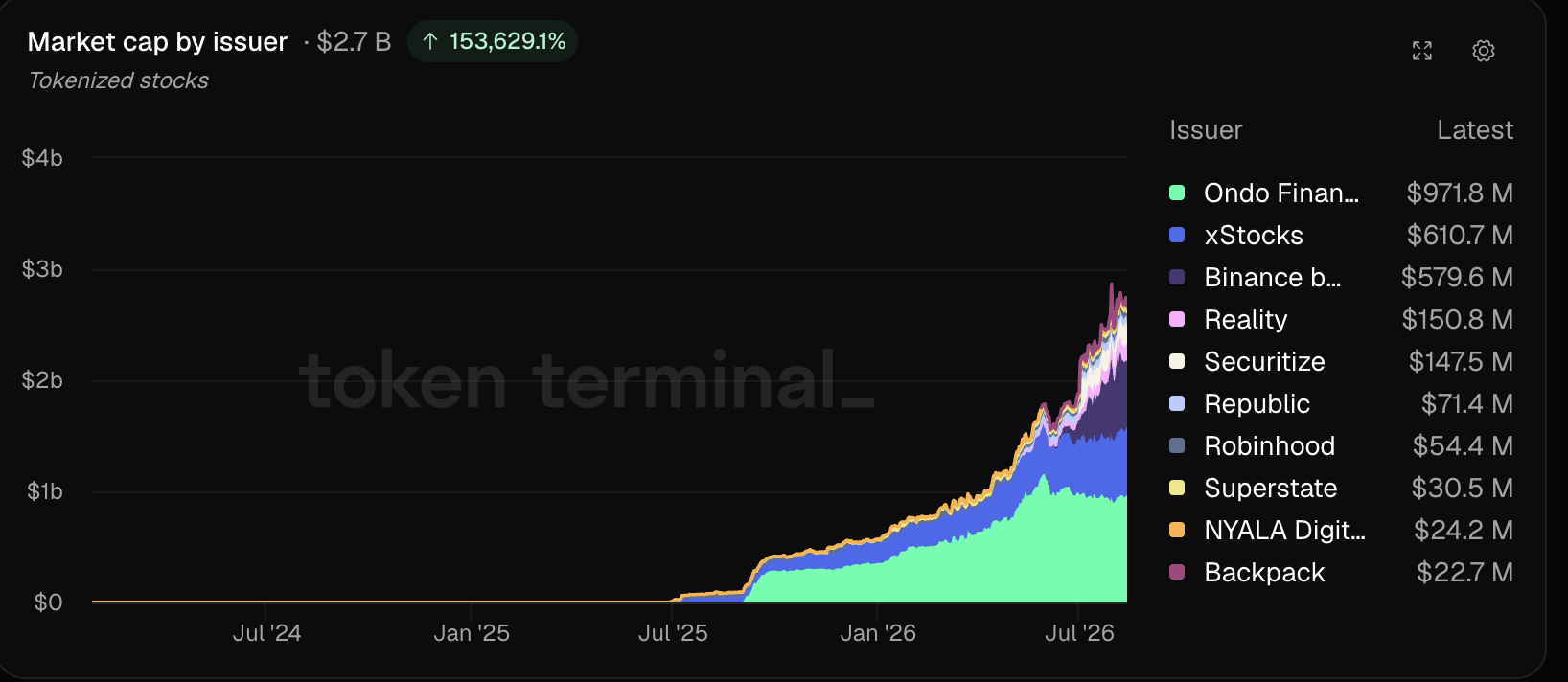
Tokenized stock market cap by issuer. Source: Token Terminal
Magazine: Solana’s fee overhaul increases burn and makes resource hogs pay

The AI-powered tool grew out of an earlier prototype as bars, brands and other businesses experiment with event contracts to offset real-world risks
A new tool aims to make one of Wall Street’s oldest risk-management strategies more accessible to small businesses, using prediction market contracts to hedge risks ranging from bad weather and rising fuel costs to the outcome of a sports promotion.
Blanket lets business owners describe an exposure in plain English, then searches live Kalshi markets for contracts that could potentially offset some of the financial impact. The tool can model how a proposed hedge might work, flag mismatches between a business risk and an available contract and tell users when it cannot find a suitable market. Blanket does not execute trades or handle customer funds; any trading takes place on Kalshi.
Fortune first reported on Blanket Friday, describing it as a new AI tool built around Kalshi’s prediction market exchange. The site was created and is owned by Lauris Zminsky, an independent financial economist who does not work for Kalshi, according to Fortune. But Zminsky has worked directly with members of the Kalshi team while developing the project, including through the exchange’s Builder’s Program.
Large companies have long used derivatives to manage exposure to risks such as interest rates, currencies and commodity prices. Prediction market contracts can potentially extend that concept to much narrower outcomes, including weather events, policy decisions and sports results. But matching one of those contracts to an actual business exposure can be complicated.
That problem has been a focus for Zminsky for months. In July, he argued that businesses should first identify the specific financial risk they want to offset, then look for an event contract that closely matches it, rather than starting with an available contract and working backward. “A hedge is not a product,” he wrote in an essay on X, saying that the relevant question is how closely an instrument offsets a company’s actual risk and what exposure remains after the trade.
Zminsky had already been exploring how the idea could apply to larger companies. Earlier this year, he built Hedgebook, a project designed to map Kalshi event contracts to companies in the S&P 500. Fortune reported that the project was developed with a Kalshi employee and was designed to identify event contracts that could correspond with risks disclosed by public companies.
Blanket grew out of a simpler experiment Zminsky launched in June. After seeing a New York bar use Kalshi contracts to offset the cost of a Knicks promotion, he built Bizhedge, a prototype that he said could “find live Kalshi markets you can use to cover a risk or run a promotion” based on a user’s description of their business. He called it “just a fun yet useful prototype,” adding, “Hedging is for everyone, not just hedge funds.”
In his July X essay, Zminsky said that he was working with members of the Kalshi team on a new demonstration of his approach through the platform’s Builder’s Program. The program supports outside developers building products around Kalshi and includes access to a pool of more than $2 million in grants, along with technical and other developer support. Kalshi says builders retain ownership of their projects. Zminsky has not said publicly whether he received funding through the program.
Earlier this week, Zminsky teased a “new build” designed to help small businesses discover event contracts with real economic uses and thanked three Kalshi team members for helping him with it.
Fortune reported Friday that Blanket had “quietly launched in stealth” and was going public this week. The site is now publicly accessible at tryblanket.app.
Blanket starts with a simple question: “What could hurt your business?” A user can describe a financial risk or promotional promise in ordinary language, with dollar figures optional, and the tool searches current Kalshi markets for a contract that could provide at least a partial offset. Blanket then explains the relationship between the business risk and the market and can model the potential cost and payout under different outcomes.
One example on the site considers a small Denver trucking company that could lose $50,000 if diesel prices spike. Blanket identifies a Kalshi market tied to crude oil prices as the closest available option, while noting that the contract does not track the company’s actual diesel bill. The example models a $45,000 gross payout at a cost of $7,605 if the specified oil-price threshold is reached.
The tool is also designed to identify when the match is too weak. A separate Gaps page catalogs risks for which Blanket found no suitable existing contract, under the heading “Markets Kalshi should make.” The site currently lists potential gaps involving weather disruptions, financing rates, energy and material costs, currency exposure and promotional liabilities, among others. Users can indicate that they face one of the same risks, potentially providing a demand signal for Kalshi about new markets businesses may want.
Blanket also works in reverse through a feature called Scout. Users can submit an existing Kalshi market and the tool analyzes which types of businesses could be financially exposed to the outcome before searching for real companies that fit those characteristics. For example, its demonstration using a Kalshi contract tied to unusually cold temperatures in Texas identifies potential exposure for businesses like plumbers, nurseries and property managers.
The site says market data and settlement rules come from Kalshi’s public API, while business discovery for Scout is powered by Bright Data and its analysis runs through OpenRouter.
Blanket is arriving after several businesses have already experimented with using Kalshi contracts to offset risks that would rarely be associated with traditional corporate hedging.
• The Jeffrey: The New York City bar, whose Knicks promotion helped inspire Zminsky’s original Bizhedge prototype, used a $5,000 Kalshi position to help cover a promotion offering customers up to $100 off their tabs if the Knicks won Game 1 of the NBA Finals. The position could pay about $13,500 if New York won, helping offset the cost of the promotion.
• TallBoy: During the World Cup, the Washington, D.C., bar offered discounts based on the U.S. margin of victory, including free tabs for a win by three goals or more, and used Kalshi contracts to hedge the potential cost. When the U.S. beat Paraguay 4-1, the free-tab promotion was triggered.
• Forme: The sportswear company partnered with promotions platform PlayAbly on an offer promising customers a full refund if the U.S. reached the World Cup final. PlayAbly used Kalshi to cover the promotional exposure.
• EGOHOME: PlayAbly later used the same model for the mattress brand, which offered customers 100% cashback if Aniya and Carl won Love Island USA. The Kalshi position reportedly cost $2,500 and could return about $55,000 if the couple won.
• 28 Wishes Ice Cream Shop: The Los Angeles shop has reportedly used Kalshi weather contracts to offset slower sales during cold weather. Owner Jason Jiang said business falls about 20% when temperatures drop below 70 degrees and that the trades have generated about $1,500 a month.
Kalshi appears to see those individual examples as the beginning of a larger commercial use case. Nicolas Hull, who handles small-business hedging at the company, told Fortune that businesses are already using Kalshi to manage exposure to weather, major sports tournaments, freight and tariffs.
He called hedging by smaller companies and businesses a “massive growth segment” for the exchange.
Kalshi is also highlighting the use case on its own Kalshi for Industry site, which promotes event contracts as tools for managing operational risks. Its examples of “hedging in practice” include both The Jeffrey and 28 Wishes alongside larger institutional users, illustrating how the company is positioning its event-contract exchange for users ranging from neighborhood businesses to professional risk managers.
The latest rally has pushed AVAX into a major demand zone as Avalanche sees an increase in RWA activity and network developments.
AVAX gained nearly 7% over the past 24 hours after briefly tapping $6.92 on Tuesday before pulling back to $6.79. The token is also up a little over 5% on the weekly timeframe.
The move comes as several developments add activity across the Avalanche ecosystem.
Securitize has now distributed $976 million in asset value on Avalanche, which is a 123% increase over the past 30 days. The ecosystem has also seen progress on its Helicon upgrade.
The upgrade, which went live on the Fuji Testnet on July 28, brings several changes to the C-Chain. It introduces decoupled, continuous transaction execution, which separates transaction execution from block generation to improve how smart contracts process data.
Helicon also adds Auto-Renewed Staking, which allows validators to opt into automatically renewing their stake and reducing administrative work for network operators. The upgrade also lowers the minimum staking duration, thereby reducing the amount of time tokens must remain locked for staking. It further brings more efficient pricing mechanisms aimed at stabilizing transaction costs on the network.
Separately, Avalanche continues to rank among the leading stablecoin networks. The network’s stablecoin market cap currently stands near $1.5 billion.
It is also the ninth-largest blockchain by RWA holder count, with 9,218 holders, according to RWA.xyz, and ranks behind Robinhood, Solana, BNB Chain, Plume Network, Ethereum, Base, Polygon, and Stellar, while remaining ahead of Arbitrum.
Another notable development for Avalanche came from Japan. Progmat, Japan’s largest security token platform, completed its move to the blockchain last month, bringing more than $2.7 billion worth of tokenized assets onto the network.
The platform migrated from a private Corda-based ledger to a dedicated public Avalanche Layer 1. Progmat accounts for over 64% of the country’s security token issuance value and also includes major tokenized real estate and corporate bond projects.
AVAX’s latest recovery comes after a month of choppy price action. The crypto asset is trading within a long-term historical demand zone of the $6.4-$7.5 area identified by market expert ‘The Boss.’ The findings reveal that buyers are attempting to slow the decline, which makes it a potential “inflection point rather than just another support level.” The Boss further explained,
“What happens next will define the broader structure. A sustained defense of this demand zone could lay the foundation for a long-term accumulation phase, while a confirmed monthly breakdown would signal that sellers still control the higher-timeframe trend.”
A two-minute price shock in a Hyperliquid market tied to South Korea’s SK Hynix has put the mechanics and oversight of equity-linked perpetuals under scrutiny.
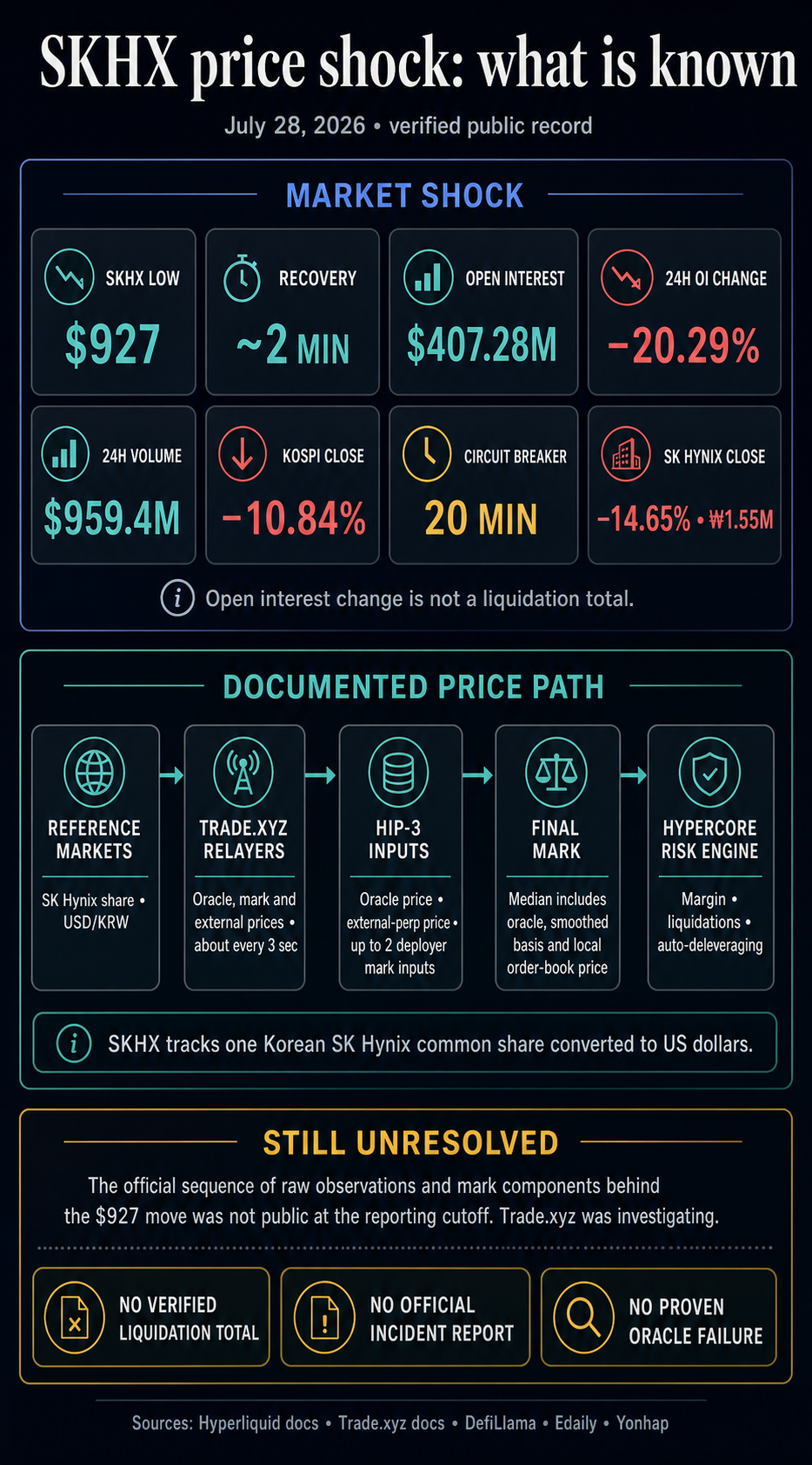
SKHX, a TradeXYZ-operated perpetual on Hyperliquid that tracks the US dollar value of one Korean SK Hynix share, briefly sank to $927 during South Korea’s pre-market window before recovering within roughly two minutes, according to local media.
A later DefiLlama snapshot put open interest at $407 million, down 20% over 24 hours, while 24-hour trading volume reached $959 million. Open interest measures the rolling value of outstanding positions, incorporating changes in both position size and price.
The underlying market was already under severe pressure. South Korea’s KOSPI closed 10.84% lower after a 20-minute marketwide circuit breaker, while SK Hynix’s Korean shares finished down 14.65% at 1.55 million won, Yonhap reported.
TradeXYZ’s contract specification defines SKHX as the dollar value of one SK Hynix common share, calculated by converting the Korean share price at the prevailing USD/KRW rate. TradeXYZ documents an external-pricing window from 8:00 a.m. to 8:50 a.m. Korean time. SKHX is separate from the company’s US-listed depositary receipt and from tokenized shares.

Hyperliquid’s HIP-3 specification gives a market deployer control over its oracle definition, oracle prices, leverage limits and settlement. The deployed market uses HyperCore’s order books and margin system.

TradeXYZ says its relayers compute and transmit the XYZ market’s oracle, mark and external prices about every three seconds. HyperCore handles matching, margining, liquidations and auto-deleveraging. In the documented design, TradeXYZ supplies the bespoke price inputs and HyperCore applies its risk machinery to the resulting mark.
The HIP-3 deployer API accepts an oracle price, an external-perpetual price and as many as two deployer-supplied mark-price inputs. HyperCore contributes a local price derived from the best bid, best offer and latest trade. TradeXYZ says the final mark is the median of the oracle, a smoothed oracle-to-market difference, and that local order-book price.

The rulebook shows how SKHX pricing is meant to work. The plunge to $927 is still a black box, with the raw observations and mark-price ingredients absent from the public record. DefiLlama names Pyth Lazer as the oracle provider. TradeXYZ says its relayer and updater carry prices into HyperCore. The incident-level handoff between those systems remains the missing piece.
BlockMedia reported at 18:41 Korean time that Hyperliquid said TradeXYZ was investigating and planned an update after reaching a conclusion. At that cutoff, the reviewed sources contained no official incident report or event-specific account of compensation, insurance impact, a halt, a cap change, or slashing.
HIP-3’s allocation of controls is clear even as responsibility for this price shock remains open: the deployer operates the oracle settings, and HyperCore executes the market and risk functions. TradeXYZ’s findings will determine whether the episode reflected the published design under extreme conditions or a price-feed safeguard that needs revision.
Dubai, United Arab Emirates, July 29th, 2026, Chainwire
Bybit, the world’s second-largest cryptocurrency exchange by trading volume, today announced a new collaboration with Finloop Finance Technology Holding Limited (“Finloop”), an AI-driven Web5 (Web2+Web3) wealth technology platform to offer the Finloop USD Instant Digital Liquidity (FUIDL), a tokenized USD liquidity product powered by Finloop and backed by an AAA-rated money market fund. Through this collaboration, Bybit will enable the share of FUIDL as collateral for trading on its platform.
The product provides institutional and professional investors access to USD liquidity through blockchain technology, while maintaining the asset backing standards commonly associated with traditional financial markets. FUIDL provides eligible investors with on-chain access to an AAA-rated USD liquidity fund, offering hourly subscription and redemption, and T+0* (same-day) interest accrual. It allows investors to move capital efficiently between traditional and digital asset markets. The underlying USD liquidity fund has received the highest possible ratings from major international agencies: AAAm from Standard & Poor’s (S&P), Aaa-mf from Moody’s and AAAmmf from Fitch. An AAA rating represents the highest rating available for Money Market Funds (MMFs).
Finloop serves as the tokenization agent and provides the infrastructure that connects traditional money market fund assets with blockchain-based settlement. The collaboration is designed to combine the transparency and speed of digital assets with the stability and operational standards expected by institutional and professional investors.
The alliance is a significant milestone in Bybit’s long-term mission to build The New Financial Platform, an open, secure, and efficient bridge between traditional and digital finance. Through this collaboration, Bybit users will benefit from same-day settlement across selected tokenized and digital instruments, made possible by Finloop’s market-leading RWA and cash management capabilities and Bybit’s proprietary infrastructure.
Yoyee Wang, Global Head of TradFi and RWA of Bybit, said: “Partnering with Finloop marks a pivotal step in realizing our vision of The New Financial Platform. This collaboration turns that vision into action, merging institutional-grade trust with the efficiency of digital infrastructure of Bybit. By enabling same-day settlement and reinforcing custody standards, we’re not just improving transaction speed; we’re redefining what financial interoperability can look like.”
By integrating ByCustody with Finloop’s tokenization technology, the collaboration will pilot T+0 settlement for select asset types, with plans for global rollout throughout 2026. The initiative also underscores a shared commitment to advancing transparency, operational excellence, and risk management for institutional market participants.
Cai Hua, CEO of Finloop, said: “This collaboration demonstrates how a wealth technology platform and a digital exchange can work together to achieve instantaneous settlement while meeting high operational and regulatory standards. We are proud to partner with Bybit on this milestone that sets new benchmarks for efficiency and trust in the digital asset space.”
For more information about FUIDL, please visit:
https://www.linkedin.com/feed/update/urn:li:activity:7466045282808434689
https://x.com/FinloopHK/status/2060284153795580006?s=20
*Subject to the actual fund arrival time.
About Bybit
Bybit is The New Financial Platform.
We believe every person should have access to every financial opportunity on earth. That’s why we’re building the first intelligent platform that connects anyone, anywhere to the world’s finance.
Trusted by more than 80 million users worldwide, Bybit brings together investing, trading, payments, and wealth-building in a single secure and intelligent ecosystem. Through the combination of AI-powered technology, deep global liquidity, robust security, and transparent operations, Bybit makes global finance more accessible, efficient, and empowering for everyone.
Built for everyone. Powered by intelligence. Open to the world.
Learn more at Bybit.com.
For more details about Bybit, please visit Bybit Press
For media inquiries, please contact: media@bybit.com
For updates, please follow: Bybit’s Communities and Social Media
Discord | Facebook | Instagram | LinkedIn | Reddit | Telegram | TikTok | X | YouTube
Disclaimer:
Bybit and ByCustody are not licensed, approved or regulated by the Hong Kong Securities and Futures Commission and do not service Hong Kong residents.
#Bybit / #NewFinancialPlatform
Head of PR
Tony Au
Bybit
tony.au@bybit.com


