Layer 2 scaling solutions help blockchains like Ethereum process more activity without forcing every transaction to happen directly on the base chain.
Ethereum’s main network is secure and decentralized, but blockspace is limited. When demand rises, fees increase and users can get priced out. Layer 2s address this by moving transaction activity to scaling systems that sit around Ethereum while still using it for settlement, security, data posting, or verification.
The most important Layer 2 designs today are rollups. Rollups process transactions off-chain, bundle them together, and post data or proofs back to Ethereum. This makes transactions cheaper and faster while keeping a connection to Ethereum’s trust foundation.

Layer
Bybit democratizes access to enterprise-grade AI across trading, account management, and customer service
DUBAI, UAE, Sept. 9, 2026 /PRNewswire/ — Bybit, the world’s second-largest cryptocurrency exchange by trading volume, announced the official launch of Bybit AI, a conversational assistant that unifies the exchange’s core services, starting with trading and customer support, within a single chat interface inside the Bybit app.
Bybit AI lets users describe what they need in plain language. The assistant interprets user intent and executes the requested action on the user’s behalf, functioning as an intelligent co-pilot for everyday trading and account management.
Chat to Trade: A New Financial Experience
“Bybit AI is an important part of our roadmap for the New Financial Platform,” said Ben Zhou, Co-founder and CEO of Bybit. “We want to make it easier for users to access the financial services they need in one place. As we continue to develop Bybit AI, users will be able to use it to find and access a wider range of products and services on Bybit. The idea is simple: you tell Bybit AI what you want to do, and it helps you find the right products and services to get it done, like having a team of financial experts right in your pocket.”
Bybit AI replaces the fragmented experience of navigating web pages, menus and dashboards with a single, continuous conversation. Instead of hunting for the right tool for each task, from checking a portfolio balance to placing a trade to submitting a support ticket, users simply state their request in natural language and Bybit AI carries out the underlying action within the chat. Bybit built the product architecture on a clear principle: infrastructure should provide the underlying connections, while individual business lines plug into a single interface, so the exchange’s many services present themselves to users as one continuous assistant rather than a collection of disconnected products.
Bybit also revealed a roadmap to bring its services together through Open API, connecting trading, earn, loans, card and customer support in a more unified experience. “We are not looking to add another dashboard or bolt on another chatbot,” said Rockman Zhang, CTO at Bybit. “The goal is to make it easier for users to find what they need and take action in one place, with a simple interface that brings the right products and services together.”
In the initial rollout, Bybit AI is deployed for all users across two main modules:
- One AI assistant for all needs: Bybit AI will cover key features and essential features across Spot, Futures, and Options trading, Bybit Earn, Copy Trading, Trading Bot, Loan, P2P, Bybit Card, Spot X, access to the Rewards Hub, and notification and subscription management.
- Intelligent support: Bybit’s customer service gets an upgrade while retaining the human touch, with Bybit AI working alongside professional human agents to optimize user experience. Smarter customer support will be integrated directly into Bybit AI, ensuring customer queries are resolved faster, better, and more effectively.
To deploy Bybit AI, eligible users should first activate the feature, which will create a dedicated Bybit AI sub-account. Bybit approached its flagship AI system on a security-first architecture. The sub-account is isolated from the user’s main balance to avoid any potential AI risk, and unlocks instant onboarding with no API key or manual setup required.
Livestream: Bybit AI Demo
Ben Zhou, Co-founder and CEO of Bybit, will officially unveil Bybit AI and demonstrate the game-changing co-pilot on September 9, 2026 at 08:00AM UTC live on Bybit. To sign up for the livestream and see Bybit AI in action, viewers may visit: How it works: Bybit AI Livestream.
Bybit AI reflects Bybit’s ambition to position itself as a New Financial Platform built for the AI era, applying artificial intelligence not as an added feature but as the connective layer across trading, wealth management and everyday account activity. The launch marks an early step in a longer roadmap toward AI-native financial services, with Bybit positioning conversational intelligence as core infrastructure.
#Bybit / #NewFinancialPlatform
About Bybit
Bybit is The New Financial Platform.
We believe every person should have access to every financial opportunity on earth. That’s why we’re building the first intelligent platform that connects anyone, anywhere to the world’s finance.
Trusted by more than 80 million users worldwide, Bybit brings together investing, trading, payments, and wealth-building in a single secure and intelligent ecosystem. Through the combination of AI-powered technology, deep global liquidity, robust security, and transparent operations, Bybit makes global finance more accessible, efficient, and empowering for everyone.
Built for everyone. Powered by intelligence. Open to the world.
Learn more at Bybit.com
For more details about Bybit, please visit Bybit Press
For media inquiries, please contact: media@bybit.com
For updates, please follow: Bybit’s Communities and Social Media
Facebook | Instagram | LinkedIn | Reddit | Telegram | TikTok | X | Youtube

Post-quantum infrastructure company QuFi Network has launched a verification platform designed to protect digital assets against future quantum computing threats without requiring changes to existing blockchain settlement networks.
The platform separates verification from settlement, using a decentralized network of nodes to validate transactions with post-quantum cryptography before they are settled on existing blockchain networks.
QuFi also launched uBTC, a proof-of-concept that applies the verification system to Bitcoin (BTC) and is currently operating on Bitcoin Testnet4. The uBTC system verifies BTC collateral and generates cryptographic proofs governing how value moves between settlement environments, while redemptions ultimately settle as standard Bitcoin transactions.
The platform uses three post-quantum cryptographic standards — ML-DSA-65, SLH-DSA and ML-KEM-1024 — for digital signatures and secure key exchange.
QuFi said the external verification layer is intended to avoid the added storage, bandwidth and computing demands that can come with adopting larger post-quantum signatures directly on individual blockchains.
Related: Crypto’s first quantum attack will look like unexplained breach: Quantus founder
Crypto ramps up quantum defenses
The platform arrives amid a series of recent efforts to prepare blockchain networks for potential quantum computing threats.
In August, StarkWare tested a quantum-resistant Bitcoin transaction on mainnet without requiring a fork. However, the transaction took hours of computation and cost roughly $150 to $200, and its nonstandard format required direct submission to a miner.
Jonas Nick announces the BIP SHRINCS proposal on Aug. 26. Source: Jonas Nick
The same month, banks and regulators across Europe, the Middle East and Asia joined a pilot testing post-quantum wallets and onchain transfers using ML-DSA-65, one of the same cryptographic standards incorporated into QuFi’s platform. Meanwhile, the Ethereum Foundation dropped the Poseidon hash function from its planned post-quantum architecture in favor of established alternatives such as SHA or BLAKE.
Bitcoin developers are also exploring protocol-level defenses. In August, Blockstream researchers published a Bitcoin Improvement Proposal for SHRINCS, an experimental post-quantum signature scheme designed to reduce the size and performance costs associated with quantum-resistant signatures.
The approach comes with trade-offs. SHRINCS uses stateful signatures to reduce their size, requiring wallets to track previously used signing keys. The scheme remains in an early stage without a completed security proof, and its design adds complexity and potential user failure modes.
Magazine: Bitcoin’s new quantum defenses, 18.9M SOL cancelled: Hodler’s Digest
1inch launches Aqua to the public, introducing the first shared liquidity layer for DeFi
- Following its developer launch in November 2025, Aqua now offers a risk-controlled alternative to DeFi’s pool-based model.
- 1inch unveils a Merkl-powered liquidity incentive program for Aqua, funded with 10 million 1INCH by the 1inch Foundation and 500k USDC from 1inch DAO.
- Aqua goes live across 13 EVM chains from day one.
ROAD TOWN, British Virgin Islands, July 28, 2026 /PRNewswire/ — 1inch, the leading DeFi ecosystem, announces the full public launch of Aqua, a self-custodial shared liquidity layer that enables liquidity providers to use the same wallet balance across multiple positions without locking assets in liquidity pools.
Following its developer launch in November 2025, Aqua today offers one of the first risk-controlled alternatives to DeFi’s traditional pool-based model, enabling more capital-efficient liquidity provisioning.
1inch Aqua works as a registry: a user connects their wallet to approve a token balance and create liquidity positions that can access that balance. The Aqua protocol tracks that balance, and when it receives a swap order that meets the criteria of the position, it pulls the requested tokens from the wallet and pushes back received tokens and fees in a single atomic transaction. Otherwise, the user’s tokens remain in their wallet and completely under their control.
“The liquidity provisioning space is broken, but you only see how broken once there’s an alternative. Today, that alternative has arrived. With Aqua, liquidity providers no longer have to accept the inefficient pool structure they’ve put up with for years,” said Sergej Kunz, 1inch co-founder. “DeFi doesn’t just need more liquidity. It needs more useful liquidity, active wherever demand appears. We built Aqua so providers get that reach without giving up custody: your tokens stay in your wallet until the moment a swap fills.”
Alongside the product launch, 1inch Network Incentives goes live — a liquidity reward program for Aqua, led by Degensoft Ltd (BVI) and delivered through Merkl. The 1inch Foundation has committed 10 million 1INCH in provider rewards, and a further 500,000 USDC boost from the 1inch DAO. The initiative is designed to accelerate liquidity growth and swap activity across supported pairs. As a result, liquidity providers not only benefit from Aqua’s improved experience but also have the opportunity to earn additional rewards. Program terms, markets and safeguards are set out in the published campaign configuration.
According to 1inch, the current pool based system is a major limiting factor on DeFi’s ability to scale and bring TradFi capital on chain. For liquidity providers, the current model of depositing into pools means handing over custody, while active capital gets spread thin across protocols, pairs and price ranges. The scale of the problem is stark: per on-chain research by Dune commissioned by 1inch, 85% of concentrated liquidity across major DEXs was underutilized in H1 2026, roughly $1.6 billion of the $1.84 billion tracked. That includes about $542 million sitting fully out of range in an average week, resulting in an estimated $150 million in fees foregone per year.
Through Aqua, 1inch is showcasing a more efficient model for shared liquidity, allowing the same wallet balance to back multiple positions simultaneously. Unlike the traditional model, where liquidity must be split across multiple pools and positions, Aqua enables a single balance to support multiple quotes at once. For example, a $100,000 balance can support three positions collectively quoting $300,000 of liquidity, with the potential to quote more. The underlying tokens remain available to every position at all times; nothing is borrowed, and any swap can only execute against the assets actually held in the wallet.
A position on Aqua can be full range, concentrated or pegged, depending on the selected pair and position type. A user can open and close positions themselves, with no lock-up. Their exposure is capped by the tokens they actually hold, not by the theoretical combined size of every position they create. If their wallet cannot cover a swap, Aqua simply does not call on their tokens.
From today, users can create positions across 13 EVM chains, including Ethereum, Arbitrum, Base, Robinhood Chain and BNB Chain. Aqua also launches with a number of additional functionalities, including a liquidity leaderboard, an incentives screen, liquidity map visualizations, batch position creation, provider profiles with cross-chain positions, sub-wallets, and an AI-assisted liquidity provisioning flow via the 1inch Business MCP with safe batch deployment, coming soon.
Aqua has undergone eight independent security audits conducted by OpenZeppelin, Bailsec, Hashlock, Hexens, MixBytes, Nethermind, Theori, and Decurity. Combined with its fully self-custodial design, which never holds user tokens, a swap can only move assets that are actually in the provider’s wallet at the moment it fills. Revocation stops new fills as soon as it confirms on-chain. Aqua is also protected from JIT fee sniping by design, as each position has a single owner, thus there is no shared fee moment bots can capitalize on. While Aqua’s design keeps exposure bounded and providers in control of their own tokens, swap fees are not guaranteed, prices can move against a position (impermanent loss), and providers bear market and smart-contract risk.
About 1inch
1inch accelerates decentralized finance with a seamless crypto trading experience for 27M users. Beyond being the top platform for low-cost, efficient token swaps with $100M+ in daily trades, 1inch offers a range of innovative tools, including a secure self-custodial wallet, a portfolio tracker for managing digital assets, a dedicated business portal giving access to its cutting-edge technology, and even a debit card for easy crypto spending. By continuously innovating, 1inch is simplifying DeFi for everyone.
Website | 1inch Business | 1inch Network | Follow on X | Explore Blog
Aqua involves risk, including loss of funds. It’s built for experienced users — do your own research. Not financial advice. Incentive rewards are variable, not guaranteed, and subject to the program’s published terms.
Canton’s Decentralized App Layer Launches, Backed by $1M+ Foundation Grant
New York, United States, July 28th, 2026, Chainwire
BitSafe has released infrastructure for builders launching decentralized financial applications on Canton Network.
Backed by a Canton Foundation Development Fund grant of over $1 million (8,500,000 $CC), BitSafe today opened the public beta of Decentralization Manager, an open-sourced framework allowing apps and institutions to build resilient products that distribute control across multiple independent operators.
Canton Network has become critical infrastructure for institutions bringing real capital and operations on-chain. Meeting institutional application standards requires audit trails and distributed trust, but until now every team building on Canton has had to build threshold custody, governance, and audit infrastructure from scratch. Decentralization Manager makes those reusable, so teams build the application, not the infrastructure.
Independently audited by Quantstamp, Decentralization Manager marks an exciting expansion of on-chain use cases and allows institutions to continue leveraging the network’s privacy-native architecture while mitigating risk by distributing their operations.
Decentralization Manager ships with pre-built frameworks for token issuance and custody and enables additional products such as:
- Token issuance: Issuers can launch and govern Canton-native tokens, ranging from wrapped cryptoassets to stablecoins and RWAs.
- Custody and multi-signature wallets: Teams can hold and transfer assets under shared, multi-party control, removing reliance on any single custodian.
- Tokenized real-world assets and securities: Builders can bring real-world assets on-chain and govern them under distributed control.
- DEXs, lending, and structured products: Institutions can launch institutional-grade financial applications with Decentralization Manager.
Contact us to start launching decentralized applications and assets.
CBTC, the first non-native asset on Canton, is the first live use case of Decentralization Manager. With over 10 million transactions to date, node operators powering CBTC already earn a share of Canton fees from on-chain transactions. Decentralization Manager now extends that opportunity across the network. Application builders get an easier path to high quality node operators who can support their products, and those operators earn the same share of Canton fees in return.
“The future of institutional blockchain depends on making sophisticated infrastructure easier to build and adopt,” said Viv Diwakar, Head of the Canton Foundation. “By open-sourcing Decentralization Manager, BitSafe is giving developers the tools to create resilient, privacy-preserving applications that distribute trust across independent operators without compromising the governance and control institutions require. Contributions like this strengthen the Canton ecosystem and help accelerate the growth of institutional digital assets and tokenized financial markets. We’re pleased to see BitSafe making this capability available to the wider community and look forward to seeing the next generation of institutional applications built on Canton.”
As of today, Palladium Labs is the first builder announced using Decentralization Manager to enable multi-party authorization for protocol operations. “Distributed trust and full auditability are table stakes for institutional-grade credit infrastructure like Alpend,” said Akshay Sinha, Cofounder & CTO of Palladium Labs. “Decentralization Manager makes that a framework the entire Canton ecosystem can build on. Adopting it was one of the easier decisions we’ve made.”
In addition to Palladium, CBTC Attestors Nethermind, DSRV, and Finoa Consensus Services have already implemented Decentralization Manager. Their institutional participation affirms a collective effort across Canton to embrace decentralized technology that prioritizes data privacy, operational control, and resilience.
The public beta is open now on the Canton Foundation’s GitHub, with an additional grant application underway. Builders who need operators to complete their Decentralized Party can reach out to BitSafe to be matched with vetted, institutional-grade node operators. Institutions looking to issue and govern Canton-native tokens can engage BitSafe’s Decentralization Services for custom tokenization engagements.
Additional quotes from ecosystem partners:
“The CBTC Decentralized Party has shown how far Canton has come, and the public beta opening of Decentralization Manager is a big step for the whole ecosystem. Onboarding was remarkably smooth for our team – contract deployment was essentially one click. For any app still running on a single validator, this is the easiest path we’ve seen to move beyond a single point of failure.” – Joonkyo Kim, CTO, DSRV
”As one of the attestors securing CBTC, we’ve operated inside BitSafe’s decentralized signing architecture from an early stage, so we’ve seen firsthand what it takes to distribute trust across independent operators in production. Onboarding into Decentralization Manager was refreshingly straightforward, the admin tooling is intuitive and whenever we hit an issue the BitSafe team resolved it quickly and communicated the whole way through.
Institutions bringing real assets onto Canton increasingly expect exactly this: no single point of control with the audit trails and operational resilience their risk teams demand. Making that kind of infrastructure open and repeatable is a meaningful step for the ecosystem.” – Mateusz Jędrzejewski, CIO, Nethermind
“BitSafe’s Decentralization Manager turns the infrastructure we already run into a setup with no single point of failure, the kind institutions expect from Canton. We’re glad to extend our partnership with BitSafe and look forward to building more together as new applications join the network.” – Daniel Schrader, Managing Director, Finoa Consensus Services
About BitSafe
BitSafe builds decentralized, privacy-enabled digital asset infrastructure on the Canton Network. As the team that brought Bitcoin to Canton ($CBTC), BitSafe’s threshold-governed multi-sig infrastructure distributes custody and governance, eliminates single points of failure, and enables institutions and developers to launch trading venues and build compliant financial products and assets across the ecosystem.
Contact
Kadeem Clarke
BitSafe
marketing@bitsafe.finance
Sheridan, USA / Wyoming, June 30th, 2026, Chainwire
Five years in the making, Autheo is launching its decentralized operating system on Mainnet — after public testnet adoption surpassed 1.8 million wallets, nearly 1 million smart contracts, and 8.8 million transactions.
Autheo today formally introduced its decentralized operating system to the public: a coordination layer designed to let the traditional Web, blockchain networks, and AI agents interoperate natively as a single system. The company is now launching its Mainnet — the production environment for the network — after more than a year of public testnet activity.
THE COORDINATION LAYER THE INTERNET NEVER HAD
The networking wars of the 1980s and early 1990s settled a principle that has shaped the Internet ever since: interoperability comes from pragmatic, openly deployed protocols, not top-down frameworks. The standards that won — TCP/IP, DNS, HTTP, TLS — succeeded by being practical and deployable, and the modern Internet still rests on them. The blockchain era took a different path: each network optimized for its own internal consistency — its own security model, consensus mechanism, APIs, SDKs, and developer tooling — and the result has been a fragmented landscape of largely siloed chains. The rapid rise of AI agents now amplifies that fragmentation, as a growing population of autonomous actors needs to transact across Web, blockchain, and AI systems that were never designed to coordinate with one another.
Protocols such as IBC, LayerZero, CCIP, Wormhole, and Axelar have made meaningful progress on chain-to-chain messaging and asset transfer — but those efforts operate at the bridging layer. Autheo addresses the problem from a different angle: a shared substrate where Web services, blockchain networks, and AI agents coordinate natively on a common identity, communications, execution, and infrastructure layer, rather than relying on bridges that pass messages between otherwise disconnected systems.
At the same time, approximately three-quarters of business applications today are delivered as SaaS, and identity, storage, compute, payments, and messaging already run as distributed services across the Web. The Internet, in other words, has quietly taken on many of the functions of an operating system. What it has lacked is the layer that lets those services — together with blockchain networks and AI agents — interoperate by default, rather than through one-off, brittle integrations built per partner, per protocol, and per chain.
Autheo’s purpose is to provide that coordination and execution layer. The Autheo OS exposes the standard functions one would expect of an operating system—identity, scheduling, messaging, state, compute, storage, and execution—as open, programmable services that any application, protocol, or agent can call. The objective is an integration substrate on which Web2 systems, Web3 protocols, and AI agents can transact and collaborate without needing to know which environment the counterparty is in. For autonomous AI agents specifically, Autheo is built around an on-chain, quantum-resistant trust and identity layer — designed so agents can hold credentials, sign transactions, and invoke services without depending on external systems or exposing private keys. The two design imperatives behind the project are simple: integration and interoperability.
“We didn’t set out to build just another network,” said Scott Bayless, Managing Director and co-founder of Autheo. “We set out to find the right relation between the ones we already have. A body has many parts. A city is many trades. The Internet today is many systems — each doing its work, none of them moving as one. With Mainnet now live, Autheo is the layer where the web, the chain, and the agent can finally work together.”
FOUNDED BY LONG-TIME COLLABORATORS
Autheo was founded in July 2021 by Todd Mortenson and Scott Bayless, long-time collaborators who have built and operated multiple ventures together over the past two decades.
The founders shared a simple thesis: the next phase of the Internet will be defined less by any single technology — and more by the coordination layer that enables the traditional Web, blockchain networks, and AI to operate as a single system. Much of what ultimately matters in technology tends to begin far from the loudest places — quietly, slowly, by those who would not have been the obvious choices.
Guided by that vision, the founders and engineering leadership spent the project’s first several years researching networks, ecosystems, protocol design, digital identity, post-quantum security, and decentralized coordination before building Autheo from the ground up around four distinct architectural foundations: TheoID — Autheo’s W3C-compliant Decentralized Identifier (DID) implementation — as the native identity primitive for users, services, and AI agents; PQCNet, Autheo’s post-quantum communications and identity framework, built upon NIST-standardized post-quantum cryptography, including ML-KEM (FIPS 203), ML-DSA (FIPS 204), and SLH-DSA (FIPS 205); a sovereign Cosmos SDK Layer 0 with native IBC interoperability; and an integrated EVM-compatible Layer 1 execution environment, operating as a Proof-of-Stake network with delegated staking and licensed validator eligibility, secured by CometBFT block finality (“Proof of Autheo”).
Solidity smart contracts can be deployed natively on Autheo or migrated from existing EVM-compatible chains, providing developers with a familiar development environment while benefiting from native IBC interoperability across the broader blockchain ecosystem.
The research and development underlying the platform has also resulted in an expanding portfolio of patent families covering core architectural innovations, reflecting the team’s long-term intellectual property strategy surrounding decentralized operating systems, digital identity, interoperability, post-quantum security, and related technologies.
Network engineering and Autheo’s post-quantum security architecture are led by Chief Engineering Officer Kenneth Harper, who has overseen the design, architecture, and implementation of the platform through public testnet and into Mainnet launch. Supporting those efforts is a multidisciplinary organization spanning engineering, product, project management, quality assurance, infrastructure, operations, ecosystem development, developer support, business development, partnerships, marketing, global channels, finance, legal, compliance, and intellectual property. Autheo’s broader contributor base spans approximately 100 people across 25 countries — blockchain pioneers, Fortune 500 operators, and researchers from institutions including MIT, Harvard, Stanford, and Caltech. Independent security audits have been completed by Halborn (testnet) and CertiK (Mainnet).
Autheo collaborates with leading infrastructure, security, and ecosystem partners — including Zeeve, InfStones, Hydrex, Halborn, CertiK, TrustSwap, Team.Finance, Utila, Ape Bond, Antier, EVU, among others — across validator and node operations, security audits, custody, token services, and ecosystem development.
TESTNET ADOPTION HAS COMPOUNDED
Autheo’s public testnet went live in 2025 and, over its first twelve months, attracted approximately 350,000 wallets and 60,000 smart contracts as developers stress-tested the network. Following the May 12, 2026, announcement of Mainnet Phase 1, adoption accelerated. In the roughly 45 days since, cumulative wallet addresses have grown more than 5x and smart contracts have grown more than 15x. As of today, cumulative testnet totals stand at:
- 1,812,088 wallet addresses
- 968,502 smart contracts
(Figures per Autheo network data, June 24, 2026. Independently verifiable on the public testnet explorer: testnet-explorer.autheo.com · verified contracts.)
Daily activity over the past month has averaged approximately 30,000 new wallet addresses and 20,000 new smart contracts. The Autheo testnet is now onboarding more wallets and deploying more contracts in a single day than it did across full months of its first year. Contract density at this stage is unusual for a Layer-1 testnet and reflects the breadth of developer use cases the team has supported across the build-out.
“Mainnet is live,” said Todd Mortenson, Managing Director and co-founder of Autheo. “The industry will be racing to retrofit post-quantum security ahead of NIST’s timeline — our developers won’t have to. We built PQC in from the ground up. One interface for Web services, on-chain protocols, and AI agents. One million human developers on-chain within three years. And the AI agents building alongside them? Orders of magnitude more. The coordination layer for that future is live today.”
WHAT’S NEXT
With the testnet validating the architecture and the Mainnet now launching, Autheo’s near-term focus is on expanding partnerships across the Web2, Web3, and AI communities and supporting builders deploying applications, agents, and protocols on the platform.
Developer Access (Mainnet, Live Today):
Testnet explorer (with verified-contract source): testnet-explorer.autheo.com
For developers seeking an early path into the Mainnet ecosystem, the Core Node and Prime Node tiers remain available at commerce.autheo.com (settlement via ETH on Arbitrum). These programs provide eligibility for long-term THEO token emissions, enabling developers to begin accumulating THEO for building, deploying, and participating in the network as the ecosystem expands. The Sovereign Validator Node program (399 nodes total) has its first 275 slots fully subscribed; the remaining 124 are reserved for enterprise partners and ecosystem customers. A dedicated builder portal at autheolabs.com is anticipated to launch, providing additional THEO token and validator allocations for projects deploying on the network.
THEO is anticipated to become available on Hydrex.fi in early July 2026, with additional exchange access expected to follow.
Additional documentation ecosystem, security, infrastructure, and listing announcements are expected over the coming weeks.
ABOUT AUTHEO
Autheo is building the Internet operating system — a decentralized coordination and execution layer that enables the traditional Web, blockchain networks, and AI agents to interoperate as a single system. The platform utilizes W3C Decentralized Identifiers (DIDs) as its native identity framework and is anchored by PQCNet, Autheo’s quantum-resistant communications and identity infrastructure built upon NIST-standardized post-quantum cryptography, including ML-KEM (FIPS 203), ML-DSA (FIPS 204), and SLH-DSA (FIPS 205). Operating alongside Autheo’s sovereign Cosmos-based Layer 0 and EVM-compatible Layer 1, PQCNet is designed to provide next-generation security for digital identity, communications, authentication, encryption, and trusted interactions across Web, blockchain, and AI ecosystems.
Autheo integrates a sovereign Cosmos SDK Layer 0 with native IBC interoperability and an EVM-compatible Layer 1 execution environment, allowing developers to deploy Solidity smart contracts natively or migrate existing applications from other EVM-compatible networks. Founded in July 2021 by Scott Bayless and Todd Mortenson, Autheo opened its public Testnet in 2025 and launched Mainnet in 2026.
For more information, visit autheo.com and follow Autheo on X at @Autheo_Network. Find the Media Kit at mediakit.autheo.com
Contact
Marketing & Media Relations
Ryan Teigen
Autheo LLC
ryan@autheo.com
608-713-1028
DeFi’s automated yield protocols were built for retail, now they just add another layer of risk
Automated yield protocols built DeFi’s most persuasive retail pitch that depositing into a vault was all a user needed to do, with the protocol handling everything else.
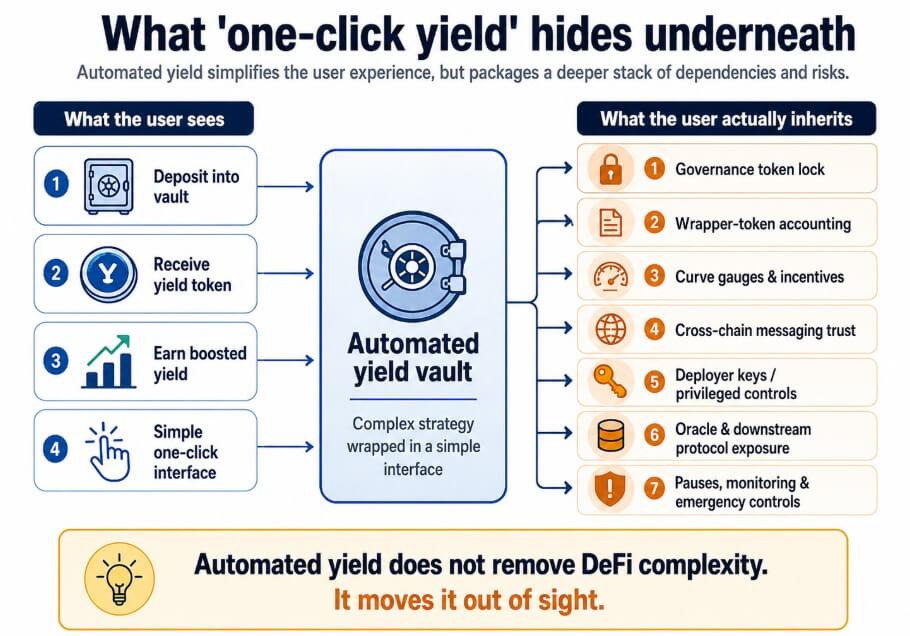
For users wanting exposure to Curve’s boosted yields without manually managing CRV locks, vote power, wrappers, gauges, and incentives, Stake DAO offered a product that packaged the full stack behind a simple interface and, in doing so, also packaged what could break.
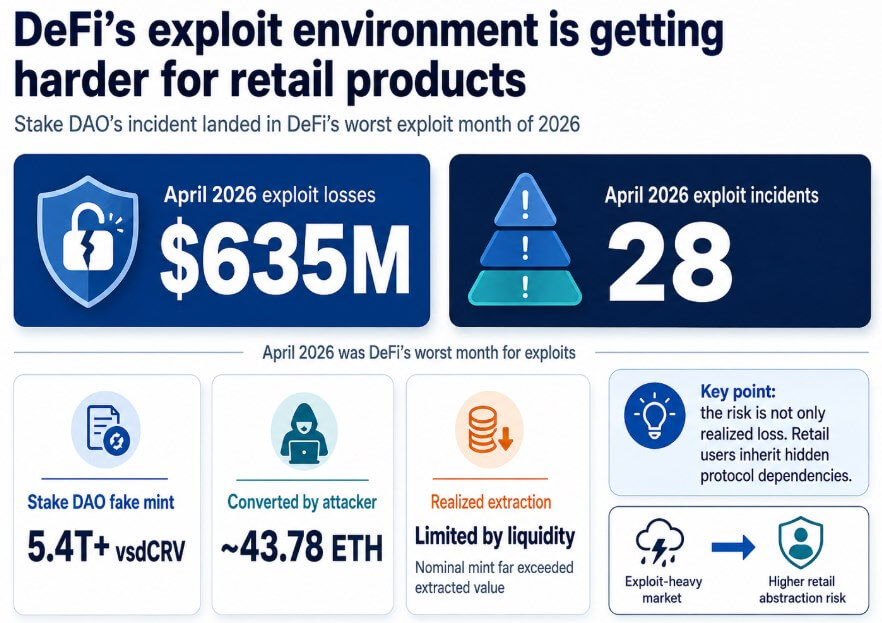
According to Blockaid, an attacker minted over 5.4 trillion vsdCRV on Arbitrum through a suspected compromise of a deployer key and began swapping tokens for ETH.
The attacker altered LayerZero-related peer configuration to forge a cross-chain message before minting 5,446,744,073,709 vsdCRV, converting a portion into roughly 43.78 ETH, with liquidity constraining realized extraction far below the nominal mint.
Stake DAO told users not to interact with vsdCRV while the situation was active. The incident spread to Curve, which warned users in an affected Arbitrum LlamaLend market, and Beefy Finance paused a connected vault with exposure to Curve and Convex.
Stake DAO’s Liquid Lockers let users deposit governance tokens like CRV, receive liquid sdTokens, and access boosted yield and governance exposure without managing the Curve-locking stack directly.
The vault interface hides all of that and, in doing so, also hides the deployer keys, cross-chain messaging trust, wrapper-token accounting, and oracle dependencies that the exploit traveled through.

Automated yield moves DeFi complexity out of sight, a relocation that only becomes visible when something in the hidden layer breaks.
Ido Ben-Natan, co-founder and CEO of Blockaid, framed the security disconnect in a note:
“Wherever there is value on-chain, there will be attackers trying to exploit it, and that’s true regardless of how simple or complex a protocol’s strategy is. Two things matter here. First, whether protocols have the right governance infrastructure in place to ensure there is no easy point of failure to exploit. Second, having a real-time on-chain security tooling that validates every transaction before execution.”
The broader reckoning
April 2026 was DeFi’s worst month for exploits, with roughly $635 million extracted across 28 incidents, driven by social engineering, bridge spoofing, and AI-assisted reconnaissance.
Manuel Aráoz, who co-founded OpenZeppelin and served as its CTO until 2019, wrote that he now considers “all” of DeFi unsafe because AI coding agents have become “superhuman” at finding vulnerabilities, while defenders must fix every bug and attackers need only one.


OpenZeppelin publicly rejected that claim, stating that Aráoz’s posts do not reflect the company’s position. The asymmetry he describes, though, has drawn serious attention beyond the attribution dispute.
Ben-Natan puts the defensive advantage in real-time tooling and adaptive threat detection:
“Hackers are increasingly leveraging AI to move faster and find new attack vectors. However, on-chain cybersecurity providers like Blockaid have deep experience using AI to stay well ahead. We continuously analyze and adapt to new threat patterns in real time, using AI agents for investigations, simulations, and malicious pattern matching.”
That real-time capability makes transaction validation a viable countermeasure to the speed edge attackers are gaining, and for automated yield protocols, governance controls, and monitoring have become the actual security layer that the vault interface depends on.
Daily signals, zero noise.
Market-moving headlines and context delivered every morning in one tight read.
5-minute digest 100k+ readers
Free. No spam. Unsubscribe any time.
Whoops, looks like there was a problem. Please try again.
You’re subscribed. Welcome aboard.
The next vault
In the bear case, more key compromises, bridge incidents, oracle contagion, and vault pauses drive an abstraction discount into automated yield products.
Users demand higher returns to compensate for hidden stack risk, making it harder to sustain the one-click yield pitch without explicit risk disclosure, and smaller vaults lose TVL as integrations become risk-gated.
The incident pattern that defined April extends through the rest of the year, and each new incident reinforces the perception that yield automation bundles risks that users cannot independently evaluate.
In the bull case, protocols adopt the architecture Ben-Natan describes, consisting of governance controls that eliminate easy points of failure, real-time transaction validation, and continuous threat-pattern monitoring, and automated yield survives in a more standardized form.
Formal verification, multisig controls, and runtime monitoring become the default infrastructure, and the products that retain retail trust are those that disclose and manage the dependency stack.
Security vendors and risk dashboards are embedded in the vault interface itself, and the competitive edge moves from hiding complexity to proving which parts of it are under control.
| Scenario | What happens | Impact on users | Impact on protocols |
|---|---|---|---|
| Bear case | More key compromises, bridge incidents, oracle contagion, and vault pauses | Users demand higher yields for hidden risk | Smaller vaults lose TVL; integrations become risk-gated |
| Base case | Protocols add clearer disclosures, monitoring, and emergency controls | Retail still uses vaults, but with more caution | Security becomes part of the product UX |
| Bull case | Real-time validation, multisig controls, formal verification, and risk dashboards become standard | Users regain confidence in monitored products | Stronger protocols consolidate trust and liquidity |
The retail promise of automated yield was always about relocating complexity, and for years, the protocol absorbed that burden invisibly. The Stake DAO exploit shows what happens when the invisible layer breaks, and April’s record shows it breaking with increasing frequency.
The next automated yield product to win retail trust will earn it by showing users which parts of the stack are monitored, controlled, and isolated, and what the protocol does when any one part fails.
AFX Launches Sovereign Layer 1, Providing An Optimized Execution Environment For On-chain Perp DEXes
ROAD TOWN, British Virgin Islands, May 18, 2026 /PRNewswire/ — AFX, a sovereign Layer 1 purpose-built for decentralized derivatives trading, has officially commenced the operation of its L1 Mainnet, signaling a definitive end to the era of trade execution compromised by general-purpose blockchain congestion. Engineered for the world’s most demanding participants, AFX introduces the Sovereign Trading Layer—a dedicated financial environment where the non-custodial transparency of a Perp DEX meets the uncompromising speed and depth traditionally reserved for institutional-grade centralized entities.
At launch, the protocol supports a high-liquidity suite of perpetual markets across both digital and traditional macro assets, featuring BTC, ETH, Gold (XAU), and Crude Oil (CL), with up to 40x leverage to ensure peak capital efficiency from the first block.
The architectural foundation of AFX represents a radical departure from legacy decentralized platforms that remain tethered to the high latency and structural bottlenecks of shared networks. By operating on a custom-built execution layer powered by DAG-based consensus and an ABCI modular architecture, AFX transforms the perpetual trading experience, achieving a specialized environment where execution is decoupled from consensus. This synergy provides a dedicated mempool optimized exclusively for high-frequency order flow and protocol-level MEV resistance, allowing for a 100ms median latency and a capacity exceeding 100,000 transactions per second.
Crucially, the AFX Mainnet introduces a Zero Gas execution model, removing the friction of network fees and allowing data-driven discipline, rather than gas costs, to dictate market success.
The Mainnet launch simultaneously debuts the Pro-Trader Suite, an institutional-caliber engine designed for the “0.1%” of traders who prioritize precision. This suite features a Hyper-Efficiency Margin Engine that mandates a mere 1.25% maintenance margin—delivering four times the capital efficiency of industry incumbents—while providing native support for the real-time re-utilization of unrealized profits. Furthermore, as the first decentralized derivatives exchange to offer native FIX protocol support, AFX provides Tier-1 quantitative firms a seamless, plug-and-play gateway to decentralized liquidity, bridging the gap between sophisticated algorithmic trading and on-chain sovereignty without the need for extensive code refactoring.
Beyond technical dominance, AFX is redefining the social contract of decentralized finance through a community-first economic model. In a deliberate move to preserve total sovereignty, the protocol was launched without venture capital, private rounds, or predatory unlock schedules, ensuring that the network’s evolution is driven purely by its active participants. This commitment is solidified by a 100% Revenue Pass-through model, where the entirety of the network’s generated value is directed back to the ecosystem’s contributors and traders. The AFX Mainnet is now live, offering a sanctuary for those who demand the transparency of a Perp DEX with the sovereign precision of a dedicated L1. Traders are invited to experience the next stage of on-chain evolution at https://app.afx.xyz/trade.
About AFX
AFX is a high-performance sovereign L1 purpose-built for decentralized derivatives. By synthesizing the rapid execution of a centralized exchange with the immutable sovereignty of the blockchain, AFX delivers a professional-grade Perp DEX environment characterized by sub-100ms finality, institutional liquidity, and unmatched capital efficiency.
XRP is flooding Ethereum and Solana, but this invisible layer exposes your wallet to a $1.5 billion risk
Hex Trust launched wrapped XRP across Ethereum, Solana, Optimism, and HyperEVM on Dec. 12 with $100 million in initial liquidity, positioning the token as a trading pair for Ripple’s RLUSD stablecoin.
This latest move to make XRP available across multiple ecosystems adds to Coinbase’s cbXRP on Base and Axelar’s eXRP on the XRPL EVM sidechain.
Within months, XRP will exist in at least four distinct wrapped formats across a dozen networks, each with different custody arrangements and bridge infrastructure.
Additionally, RLUSD has over $1 billion in circulation, mostly on Ethereum, and deep XRP/RLUSD pairs on chains where capital already sits, expanding XRP’s addressable market beyond XRPL’s native orderbooks.
But the expansion trades one risk profile for another. Native XRP operates as a trustless protocol asset, while wrapped XRP replaces that model with a custodian holding real XRP, a bridge coordinating cross-chain state, and smart contracts managing the synthetic token.
The question is whether the liquidity gains compensate for the new layers of trust, operational complexity, and attack surface.
What actually launched
Hex Trust issues wXRP tokens 1:1 with native XRP held in segregated institutional custody, with minting and redemption restricted to authorized participants via a KYC/AML-compliant flow.
The token uses LayerZero’s Omnichain Fungible Token standard, synchronizing supply via message-passing contracts across multiple chains. Hex Trust seeded the launch with $100 million in TVL and positioned wXRP as a counterpart to RLUSD on EVM chains.
Wrapped.com has offered Wrapped XRP as an ERC-20 token on Ethereum since December 2021, with Hex Trust as the custodian.
Coinbase’s cbXRP on Base follows the same structure: 1:1 backing by XRP held in Coinbase custody, redeemable through Coinbase’s operational flow.
Ripple’s XRPL EVM Sidechain, live on mainnet since June 2025, provides a different on-ramp. Users lock XRP on the XRP Ledger and receive eXRP on the EVM sidechain via Axelar’s bridge.
The sidechain uses eXRP as its gas token, and Axelar’s interoperability layer connects it to 80 additional chains, routing eXRP into broader EVM DeFi.
Firelight’s stXRP adds another synthetic layer: users stake XRP on Flare and receive a liquid staking derivative.
The proliferation is rapid, as each product targets a different use case, but all replace native XRPL settlement with a trusted intermediary.
Liquidity gains are real but conditional
RLUSD reached $1 billion in circulation within a year of launch, with most issued on Ethereum rather than XRPL.
That gives XRP a large, liquid stablecoin counterpart on chains where trading volume already concentrates. Hex Trust’s $100 million initial TVL seeds deep orderbooks from day one.
Wrapping XRP on Ethereum, Solana, and Base plugs it into the deepest on-chain trading venues.
Native XRPL has a functional DEX, but its liquidity is thin compared to Uniswap, Curve, or Raydium. A wrapped token on those platforms gains access to better execution, tighter spreads, and integration into lending and yield protocols that do not exist on XRPL.
The XRPL EVM sidechain and Axelar bridge create a direct path from XRPL into multi-chain DeFi. Lock XRP, mint eXRP, route it through Axelar to Arbitrum or Polygon, and XRP functions as collateral in protocols that have never integrated XRPL directly.
But the liquidity improvement assumes wrappers maintain tight pegs, custodians process redemptions reliably, and bridges do not become attack vectors. Each assumption introduces new points of failure that native XRPL does not have.
Where risk migrates
The shift from native XRP to wrapped representations transfers risk from protocol-level consensus to custodial and bridge infrastructure.
Custodian and issuer risk comes first. Every wrapped XRP product requires someone to hold the underlying asset. For wXRP, that is Hex Trust. For cbXRP, Coinbase. For eXRP, Axelar’s validator network controls the bridge state and mint/burn logic.
XRP wrappers add another layer of risk on top of the XRP Ledger’s consensus, as they are centralized entities that promise to hold and redeem XRP. If the custodian halts withdrawals, declares insolvency, or suffers a hack, the wrapped token’s backing disappears regardless of what happens on XRPL.
Bridge and interoperability risk is the second layer. Hex Trust’s wXRP uses LayerZero’s OFT standard for cross-chain coordination, managing supply via off-chain message-passing and on-chain validation.
Axelar’s eXRP depends on validators relaying state between XRPL and the EVM sidechain.
Bridges have been the single largest target in DeFi exploits. Hacken’s 2025 Web3 Security Report showed that over $1.5 billion of the $3.1 billion stolen from crypto services in this year’s first half relates to bridges, accounting for over 50% of DeFi losses.
Vitalik Buterin’s argument against cross-chain architectures emphasizes that bridges do not diversify risk but rather concentrate it. A bug in a bridge contract can drain reserves across all connected chains simultaneously.
Redemption mechanics form the third risk domain. Hex Trust’s wXRP restricts minting and redemption to authorized participants, not end users. If those merchants become insolvent or halt operations, liquidity providers holding wXRP have no direct path to redeem for native XRP.
The token can trade freely on secondary markets, but its convertibility depends on intermediaries remaining functional.
XRP already exhibits fragmentation: Wrapped.com’s Ethereum wXRP, Hex Trust’s multi-chain wXRP, Coinbase’s cbXRP on Base, and Axelar’s eXRP all claim 1:1 backing but operate on separate infrastructure.
A liquidity shock or operational pause in one version creates arbitrage gaps, temporary de-pegs, and user confusion about which wrapper holds value.
| Risk type | What it is (plain English) | Where it shows up in XRP’s multi-chain setup |
|---|---|---|
| Custody / issuer risk | Someone has to hold the real XRP and promise 1:1 backing for the wrapped token. If they fail, the wrapper can be under-collateralized or unrecoverable. | Hex Trust for wXRP; Coinbase for cbXRP; any custodian behind older ERC-20 wXRP; entities holding locked XRP for bridges or sidechains. |
| Bridge / messaging risk | Cross-chain value moves via bridge contracts and message relayers. Bugs or attacks can mint extra wrapped tokens, block redemptions, or steal locked XRP. | LayerZero OFT stack for multi-chain wXRP; Axelar bridge for XRPL EVM eXRP; any third-party bridges linking XRP to EVM or Solana. |
| Smart-contract / protocol risk | Wrapped tokens and bridges rely on smart contracts with upgrade keys and governance. A bug, admin error, or malicious upgrade can break the wrapper. | wXRP contracts on Ethereum, Solana, Optimism, HyperEVM; cbXRP contracts on Base; eXRP contracts on XRPL EVM; DeFi protocols that list these assets as collateral or LP tokens. |
| Redemption and peg risk | The promise that 1 wrapped token always redeems 1 native XRP depends on smooth mint/burn flows and cooperative issuers/merchants. Stress events can break that. | Authorized-merchant model for wXRP; institution-only redemption flows at Coinbase; bridge withdrawal queues when moving back to XRPL. |
| Liquidity fragmentation | Multiple different “XRP” tickers across chains split order books and depth. Some wrappers may be deep and tight, others thin and fragile. | Native XRP on XRPL; Hex Trust wXRP; legacy ERC-20 wXRP; cbXRP on Base; eXRP on XRPL EVM; any future competing wrappers. |
| Regulatory / compliance risk | Wrapped assets and custodial bridges sit squarely in regulated territory. Enforcement or licensing changes can force abrupt pauses or wind-downs. | Hex Trust’s regulated custody; Coinbase’s cbXRP; RLUSD–wXRP pairs on KYC venues; any wrapper issued under a specific jurisdiction’s rules. |
| Operational / key-management risk | Custodians, bridge operators, and protocols all depend on ops processes and key security. Human error or compromised keys can be fatal. | Custody setups for the underlying XRP; multisigs or HSMs securing bridge and token contracts; relayer and oracle infrastructure that reports cross-chain state. |
| Narrative / functional drift | Once XRP is wrapped and paired with RLUSD or other stables, its role can shift from “payments asset” to “volatile DeFi collateral,” changing who uses it and why. | wXRP–RLUSD pairs on Ethereum/Solana; DeFi protocols that treat wrapped XRP mainly as yield collateral, not as a settlement rail. |
Testing for infrastructure versus wrapper theater
The expansion can be evaluated through four questions that reveal whether the product improves market plumbing or adds synthetic layers without reducing systemic risk.
First, who holds the XRP, and under what regime? Hex Trust and Coinbase position themselves as regulated custodians with segregated client assets.
RLUSD is regulated by the New York Department of Financial Services, and Ripple just got a national bank charter. That regulatory scaffolding determines whether users have legal recourse if custody fails.
A wrapper that cannot clearly identify its custodian, audit trail, and reserve attestation is not infrastructure, it is an unregulated promise.
Second, how many dependencies sit between the user and native XRP? A Solana DeFi user holding wXRP depends on XRP remaining on XRPL, Hex Trust maintaining reserves, LayerZero OFT messages propagating correctly, and Solana smart contracts executing as designed.
Native XRPL settlement depends on XRPL’s consensus. Wrapped XRP has four or five.
Third, what economic role does XRP serve once wrapped? RLUSD’s $1 billion circulation and positioning as a payments stablecoin create tension. A stable, regulated dollar token may be better suited for institutional settlement than volatile XRP.
If true, wrapped XRP ceases to function as a transactional medium and becomes collateral sitting atop a stablecoin-based payments layer.
Fourth, is the risk compensated and transparent? Bridges remain the industry’s preferred attack surface, with billions in losses since 2022. If a wrapper offers marginal convenience but depends on an opaque custodian or experimental bridge design, the trade-off is asymmetric.
By contrast, if wXRP/RLUSD pairs develop deep liquidity on audited protocols with circuit breakers, the risk/return calculation becomes defensible.
Risk reallocation
XRP’s expansion across Ethereum, Solana, Base, and the XRPL EVM sidechain is not a decentralization narrative. It is a liquidity-for-custody trade.
The wrapped tokens improve access to deeper markets and richer protocol integrations. However, they replace the XRP Ledger’s trustless settlement with trusted custodians, experimental bridges, and fragmented redemption flows.
For institutions evaluating whether to deploy capital into wrapped XRP, the calculus is not “does this expand XRP’s reach?” but “does the custodial and bridge infrastructure meet the same reliability standard as the native ledger it wraps?”
The current architecture works as long as nothing breaks. The question is what happens when something does.
The VerifiedX (VFX) Network the people’s network, a fully decentralized and deflationary layer 1 blockchain and Halborn, the award-winning blockchain cybersecurity firm, have announced a strategic partnership focused on strengthening the core security, audit transparency, and resilience of the VerifiedX protocol.
The collaboration will encompass comprehensive auditing of all core code, including consensus mechanisms, peer-to-peer validator services, and the overall network security posture of the VerifiedX Layer 1 ecosystem.
Ongoing Collaboration and Community Program
Beyond initial audits, the partnership establishes a long-term joint security program that includes:
- Continuous code review and monitoring of future upgrades
- Smart-contract audits for ecosystem and projects building on VerifiedX
- A bug-bounty advisory program incentivizing community-driven vulnerability reporting
- Shared research and threat-intelligence collaboration for proactive security innovation
“Security builds trust, and trust drives DeFi. Our partnership with VerifiedX reinforces the effort to make decentralized ecosystems and their blockchain foundations safer for everyone“ – Gabi Urrutia, SVP Security & Field CISO
Partnering with Halborn ensures VerifiedX remains one of the most secure and transparently audited Layer 1 blockchains in the industry. The collaboration extends far beyond auditing code as it is creating an evolving standard of integrity and protection for the decentralized economy as the benchmark for security.
About Halborn
Halborn is the industry-leading blockchain security solutions firm
for enterprise-grade digital assets, trusted by the top financial institutions and
blockchain ecosystem leaders. Experience world-class, end-to-end security, from
smart contract auditing and pen testing to advisory services and beyond.
Halborn’s Past and current clients include Circle, Coinbase, Unisawp, Solana,
Animoca Brands, and Grayscale among others.
About VerifiedX
VFX (VerifiedX.IO) is the people’s network, a next-generation decentralized protocol that is both a universal layer 1 and a Bitcoin specific sidechain / reliever chain, focused on trust, transparency, and deflationary economics. With a fully mined supply and all network fees burned, VerifiedX operates as a zero-inflation, asset-backed blockchain purpose-built for everyday users, third-party adoption, peer-to-peer finance, tokenized asset verification, and secure on-chain storage.
The network’s native coin (VFX) can be accessed directly in-wallet, and enables minting of Verified Bitcoin Tokens (vBTC) with a 1:1 evergreen self-custodial peg coupled with smart contract utility and full asset recovery features for funds.
Providing robust in-wallet and self-custodial options for everyday users to plan, transact, save, spend, borrow, and vault Bitcoin, VFX funds, and digital assets are the cornerstone of the VerifiedX ethos. As the first universal layer 1 and Bitcoin reliever chain, the network dramatically reduces costs of ownership and frictions for everyday users and integrators around the world and provides multiple layers of convenience, security, and self-custodial empowerment.
Learn more at VerifiedX.io.
For Further Halborn Inquiries:
Website: https://www.halborn.com/
Twitter (X): https://x.com/HalbornSecurity
LinkedIn: https://www.linkedin.com/company/halborn
YouTube: https://www.youtube.com/c/Halborn
Github: https://github.com/HalbornSecurity
Email: [email protected]
For Further VerifiedX Inquiries:
Website: https://verifiedx.io/
Discord: https://discord.gg/7cd5ebDQCj
Twitter (X)): https://twitter.com/vfxblockchain
Github: https://github.com/verifiedxblockchain
Email: [email protected]