U.S. Treasury yields retreat from the highest levels in decades, while bitcoin holds above $64,000.

 Live Chat
U.S. Treasury yields retreat from the highest levels in decades, while bitcoin holds above $64,000.
Bitcoin
BTC has fallen to $63,200 from nearly $65,000, a 2.7% decline that has spilled over into the broader crypto market and dragged down the likes of ether (ETH), XRP (XRP), solana (SOL), and others. The drop ends the brief resilience the market showed earlier Monday as shares in NVDA tanked on Wall Street.
The Senate has shelved the CLARITY Act to prioritize a Russia sanctions bill, making a vote on the much-awaited legislation, touted to deliver regulatory clarity and unlock massive institutional buying for digital assets, unlikely before next week. This leaves only the final days before the Aug. 8 recess.
Asian stocks cracked sharply, with South Korea’s Kospi index falling 10% to its lowest level since mid-April. The index has now dropped 25% from its mid-June peak. The latest decline featured steep losses in heavyweights such as Samsung and SK Hynix. “The market is falling out of love with chipmakers at the moment and that’s been a big driver of the bull market in South Korea,” InvestingLive wrote.
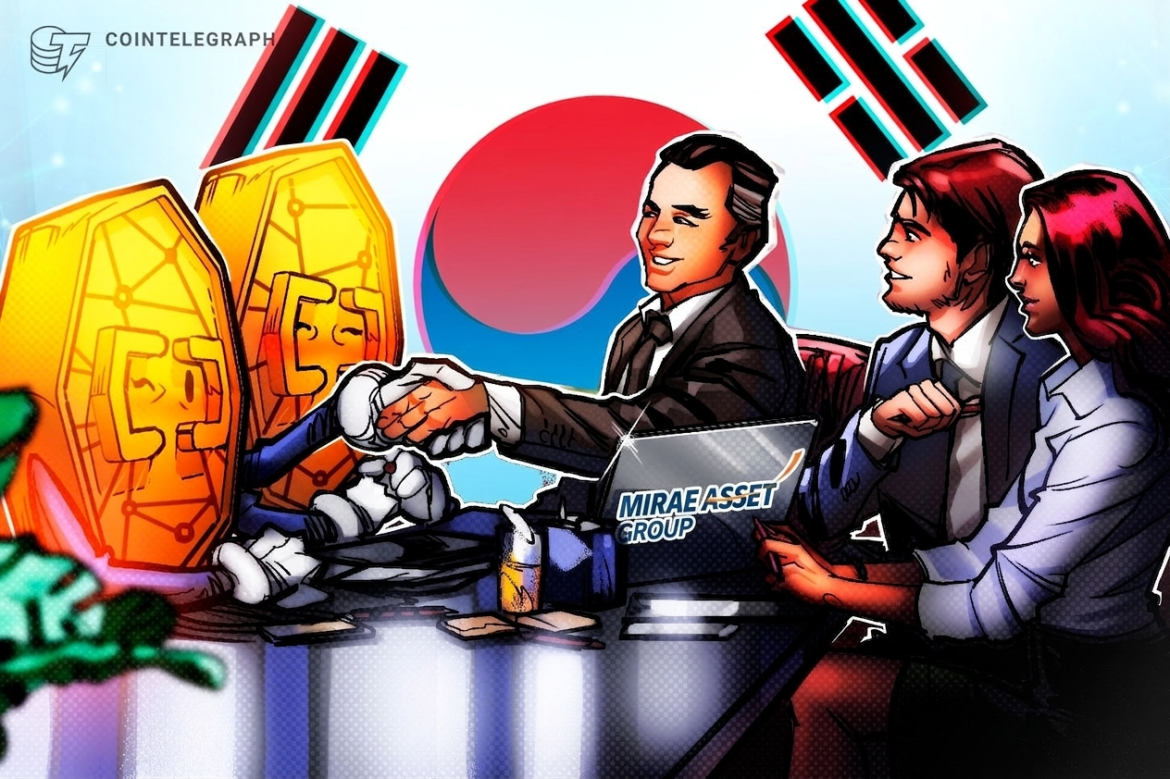
Mirae Asset reportedly plans to use the South Korean crypto exchange as a hub for tokenized assets, stablecoins and digital finance.
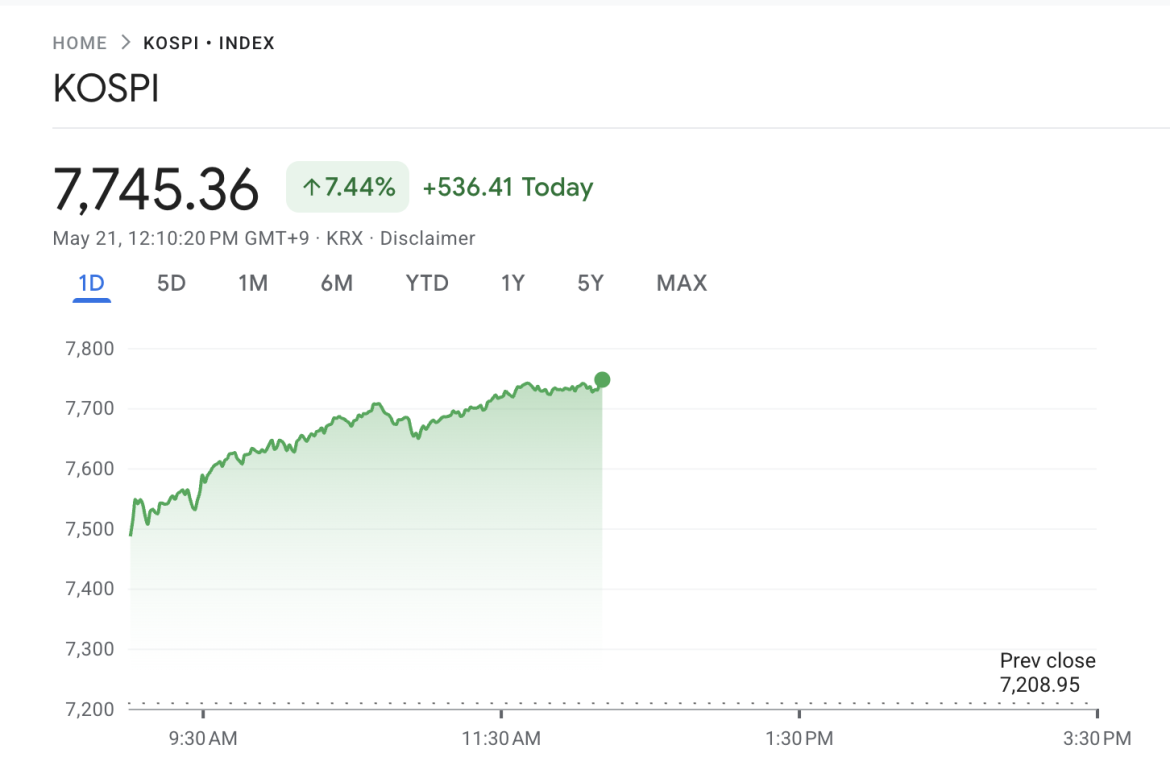
South Korea’s KOSPI surged 7% on Thursday, snapping a multi-day losing streak as Asia-Pacific markets tracked Wall Street’s gains.
The benchmark had fallen 9.35% after hitting an all-time high above 8,000 last Friday.
Earlier-week declines came as President Donald Trump signaled possible US strikes on Iran, rattling investors. Sentiment has since reversed, with Trump saying Washington is now in the “final stages” of negotiations with Tehran.
In addition, Samsung Electronics and its worker union reached a last-minute wage agreement late Wednesday. The deal suspended an 18-day strike scheduled to begin Thursday.
Samsung shares climbed more than 6%, while memory rival SK Hynix jumped 11%. Semiconductor names also lifted after Nvidia’s latest earnings showed revenue climbing 85% year-on-year to $81.62 billion.
Follow us on X to get the latest news as it happens
The KOSPI has tripled in less than 18 months. According to the Financial Times, the pace beats the Nasdaq Composite’s dotcom-era climb by roughly six months.
The rally is fueled largely by the country’s two heaviest-weighted listed companies, Samsung Electronics and SK Hynix. The pair now make up a record 42% of the benchmark, with Samsung up roughly 130% this year and SK Hynix climbing nearly 170%.
Surging memory-chip demand from AI hyperscalers has anchored the run. Notably, Goldman Sachs, Citigroup, and JPMorgan have raised their year-end KOSPI targets in recent weeks.
Subscribe to our YouTube channel to watch leaders and journalists provide expert insights
The post South Korea’s KOSPI Stages 7% Comeback Powered by 3 Catalysts appeared first on BeInCrypto.
One day after recording its worst single-session loss in history, South Korea’s KOSPI surged more than 11% on Thursday, staging one of the most dramatic reversals the index has ever seen.
No major economy is more acutely wired to Middle East instability than Seoul — and this week proved it.
South Korea’s two main stock indices — the large-cap KOSPI and tech-heavy KOSDAQ — are among Asia’s most actively traded markets and a key barometer of Korean retail investor sentiment.
By mid-morning, the KOSPI had climbed to 5,682 — up from Wednesday’s close of 5,093 — after touching an intraday high of 5,715. The KOSDAQ recovered above the 1,000 level, gaining over 11%. A buy-side sidecar was triggered in early trade — a striking contrast to Wednesday’s sell-side sidecar and full circuit breaker halt. The won strengthened sharply, pulling back from an overnight high of 1,505 to trade near 1,461.
The catalyst: oil prices stabilized, with Brent crude holding at $81.40 and WTI at $74.66, and reports of back-channel contacts between Washington and Tehran lifted sentiment across Asian markets. Wall Street had closed higher on Wednesday, with the Nasdaq up 1.29%, led by Tesla (+3.44%), Amazon (+3.95%), and Nvidia (+1.66%).
Samsung Electronics and SK Hynix — which had shed 21% and 22.75% respectively from their late-February peaks — rebounded 13–15% in early trade. Foreign investors, who had used both stocks as first-resort liquidity during the panic, returned as net buyers of over 710 billion won by mid-morning. Retail investors added another 600 billion won alongside them.
The scale of the crash and recovery reflects a structural reality. Over the two sessions on March 3–4, the KOSPI and KOSDAQ fell 18.43% and 17.97%, respectively — the worst and second-worst performances globally. Japan fell 6.57%, Taiwan 6.46%, and China’s Shenzhen Composite just 3.76%. US indices barely registered, declining less than 0.35% combined.
Korea imports over 70% of its energy from the Middle East and operates an export-dependent economy with high sensitivity to commodity shocks. When US-Israel strikes on Iran triggered Strait of Hormuz closure fears, global risk was concentrated in Seoul with exceptional force. Wednesday’s KOSPI decline of 12.06% surpassed even the 12.02% drop recorded the day after 9/11 — a threshold that had stood for 25 years.
Analysts are cautiously optimistic but warn that the path forward depends on geopolitical developments. One analyst argued that a prolonged Hormuz blockade is self-defeating for Iran. It would cut Tehran’s foreign exchange revenues while inviting further military response. Another pointed to a potential mediator as the key turning point. At current index levels, he said, “the case for buying is strong.”
Mirae Asset set a near-term KOSPI recovery target of 5,800. Kiwoom Securities suggested the two-day selloff had effectively front-loaded the war risk premium in full.
For crypto markets, as BeInCrypto reported Wednesday, Korea’s retail investor base showed some resilience during the crash — with newly listed tokens on Upbit and Bithumb posting double-digit gains even as equities collapsed. But Thursday’s equity rebound may quickly reverse that dynamic.
With foreign and retail investors pouring over 1.3 trillion won back into equities in a single morning session, the stock market’s gravitational pull reasserts itself. Korea’s crypto volumes had already dropped by more than 80% during the KOSPI’s 85% bull run since President Lee’s election, and a sharp V-shaped equity recovery threatens to drain whatever crypto inflows emerged during the two-day panic.
The won pulled back from 1,505 to near 1,461. That partial recovery reduces the currency-hedge appeal that briefly boosted digital assets. The effect is already visible in the data: Bitcoin rose 6.4% in dollar terms over the past 24 hours, but gained only around 5% on Upbit in won terms — the won’s sharp rebound absorbed more than a percentage point of that gain.
If geopolitical risk continues to ease, the KOSPI could push toward Mirae Asset’s 5,800 target. Korean retail capital — historically the most swing-sensitive in global crypto markets — would likely follow equities. Not digital assets.
South Korea’s long-awaited Digital Asset Basic Act (DABA), a sweeping framework meant to govern crypto trading and issuance in one of Asia’s most active digital asset markets, has been delayed amid disagreements among regulators over stablecoin issuance.
The most significant disagreement centers on who should have the legal authority to issue KRW-pegged stablecoins, according to a Korea Tech Desk article. The Bank of Korea (BOK) argued that only banks with majority (51%) ownership should be permitted to issue stablecoins. It said financial institutions are already subject to stringent solvency and anti-money-laundering requirements and therefore the only ones in position to ensure stability and protect the financial system.
The Financial Services Commission (FSC), which oversees financial policy-making, is more flexible. It acknowledged the need for stability, but warned that a strict “51% rule” could stifle competition and innovation, blocking fintech firms with the technical expertise to build scalable blockchain infrastructure from participating, according to the report.
The FSC cited the European Union’s Markets in Crypto-Assets regulation, in which most licensed stablecoin issuers are digital asset firms rather than banks. It also pointed to Japan’s fintech-led yen stablecoin projects as an example of regulated innovation.
The deadlock highlights a broader global debate over whether banks or fintech firms should control fiat-backed stablecoins, a decision that could shape competition, innovation and monetary oversight.
The ruling Democratic Party of Korea (DPK) also opposes the BOK’s 51% rule, a Korea Times article reported last week.
“A majority of participating experts voiced concerns about the BOK’s proposal, with many questioning whether such a framework could deliver innovation or generate strong network effects,” DPK lawmaker Ahn Do-geol said. “It is also hard to find global legislative precedents in which institutions from a specific sector are required to hold a 51%.”
He said the BOK’s stability concerns could be mitigated through regulatory and technological measures, a view the lawmaker added, “is broadly shared among policy advisors”.
Foreign-issued stablecoins are also another key sticking point. According to an earlier draft of the government proposal prepared by the FSC, foreign-issued stablecoins would be allowed in South Korea if they are licensed and have a branch or subsidiary in the country. That would require issuers such as Circle, which issues USDC, the world’s second-largest stablecoin, to establish a local presence for the token to be legally used in the country.
The regulatory deadlock is expected to delay the bill’s passage until at least January, with full implementation now unlikely before 2026, according to AInvest. South Korea’s digital assets act marks a significant shift in a country that for nine years banned crypto, a stance that its financial watchdog began to soften earlier this year.

Start every day with the top news stories right now, plus original features, a podcast, videos and more.


