The expansion gives institutional and automated traders real-time access to Kalshi’s political markets as election betting activity continues to grow.

 Live Chat

The expansion gives institutional and automated traders real-time access to Kalshi’s political markets as election betting activity continues to grow.
The Ninth Circuit has dealt Kalshi one of its biggest legal losses yet, ruling that the platform’s sports-event contracts are sports bets—not swaps protected by the Commodity Exchange Act. The decision lets Nevada enforce its gaming laws against Kalshi’s sports products, deepens a circuit split with the Third Circuit, and raises the stakes for prediction-market operators facing state regulators around the country.
The United States Court of Appeals for the Ninth Circuit delivered a major win to Nevada Friday, and a major setback to Kalshi’s central legal argument for offering sports contracts nationwide.
In a published opinion, a unanimous three-judge panel affirmed the dissolution of Kalshi’s preliminary injunction against Nevada gaming regulators. The court held that Kalshi had not shown it was likely to prove that the Commodity Exchange Act preempts Nevada’s gambling laws as applied to its sports-event contracts.
The key conclusion was blunt: Kalshi’s sports products are sports bets, not Commodity Futures Trading Commission-regulated swaps.
That does not end Kalshi’s case altogether. The court remanded the dispute over Kalshi’s election contracts to the Nevada district court for separate consideration. But for the platform’s sports business, the part that made up more than 90% of Kalshi trades and 95% of its revenue in 2025, according to the opinion, the ruling is a serious legal problem.
The dispute began in March 2025, when the Nevada Gaming Control Board sent Kalshi a cease-and-desist letter. Nevada argued that the company’s sports-event contracts constituted an unlicensed sports pool under state gaming law.
Kalshi argued that it is not a sportsbook but a CFTC-registered designated contract market (DCM) listing federally regulated event contracts. It stated the CFTC’s authority over swaps preempted Nevada’s gaming rules. A district judge initially gave Kalshi a preliminary injunction, but later dissolved it after a separate Nevada ruling against Crypto.com reached the opposite conclusion on similar sports contracts.
Friday’s appeals decision backs Nevada’s position. The court held that the Commodity Exchange Act gives the CFTC exclusive jurisdiction over qualifying swaps traded on a DCM, but that Kalshi’s contracts on sports outcomes do not qualify as swaps in the first place.
The panel said a bet on whether a team covers a spread, wins a game, or hits a particular score is not materially different from the same wager at a conventional sportsbook. Kalshi’s market structure may differ from Caesars or MGM, the court said, but those differences do not change the legal substance of the product.
Kalshi’s argument centered on the broad statutory definition of a swap: a contract tied to the occurrence or nonoccurrence of an event or contingency that carries a potential financial, economic or commercial consequence.
The Ninth Circuit agreed that the CEA can preempt some state regulation of swaps traded on federally designated markets. But it rejected Kalshi’s view that every event contract listed on a DCM automatically receives that federal shield.
The court’s reasoning had three major pieces:
The judges also rejected Kalshi’s claims of conflict and field preemption. They said Kalshi could comply with Nevada law by geofencing users in Nevada, as other regulated entities do. They held that Congress had not clearly given the CFTC authority to displace states’ longstanding role in regulating gambling.
The ruling creates a direct and increasingly consequential split with the Third Circuit.
Earlier this year, the Third Circuit affirmed an injunction protecting Kalshi from New Jersey gambling enforcement, concluding that Kalshi’s sports-related event contracts could be treated as swaps under the CEA and that federal law preempted the state’s attempt to regulate them.
The Ninth Circuit explicitly disagreed with that approach. It said the Third Circuit read the term “event” too literally and failed to account for the statutory context, the CFTC’s prohibition on gaming, and the fact that Congress has historically treated sports gambling as an area for state and tribal regulation.
That leaves two federal appellate courts interpreting the same federal law differently. Kalshi may seek rehearing or Supreme Court review, particularly because the CFTC appeared as an amicus supporting the company’s position. But for now, the Ninth Circuit’s decision is controlling across a large portion of the West.
The American Gaming Association hailed the decision as a victory for state authority and the established gaming framework.
“The Ninth Circuit’s unanimous decision confirmed state and voter choices about sports betting in their communities,” the AGA said in a statement. “The American Gaming Association applauds Nevada’s leadership for protecting and preserving the state- and tribal-regulated gaming framework. This ruling is a significant win for consumer protections and taxpayers.
“It is a big loss for Kalshi and other backdoor sports gambling operations who defy state laws.”
The Nevada ruling is a major setback for prediction markets, but it does not settle the nationwide fight.
Kalshi has picked up preliminary-injunction wins in New Jersey, Tennessee and Arizona, while courts in Maryland, Ohio, New York and now Nevada have rejected or limited its preemption argument. The Fourth Circuit appeal from the Maryland decision is still pending, and the Ninth Circuit’s ruling notes that litigation remains active in multiple jurisdictions.
The immediate practical distinction is between sports contracts and other types of event contracts. The Ninth Circuit sent the question of Kalshi’s election markets back to the Nevada district court rather than deciding it, leaving political prediction markets outside the court’s core holding for now.

This latest U.S. appeals court ruling sets up a rift between federal courts on event contracts, suggesting the U.S. Supreme Court may need to settle the matter.

A Washington court order calls for Kalshi to block contracts tied to sports, elections, politics, entertainment, culture, technology, science and mentions, with GeoComply geofencing required by Sept. 2
Kalshi must halt most of its event contract operations in Washington under a sweeping preliminary injunction that extends well beyond the sports contracts targeted by most other states.
An order signed Wednesday finalizing the injunction’s terms bars Kalshi from offering or facilitating Washington trades involving sports, elections, politics, entertainment, culture, technology and science, and mention markets. Contracts involving commodities, climate, economics and finance may remain available.
“They were allowing bets on pretty much every aspect of American life,” Washington Attorney General Nick Brown said in a video posted to X on Thursday, citing markets involving sports, natural disasters and measles cases.
“We sued, and we won,” Brown said. He later acknowledged that the preliminary injunction does not resolve the underlying lawsuit: “This case isn’t over. There’s still a long way to go, but this is a great early win for us.”
The order phases in the restrictions over the next three weeks. By Aug. 19, Kalshi must use IP addresses and customer residency information to prevent people in Washington from opening positions in prohibited contracts, including through third-party intermediaries carrying its markets.
By Sept. 2, Kalshi must deploy multi-source geolocation technology provided by GeoComply. If the system is not operational by then, Kalshi could face penalties of $120,000 per day. The company can instead submit an affidavit describing its implementation efforts, leaving the court to determine whether it exercised sufficient diligence and whether penalties are warranted.
Kalshi must also stop advertising the prohibited contracts specifically to Washington consumers and make good-faith efforts to exclude the state from nationwide campaigns when technologically feasible.
Washington users can still exit existing positions and withdraw their funds. Kalshi must also preserve records connected to those customers while the litigation continues.
Brown sued Kalshi on March 27 after the Washington State Gambling Commission declared in December that event contract markets were not authorized in the state. The complaint alleges violations of Washington’s Gambling Act and Consumer Protection Act.
Kalshi immediately removed the case to federal court, arguing that the Commodity Exchange Act gives the CFTC exclusive jurisdiction over its federally regulated exchange. A federal judge returned the case to state court in May, and the Ninth Circuit denied Kalshi’s request to pause the proceedings during its appeal.
King County Superior Court Judge John McHale granted Washington’s request for a preliminary injunction in July, finding that the state was likely to prove its claims and that continued operations could substantially harm consumers. He then directed the parties to propose the language and scope of the restrictions.
“States don’t have jurisdiction to regulate prediction markets,” Kalshi said after that ruling, according to Reuters, pointing to federal decisions supporting CFTC exclusivity. Kalshi appealed the injunction, but must now implement geofencing while continuing to challenge the state’s authority and the breadth of the restrictions.
Washington’s injunction appears to be the broadest court-ordered restriction on Kalshi’s product range to date. Before the Washington order, Michigan and Nevada were the only states to implement active court-ordered restrictions, while a Massachusetts injunction remained paused during Kalshi’s appeal.
The Michigan restriction applies only to sports contracts. Nevada’s order blocks sports, election and entertainment contracts. Washington reaches those subjects and adds politics, culture, technology and science, plus mention markets, leaving only a handful of expressly permitted categories.
The action could also have implications beyond Kalshi. The Gambling Commission’s December notice applied broadly to event contract markets, although Washington has not filed a comparable enforcement case against another platform.
Robinhood filed a preemptive federal lawsuit against Brown and the commission on March 30, three days after Washington sued Kalshi. Robinhood argued that the state’s actions created an imminent threat to its event-contract business, which distributes markets from Kalshi and ForecastEx.
Crypto.com-owned Nadex followed on July 22, two days after McHale granted the preliminary injunction. Crypto.com’s OG platform similarly argued that Washington’s action against Kalshi demonstrated a “concrete and imminent threat” that the state would pursue other federally regulated platforms.
For now, Kalshi remains Washington’s only direct prediction-market enforcement target. But the breadth of the injunction gives the state a potential roadmap for pursuing significantly more than sports contracts on competing platforms if the order survives appeal.

The AI-powered tool grew out of an earlier prototype as bars, brands and other businesses experiment with event contracts to offset real-world risks
A new tool aims to make one of Wall Street’s oldest risk-management strategies more accessible to small businesses, using prediction market contracts to hedge risks ranging from bad weather and rising fuel costs to the outcome of a sports promotion.
Blanket lets business owners describe an exposure in plain English, then searches live Kalshi markets for contracts that could potentially offset some of the financial impact. The tool can model how a proposed hedge might work, flag mismatches between a business risk and an available contract and tell users when it cannot find a suitable market. Blanket does not execute trades or handle customer funds; any trading takes place on Kalshi.
Fortune first reported on Blanket Friday, describing it as a new AI tool built around Kalshi’s prediction market exchange. The site was created and is owned by Lauris Zminsky, an independent financial economist who does not work for Kalshi, according to Fortune. But Zminsky has worked directly with members of the Kalshi team while developing the project, including through the exchange’s Builder’s Program.
Large companies have long used derivatives to manage exposure to risks such as interest rates, currencies and commodity prices. Prediction market contracts can potentially extend that concept to much narrower outcomes, including weather events, policy decisions and sports results. But matching one of those contracts to an actual business exposure can be complicated.
That problem has been a focus for Zminsky for months. In July, he argued that businesses should first identify the specific financial risk they want to offset, then look for an event contract that closely matches it, rather than starting with an available contract and working backward. “A hedge is not a product,” he wrote in an essay on X, saying that the relevant question is how closely an instrument offsets a company’s actual risk and what exposure remains after the trade.
Zminsky had already been exploring how the idea could apply to larger companies. Earlier this year, he built Hedgebook, a project designed to map Kalshi event contracts to companies in the S&P 500. Fortune reported that the project was developed with a Kalshi employee and was designed to identify event contracts that could correspond with risks disclosed by public companies.
Blanket grew out of a simpler experiment Zminsky launched in June. After seeing a New York bar use Kalshi contracts to offset the cost of a Knicks promotion, he built Bizhedge, a prototype that he said could “find live Kalshi markets you can use to cover a risk or run a promotion” based on a user’s description of their business. He called it “just a fun yet useful prototype,” adding, “Hedging is for everyone, not just hedge funds.”
In his July X essay, Zminsky said that he was working with members of the Kalshi team on a new demonstration of his approach through the platform’s Builder’s Program. The program supports outside developers building products around Kalshi and includes access to a pool of more than $2 million in grants, along with technical and other developer support. Kalshi says builders retain ownership of their projects. Zminsky has not said publicly whether he received funding through the program.
Earlier this week, Zminsky teased a “new build” designed to help small businesses discover event contracts with real economic uses and thanked three Kalshi team members for helping him with it.
Fortune reported Friday that Blanket had “quietly launched in stealth” and was going public this week. The site is now publicly accessible at tryblanket.app.
Blanket starts with a simple question: “What could hurt your business?” A user can describe a financial risk or promotional promise in ordinary language, with dollar figures optional, and the tool searches current Kalshi markets for a contract that could provide at least a partial offset. Blanket then explains the relationship between the business risk and the market and can model the potential cost and payout under different outcomes.
One example on the site considers a small Denver trucking company that could lose $50,000 if diesel prices spike. Blanket identifies a Kalshi market tied to crude oil prices as the closest available option, while noting that the contract does not track the company’s actual diesel bill. The example models a $45,000 gross payout at a cost of $7,605 if the specified oil-price threshold is reached.
The tool is also designed to identify when the match is too weak. A separate Gaps page catalogs risks for which Blanket found no suitable existing contract, under the heading “Markets Kalshi should make.” The site currently lists potential gaps involving weather disruptions, financing rates, energy and material costs, currency exposure and promotional liabilities, among others. Users can indicate that they face one of the same risks, potentially providing a demand signal for Kalshi about new markets businesses may want.
Blanket also works in reverse through a feature called Scout. Users can submit an existing Kalshi market and the tool analyzes which types of businesses could be financially exposed to the outcome before searching for real companies that fit those characteristics. For example, its demonstration using a Kalshi contract tied to unusually cold temperatures in Texas identifies potential exposure for businesses like plumbers, nurseries and property managers.
The site says market data and settlement rules come from Kalshi’s public API, while business discovery for Scout is powered by Bright Data and its analysis runs through OpenRouter.
Blanket is arriving after several businesses have already experimented with using Kalshi contracts to offset risks that would rarely be associated with traditional corporate hedging.
• The Jeffrey: The New York City bar, whose Knicks promotion helped inspire Zminsky’s original Bizhedge prototype, used a $5,000 Kalshi position to help cover a promotion offering customers up to $100 off their tabs if the Knicks won Game 1 of the NBA Finals. The position could pay about $13,500 if New York won, helping offset the cost of the promotion.
• TallBoy: During the World Cup, the Washington, D.C., bar offered discounts based on the U.S. margin of victory, including free tabs for a win by three goals or more, and used Kalshi contracts to hedge the potential cost. When the U.S. beat Paraguay 4-1, the free-tab promotion was triggered.
• Forme: The sportswear company partnered with promotions platform PlayAbly on an offer promising customers a full refund if the U.S. reached the World Cup final. PlayAbly used Kalshi to cover the promotional exposure.
• EGOHOME: PlayAbly later used the same model for the mattress brand, which offered customers 100% cashback if Aniya and Carl won Love Island USA. The Kalshi position reportedly cost $2,500 and could return about $55,000 if the couple won.
• 28 Wishes Ice Cream Shop: The Los Angeles shop has reportedly used Kalshi weather contracts to offset slower sales during cold weather. Owner Jason Jiang said business falls about 20% when temperatures drop below 70 degrees and that the trades have generated about $1,500 a month.
Kalshi appears to see those individual examples as the beginning of a larger commercial use case. Nicolas Hull, who handles small-business hedging at the company, told Fortune that businesses are already using Kalshi to manage exposure to weather, major sports tournaments, freight and tariffs.
He called hedging by smaller companies and businesses a “massive growth segment” for the exchange.
Kalshi is also highlighting the use case on its own Kalshi for Industry site, which promotes event contracts as tools for managing operational risks. Its examples of “hedging in practice” include both The Jeffrey and 28 Wishes alongside larger institutional users, illustrating how the company is positioning its event-contract exchange for users ranging from neighborhood businesses to professional risk managers.
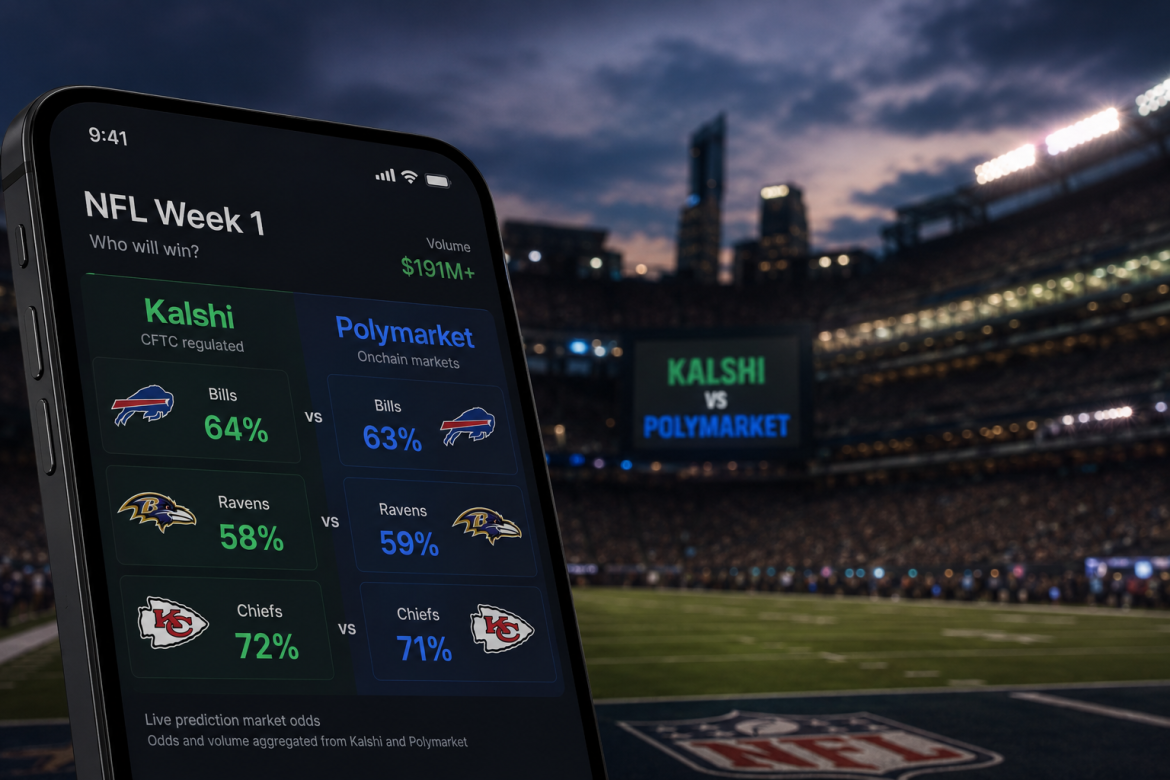
Week 1 features two toss-ups according to prediction markets. Buffalo holds a narrow 51% edge over Houston, while Green Bay and Minnesota are near deadlocked. DeFiRate aggregates and compares Week 1 odds alongside prices from FanDuel, DraftKings, Kalshi, and Polymarket.
NFL Week 1 prediction market odds continue to fluctuate as we enter preseason games, with kickoff scheduled for Wednesday, Sept. 9. It’s a big game rematch of Patriots vs. Seahawks at 8:20 p.m. ET on NBC. NFL futures markets remain incredibly active at leading platforms, with volume on Kalshi already moving past week 1 of last year.
Week 1 opens with some of the NFL’s biggest rivalries already on the board. The Cowboys and Giants renew their NFC East battle under the Sunday night lights, the 49ers and Rams kick off the season in Australia, and the Bills and Texans are separated by just two percentage points in early trading. Below, we compare opening odds from Kalshi, Polymarket, FanDuel, and DraftKings for every Week 1 matchup.
Kalshi released Week 1 odds on May 16. Probabilities are updated weekly as volume grows with links to live odds feeds for each individual game. Polymarket odds remain TBD and will be updated as markets open.
| Game | Kalshi | Polymarket US | FanDuel | DraftKings |
|---|---|---|---|---|
| Patriots @ Seahawks | SEA 67% / NE 33% | TBD | SEA -198 / NE +166 | SEA -198 / NE +164 |
| 49ers vs. Rams (Australia) | LAR 64% / SF 36% | TBD | LAR -210 / SF +176 | LAR -180 / SF +150 |
| Saints @ Lions | DET 74% / NO 26% | TBD | DET -320 / NO +260 | DET -310 / NO +250 |
| Bears @ Panthers | CHI 57% / CAR 43% | TBD | CHI -146 / CAR +124 | CHI -148 / CAR +124 |
| Bills @ Texans | BUF 51% / HOU 49% | TBD | BUF -110 / HOU -106 | BUF -122 / HOU +102 |
| Ravens @ Colts | BAL 63% / IND 37% | TBD | BAL -200 / IND +168 | BAL -180 / IND +150 |
| Falcons @ Steelers | PIT 59% / ATL 41% | TBD | PIT -146 / ATL +124 | PIT -170 / ATL +142 |
| Buccaneers @ Bengals | CIN 63% / TB 37% | TBD | CIN -210 / TB +176 | CIN -198 / TB +164 |
| Jets @ Titans | TEN 55% / NYJ 45% | TBD | TEN -134 / NYJ +116 | TEN -155 / NYJ +130 |
| Browns @ Jaguars | JAX 76% / CLE 24% | TBD | JAX -405 / CLE +320 | JAX -380 / CLE +300 |
| Commanders @ Eagles | PHI 66% / WAS 34% | TBD | PHI -215 / WAS +180 | PHI -218 / WAS +180 |
| Packers @ Vikings | GB 50% / MIN 50% | TBD | GB -110 / MIN -106 | GB -115 / MIN -105 |
| Dolphins @ Raiders | LV 63% / MIA 37% | TBD | LV -210 / MIA +176 | LV -205 / MIA +170 |
| Cardinals @ Chargers | LAC 79% / ARI 21% | TBD | LAC -590 / ARI +440 | LAC -625 / ARI +455 |
| Cowboys @ Giants | DAL 56% / DAL 44% | TBD | DAL -152 / NYG +128 | DAL -148 / NYG +124 |
| Broncos @ Chiefs | KC 57% / DEN 43% | TBD | KC -146 / DEN +124 | KC -162 / DEN +136 |
Wednesday, Sept. 9
New England Patriots @ Seattle Seahawks | Lumen Field, Seattle, WA | Wednesday, Sept. 9 | 8:20 p.m. ET | NBC/Peacock
The Super Bowl LX rematch kicks off the 2026 season in what marks just the second time in 75 years the NFL has opened on a Wednesday. Seattle is favored, reflecting both the home field advantage and the perceived gap between the two teams. The storyline here is whether Drake Maye and company have closed the gap since February’s 29-13 defeat.
Thursday Night Football, Sept. 10
San Francisco 49ers vs. Los Angeles Rams | Melbourne Cricket Ground, Melbourne, Australia | 8:35 p.m. ET | Netflix
The NFL’s first-ever game in Australia is one of the tightest on the Week 1 slate by pricing. The Rams enter as a modest favorite. They’re currently favored in Super Bowl odds on Kalshi, and second behind the Seahawks at Polymarket. Both teams enter with genuine NFC West title ambitions and legitimate Super Bowl cases, making this a must-see matchup.
Sunday, Sept. 13 – 1 p.m. ET games
New Orleans Saints @ Detroit Lions | Ford Field, Detroit, MI | 1 p.m. ET | Fox
Detroit opens as one of the heaviest favorites of Week 1. They’re favored to win the NFC North this season and widely expected to rebound from last season’s fourth-place finish. New Orleans arrives as a 1% Super Bowl contender on Kalshi. Pricing suggests this is one of the clearest mismatches on the opening slate.
Chicago Bears @ Carolina Panthers | Bank of America Stadium, Charlotte, NC | 1 p.m. ET | Fox
Chicago opens as a slight road favorite, with Carolina aiming to prove last season’s NFC South crown wasn’t a fluke. The Bears are at 23% to win the NFC North on Kalshi. A clean Week 1 win on the road would be a strong early statement in what shapes up as a genuinely competitive division race with Detroit and Green Bay.
Buffalo Bills @ Houston Texans | NRG Stadium, Houston, TX | 1 p.m. ET | CBS
The tightest line of the early Sunday window, with Buffalo installed as a slight favorite. The Bills enter as the AFC East’s top choice at 58% on Kalshi. Houston is favored at 39% to win the AFC South. A Bills loss here would immediately tighten the AFC East market, while a Texans victory could spike their division and conference pricing.
Baltimore Ravens @ Indianapolis Colts | Lucas Oil Stadium, Indianapolis, IN | 1 p.m. ET | CBS
Baltimore opens as a road favorite against a Colts team still waiting on Daniel Jones to return from an Achilles tear. The Ravens lead the AFC North at 47% on Kalshi, the most dominant divisional position in the conference. Indianapolis is at 16% to win the AFC South at Polymarket, behind the Texans and Jaguars.
Atlanta Falcons @ Pittsburgh Steelers | Acrisure Stadium, Pittsburgh, PA | 1 p.m. ET | Fox
Pittsburgh is favored to get the home win, but heads to opening week with questions. The Steelers’ quarterback situation remains unresolved. Aaron Rodgers is still unsigned, contributing to the line discrepancy between books. Atlanta checks in at 21% to win the NFC South on Kalshi, last among the four teams.
Tampa Bay Buccaneers @ Cincinnati Bengals | Paycor Stadium, Cincinnati, OH | 1 p.m. ET | Fox
Cincinnati opens as the home favorite and looks to bounce back from a 6-11 finish. The Bengals sit at 32% to win the AFC North on Kalshi, second only to Baltimore’s 47%. A strong Week 1 performance at home against Tampa Bay would be an early signal that better days could be on the way for Cincinnati and potentially tighten division pricing.
New York Jets @ Tennessee Titans | Nissan Stadium, Nashville, TN | 1 p.m. ET
Tennessee opens as the favorite as they welcome a New York team that has lots of questions to answer following a 3-14 campaign. The Titans are at just 8% to win the AFC South on Kalshi, with the Jets at 5% to win the AFC East contender at 5%. Both franchises enter 2026 with low expectations and something to prove early.
Cleveland Browns @ Jacksonville Jaguars | EverBank Stadium, Jacksonville, FL | 1 p.m. ET | CBS
Jacksonville opens as one of the largest favorites of the week. They won the AFC South a season ago, while Cleveland finished in the basement of the AFC North. The Jaguars, at 33% to win the AFC South on Kalshi, are well-positioned to make a division title run. A dominant Week 1 home win could help set the tone, while a tighter game could impact expectations.
Sunday, Sept. 13 – Late games
Washington Commanders @ Philadelphia Eagles | Lincoln Financial Field, Philadelphia, PA | 4:25 p.m. ET | Fox
Kalshi has the NFC East as a dead heat between Dallas and Philadelphia at 35% each, with Washington at 17%. The game is being priced as a clear Eagles advantage in Week 1. A Commanders win here would shift the division market, a race the prediction markets are already pricing as one to watch.
Green Bay Packers @ Minnesota Vikings | US Bank Stadium, Minneapolis, MN | 4:25 p.m. ET | CBS
Kalshi has Green Bay at 30% and Minnesota at 20% to win the NFC North. Detroit (33%) and Chicago (23%) in the mix make this one of the most competitive chases on the board. Neither team can afford an early stumble in what shapes up as one of the more compelling matchups of the late Sunday window for Week 1.
Miami Dolphins @ Las Vegas Raiders | Allegiant Stadium, Las Vegas, NV | 4:25 p.m. ET
Las Vegas opens as a home favorite against a Dolphins team Kalshi views as the AFC East’s biggest longshot at 4%. Miami’s worst regular-season record odds of 31% on Kalshi make this a game the Raiders, at 8% to win the AFC West, genuinely need to win early to establish any credibility in a division where three teams are bunched within four points at the top.
Arizona Cardinals @ Los Angeles Chargers | SoFi Stadium, Inglewood, CA | 4:25 p.m. ET | CBS
The most lopsided line of Week 1 by a significant margin. The Chargers, at 34% to win the AFC West, open as heavy favorites in a game that should do little to move any market. The Cardinals, at 1% Super Bowl odds on Kalshi and 28% worst record odds, appear to be headed into the clearest mismatch on the slate.
Sunday Night Football, Sept. 13
Dallas Cowboys @ New York Giants | MetLife Stadium, East Rutherford, NJ | 8:20 p.m. ET | NBC (SNF)
Dallas opens as a road favorite for this divisional primetime showdown. The NFC East race is a virtual dead heat on Kalshi, with both Dallas and Philadelphia at 35% to win the division. The Giants are getting some market respect at 17%, up 4 points recently on Kalshi, under new head coach John Harbaugh. SNF is set to be a marquee game of the opening slate.
Monday Night Football, Sept. 14
Denver Broncos @ Kansas City Chiefs | Arrowhead Stadium, Kansas City, MO | 8:15 p.m. ET | ESPN/ABC (MNF)
Kansas City opens as a home favorite in the most strategically significant game of Week 1 from a division market standpoint. Kalshi has the AFC West as the tightest division race in football: Chargers 34%, Chiefs 32%, Broncos 30%. Patrick Mahomes’ availability is the central question. All signs point to him playing, but his recovery remains one of the offseason’s defining subplots.
The NFL preseason opens on Thursday, August 9, with Panthers vs. Cardinals in the Hall of Fame Game at 8 p.m. ET on NBC. Here is where the key markets stand as we get set for the return of football.
The Los Angeles Rams are the consensus Super Bowl favorites, trading at 16% on Kalshi and 15% on Polymarket. Behind them is a competitive chase for second place. The Bills, Ravens, Chiefs, and defending champion Seahawks are all jockeying for position, with prices moving between 6-8%.
On the conference side, the Rams are favored by a wide margin, with the Seahawks and Eagles priced as the biggest threats. Over in the AFC, probabilities are much tighter, with the Bills currently slightly ahead of the Ravens, Chiefs, and Chargers.
Division markets point to several compelling storylines. The AFC West is the tightest race on the board at Kalshi, with three teams trading within four points of each other: Chargers 34%, Chiefs 32%, Broncos 30%.
For the NFL MVP award, both platforms have it priced as a tight chase. Josh Allen (11%) is right ahead of Joe Burrow (10%) in current pricing on Kalshi. On Polymarket, it’s Allen at 13%, ahead of Lamar Jackson at 11%.
Kalshi’s Super Bowl LXI market has logged over $52.8 million in trading volume before a single game has been played. The figure speaks to the growing role prediction markets are playing in how NFL fans engage with the league during the offseason.
Polymarket’s Super Bowl market sits at $42.6 million in volume over the same period. Combined, the two platforms have seen more than $85 million traded on Super Bowl futures alone, with division and conference markets adding tens of millions more.
That number will climb steadily through training camp, the preseason, and into the regular season as even more markets open and weekly trading activity accelerates.
Prices continue to move for Bills vs. Texans, which has the potential to be one of Week 1’s most competitive showdowns. At the initial release, Houston was a slight favorite. It’s now listed as close to a coin flip, with Buffalo on top.
Probabilities have widened on the 49ers vs. Rams as the off-season moves along. Los Angeles opened as a pretty sizable favorite, but the spread widened after the club swung a blockbuster deal to bring Myles Garrett to town.
As the preseason moves along, there will be increased trading volume on all of the Week 1 matchups. The news cycle moves rapidly throughout August, and notable developments tend to translate into price moves.
The 2026 season represents another significant step in the growth of NFL prediction market trading. For traders, the practical implication is that the NFL is no longer just a sportsbook sport. It is a fully functioning prediction market ecosystem with real liquidity, regulated infrastructure, and a growing suite of contracts that will expand as the season progresses.
Trading will remain active throughout the offseason, with volume and pricing sharpening as kickoff approaches. The Super Bowl market, already past $85 million in combined volume, will continue to attract significant trading activity through every week of the regular season and into the playoffs.
Related: See daily trading volume on NFL markets
UFC Fight Night descends on Belgrade for the first time for an early Saturday card. It’s Uros Medic vs. Daniel Rodriguez in the main event, with a clear favorite emerging at Kalshi and Polymarket.
UFC Fight Night Belgrade lands at the Belgrade Arena for the first time ever on August 1st with a welterweight bout for the main event. Vicious knockout artist Uros Medic takes on the dangerous Daniel Rodriguez in a fight that many expect to see a decisive finish.
The main card gets underway at 1 p.m. ET on Paramount+, with early prelims kicking off the action at 10 a.m. ET.
Kalshi and Polymarket traders are lining up almost identically across six main-card bouts, with only one two closely contested markets on the entire slate.
Here’s your full fight-by-fight breakdown through the lens of Kalshi and Polymarket, the two platforms redefining how fans engage with MMA outcomes.
Uros Medic enters as the heavy favorite in Belgrade’s historic first main event, with Kalshi pricing him at 77¢ and Polymarket at 78¢, reflecting the hometown knockout artist’s power and the crowd advantage he’ll carry into the cage. Both men actually enter on three-fight win streaks, but Rodriguez’s layoff and off-cage turmoil appear to be weighing on trader confidence, leaving him priced at just 24¢ across both books.
The tight agreement between platforms suggests little disagreement here. Traders see Medic’s finishing power and home-field energy as the deciding factor in this five-round welterweight headliner.
Prediction Markets
$500
bonus
Trade $25, Get up to $500
Claim Now!
T&C’s apply.
The co-main pits former light heavyweight champion Jan Blachowicz against unbeaten short-notice replacement Navajo Stirling, and the market has firmly sided with the rising prospect, pricing Stirling at 76¢ on both platforms. Blachowicz trails at 26¢, a striking number given his championship pedigree, but it reflects growing trader belief that age and inactivity have caught up to the veteran against a hungry, undefeated younger fighter.
Some fans have already predicted this bout could push Blachowicz toward retirement if Stirling’s size and short-notice readiness translate into a dominant performance.
Aleksandar Rakic returns to the Octagon only to move up to the heavyweight division to take on veteran heavyweight Marcin Tybura, and the market gives the Austrian a clear edge at 77¢ on both platforms. Tybura sits at 24¢ across the board, with traders leaning toward Rakic’s dynamic striking and athleticism over the durable but grinding style of the longtime UFC heavyweight.
The near-identical pricing across both platforms shows little room for a contrarian angle, though Tybura’s chin and cardio make him live if the fight extends into the later rounds.
This middleweight matchup features one of the tighter markets on the card, with Robert Valentin favored at 61¢ over local Serbian fighter Dusko Todorovic, who sits at 41¢. The gap is notable given Todorovic will fight in front of a home crowd, suggesting traders are weighing Valentin’s technical tools more heavily than home-field emotion.
With a 20-cent gap rather than the lopsided pricing seen elsewhere on the card, this bout carries real live-underdog appeal for anyone backing the hometown fighter riding crowd energy.
Vlasto Cepo is a huge favorite in this middleweight fight, trading at 75¢ on Polymarket and 77¢ on Kalshi against Gilbert Urbina, who is trading for 26¢. The fact that the odds are the same on both platforms shows that traders believe Cepo can finish and will get the win against Urbina.
Urbina’s power still keeps him alive as an underdog value, but the market has come to a clear consensus that Cepo has the stylistic edge here.
The tightest market on the entire main card has Noah Gugnon as a slight favorite at 53¢ against local fighter Milos Janicic at 48¢ on both platforms. That near coin-flip pricing shows that traders are genuinely uncertain whether Janicic’s home-crowd advantage and upside finishing ability can outlast Gugnon’s overall skill set.
This final fight on the main card is the one most likely to see real line movement as fight time approaches, with less than 5 cents separating the two sides.
The preliminary card carries plenty of intrigue heading into UFC Belgrade. One of the standout matchups is L’udovit Klein taking on Tofiq Musayev in a lightweight bout that pits Klein’s well-rounded skill set against Musayev’s aggressive striking pace. Right alongside it, Oban Elliott squares off with unbeaten prospect Michael Oliveira in a welterweight clash worth tracking. Oliveira enters with a perfect 9-0 record and real finishing upside against a durable, experienced opponent.
Further down the card, the bantamweight pairing of Mark Vologdin and Borislav Nikolic deserves attention, as does the featherweight bout between Dennis Buzukja and Bogdan Grad, a matchup of two fighters looking to build momentum on the regional stage. The women’s bantamweight fight between Nina Milosevic and Hailey Cowan rounds out a deep prelim slate. Those give fans an early crowd-energy gauge before Belgrade’s historic first UFC main card gets underway.
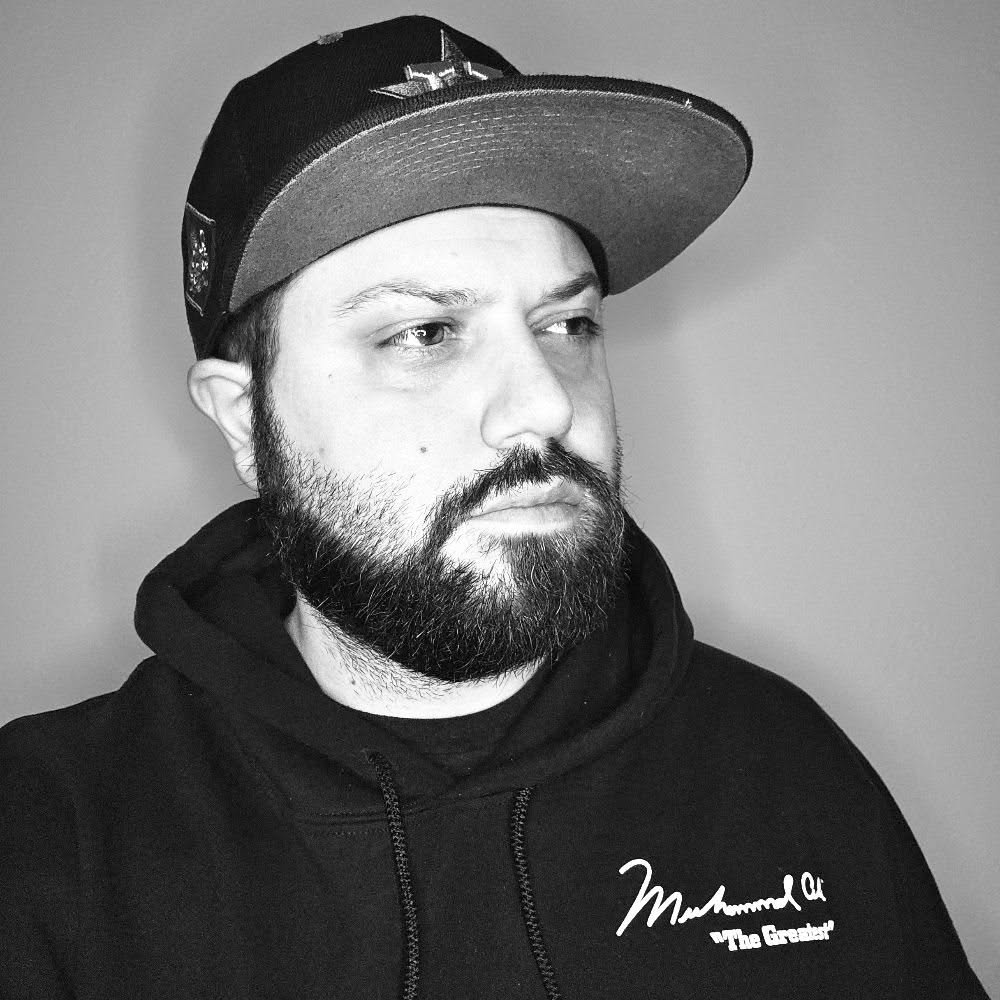
Garrett Kerman
Garrett Kerman, known as “The Fight Analyst” in the MMA community, is a veteran sports journalist and expert analyst. Garrett has worked for top platforms, including Home of Fight and ClutchPoints. Garrett focuses on high-level statistical breakdowns and news coverage. His work spans from the stylistic intricacies of a UFC main event to the latest breaking news, bridging fight analysis and breakdowns for fans and bettors looking to beat the books.

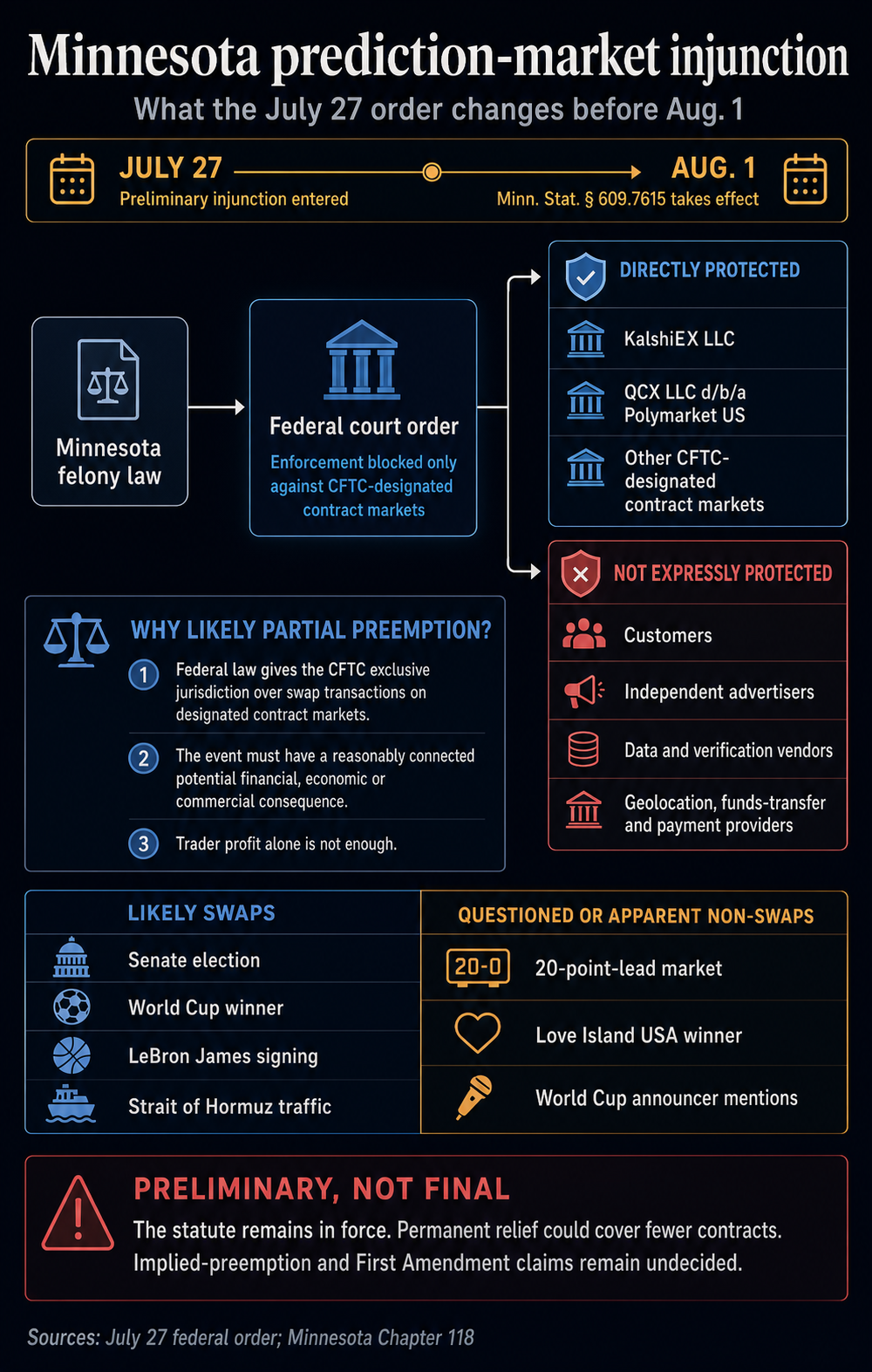
A federal judge has temporarily barred Minnesota from enforcing its new prediction-market felony law against federally regulated exchanges designated by the Commodity Futures Trading Commission as contract markets, including Kalshi and Polymarket US, days before the statute takes effect on Aug. 1.
Judge Katherine Menendez granted preliminary-injunction motions filed by the CFTC, KalshiEX and QCX, the registered entity doing business as Polymarket US. Her July 27 order prevents named Minnesota officials from enforcing Minn. Stat. § 609.7615 against CFTC-designated contract markets until the cases reach a final merits decision.
Menendez found the plaintiffs likely to prove that the Commodity Exchange Act expressly preempts part of Minnesota’s law. Federal law gives the CFTC exclusive jurisdiction over swap transactions conducted on designated contract markets, and the swap definition can include event contracts whose outcomes have a reasonably connected potential financial, economic or commercial consequence. A trader’s potential profit alone is not enough.
The order does not treat every event contract as a swap. Menendez identified markets tied to a Senate election, the World Cup winner, a LeBron James signing and Strait of Hormuz traffic as likely swaps. She questioned a 20-point-lead market and said contracts on the winning Love Island USA couple or words used by World Cup announcers appeared unlikely to qualify. Any permanent injunction could therefore apply to fewer contracts.
Chapter 118 replaced the prediction-market provisions enacted earlier in Chapter 97. The law remains scheduled to take effect Aug. 1 for crimes committed on or after that date.
Under its core offense, creating or operating a covered prediction market, or intentionally facilitating it through specified listing, funds, settlement, counterparty or pricing activity, is a felony when done for consideration and as part of a business. Other provisions cover providers who knowingly supply data directly to a market, or geolocation, funds-transfer or payment services to one, to enable or settle prohibited wagers. A separate clause criminalizes advertising or marketing financial or technological products that promote prohibited transactions.
Because the order protects only CFTC-designated contract markets, it does not expressly shield customers, independent advertisers or outside service providers. The statute remains in force, and the court has not decided the plaintiffs’ implied-preemption or First Amendment claims.
Polymarket US welcomed the ruling and said it expected to keep serving Minnesota users. Attorney General Keith Ellison said the state disagreed and would continue defending the law as the record develops.
By contrast, a New York court denied Kalshi interim protection from existing state gambling enforcement earlier in July. Both cases remain open, and the opposite preliminary results do not settle how federal registration interacts with state gambling laws nationwide.


Kalshi’s Robert DeNault and prediction market critic Mick Mulvaney agreed on the industry’s potential value but remained divided over sports contracts, consumer protections and state authority
A Kalshi enforcement official and one of the prediction market industry’s most prominent critics found surprising common ground Wednesday during a Council on Foreign Relations (CFR) roundtable, agreeing that prediction markets can provide legitimate value for forecasting, hedging and information discovery while continuing to clash over sports event contracts.
The CFT hosted the “Prediction Markets and the Public Interest” roundtable. The CFR is an influential, nonpartisan foreign policy think tank and publisher of Foreign Affairs. It brought together Kalshi Head of Enforcement Robert DeNault and former acting White House chief of staff Mick Mulvaney, executive director of Gambling is Not Investing, a coalition advocating for state and tribal gambling laws to regulate sports event contracts.
The two men, who said they had not previously met, remained cordial throughout the discussion despite their disagreement over sports contracts. Asked whether prediction markets create public value, DeNault argued they have emerged as decision-making tools that can counter misinformation, help businesses hedge risk and improve forecasting.
“We’ve seen a use case for prediction markets where they cut through the noise and allow users, both traders and people just using them in order to make decisions or as informational tools, to understand the world around them,” DeNault said.
Rather than challenging that premise, Mulvaney said he agreed with much of DeNault’s assessment.
“I actually don’t disagree with all of that,” Mulvaney said. “I think there’s value in what these folks do.”
He later added that prediction markets are “a legitimate tool” and said, “I believe in the wisdom of crowds.”
That common ground largely disappeared when the discussion turned to sports event contracts. Mulvaney said his group’s disagreement with Kalshi centers primarily on sports trading rather than prediction markets more broadly.
“Really, what we’re focused on in our group is the overlap between the prediction markets and sports gambling,” he said.
Mulvaney argued that a transaction tied to a game result remains sports gambling even when it is offered through a federally regulated exchange. He illustrated the point by describing two people taking opposite sides on whether the Yankees would win, then questioned why placing Kalshi between them would change the nature of the transaction.
DeNault pushed back on that reasoning. He argued that many familiar financial products could be described as gambling if the mere existence of opposing positions on an uncertain outcome were enough to define them that way.
“If there is a trade between two parties — if this happens, I get the money, If this happens, you get the money — that defines most swaps, most trades, most insurance contracts,” DeNault said. “So then the definition of gambling is limitless.”
The exchange captured the central divide between Kalshi and Gambling is Not Investing. Kalshi maintains that its sports contracts are federally regulated derivatives listed on a Commodity Futures Trading Commission-approved exchange. Mulvaney’s group argues that contracts based on sporting events are functionally sports wagers and should remain subject to state gambling laws.
Mulvaney said the dispute is not simply about whether prediction markets can produce useful information. It is about whether federal oversight of an exchange can displace states’ traditional authority over sports gambling.
DeNault argued that Kalshi’s sports contracts operate within the same federal regulatory and compliance structure as its contracts tied to elections, economics and other events. For Kalshi, he said, the fact that a contract references a sporting event does not by itself remove it from the derivatives framework.
The roundtable’s audience included representatives from hedge funds, banks, venture capital firms and policy organizations, with questions coming from participants affiliated with Symmetry Investments, Morgan Stanley, Brookings Institution, Commonweal Ventures and the Coalition for Prediction Markets.
The discussion also moved into territory more closely aligned with CFR’s foreign policy focus, including whether prediction markets could create national security risks by rewarding people with access to sensitive information.
Mulvaney raised reports that foreign intelligence services may monitor prediction markets for signs that traders possess inside knowledge, comparing that activity to the longstanding practice of watching indicators such as increased pizza deliveries near the Pentagon.
DeNault said Kalshi now evaluates proposed contracts for risks beyond ordinary market manipulation.
“We’ve implemented recently a risk scoring framework that takes into account national security risks for all contracts that are going live on the platform,” DeNault said.
He said that review has led Kalshi to draw limits around certain military-related markets.
“We don’t want to be listing contracts that relate to kinetic military activity to the extent we can avoid that,” DeNault said.
DeNault said the company’s approach predates the new framework.
“As an exchange, it has always been our position not to list contracts like strike markets or that directly turn on physical violence or a military activity taking place,” he said.
The public interest discussion also brought pointed questions about whether prediction-market platforms are doing enough to protect consumers as they expand.
Author and technology investor Esther Dyson said addiction may be the industry’s most direct consumer-facing consequence. DeNault said Kalshi has added loss monitoring, deposit limits and a system allowing users to exclude themselves across participating platforms.
“We have the first nationwide self-exclusion program,” DeNault said. “So if a user self-excludes from our prediction market, it counts as a universal self-exclusion from other prediction markets using an integrity vendor that we partner with.”
Mulvaney highlighted one difference between Kalshi and state-regulated sportsbooks that could expose younger customers to sports trading.
“Most states, sports betting is 21. For the CFTC, it’s 18,” Mulvaney said.
DeNault said Kalshi bars customers between 18 and 21 from using credit cards. It also applies additional account monitoring, while arguing that addiction risks are not limited to any one age group or type of financial platform.
Later, Jonathan D. Cohen, sports betting policy lead at the American Institute for Boys and Men, challenged DeNault over past Kalshi advertisements that used gambling language or portrayed the platform as a way to quickly make money.
DeNault acknowledged that prediction-market companies had not always exercised enough restraint as they pursued rapid expansion.
“Young companies often rush and get out ads and start to focus on growth at all costs,” DeNault said.
DeNault said Kalshi has since adopted marketing and affiliate guidelines and removed some earlier ads.
“We’ve taken a lot of steps to ensure that the ads that we’re airing are compliant, that they meet our responsible marketing framework,” DeNault said.
Mulvaney’s defense of state authority over sports contracts prompted Aaron Klein of the Brookings Institution to invoke states’ rights, a longtime conservative rallying cry, and press him on why Republicans sometimes favor federal intervention instead.
Klein pointed to two examples of Republican administrations overriding state objections: President Ronald Reagan’s push for a nationwide minimum drinking age and the Trump administration’s support for federally regulated sports event contracts. He asked Mulvaney why conservative Republicans favor state authority in some cases but federal power in others.
“I didn’t like the decision on the drinking age,” Mulvaney said. “I always thought that they abused the interstate Commerce Clause, which Republicans hate until they decide they want to do something with it.”
Mulvaney added, “I don’t think [the states’ rights question] falls neatly into party lines anymore.”
Mulvaney later predicted that Congress is unlikely to settle the sports-contract dispute, leaving the courts to resolve conflicting interpretations of the Commodity Exchange Act. He said differing appellate rulings could force the Supreme Court to decide whether federal law clearly gives the CFTC authority to regulate sports event contracts nationwide despite conflicting state gambling laws.
Mulvaney said Congress could expressly grant the CFTC that authority. Without such clear authorization, he argued, courts should defer to the states.
“Short of that, we’re going to respect the historical role of the state when it comes to gambling,” Mulvaney said.

Kalshi promo code RATE is available for Mexico vs. England knockout stage. Complete match preview and details on how to claim a $10 trade bonus.
The 2026 FIFA World Cup descends upon the iconic Estadio Banorte in Mexico City for a blockbuster Round of 16 showdown this Sunday, with a coveted ticket to the quarterfinals on the line as host nation Mexico clashes with England.
The match is slated to kick off tomorrow at 8:00 p.m. ET.
The Kalshi markets currently position the Three Lions as slight favorites to survive the hostile environment and advance in this weekend’s massive knockout fixture. New Kalshi traders can enter the promo code RATE to get a $10 trading bonus for the host nation matchup.
| Platform | Sign-up bonus | Promo code | How to claim | |
|---|---|---|---|---|
| Trade $10, Get $10 Free |
Best deal so far. Complete $10 in trades within 90 days. |
Claim Now |
Enter the promo code RATE when creating a new Kalshi account to claim a $10 trading bonus for World Cup markets. Here are the steps to follow to sign up and claim the bonus.
Check out our Kalshi promo code guide for the full terms and conditions. Enter the Kalshi code for your state
| Referral Code | Eligible States |
|---|---|
| RATE | All States + DC, excluding AR, AZ, CT, IL, LA, MA, MD, MI, MT, NJ, NV, and OH |
| Outcome | Prediction Odds | American Odds |
|---|---|---|
| Mexico to advance | 50% | +100 |
| England to advance | 50% | +100 |
| Regulation time – Mexico | 32% | +213 |
| Regulation time – England | 39% | +156 |
| Regulation time – Draw | 30% | +233 |
| Regulation time – England to win by 1.5 goals | 17% | +488 |
| Regulation time – Over 2.5 goals scored | 40% | +150 |
| Regulation time – Both teams to score | 20% | +400 |
| Goal scorer: Harry Kane – England | 42% | +138 |
Mexico enters this Round of 16 clash with the roaring support of a home nation and El Tri have used that electric energy to look like a true dark horse in the tournament. The hosts emerged from the group stage under huge pressure, playing a high-press style to set up a thrilling 2-1 victory over Colombia and clinch their knockout spot. Santiago Giménez has been Mexico’s main offensive weapon, showing top-level positional awareness and a clinical touch that makes him a constant danger inside the penalty area.
Mexico has a highly organized spine with Edson Álvarez anchoring the midfield as a defensive shield, intercepting play with relentless intensity. Prediction markets are pricing this as a super close, toss-up match. Kalshi is pricing Mexico’s chances of reaching the Quarterfinals at a 50/50 chance.
But England are a massive tactical hurdle with a deep, star-studded squad that has the composure to deal with hostile away crowds. The Three Lions navigated the group stage with ease, with Jude Bellingham’s brilliant box-to-box engine and Harry Kane’s veteran leadership helping them comfortably dictate the flow of their matches. Interestingly, the history books are on paper in favor of the European giants, but England has famously struggled with the high altitude and heat of Mexico in past World Cup tournaments, a historical nugget that tactical traders are weighing heavily ahead of kickoff today.
Bukayo Saka is still a potent threat on the right-hand side, able to single out defenders and break through stubborn low blocks with ease. Kalshi has England as a razor-thin 50% chance to win the match and survive this hostile environment, and prediction market traders are finding massive value on both sides of a contract that promises to be an absolute tactical chess match.
Trading this epic Mexico vs England World Cup knockout match on Kalshi totally changes how you see sports as a fan. Unlike most sportsbooks that lock up your funds as soon as the match begins, Kalshi is a fully regulated financial exchange where you can buy and sell contracts in real time.
If Mexico thrives on its home crowd and gets an early goal, the value of their “Yes” contracts will immediately increase and you can cash out and lock in your profits right then and there. On the other hand, if you see England’s top midfielders getting full control of the ball early on, you can easily liquidate your position to limit your exposure before a dip in the price.
Basically, this modern structure treats sports data as a financial stock asset. In other words, your profitability depends only on your ability to read the changing momentum of the game, not just guessing the exact final outcome. It provides an unparalleled level of execution speed, tight spreads and transparency that legacy betting platforms simply cannot provide.
Get your $10 trading bonus today with promo code RATE to dive straight into the action of this fast-moving World Cup market. Here’s your chance to top up your account balance and feel the thrill of trading World Cup contracts as the drama unfolds.
NOTE: Prediction markets involve risk, and prices can move quickly before and during live events. Users should trade only with money they can afford to lose, review the rules for each market before buying shares, and avoid chasing losses.


