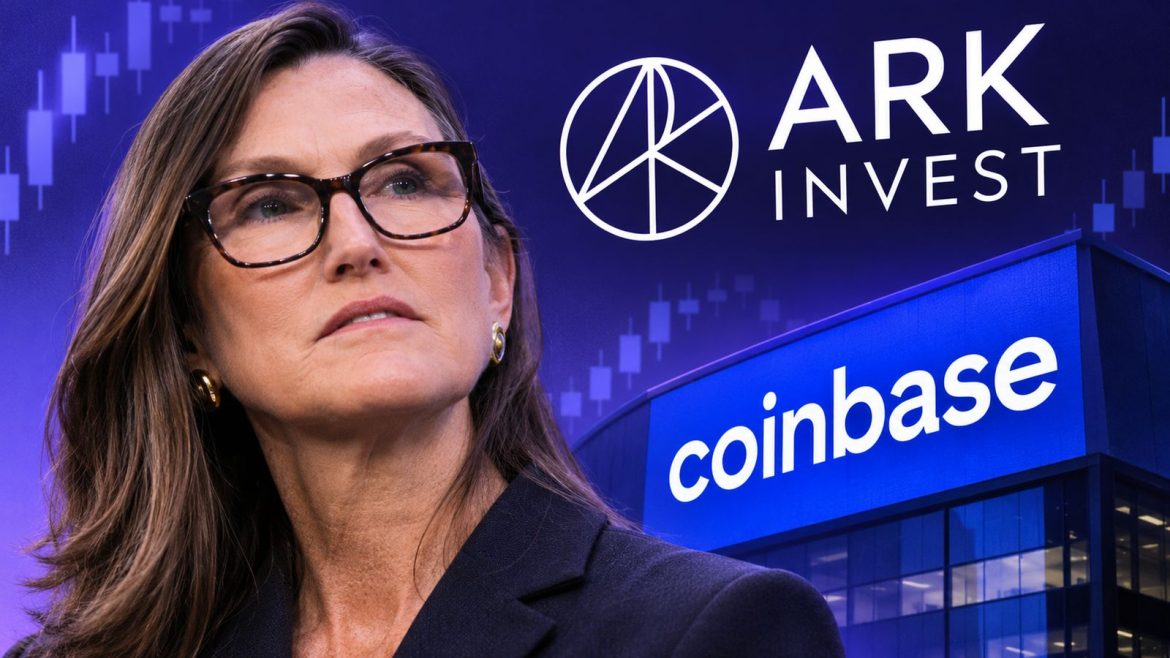
Cathie Wood’s Ark Invest bought $3.4 million of Coinbase shares, $2.6 million of Circle, and $645,820 of Robinhood on Monday.

 Live Chat
Cathie Wood’s Ark Invest bought $3.4 million of Coinbase shares, $2.6 million of Circle, and $645,820 of Robinhood on Monday.

Deutsche Börse said Tuesday it will invest $200 million in Payward, the parent company of crypto exchange Kraken, deepening a partnership between the two companies as the German exchange operator expands further into digital assets.
The investment, which is subject to regulatory approval and is expected to close in the second quarter, will give Deutsche Börse a 1.5% fully diluted stake in Kraken through a secondary share purchase.
The investment is another sign of growing interest in the cryptocurrency industry from traditional finance (TradFi) institutions. The deal is part of the Frankfurt-headquartered stock exchange operator’s plans to offer access to a wider array of blockchain-based securities and tokenized investment products and builds on its prior partnership with Kraken.
On Dec. 4, 2025, Deutsche Börse entered into a strategic partnership with Kraken to improve institutional access to regulated crypto investment products like spot trading, tokenized markets and derivatives, including the integration of Kraken-backed xStocks to its digital asset infrastructure, 360X.
Deutsche Börse said the collaboration is intended to produce new products across trading, custody, settlement, collateral management and tokenized assets.
Kraken said on Nov. 19, 2025, that it had confidentially submitted a draft registration statement to the US Securities and Exchange Commission for a proposed initial public offering, a day after announcing an $800 million fundraising round that valued the company at $20 billion.
Kraken is one of the largest cryptocurrency exchanges by daily trading volume, according to CoinMarketCap data.
Kraken did not immediately respond to a request for comment.
Related: Kraken IPO, M&A deals to reignite crypto’s ‘mid-stage’ cycle: fund manager
The move comes as other major financial market operators deepen their crypto exposure.
On March 9, Nasdaq, the second-largest stock exchange by market capitalization, partnered with Kraken and its infrastructure subsidiary, Backed, to develop an equities transformation gateway that builds on Nasdaq’s tokenization proposal filed with US securities regulators in September 2025.
A week earlier, Intercontinental Exchange invested in crypto exchange OKX to bring NYSE-listed tokenized stocks to the exchange starting from the second quarter of 2026.
In January, CME Group, the largest derivatives exchange by volume, announced plans to launch crypto futures contracts tied to Cardano (ADA), Chainlink (LINK) and Stellar (XLM). On April 6, CME announced plans to add Avalanche (AVAX) and Sui (SUI) futures contracts starting May 4, subject to regulatory approval.
Magazine: Can Robinhood or Kraken’s tokenized stocks ever be truly decentralized?

Kalshi secured margin trading approval through affiliate Kinetic Markets LLC and announced an ARK Invest research partnership in the same week, completing the federal infrastructure for institutional-scale prediction market trading.
In 48 hours, Kalshi announced a formal research partnership with ARK Invest and secured NFA registration as a futures commission merchant through affiliate Kinetic Markets LLC, officially unlocking leveraged margin trading on prediction markets for the first time. These two developments, arriving in the same week, close the loop on a six-month institutional buildout on a foundation of research credibility, compliance infrastructure, prime broker access, and now the account structure that lets hedge funds trade at scale.
The state-level legal exposure, Arizona criminal charges, Nevada operational ban, and 20+ active lawsuits remain live and active. That includes the state of Washington’s Attorney General just filing suit against Kalshi, which adds to the growing number of states striking first in court.
Meanwhile, the federal infrastructure for Wall Street-grade prediction markets is now fully assembled. Let’s dig into what that actually means, and and the many months of groundwork that made it possible.
Since Kalshi received clearinghouse approval in 2024, every trade on the platform operated under a constraint most users never noticed: per Cryptopolitan’s earlier reporting on the margin discussions, regulators permitted the clearinghouse to operate but only for fully collateralized trades, requiring customers to deposit the entire position value before placing an order. So a $10,000 position required $10,000 in the account; no opportunity to place a trade based on credit, leverage, or margin call.
For a retail trader placing a $500 position on a Fed rate decision, this is not a visible barrier. But for a hedge fund building meaningful exposure or hedge positions across dozens of macro markets simultaneously, it is a dealbreaker. As Charles Schwab’s futures margin explainer describes the standard derivatives model: For a retail trader placing a $500 position on a Fed rate decision, this is not a visible barrier. But for a hedge fund building meaningful exposure or hedge positions across dozens of macro markets simultaneously, it is a dealbreaker.
As Charles Schwab’s futures margin explainer puts it: “Futures margin allows traders to pay less than the full ‘notional’ value of a trade, potentially offering more efficient use of capital or opportunities to hedge against adverse market swings. Futures margin is leverage that can potentially enhance returns.” That capital efficiency is not a convenience feature, but rather the basic operating condition under which institutional derivatives desks function.
Under the old structure, $50 million of exposure across CPI, deficit-to-GDP, and Fed decision markets, for example, required $50 million in cash on hand before trading could start. Under a standard margin regime, that same position might require $5 million posted with the other $45 million free to deploy elsewhere in the portfolio. That gap is the difference between prediction markets being a curiosity and a viable institutional instrument.
Bloomberg reported that Kalshi secured the approval through affiliate Kinetic Markets LLC, registered as a futures commission merchant via a March 24 NFA filing. An FCM is the regulated intermediary that sits between a customer and a clearinghouse in a futures market: it accepts customer funds, collects initial margin, marks positions to market daily, and issues margin calls when accounts fall below maintenance thresholds.
Per the CFTC’s own introduction to derivatives, this system prevents traders from building up large untracked losses. Rather than unlimited exposure accumulating silently, losses are settled on a rolling, pay-as-you-go basis. The FCM absorbs any credit shortfall between a margin call and a customer default before it reaches the clearinghouse or other participants.
That credit-risk function is why FCM registration carries significant capital requirements, daily NFA reporting obligations, and regular examination. Routing it through Kinetic Markets LLC rather than KalshiEX LLC itself keeps the intermediary’s capital and compliance obligations separate from the exchange entity, which is standard architecture for multi-entity regulated derivatives groups.
Earlier this month, Bloomberg reported that Clear Street CEO Ed Tilly told the Futures Industry Association conference in Boca Raton his firm expected to clear its first Kalshi trade by end of March, with broader client rollout later this year. Marex global clearing head Thomas Texier told Bloomberg at the same event: “Over the last few weeks we’ve seen very large hedge funds coming to us and saying, ‘Can you give us access to these markets?’”
Marex’s structured products desk is also exploring prediction market contracts as hedging instruments in packaged investment products. Before the Kinetic Markets FCM approval, those clients could access Kalshi through prime brokers, but under the fully collateralized requirement. They now have a margin-enabled account structure to trade through.
Tradeweb cohead of global markets Troy Dixon told Wired that internal skeptics had told him he was crazy for pursuing the company’s Kalshi data partnership which was announced in February, he told Wired. Dixon says that the mood reversed entirely after the announcement: “We’ve been inundated with calls. We have never had this kind of feedback from clients on any other announcement.”
Tradeweb, majority-owned by the London Stock Exchange Group, serves pension funds, mutual funds, banks, hedge funds, and insurance companies, the same institutions now gaining margin-enabled access through Kinetic Markets. As we covered when the Tradeweb deal was announced, the partnership’s second phase involves direct trading of event contracts inside Tradeweb’s platform, not just data distribution.
The official Kalshi newsroom announcement of the ARK Invest collaboration on March 26 laid out three specific institutional use cases:
Founder, CEO and CIO of ARK Invest Cathie Wood said on X: “Prediction markets are not just a new derivatives market — they represent a powerful new way to quantify risk and surface forward-looking insights.” She also stated in the press release: “We believe these signals can enhance our research process and provide valuable context around key drivers across disruptive sectors, helping investors better quantify uncertainty and make more informed decisions.”
At @ARKInvest, we’re always looking for new tools that can sharpen our research and improve how we make investment decisions. Prediction markets are not just a new derivatives market — they represent a powerful new way to quantify risk and surface forward-looking insights.
We’ve… https://t.co/BLFzORsaVK
— Cathie Wood (@CathieDWood) March 26, 2026
Nick Grous, ARK’s Director of Research, said the aim is to bring “forward-looking signals to a broader set of investors.” Live markets are already running through the pipeline, including nonfarm productivity and the US deficit-to-GDP ratio.
This is not a co-marketing arrangement. ARK is building a systematic research workflow around Kalshi data, requesting and monitoring specific markets as inputs to portfolio construction and risk management. It is the use case Kalshi has described since its founding: not retail traders on sports outcomes, but institutions using prediction market probabilities as a real-time data layer alongside conventional financial signals.
In December 2025, Kalshi Research launched, positioned similarly to OpenAI and Anthropic’s research arms, alongside a debut study comparing Kalshi’s inflation forecasts to Wall Street consensus. The Crisis Alpha study found that Kalshi outperforms Wall Street by 40% overall, matches or beats consensus on 85% of inflation prints measured one week out, and delivers 50% lower mean absolute error during shock periods, when institutional decision-makers are most exposed to being blindsided.
When Kalshi’s CPI estimate diverged from consensus by more than 0.1 percentage point a week before the official release, per CoinDesk’s coverage of the study, the probability of a significant deviation in the actual reading rose to about 80%, against a 40% baseline. Academics from Harvard, Stanford, Yale, and the University of Chicago are already working with Kalshi Research. That is the evidence base the ARK partnership is built on.
In February, as we reported at the time, Kalshi formed an independent Surveillance Advisory Committee, including Daniel Taylor, director of the Wharton Forensic Analytics Lab, and Lisa Pinheiro of Analysis Group, designed to publish quarterly public reports on flagged trades, investigations, and disciplinary proceedings. At the same time, they partnered with Solidus Labs for institutional-grade trade surveillance across its 4,000+ markets. Per the Business Wire release, Brian Nelson, former US Treasury Under Secretary for Terrorism and Financial Intelligence, was engaged to advise on market integrity, and Robert DeNault, previously of White & Case’s global white collar practice, was appointed Head of Enforcement.
Mansour explained at the time the need for the concerted market surveillance and transparency push: “When people believe a market is unfair, they stop trading. Liquidity dries up, volume collapses, and the market dies.” That infrastructure has been building in lead-up to the FCM filing.
As we covered when the Coatue round closed, As we recently covered, Arizona filed 20 criminal counts against Kalshi the same week the company closed a new funding round that sent its valuation soaring to around $22 billion. In its filing, Arizona accused Kalshi of operating an illegal gambling business and offering election wagering that violates their state law, while the Ninth Circuit effectively forced Kalshi to remove several market offerings in Nevada, at least temporarily.
The FCM registration is a federal instrument. Every state enforcement action is a bet that CFTC jurisdiction does not preempt state gaming law. So far, Kalshi is building faster than the courts are ruling.

The transformation of the crypto market has brought technological innovations to the limelight alongside promoting institutional adoption of cryptocurrencies. New milestones such as rise of layer-2 scaling solutions and momentous growth of DeFi have changed the conventional assumptions about utility of cryptocurrencies. With bullish sentiment ruling the crypto market, the search for best crypto to invest in 2026 has been gaining traction. More people want to know about cryptocurrencies and take the best pick after recent events stoked curiosity about long-term value of crypto assets. Let us find out the top cryptocurrencies that are likely to rule the portfolios of crypto investors.
Want to get an in-depth understanding of crypto fundamentals, trading and investing strategies? Enroll now in the Crypto Fundamentals, Trading And Investing Course
Prominent events such as approval for Bitcoin ETFs, the Bitcoin halving event and Bitcoin crossing the $100,000 mark have signaled the possibilities of favorable trends for investors in the crypto space. The broader crypto landscape also awaits a makeover with the new US President extending significant support to the crypto industry. The positive sentiment among crypto investors has also gained strength with the adoption of altcoins and memecoins. You must check out the following cryptocurrencies which are expected to be the top favorites in 2026.
The biggest player in the market is obviously the first favorite of every crypto investor. Bitcoin has been through some notable changes in 2024, achieving its all-time high in December. Anyone searching for keywords like “cryptocurrency best to invest” will come across Bitcoin in almost every result. Bitcoin is one of the top crypto assets as it offers robust security alongside the benefits of decentralization. It has attracted institutional as well as retail investors due to growing adoption and new technological advancements.
Many people continue to believe that they can use Bitcoin for hedging against economic uncertainties in the market. You must also know that the performance of Bitcoin serves as an indicator of the broader crypto market. Technical indicators suggest that the upward trend in Bitcoin prices will grow stronger thereby implying promising opportunities for investors.
Enroll now in the Bitcoin Technology Course to learn about Bitcoin mining and the information contained in transactions and blocks.

XRP has experienced significant boost in activity in recent times with its commitment to revolutionize financial services. The utility of XRP will be one of the key factors that will safeguard its value in the long run. XRP has successfully bridged different currencies and has directed its strategic priorities towards compliance. All of these aspects indicate that the XRP token is an investor favorite and ideal contender for transforming digital finance.
 The list of best choices in the crypto market must also include Ethereum as it is the second biggest cryptocurrency. Ethereum is one of the answers to “Which is the best crypto to invest right now?” as it still remains one of the formidable drivers of innovation in the crypto space. Ethereum introduced smart contracts and provided the most crucial resources to create decentralized applications. The advancements in Ethereum such as protocol upgrades have elevated security and scalability of the blockchain.
The popularity of Ethereum among crypto investors will continue to grow as the blockchain establishes grounds for introducing new solutions. Use cases of Ethereum in NFTs and DeFi will play a major role in attracting investors. With a rapidly growing developer community, Ethereum has gained a strong position among crypto assets. The positive momentum in the growth of Ethereum prices will gain fuel from the robust technical structure and investor confidence.
Excited to learn the basic and advanced concepts of ethereum technology? Enroll now in the Ethereum Technology Course

The notable traits of Dogecoin that have attracted attention include the active community and low transaction fees. Dogecoin has become one of the top choices for microtransactions and donations to charitable projects. The cultural significance of Dogecoin is also something to watch out for as it will strengthen its position in the crypto space.

Avalanche works with a unique consensus protocol that enables confirmation of transactions with lower latency. The features of Avalanche will appeal to enterprises and developers who want interoperable blockchain solutions. AVAX will be a top favorite of crypto investors as the Avalanche blockchain emerges as a major contender for flexibility and performance.

You must know that Solana works with a special consensus mechanism and its distinctive architecture that facilitate faster transaction processing. As the Solana ecosystem continues growing, investors can expect upward trend in value of the SOL token. The commitment of Solana blockchain to innovation and support for developers might also support SOL in becoming one of the top crypto assets.
Enroll now in the Solana Development Course to understand the workings of the Anchor framework, Solana Program Library, and Solana tokens.
 The top performers in the crypto space will also face competition from Cardano blockchain. The ADA token might become another investor favorite in crypto for its utility in designing the future of blockchain. Cardano adopts a research-driven approach to blockchain development with the support of scalable and secure infrastructure. The Cardano blockchain has been making significant improvements in network capabilities alongside ensuring rapid expansion of its ecosystem.
Investors can expect ADA prices to go up as Cardano attracts attention from different industries such as agriculture and education. The commitment of Cardano to innovation along with the structured development approach makes it a reliable player in crypto market. The rising confidence of investors in ADA due to its strong technical structure will drive investor interest to new heights.

Chainlink has also achieved significant growth with a large network of data providers. The oracle network has also made the most of integration with different blockchain platforms to improve smart contract functionality. Chainlink has the capability to revolutionize applications in the domain of insurance and DeFi. With the support of strategic partnerships and continuous technical advancements, Chainlink is a leading decentralized oracle. Therefore, the LINK token will also become one of the top investor favorites in crypto.
Build your identity as a certified blockchain expert with 101 Blockchains’ Blockchain Certifications designed to provide enhanced career prospects.

Some of the prominent highlights of Tron include low transaction costs and higher throughput. Developers can rely on Tron to create efficient decentralized solutions. As Tron engages in new partnerships, the value of TRX token might grab the attention of crypto investors in 2026.

With the expansion of Binance Services, BNB will find new utilities. The importance of BNB in the Binance ecosystem will support its rise in the broader crypto market. Investors who favor versatility are likely to look for choices like BNB for tapping into the crypto landscape.
Cryptocurrencies have emerged as one of the viable assets for investment with the potential to deliver promising returns in the long run. While volatility is one of the notable concerns with cryptocurrencies, investors look for the ideal time and assets to capitalize on the crypto market. You can use information about the top cryptocurrencies to invest in now and pick the best assets for your portfolio. Learn more about the best practices for investing and cryptocurrency trading from experts now.

*Disclaimer: The article should not be taken as, and is not intended to provide any investment advice. Claims made in this article do not constitute investment advice and should not be taken as such. 101 Blockchains shall not be responsible for any loss sustained by any person who relies on this article. Do your own research!

ARK Invest closed out the week with a fresh round of accumulation across several of its flagship funds, picking up positions in Circle, Bullish, BitMine, Robinhood and Bitcoin ETFs as crypto-related equities rebounded.
The largest set of purchases targeted Bullish, with ARK Innovation ETF (ARKK), ARK Fintech Innovation ETF (ARKF) and ARK Next Generation Internet ETF (ARKW) expanding their exposure, according to trade notifications for Friday. Combined, these buys amounted to about $2 million, following Bullish’s 5.75% gain on the day.
ARK also continued accumulating BitMine, with purchases across ARKF, ARKK and ARKW totaling approximately $830,000. BitMine closed slightly lower on the day but remained within its recent trading range near $26.
Furthermore, the firm added small amounts of Circle and Robinhood. It acquired 3,529 Circle shares, worth $250,000, as the stablecoin issuer’s stock climbed more than 6%. ARK also added about $200,000 in new Robinhood shares.
Related: Cathie Wood’s ARK loads up on Circle, BitMine, Bullish as crypto stocks slide
On Friday, ARK increased its Bitcoin (BTC) ETF exposure by nearly $600,000, led by fresh purchases of the ARK 21Shares Bitcoin ETF (ARKB). The ARKF and ARKW funds together added more than 20,000 shares.
The purchase comes as the US spot Bitcoin ETF market is facing one of its sharpest downturns since its launch. The 12 funds collectively recorded nearly $1 billion in net outflows on Friday, marking the second-largest daily withdrawal to date and placing the group on pace for its weakest week since February.
Outflows have accelerated throughout the past month, with around $4 billion leaving the products as Bitcoin’s price has slipped roughly 30% from recent highs.
Related: ARK Invest scoops $10M in Bullish as it hits record low amid crypto stock rout
On Thursday, ARK made its largest daily acquisition of the week. The firm snapped up $10.1 million in Coinbase, $9.9 million in BitMine, $9 million in Circle and $9.65 million in Bullish, alongside additional purchases of $16.8 million in Nvidia and $6.8 million in Robinhood.
Prior to that, the firm also purchased $16.8 million worth of Bullish shares, roughly $15 million in Circle and about $7.6 million in BitMine across its ARKF, ARKW and ARKK ETFs on Wednesday.
Magazine: 2026 is the year of pragmatic privacy in crypto — Canton, Zcash and more


